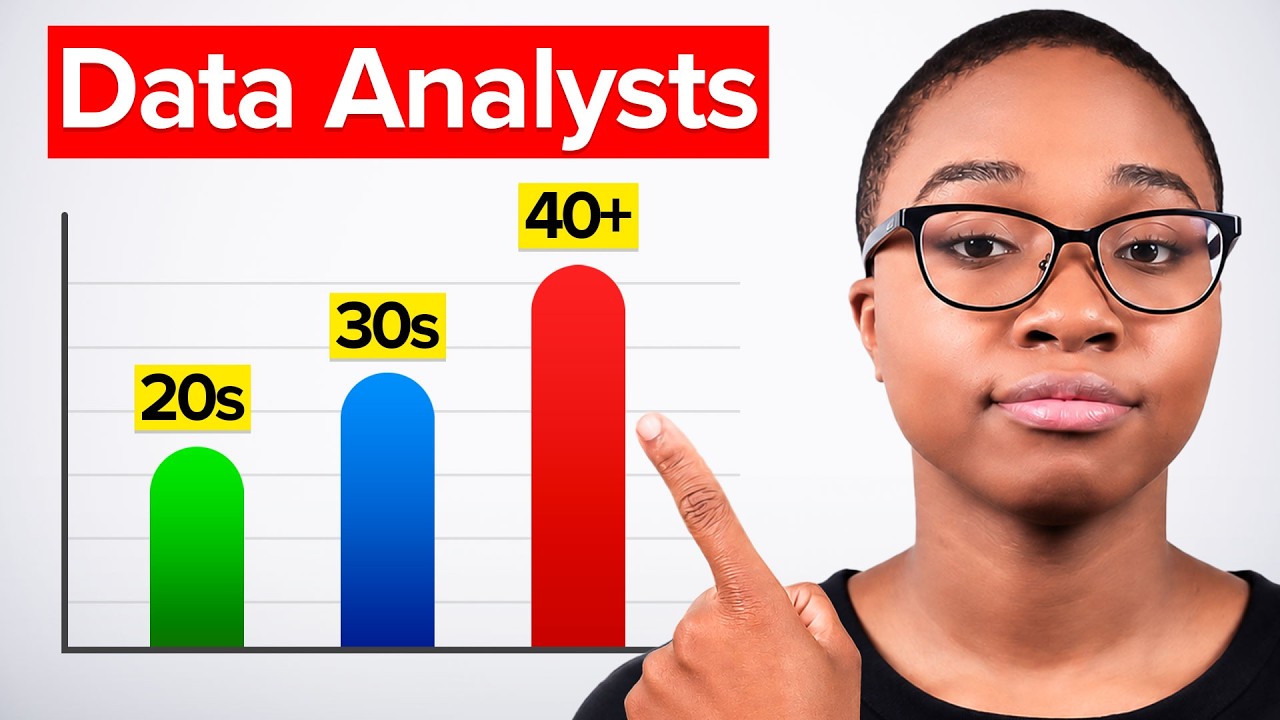
In this motivational talk, Kedeisha Bryan confronts the common belief that age is a barrier to entering data analytics. She explains that the fear of being "too old" is actually a proxy for concerns about risk, time, and wasted effort, not chronological age. Using industry data, she shows that the average U.S. data analyst is 43 years old and that over 60% of analysts are over 40, disproving the myth of a youth‑only field. Bryan argues that hiring decisions now prioritize business judgment and domain expertise over raw technical skill, citing studies that 69% of job postings favor domain knowledge and that 42% of large companies cite business acumen as the top skills gap. She frames older professionals’ life experience—management, budgeting, industry knowledge—as a competitive advantage. Bryan then outlines a concrete four‑step plan for career changers: (1) choose a domain that aligns with past experience, (2) learn a focused skill stack (Excel, SQL, one BI tool, data storytelling, Python), (3) build 2‑3 business‑oriented projects that include recommendations, and (4) gain real experience through pro‑bono consulting for nonprofits. Throughout, she emphasizes that proof of value, not age or certificates, wins interviews, and she directs viewers to additional resources for a 90‑day starter plan.
Chapters
One of the most common messages I receive constantly, am I too old to become a data analyst? Sometimes they're 30, sometimes they're 40 or even 50, and almost every single time they're asking the wrong question. A lot of people assume data analytics is a young person's field. They imagine competing against recent graduates who have more time, more energy, and more technical knowledge. So they delay or they never start at all. What's interesting is that many of the people who successfully transition into data analytics are not 22-year-olds. They're professionals changing careers, parents, teachers, military veterans, people who already have years of experience in another field. So in this video, I want to break down where the I'm too old comes from and what the data actually says and what really determines whether someone succeeds in the transition. Because I think age is one of the biggest reasons people talk themselves out of so many opportunities that they could realistically achieve. And by the end of this video, you'll probably realize the thing holding you back isn't your age at all. All right, so let me start where this fear actually comes from because I I get it, and I felt it personally. A few years ago, I was the one who felt that I missed my window. I dropped out of college after 4 years. I joined the Navy, and when I got out, I expected to walk into a good job. Instead, I was delivering pizzas, working in warehouses, and dropping Amazon packages for $8 to $15 an hour for over a year and a half. I wasn't 22 with all the time in the world. I had bills, I had pressure, and every time I looked at data analytics, this little voice said, everyone in this field is younger than you, more technical than you, and already ahead of you. So why even start? And that voice is really where the real enemy is here. And it almost cost me everything that I have now. But here's the thing about I'm too old. Most people who say it don't actually mean their age. They mean something else underneath it. They mean, hey, I have a mortgage and I can't afford to gamble. They mean I've got kids, so I don't have 3 to 6 hours a day to study. They mean I'd be starting over and starting over feels like admitting that the last 15 years were wasted. And they mean. What if I put in all this work and it doesn't pan out? That's not an age problem. That's a risk problem, a time problem, a fear of wasting effort problem. And those are real and valid. I'm not going to pretend that you got the same runway as a 22-year-old with no rent to pay. You don't. But watch what happens the second we name the actual problem. It becomes something that you can actually solve. You can't fix, I'm 41, but you can absolutely fix, I don't know how to study efficiently around my full-time responsibilities. So when people say that they're too old, they're actually describing a completely different problem. So let's stop arguing about age and actually go into what this field actually looks like. Okay, so that picture in your head, a room full of 22-year-olds doing analytics work, that's not the field. That's just a stock photo. Let's look at who actually does this job. In the U.S., the average data analyst is around 43 years old. Not 23, 43. And people over 40 make up roughly 60% of data analysts right now. The young person field that you're scared of does not exist. Most of the people in it are closer to your age than a fresh grad. And it makes sense when you see where these people are coming from. They're not all computer science majors. They're former teachers, nurses, veterans, people who spent 10 years in retail or logistics or finance and then pivoted. This field is built for career changers because the work rewards people who already understand how a business runs. It's not a shrinking door. The Bureau of Labor Statistics projects analytics roles growing at around 25% this decade alone, way faster than the average job. And more than 40% of the people enrolling in graduate and upskilling programs right now are adult learners. You wouldn't be the odd one out, you'd be the norm. The typical data analyst is probably older than you think. So if the data says age isn't the wall, then what is? So let's look at what actually decides who makes it. And no, it's not age. And it's not even the tools. I reviewed thousands of portfolios. I've sat through hiring conversations and the gap between people who get hired and those who get ghosted almost never comes down to who's younger or who knows more Python. It comes down to judgment. Anyone can pull a number. The market stopped paying for that though. What it pays for now is a person who can look at a 12% drop in customer retention and tell you whether it's a pricing problem or an onboarding problem or a competitor problem, and then tell you what to do about it. That's business thinking. That's strategic thinking. That is judgment. And that is the single biggest thing separating analysts who are getting interviews and promotions from those getting ignored. And the job market is screaming this at you. One study of around 1,300 real job postings found that 69% now ask for domain expertise over generic or general technical skills. And when Cisco surveyed over 600 large companies about their number one skills gap, the top answer was not SQL. It was not Python. It was business acumen. 42% of them. The supply of people who can click through tools is massive. The supply of people who understand the business is almost empty. And that gap is your opening and opportunity. This is the whole thing I built my whole coaching around. You don't get paid for what you know. You get paid for what you can prove. No hiring manager in history has ever picked a candidate because of their birthday. They hire because they can solve their problem and show the receipts, which means the game was never be 25. The game is be the person who can prove that they can think like the business and that you can build at any age. All right, now here is where we flip it completely, because if judgment is a thing that matters most, then being older isn't your handicap. It's actually your unfair advantage. Think about what you're actually carrying that the 20, year old fresh grad isn't. You've sat through real meetings, you've managed people or budgets or even angry customers. You know what a deadline feels like. You know what office politics feel like. And you know what it costs the company when a decision goes wrong. You have domain knowledge, years of knowing how a specific industry actually works. And that is the thing that companies are begging for. And that is the thing no one can cram into a weekend course. So stop trying to hide your past career and translate it. A nurse who learns analytics and goes after healthcare companies isn't competing with 500 generic applicants or new grads. She's competing with maybe 5 people who have both the data skills and the clinical background. In that pool, her odds aren't close to everyone else's. They're better. Here's a real story. A student of mine, Caitlin, she was a teacher. She didn't pretend her classroom years didn't happen. She built a portfolio. She was posting on LinkedIn and she leaned into what teaching gave her communication, Breaking hard things down into simple terms and running a room. A recruiter showed up into her inbox and then within a week she had an offer for a finance analyst. The teaching wasn't a baggage, it was the reason she stood out. The skills that make someone successful in data analytics aren't technical at all. Half of the job is just understanding people and the business behind the numbers. And you've been doing that longer than the new grads have been in the workforce. All right, quick pause. Now, if you want to land your first job in data analytics and avoid the lengthy mistakes that I did, click the link the pinned comment where you can find the exact steps that my students use to land their job in data analytics without going back to school. All right, now let's get back to it. Okay, so let's make it practical. So if I were starting today as a 40-something, uh, with a job, a family, limited hours, here's exactly what I would do and what I would not do. I wouldn't spend one minute worrying about my age. I'd spend that energy on 4 moves. Number 1, pick a domain that matches my past life, from healthcare I'm becoming a healthcare analyst from logistics supply chain analyst. I'm not a generalist fighting everybody. I'm a specialist competing with almost no one. Number 2, I learned the right small skill stack. Not every tool on the internet. Excel, SQL, one BI tool, data storytelling, Python, and that's it. That's enough to do the job. Chasing 20 tools is how people get stuck in tutorial loop for 2 years and never get a job. Number 3, I'd build proof, not certificates. 2 to 3 good projects that solve a real business problem in my domain where I don't just make a chart, I make a recommendation. A certificate just says I sat through a class. A project rooting in business thinking says I can do the work. One of those gets you hired and it's not the certificate. 4, and this is the one I would guard with my life. I'd manufacture real experience instead of waiting for it. I'd reach out to a local nonprofit. And yes, I've said this in multiple videos and I'm going to keep saying this, local nonprofit and offer them 30 days of free analytics consulting, you build a dashboard, a short consulting deck, and a set of recommendations. Now you have real stakeholders, a real result, and a story for the interview that kills the, I don't have experience, or, I just have these projects. That's lame. If I were starting at 40 today, I wouldn't worry about my age. I'd spend that time being valuable. And valuable has no age limit. All right, so the people who make this transition are not the ones who started at some perfect age. There is no perfect age. They're the ones who started anyways, more mortgage, kids, doubt, and all. It doesn't matter. And built proof until the job market cannot ignore them. Your age was never a thing standing in the doorway. Age can change your path, but it doesn't close the door. The only thing that closes the door is deciding that it's closed before you even knock. And remember why you're doing this. You're not learning data to get a job. You're learning to become more valuable and the kind of valuable that gets you found, gets you paid, and lets you say no to average offers. That's not a 22-year-old's game. That's your game. So now that you know that age was never the thing holding you back, the real question is what you'd actually do to make the move. I made a full video on exactly that. What I would do if I was starting from scratch in 90 days. It's right here. Check it out. I'll see you in the next one.