Building Relationships with Tech - Interview with Rick Fox of Vertafore
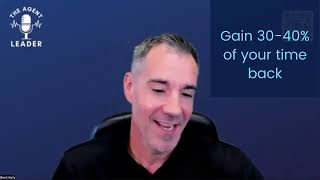
Rick Fox, head of sales at Vertafore, moved from running an independent agency to tech roles. He argues technology should enhance agent-client relationships, not replace them. Automate renewals and ID cards to free staff for real risk conversations, and let customers choose how they reach you: phone, email, text, or portal.
Questions this video answers
September 6, 2022
Head of Sales at Vertafore
Approximately $5.5 billion (acquired by Roper Technologies, described as occurring about two years before the interview)
Chapters
Welcome to the Agent Leader Podcast. My name is Brent Kelly, your host. Thanks so much for joining me on this episode. As always, the purpose, the passion of the Agent Leader Podcast is to help you, the agency leaders out there, to help you gain clarity, build consistency, and to make a commitment to become your best version possible. And I have to, if you're watched on video, show our book, which is entitled, gosh, Best Version Possible. It's been out this year and, and you can find it at sitkins.com bvp sitkins.com bvp or you can go find those fine folks at Amazon or Audible. You might be able to get it there as well. So check that out. I've got a very, very special guest today. And in fact, I told him before we went live here that he is one of the first of hopefully many guests I'll get. That's outside of some things that we've done primarily on this podcast and you know, this podcast, I'm sure I'm not the only one here that this has happened to. But this podcast started because I thought I would turn on the mic and share some ideas one day, which is what I did. And then I began to bring in some of our members or agency members and partners. I began to bring in some of the people that have been part of our, whether it's a producer program or elite sales mastery program, so they could share some things they're learning to the audience. But I haven't had very many those that are quote, unquote, outside of maybe our immediate sphere. And I want to do that. And I want to do that for many reasons. I will tell you selfishly, I want to do it because I want to learn from people and grow. And so I'm going to be much more intentional this year. And with all that, I want to make sure that I do the right and just job of introducing our guest today. I've got Rick Fox, who's the head of sales at vertafore. You may have heard of them. They're a small little company, vertafore. Right, Rick? Just a little thing out there. And I do scrappy.
We're scrappy.
Okay, Scrappy. They're hoping they can, they can make it through. But I know a lot of our agency partners that we work with certainly are very familiar with vertafore and some of the different products and services and things that they do, mainly in the tech space, obviously. So excited that Rick and I connected and we're able to have a great conversation today because I know he's going to be sharing things that I'm going to learn a lot today. And I know you, as an agency leader, are going to get a lot from having Rick on. So with all that. Rick, welcome to the Agent Leader podcast.
Thank you, Brent. I appreciate it, man. It's. It's good to be here. I, like I told you before, I also do a podcast, so it's just a. It's just a. It feels a little off like this, but really excited to be here. And my favorite thing in the world is sharing information with people in our industry. So it'll be fun. Let's have some fun.
Yeah, we will. And maybe, maybe like you, when I was small, my mother said, you know, Brent, one of the things that you like to do a lot is to talk. So maybe that's just part of how this came. I just get on and I just talk to people. I ask questions, and. And I would say it's kind of our virtual cup of coffee. So let me get the basic stuff out of the way because, again, I think we were joking about Vertafore, But I would like people to get to know more about you, Rick, and I would as well, of just some of your background, your history. How did you get to where you are and what do you do, you know, day to day to help agencies.
Yeah. So, long story, I'll try to make it short. Back in what feels like a million years ago, I was actually an agency owner myself. So I was an independent agency owner. Started an agency, worked at a big agency, started my own agency from scratch, independent. Along the way, grew it organically. And then I acquired seven more agencies and kind of built up this bigger, bigger agency and sold that back In, I think, 20. It was either. Oh, yeah. Oh, wait. At that point, really wasn't looking to sell, but was at the point where, you know how it is. It's. It's an acquisition business. Guy that I had met at the, I think the Oregon Mutual golf tournament called me and was like, I want to buy your agency. And I was like, hey, I want to buy yours too, kind of a thing. And he said, no, we're going big. Name your price. And. And we negotiated. And I. I went really high, didn't plan on selling it. They came back and said, let's do it, and the rest is history. The good news about that was is I was able to exit and then get into technology, which is kind of where my head was going anyway in this space. So I went to Vertafore. I was actually Recruited to Vertafore. And this is when the headquarters was back in Bothell, Washington, about six miles away from Microsoft. All the tech talent in the world, but not maybe as many insurance minds as they needed to be there. So I sort of jumped onto that side. I stayed there for almost four years before I left to go run another insurance company called Agency Revolution. So marketing automation platform specific to the insurance industry. I was an owner, equity partner in that. In that firm, built that up to prepare it for a transaction. We sold it to a larger financial technology company called FMD Suite. And. And then I kind of stayed on for a bit to kind of run the insurance side and then had the opportunity to look at other options. And to your point of what about Vertafore? What's the story there? You know, I've been around this industry for long enough to have a lot of people that were knocking on my door at that point in my career. And vertafore was the clear, easy choice for me. And I'll tell you why. I think the strategy that vertafore has put in place to help independent agents today, tomorrow, and for a long time into the future is, is it runs unopposed. We talk about like we can get into details about open architecture and choices and the changes in technology and everything that's either has come or is coming and the way it is set up to succeed through Vertafore, the way we're planning and strategizing and obviously I'm a fairly large part of that in my role. It's. It's really exciting and I would say the most. And then the other piece for me was to your point is I love to talk to. And vertafore is not a scrappy company. We're a. We were acquired almost two years ago by Roper Technologies for five and a half billion dollars. So we have a pretty loud voice and so my talkative nature gets to get to more people. So it, it was the right decision for me as I am a huge proponent of the independent channel. I am a massive believer that this is the way all consumers should be conducting their insurance world. And I want to help as many as I can from the agency side fight the good fight, I guess is the best way to put that. I mean, there's a lot of noise out there, there's a lot of competition, but that independent space, that professional risk assessment is still needed at the agent level. And I want to help them fight.
Yeah, love that. And I will tell you, I set up my share a little bit Straighter. When you use the number 5.5 billion. That's a big B with a B with a B, big capital B there. I sent you, Rick, just a few questions that to discuss, but I told you it'd be like a cup of coffee. And so as you were saying that, it hit me because I did a little bit of homework. And by the way, again, you guys are sort of known in the marketplace, so it's not like the first time I've heard the name. Right. But it is interesting looking at things. One of the things that we believe in all the time, you know, how do we pivot away with independent insurance agencies? How do they begin to pivot more away from just being a commodity, just being a transaction, just being a quote machine, versus truly being a risk advisor and deepening relationships? And, you know, obviously, you know, you guys are involved in the tech space at a very high level. One of the things that I believe. I'd love to get your thoughts on this because I know you do this in different ways. And some of the clients we work with is I always say, you know, technology shouldn't replace the relationships. You should enhance it. Right. You should be able to leverage it.
Right.
In a higher way to have a more of a human touch. So how do you see that playing out? I guess I'll just start with that. Just where do you see the opportunities for more relationship building by leveraging the power of technology?
Yeah. So it starts with how much time you have in your day and where the easy answer, and everybody will use this word, but I want your listeners, anybody that wants to listen to my voice, ever to live by the credo. I need to be more efficient and efficiency is gained with technology. That's the best way to do it. Like the old school way of thinking, and I can say this because I was an old school agent 25 years ago, is we're busy. Let's hire someone. That was. Right. I mean, that was the way that. That's the way we did it. And. Or you'll ask an agency what their differentiator is and they say, service. Yeah, we're a service. And then I challenge them by saying, tell me more. And they're like, well, you know, like if. If they call, we pick up the phone and we help them. It's like, okay, that. That's not service. So. So I look at it in two, two, two buckets, where. Actually, let me make one more point first. This is important because I always try to set the table that whoever's listening to this Wherever you are on your tech journey, that's okay. So I had a conversation, it's probably been five or six months ago now with an agency owner and I just asked, I always ask the question, where are you on your tech journey? And, and he's like, we're pretty far forward. We, we think of ourself as tech forward. Which of course my next question is tell me more about that. Right? To which his answer was, well, you know, like all of our, all of our staff have two monitors on their desks. Like that was tech forward in his mind. So my first, my first reaction was to almost laugh, right? But then I took it as a, I use that as a reference point because every agency is different. Now if, if you're still using paper files and dial up modem like I mean I, you, you see the picture I'm painting. I'm not going to ask you to jump into artificial intelligence and machine learning tomorrow. What you need to be doing is progressing in your journey. So let me give you the two main areas where you can just, tomorrow you can start to affect that. Okay. The, the baseline there is meet your customers where they want to be met. Number one, number two and number three are all the same. Today's modern consumer is so different than they were a year ago. I mean two and a half years ago when the pandemic hit. I'd never used UberEats before. Now I'm like a gold star, like you know, whatever preferred person. Because we'll change and it's going to change again. And so the key that I always say is if your customer calls you call them back. If they email you, don't pick up the phone and call them, email them back. If they text you and you don't have text capabilities, you have a hole in your ability to communicate with them. Do you have, do they have the ability to at some level communicate with you 24 7? Do you have, do you have a portal for them? Is there a self service option through your website or through an app? That's something that vertafore has something that we call insurlink which gives them the ability, do you need an ID card? Do you want to request an endorsement, whatever that might be? Do that at three in the morning on Sunday and we'll, and it'll get taken care of. So the first thing is like the baseline is meet your customers where they want to be met. How do we do that? We automate and we, we make, we make that connection so much easier for self service. So automating process number one. And this is where I get pushback from agencies that aren't willing to change. It's, we need to, I'm like how, how do you communicate with the people we call everybody every year? Do, do you want, like Brent, do you want me to call you? I don't want you to call me. I want you to send me an email and I'll get to it when I have time. So it's, it's the first thing in the process of automating is can I send, can I put in a cadence? Can I put in a like, like what my old company Agency Revolution does, what some of our management system capabilities are, what there's plenty of other products out there that you could buy on a technology side to set up a cadence or a campaign around a welcome kit. A lost lost leads a renewal. Anything it is that goes in the background. It says on day 60 before renewal. Hey Brent, it's Rick. Just wanted to check in and see if this, this and this is happening. I didn't touch it, I didn't do anything. And you got it and it sounds like it came from me. So what does that do? That creates less time in the day that I'm spending doing busy work which means what I can do what you asked your original question, which is build a deeper relationship with my customers because we're having insurance conversations, we're having insurance interactions, not paper pushing interactions. Automation is one and then again what I said about self service is the other. So we have customers, large customers that are afraid to go to a self service portal because they think it's going to download grade their relationship. And I'm going to tell you it's the exact opposite because we have agencies that have done studies that will tell you that 30 to 40% of their time is moving paper around, ID cards, an endorsement, change of address, all of those things. So if I gave a staff member 30 to 40% more time, could they go build more loyal customers, could your retention go up? Because the real conversations are now happening. So it's just looking at it through a little bit of a different lens that isn't, you're not losing, you are 100% gaining, especially in 22 and beyond. Like the world's changed. Nobody wants to sit around and wait three days for you to call them back and hope that you answer and play phone tag for another two days because they can go to Geico and get anything they want in five minutes. Well, I guess, sorry, 15 minutes.
Yeah, well yeah, something like that. It's somewhere. I don't know. We haven't time to. Somewhere in there, you know, so many great takeaways there. Rick, as you're sharing that, I was sitting here writing down notes, so I certainly don't want to share them all. But just, I mean, one of the things that really struck me, I mean, and this is just, it's common sense, but it's missed. That's why it's not so common sometimes, is the fact that, you know, meet people where they are, you know, I mean, that's it. And, you know, I should be on.
Your walls that should, at your agency, meet your customer. Where they want to be met, should be on every wall.
Yeah. And this is so true. Whether you talk about technology and automation. It's. It's true, you know, in a sales process. I mean, it's true in so many ways where we get people. This is all the stuff that we have or we do. Well, do you value that or do they value that?
Right?
And it's like, well, maybe they value. You don't know. So I think that is such a critical piece. And absolutely, you know, we hear all the time about just how busy everybody is, just so busy. And listen, I know there's, there's a lot of truth to, you know, all the things that go on day to day, but it does come back to how much of that busyness could be in a process, could be automated, could be filling gaps and holes that they probably know they have, but they're not quite sure how to fill. And I think, most importantly, and you addressed that question at the end, which I love, is it allows humans to be human, to be critical thinkers, to add empathy. Right. To team, build, to be proactive in different ways that quite honestly, technology can't for as much as it does. It does amazing things. But that's where I love that you. And how you answered that question.
There's. So people are busy, right? Like, like you said, this is a busy business. And so if, if I can get like my whole, like when I say leverage technology, I don't mean for the sake of technology. I mean for the sake of giving back more time. Let me give you more time in your day to go be what you want to be. And you said it. A true risk assessor, not. Not an agent. Because. Because I can train a monkey to print up an ID card and email it to you. That's right. That doesn't make me a risk assessor. That doesn't make me somebody that you have loyalty to. Us having a conversation about your 16 year old that just turned, you know, just got their license, or a property that you're thinking you want to put on or what level your umbrella is, or let's talk about your business that you own. Those are, those are risk assessment conversations, not. Oh, so you're I have the zip code wrong on the lien holder on your car, right? You know what I mean?
Absolutely. Absolutely. I mean, yeah, I. Could I go on?
More from Roger

This Shift Helped Us Unlock Growth 💡 | Agency Leadership Tips #insuranceagency #agencygrowth





How AI Can Help Insurance Agency Owners Master Their Financials (Without Being a CFO)

From AI Hype to Real Results: Steve Anderson on How Insurance Agencies Can Use AI to Grow Now



