Click #4 for Insurance Professionals - Move from Renewals to Referrals
Brent Kelly and Roger Sitkins argue insurance agencies rely too heavily on renewals (averaging 90%) and miss referral opportunities (under 10%). They outline a process: set expectations day one, deliver a six-month promise report, and ask for referrals. Agencies using disciplined referral systems can achieve 20%+ producer growth and significantly increase agency value.
Chapters
Welcome to the Agent Leader podcast. My name is Brent Kelly, your host. Thanks so much for joining me on another episode. And this is part four of an eight part series that we're doing on clicks. And if you're not sure what a click means, click is another term for a breakthrough, maybe a bigger, better idea, something that you haven't thought of before, something that maybe you have, but you haven't executed. And I've got my very special guest who's been on all of these parts with me so far. He'll be on all eight of these sessions on these clicks and these breakthroughs. Roger Sitkins, the founder and CEO of the Sitkins Group, is with us. Roger, welcome back for part four.
Well, it's great to be here, as always. And this is one of my favorite ones. So we're going to jump all over this one.
Yeah. So we're going to get into today this idea and this is a, I'll give, give you some, some food for thought here as the audience we're going to be talking about today. But this is such a powerful breakthrough or a click. But it's this idea that we've got to move from renewals to referrals. Right? From renewals to referrals. And we'll talk deeper about that and why that's so important. I'm guessing that you as an agency leader, you know, are probably thought about the fact that, gosh, you know, we could get more referrals, but we really want to dive deep into the clique, the breakthrough of what happens in this area. Before I get into that, I always want to give the mission the pur of this podcast, the Agent Leader Podcast. Our mission, our purpose is to help you, the agency leader, gain clarity, to help you build consistency and to make a commitment to become your best version possible. And our best version possible book is out. If you're watching this on video, you can see that Roger and I are both doing a great job of advertising. Right, Roger?
We're standing right in front of it.
Roger, we are co authors of this book and get very excited that it's out in the marketplace and that agency leaders and agency professionals are getting their hands on it and allowing them to take this information and begin to make their agency the best version possible. And that's also why we're doing these clicks, the series, because these eight clicks that we're talking about are truly major breakthroughs. And maybe for you as an agency leader, maybe it is a, an absolute. I've never really thought about this or it could Be just a slight adjustment, but whatever it is for you, we want it to be a click to help your agency get better. So with that, Roger, are you ready to get serious on this topic of moving from renewals to referrals?
Let's go deep on it.
All right. Well, I want to set it up with this. And this is something that we share on our trainings with agency leaders, with producers, certainly, and service teams, just the whole agency to understand this. But here's the concept that I want to start off with. And this is a fact. I mean, there are stats on this, is that in industry, this industry. And we should all be looking up upstairs and say thank you for this great industry. But on average, about 90% of clients renew with insurance agencies. That's pretty great.
That's really great.
I always say, hey, listen, nine out of ten people are going to pay you money next year. That's great. Here's the bad News. Less than 10% of those same people will refer another client to your agency. So 90% plus renew, less than 10% on average, refer. So I want to, I'm just going to throw that out there and let the audience think about it. But Roger, you and I have been talking quite a bit about this. I mean, for a long time you've been talking about this, but there is this blinding flash of the obvious that we talked about recently. And I want you to share this with the audience. What was this blinding flash of the obvious that we were considering the last several months here?
It'll become very obvious to everybody very quickly as we were looking at what's happening in the industry and the fact that it is a great business. I mean, it's a recurring revenue model and 90 or 88, 90, 92%, whatever, other clients renew. Even if you don't do a very good job, it's somewhat passive to say the least. So as we're reviewing this, I said, brent, you know what? Renewing insurance policies is not the problem. It's not the problem at all. The problem is the client experience is not so great. Okay? It's like, well, we give good service and we're pretty reactive on stuff. But it's not a client experience where people are going, wow, what a great experience. And we've all had it. You go to certain businesses, you say, what a great experience. But then with the insurance business, too many people realize that we don't have to do much. We, we can be semi successful, semi committed. 90% renew every year. We'll write 15%, we'll gain 5 net. And we're pretty good. But what they're not doing is they're not saying, hey, what's the client experience? And how do we make that client experience truly a wow Client experience? To the point that they start bragging about you, they become raving fans for you. And then when you can put in a true, what we call the reverse referral process on top of it, you're getting referrals from at least 50% of the customers. And our better ones are getting them from 80% of their customers, at least 80% that they want to replicate. But again, what's the client experience? And if it's not a holy smokes, it's the best thing I've ever seen, you've got a problem and you're in a race to the bottom and you're stuck in the commodity business. So that's my blinding flash of the obvious on it.
Yeah, I mean, it's something that we talk about. And that leading stat that I started off with, I mean, again, we share that to our agencies all the time. Okay, okay. But there's obviously something missing there. And you know, it's like, well, why is there that gap between referrals and what people continue to renew? And let's face it, I mean, people don't like the renewal process. Right. Most clients and Roger, talk about that all the time. I do want to ask you within this is that one of the things that we do work really hard and it's such a key point of one of our key processes is the continuation process. And I think this is part of that mindset, Roger. This idea of, of renewing accounts is kind of easy. That's not really what you want to do. So can you just maybe a high level here, Obviously we can't go too deep into this, but on a high level, share what that difference is between a renewal and as you just described earlier, and I mentioned the continuation.
Right. Well, if you're just renewing policies, then you're in the commodity business or you're just passively renewing. The old days, agencies actually had a rubber stamp that said renew as is. They would smack it on the file. That proves how old I am here. But rather than that, there should be a continuation process. And it's not on every account. Okay. But it certainly should be on a minimum, the top 20% and for most agencies, the top 50% of their customers should have this continuation. We don't renew policies. We can continue relationships and that starts. And again, we'll just do a high Level overview on this. It starts at day one of the policy, so it's at delivery, installation, whatever you want to call it, and maybe some smaller accounts. It's simply a phone conversation, but it truly is identifying what are the client expectations. We've talked about this before in your podcast, Brett, where people say, oh, what do we do? As an agency, we exceed your expectations. But they don't even know what they are. So it starts with identifying what is the expectation of the client, documenting that and then making sure that there is some form. And again, it's going to vary by size of account, but at a minimum, there's a phone call at the six month anniversary on some of the smaller customers. Okay. What we really prefer, we start especially looking at the top 20% that are 80% of the revenue. We want a stewardship report, or what we like to call the promise report. Because what we say is we keep promises. That's part of our culture. So at the stewardship report meeting, when we're going out there, first of all, we should send an agenda ahead of time. Here's exactly what we're going to talk about. And then once you've reminded, if not proven, but certainly reminded, the client, here's what we did for you in the first six months of this policy year. That's the best time to ask for the referral. That's the best time. By the way, the referral is on the agenda. It's just that people miss the process. You know, we've been talking so much lately about the power of proven process and if the process is, well, we kind of renew as is. We do what we all have done, rather than saying, wait a minute, if we're a professional, we need to send an agenda out and the agenda on it should have an item that once you've reminded them. Because we hear this all the time from the producers, Blair. Our clients just don't really remember everything we've done for them. Well, they can't. They're busy running their business or their life. So we remind them, we get them to say, wow, that's great, thanks. I forgot about that. I forgot about that. You've now reinforced the value you've brought. And then you say, by the way, the next item on our agenda is referrals. I've got here a list of some people I'm thinking about calling on. Who do you know? What can you tell me about them? It's that simple. But it takes a heck of a lot of work to get little to get the stewardship report in place, but then whole reverse referral and being able to have the names of the people that we know, they probably know. It's a deep process, but it works when you have the pigheaded discipline to follow the process.
Right. Well, as you said that, Roger, I mean it, you know, again, it starts from these clicks. It starts with a mindset, right? It starts the fact of are we going to be an agency that earns and generates referrals because we do such a great job in the client experience, Right? That's my version of it. But that's, you know, a lot of agencies would go, well, yeah, if we get a referral, great. If we don't, oh well, well. But think about what that's really saying. And one of the things that we've talked about in some of our recent programs, I love this, Roger, so I won't steal, I'll let you say it, but there's a, and hopefully, you know where I'm going with this. But there's a kind of a tagline, so to speak, or a mindset or identity.
Right.
And I think, I think, you know, I'm talking about, it's what would be, what would be our agency approach. Could you share that? Cause I love that with the audience.
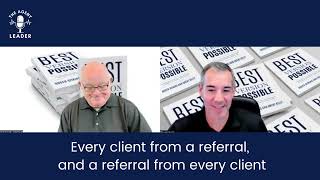
It's a mindset, okay? And it's an attitude and it's a mantra, whatever you want to say, but it's about as simple as you can get, but just not easy. And here it is. Every client from a referral and a referral from every client. Now think about that. And hopefully some people listening.
Could you, could you say that again? I mean, just because I think when you hear it, you go, oh, but then like, but just think about this now, just agency leaders listen, like, just stop for a second and listen to what Roger says and go, imagine if this was the culture, the DNA, the mindset, the attitude of our agency. So Roger, go again.
Every client from a referral. And by the way, it's a targeted referral, but every client from a referral. And then the client experience is so great and the reverse referral process is in place that every client we get gives us a referral. When. Not the first day, but most times at the six month anniversary because you've proven that you've done a great job and you're, you know the thing, it's always interesting to see the producers when, when their light comes on, that blinding flash hits them when they go, you know, referrals really better than anything else. And, and if a customer isn't Giving me a referral. What does that say? And the other thing, Brent, you know, like, why don't people do this overall? Well, there's the fear of hearing. No.
Right.
And Tony Robbins first coined that fear, false evidence appearing real. We kid around a program saying, did any of you ever die when you asked for a referral?
Yep.
Okay. Okay. So that's good. And then the big reason overall is they don't have the process and they're not prepared.
Right.
They don't have that relentless preparation we talk about. They don't have the attitude that, hey, every event deserves my very best. My very best for the stewardship report includes relentless preparation, a great report to give to them, and then also have the list of people that I want to be referred to. And this is, you know, for the 97th time in your podcast, these are things we talk about. This is simple. And we get criticized. Oh, it's that simple stuff. I know it's simple, but it's not easy. And once people realize that, oh, it takes that pigheaded discipline to do what I said I was going to do. What's the proven process?
Right. Well, that's the thing that ties us together, and I hope it's what the leaders are hearing or insurance professionals. Anyone who's listening to this is that it does start with a mindset, an attitude, a philosophy. But then you connect that to. Because our mindset attitude, philosophy is X, our process must be Y.
Right.
Like, and you mentioned the continuation process you mentioned earlier, and we'll probably talk more about it here in a little bit. The reverse referral process. Well, that's a process. Now, why would you have a process if your mindset or attitude didn't. The culture didn't support it. Right. So it's. I mean, you got to marry those two things together. And I know. I have other questions that I. I want to make sure I get to. But I do have to throw another. I also hope this isn't a curveball. But it's interesting you said that one of our clients. You'll know who I'm talking about. I recently sent us a report. In fact, you asked me to look at it as far as kind of the demographic, the. It showed the overall. All their marketing that they were doing in different ways and then the outcome from that. And please hear me. You know, I'll speak from my heart first. I'm not against some of the other forms of marketing that are out there. I'm not anti digital marketing in certain aspects. In fact, we always say, you know, leverage technology to increase relationships. But when you look at results and what we're about, Roger, when we work with agencies is results, like getting results, that's what people want. And so one of our great agency partners, and they have had, I mean, incredible growth over the past several years. They've got a whole marketing department and we're looking at all the stuff and they've got a little pie chart of this and I don't want to get the number wrong, but if I remember, I don't have it right in front of me, but it was, it was, I want to say 93% of the total was based on either some form of a cross sell or a referral, internal, external referral. Like that was 93% of their growth. And you want to add any of that or did I get that right?
Yeah, it was, I think that's correct. I guess we should have it. But it's certainly representative of what the charts show. So they had a pie chart and it just said here's the source of every piece of new business. And most agencies don't track that. They don't know where the new business comes from. Well, this agency and they've grown, I mean they've been averaging well over 20, 25% growth for the last six or seven years.
Over 25%, it's, it's pretty phenomenal. Yeah.
What are their, in their total revenues now or how much?
That's a great, just went over, I think 7 million somewhere in there. Yeah.
Okay. And I mean they're sponges, they're great people, great leadership. And so they looked in there, they could tell you whether it was from a Facebook ad, whether it was a, you know, just Google over Google words, AdWords overall, whether it came through LinkedIn, local advertising. Because they ask what a concept they ask. But the blinding flash of the obvious was the two big things again round out that cross sell and referrals were the vast majority of their new business. And I say this tongue in cheek at times that if your producers, if your agency overall would follow these concepts and they would take these simple, proven processes and make them non optional, make them guardrails for the agency, that they would never have to spend another penny on advertising. Now I still believe in it. I believe in it for brand awareness, I believe in it for education. There's reasons to do it. But at the end of the day, what's the most successful, most productive way to get new business? And we've said this, I think in the podcast, I know we say it in the programs all the time is we'll ask producers, what's your closing ratio on a referral? Oh, 85, 90%. What's your regular closing ratio? 20, 25%. You, too, could be a coach to insurance agencies. And we get this going and get them to understand the power of this, but it still comes down to what's the client experience? How do we get to a wow. And then we get, how do we turn them into raving fans? And how do we have a process that makes getting the referral predictable and guaranteed? And what we've seen when it's followed and you know, again, it sounds simple. It's not easy to have that for the third time, picketed discipline. But when it's followed, you're getting referrals from 80% of your clients. Now, the key is, which ones do you want to replicate?
Right.
And then what do you do when you get the referral? Because we've seen people that have got a referral and then they go back to. Well, we don't really have, you know, we're kind of still look, copy, quote, pray people.
Yeah. So it's.
It's kind of crazy, so.
Well, it's. It's a great point. I get. I just, I kind of threw that out there because it just struck me. I'm like, you know, I mean, it's like we say success leaves clues. And, you know, one thing, Rod, you say all the time, and I say it too, is that your best clients want to help you.
Oh, yeah.
But guess what? They're busy, too. So you've got to show them the way. You've got to make it easier for them to do it. You've got to have a process. All right? But when you do that, they'll go, sure. In fact. Right. I mean, it's like. And I add one more thing to this, it always makes me chuckle. Certainly in our producer program is, I mean, shouldn't make me chuckle. First of all, I love when people do the things that we teach. But when they come back, and I've had, whether it's one on one calls or in our programs where people are like, brent, I got to tell you something. I'm like, what? They're like. So you talked about that reverse referral process, right? And you set it up, and it was this and this and this and this. So I did this and this and this and this. And I said, well, what happened? I got two referrals from really good future ideal clients. And then what happened? Oh, I already closed one of Them, right? I mean, like. And again, it depends on the situation. But it's just, it's funny, but it's kind of sad in the same sense that it's there. It's just, you got to do it. So. All right, you, you mentioned you kind of already answered this question, but maybe there's more detail if you want to give. If not, that's fine. But why do you think and maybe that you could maybe look at an agency side of things or a producer side of things. But why do so many agencies miss out? I mean, we're kind of joking about it, but we shouldn't. Where do they miss out on this?
Well, they're not prepared. They're not prepared to ask for a referral. And, and when we've ambushed people and said, hey, ask me for a referral right now, whether it was, you know, in the days pre Covid when all of our sessions were in person and now even with our virtual sessions, ask me for a referral and I have a referral. And so they're not prepared. They don't know how to do it. We're asking them to do something they haven't practiced. I love watching America's Got Talent. And last night my wife Stephanie and I watched it. We, you know, we record it so we can get through the stuff. So we were watching one of the Tuesday things. Today's Wednesday. We're recording, actually, today's Thursday. Excuse me, but we watched it Wednesday. And every time I watch it, Stephanie, she knows what's coming. Some act will come on. That's just phenomenal. It's life changing for the act, the group of young kids, performers, whatever. And I always say, gee, do you think they practice? She said, I knew you were going to say that, but I always say it. Do you think they practiced? Yes, hundreds and hundreds and thousands of times. So there's. They just don't. Even the agents don't do low risk practice on how to ask for a referral. Thus they're not good at it. And the mindset deep down inside, I truly believe they realize they haven't done something so great. They haven't really earned it, which had trash, but they've got it. And they go, I'm just so happy I got through this meeting. I'm just so happy they renewed. Well, first of all, you were focused on the renewal. You weren't focused on it as a continuation. So there's just that whole thing of, gosh, if I just got referrals, life would be cool. Then make a commitment to it as an individual producer, it's my guardrail. As an agency, it's our guardrail, guardrails. Why don't we do that? So you know what's really, I guess it's frustrating for me because at times, and I know we've talked about this before, at times, I feel that for some producers and for some agency owners, it's almost like we want it for them more than they want it for themselves. Well, they're probably not listening to the podcast anyway, but I just see this where they're saying, gosh, life would be so great. And we help them get this vision, we help them start identifying, hey, what is the best version possible your agency look like, or you as a producer or you as a high performance team? And they catch the vision, but then they go back to being busy, but then they go back to day to day stuff. And then they go back and they fall in the commodity trap and the service trap and everything, rather than saying, wait a minute, our goal is to continue relationships, have such a great continuation process that we earn a referral. We have the referral process that actually gets the referral, and then we have a set offense that we go out there and we differentiate and people buy and we have a very, very high closing ratio. And that's what our best agencies are doing. It's not an overnight thing. I say this a lot, Brent, that sometimes people think, oh, is this a get rich quick game? No, this is a get really rich slow game. But do it the right way, do it profitably.
Yeah, just a couple notes I wrote down as you were talking there. I mean, I think a lot of this does come back like, you know, what's your standard? What does excellence look like? You know, I asked that to a group yesterday. You know, it's just it again, sounds like a basic question, but like, what does excellence look like? And are we striving for it? Are we on a journey for that? Or are we just, ah, we're okay. And if excellence looks like to you that your best clients should want to, in fact, they should be encouraged to. They should, you know, to give a referral to another great client because of what they've experienced. Well, are we, are we striving for that or are we settling? And, you know, I've said to you many times, I've said this podcast, I do believe that one of the, if not the most toxic word in this business is complacency, because good is pretty good, at least financially in many cases. But, you know, is that what you want is that we're striving for. And one more comment on that. Roger, I love this. And just the term of being a coach. You've had important coaches in your life. I have too. We love to be coaches to others. I think what a great thing that a coach does is they do see more in you in many cases than often you see in yourself. And they'll get you to kind of go, oh, wait a second, there's way more out there for me that I've never even thought of. Why am I not going for it? So, and again, we can think about this in terms of referrals. All right, Roger, one more question. And I want to set this up for, you know, we haven't been doom or gloom, we've been real. Right. Real about what's happening out there. But I do want, if you would paint the picture for an agency leader listening that goes, okay, this makes sense. Like, duh, we should do this. We should create a process around it. But what does the referral based agency look like? What are they doing? And I think here's maybe a great question. What's the outcome?
Well, it looks like the agency they've always dreamt of, or they go to an agency meeting of some sort and they're sitting there and they're sharing ideas with other people and they're going, God, I wish that was my agency. I wish that was my agency. To me, based on my experience, okay, when the agency principals committed and when they get their whole team aligned. And this is, you know, we've talked about this. It starts with agency alignment. We've all got to understand where we're going. The thing we've talked about all the time now is that the same goal, different role, same goal, retaining and obtaining ideal clients, there's an appreciation and acknowledgement of different roles. Okay, what it looks like is they absolutely understand the 80 20, which we'll be talking about in our next click. They know their vital few clients, they know who they want to replicate. They have the vision that everybody in the agency understands that they're all on the same page. They have an attitude, which we've talked about before, that our great coo JD Cahill did that with us. She said, hey, complacency doesn't live here. What it looks like is the ultimate marketing strategy. They round out, they retain, and they replicate their A and B relationships. And everybody's A and B relationships are different. A producer's A and B relationship's a little different than an agency overall. But if every producer actually does. Look, I'm going to round out in other words full time clones only. I'm going to retain because of my continuation process and I'm going to replicate my A's and B's and what we've shown statistically and I'd love to be able to say and everybody's done it. No, it's one of the toughest things of anything we teach and we've talked about it on here before but if you do the numbers and you follow the process and you have fourth or fifth time now, big headed discipline. The producers books will average growth of 20% a year for the next three to four years. And so let's say it takes a little bit longer. Let's say that at the end of four years it's not 80% but it's 60%. That's phenomenal growth. Not every producer is going to do it. Some producers are already retired in place, they just forgot to tell anybody. Some are plateaued and happy. Okay, that's called real world. But those that are committed to growing, if they will follow the process, if they'll get in to a commercial, get involved with us, we'll help you. This is the passion we have. We're going to this passion to say this is the best version possible. Let's get on this journey together to that. It's so cool when people are coming back going God, that worked, that worked. Yeah, because you did what we've talked about and the things we talk about are proven processes now you know, when I first started maybe some of the stuff was a good idea. But no, this is stuff that actually works when you do the work. So it comes back to well, what's it like? Well, every client you have came from a referral and every new client you got gave you a referral. Did they give you referral the first year at that six month anniversary? Maybe not. Maybe it was the second year, maybe it was the third year. We don't know when but we do know that the best agencies operate on proactive, not reactive referrals. We were talking with a prospect yesterday or the day before the two of us and they said well yeah, we get a lot of referrals, but we just get them because they're pretty good agency. They're already 12, 14 million of revenue. And I said well what would it look like if we could follow that as an overall theme for the agency? And they went oh my God. I said, you think it improve your personal income? Oh yeah. What about the value of your agency? Oh, yeah. And so what it looks like is an agency that has controlled quality and profitable growth, and they're increasing the value of their agency by not just a million, but millions of dollars every year. Because as we know, $100,000 of increased profit is worth 1.2 to 1.4 million. Let's play it nice. Let's say it's only worth a million. Okay. In fact, I was listening to a podcast this morning at the gym, and I haven't even had a chance to share it with you yet. But he said something pretty interesting. He said, the speaker was saying, from day one, for some reason, I've treated my career as a stock, a Wall street stock, and I have to keep investing in that. I have to keep monitoring, I have to keep growing it. And I thought, that's a good attitude. There's my pontification for the afternoon.
No, I love that. Thank you for sharing that. Because it does. I mean, a part of it is, yes, the mindset of the process, but I do want to paint a picture to the audience of listener of what's possible and what the outcome could look like. And yeah, and we say, I love Zig Ziglar's quote. You know, money's not everything. It just ranks right up there with oxygen, you know, like, you know. So again, part of that is, again, the fact that you're doing excellence, right? When you do excellent work, you get paid back on those things. So thank you, Roger, for sharing your wisdom on this. Again, this is such an important mindset. Click into a process. I do want to tease the next click a little bit into this because you indicated now we're going to get in the next click about. Not everything is the most important thing. Right? Not everything is the most important thing. I think the big click that we're going to get into the next session together is the fact that what are those vital few things and are we thinking about that in those terms? Last thing I want to bring up here, too, is that this subject today is an example of getting simplified and focused. In fact, you're going to hear more and more coming out. It's not all ready to be released yet, so I've got to incur my enthusiasm, as Larry David would say, a little bit on this. But the idea is there are four things, four key things that we're going to go very deep and get very clear with agencies about. And hint, hint, this may be this topic today, may be one of those key phases that we're going to talk into about the new experience that we're going to be delivering to agencies coming very soon. And so keep your eyes and ears open. There's exciting things coming. I can tell you now if, Roger, if you want to add to this, you can, but I can just tell you the excitement building of what we're doing at Sitkins Group, it's real. And the reason why is that, you know, there are things that you have worked so hard in your career for, things that I'm truly passionate about, that we're going to help agencies do things and achieve things that they never thought possible. So is that a good tease, Roger? You want to add anything to that?
It's when it's introduced, people understand it's the only place in our whole industry where this holistic approach is going to be brought to them. And it's taken me a heck of a long time. And you being with us for almost five years now has been a catalyst for that, to bring it all together. So I'm really excited about this. It's going to impact people. It's going to. They're going to be able to clearly identify, here's what my best version possible looks like. And here's exactly how I'm going to.
Get an exact process.
Tease, tease, tease.
All right, well, that's enough on that. And by the way, too, if you again, are interested in the book, it's a great place to get just the overall concept of everything we've talked about and more. Best version possible, go to sipkins.com bvp so thanks for listening, Roger. We'll talk to you again soon. All right, everybody, be good. See you.
More from Roger

This Shift Helped Us Unlock Growth 💡 | Agency Leadership Tips #insuranceagency #agencygrowth





How AI Can Help Insurance Agency Owners Master Their Financials (Without Being a CFO)

From AI Hype to Real Results: Steve Anderson on How Insurance Agencies Can Use AI to Grow Now



