Collaborate and Thrive: How This Agency Sustains YOY Growth While Building a Legacy
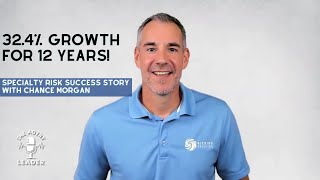
Chance Morgan built Specialty Risk Insurance from 3 people to 100 across 45 states with 32% annual growth for 12 years. He hires for culture fit, trains people from scratch through an internal university, and prioritizes family needs like paid leave during crises. His goal: build a place his kids want to work.
Questions this video answers
July 9, 2024
32.4% average YOY organic growth over 12 years
About 100 staff members
Approximately 85% commercial; ~70% of business connected to food/agriculture supply chain
About 45 states
Chapters
What if your Insurance agency had 32.4% organic growth rate, but not for one year or two years, or even three years, but average 32.4% organic growth year over year for 12 straight years? Well, I'm guessing you'd be pretty excited. On today's Agent Leader Podcast, I have the privilege and opportunity to speak with Chance Morgan Chance, a longtime client and friend of our organization. And he talks about culture, he talks about results, and he talks about how doing the right thing is simply the right thing. This is a firm that started with three people and is now over a hundred. And guess what? They're just getting started. Welcome to the Agent Leader podcast. My name is Brent Kelly. I am your host. I am delighted to be with you today. And today I have a very special guest I'm super excited to have a great conversation with. In fact, he's one of our members. Their agency is one of our Sickens Network members for a long time. Longtime friends, longtime participants in a lot of things through Sitkins and Roger Sitkins over the years, and I think more importantly to you, the Agent Leader. I know in our prior conversations, I know today this gentleman is going to have some great things to share, some takeaways to think about, about growth, about culture, about whatever else we talk about, which could go lots of different directions. I have Chance Morgan with me today, and technically he's the sales and product development person at Specialty Risk Insurance in Southwest Missouri, but as we were joking before we went live, that's one. First of all, they don't have titles. Number two is he's probably got about 15 of them, plus, if. If there actually were. So, Chance, welcome to the podcast.
Thank you, Brent. It's really, really pleasure to be here. And I know we've had these conversations a lot off and on, and they're always fun. Maybe they're less fun when you're being recorded, but we'll see how that goes. It is funny you bring that up already about the titles. I mean, we believe since we started 12 years ago that you start giving people a title that just really tells them what they don't have to do. And so we don't believe in titles. Granted, the insurance industry loves them, and they don't know how to talk to you until they know what title you have. And so we enjoy filling out different titles on different applications to let them know that, yeah, I'm capable of answering this question for you, even though my title doesn't make you think so. And so we have a lot of fun with it. So I've been a maximizer and a product and development guy. We joked earlier, I'm just the guy that you can come in and talk to, the counselor. So sometimes we actually do construction work, like the fence out front we build. So just whatever needs to be done is what we do.
Yeah, you definitely a lot of roles. Obviously, you know, big reason I want to talk to you is that your agency has been very successful. And I guess people can define success in a number of different ways. And I think you've already alluded to, I think a big part of your success is, let's be very frank, your agency is unique out in the world and how you do things and how you view things and some of your philosophies and. And here, here's the better news. You've had great results. Not that you haven't stubbed your toes or made mistakes. I'm sure we'll talk about that. But yeah, it's an incredible story. And obviously, you know, one of the things that you do is help support the agency. Help support Kevin Charleston. Right. The president. He's been on this podcast. It's been a few years ago since he's been on here, but it's just always exciting to catch up. And I know we were joking. We had a conversation a couple weeks ago on a different issue and we started just having conversations. And I go, my gosh, and would be incredible to have on the podcast. There's so much value there. So now we're going to try to recreate that.
Right.
Chance we can do that. No pressure. So before, you know, I want to hear about lots of different things, but just give an overview, if you would, of the agency. Just kind of background of the agency.
Yeah.
What you're all about, all those good things.
So we're. We're obviously just a standard, independent type of agency. We have contracts with hundreds of different companies and we sell about everything. You know, we. We do a little personalized employee benefits, little safety, a little HR, but we're about 85% commercial. You know, the rest is all kind of ancillary to serve our big commercial customers. Inside of that, 70% of our business is really connected to food. Not, not specifically like chips necessarily, but we have snack food manufacturers, but basically any, any phase from the dirt to the plate. So we do a lot of livestock, a lot of farms, a lot of processing, a lot of shipping, a lot of ingredients. We're just really big in the, the. The ag world. But not just singularly farms or singularly livestock. So we Just. And because of that, we've been able to build a. A subset that people look for. You know, it's. It's nice to find someone that understands the. The food side. And so we've been able to work in about 45 different states on the last 12 years. We've grown on that. We actually have a year over year growth of 32.4% for 12 years. Which means if anyone's ever been taught the rule of 72, every two years and two months, we double, which is nuts. Yes, we haven't quite two years and two months doubled staff, but it gets close. And so, you know, we've now reached about 100 staff members. And it's. It's been a challenge in terms of just keeping up with people. Yeah. And that's, of course, culture and people are a key asset. And so we think we're pretty good at it. But just as an agency, it's been. We're not in a very big town. Carthage has about 14,000 people. The whole county we're in has about 200,000 or two hours from Kansas City. We're two hours from Fayetteville, two hours from Tulsa, four hours from St. Louis. So we're tucked in the middle of the southwest. And just not a lot of people.
Yeah, there's a lot I want to unpack on this chance because I think, and it's interesting because you live in that world, right? You do it every day and you've done it for years and years. Like, oh, that's just kind of how we've done it. But I have no doubt, and some of the conversations, people go, hey, what? Like you go back to your organic growth 32.4%, and that's not one year. And that was the exception or just because of a hard market.
That's when you take last 12 years and factor in the year over year, it is average 32.4%.
I think. I think most agency owners and leaders would go, oh, I'll take that. So, you know, I do say that because if you haven't yet, like, lean into what Chance is going to share because it's really interesting. I think what I'm sure we'll go deeper into, and I want to go deeper into is the fact that it's one thing to have that growth for a year or two. And we see that with a lot of agencies because you've got a good person, hard worker, a couple good producers, whatever it is, and they're out there doing it. And you guys had that years ago. I mean it's like, but then it's like, how do you replicate that? How do you build that in the fact that, oh gosh, now we need people to support this and these people that support us aren't necessarily like us when we started. But you've gone a very unique way and approach in how you've gone about that. And by the way, if you want to get an idea of their culture, quick side note, go to the website and just look at the photos. You might notice a few cowboy hats. Right there's, it's, you know, they're, you're very authentic in who you are and what you do. So I want to start with that chance. Just the fact that how do you, and you kind of hit it. How do you grow at that rate? I mean, you said double every two years and two months.
Yes.
To have that kind of growth and then support it with people who come from different backgrounds, different experiences, different ways they look at things, maybe different philosophies or, or how do you, how do you manage all that?
The hardest part for us is that we realize that we're better off training both insurance and technology. So instead of just going out and recruiting people from other agencies that have insurance experience, we actually found that we're better off training them from scratch. Slows us down a little bit, but what happens is we end up having four or five people start in batches. So we've also been able to position ourselves locally that we don't recruit much, we don't call many people, we don't run a lot of ads, we'll Throw some on LinkedIn every now and then looking for something special. But in reality people are calling us. And so we're getting, we're getting good agricultural minded, hard working, middle of the country culture. They're walking in the door and saying, we understand you're a great place to work. So what we've done, marketing wise, we've positioned ourselves is that we have a white collar agricultural job in southwest Missouri for you. You know, because there's a lot of kids that grow up in agriculture. But you know, you're in the mud, you're in the muck, you're in the heat, you're in the cold, you're. And, and they all love it, they love the background, they love part of it. But at some point some of them say, I kind of want to just do loans for a bank for farms or. And so instead of just being. The only agriculture white collar jobs in the area are at the banks. We've been literally teaching schools. We spend time with a lot of the local colleges all the way to. We go three hours away, pretty much every direction. Anybody that has an ACT program, we go pitch that we have white collar jobs for you. Even to the point that if we bring someone in, say from Oklahoma City, osu, the best one to find is a couple AD kids that are in the dorm. So it's summer, they have to go home because the dorm kicks them out. Well, we'll pay them to come be an intern for three months or two months at our office and we'll rent them an apartment. Well, they can't afford to go work somewhere and rent an apartment, but you give them apartment and pay them well, they don't go home. They come work for us for a few months. Well, then what happens is they go back and work. So we've been able to find people by just recruiting heavily youth interns. But also when we do find someone to college, hey, go build this little processing team. We paid one guy a dollar, a dollar an hour override, and he hired three people to process underneath him while he was at school. And we hired all four of them when they graduated. One since went on to work for a bank, but the other three are still here. So, I mean, it's just culturally, we've just tried to tell young people that we have a place that you're going to want to work if you want to be an ag and not have to be in the cold and the heat.
Yeah, yeah, I, I love that approach for a lot of different angles and I want to go again, go, go deeper in this. But I think one of the things you said initially, Chance, we talk about this and again, some agencies do a good job, some agencies struggle, but it's like, well, we just need to find people that have some insurance knowledge or experience. And then, you know, we'll kind of straighten it out and figure it out and get in our approach, which is hard because those people, maybe they're good, maybe they're not, but they come with prior habits, prior, prior ways of doing things. And what you said is we're going to get them before they have any bad habits and we're going to treat them from scratch. And you know, something that, that we talk about, and I've talked about in this podcast is the number one role of an agency leader above anything else, is to grow and develop your number one asset, your people. And, and, and you all take that on literally, like that's what you do. And of course, the outcome is the growth around that. Now, I'm guessing there's probably a person who listening, going, wait a second. So you just go find. Can you mention the college stuff? And you find people have the right attitude, the right spirit, you can kind of. You get a sense of as a person, and then you train them. How do you do that? Chance. Now, again, I know it probably varies, but just give me an overview of how do you do that? What does that look like?
What's the point? No, it's a great. It's a great question, and it's funny. It's our biggest challenge today. Still. We're never satisfied. As weird as that sounds. Even though we know we've been successful, we've never just woke up one day and said, you know what? That's good enough. The phrase doesn't exist here. That's good, but. That's good. But you know where the coach that was never, like, super friendly was like, okay, yeah. Oh, yeah, you scored a run. You're supposed to, you know, oh, you made the tackle. Yeah, well, you need to go make 22 more. So we win this game, but we're not that touchy. Feel. We have some others around here that fill in those roles a lot better than we do. But what we do look for, first and foremost, is the phrase we actually use is, would we enjoy spending the day in the truck with them? Oh, if the person we're sitting across interviewing who wants to come work for us, if at the end of the interview, end of the day, end of the conversation, everyone looks at each other and says, I would enjoy spending the day in the truck with that person, that's the number one rule to get hired here. That doesn't mean that they're not weird or a little odd or a little strange, because we do appreciate the differences. But that's because what happens is we spend so much time together, we become so cliche. Everyone says it, a family. But we treat you like family. You are ours to raise. It's a little bit of a biblical concept, but once you're in our circle, you're ours to take care of.
Yeah.
So we. We live in that world, and so you have to be one of us, and we are one of you. And so it makes real easy. I have a lady that sits out in front of me. We hired her from a bank not too long ago. Finally, after about three weeks here, she just turned, said, holy crap, you all really do like each other. No, we really aren't. Just kidding. Everyone says it. You know, Roger's favorite Thing we exceed expectations. You don't even know my expectations. No. We're a family. And then you go meet the people and nobody likes each other. Right. So that's the number one thing. We find people that truly are fit personally. And then we teach them the insurance. With that, we maybe lose a few more out of it than we like, but we never lose the friendship. Mm. So when they don't make it in the insurance or they don't like the field, or they don't like what we're doing, they still leave and we go find them in jobs with our, with our customers. We've even sent people to our competitors because they had a role that we didn't. So that's the number one thing. Then training wise, we do have a pretty. We have a two month kind of plan laid out that walks them through both teaching them our technology. We use Applied epic and then also insurance, getting them licensed, teaching the insurance. But then we've also been building Specific Risk University and Special Risk University is literally going to be a platform of 100 level, entry level topics. Next year we'll go to 200 level, then 300 level and 400 level. Eventually we may even offer master's kind of. But it's very early in our development. I can't tell you much about it. For instance, I teach an Insurance 101 class and the very first thing we define is what is insurance, what is a deductible, what's an underwriter, what's, you know, we literally teach them the language. Weirdly enough, we have people that have been insurance for 20 years and I've taught the class and they go, I didn't know this one thing. And not that there was anything special about the class, it's just, it was intentional. I took the time to say, here are the things that you should know. And then they're like, wow. I actually, no one had ever said that. So we, we are very, we teach accounting one on one. We teach, you know, property. But we also, we've also gone through our state association and we've hired a trainer and we do CIS CSIR classes in our office for ourselves. We don't send them off. We bring in the trainer for two days. Half the team goes one day, the other half team goes the other day. And now that we've gone through the first 18 months of that, we have like nine people that all got CISR certified last week.
Yeah.
So it's just a constant education. Yeah. Discussion.
Yeah, it's, you know, chance again, you guys live that out. Again, not there's not challenges or frustrations, but like, how do I grow and develop these people? And it's not that family is just a cliche. You're right, because a lot of people say it. But I. You know what hit me on this? First of all, if you didn't write this down, I mean, again, maybe you're not in a truck of a different thing, but, like, do we enjoy spending the day. Would we enjoy spending a day with him in the truck? Like, what a great question. Like, basically, are we compatible? Right? I mean, that's. That's number one. And then I think, what else is interesting? Chance, you mentioned too, that, you know, some people, maybe long term, it doesn't work. But, you know, in those situations, whether you're helping find them different employment outside or even at a competitor, what I'm hearing in this as a family is even though maybe this isn't good fit right here, and we don't want to waste the rest of your life being frustrated. And we're frustrated, you're frustrated. Like, we love you enough to tell you the truth. We also love you enough to do what's best for you, and I want to help you go do what's best for you. And it's not here. And that's cool.
We. And we have that same conversation even in every process. The most extreme one we had is we talked to this young lady and she had this love for spending time on, literally, hog farms. And she'd had some internships, her education was in it. And finally we just said, hold on. Why aren't you applying at hog farms? She goes, I. I don't know a lot of them. And I. I got out of school and I was supposed to find a job, and all my family friends told me about this place, and they're like, hold on, here's three numbers. Call them. Well, she called those. She left, called those people and got a job on one of those farms. If it's not a fit, it's not a fit. And it has to be good for both. You know, sometimes people forget in the business relationship, if it's not good for both the vendor and the buyer, at one point, one of them is gone. The vendor loses the buyer, the buyer loses the vendor. And so we. We treat our. We treat all interactions that way. Is it really does have to be good for both parties or one of the parties eventually leaves. Yeah. And so we've sent. We've told people that, you know, that they live too far away and with their family Situation this, we highly recommend that they, they go over to look at some other people that do this because it doesn't, it's too much. It's too much out of your family. Because that's another rule. If you don't want to go to your kids football game or basketball game or tennis match or concert recital, you don't belong here. You're the wrong person.
Say that again. I mean, hopefully people got it, but say it again. Your philosophy there.
So our philosophy is we have teams. You're all backed up by teams. And if you're not doing everything you can to leave and go watch your kids event, tennis, concert, choir, band, whatever, football. If you're not making arrangements so you can be gone and at that event, you are the wrong person. You should not work here. You do not belong in this culture. Because that is number one for us. We have literally told people to leave the building because their kid has a tennis match. It starts in 30 minutes and we will take care of it. Leave. You only have a small window with your children. Don't miss a minute. Yeah, yeah.
And listen, as a, as a dad of five kids who. One's already in college and it's going quick. Be there soon.
Yes.
Amen. Amen.
And Kev, Kevin and I raised our kids through this. I mean, his were, his were teenagers and mine were too. And so, you know, his are now. Well, one's here is on her third baby, and mine are 23 and 21. And so we've, we've. Our, our events are done. Yeah.
Yeah.
And so it's funny, we still believed it before events were done, but now that they're done. Almost makes you a little teary.
Yeah. Oh, I mean, yeah, it does. It's, it's, you know, I mean, there's always areas of perspective in life, you know, and I think we get into it again. I, I get this way too chance where you just get like so focused and we're going to do this and do this and grow here and do this and, and all of a sudden, in fact, I had a conversation with my wife. I'm like, you know what? Like, we talk about our last child who was kind of a surprise in our family, and she's already going to be seven. And I'm like, oh, my God, I'm going to blink again. I'm going to be 56 years old and she's going to be gone and I'm going to go, what was I doing?
Right?
And you know, again, maybe for you it's something Else it's not kids. Right, whatever. But I think the point of it is don't miss the big things.
And if you don't believe those are big things, then you're just really not a fit here.
Yeah, but, yeah, tie that back in your culture is.
Yeah.
Well, I'm going to get into the kind of the, the, the, the real substance we were talking that to me is, is I don't know if you can shape this is the mission or whatever. But before I get into that, I did want to address one thing because you said something that really caught my ear about, you know, like, we do really good. I could argue you're probably doing great in some cases if you just compare it. But you're always going, what's next? What's possible? What are we missing? What, what's our next level? And, you know, I think there's a, Again, it's, there's challenges here because no agency is perfect. Your agency will never be perfect. But to me, it's the fun and the challenge of if it's just about money, it's about winning. Like, how do, how, how do, how do we win at higher levels? Which, by the way, winning is fun. And, and I want you to address this because one thing, Roger, I have been talking the last few weeks and I've added to my speaking engagements is that I was telling the agencies, like, how many here, by show of hands, are getting good results? They're like, probably okay. And I go, hey, good news, bad news. The good news is you're probably getting good results. The bad news is you're often, you're likely caught in a good results trap because immediately that causes complacency. It's like, you know, what's the hardest championship to win? Well, they could say the first, but quite frankly, the second one's even harder because you're like, yes, we did it. We don't have to do all that work anymore. I'm like, yeah, you kind of missed it, though. That's what got you there. So anyway, address that, if you would.
Well, it is tough. And, and we. What's funny is that we don't have measurements like that that we ever really look at. I can tell you right now we're a small flea in the world of insurance. You know, when you start looking at the, the aggregators and the, and of course, the, just the, the purchasers and the. Just the hub. The hubs and the marshes, we're tiny, but we don't believe they do anything that we can do. And so We're a little fearless and like, oh, let's do it, why not? But that also helps us in that we don't wake up every day and judge ourselves based on that. We've never actually had a monetary or numerical or a measurement goal. Kevin talked a long time ago. We talked about, you know, Sun Tzu and the Art of War and that sometimes you can be egotistical with your, with your goals and your measurements and to avoid that. And so we have short term kind of concepts where, hey, we're going to go to be in a regional firm, we're going to go to be in a more national firm, we're going to work on building teams, we're going to work on building our education system. But we've only had one long term goal since the agency opened 12 years ago and that was to build our place. Build a place our kids want to work.
Yeah, just for a second, I want to stop here, I mean, interrupt you, but I want, I want to slow down because I don't want this to be missed because this really was, I mean, I'm going to give a little backstory. So last year we had an in person event which you and Kevin both said, we had so many things going on, I wouldn't want to even come. There's so many things going on. We get it. But you were there, you leaned in, we had great conversation and then you mentioned this to other agency leaders in the room about your philosophy. So I want you to share that again and then expand upon what that means, what the results have been, what you've learned. So go.
It was funny, it almost felt a little pedestrian in that meeting that you're talking about because there were so many fantastic agencies and they had all this measurement and all these goals and they were going to increase, you know, growth by so much in a next quarter and profit. And, and I, I almost think it ended up being us last. Like we were kind of hiding, like, I don't know how to answer this question of what we're going to go home and measure. So I just finally said it. We don't have these goals. We only want to build a place our kids want to work. And if your kids don't want to work here or you don't want your kids to work here, we're. Are you doing to fix it? And that goes for every single person that works. And so that means, are you building a family culture? Are you, are you making your job a better job? Are you, you know, if you don't like being Account manager and grinding away all day because you're doing small farms or you're doing personal lines. What are you telling us to do to make this something you would want your kids to come do? You know, if you think we should have more time off or less time off or another office or you have the flexibility to tell us in any way you believe would make this a place your kids would want to work. Now, we back that up, too, in that almost every whiteboard in the building has drawings. Everybody's office has a whiteboard. Some use renewals. Mine's got a list of stuff we're doing for a new headquarters you're building. But there's notes from kids, you know, hi, dad, Or. Or, hey, I chance. Or, you know, I mean, everywhere you look in the building, there's drawings or notes from kids on whiteboards. And nobody walks in and says, hey, that's not professional. We can't have those here. It's like we work around them for months. And finally, I think I had one on the one outside my office that had been out there for almost two years. Okay, I could probably racist now. I clean the whole thing. But we. We just. Kids are welcome, you know. Now we're not a daycare. We still work to do, but we want your kid if they're swinging by, Even if they're 18 years old, 19, 20, you want to swing by and grab a drink from the refrigerator, just come in and say hi to dad and grab one, leave. Just. Just come say hi. And so we have a lot of kids that say, I want to do what dad does. I want to do what mom does. But that also means when you go home, you don't go home to complain. You don't go home and just complaint here. Let's fix it. Let's do something about it. So it has this enormously holistic thing that almost never runs out of tentacles.
Yeah.
But it's literally our only number one goal. And we. And we. We preach that every year at our annual. Annual meeting.
Chance, you've heard Roger, myself, someone probably at Sipkins at some point or many times over the years, say the one thing. Question, what's the one thing? So that by doing it, make everything else easier and necessary. And I'm like, it's a great one.
The one thing.
And my brain was taking me places. I had. I've heard you talk about this before. We've had conversations. But what hit me, as you were saying, I'm like, boy, from a subconscious level, you're thinking about things that Are bigger than you.
Right.
I mean you really are. It's a bigger picture of things if you're frustrated like you said. I think this idea when you said let's fix it. But it's also a concept of make the place place better than when you found it.
Yep.
I mean so there's that tied into it and of course that, you know, the fix it part of it is, is like come up with solutions versus just gripe and complain. Because if it's a place you want your kids to work, well then I've got to leave it better than I found it and I've got to come up with solutions versus only talking about the problems.
Right. It also means it has to exist. So we have to be future thinking. We have to be aware. We have to be prepared to meet what's coming, good and bad. You know, I think we've always been pretty willing to say we'll invest in ourselves. You know, we, we're not the field of dreams. You know, you build that they will come. But we have been at times, yeah, we think it's coming. Let's build it. Let's be ready. You know, we have a big concern. We're moving buildings in a couple weeks and it's going to be on a u. S. Interstate and literally across the streets, the largest stockyards in America. You know, our neighbors to the across the street are they build pens and metal work for farms and ag. I mean we are actually going to change our exposure by such a level. We're a little concerned we can't keep up with demand once we open that door. So we've been hiring like great. We don't even have a chair to put people in. And we have four people starting the next week. Like they're literally going to sit in someone else's office with them until we move. But we know we have to be prepared for the challenge that's coming. Yep, yep. I don't know. We, we've been pretty fortunate. We, we, we, we never seem to run out of new business opportunities.
Yeah, well, it's, I mean it's a testament to doing the right things. I mean I think, you know, I think part of that chances. Listen, as you're saying it hits me. It's like what, what areas do we do? I do agencies over complicate things sometimes and I, you know, I think we do.
But we're also pretty simple guys. What Just, just take care, you know and so if there's something that needs to be done, just go do it. You Know. Yeah. If you see what's coming, why aren't you doing anything about it? Back to, why do we have titles? Because. Well, I'm not. That's not my job to worry about accounting.
Mm.
Really? Why not? She needs help. They need help. If I see something coming, why wouldn't I warn vice versa? So, yeah, we just don't. Like you said, when the one thing's the one thing, how to make this place a place your kids would want to work. It does involve all aspects, and so you have to be really cognizant of the 360 view. Yeah, well.
And I think, too, that we have to go really deep in it. But, I mean, to me, if you have a foundational principle or philosophy that is your guidepost or. Right. What shapes so many things, it in many ways makes decisions easier in the sense of, oh, well, does it fit with that? If the answer is yes, then, yeah, we consider we do it. If it doesn't, we don't do it.
Absolutely my best example of that in the world. Maybe it's not a book tour, but Patrick Lencioni has a book. Three Rules for a Frantic Family.
Yes.
It's my number one gift to give everyone in the office that has a family. If you will take the time to narrow down the three things that you choose all of your decisions off of your life becomes so simple.
By the way, you recommended that to me years ago, and I don't know if you sent it to me or I bought. I don't remember, but I think I.
Sent you one, actually.
Yeah. And I. And I read it and I loved it, and it actually reminds me of, I need to read that book again. So there you go.
It is.
It hit me. It's. Obviously, he does a great job in his business.
I keep multiple copies on my desk. Oh. Someone walks in and we start. I'm like, you know what? You should read this. Come talk to me about it.
In fact, sorry, podcast listeners, but in fact, I was looking for that over the last couple months, and I couldn't find it. And I'm like, I think I gave it to somebody, and I just realized I don't remember who. So now I have to get. I'll just get more copies and give.
It to more people. It's literally one of my favorite things to share.
Yeah.
Because we used it. I used it personally. I took it home, and my wife read it, and I read it. We talked about it, and we literally made decisions that for the next 10 years guided everything we chose to do. You Know our kids schedules changed or the things they participated in, the things they didn't. It was, it was. But that's, that's again, you back to the one thing. Technically that's three things, but the one thing that makes it really easy to. It's that guidepost every. All our decisions are based on. Right. Is this going to make it better for the future?
And man, we could. Again, I want to be respectful of your time here because I got a couple more questions I want to ask you.
It's, it's.
There are you think about the amount of decisions that goes through it goes through any human's brain in a day. Right. Should I do this? Should I do that? Should I do that? Should we do that right here? I mean, and, and so to have those where they could guide post guardrails, whatever term you want to use, take some of the pressure off. I just need to do these things.
Yeah, yeah. So we, we, we really believe in narrowing it down to what's what, what really matters, because there's a lot of opportunity out there. We're never going to run out of opportunity. Roger said for 20 years, you drive by more insurance on your way to work than you'll ever write. Yeah.
Yeah.
Well, let's just whittle you down and make choices. What fits us? Yeah, yeah.
I think he's also some, some to the effect of every problem I've ever had in my life started as a great opportunity because there's so. Oh, that. I thought that was another one.
Of course.
Back to your guy rails.
Go.
Okay. Does that fit? Okay, let's, let's look at that. That. No, it doesn't. So I do want to ask Chance because we had a great con. When we had a conversation a couple weeks ago, you mentioned. I want to give a practical example of this. I don't think you would share it if I didn't ask. And I think it's important. You know, obviously when you're a family, families have issues, struggles, challenges. You know, there's, there's death, there's sickness, whatever. I know you had a recent example, someone on your team who was dealing with something and I just thought was fascinating of your approach. And maybe other agencies do this, which is great, but it was just like not even a. It was like. It was what we did. So can you share that story?
Oh, absolutely. And I think you're going to find a lot of great examples where great agencies do great things.
It.
This does help explain a little bit of a philosophy we have in that we don't really have a. We don't have a PTO schedule. We don't have a vacation schedule. We literally kind of joke that if you need a vacation, you should probably take one. If you're sick, you should stay home. But what happens is that we want to keep it flexible. We want to keep this. This lean concept of if you need to do it, go do it. Just make sure your team's prepared. But we actually had a lady that worked for us, and she was actually on a business meeting where she was getting some training for a commuter system and her husband went to the emergency room. Toughest guy in the world. The fact that he went to the emergency room was already an alarm bell. The next day there was a regular came home. She came home, found out he had stage four cancer and wasn't going to. Wasn't going to be long. We immediately sent her home. We actually literally bought a freezer and butchered a cow and filled it, gave her month worth of cash and told her to stay home. And we got her covered. And over the next few months, we continue to pay her as if she was working every day. And she kept asking us for a computer so she could work on some emails and stuff, and we would conveniently forget to bring it and go see her and be like, oh, we don't know, we forgot it, or whatever. We were never going to bring her computer. And, you know, I think about 60 to 70 days later, her husband ended up passing. And then we gave her some time to get through that. Well, when she came back about 90 days after that started, she got to come back to work with us as part of her family and friends. We didn't take the last 60 days away from her. Yeah, instead we gave her a respite and a break and a chance to, to finish out that time and then come back and feel like she wanted to be back instead of, I can't believe those guys stole this for me. And so that's the example we explained to our co workers then. This is why we have to protect our system of if you need a vacation, you should take one. If you're sick, you should stay home. We're not telling you you have two weeks or three weeks or four weeks or point hours, 0.8 hours per day or whatever. We're just adults. You work, we pay you. It's really simple. In fact, Oliver, it's all connected. Kevin has these thoughts. They're all, we do a few things in a where we pay once a month. I see Burger King offering On the sign that they pay daily, now we pay once a month. We find out that over time, people clean up their credit, they clean up their finances, they clean up things. We help a new person get through. We'll pay them weekly for the first few months they need to, but we get them to same time. We pay them once a month. On top of that, we're going to make sure that you're taken care of. If you need to go somewhere, go somewhere. Even if you've been here a week. But if you've been gone too long, we're gonna say, hey, you've been gone too long. Maybe we should bear this back a little bit. But most importantly, they have a team that's depending on them. And so as long as the team's backing them up, it really doesn't. Nobody misses it. Nobody knows.
Yeah.
And that took us a long time to build, but we're still building. We're still, now we're, now we're working on leadership of the teams. We had no teams and now we have 10 teams. And so now we're trying to build 10 leaders of those teams.
So it's, it's fascinating too because part of this too is it's do the right thing. Right. Treat people as they should be treated. I mean, just basic foundational things. And you know, part of this too, and you've addressed this in different ways, there's certainly accountability behind stuff. Right. You got to do your job at high levels. It all blends together. Right. It's not like it's one or the other.
Right.
It's both. And I think that's what's been so powerful and so interesting. I've got chance. You have time for two quick questions. You can make them as quick as you can. First one is a bit self serving and I'm actually interested too because you have, you know, going back years ago when attending some boot camps, have been part of Sitkins to some degree for a long time. And you know, it's funny you said as far as like the person riding the truck with you, one of our concepts of Sitkins, if we want to have our members be someone you can go up on stage and put your arm around. Yeah. Part of that mentality. But I'm curious from, from your experience, whatever it is, what do you think's been the biggest impact? I don't, I don't know I've ever asked this question. So I'm curious if the relationship with Sipkins and what you guys have done.
The Sitkins relationship's An interesting one, because we don't catch how often we use some of the same concepts and phrases. And, you know, I do know that when you guys rebooted and we joined right away and sent our first producer, he came back and kind of custody goes, you've been using this stuff on me for years, and I didn't even know it. You know, Kevin was in the first class of the sickens 100, and I was in maybe the third one or fourth one.
I don't know.
Yeah, I think 2006. So, yes, we've been around a lot, so, you know, the foundational things work really well for us. Yeah, they're just beliefs, and to be fair, they've helped build some of the things we just discussed.
Sure.
But number two, the relationships. We don't believe anyone's really a competitor. You obviously use the word. We actually like to joke that we don't like to get to know our competitors because a lot of times we like them. Well, that's the Sitkins guys. You know, you end up liking them. Yeah. But what's funny is that they don't feel we're competitor. We don't think they're a competitor. And you end up talking, you know, I know. Interesting enough. Kevin's daughter always joked, I will never work for Kevin Charleston. She played softball, Division 1 Texas State, and ended up changing a major to a business degree. At the end, she needed an internship, and Kevin thought, what if we got her an insurance internship? Turns out there's a little company down there called TCOR who literally changed their name to Total Cost of Risk because of Sickens. And I was friends with those guys. And so I just called them up and said, hey, boss's daughter wants an internship. I go, I'm just warning you, if it works, we're gonna steal her back. And they hired her. She worked down there for about a year and a half, and we ended up. She ended up deciding to move home and found it. Found a nice young man and the works. But. And she did finally leave and came up. They tried to keep her. They put her in the safety side, contract side, so she didn't really learn any insurance stuff that they could use against us. But. But no, we. That. That type of relationship with Sickens is powerful, and we've even used it to our own good. She's now in charge of operations here, and her husband is one of our top producers. And so it's just. That's. That's the beauty of the series is you get to just find people that Think like you, or more importantly, believe in the same concepts, but maybe have a different thought process. So. Yeah, but yeah, yeah, we, we actually do. Just like when we went down to your, your session last year, everyone in that room was, was different, but all in the same kind of mindset. Let's grow, let's be better, let's succeed, but not just for the sake of. I got to be number one.
Yeah, there's a deeper meaning to that. It's really fascinating. Chance. And I mean, there are, there are a lot of different aspects and types of people and I mean, just way they look at things. But I think there's certain commonalities. Right. I mean, even going back to the fact of, like, you know, we wrote the book Best version Possible. There was a reason we didn't set out to write like, let's do a book called Best version Possible. We just started talking about, well, how do we define this? Because every agency is different. It's not always about a metric. I mean, yeah, there's certain aspects, but like, what if they just realize that there, there's a better version, a best version of them, and the leaders and the agencies are seeking that, knowing there's no perfection. But why would you not want that? Right. Or at least to go that direction? I think that's the belief system. And they may have different types of ways they do things, niches of business, different processes to a degree, but the beliefs are very similar.
Well, and you're right, we obviously believe the same thing. We want to be the best version possible.
Yeah.
And that's again, back to what? Even if I don't use all the tools that Sitkins gives me, you've still given me nomenclature and common language and ways that we can express it that everyone does understand. Yeah, yeah, it's, it's, it's very powerful because the words matter. If you go around your office and no one's using the same words you are, they don't believe the same thing you do.
Yeah, they do. It's, it's always, it's always fun too, to get. Everyone's got their own vernacular and we appreciate that. But like to see agencies that have mirrors or different things. Is this your best version possible? It's like, oh, cool, it, it, it meant something. Right? That's, that's, that's the power behind that and of course, certainly in the stories you've shared today. All right, one final question. This is all about you. So, and I, I gave you a little idea, this question. I don't know where your Brain is on. But I love Ask this question every interview, and it's very straightforward. If you Chance, we're having a conversation with a younger version of Chance, and let's just say getting out of college or starting your professional career, whatever it is, you're early in your career, if you were having that conversation and that young Chance looked up at the current Chance and said, chance, Old Chance, older Chance, I'm gonna call you Old Chance. Give me one piece of advice. What would you give that younger version of yourself?
You know, like you said, I knew it was coming, and there's so many technical things you can think of, and. But at the end of the day, the thing's been on my. My mind lately is if I could have embraced being kind earlier, I think I just. I would have had more joy, more pleasure, and so would the people around me. I'm not saying I was a mean guy, but, you know, you. It's easy to think, forget. It's easy to forget that everyone has something going on that you might not know. And it's easy to want to just jump right into them to say, hey, this isn't working? Or, why are you doing this? Versus just, are you okay? You know, it. We. We've gotten better at it here and doing it more often and being more involved than just saying, are you okay? It's amazing that they almost start healing themselves. You almost don't have to coach how to fix it. You just have to help them get through it. So if I could. If I could have known a lot earlier how much better everyone's life would be, including mine. Just being kinder.
Yeah, that's really good. It's interesting because, yeah, it's basic but powerful. And I think that's why it's powerful. It's basic. And I. I won't share it here, but I just think in last it, last week or two weeks ago, I was traveling last week. Long day, got delayed again. You get in your own little world. And I got this, and I got to do this, and I get in an Uber car, Uber van with this guy, an older gentleman, and it's like he had the most amazing story. And part of me wanted to be like, I'm done for the day. I just want to get in and just ask questions. Well, tell me how you did that. Why. Why was that? What was the impact? And what's fascinating is I know you've experienced this and. And. But it's not easy. But when you. When you do that, you know, and you're. You're you're filling, helping fill someone else's cup. Yours grows.
Seriously, the thing we say around here, when you spend your day making everybody's day better, you have the best day.
Best day. What a great day.
Yeah.
And the day you're running around all self absorbed and I gotta do this and why isn't this happening? I need this. And we all happen. We're human. Right? Yeah. You get back and you're like, you might have gotten more done technically.
Right.
But you've got way less fulfillment and probably less outcome for sure.
Absolutely. Yeah. That's the number one thing my younger self would be taught.
Wow. Well, Chance, thank you so much. I told you 30ish minutes and here we are an hour later. I had, I kind of had a feeling, but I, I was happy to.
Spend it with you.
Yeah, it's, it's great. It's important conversation, I think. You know, obviously I want to have you on here because the stories you tell and what your agency is doing. Yes, there's agencies that are doing great things for sure. But I think your agency is a very unique and powerful story that needs to be shared. I think people, if they take one thing from what you said, hey, that's something we should consider or implement or get that book or whatever it is, it's super powerful, super powerful. So I want to thank you for that. As far as you, the agent leader, listener, if you want to learn more about what we do with agencies, if you want to be like Chance on their team to some degree, if you go to sitkins.com bookacall sitkins.com bookacall what we're doing for agencies now is certainly want to get to know you. We'll run an agency assessment. If it's qualified, we'll provide you with the plan and that in that point you can determine if it makes sense to join the network, be part of that and become best friends with Chance and his team. How's that? So, Chance, thanks so much. Any final comments from you before we wrap up?
No, I just appreciate your time and your guys friendship. We love spending time with you, even if it's virtually. I'm looking forward to seeing you again in person.
Yeah, me too. Me too. All right, Chance, we appreciate it and as agent, leader, podcast listener, thank you for listening. Wish you all the best and your success. Take care.
More from Roger

This Shift Helped Us Unlock Growth 💡 | Agency Leadership Tips #insuranceagency #agencygrowth





How AI Can Help Insurance Agency Owners Master Their Financials (Without Being a CFO)

From AI Hype to Real Results: Steve Anderson on How Insurance Agencies Can Use AI to Grow Now



