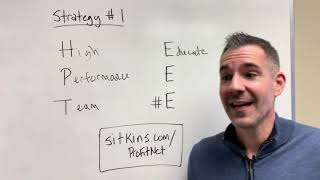
Brent Kelly of the Sitkins Group presents a short coaching video on building high-performance teams in insurance agencies, introducing one of seven core Sitkins strategies. He defines a High Performance Team (HPT) as coordinated sales and service roles working together to acquire and retain ideal clients, and outlines three actionable pillars — Educate (internally and clients), Empower (coach and delegate), and Execute (weekly meetings, standards, accountability). He also invites viewers to the Profit Net event in Cape Coral, Florida (March 11–13).
Questions this video answers
March 11th through March 13th (year given in metadata: 2020).
Cape Coral, Florida.
Brent Kelly (Sitkins Group).
Educate; Empower; Execute.
January 20, 2020.
Chapters
Hi, Brent Kelly here of the Sitkins Group with my profit tip Professional Fitness to help your agency gain clarity, build consistency and to make a commitment to become your best version possible. As you can see on my whiteboard today I have strategy number one. In the upcoming weeks I'm going to share seven of our core Sitkins Group strategies with you, the viewer. And a big reason why I want to do this is I want to introduce you to these core strategies and and also invite you to our upcoming masterminding event, the Profit Net event, professional fitness networking event that we have in Cape Coral, Florida, March 11th through the 13th. This is our premier event for the Sitkins Group. And really as a non member, this is your only opportunity to attend, to network, to share, to learn some of the things that we talk about outside of being one of our private clients. Now our private clients are going to have some special access, but you as a guest will get the full experience of Profit Net. Now I want to go through again the seven strategies and start with strategy number one. This is the foundational core strategy of everything that we teach and preach around Sitkins. You may have heard me or some other coaches or Sitkins members talk about this before, but I want to share a little insight into what these letters mean on the board. Hpt. Well, core strategy number one is this. You as an agency have to build a high performance team. What does that mean, a high performance team? Now I think the idea is pretty common for most agencies, producers, sales, service teams is the idea is that we want our producers to be in a proactive role that they're producing. The definition of a producer is one who produces. The service team is in more of a reactive role. And what happens in most agencies is that sometimes we get these things squashed, we get them mixed up so our producers aren't doing the job they should be doing, which is producing risk advice, relationship building, and our service team gets caught in some other functions that they shouldn't be as well. And so a high performance team is this idea that although we have different roles and different functions, we are equally involved in retaining and obtaining ideal clients. If your agency doesn't have a high performance team, if you're not taking the time to have sales and service really work together and this is one of the most critical issues that we see with agencies. There's conflict in many different areas. It's really hard to do any of the other things that you really want to accomplish in your agency. That's why this is so critical. And we spend so much time Diving deep with agencies and high performance teams. So why do I have three E's here? Well, I'm going to give you some actionable takeaways that you can start to look at in your agency in building a high performance team. Now none of this happens overnight. I wouldn't suggest that, I wouldn't tell you that. But if you can begin to build some of these things into your agency, it'll make a huge impact long term. I think some of the biggest successes that I've seen personally, personally in coaching agencies is that when they really devote time and energy to a high performance team, the results begin to truly skyrocket. Again, we're putting people in the right roles, the right positions to do the things that they're trained and equipped to do. So let's go to the three E's. What's the first one? Well, educate. The first thing we have to do is educate. Now what does that mean? Now there's two parts of education that I want to share on this video. The first education is the fact that the producers need to educate their service team on what's going on, what's happening, what they're working on. The service team needs to educate the production team on what's going on, what's happening, what they need from their production team, all those kind of things that's going on. Any red flags that may be happening? One of the things that I've Learned in my 16 year marriage is that if my wife and I, we don't communicate, we don't educate each other on the upcoming week, where am I going, where is she going, where are the kids going to be, where are we spending money, whatever it may be. Our entire week is chaotic. And so to fully educate your sales and service team should be having a high performance team meeting each and every week. I don't care if it's 10 minutes or 30 minutes, although probably most of them take 20 to 30 minutes to do the right way. And we actually have an agenda and some supplemental information that we help agencies with to do this, but some type of education meeting that we are coming together proactively to talk about what's happening, what did happen and how we can improve in the upcoming week. It's about educating each other. The second part of education is educating our clients. There's this syndrome out there with insurance producers in particular called Saku S a k U which stands for the source of all knowledge in the universe. You know, I spent 15 years as a commercial lines producer and I get this syndrome very well. Because we go out as a producer, we find the relationship, we develop a relationship, we sell the relationship. So we say things like this. If you need anything, you give me a call if you need anything. So guess who our clients call for everything, whether it's super important or not important at all. They call me because I told them, I educated them to do that. Great producers, great agencies understand that the roles and responsibilities are there for a reason. There are times the producer does need to reach out to the client. Obviously proactively is best. But there are many things, certificates, changes, whatever they may be, that are minor things that our service team can handle better. They make less errors on and allows our producers to do what they do well and our service team to stay in their role. But we have to educate our clients and tell them that we are better as a team, that it will serve them better when they work with our amazing service team and highlight what they do, who they are, why it's so important to them, and they'll free you up to do the things the producer you need to do. So education both internally and, and externally. The second part, and this is probably more of a philosophical idea to a degree, but there certainly is a lot of tactical ability as well, is to empower. One of the mistakes I see, and this particularly happens with producers to service teams, is hey, listen, the client called and had a question. The service team isn't equipped, so to speak, or they don't know the answers to this question. So let me just answer it for you, right, I'll take care of it, I'll get back to him and move on. Well, how does the team learn in that type of setting? So to empower is to begin to coach. If you're a producer and you're watching this, are you coaching your service team or are you just answering the questions and moving on and saying, listen, here's what happened, here's why I this, I want to share this with you so that next time you know, you have a better idea, what questions do you have for me and work together. It may take more time to empower, to give authority to in the short term, but in the long term it'll free both sales and service up to do what they do best. And lastly, this is an actionable thing. Execute. Execute. Now I could talk a lot on execute. In fact, Profit Net, I'm doing an entire keynote and we're going to roundtable around it on the power of execution in different areas for your agency. Because ideas are plentiful. Execution is where you actually get results. And so how do you execute a high performance team? Well, one is you actually have a weekly meeting, right? And as an agency leader, you hold them accountable to that. It's a culture of accountability. This is important to our agency. We've got to have sales and service in different roles doing what they do best and to execute we're going to set standards and hold accountability and we're going to understand if you are or not doing that. By the way, the service team should be driving high performance team meetings because producers are producers and they will always find something else they can do or should be doing. But just 20 to 30 minutes each week to execute upon a high performance team meeting will save countless hours, minutes, errors, whatever it may be moving forward in your agency. So strategy number one, does your agency have a high performance team? A functioning high performance team where sales and service equally important but different roles and they stay within those roles to get the best experience to the client and and the best result to the agency. Love to see you at Profitnet. If you reach out to me if you have any questions, I wish you all the best in your success.