How to Grow Your Agency from $6 Million to $33 Million: Insights from a Top Insurance CEO
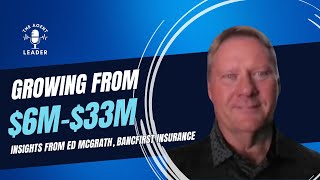
Ed McGrath, CEO of Bank First Insurance Services, grew the agency from $6M to $33M by operating independently within the bank, ditching producer contracts, and investing in training. He expects $50M in five years and credits success to hiring disciplined people and building processes that work without him.
Chapters
On today's Agent Leader podcast, I have the pleasure of interviewing Ed McGrath, who has helped lead Bank First Insurance Services from 6 million to an astounding $33 million in revenue. And guess what? They're just getting started. We're going to talk about the secrets to monumental growth as Ed, the president and CEO, sits down with me to discuss some of the key areas in terms of culture, strategies, processes and producer development. Development. You do not want to miss this episode. Enjoy. Welcome to the Agent Leader podcast. This is the podcast for agency leaders to learn, to grow, to develop, and ultimately become their best version possible. My name is Brent Kelly. I am your host. Excited to be with you and excited to share a very special guest. I have Ed McGrath today who is the President and CEO of Bank First Insurance Services. They are located in Oklahoma, although they also have offices in Texas, so they continue to expand. Bank First Insurance is a top 100 insurance agency and Ed's got a wealth of knowledge and experience. And as I tell all my guests, I may go all over the map in our conversations, but I can tell you this. In my relationship with bank first and of course, getting to know Ed, you're going to get a wealth of ideas and thoughts. And my guess is, Ed, you might even challenge him a little bit today. I don't know. We'll see what happens. But first and foremost, Ed, welcome to the Agent Leader podcast.
Thanks, Brent. Glad to be here.
So I'm going to start off and just keep this very high level. If you could share with the audience, the agent leaders out there, Ed, just a little bit about bank first, the overview and then certainly your particular role involvement with the agency as well.
Okay. Bank first is a publicly traded bank in Oklahoma and now in Texas. They got into the insurance, property and casualty insurance agency business. Their first acquisition was in October of 2004 and purchased my agency in two and a half years later in April 2007. So the leadership of the bank was looking to expand their total offering in financial services. Made sense to him. We've had one acquisition since it was a small million dollar book. It was more of a relationship situation. So the total revenues on all acquired that bank first paid for was $6 million. So since 2004, lots of things have changed. And some of the things that have changed is we've expanded into different cities. We have four offices in the state of Oklahoma and one in the Dallas Fort Worth metroplex area. So we have grown organically from that 6 million of acquired revenue to this year. We'll, we'll finish about $33 million plus. So the leadership of Bank first knew from the very beginning that we could not run an insurance agency like we run a bank. So they encouraged, I think that's a nice word, encouraged me and our agency leadership team to operate as an independent agency and not as a bank owned agency. So the success that we have had as a bank owned agency is I think a direct relation and benefit of the leadership of bank first themselves. Saying you guys are autonomous, you do what you do, we'll do what we do and we won't try to micromanage you. Some of the bank owned agencies that I have seen in the country and I've gone through the Marsh Barry and the bank owned agencies and participated in that and the stories I've heard, you know, I just said I'd lay the keys on the desk and say good luck, you know, with what I've seen. So we're, we're a little different and, but we, we get to enjoy the benefits of a large publicly traded bank and all the resources and get to live every day as an independent agent and serve our customers as such.
Yeah, well, a little different but I again, I'm right. Look at the numbers again. From 6 million to 33 million in 20 years. Yeah, that's impressive. And there's a lot to that. Right. And I want to get right into this. We were talking before we officially recorded. So one of the things is obviously we've got a relationship with bank first, part of the Sitkins Network. And let me ask this first Ed, because I don't know the exact number off top of my head. How many million dollar producers do you have in your organization right now?
Million plus dollar producers.
Million plus. Yeah. Some, yeah. Somewhat beyond.
Yeah. So multi, we have multi million dollar producers. So we have 16 multi million plus dollar producers. So we have 33 total agents. Eight of them, eight of them are new and they're on subsidy right now. So you know, we have really been investing in new agents believing that. And quite frankly one of the reasons, you know, when we first started talking is when you have that many agents with that large of books, they become satisfied.
Yeah.
With the great agents that we have that represent us also need to add new agents so that we can continue to replicate and grow the way we have.
Yeah, well and kind of mentioned this. I'll go right there. So we first started talking, you know, learning about the history of Bank First Insurance and the growth and one of the questions I ask in one of our initial meetings is why in the Heck, do you need us or want to work with us? And again, not that we don't feel that we can add value to agencies. That's our role and our goal of what do. But with the growth that you have all had and experienced, it wasn't like there was major things broken, right? There was some really good things happening. So if you could address that. Ed, why, why the partnership? What were you looking for long term?
So I was first exposed to Roger Sickens back early on. So I've been an agent since 86 and through young agents in. Roger actually came in and talked to us and, and I utilized some of the things that I had learned from his presentation. The. To answer the question why now? It's because. Succession, leadership, succession. I'm stepping down as President and CEO in January 1st and bringing on a new president. Very sharp young man, very capable. But kind of the, the things I say and do, most people don't get away with. And you, you've experienced some of that yourself with me. But you know, I also say you can't club off me the way I do things don't necessarily work for anybody else. You know, you can't bounce off trees, skip on water and land on the green every time and think that's normal. But it worked for me. So what I wanted to do was put a, a more disciplined, accountable process in place to enable us to replicate and grow our business the way we have. So I believe what got us here wasn't going to get us to 50 million, especially with me stepping down here at the end of the year.
Yeah. Yeah. It's interesting. Again, I, I don't know if I've said this directly, but you know, kudos to you for that, Ed. Just from a personal level of, you know, it's interesting because I, you, you probably are not going to say this, but I'll say it right. A lot of leaders don't think that way outside of their exit. Right. It's, it's, hey, I did my thing, I worked hard, I achieved some stuff and now I'm gonna go do whatever I want to go do, which is great, versus I want to leave this place in a really good area for long term growth even after I'm not there. And again, that speaks volumes. And we see this often from, you know, just great agency leaders. They think well beyond into the future. And I think that that's just again, a kudos to you for that. I want to start with success. And again, whether it's a specific situation or an area that you Guys have had great success. I know it's more than one or two that could probably go on for a while here. But you know, from the agent leader audience here, people listening, going, wow, this is an agency went from 6 million to 33 and they're going to be continu grow. What are some things they've done or doing that have worked so well and what can I learn from that? So I guess it's the way I'll approach. The question you had is just maybe highlight success or two or however many you want of things that bank first. Your organization has done really, really well to get that momentum. You've achieved well.
The single biggest thing is our ability to attract really high caliber quality people. And I, I would rate that as one of my greatest accomplishments because the agents, the staff, the leadership team we have, I would, I would tell you they could go anywhere. And it's funny, we don't have contracts with anybody. I have no employment contracts. I don't believe in them. I never have. And I told the, I told the bank write off, I don't want them. You know, we try to create the environment that if you can't succeed here, you can't succeed anywhere. And I want everyone to be here. I, I want them to want to be here. And if either one of us change our mind, then, you know, we'll have that conversation. But we don't lose agents and we don't have producer contracts. So it's, it's, it's kind of crazy. It actually reminds me of a psychology experiment we had in college where they hooked us up to electricity and they would shock you. And with one of the experiments, you had a button that you could push to tell them to stop, and with the other one you didn't. So they, what they found is the people that didn't have the buttons to tell them to stop would, would say, oh, it's too painful at a lower level than the people that had the buttons.
Interesting.
To stop the pain at any time.
Yeah.
I probably made 10 bucks on this, so I might be sharing something here.
Yeah.
But I think it's, I think it's really the control thing.
Yeah.
So the fact that they know they can go, the customer will make the decision who they want to do business with.
Yeah.
So we don't have contracts and, you know, that's a little different. And somebody might look at that and say, oh, you know, you're vulnerable. But I, I feel that, you know, you create the culture, the environment where people want to be there and they're all, they all have their meat inks and are we ink and, and we're, we're all being successful together.
Yeah. Well, there's a track record there to support your claim, to say the least. Although I, I know right now there are people listening. Their jaws are probably on the floor. Like, you what, you know, you don't have any contracts like. No, no. Which, you know, and this word is probably overused, but I think what you said there and I wrote down, I mean it's, it really is the word empowerment. Like it really is giving power to others. And I think that's interesting too. I hadn't thought about it in that way about the control and it's interesting. Like if I don't have any control. Right. Like you start to get. That's when you have all these feelings and things and you get squeamish versus. I've got some control here and I could control it. I don't want to be here anymore if I wanted to.
Yeah.
But because I have some of that control, I realize I'm much better served. So it's just, it's very interesting. I have to. Have to go look at that experiment you talked about.
It's. It's 45 years old.
It's crazy. That's crazy. So. Well, from a cultural perspective, again, not, not shocking what you built. Anything else, again, it could be internal, external, that, that you found that has really worked well for your agency.
When I look at successes, I have to look at the problems that we're facing.
Sure.
You know, that's how we, how are we going to measure our success? It depends on the, on the obstacle in front of us.
Yeah.
Something we just did recently. In fact, we finished it two weeks ago. We struggle like everybody else for talent. You know, I mean, this is an ongoing battle for a long time. I think Covid, you know, escalated exponentially for us. So something I had happen a couple of months ago had a producer come to me, one of our million plus dollar producers and most of our businesses won on broker selection as opposed to quoting. But the producer came to me, he said I would not accept a border if anyone handed it to me because we don't have the service staff to be able to, to serve the customer. And you can imagine how I might have responded. It sounded a lot like, oh hell no. And so what I did is I contacted the Hartford School of Insurance. I contracted with them. They came in and did a two week school for us for the commercial lines coverage specialist school. And then a lady who had recently retired this last year brought her back and said, okay, you've been retired for six plus months, it's enough now, I need you to come back to work. And. And she is teaching a class of 18 students on how to become account managers. So, you know, actually it's 15. So we had three new producers I put through the Hartford school and 15 new prospective account managers and then we will deploy them into our different offices across the state and Texas. So that's the problem and this is our success. We believe that doing this internally instead of paying headhunters or paying somebody $20,000 more than they're making where they are now and promising them to work remote, that seems to be the, the hook. We're going to grow our own.
Yeah, that's great story. And I just, I making notes here, I mean, of that, I mean obviously, yes, there's a challenge for talent and I do remember, yeah, very distinctly you mentioned the fact that basically we don't have capacity to write more business. Right, right. Which to say the least is a problem. I think. You know, what you said there. And again, part of this, I keep thinking of learnings and takeaways is there are a lot of people and this happened to me too. I'm certainly. This has happened to me, but I try not to be this way. Is that there's a problem or there's an issue and you go, I guess it's just not possible. And the difference is you've heard us talk about this probably in some of our sessions. It's not possible. Unless what? Yeah, right. It's not possible. Unless what? Well, not unless we do this. And, and I think for a lot of, of agent leaders and people in general, you know, I've been here before, is that we focus so much on the problem or the challenge that we never discuss the solution and we spend the majority of our time complaining about the, the problem first. The majority of a time brainstorming and filtering what is the action we're actually going to take for the solution. And to me that's an abundance for scarcity. And I don't have a question here necessarily, Ed, other than. And maybe there's other areas you've seen that. But hey, do you agree that and see that a lot of people are. Scarcity mindset versus the abundance mindset. And, and how do you see that apply? Maybe just insurance agencies in general. That's a vague question, but I'd love to get your feedback there.
You know, saying all agencies, when you look at the independent agent Landscape, anywhere from the four man office to the, you know, international broker. It's, we all struggle with a lot of the same issues, but. People have resources today that didn't exist 40 years ago. So when I started in the agency business, you know, I had an IBM selector typewriter, I had a copy machine and I had a desk phone. That was my technology and I had a, I had a phone book, you know, that was my total technology. What's available to people today to overcome these obstacles, the amount of information and the, the solutions that we can provide. The distribution outlets that are available to agencies today is just, there's no excuse if, if you're willing to do the work. You know, I, I have a saying that everything works if you will. You know, it's just that simple. You know, every diet I've been on will work if I'll work. That, that's, that's the, that's what it takes. So it, it's just a willingness to put yourself out there, take risk and you know, embrace it, just lean into it.
Yeah, yeah, it's a great, it's a great, I mean it's such a simple but important concept. Like it only works if you do. And it is true. And I think part of that too, Ed, is, is you got to be a bit creative. And you mentioned taking risks, but I got a bit creative. How could I do this a bit differently? I mean even going back to what you said as far as the trajectory of the agency, what got us here is probably not going to get us there.
Right?
So I got to be a bit creative. What's some new innovative things I can do? I didn't prepare you this question, so I apologize. But I want to ask, I told you I get curious about stuff because I, I was thinking back earlier on and we talked about the amount of, of top level production talent, multimillion dollar producers that you have. And I, quite frankly, I don't have the opportunity to have that many agents and leaders with that many multi million dollar producers. And so it hit me on this is that, you know, because you've worked so closely with so many of them, what are some of the characteristics that you've seen in the top, top level producers? What do they have? What do they possess? What do they do? How do they think? I think that'd be a fascinating, you know, question to get you to share because you're so close to it.
Well, you did, you did not prepare me for this question. I didn't, you might be a little surprised on this answer.
All right.
Our number one, our highest producing agent actually went through the Sickens program more than 20 years ago. Wow.
Okay.
And he was with a different agency at the time. I hired him in 2008 and brought him on. But it's those disciplines that there's no magic to this. It's. It's really the processes and the disciplines, and that's. That is the difference. It's. And it sounds so simple just to say that, but it's hard work, and a lot of people don't like hard work. You know, being disciplined, being consistent, working, working the plan, the process is just that. And, you know, there's no magic there. There are guys that, you know, specialize in. In different business segments, and. And they're. They're very good at that. And there are guys that.
They.
They are network builders, and they. They just thrive on reciprocity. You know, kind of zig ziglar, you know, they're doing something for someone else all the time. They're. They're always networking. They're always building their. Their pipelines. They're working their centers of influence. But. But really, it's just the processes, the disciplines, and what. What I have created loosely, I believed after you sent me the book, best version possible, which I guess you sent it to everybody, if you sent one to me. But when I received the book, I read it, and that's what caused me to pick up the phone, because I recognized what I had been doing again wasn't going to get us from 33 to 50, especially at this point in time when I'm stepping out as the president and CEO. So I wanted to give our leadership team and the next president a accountable process to continue to grow our agency, because our trajectory line, you know, just looks like that. And, And I think it's a failure of leadership if we don't continue it. You know, I didn't do my job. So, you know, he's. He's bought into this. And, you know, I. I expect us to be there. I expect us to be 50 million within five years.
Yeah, well, I, you know, yeah, I'm going on hunches here, and hunches aren't going to solve any of the world's problems. But knowing, and I think used the word several times there. Well, you meant discipline. I also want to throw in the world dedication. Right. Like, part of that is, no, we're going to make this happen. All right? And there's that, that, that focus on that. And I, you know, you've been on some of the leadership sessions we've been doing the last few weeks and I've been talking about this. I think what you said, Ed, is, is really, it illustrates this point really well that anybody can get excited about something for a short period of time. I mean, I can think of many things. Like you mentioned the workout, like this time I really mean it.
Right.
But it is whether you want to wear the dedication, consistency, whatever is, am I willing to put the work in even when it sucks?
Yeah. Do what it takes.
And it's like, well, I don't want to hear that. It's like, well, I would love to tell you there's some magic bullet or whatever pill, whatever term you want to use, but it's not. And you know, and having the pleasure of talking to some top level producers myself. I mean, it's always like you ask a question of what's made you successful and you always want to expect this like really cool answer. Although now I don't. The answer is generally I just do the basic stuff a lot. Right.
And I do it really well and.
I do it really well. Right. I, and I, and I continue to get better and I just keep working it and then I work it and then I work it and then I work it. And I remember talking to producer and he, I forgot how he worded. He goes, you know what? He goes, there are some weeks and some things that I do that I really don't like it. He goes, you know what though? I really love my lifestyle.
Yeah. And I thought it's, it's been a tremendous ride, tremendous career and you know, it's, it's where those B minus students can really shine. Yeah.
Well, it's, I, I suppose that's one way to look at it. But part of it is being B minus wasn't about the work ethic. Right. Or dedication necessarily. Might as well. I wasn't interested.
It was a life, life, work, life balance.
There you go, there you go. Well, I, I want to hit one more thing on here, Ed. And I know I've again, it's my own fault. I encountered the conversation. They gave you some questions. Then I go all over the map on things. But you've been doing this for a while and I want to ask a question. It's a question to ask every agency leader if, if you were having a conversation with a younger version of Ed, so newly started in the business. Ed is walking down the street today and you run into him and besides the fact you probably say, wow, what a good looking guy. Not that you're not A good looking guy now, Ed, but you look back, oh, look at this. And he looks at you and he says, hey, listen, wise Ed, if you could give me one piece of advice, what would it be?
Other than buying certain stocks 40 years ago? Yeah, other than that. The biggest thing that I would say is trust yourself and take more risks. Because I look back and can see certain stages of my life. Had I trusted myself more and taken more risk at that at those times, I could have done, you know, I could have done exponentially more than, than we've accomplished so far. And that, that's, that's really it. You know, don't play it safe. Not that I feel like I played it safe, but, you know, there are times when I definitely, if I would have had more confidence in myself, you gotta, it's a mindset. The battles between the years, all the time. But had I had the mindset and taken those risks and really believed in myself, it would have been fun to see, you know, what we could have accomplished.
Yeah, it's, you know, from an emotional level, it is interesting that maybe we don't always use a term, but fear of different things holds people back in a lot of different areas. And whether we like to admit or not, we all experience different levels of it at different times in different places. So I think that's a really interesting answer. There isn't a wrong answer, but. So I'm going to ask you another question, Ed, because why not? It's my podcast and I have you on here, so I don't want to keep you too long. But within that, where do you again? I just, I come back on the producer relationship and maybe your own experience. Where have you seen fear, doubt, uncertainty hold people back? In what ways? Because it's everywhere.
Yeah, yeah. Something as simple as asking for referrals. You know, I mean, it's so simple. Here you've, they, they're singing your praise and you're saying thank you and you know, that's my job and not having the confidence in yourself to believe you're worth asking for a referral. I mean, that's just one area, but it's an important area because a lot of our business is. At least 35% of our business is referral based in our agency. But that's uncomfortable that you just solved a problem for them. You've created this risk management solution and you're not confident still at this point to be able to ask for a referral. So that's, that's one area.
Yeah, it's a big Area, you're right. And there's more than that. But I, you know, and just basic numbers. Again, it's all, every agency is different, but we've seen it. Gosh, why is it that 90% of clients will continue to pay you money, renew with you, yet less than 10% lacked the referral? Like, why is there such a gap there? And, and you've heard us say this, Ed, in our programs. Your best clients, they really do want to help you.
Yeah, I believe that. But I think that's a confidence, you know, that that is one area where confidence is a key factor there.
Yeah, yeah. What outside of, of pending future, basking in the sun and glory of retirement someday, Ed, what are you most looking forward to the next even year? Because I know you're going to be doing some consulting work with bank first as well. What are you most looking forward to?
The thing I get the most joy out of right now is building up younger producers and helping them be successful. I mean this industry, we are losing so much talent here within a five year period. You know, I'm actually on the, on the young end of it and I'm receiving my, my Medicare card my next birthday. So you know, but I consider I'm still at the young end of it. There's a lot of guys that are going to be and gals that are going to be out of this industry and creating those same opportunities for young people to see what a great life this has been, you know, for me and for so many others and just helping them, equipping them to be able to do that.
Great. I love it. And we need, we need more ads and people doing that. I know there are a lot of people that are giving back to the industry, but in fact I was talking to someone earlier today and I said, I don't know where I heard this, but I said, you know, one of the things, if we can help young people that might be in a really cool or they consider a great job.
Right.
Understand that there might be a really good job. That's an amazing, great career.
Exactly right.
That'll change their life. So Ed, as again, we kind of wrap up here a little bit. I'll leave this open. Any other thoughts, ideas, comments? You've got the platform here with agent leaders that are listening in. Some general thoughts as we kind of wrap up here today.
I think the best agencies right now, including ourselves, are enjoying tremendous growth and profitability, but we can't take that for granted. You know, in 38 years I've seen, I've seen markets change. So the biggest challenge is having the right foods in our shops and equipping them. So no matter what those obstacles are, whatever change is going to hit us, be it inflation, you know, be it war, whatever it's going to be, we're going to have the right people in place and the right resources to, to handle what's coming. We don't know what's coming, but again, no fear and just lean into it. Know that we have the right who's. And it's always that. The book who, not how. So, you know, we're, we're going, that's what we're doing. We're, we're trying to put together the best work family for Bank First Insurance services that we'll be able to handle as well as anyone what's, what's coming and to be able to deal with that. Yeah, because it's good, but it's not going to stay good forever.
Well, I, I, we've probably overused this quote and maybe you've heard it in different stuff, but I do love it. The Warren Buffett quote that when the tide rolls out, we'll know who's been swimming naked.
Yeah, that's right.
And it's true. And I think, you know, just, I guess my summary in my head of what you said and I, you know, I always use the phrase control the controllables, but it's true there's certain things that we do have some control and power over and many things that we don't and doesn't mean the things that we don't don't impact us. It means that it's not our best use of time.
Right.
And energy in many cases of what if they do this and what if this happens? And what happens here is let's empower our who's got good who's and give them processes and plans and tangible things we can, we can do that give us some power and control back regardless of what happens. Because I can't control that what's outside, but I can't control what's here. And I think that's a very, very powerful thing. So, and thanks so much for being a guest on the podcast. It's been a pleasure and again certainly appreciate the partnership with Bank First Insurance and getting to know you and one thing I know about you and the agency is you will get to your 50 million because there's dedication to it. So I know you've had a ton of value. So Ed, thanks so much for being on the podcast today.
Brent, thank you. Enjoyed it.
Appreciate it.
More from Roger

This Shift Helped Us Unlock Growth 💡 | Agency Leadership Tips #insuranceagency #agencygrowth





How AI Can Help Insurance Agency Owners Master Their Financials (Without Being a CFO)

From AI Hype to Real Results: Steve Anderson on How Insurance Agencies Can Use AI to Grow Now



