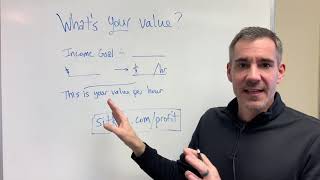
Brent Kelly shows how to calculate your hourly value: divide your annual income goal by 2,000 work hours. If you target $200,000 a year, that's $100 per hour. Any task that doesn't earn that rate is burning money.
Questions this video answers
$200,000
2,000 hours
$100 per hour
March 11, 2020
Chapters
Hi, Brent Kelly here, the Sitkins Group with my profit tip, Professional Fitness, to help you and your agency gain clarity, build consistency, and to make a commitment to become your best version possible. Well, today's tip is around the value of your time. In particular, what's your value? You know, I think oftentimes we have certain goals in mind that maybe we want to make what our earnings should be for that year, what we want our income to be. And yet we don't really stop and think about the, the things that we need to do really down to every hour that contribute to that goal. Now, let me give you an example, just something to think about. I don't know what your income goal is. It could be all over the map. That's not for me to decipher. And that's a personal thing that you need to think about. But obviously you should have some type of income goal. What is you want to make in a particular year, what you want to earn. Now, it may depend whether you're on a salary or have salary plus commissions or commissions. I get all that as well. But let's just kind of take a look at an example here that I could share with you, let's say, for an example, and I want to keep math easy for my sake today in this video. But let's say, for example, that you have a goal to make $200,000 this year. Now, for some of you, that may seem like a ton of money. For others, it may not be nearly enough. So let's just use $200,000. Well, how do we figure out what that really looks like per hour? What do you really, what do you need to contribute? What's the value you need to provide per hour during your work time to get to $200,000? Well, the easiest way to do this is simply to divide by 2000. Why? Because, and again, this is an average. You may be higher, you may be lower, I get that. But 2000 is about how many work hours we typically see in an average American work year. So just take that for a basic example. We can take 2,000 hours. We divide our income goal by that. We know that in this particular example, again, I like easy math. That's why I use this. That to make $200,000, your value per hour must be $100 per hour. So this begs the question. This begs the question, if you want to make $200,000, which breaks down to about $100 per hour, what are you doing every work hour that's contributing, and what makes you worth $100 per hour. Now, we work a lot with insurance producers, and we see this frequently. They're doing things that aren't producing $100 per hour work. Now, obviously, when you close a big sale, you may make a lot more, but the practice, the preparation, the communication, all the things that go into that contribute to earning $100 an hour, whatever your role of responsibility is, I just want you to take a second to think about what is your value per hour, and are you doing things each and every day that contribute to that value? Are you doing just busy, crazy stuff? Are you getting caught up in distractions both internally and or externally, not doing the real work you need to do? Because here's the best example. I had someone tell me, imagine this is just using this case. Imagine that you started the year and I said, what's your goal? You say, $200,000. I say, great, here's the deal. I'm going to give you $200,000 right now. Now you have $200,000 for the year. Congratulations. You just earned that. However, this is a big however. Every hour that you're doing unproductive stuff while you should be doing work stuff, I am going to burn $100 or I'm going to take it from you. I'm going to rip it up, and by the end of the year, we'll see what you have left. See, oftentimes, certainly if you're in a commission type of position, we get to the end of the year and we go, man, you know, I really wanted to earn or do this, but I only got to that. A big part of that is all these individual hours throughout the year that we're not doing the things that actually contribute to you earning your ultimate goal of getting whatever your personal income goal is for that year. So just take some time to think today, tomorrow, next week, and beyond. What is your income goal? What does that look like per hour? And is the work you're doing worth the value? Are you providing the value needed to earn your final income goal for the year?