Producer Pipeline Development
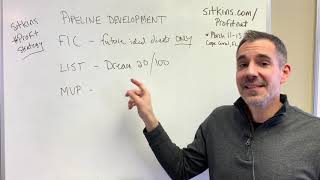
Brent Kelly explains how insurance producers should build pipelines of future ideal clients instead of generic prospects, using a metric called MVP (monetized value of pipeline) to track potential commission adjusted for conversion rates. He recommends keeping MVP at roughly twice your annual goal and maintaining visible target lists like Dream20 or Dream100.
Questions this video answers
Monetized value of the pipeline.
March 11–13.
Chapters
Hi, Brent Kelly here of the Sitkins Group with my Profit Tech Professional Fitness to help your agency gain clarity, build consistency, and to make a commitment to become your best version possible. Well, over the past many weeks, I've been going through some of our core strategies, our pro fit strategies that we are fundamental to what we teach and preach at Sitkins. And today I have number six, our sixth core strategy, our profit strategy around pipeline development. I'm going to talk about some key areas within pipeline development that may be a little bit unique in some areas and some things maybe you've heard before. But I'm going to talk about it probably in some different ways that maybe you haven't thought about before. Before I get into that, I do want to make reference to our Profit Net event. Again, if you want to be at an event at a place where there are smart, committed insurance agency leaders discussing key issues and not just ideas, but execution of ideas, come visit us at Profit Net. This is the last time that this will be open to the public. After that, only for our private client members. So if you want to learn more, be part of something pretty incredible, make sure you check that out that I have on the whiteboard there above me. All right, pipeline development. Let's talk about pipeline development. You know, one of the things that I see oftentimes with insurance agencies, and this was really going to be a shocker to you, is that most agencies and producers have a pipeline that's pretty empty or at least meager or maybe at best average. And so our goal pipeline development is we want to help agencies and producers like yourself have more opportunities than time, that you've got more opportunities with the right clients or future clients than you do time. Well, how do you do that? Well, I think there's some things that I want to share here in my tip. And again, I can't get to everything, but hit some of the highlights that maybe again, a little bit of a change or a different thought than what you've seen or heard before. The first is this idea of fic. And I already used the term, but it's future ideal clients. Future ideal clients. And I'll make an extra mark here only. Right. We really want to stop using the concept in the term of suspects or prospects. You know, if you fog a mirror, you're worth talking to. You know, if you have a pulse and you have a checkbook, we've got a chance to talk. Because you never know, you might get lucky. See, having a full pipeline does many things. Obviously it gives you more opportunities to Talk to people and to make more money, but also gives you something called WAP, or walk away power. When you've got a pipeline filled with future ideal clients that you've targeted, when you have an opportunity with someone, you go, you know, I don't think this is going to be a great fit. I can tell they're using me. I can tell we don't have the right capabilities to help them. Then we have the opportunity to say, you know, I don't think this is going to be a fit. We're going to walk away. And you can say that in many different ways. But having a pipeline full with future ideal clients gives you walk away power. What are some characteristics of future ideal clients? What are some ways that you can begin to identify them for your agency? Because it's certainly a huge issue. Well, one of the things that we look at, we talk a lot at Sidkins, is about 80, 20, that 20% of your clients produce 80% of your revenue. So if you've never really identified future ideal clients, one of the first things you could do, and the easiest thing is to look at who you currently have. Who are your current best clients? What are some key commonalities that you see between those clients? Maybe it's a certain niche, maybe it's type of demographic, maybe it's, you know, it could be a number of different things by the carrier you work with and some of the things that they do. So what are some of those characteristics on a future ideal client? Secondly, I really believe the days of the proud generalist are coming to an end. And if you're an agency that we're a full service agency, we do everything. We do all things for all people. That's what makes us unique. You can do okay, you can do okay. And actually maybe you can do pretty good. But to really get to the highest level, you really have to understand specifically who and how you're going to specialize, how you're going to become the expert. One of the programs that we offer is an elite mastery program. Those agents and producers that have gone through our producer camp have an opportunity to go to our elite level. And we had 30 producers in our elite camp this fall. 28 out of the 30 producers in that camp. 20 out of 30 had a defined specialty or a niche. They could talk about it, they could name it. Their book of business was around that. And these are producers have books of business between a half million and $4 million in commission revenue. They're doing okay, right? And just think about specialists for a second who gets paid more? The specialist in a heart specialist or a family practitioner? It doesn't mean the family practitioner doesn't have value. They do. But to get to the highest level, we've really got to specialize that we can understand what's in it for the client. Because here's the deal. They expect you to understand insurance, it's your job. But they're really surprised and impressed when you can ask the right questions, when you can position yourself differently, when you have inside knowledge and expertise of their business, are what they do, what they value, how you can impact their profitability, their clientele, their employees. And that's by identifying future ideal client. Next is actually have a list. Now, this is a big challenge. We have agencies that will do a Dream 100 board. We have producers that will do a Dream 20 board. You can make it whatever number you want. We find that 20 is a great number, but actually have a list. I'll go ahead and write this down. But what if you as a producer had a Dream20 or as an agency, a Dream100 list that you actually have them named so that everybody can see it, or as a producer, it's visible to you. Just like on this board I've got, you know, I'd have names of potential future ideal clients that I could identify and see and think, what do I need to do? And within this, we actually have a tool with our private clients that we use called a target account strategy plan. So not only going to name who they are and list them, but we're going to create a strategy plan around each and every one of them. Who's the current carrier? What are the influencers? What's the next step we're going to take? What are our competitive advantages? What do we need to know? All those kind of things. We've got a whole checklist around that that you can write out so that you really get specific on your future ideal client. And again, visible and using a list is really important to building a pipeline that's not just a database of hope, as I've called it. I got a bunch of names, but actually a future ideal client list with power that gives you direction. And last thing I want to share is this. People ask, well, how do you measure a pipeline? How do I know if my pipeline is full? Besides, you know, because some people make up, you know, you should have 50 people in your pipeline. Well, here they go. I wrote down 50 names. Well, that's not a full pipeline. You just again, have a list, just a basic list of hope not A list of a dream 20 or 100 that you're actually saying, here's what we're doing. So. So MVP stands for monetized value of your pipeline. And I don't want to make this complicated, so if I lose you here, I apologize. But it is important because one of the things to say is, how do I know if my pipeline is full? Well, first of all, you have to know your annual goal as a producer. In particular, what's your annual goal? What do you want to earn this year? What does it look like? So you got to have that idea obviously, first. But let's just say, for example, I'm just going to make up numbers here. Let's say that if you look at your actual list, not just a database of numbers and hope, but actual list of. Here are future ideal clients I've identified and I'm tactically working on, but I'm having some type of conversations and strategies around. And let's say you look at your total size of all the revenue in those clients, you have $500,000 of commission revenue, potential commission revenue within your list, right? Specific list that you have. Now, the next question you have to ask yourself is, and most agencies and producers don't track this, but you want to kind of go back and look at it if you don't and say, how many of last year, first appointments that I had? So we call these executive briefings. But first appointments that you had, you sat down, you had an initial conversation with someone actually led to a second appointment. So you asked some questions, just basic questions. You told your story a little bit, and they said, let's go on and have further discussions. Now, obviously, I know in some small commercial and personal lines, this may all happen at one time, but for commercial lines in particular, we have something called a conversion rate, which is first appointments to second appointments. So that's something you need to track because it makes a difference in understanding is your pipeline full? So let's say that your conversion ratio, first appointment to second appointment was 50%, meaning half those people you saw on a first appointment, you actually had a second appointment, further appointments with. So this means that right now your actual monetized value of the pipeline is 250,000. Right? Because you're only converting 50% of those, then we need to understand our closing ratio. What is our actual closing ratio? How many presentations do we give? We're actually having a conversation about, here's our presentation. You may call it a quote, but a presentation that we give that they say, yes, we want to be your client. And let's just say, for example, in this instance, to make numbers easy, it's also 50%. So now when we look at if you want to measure a monetized value of the pipeline, in this particular example that I gave, the monetized value of the pipeline would be $125,000. Well, what does this number mean? Why is that important? What we found is that this number should be always two times your annual goal, right? So two times your annual goal should be that. So in this case, again, simplified, if your annual goal was 60,000 or 50,000, you're doing great. If your goal was 75,000, you're a little short, right? Just to give you perspective, and I just use very basic numbers for you to see, but this allows you to actually be honest with yourself and where you're at. Obviously, the higher your conversion ratio and closing ratio are, this number can be smaller and you can still attain that. But again, the point is not just to put in numbers, just to fill something in, but to really, as a producer and agency, go, where are we really at? And is your pipeline truly full? So future ideal client pipeline, not suspects or prospects, make an actual list, not just a database of hope, but a list, and have some type of plan around that and understand, is your pipeline full? By using the monetized value of a pipeline. These are some things that we teach. We go way deep in this with our private clients and our producer camp as we continue to work with them. But I want to share some of this with you today on one of our profit strategies, again, March 11th through 13th. If this makes sense to you and you want to go deeper in some of these areas, these are things that we work with you specifically in this mastermind event, March 11th to 13th. Hope to see you then. All the best in your success.
More from Roger

This Shift Helped Us Unlock Growth 💡 | Agency Leadership Tips #insuranceagency #agencygrowth





How AI Can Help Insurance Agency Owners Master Their Financials (Without Being a CFO)

From AI Hype to Real Results: Steve Anderson on How Insurance Agencies Can Use AI to Grow Now



