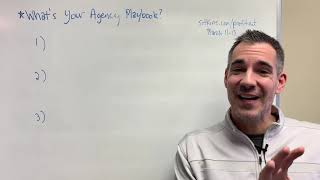
Brett Kelly of the Sitkins Group presents the final (7th) profit-core strategy: building a replicable agency selling system or playbook. He proposes a three-part framework—Prepare (strategic readiness: ideal-client targeting, sales/service handoffs, differentiation), Play (engagement process: executive briefing, deep discovery, solution presentation, using the Risk Concierge approach), and Stay (client retention: relationship management, promise reports, exit barriers)—and urges agencies to codify and practice a set offense rather than "winging it." He also briefly promotes Sitkins' Profit Net event (Coral, Florida, March 11–13) and offers help via sitkins.com.
Chapters
Hi, Brett Kelly here, the Sitkins Group with my profit tip professional fitness to help your agency gain clarity, to build consistency and to make that commitment to become your best version possible. Well, this is number seven of seven. I've gone through the Sitkins profit core strategies over the past several weeks here on these videos and this is the final one. I'm going to be talking about an agency selling system or agency way of doing business. Before I get into that, I do want to reference for the last time here as time is running short, our profit net. So Coral, Florida, March 11th to the 13th profit net. We've got high level speakers and coaches and most importantly, we're going to have other agency leaders, professionals like yourself there to become their best version possible. There's nothing like peer to peer interaction and we're going to set you up in mastermind tables throughout to help you turn ideas into actual tangible execution. There's a big difference between ideas and execution and we're going to dive deep into that in profit net. So go to that website if you'd like to learn more. Like I mentioned, there's still some spots but time is definitely running out. So let's talk about core strategy number seven. This is an agency selling system or agency selling process or agency way of doing business. You could factor this in a number of different ways. But here's the question I want to ask you, and I ask many agency leaders across the country, is what is your agency playbook? What is the playbook you use to run your set offense in your agency? And by the way, your set offense goes into continuations and renewals as well. But what are you doing to build your agency offense? Could you imagine for a sports team of any kind? Certainly a team sport. And there's absolutely no set offense. Everyone just goes out in the field or the court or the rink or whatever it is and they say just go get it right. It's a true pickup game. Now, by the way, if you have enough talented people, you're probably actually going to sneak a few wins out there just on pure talent alone. If you have talent. But can you replicate winging it? Can you replicate winging it? Well, the answer is of course no. Every great agency, and there's not many out there that do this at a high level, have a true set offense that can be replicated. Now we're going to have flexibility within that. We've got different personalities, different people within that, but we've got to have a true set offense that our agency can understand, that we can understand the mission, the vision, the critical success factors and, and to be able to teach and to replicate this. So I want to go through three basic areas, high level areas that we teach and then give a little context around each one of those to help you as an agency leader. The first one is this. The first step of an agency playbook is simply to prepare. Now this may seem obvious, and I've talked about some of these things before, but I will tell you, the majority of agencies don't really prepare, at least not strategically, how they want to conduct business. If you've been watching my previous videos, I've talked about certain areas, whether it's buying back time. So preparing to understand that we have got to have a true sales service handoff, that we've got to put our sales and our service teams in unique roles, we have to prepare to do that, that we have to understand the power of 80 20, that we're working with the right clients, that we've identified future ideal clients, specifically who they are, what they're looking for, and having a targeted account strategy plan around all of those. That we have points of differentiation in our agency, that we really know how we are different, that we can ask questions around that and show evidence. Those are just a few examples of many that agencies need to do to prepare to go play the game at the highest level. As you can imagine, to go on with my sports analogy, most teams, not only great teams, have a set offense, but they practice and prepare that set offense before they go out on the court or the field or the rink. So how are you doing? What is your agency doing to prepare to go play the game of insurance and risk management at the highest level? Number two is actually getting on the court, the rink, the field, whatever it is. Right. In our case, it's getting in front of our future ideal clients and clients and playing the game at the highest level. Now, most agencies kind of just show up, they throw up and they blow up. That's the strategy for many agencies out there, is we just kind of go out and wing it. But as I said earlier, can you replicate winging it? Well, no. And your agency may have a few talented individuals that can get by with some of that. But from agency growth to really be a vertical acceleration agency, we've got to have a game plan around how we're going to play the game. Now here's just three quick things that I'll share with you. Number one, I believe when you're going to play the game, you should have some type of executive briefing. If you're meeting with a future ideal client. You've got to help teach them and help them understand what is the purpose of this meeting or what is the process that we have that's unique and different and what's the payoff, how do you win? And at the end of the day, the first meeting is pretty much around play. Is, is there a fit? Do we want to continue to have further conversations going forward? Now, this may all happen in the same meeting, depending on the size of the account you're working on, but especially if you're working for larger accounts. The first meeting is just to determine is there a fit. The second part is to actually do a deep discovery. This is where you're actually a risk advisor versus just a transaction person out there in the marketplace. We've got a complete system called the Risk Concierge program that we teach and train around with our private client members. But to really understand what are the unique and compelling things that you do, ask questions around those and ultimately allow the insurance future ideal client to design a program that they get to buy from you. Now think about that for a second. Is that powerful? Well, yeah, it is. And again, if you have an actual system in there of how you're going to do that and it changed the dynamic and from beginning to end you look and sound different. And lastly, it's just a presentation of solutions. You've helped them by asking questions, design the program. Now you're going to give solutions. What's the impact at this point? They're going to go, wow, that was so important to me. I can't believe you brought that up. Well, any great agency or any great producer would say, well, I didn't bring it up, you did. I'm just giving you what you asked for. So again, the play section is critical around executive briefing, a discovery session and a presentation of solution. Again, we dive very deep with our private clients in these areas and actually have a proprietary system that we help teach around. The last part is stay. Right. So prepare, play and stay. The idea is now we've worked so hard to acquire a new client. What are the things that we're doing to have them stay not just for a year or two, but be a lifetime client. Now, there's a video I did recently on exit barriers. That's a big part of that. So making sure they're full time clients only to make sure that we do have a formalized relationship management program, that we have a true continuation process that talks about defining, always defining and redefining what they want. What they ask for, to document, to put that in writing, to say here's what you said and of course deliver, which we call a promise report. Here's what you wanted, here's what we wrote down, here's what we actually did. We promised this to you. Are we delivering? And then of course talking about market conditions and how we're going to move forward. Our goal and stay is to make the renewal a non event. Too many insurance agencies out there with their clients. Every time the renewal comes up we get all freaked out. Now don't get me wrong, that's going to happen time to time. Not every renewal situation is a perfect event. But our philosophy and our mindset at Sitkins is not to have a renewal but to continue a relationship. And that starts from preparing to play all the way through stay that we have a coherent process that works for long time clients. That is an agency playbook. My question to you is what's your agency playbook? We'd love to talk to you at Sitkins if we can help you in any way. If you have questions, we'd love to learn more about your agency to see if there's a fit and us working with you at some point down the road. So Visit us@sitkins.com I wish you all the best in your success.