The Five Biggest Mistakes Agency CEOs Make
Brent Kelly and Roger Sitkins break down five mistakes agency CEOs make: treating busyness as success, ignoring top clients, lacking differentiation, underinvesting in training (0.4% vs. industry standard 2%), and skipping strategic planning. EHD Insurance generated $1,014,000 in new business using broker record letters.
Questions this video answers
September 28, 2020.
$997 (standard price quoted as $1,997).
Five live virtual sessions, 90 minutes each.
$1,014,000 in new business revenue.
168 hours per week (7 days × 24 hours).
Chapters
Haven't made it yet. You're good to go. All right. We're good to go. Well, hey, a huge welcome to all of you and again, appreciate you for those you have your camera on to say hello at this point, if you want to turn them off, you're welcome to do so. Roger and I will be doing that, the presenting, although we will be interactive today and asking you some questions. My name is Brent Kelly. If you don't know me, many of you don't. I am the vice president here at the Sitkins Group, and I just want to officially welcome everyone I know, Roger, along with myself. We can't wait to share all these ideas that we're going to talk about and help you avoid some of these costly mistakes, mistakes that we see in your agency and also provide you some resources and ideas to help you address them. And, you know, one thing that I know and obviously familiar faces on the webinar here today is that I have no doubt this is not the first workshop or webinar or training you've attended to help improve the quality of your agency. We appreciate you being here because we know you want to get better, and we certainly. I know, on behalf of Roger, we applaud you for that. Just a quick note of this. These are not just the only five mistakes that insurance agency leaders make. Okay. As CEOs, you know, I think I've already made four or five mistakes since I've been in the office today. We all make mistakes, but these are the mistakes that we see that have been the most impactful. Right. And probably the most common in a lot of insurance agencies. I mentioned. I make mistakes. We all have frustrations. Sometimes we look like this guy. And I know I get the opportunity to talk to leaders every day just like yourself. And I know that you have frustrations. We all do. So I want to start off just by asking questions to get to know you a little better and maybe where you're coming from into this workshop. If I had to ask you, what is your top frustration or your main frustration as an agency leader, what would it be? So, just going to give you a second. There's a little chat feature. Some of you are very familiar now with zoom, but if not, there's a little chat box you click. Click on chat. If you could just type in your top or main frustration that you're dealing with right now. I'm going to give you a few seconds. I'm going to walk over to my other monitors so I can read some of them. So I'll Be back in a second. But just type in your main or top frustration. I want to hear from you. And this will be interactive. So type in your main frustration. If you don't have a frustration, if you have no frustrations, that things are really good for you, I. All right, let's listen. Time management. All right, good. Greg, we're going to talk about time management to a degree. Mike said the same thing. Jonathan, finding good help. Matthew mentioned recruiting the best people. That's a huge one. Accountability from Neil Young. Obviously, we're going to talk about some accountability today and some other things. So here's another one. Top frustration, more of a pain point just started, just started in June. So welcome. Hey, you're a new person here on the line. So, again, many frustrations and they vary. Here's the bottom line. We all have frustrations, right? And I always ask this question in many of our trainings, what's your biggest challenge? What's your biggest obstacle? What's your greatest frustration? And I may get some similarities, but, you know, they can vary as well. The bottom line is this. We all get trapped, right, in different areas, whatever. Our frustration is what we really want. And when I talk to agency leaders, what they really want, typically at the end of the day is this. William Wallace said, I want freedom, Right? You want freedom. Now, you may define freedom a little bit differently than other people, but we want to live and we want to work without constraint. That is really what freedom is. So the next question is how, how can you reduce these frustrations? How do you avoid some of the common, the biggest mistakes that we see that really focus your time, focus your attention, focus your energy on the right things, the most important objectives and in the most productive areas. That's what we're going to talk about today. Now, real quickly, we always believe in telling the purpose of, of why we do anything. Well, the purpose of this workshop today is twofold. Number one is we want to address these five mistakes, obviously, that we've talked about. And number two is I want to help you share a way or share away. We will together share a way to move from ideas to true execution so that you can gain the freedom and the results that you really want. So here's my next thing in the chat box if you are ready to go and dive in. Now, we don't have a worksheet for this per se, but hopefully you've got a pen and paper. If you get a pen and paper ready, if you've got all the other stuff turned off right on your computers, I know the digital world. It's easy to have email open and this open. If you're ready to go, type in let's go because we're excited to share some information. So type in go or let's go. I want to know that you're listening, that you're ready to play the game hard, and that we're going to have some great. Have a great time together the next 45 minutes or so. So. Okay, we got some. Go, go, go, go. Let's go, let's go. All right, well, I now have the privilege formally introducing someone who has truly impacted the lives of thousands, I mean, literally thousands of insurance professionals across the country and in the world. And obviously, some of you already said hi to Roger as he popped on. Really? Already? Before he officially got started. This is actually a picture recently of Roger and myself doing a private training for one of our best members. By the way, I'm going to mention them or refer to them a little bit later, but if you know Sitkins at all, we love acronyms. This was a fun picture because this agency actually took all the acronyms and then kind of gave them back to us, and they presented a whole acronym chart to us. But Roger is just a great leader. And here's the one thing I'll share with Roger that's most important and why you should listen to what Roger has to say is he has a heart for insurance professionals. He truly has a heart for insurance leaders. And we sit down and talk, it's how can we add value? What can I do to share in my now almost 40 years of learning that will have the greatest impact on agency leaders like yourself? So, without further ado, I'm going to formally introduce my mentor, my friend, Roger Sitkins. Roger, over to you.
Thanks, Brent. And again, officially, a great welcome to all of you. You know, if you only remember one thing from our session today, just one thing. If you only remember one thing, it's pretty simple, that mistakes left unattended will become a crisis. I want you to write that down. Mistakes left unattended can become a crisis. And. And something I learned recently that I really love, this quote, you see it here on the tv, that mistakes have the power to turn you into something better than you were before. So two things to write down. Number one, mistake left unattended becomes a crisis. And number two, mistakes have the power to turn you into something better than you were before. But there's a filter on that, and the filter is that you don't repeat the mistake. And that's What I see all too often is we have a mistake because it's such a great business. We can get away from it, we can go around that it's not that big a deal. But eventually they all add in. So mistakes have the power to turn us into something better than we were before, as long as we don't repeat them. Several years ago now, three, almost four years ago, Brett and I were preparing for a CEO camp that we were doing, and we're having it in Atlanta. And we're big believers in relentless preparation. We preach it and we actually do it. And we were sitting together the day before and we were going through all of our presentations and we were doing our low risk practice, something I hope your agency does. And Brett asked me a question that really went to my soul. He said, roger, if one of the agency CEOs comes up to you tomorrow and says, what's the best version possible of an agency? How would you respond? Again he says, what's the best version possible? Well, I started pontificating primarily around clarity, consistency and commitment. The three Cs we talk about clarity, consistency, and commitment. And then I went into a bunch of the strategies, et cetera. And so it gave us a foundation to make sure we were touching on the key issues. But for some reason, that question wouldn't leave me. See, the brain has a hard time ignoring a great question. And that night, I literally couldn't sleep. I kept thinking, best version possible. What is it? How can I define it? How can I use that as a tool to serve the agency CEOs we work with at even a deeper level, help them understand more? Well, right at three in the morning, I finally just got up and I got on my iPad and I Googled best version possible. And I ran across a whole bunch of comments about it. I thought it was pretty interesting. But the one that stuck out at me the most was from a Canadian songwriter, Chris Assad. And he said this, he said, close your eyes and imagine the best version of you possible. That's who you really are. And you've got to eliminate anything that's holding you back from that. Okay? So I want you to think for a minute about your agency. And if you're not driving, okay, please do this with me, but just close your eyes and imagine the best version possible of your agency. That's what you really want it to become. It's the things you think about when maybe you're having trouble sleeping. You lay there, you've got some issues going on, and you start thinking about what is the best version, because I know I haven't maximized it yet. What is the best version? So, again, close your eyes and imagine the best version possible of your agency. That's what you really can become. But you've got to eliminate obstacles. You've got to eliminate mistakes. And so what we're going to be sharing with you today, as Brent already mentioned, is five of the biggest mistakes we see. They're not the only ones, and they may not all apply to all of you, but I'll bet there are two or three that are maybe negatively impacting or certainly keeping you away from your best version possible. Away from your best version possible. Okay. As we come out of COVID and we certainly all hope and pray every day that we do come out of it, that the economy continues to come back, things are going well. Certainly there's a new norm. You know, who would have thought that four, five, six months ago, seven months ago that we'd be doing so many zoom things? We've actually had all over 500 people now attend some of our training programs through the zoom format. So we're doing really well. Some of you have already been involved with it. Our great friend Tim Menaka certainly has. But as we come out of this, we know there are going to be two types of agencies. And I want you to think about yourself. There will be pretenders, and there will be performers. The pretenders are going to say, well, okay, we got out of it and everything's fine. And hope is still my strategy. And I hope things work out here, and I hope things work out there. And they think that things are going to go back to normal. No, they're not. No, they're not. This is a time where the best agencies are going to be the performers. They're going to come out of this. They're going to right size their organization. They're going to do the things that will take them to the highest and best version of their agency. I want you to write this one down. This is something I read just this over this weekend, and it really stuck home with me. It said, stop being the reason you don't accomplish more. So I changed it. And I want to look at you and your agency as the CEO, as an agency leader. Stop being the reason your agency doesn't accomplish more. It all starts with leadership, and leaders know the things that are holding them back, and they eliminate them. So that's what we're going to be talking about today. Brett, back to you.
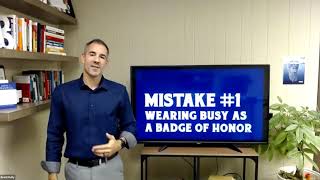
All right, so let's dive into the five mistakes and the first thing that I'm going to do is just do a quick overview of all five of them. And as I mentioned earlier, hopefully you've got a pen and paper or something you can write with to jot these down. And again, these mistakes may all impact you differently. Some may have a huge impact on your agency, have been really holding you back from that best version that Roger talked about. Some may not be a big deal. And as I mentioned also earlier, these aren't the only ones, but these are the ones that, as Roger and I talked and prepared for this workshop, we say, you know, if there were five things that really stood out, that mistakes, but that mistakes that agency leaders make, these are the ones that really stand out. So I'm going to go through these briefly and then we'll dive deeper in each one of them. The first one is this is making busy a badge of honor. So we'll talk about making busy a badge of honor. What does that mean? Number two is Ryder's going to talk about this idea of ignoring the power of Pareto. Some of you have heard about Pareto. Some of you, this may be a newer concept. Then we're going to talk about this idea that you can replicate average. A mistake that we see agencies make is they replicate average in their agency. And I'll talk about what that means in terms of pipelines and differentiation. Then we'll get into this idea, this mistake of stepping over dollars to pick up dimes. Roger's going to talk to you about the greatest investment that you can make in your agency. And then we'll talk lastly about this concept of running the wrong way enthusiastically. Does your agency have a clear defined strategic plan? So I know I went through those quickly, but now I'm going to go through each one of these. We're all going to go through each one of these in greater detail. So let's start with mistake number one. So again, hopefully you're taking notes and ready to lean into this. Mistake number one is wearing busy as a badge of honor. You know, I know things have obviously changed dramatically since March, you know, with COVID for many of us. But if you ask most insurance professionals and agency leaders just in general terms or ask any human being, how are things going? What's going on? The common response is busy, I'm busy. I'm busy right now. We all have distractions. We're busy for different things. But the idea is that busy. The idea of busy is not a badge of honor. I want you to write this down somewhere that this is so impactful that time, right? And some of you mentioned earlier, frustration is time management. Time is your only diminishing asset. Time is our only diminishing asset. You can get back money, you can get back things, in many cases, you can even restore some relationships, but you can never get back your time. And that's why it's so important, not just to protect it, but to invest it properly at all costs. And unfortunately, the mistake that too many agency leaders and agencies make is they just kind of were busy as a badge of honor and not focused as much on results. Here's something to consider that most people misunderstand about time. You can't manage it. Some of you put time management, here's the bottom line. You, me, Roger, anybody else, we all have 168 hours in every week. We have seven days a week, 24 hours a day, 168 hours. In fact, the idea of time management was created back in the 19th century on mass production lines, right? It's just about managing time each and everything. But we live in the information age, we live in the digital age. We know that the power of knowledge and actually applied knowledge is true power. So we can't manage time, but we can manage our situations. We can manage our energy and activity based agencies that we see that we're busy as a badge of honor. Every year is kind of the same, every quarter pretty much the same. It's that definition of insanity just doing the same thing and expecting a different result. So I want to share with you and throughout this workshop we're going to share stories of agencies that we work very closely with just to give you a better understanding. One of our top partner agencies is EHD Insurance in Pennsylvania. They began to work with us in 2018. Here's a picture of their leadership team and their focus was to, like many agencies, probably like yourself, was to increase their organic sales growth. And you know, while there are several areas of sales and leadership that we've addressed together in our partnership, the top issue was based around establishing high performance teams and this idea of producer productivity where sales and service were focused on their specific roles and responsibilities. And just to move from this idea of are we an activity based agency to a results based agency. I want to share with this and Kristi, you could make this full screen as well if you would. Some of our coaching that we've talked about with them. We together design and they came out with this, but with our help, this best version pyramid just for their insurance producers.
Right?
One aspect of the agency and this idea and this foundation was are we results based on, are we activity based? Now I'm not going to go through all 11 of these. You can see these on your screen. This was again customized to them and to their specific agency. But the bottom line and where I really want to focus is actually at the top. Right? The bottom line is the top on this is that we have to understand that we've got to move from activities to results. The first thing is this, leaders lead. And if you lead based on activities, you're going to get activity based stuff. If you lead based on results around personal accountability, EHD did, you'll get results based stuff. Right? So what are you going to focus on? Where are you going to focus at? And think about ehd, which was really exciting. And I'll challenge each and every one of you listening. It's not just talking the talk. You can come up with graphs like this or pyramid. Those are important, impactful, but it's about walking the walk. And that's what makes them and agencies like EHD different. Because one of the most important metrics just to focus on results and activities is a metric called tss. May want to write that down. Tss, which is time spent selling. Time spent selling. And the biggest thing that we see with agencies, the mistake they make in activities versus results is that they have part time producers.
Right?
We have part time producers. Why? Well, they're caught up in all kinds of things. Right. So it's a really important metric to measure and just to give you an example of results in 2019. So last year EHD had incredible success with intense focus on results. Now there are a lot of different results I can share with you, but I want to share with one that is just, it's so impactful. It's, it's really incredible what they did 2019, they wrote $1,014,000 in new business just on broker or agent or record letters alone. Just broker record letters alone. That's it. 1,014,000 in new business revenue. Well, how did they do that? Because they got really intentional about what constitutes a result versus what is just busy. And the cool thing, even amidst the COVID pandemic that we're all living through right now, so far in 2020, they are on the exact same pace. Right. So mistake number one is wearing busy as a badge of honor. Roger, over to mistake number two.
Mistake number two is ignoring the power of Pareto, the 8020 rule. Pareto's principle, I'm sure you've all heard it to one degree or another. It Impacts every one of us every single day. Because there is a predictable imbalance in the universe. Basically, 20% of our efforts get us 80% of our results. Twenty percent of what we do gets us 80% of our results. 20% of what we do gives us 80% of our happiness. By the way, 20% of what we do in our agency gets us 80% of our results. Which of course means that 80% of it might be just some hysterical activity on the way to the grave. Hog, as we call it, H A W G. Hysterical activity on the way to the grave versus focusing like EHD did and generate a million dollars of new commission income just on bors. And by the way, that wasn't all their growth. And we don't even teach going for a bor. A BOR is a natural outcome of an agency's selling system where leaders lead how they differentiate in the marketplace. And Brent's going to talk about that even more. The 8020 rule. And a lot of you have seen this with me before, but what have you really done with it? Okay, here's what we know. The A accounts in your agency, the top 5% of the customers will be 50% of your revenue. Now, I want to stop you for a second if you're new with us. Every time I've delivered this, and I've delivered this topic 5, 6, 7, 800 times, maybe a thousand, and I've done thousands and thousands of studies on agencies and producers, books of business, and every time I'll get somebody that they're thinking, and some of you are probably thinking, well, that's not us. We're different. I'm sorry again, there's a predictable imbalance in the universe. This is real. The top 5% of the customers are 50% of the revenue. That means the other 95% of the customers generate the remaining 50% of the revenue. How does that break down? Well, the B customers, the middle 15% are 30%. So the top 20% are 80% of the revenues. Gee, what a surprise. But it also means that the bottom 80% of the customers are only 20% of the revenue. Now, how does this impact you as an agency? Well, number one, I think you're very vulnerable. If you lost the top 5% of your customers, what happened to your agency? Do you know that the. Not just the A's, but as we call them, the super a's, the top 2% of the customers in the average agency are a third of their revenue. So you could have 2% of your customers lose a 30 year revenue, you could be out of business. You could be out of business, or certainly you'd be dramatically impacted. If you don't know your numbers, if you don't do anything else from this other than remember that mistakes left unintended become a crisis. If you don't remember anything else, it's go do your 80, 20 and figure out what's really going on in your agency. Because what we see is the average agency, every year they replicate the same footprint. Brent's going to talk about that too. But their agency as a model never really changes. And what happens is they get into what we call horizontal stagnation. Horizontal stagnation. And here's what it looks like. If you look at their revenue year after year after year, they're on a pace of pretty average growth. You know, the 3, 4, 5, maybe 6% growth that we see that the average agency has. All right? The problem with it is that their average customer size never really changes. And I'll share one thing I learned a million years ago, one of tens of thousands of things, is that the size of your agency will always be driven by your average customer size. It's really that simple. So when you look at your agency, just ask yourself this question. The direction my agency is going today, is that really the desired destination where I want to wind up? Look at your agency three years ago, where it is today, and say, if I stay on that same path, where will I be the next three years, five years, 10 years? Your direction and your destination, your desired destination have to match up. But again, if your number of customers, your average customer size stays the same, you're just going to keep bumping along as you have in the past. Now, vertical acceleration that we talk about with the agencies we work with. And when the owners buy into this and understand how to do it, they know the behaviors and strategies that make a huge difference. The agencies and the individual producers will look like this. They'll go along, they'll be replicating, kind of just doing the same old things. But all of a sudden one day they realize, you know what? I've got to dramatically impact my average customer size. I've got to take my game up several levels. And what happens is the number of customers stops, starts dropping dramatically. Starts dropping dramatically. And the difference in these charts here is pretty simple. It's your average customer size. We say this all the time. You're leading an agency. And I certainly would hope that every one of your producers would become, at a minimum, a million dollar producer. A million dollar producer. You can't be a million dollar producer. You can't have million dollar producers if they're writing thousand dollar accounts. Why? Because they can't handle a thousand customers. So start challenging yourself on Prado's principle. Is it real? For me, one of the agencies that we worked with about three, four years ago, another one where they're one of our network members, we did a private camp for them. They're a great agency. They're 6, $7 million of commission income at that time, but they were going along at only a 3% growth rate. Just using the power of preto and thinking, you know, we're going to replicate something. You might want to even write this down. You're going to replicate something in your agency. As a leader, what do you want to replicate? Well, this is at the end of the final training program we did with them. It's a leadership team, myself who were in basically an agreement huddle where we're all buying in. We're getting ready to break the huddle. Within nine months, they went from 3% to, to 9% growth rate. Now the average good agency rate now is doing pretty well. It's at about a 6% growth rate based upon the best practice study. But they went from three to nine. Nine is 50% better than six. How they used the power of Pareto. They used the power of Pareto. When we look at this, I can tell you this. The mistake that's made overall is that if you don't understand it, you're allowing profitable accounts to subsidize unprofitable accounts. Think about this. How about this one? The bottom 50% of your customers are only about 10% of your revenue. Okay, you don't believe it? Run the numbers. The bottom 50% of your customers are 10% or less of your revenue. That means the top 50% are 90% of your revenue. Don't allow, please don't allow profitable accounts to, to subsidize unprofitable accounts. Brent, back to you.
All right, well, let's go on to mistake number three, a little deeper in kind of what Roger said and this idea of replicating average. What I mean by replicating average, there's a lot of agencies that they replicate the stuff that isn't that great yet some of the things that they've done really well or could do really well, they kind of forget or put off. And so let's talk about that in a little deeper again, replicating average. Let me ask you just a question. Obviously I've got all these apples up here. Have you Ever heard any one of these type of phrases? Right. Can I get a free quote? I'm looking to keep my current agent honest. Or of course, the one representing this image here is, could you provide me an apples to apples quote? Right. I'm sure you've heard that many insurance agency leaders and producers have heard that. But all these phrases have one common theme. It means simply that you have little differentiation in the marketplace. You're not really an insurance advisor. You're really more of a commodity that looks kind of like everybody else there in the marketplace. And here's the frustrating part, and this is the huge mistake of replicating average, is that most agencies, if you look across the board, most agencies gladly offer a free quote or do unpaid consulting, and they never even think twice about it. Yeah, we can share this with you. Yeah, we can give you a free quote. Here's something I want you to think about. And this, worth writing down certainly on your sheet, is that you can't have a differentiated sales process. You can't have a differentiated any process if you don't really know how you're different. Right. The bottom line is this. We've never really taken the time, at least the mistake that I see with agency leaders really taking the time to understand what does make our agency different, what makes our agency different. And this is true with newer agencies, established agencies. We just got finished yesterday in one of our mastery programs, the average. This was a producer program, not an agency program, but the average producer was $1.2 million in revenue. It's a great class, a great mastery program. But even at this level, they still struggle with this. And it's a constant fine tuning and improvement. Right. That you've got to look at. You know, I get the opportunity to do a number of trainings and keynotes and workshops across the country, although it's been obviously less frequent with what's happened this year. But, you know, whenever I get a chance to be in a room like this and share some ideas, not only do I get a chance to share things, but I love to ask questions and learn from an audience. And a question that I almost always ask in my training to some point is, hey, what makes you different? Or better yet, why should I do business with you and your agency versus another agency in the marketplace? It's a pretty basic standard question, but typically after I ask that question, what really makes your agency different? I get several seconds, if not minutes, of blank stares, like, well, you know. And if I begin to hear answers, I typically hear one of five types of Responses. Now, these aren't the only responses, but these are the common responses that we see. Number one is this. Well, we're different because we provide great service. Right? Great service. What does that mean? Well, it's just. It's just great service. Number two is that, well, we can save you money. Right? One of our differentiators is that we're competitive. We can save you money. We can save you money on your insurance this year. And this is where a lot of agencies and producers default to right away. Number three, we represent all the markets. What does that mean? We're independent. Right. Let me ask you a question. Do you compete against other independent insurance agencies? Do they also have other markets? Yes. So it's true, but not very differentiated. Number four is that we're local or we've been in business a long time. It's more of a reputation or local relationship type of thing. Could it be effective? Maybe, but depends on how you leverage it. And of course, number five is my all time favorite. It's like this, this magical vortex in the universe. Suck all the best people and then put them in insurance agencies across the country. Because if you ask insurance agency leaders, typically when I'm out talking and doing trainings, it makes you. We have the best people, Brian. The best people. It's like, okay, what does that really mean? And although again, these may have some truth to them, the question you really have to ask is, are they generic or do they really differentiate yourself? Right. If you ask what those have in common is they're generic. In fact, we give them a Name, the generic 5. Some of you may have heard that before. So I have a quick question for you. Just a quick challenge. Right now. I want you to write down your number one agency differentiator. Just go ahead. What comes to mind? What makes you and your agency the number one differentiator that you have amongst all of your competition out there? Go ahead and take a second. Write it down. Now, hopefully this pops right to your mind, or you got maybe a few examples. But now that you have that written down, I guess the next question I would ask is, does that apply to the generic 5? Is it a generic differentiator or is it substantial? Does it have impact? Does it have impact? One of the things that we love to do, obviously in working with our clients is to have these conversations. One of our best clients on the east coast, this great example, they were really struggling with differentiation. We met with them a few years ago and like many agencies, they were kind of using these generic terms and generic phrases. And they were just plodding along, right? They were making some progress, but they were a little bit frustrated. And we began to work with their sales team, their service team, their leadership team, to help them move, not just mentally, but strategically from this mindset of being a vendor to a trusted risk advisor. They were challenged to think about this generic 5 and how they could go deeper. A couple of things that we helped them with and they worked really hard on, number one, is to move from just having suspects and prospects, right? It's not just generic differentiators, but generic future clients you want to work with. So moving from suspects and prospects to understanding, defining, having targeted strategies around future ideal clients. There is a difference both philosophically and strategically in how you do that. And then of course, secondly is to understand what are their five greatest points of differentiation, what's the impact and how can they share that? And I wanted to put this on the, on the screen. You can see here, they came up with a top 100 list in their agency. Now, this isn't fancy, right? This isn't digital. This is a cork board with three by five index cards. But I want to share this to you because the results, by just getting focused on differentiation when it comes to clients and how you present yourself made an absolute huge difference. Right. We went through this board with them and the result in the first year, just based on this board, right? Just this board alone was just slightly over $750,000 in commission revenue from this board alone. Why? Well, they did a number of things, but the bottom line of this is they got focused on who they want to work with, why they wanted to work with them, and what made them different. The bottom line is this. And I would challenge you to write this down if you haven't seen this before. Right. But this is really important with focus of your agency to avoid this mistake. No more practice quoting, no more unpaid consulting. It has to be a mindset and a strategy. And beyond just the 750,000 plus this agency created by having a focus board, they actually had a 29% increase, increase in 2019 in growth for their agency. Again, by getting very focused and by changing the conversation. Yes. Even with COVID you know, I truly believe that you have two choices. If you're listening right now, you have two choices moving forward. You can continue to play the transactional quote game and you can play it really hard and really fast. And I believe ultimately with what's changed in technology, you're going to be in a race to the bottom. That's option one. Or number two is you can position yourself as the point of comparison in your marketplace and go dominate. So important things to consider meeting or.
Your next sales meeting and just say, why should people do business with us? What's unique about us? I think you're going to be shocked. I think going to be shocked. Mistake number four, stepping over dollars to pick up dimes. Stepping over dollars to pick up dimes. Training magazine did a research quite several years ago now and I've seen it updated a few times. And they say that professional services firms, that's what we fall into. Professional services firms, the best ones, invest 2% of their revenue in the training and development of their teams, the training and more importantly, development. I'm not just talking about continuing education training. I'm talking about developing your people to be so much better, to be their best version possible. So you can't have the best version possible agency if it's not housed by a bunch of best version possible individuals. So I took that number and I went to the best practices study and these are the best agencies. So you can imagine the average agency is less than this. What does a best practices agency invest? 0.4% in the training and development of their people. Look at your numbers. How much are you investing in your team to get better now? Okay, we only spend 0.4%. So I guess we're making some money. I guess we're doing okay. But then we sit there and as agency principals, we wonder why our revenue per employee is so low. Well under $200,000 of revenue. Okay, we wonder why our operating profits aren't where they should be. We wonder why just the individual productivity of the team, team members, what they're handling on a workload is so low. I learned a great lesson about this several years ago. One of my best clients, one of my best friends, taught me a great lesson. That's one of the beauties of what I do. I'm dealing with successful people all the time and we're learning and sharing it's collective genius, as we refer to it, sitting talking with him and I realized that not only did he have me hired as his overall agency coach and the producer coach and sales leader coach, but he had an HR consultant, he had a PR consultant, he had health and wellness consultant, and he had a communications consultant. He had all these consultants. There were like four or five others that he dealt with. And I said to him, I said, chris, why do you have all of these consultants? I mean, you've got me. Why do you have all these others? And he looked at me very stone faced and he said, because I don't know what I don't know and I'm going to find out before my competition does. Think about that. I don't know what I don't know and I have to find out about it before my competition does. By the way, he was the first agency I ever worked with that got over $200,000 of revenue per employee. Eventually we got it up to a little over $275,000 of revenue per employee. His agency was worth a lot of money when we got it sold. When we got it sold. So I want you to just think about your agency overall. One of the quotes that I just love from Warren Buffett, he said, the best investment you can make is in yourself. The best investment you can make is in yourself. Then he added on, the more you learn, the more you earn. You might want to write that one down. The more you learn, the more you earn, you know? So let's face it, in our business, it's pretty easy to get semi successful, quite frankly. You don't have to do anything we talk about and you're going to be semi successful. I kid around with people all the time at our CEO programs. How many of you are making more money than you thought you'd ever make? All the hands will go up and then I'll say, how many of you are making more money than you'd make if you had a real job? And of course, people start laughing and they get a little embarrassed. It's easy to be great at this, at least semi successful. Now, the great ones are going to solve these problems and so many more. But I want you to keep this in mind. In our environment today, every hundred thousand dollars of unrealized profit is a loss of a million dollars of agency value. Why? Because it's The EBITDA times 10 as a bare minimum now in the marketplace. So what could you do as an agency CEO, as a leader, to improve the value of your business? Hey, everybody eventually leaves their business. Every one of us will eventually leave our business. Okay? Whether we want to or not, by the way. But if you're not implementing, if you're not doing the things we're talking about here, you're leaving literally millions and millions of dollars of value on the table. All right, that's a negative side. Let's take the positive side. Everything I do to improve my sales, improve my retention, improve my operating profit, improve my people, everything I do can add up pretty quickly to $100,000. And every $100,000 of increased profitability. I, I am now or my agency is now worth a million dollars of increased value. Why would you leave it on the table? Think about it right now. How many millions are you leaving on the table by not doing some of the things where people everything I do can add up pretty quickly to $100,000 and every $100,000 of increased profitability I am now, my agency is now worth a million dollars of increased value. Why would you leave it on the table? Think about it right now. How many millions are you leaving on the table by not doing some of the things we're talking about here today? With that, Brett.
All right, Roger, mistake number five, you've made it all the way to the fifth and final mistake. And you know, how are you doing so far? Again, some of these may be affecting you more than others, but it's the idea maybe give yourself a rating on these 1 through 5. Where am I at, you know, as far as making these mistakes? So let's get a mistake that number five, which is running the wrong way enthusiastically. What do I mean by this running the wrong way enthusiastically? Well, I need to share the story. Hopefully you can see this here on my, on my camera. The Road Less Stupid. This actually comes from this book, the Road Less Stupid by Keith Cunningham. It's just a great book title. In fact, the top the book says avoiding the dumb mistakes that sabotage growth, profits and business success. So he calls a lot of things stupid tax. But in the beginning of this book, and just to give some background on Keith Cunningham, this is a guy who, I didn't know him really very well until I listened to a podcast and of course read this book. But he had built several multi, multimillion dollar businesses and then lost everything, right? Multimillionaire, but lost it all. And he talks about how much stupid tax he paid. Now there were market conditions and he talks about that. But he said the biggest issue was that I did dumb things and now it's about what I'm going to learn from them. And so he learned from these mistakes and, and built everything back. And even more so he's a multimillion dollar business owner and leader again today. But he talks about in this book the Road Less Stupid, the very beginning, his first premise is this. Running the wrong way enthusiastically is stupid. Running the wrong way enthusiastically is stupid. And now I don't know if you're running the wrong way. Maybe you're running too many ways. Maybe you got some detours. It could be lots of things. But the bottom Line of this is the biggest thing we see with insurance professionals and agency leaders is not the fact that you don't work hard. That's not typically your biggest issue. In fact, just out of curiosity, and again, using the chat function, if you work hard for your agency, type in yes. Just type in yes. Now, if you're a no, maybe you want to not write on this one, but I'm guessing I'm seeing some stuff coming in yes. Yes. Yes. Do you, do you work hard? Well, the answer, the obvious answer is yes. So here's my question. Why is it that some insurance agencies have higher organic growth rates, higher retention rates, they have better agency culture, while many other agencies are stagnant and frustrated? Is it work ethic? Well, I think just what you answered and when I talked about no, I don't think it's just work ethic. It could be part of it. Is it desire? Maybe. Is it risk? Resources and tools could be part of it. But I can tell you that usually it comes down to one simple yet very challenging difference. It's a plan. What's your plan? Right. Highly profitable agencies with a strong culture, they have a plan, not just a theoretical plan.
Right.
That's one thing. But a plan that is clearly defined, that is consistently communicated and inspires full agency commitment. Right. It's part of the agency's DNA. Right. It runs through the agency. And by the way, the plan doesn't just live here, right in our head. That's part of it. It lives here, right in our heart. So my question to you, and this is just hypothetical to think through, is what is your specific agency's plan right now? Whether it's financial, strategic, leadership, development. Right. Let me ask a different question. If I ask you what does your team rally around? What's your agency rallying cry? How would you respond? How would they respond? Right. I want to share a story of an agency really did this. Well, in fact, I've got the actual copy of Rough Notes here from June of 2020. This is the left. There is Eric Loesch and Hill Shaw, the agency principals of Atlantic Shield Insurance in South Carolina. And they've been one of our client members or private client members for coming up on three years. And again they're featured here in Rough Notes just the past month. It's a great article, so go check it out. But I first spoke to Hill Shaw at the end of 2017, so been a few years now. And he shared with me, hey, here are the successes and here are also some of the struggles of the Agency, you know, just like you and what you typed in the chat box. Hill and Eric are really hard workers, I mean super hard workers. And they grew their agency from scratch to a reputable agency with a lot of team members. But they began to realize that there is a problem, right. They could no longer simply count on their ability, right. Or their team's ability just to work harder. Right? Because that's, it has to be more than that if they were going to really grow and flourish. And they didn't want to admit it. This is like any agency leader. I don't want to admit some of the struggles that I'm having, but they'd hit a plateau, right? And they were successful from the outside and we've all been there. You know, it's like if you talk to your friends and family, Roger alluded to this, it's to this earlier and say, hey, yeah, absolutely, these guys are successful. And they were. But the biggest thing is they were tired, like really tired. They were unsure, okay, we have a couple options here. Either we need to sell this so that we can go have a life again or we got to figure out a better way, right? Because our option, other option would be just to work harder. And if we do that, we're going to sacrifice more time, more energy with the people and things that we care about most, right? Our friends, our family, our spouses, our kids. Right? That's what was impactful for them. And early on, I remember this in our relationship and working together, we asked a question, we asked a lot of agency leaders, hey, what's your plan? I just asked you that. And we were presented a multi page document with all these different strategies and ideas and things. It was good, but it wasn't very well understood. In fact, I asked him, I said, how many of your team members really understand and believe in this plan? And they're like, you got me, right? So we began to work on them with creating a plan. And this is getting a sample, an example, one that we use a lot of agencies, just a template, but it includes basic parts that are hugely important and a mistake that agencies make. It has a mission, which by the way, a mission isn't just a statement, it's the heartbeat of the agency. It has a vision where the team and the agency goes, here's where we're going. Because I tell you what, your team wants to know where they're going. It talks about critical success factors, what are the non optionals and the key performance indicators. So how are we going to measure and manage things? So that we have the best behaviors. And then of course, the one thing we have there on the bottom of what is the agency's focus, what do we rally around? Now, Atlantic Shield did this and they created this plan that was not only understandable, but their team was excited about and they are accountable too. You know, one of the things that we share on this is that to get your entire team on one page, it'd be really cool to have your business plan on one page. Now, the biggest thing that I want to share is this, is that Atlantic Shield and other agencies like Atlantic Shield that have done this, they have made the difficult decision. And this is a difficult decision, but a really important, impactful decision. To slow down, to grow. To slow down, to grow. It sounds kind of like counterintuitive, right? Let me slow down. It means that you got to take time to strategically think, am I running the wrong way? Enthusiastically? Because I don't care if I'm in a race with someone. I don't care how much faster they are than me or how much harder they work if they're not going the right way.
Right.
Are they going three different ways? Right. So they made the impactful decision to say yes to their futures. And by the way, their numbers prove it. This isn't just theoretical. Atlantic Shield has grown from 5.4% in organic growth in 2018. So 2018, they were 5.4% organic growth. 2019, they jumped all the way to 13, which was a great jump. And at the end of June 2020, again, they were just featured on Rough notes. Their growth rate is up to 18%. Yes. In the middle of COVID Right. Why? Because they're running with intention and strategy, not mass hysteria. Not mass hysteria. So let me ask some questions to you, and I want to do just a review here of the mistakes that we shared. Again, some may be more impactful than others to you, but if you followed some of the things that we talked about and the examples that we share in some of the agencies and again, from a high level overview to avoid even one of these mistakes. Right. Or get better around them, what would that really mean to your agency? Right. So I want to do just a quick recap of these mistakes and again, kind of using some visuals here. Number one was about wearing busy as a badge of honor. And just some things to think about for you. Are you mistaking activities for accomplishment? Think about that. Are you mistaken activities for. Well, you know, my team is really busy. Well, is that really accomplishment? Do you have a high performance team where sales and service are working together, or do you have a high maintenance team? There's friction, there's frustration. Are you measuring improving your agency's tss? Remember, TSS is time spent selling. And I think the biggest question here, I'd ask you around this mistake is are you compromising your agencies and your own most valuable resource, your time. Right. That's wearing busy as a badge of honor. Mistake number two that Roger talked about was not leveraging the power of Pareto and the 8020 rule. Just a few questions to consider. Does your agency right now, does it suffer from the 2:2 syndrome? Right? Too many accounts, paying you too little money. That's the tutu syndrome. Are you vulnerable in some of the areas with your best clients? Are you maximizing the value of the relationships from your best clients. Right. That Roger talked about earlier in some of those mistakes, Mistake number three was replicating average. You guys, you gals, you people are all the same. Just some questions to consider on this one. Have you defined future ideal clients in your agency? Or are you still working on suspects and prospects, hoping you get lucky? Are your pipelines overflowing? Are you differentiating generically or strategically? Right back to the generic five that I shared with you. And here's the last question. I mentioned this earlier. I'll say it again. Is your agency right now, is it a comparison point, right, Just another agency in the wind? Or is it the point of comparison when you have conversations? That's a mistake that many agencies make. Mistake number four, Roger talked about stepping over dollars to pick up dimes. It reminds me when he was talking about that I had a great mentor. Actually, this was about a year ago. I was taking an Uber ride. I was doing a workshop with some other speakers, and me and the other speaker hopped in the car together, head back to the airport. And I always like to ask great questions, you know, the best questions I can to people that are really smart. And I said very basically, hey, what's the best piece of advice that you've ever received of all the things? Because this guy's done really, really well in his business, his career? And he said, it comes from my dad. And he asked me this question. He said, well, what denomination will you think in? What denomination will you think in? Beliefs, drive behavior. And it's such a great question. It's like, do you think in hundreds, do you think in thousands? Do you think in millions? Right? Because I can tell you the greatest obstacle a lot of agencies have isn't tools and resources that could be part of it. It's what's between the ears? Right. It's that I don't know that I believe that I can do this. And so the quality of your results and all of our results largely dependent on who and what we surround ourselves with. So who and what are you surrounding yourself with right now? To think bigger and to live bigger. So things to think about. Number five is running the wrong way enthusiastically. I just talked about that. You know, I believe that hope is really important, especially during these times. But hope is not a strategy. Hope is important, but hope is not a strategy. So does your agency have a powerful yet simple plan that everyone on your team can rally around, that can believe in and can be accountable to? Do you have a culture and a cadence of accountability in your agency? We talk about that. A culture, the language of behaviors and the cadence, the frequency of accountability. Because if not, there's a good chance you may be running the wrong way enthusiastically. You know, I said at the beginning of this workshop that our purpose was twofold. Our purpose was twofold. Number one is share with you the five biggest mistakes that agencies make. We've gone through those and shared examples. Secondly was to share with you a simple yet powerful way to move from ideas to execution. I love this quote from Thomas Edison. Ideas without execution are hallucinations. I love ideas. I love to idea share. But if we don't do anything, if we don't take any of these ideas and do something, we're just kind of wasting time and energy. I would ask you, how many things have you been part of or maybe you've listened to something like this or something else, and you go back and look in the drawer and go, oh, yeah. Oh, yeah. So I want to take just a few minutes with you to share a new opportunity that we are so excited about here at Sitkids. And, you know, I believe that every challenge does have an opportunity. I think every challenge is an opportunity really in disguise. About five months ago now, I guess it's been that long, I flew down to Florida. We were doing our annual networking event with all of our private client members, other agency leaders. And I can tell you, from the time that I got down there on Wednesday to when I flew back on Friday, the world had changed. You've experienced it, we've experienced it, and we've all been affected in different ways. With COVID right. It's the elephant in the room. You know, our most popular programs are our producer program, our sales leadership program, our agency CEO programs that were on site have all been shut down. And we discussed Doing virtual training, live virtual training for, you know, for a couple of years. But the challenge was, how do you recreate the experience, the interaction, and most importantly, the application of learning. Right. To transfer that learning into result. The very next week, we got together and really started to share what would it look like? And we launched our very first virtual producer camp. Again, this is our most popular program, and we launched it virtually. We knew we had to make the experience unique and unlike typical webinars, make it a live stream, make it interactive. And in the past two months, it's very interesting. Past two months, we have successfully coached producers, agency sales leaders, and account managers through these virtual camps with huge success. It's been a great learning experience. It's also been very, very successful. We were so excited about that to be able to impact the lives of more insurance professionals. In fact, as Roger talked about earlier, we have now had over 500 people in our camps and getting great feedback. We're always looking to go to that next level, but just getting great feedback and already starting to see some great results through these live virtual programs. So I want to introduce to you and offer to you our CEO Bootcamp. Right. We're proud to announce our CEO Bootcamp, and we've thought a lot about the function and the design and the impact of this program. So let me just share with you what it looks like. If this is a fit for something that you'd be interested in moving forward. It's five virtual sessions. Five live virtual sessions. So live streaming, just like we are now, it's 100% virtual. You know, one of the things about virtual is that, you know, it's like, it's not always as good as I admit, it's of a given high fives and handshakes. But guess what? There's no travel cost. It's less time commitment, and we can still share this important information and interact just like we would in a live session. So five live sessions, 90 minutes each, focus on helping your agency moved from these ideas to execution, from being trapped in certain areas to ultimate freedom that you want. So let me give an overview of what these five sessions look like so you get an idea of what's going to be shared with you, what you're going to learn, and how you can apply it. Well, session number one that we're going to have is around moving from activities to results. We talked about this mistake today. Obviously, share with you some of the results from EHD insurance results. Thinking and focus starts at the top, right? Leaders lead. So in this session, we are going to share ideas and resources to help facilitate unity and teamwork in your agency, to help your team understand key roles and responsibilities, to improve communication, to accelerate your productivity throughout your entire agency. In fact, you know, one of the things just from this session, this teaching and these resources alone, agencies can improve their productivity by 25%. Not even getting into the tools and strategies, just understanding the power of productivity by 25% just off this one session. So that'll be session number one. Session number two, we're going to dive deeper into leveraging the power of 80 20. You heard about the mistake today. Now we're going to dive deeper into this to give you a focused strategy to leverage your time, your energy and your effort with your best clients, to leverage that 80% of revenue that Roger talked about today. And by the way, also going to vastly reduce some of the most vulnerable areas in your agency that you have today, what you're doing with that top 5%, that top 20%. So we're going to really help you leverage and maximize this principle. Session number three, differentiate to dominate. Remember, you can't have a differentiated process, sales process, any process, if you don't know how you're different. So this session is going to help you understand the differences and strategies between suspects and prospects and future ideal clients. And we're going to give you some tools and resources around that to help you identify and maximize your agency's superpowers that you have superpowers, you just got to understand them and maximize. And to help you change the conversation from quotes and transactions to advice, risk relationships. Session number four is going to be a financial model and peak performance. I asked you earlier, what's what, what's your model? What's your plan? Roger talked about investing in your agency. What is the financial model that you need to create your agency to be successful, to be results based. And when it comes to peak performance, what if you just got, Let me just think about this for a second. What if you just got an extra 1%, 2%, 5% from each and every member on your team, Right? These results multiply. This is going to be a huge impactful session for all of you in session number four. Session number five is creating your one page business plan. I just talked about that. I shared a sample with you. This is about the mission, the vision, the key areas, and the one thing that your agency needs to focus on. Remember to get everybody on the same page. It's really helpful to put everything on one page and we're going to take all the first Four sessions, tie them together and help you walk out with an agency plan that's effective, impactful, and that your team can rally around. So let me add a few other things that are really important that are part of these sessions that we're going to do in our boot camp. Number one is the collective genius of the roundtables. And some of you I know on this call have experienced this already. They've been through our programs. One of the most powerful things that you can do as an agency leader is surround yourself with other smart agency leaders. And so every session we're going to be doing multiple roundtables based on a philosophy, approach, principle, a strategy, a question that you can interact and roundtable around and then come back and share to the room. It's hugely powerful. It's the power of the mastermind. We're also going to do a weekly Q and A. I mentioned Roger's experience. I've been around a lot of agencies and producers myself, and we're going to stay on after each session, live with you as an attendee, and just answer whatever questions you have. It's like having a consultant at your disposal. So we're going to do a weekly live Q and A at A after every single session with you. If you want to hang on and ask some great questions, we love to answer that. It's been a great part of our program. It's been very interactive, very conversational. A couple of resources we're going to give you as well. We're going to offer you a Sipkins app. We have a specialized application just for you. If you attend our program, it's going to tell you about the login information. We're going to have a wall, a community, a dashboard, recommended reading. Everything is going to be on the power of your phone. You can have it with you at all times. It's a great tool. Really proud to have a Sitkins app just for attendees of this program. Also, you're going to have a website login with all of our information, all the lessons, the replays, the documents, and the resources there with you as well. So I know that I've gone through that. You're asking, well, Brent, what does all this cost? What's my investment for me as an insurance agency? You'll see here again the CEO boot camp, the five sessions, the private app, the live Q and A, the peer roundtables that I talk about. We're gonna do all this for $997. I will tell you that only that are people that are part of this workshop right now, they've been part of these workshops, are getting this special offer. So you're gonna get an email from our team, we wrap up today and that's gonna give you a discount code if you're not part of this workshop. The price is 1997, so $2,000. But for being on this, this is 997. Right. Roger mentioned like, what investment are you gonna make into your agency that's going to multiply your results? And we believe that at this price point it really is a no brainer. We have a heart to help insurance agency professionals. We love to share success stories. We want you to be one of our success stories. So last thing I'll share. And again you're going to get an email from our team to sign up and again you're going to get a special price. Is that, when does it start? Well, September 28th. That's the start date for this program. Again, it's five sessions. You'll get more information in the email. But September 28th, we kick off five live sessions and we really cannot wait to get this started. Help agencies like yourself be that best version possible. With that, I'm going to turn over to Roger for some closing thoughts.
Thanks, Brent. You know, a couple things jumped in my mind here. I wrote down some additional notes I hadn't even planned on. I went back to this slide. Stop being the reason your agency doesn't accomplish more. I'll never forget the time in one of our early CEO forums that we got talking about the fact that so many agencies are activity based on hey, is everybody busy? I'm busy. You're busy? Oh, you think you're busy? You should see my day. And one of the agency principals raised his hand. We were in a big U shape, raised his hand. I said, what? He said, you know what I just realized? I realized that for years I have sanctioned activities and I have never demanded results. I said, why not? He said, because I didn't have to because this business is so good. Another time we were having a big client meeting and we're on Captiva island in the Fort Myers area in southwest Florida. And we're really big on the collective genius that Brent mentioned. Getting some really smart people together. One of my favorite sayings is, hey, if you're the smartest person in the room, you need to go find a new room. Well, we were putting the agencies together by size. So we had under 2 million, 2 to 5 million, 5 to 10 and over 10. And this one agency principal that I knew really well he was in his mid-30s. He was right at 2 million of revenue, so he would have been in this 2 to 5 million dollars range. He was walking into the roundtable room for the five to $10 million income agencies. I said, hey, Mike, wait a minute. Wait a minute. You're going in the wrong room. He turned around and looked at me, said, roger, I already know how to be a $2 million agency. I want to know how to become a $10 million agency. And that was, by the way, about 12 years ago. Today, their agency is a little over 12 million in revenue. Why? Because they realized that good was no longer good enough. So I'm just going to challenge you again. Hey, stop being the reason your agency doesn't accomplish more. You might want to underline this, Star. Whatever. Write it down someplace again. But stop being the reason there is a best version possible of your agency sitting out there waiting for you. One thing we didn't mention. Guess What? This is 100% guaranteed. You get in the program, and it's not working for you. You don't like it? Hey, no blood, no foul. Just tell us it's not for you and you get your money back. So please look for that email. We'd love to have you join us. We'd love to be able to serve your agency and help you become that best version possible. Thanks for attending.
We appreciate it.
More from Roger

This Shift Helped Us Unlock Growth 💡 | Agency Leadership Tips #insuranceagency #agencygrowth





How AI Can Help Insurance Agency Owners Master Their Financials (Without Being a CFO)

From AI Hype to Real Results: Steve Anderson on How Insurance Agencies Can Use AI to Grow Now



