Building a Culture of Trust-driven Inclusive Leadership | with Vessy Tasheva
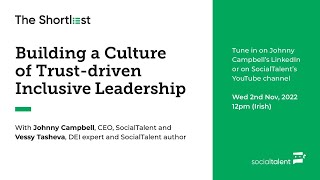
Recorded interview (Nov 3, 2022) between Johnny Campbell (host) and DEI expert Vessy Tasheva about building trust-driven inclusive leadership. They define trust-led leadership vs. fear-based approaches, outline four guiding elements (trust, empathy, stability, hope), and give practical practices — especially one-on-ones, emotional check-ins (emotion wheel/weather metaphor), transparency via OKRs — including considerations for remote/hybrid teams and repairing broken trust.
Questions this video answers
November 3, 2022
Trust, Empathy, Stability, Hope
High-trust organizations have 76% higher employee engagement and 74% less stress.
vessy.com
Chapters
Sam.
You're very welcome. It's episode 121. That's one to one of the shortlist. I'm Johnny Campbell, your host and the co founder and CEO of Social Talent. And today we're going to be talking about trust. Trust is something that we seem to be finding ourselves with less of these years. These years in 2022, for example, as we broadcast, trust is at an all time low. Trust in institutions, trust in government, trust in each other. But if you look at the Edelman Trust Barometer, the trust that comes out top is trust in your employer and particularly your boss. And surprisingly perhaps to some of you, trust in organizations beats trust in pretty much every other institution. So it's important therefore for us to be talking about trust and its role in leadership. Our guest today is going to be talking about how do you build a culture of trust driven inclusive leadership? So it's a really important element. When we talk about inclusion and being included, trust typically pops up and everyone deserves to feel comfortable, as we say, bringing their whole selves to work.
Right?
And as a leader, it is the leader's job to create an inclusive high trust environment. Employees are happier, they're more productive, they're more engaged, more motivated when a culture of trust is fostered, most of us pretty much understand this, but how do you do it? How can a leader build this? Well, today I'm delighted to be joined by DEI expert and social talent author Vasy Teshiva about this very topic. And on this week's show we're going to dig into how do you create trust, especially in the context of the polarized world we find ourselves in today and how trust driven leadership is something that needs to be consistently practiced in order to be perfected. Vessi, you're very welcome. I've been watching your training. I was saying to you before the show kicked off the last three weeks as it's on my current Q4 learning here at Social Talent as a leader, really enjoying it, finding it very accessible. Dying to dig into this topic with you, but maybe you could start by introducing yourself to our audience and explain how you ended up being someone who speaks on this topic and has become very well known and trusted, if you pardon the pun, in this area.
Thanks, Johnny. And I'm delighted to hear that you're actually going through the training yourself. Looking forward to some of your feedback and the leadership team's feedback when, when you complete the training. Oh, how, how did it start? I think originally as a business. Vest.com started out of frustration as a DEI and mental health consultancy related to problems I was observing, experiencing in organizations. And I wanted to change that. But more specifically on trust. I am, I am currently training as a psychoanalytic psychotherapist in Trinity College Dublin. So trust is a topic that I examine as part of my, my dissertation in Trinity. And it's something that, you know, I kept revisiting and why am I doing it? Should I change to something else? And there was always something about trust that kept going, kept bringing me back to the topic of trust. I think it relates to two things. On the one side, you know, our own upbringing, how we experience trust, do we trust ourselves? Do we trust others? Do they trust us? But then working with organizations, whenever, you know, when we do state of inclusion report, we create their DEI strategies. It was never just about, you know, just LGBTQ inclusion or racial diversity or something like that. It was going into deeper and deeper topics. First it kind of transitioned into transparency, accountability, and then it boiled down to trust. So we kept seeing if there is skepticism towards the leadership team, if people are doubtful of whether there is authentic commitment to dei. It wasn't just about that. It was trust in place or lack of trust in different aspects of the organization and in different ways towards the leadership team. Now it's very interesting to turn it around, you know, because a leader can say, oh, what can I do? They just don't trust me. Why are they such not trusting group of people? You know, they can put it this way, but we can also say, are you a leader who is capable of containing this feeling? And if people don't feel like they trust you, recognize that and still be able to contain those feelings. Sometimes leadership is compared to parenting. And some people's reaction is, oh, I don't like kids, or I don't want to parent my employees. Let's move away from that. It's not that they're children and you're the parent and you know, and they don't know. It's not about. There is some potential power dynamics in, in both cases if one is to, you know, maybe come from a position of power. But how about trust? If. If someone is upset, you know, and you're actually the one, you know, you know, you're the, you know, the position who. The person who has the final decision to make. It is up to you what happens. And it isn't about just being like, oh, you know what, John, I see my decision upset you. I'm just going to change my decision to make you happy. It's not about that. But do I have the capacity to actually hold your upset, help you work through the emotional bits of your upset? Because I'm holding it and I'm accepting it. So you're not in danger to be unhappy with me or even angry with me at this moment. So then we can move on and repair from distrust. Because now you know that you being unhappy with me is okay. And that's how we communicate, you know, if, you know, if that's what's happening between us. But now we have a trust based relationship. Right, so you still feel safe. And it's similar when we do, you know, performance management. We want people to feel challenged, but they still need to have a sense of safety and stability. So you're challenged just enough that you're getting outside of your comfort zone, but without feeling insecure or threatened.
When we talk today about trust driven leadership, explain to me why we need to talk about it. As in what is the alternative or what have been perhaps the traditional styles of leadership that perhaps didn't focus on trust or didn't engender trust. Talk to me about other alternatives and perhaps the types of leadership that doesn't focus on trust. Why do we need to focus on this today? What's not working and why Other types of leadership and why does that, why does that occur?
Yeah, so the other extreme would be kind of fear based leadership. And that's usually when verbally or non verbally, it's communicated. I'm your boss, you need to do what you're told to do. Or unless you meet those expectations, there would be negative consequences for you. So there is a power play and sometimes it can be implicit and sometimes you would hear people say such things. Now with trust based, it's I trust you're doing your best, but and even if you're not meeting the requirements now, it doesn't mean that, you know, whatever you do, we would just keep things that way. But if someone on my team is underperforming, I would still give them feedback, trusting that they can hear the feedback. Maybe we will no longer work together, but I'll say, okay, this is where I, you know, I've been trusting you. And there is still an opportunity for them to say, aha, I see what I missed. And they can still try to change that, take that feedback on board. And there is someone on the team right now that I shared feedback. And so I didn't say like this is the end. I left some space to see if they will take that on. But they didn't make the kind of the, the, the effort to now, you know, create an opportunity out of the situation. So you know, they gave up but I did trust them with, you know, this is how things are happening. And you know, I think this is where we find each other as humans trusting each other. So it isn't about making things extremely predefined. You know, we will do those 10 things, 1, 2, 3, 4 and 5. And even in the course, as you mentioned, you know, we look at, okay, it's trust driven, but does it mean it's only about trust? No, it's about empathy, it's about stability, security, it's about self care, it's about hope and you know, creating hope is about trust creating, you know, knowing how to look after ourselves. You know, self care goes back into trust. So there is a lot about containing people's emotions and then the power of one on ones that supports us here. There are two pieces of research that I refer to in the course. One of them is that high trust organizations have 76 higher engagement, employee engagement and 74% less stress. So if I don't feel like, you know, you know, I'm just about to be fired or if I do something wrong or under deliver or say or you know, misbehave, in a sense I will be punished. But rather there is, there is a sense of safety. I still need to do my bit. I am challenged. But my capacity doesn't go into, oh my God, how I'm gonna cope with this, you know, going into our coping mechanisms. I will not eat, I will not sleep or whatever it is for the personal overeating, over sleeping, you know, whatever, just so they can push it through to deliver because they're full of anxiety or depression, whatever, whatever way stress impacts them.
I don't mean to go straight to it, but I think it's important to address.
Right.
For folks who are skeptical listening to this when they're looking at that comparison. Vessi, it's a great comparison. Maybe the fear based leadership, which is if you don't do this, here's the consequence versus trust. There's a temptation for cynics to hear that and say, well okay, is this a no consequence relationship? Is this a situation where you have a boss and her subordinates and there's no consequence to underperformance or not doing a job, which, what happens, you know, in a situation where the trust is broken, let's say, or not delivered upon or the person, maybe there's trust but the person isn't performing in that situation. Does the person have no consequence. You say that they, they don't have fear. They, they feel that they're safe. But how far does that stretch in terms of, you know, let's say a sales job or a job where you have a very obvious output and if you're not delivering upon it, you know, is it just, well, it's okay, we all have trust, so everyone's fine, or how far does that stretch?
You know what's funny? That trust based leadership, it's about the leader building trust. It's not, oh, do you trust your employee? And that's a common pitfall because what are you doing to deserve people's trust as a leader? Are you transparent? Are you accountable? Are you, you know, are you predictable? Are you trustworthy? And yes, okay, some people won't be able to perform. You don't have to just keep people around for the sake of it. By no means, but very often when we, whenever we have issues related to trust in an organization, it starts in the, in the leadership team. It's because the leaders are not transparent enough, accountable enough, they're not predictable, nurturing enough, they're failing to contain. So this unlocks then, you know, sometimes even very primitive anxieties in people. What is, what is going on in this company? Do we even know where we're going? You know, and that is distracting. So what would it look like in practice? How about we have okrs? There is full transparency. We know what the, what our mission is, what our vision is, what our values are. We see how the OKRs on organizational level, from leadership level, through every function, connect. There is nothing sensitive about it, you know, kind of, you know, no legal liability there that can be, you know, created by just having that level of transparency. So people know what they're doing today contributes to their own OKRs or their team's OKRs or to the organizational ones. So similarly, you know, if, if their leader falls sick tomorrow, let's say their CEO for six months, that trust can hold. But if no one is, you know, kind of acting like a, like a whip to force people to do things, things will fall apart because the transparency, the accountability, the predictability, the safety, the trustworthiness will be lost.
You talk about four principles and you touched on them a few minutes ago. You talk about trust, you talk about empathy, you talk about stability, and also about hope. Walk us through those four elements and maybe share your views on how they, how they combine together to drive this kind of more holistic, inclusive leadership approach.
One of the most simple practices and probably most of our Audience is already applying, but not thinking about it through those terms is having one on ones. And I think sometimes we have a missed opportunity in one on ones when we don't think about it this as a way to really foster trust. It does take vulnerability on our side as well. Especially when, you know, we, we understand that one on ones need to be separate from operational things. So if the operational thing is like, hey Johnny, how is this course going? You know, when are we going to launch it? Or what feedback do we have? How are the sales numbers? You know, I'm driving the agenda, you know, and in the 101 you bring the agenda and you tell me, hey Vessi, this is what's going on for me right now. Maybe there are organizational changes that make me feel a certain way. Maybe I feel excited about them, what opportunities might come my way, or I feel threatened by something in the organization, or maybe I have an interpersonal tricky situation and I need some help there. Or just your perspective on things or mentorship. So the moment that allows for the employee to bring what's actually on their mind rather than what they think they should be talking about and building a very human relationship there. And people do bring up, you know, oh, there is this project, I have this blocker, but they choose to bring that up. And sometimes the blockers that they talk about might not be operational or organizational. It's something in their life and they just want to share and that is a blocker that might be impacting their performance at the moment. So the best thing we can do is just to contain that feeling. Now, it's not to say that listening to people's challenges is easy. And I think, you know, again, going into the cynical response, someone will be like, no, we're solutions, focused people. We're not about the problems. Before we move into solutions mode, we need to understand the problem. We need to empathize with the problem. If we don't do the emotional work, then we are suppressing that and we're moving into solutions. Short term it can be more efficient because we saved 15 minutes. We didn't do the emotional type part of the chat, but that person just knows we have no capacity to deal with their emotions. Having any emotions is not acceptable. What we want from them is only productivity, efficiency. Give me solutions, give me business results. You don't matter as a human. Give me purely your analytical, productive self. But you know, any field, marketing, sales, engineering, we need to stay creative, you know, connected to both our analytical and creative self. So if I'm telling you Non verbally, I'm implying, you know, shut down half of yourself. You know, even if you're not 50% creative or whatever I'm saying I don't want you to bring your whole self to work. I will select the pieces and the rest will be punished or at least not recognized. And by ignoring it, that it, that can be also a form of management.
So if you're a first time manager, or you're a manager who has inadvertently been transactional, who only talks about the work done, did we hit our target, etc. What kind of language can you use or what kind of questions can you ask just to set up this type of one on one conversation to start it off again? Because we might have listeners who go, yeah, I get that, that makes sense, I'd like to do it. But what you say, like, is it like, how are things going? What's up? What do you ask someone? What are the kind of questions that work in a one on one situations? Messi.
Yeah. So usually if someone asks you, how are you? How are you? People just say good because they know that the question implies they're not interested in hearing how you find. It's just a matter of greeting each other. If you actually want to know how someone feels, you can say, how are you feeling today? What, like what's on your mind? What's going on for you right now? Working otherwise, right? So how are you feeling today? How, how are you feeling right now? There is more of an emphasis of the moment rather than just the usual phrase that will like, hi, hi Johnny, how are you? You know, and you'll be like, you know, it's just a figure of speech. I'm not expecting you to tell me what's, how you're actually feeling. But let's say we have an employee that maybe is not very articulate when they talk about their emotions or they're not used to this, or maybe we are new to this type of conversation. So we both always avoid any of this and keep going back only to the, you know, operational sync type of conversation, the productive bit. And then what we can do is use a tool that helps us identify the emotions and that can be as a warm up tool. In the course we were looking at a specific tool and it helps us see. So maybe some of the audience is familiar with the emotion wheel. There are like hundreds of emotions and through the emotion wheel you can recognize, you know. You know, it kind of, it can help you navigate like do you feel happy or sad or angry or scared? You know, it's kind of simplified, but you can go into much more nuance. You know, I feel humiliated or I feel excited or joyful. So it isn't just like good, bad. And it also helps people see that when we're overwhelmed, we're usually dealing with a number of emotions at the same time. And some people can be paralyzed in that feeling of overwhelmness that can impact productivity, among other things. And obviously happiness, engagement, ability to learn. So using a tool like this teaches us to say, okay, wait a moment, what's going on for me? Why am I in this, in this space? Why am I not able to be my usual self? You know, be curious, be open, maybe calm, courageous, engaged in my learning, or be productive. What's, what's going on? And break it down. Okay, so I feel, maybe I feel excited, nervous, a bit down, maybe a bit offended. What else, what else is going on? And these, this can be in different, from different aspects of our lives. But we don't cease being the other aspects of us when we join a meeting, right? You know, maybe we had a fight or we have exciting, I don't know, personal projects or something else that we're bringing as an emotion. So breaking it down into emotions and being able to see that they don't cancel each other. We can be broken hearted and in love at the same time, maybe because of different people, or we might be in love in different people at the same time. You know, whatever the, you know, the personal story is. And all of this can be a lot and just sometimes putting it down, talking it out, helps us structure things. And as a, as a manager, you know, it doesn't mean you need to know about the love life of your employees, but it means you can teach them how to work with their emotions so they are more productive so that they grow as individuals. So they don't see you just as the person who pays their salary, but someone who is actively interested in their well being. Not some employee assistance program that barely supports them with anything actually, because we, if we look at those, the payment per employee is so low per month that if, if, if those programs were expecting people to, let's say, see a therapist once a week, et cetera, they would be operating at a loss. So, you know, that, that tells us what's really happening there. So really actually investing in the well being, the personal growth of people and then becoming their better selves, they can achieve more in the organization, trust themselves more as we become more trustworthy leaders at the same time.
I heard a great example Last week at LinkedIn Talent Connect, one of the speakers was speaking to this topic of how do you have, you know, better one on ones that are focused on that well being and personal health. Personal kind of personal well being, I guess. And they said they use an opener, which is every meeting, one on one they'd say, tell me what weather are you today? You know, are you stormy, are you sunny, are you cloudy, are you raining, are you drizzly, Is it? And the speaker shared that this was a great device to help really force someone not to be sunny because you won't go blue skies every day, you're gonna go, okay, a bit overcast. And in that you have license to kind of explain yourself in language that maybe is less, less confrontational, less emotional. You're putting yourself, your feelings in the context of weather or something similar to that, which I think is, you know, there's lots of great devices. You mentioned the wheel, other ways of doing this. But I think it's, it's the intent that's really important. Talk to me though, Vessi, about when trust is broken because obviously in a perfect world, we have high trust all the time. Everything is great in terms of the engagement, the relationship. But how, how can a leader break trust? What are the typical ways you've seen leaders can break that trust? And then can you come back from that? And if so, how?
I rarely hear leaders apologize or admit that they've made a mistake and hold themselves accountable for their mistakes. These are, you know, in any other relationship we'll just say like, sorry, I, I messed up or sorry, I was wrong. We don't hear leaders do that. And there is a taboo that if they admit any fault, people will think less of them. But it's not about perfection. We're all imperfect. We all make mistakes. We can't always say or do the right thing. So just when, when something happens. So we're not doing it in pursuit of perfection, we're doing it in pursuit of being trustworthy human beings. We're transparent and accountable and there is a level of predictability and security and it's nurturing. And if, and we fail people, and we do that in every type of relationship at one point or another, you know, it depends how often we do it. And you know, if, if we have kind of, if we do it too often and we don't show actions to, to, you know, compensate for that, then people just run out of capacity to trust us anymore. Right. It's a bit like a bucket. Do you add to it or do you keep taking away, Are you giving or taking and are those things imbalanced? So if you make a mistake and essentially you're taking away from that bucket of trust that was put in you, you apologize. And that's a way to get some of that back. Now it's not just the action for the sake of action, it's about genuinely apologizing. But firstly, understanding what really went wrong. I see a lot of, a lot of leaders struggling with self knowledge where you know, when feedback is, is showing, shared by the employees. Let's say we're creating the state of inclusion reports and we have these findings. These are how your employees feel. These are the numbers. Quantitative and then qualitative research, you know, and this is the picture, you know, and this is the margin of error and the confidence rate, you know, because leaders are like, show me the numbers. Well, here are the numbers. And when leaders don't like what they see, they start to discredit the data. They'll be like, ah, you know, this margin of error is too, hi. Or how about, you know, this is a month old or three months old report now. Well, but you were not showing up for the brief calls earlier, right? So, so who is at fault? So we all have defense mechanisms, every single human, it's just human to have defenses. But are we people who are aware of our own defenses that we tend to put in place or do we get defensive? And even if I get slightly defensive, do I say actually you know what, I just went into defense mode, this is what I do. Let me, let me come back to it. Let me just listen to you. What do you have to say? And it will be hard for me to hear it, but let's create this space. So trust in an organization is limited by the capacity of the leader to know the truth about themselves and to trust themselves. And here we go into kind of deeper concept of is the leader living their true self or, or a false self that you know, maybe they picked up from society throughout their upbringing. You know, maybe it's influence of religion or their own family or you know, everything together, you know, it doesn't matter. But we are the products of, of somewhat of our own personality and somewhat of the environment that we were brought by and all of the work opportunities in between that eventually made us a leader. So it is extremely uncomfortable and can be even painful to hold the mirror of seeing what one is actually dealing with.
And you talk about this in your training, this concept of self care when it comes to trust driven leadership. So what is that? Is that the Equivalent of on an airplane putting your oxygen mask on you first before children. How does that look like Bessie, in terms of constant self care and examining yourself? How does one do that?
Yeah, so I think the comparison with the mask on the airplane is really good because essentially we're not throwing someone else under the bus to save ourselves. It's about to be able to help someone else. We need to be in a good place. So we need to feel contained, to be able to contain someone else's feelings as well. Right. So if I am completely overworked, stressed out, you know, approaching burnout, and I have a one on one with an employee and they, you know, they feel anxious or worried or depressed, whatever is going on, maybe it's about a project or 20, 23, you know, whatever, or something in their personal life, I will have zero capacity to help them feel contained, even just for five minutes if I, I don't have that capacity within myself. So how do we practice it? You know, maybe for someone it's a hiking the mountain on their own or someone else might be hiking the mountain with their family on the weekend or someone, it could be doing their meetings while walking around their house if they're remotely working or in their office. It's very individual. But again, it takes, it requires self discovery. Curious to know first about yourself.
You mentioned walking around the house of your remote working. I want to pull that thread a little bit if I can. Vessie, A lot of people have shared their challenges of remote or hybrid working and particularly leadership has, you know, come under a lot of pressure where folks felt the traditional leadership models didn't adapt well to remote or they couldn't adapt them themselves. Is there a difference when it comes to building trust in remote or hybrid situations? And if so, what are those differences and what are your recommendations?
Yeah, I mean, you know, the distance and proximity, physical proximity can impact things. So an example from a recent workshop, you know, usually people join over remotely over zoom. So every participant has an identical experience, you know, there with their laptop and they join. But we had three people happen to be in the office on that day and they were joining from the same computer and everyone else was joining on their own. And one of the people who was joining on their own, I guess they were also in the office, they said, oh, which room are you in? So I can come over immediately. That creates, you know, kind of imbalance because now, now it becomes the thing, you know, as if, as if it's, everyone is better off being there as a group now. Actually I, I Told them hold on for the, for this is a workshop. You're actually better off having the screen to your own, being able to see it up close, I need to be able to see it. You know, it's interactive. We cannot have three people on the same screen. You know, but this is what happens in a hybrid setting when some people have availability to be in the office more and some need the accessibility of working remotely. You know, maybe these are neurodiverse people, maybe there are people with disabilities, maybe their parents or caregivers or just introvert people who just prefer to have the nice and quiet focus time working from home rather than doing the commute, etc. So what happened in some companies is that male leaders were tired of sharing their living room or bedroom or you know, their house with their spouses who you know, tend to be looking after their kids. And they said well, we need to go back to the office. So and then you end up with offices where it's mostly male colleagues that go to the office because they're happy to kind of leave the care giving responsibilities to the female members of their family. And that actually created further imbalance not just in the workplace but in society. So then you know, people who tend to get promoted more easily in general because they are similar to their leaders spend also more face to face time with their leaders. So how do we, how do we come come back from that? We need to be very conscious, we need to be very thoughtful and intentional with communication when, when we have remote working or hybrid setting and okay, if, let's say Johnny, you and I work in the same office and we have the flexibility of being there two days a week or even five days a week and other colleagues don't have that. Do we make the intentional thoughtful effort of scheduling time with them for one on ones to have that quality time or if I have a beer with you in Cockatree, you know, it's like, well, we just happen to be there. But if someone else doesn't go to Hakotree, they don't have the social catch up with you, they don't have as much visibility on their own projects, they don't get to know you more as a person and kind of build a more friendly relationship. So their career is impacted by that and they would probably feel, you know what some people are taught about and are top of mind for promotions or career opportunities and if you don't show up, it's not as supportive of the environment. And then support is an aspect of trust.
You mentioned the differences in Gender, again, there was Data shared by LinkedIn with us last week suggests that women are 24% more likely to apply for remote roles than men. And again, it shows a bias. You know, we can only hypothesize on the origins of this or the whys of this, but the data is very strong that suggests that there is an imbalance between those who wish to work remotely or require that access. And again, it's being thoughtful, it's stopping and thinking and not just in your own perspective on these things.
Yeah, well, you're like less likely to be sexually harassed if you work from home. Or at least there is a bit more control distancing if the. Let's say the culture is more toxic. You know, you can just switch off your camera, leave the room, you know, try to forget about it. If you're in the office and you're dealing with this, that's much harder. But then it's typically women. It varies slightly from country to country. Across Europe there are studies, but overall it always falls back on women to be caregivers, be that to children or elderly members of the family or people with disabilities in the family. So women end up being at home. So it can look like it's their choice, but it can very much be that they're expected to do that.
So do you think there's a challenge when it comes to trust, Bessie, that we started the pandemic, perhaps by setting expectations with some people that remote or full hybrid would persist? And then the last 12 months, even particularly the last six months, a lot of companies have had to change their policies. And do you think that's been a damaging thing? And if so, how does a leader deal with that when perhaps it's not her decision, it's the company, but she has to then break the trust that has been set by the company with her team in changing the rules to maybe enforce them to be in three days or two days, a week or whatever that might be. Is that a challenge today for folks, do you think?
Yeah. And it puts the leader in a very hard position. You know, in your example, if she actually disagrees with the practice, but she has to introduce it to the team, I think holding that ambivalence is again, about containing. So to be able to acknowledge that, okay, this is the reality. It doesn't sound like in the example that you're giving there is any flexibility. So this is our reality. I'm not happy either, but, you know, this is. This is what we need to do. So being able to contain the upset of the employees. Of course there are boundaries. You know, if you start every meeting and employees only complaining every single time, you'll be like, okay, we talked about this, now it's time to move on. And you know, we have talked about this, right? And, but we're not trying to just push it, push it aside and pretend it's not happening and say if you don't come, you know you will be fired. That kind of black and white situation. But it is very hard for leaders when, let's say a team lead, when the company is not interested in understanding how it impacts people's lives. Some people have joined the company throughout the two years of the pandemic. So if you joined part time or you joined, let's say hybrid or remote, and now I'm telling you, you need to be in the office when we only allow full time, you know, you never signed up for that. So that's maybe 20, 30% of the company due to, you know, attrition rates over the last two years, which would be natural in any company there, you know, it's dynamic and we see high, high numbers of people switching companies because of those specific reasons. I think it's a, it's a shortcoming on leadership teams that want to be in the office, sometimes for personal reasons, sometimes because they're used to it. It's very easy to fall into the status quo and it shows lack of trust in their employees. And I think it's, it's hard to believe that other people are accountable if you're not accountable yourself.
I like what you're saying in terms of, if I'm hearing you correctly, Bessie, this isn't about leadership through fear, but it's also not about leadership through pandering to everyone's needs. Trust isn't either of those things. And the analogy, if it works for you, that comes to mind to me is it's friends, friendship, let's say friends versus family. Family. You can't unfortunately sack your family. They are your family forever. That's just the way it is. But your friends, we do pardon the phrase sack our friends. Sometimes somebody we decide is not going to be our friend anymore because we don't like you. We don't trust them, let's say, anymore. And trust is something that takes a long time to build. With friends. It can be eroded very quickly. And again, the way to get it back is to apologize often. But there is an expectation of a friend that you have to give to the relationship. If it's all one sided, you can walk away Again, to your point, around an employer, there is a consequence. Perhaps family is a bad analogy because you kind of can't walk away. Families, family walk away. But friendship, does friendship work for you as an analogy in terms of trust based leadership or what do you think.
In, in certain, in certain aspects, I guess in a friendship we would expect, you know, equal authority. No, they're equal friends to each other. Unless there is power imbalance. Yeah. In a, in a, in a family, you know, we can say, oh, we're, we're stuck with each other. But in either case, working through is the key. Let's say in a family, you have a member of the family that comes out. Some people can shut them out, others can accept them. And there is also the middle ground. Okay. You know, there is a member of the family that's kind of struggling to, to understand, to come around, but maybe they still want to. So how do we work through this? And it's similar in therapy. You know, there is something that maybe we want to change about ourselves or we understand we have like a specific coping mechanism or a defense, we want to work on it, we have no idea how to do it. And it's just working through that eventually we get on the other side and building trust, maintaining trust, repairing trust, it's about working through. But usually we just think about shortcuts, especially in business. We're like, what are the low hanging fruits? There is no long a low hanging fruit with trust. So short term, that will make you very impactful. But another six months down the line or another six months down the line, you will pay a higher cost. It becomes a legacy code. People understand legacy code, but they don't understand dei legacy or trust Legacy.
I love that. There are no shortcuts in this. You got to work through. Betty, you've been very generous of your time today with us here this afternoon here in Dublin as you broadcast live. I'm going to ask you for one more piece of advice, though. I wonder if you could leave us with advice for our, our listeners today. Whether it's advice that's been passed on to you by somebody else, or it's something you've gathered from your own vast experience and knowledge. What would that piece of advice you'd like to leave our audience with here today be?
Yeah, go inside and go deep. We live in a society that's all about, you know, everything is on demand. Everything is about quick, you know, take away, you know, everything is about immediate consumption, growing as a person, growing as a leader, building meaningful relationships, finding purpose that's actually, you know, contagious. People want to stay with your company even if you run out of funding, but they want to stay there because they believe in the mission. That's coming from trust. You know, ideally you, you didn't run out of funding but by that time. But that is when you, when you know yourself, when you have found insight and you went deep. But also it's not, it's the habit of doing that. It's not, you know, you don't go from A to B and that's the end of the journey. It's about strength of a continuous self. If you want. So we constantly rediscover ourselves. Who we were five minutes five years ago is not who we will be five years from now. So having the strength to continue on that personal journey to be better leaders and just better people.
Fessy, I love that and thank you. And if folks want to contact you to know more about the work you do with organizations to help you provide the workshops you run, how can they find out more details?
Yeah, vessy.com you can find everything there.
V-S-Y.com all you need to build trust with your team and organization. Vessi, thank you so much for taking the time to join us here today and share your insights. A pleasure completing your course. I have one more section to complete before my deadline tomorrow. I'm looking forward to giving you feedback once we're done. Thanks so much for joining us. Thanks Johnny and thank you for joining us to listen today and hopefully that's inspired you on how you can be a better leader. You can bring trust into the equation to drive a more inclusive environment as well and you can move away from being perhaps that fear based on leader to a much more inclusive, trust based leader. We'll be back next week. Our show rolls on to episode 122. Do join us next week. We'll be live on YouTube and LinkedIn if you want to join us at 4pm Ireland UK time. That's 11am on the east coast of the US 9am or on the 8am in the west coast. I'll be joined by Charo Malhotra. Charo is somebody I've known for a long time. She's a leading HR and employer employer branding expert, has worked with tons of businesses from Nestle to McKinsey and she's going to be talking to us about how to communicate company culture through employer brand. And Sharu is somebody I've known who's really been a passionate advocate for the power of employer brand, but not only an advocate. She's lived it for massive brands, driven the changes executed on those changes in those big organizations, on driving really powerful employer brands. And she'll be sharing with us her secrets next week on the show. It's episode 122. That'll be live on Wednesday the 9th of November on your podcast app by the evening time. If you prefer to listen to the podcast or again you join, can join us on YouTube, SocialTalent or LinkedIn on my personal profile in JohnnyCampbell as well. Or you can find that and any other previous episode and links to our Future episodes at socialsounds.com forward/the shortlist. We'll see you next week.
More from Johnny


Where Does Your Hiring Stand? Diagnose It with the Maturity Model | SocialTalent

Where Does Your Hiring Stand? Diagnose It with the Maturity Model | SocialTalent






NEW CONTENT - How to use Generative AI for Recruitment Marketing with Glen Cathey | SocialTalent

NEW CONTENT - How to Use Generative AI for Sourcing & Recruiting with Glen Cathey | SocialTalent

NEW CONTENT - How to Unlock the Power of Generative AI with Glen Cathey | SocialTalent