Creating and sustaining employment for the visually impaired
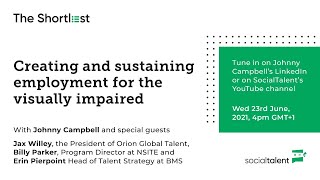
Jax Swiley, Billy Parker, and Erin Pierrepoint discuss a pilot program that trained blind and visually impaired people in recruiting and sourcing, starting with eight participants in Vermont in 2019. The first graduate, Melissa Shaw, got hired. Now three organizations partner to scale it: NIB/Insight recruits candidates, Orion provides mentoring and placements, and SocialTalent handles training.
Questions this video answers
Eight individuals participated in the pilot.
Melissa Shaw.
Insight Connect.
Email: jaxsoryanogt.com (as given in the transcript).
Chapters
Sam. Welcome everybody to what I think might be episode 56 or 57, but it's 50 something of the shortlist. I am Johnny Campbell, your host and CEO and co founder of Social Talent. And welcome to our latest edition of the Shortlist. I'm really excited about this week's show as we've got not just one, not two, but three fantastic guests discussing a pretty important topic and that is creating and sustaining employment for the visually impaired and blind. This is a really, really a hot topic. I think it's one that's going to be close to the heart of many of you who are looking to both recruit, but also to drive more inclusivity in your organizations. And we've got a whole cast of folks who are really passionate about this subject and can teach you and educate you in how to really make this work for this community and for your organization. Before we get into the show, quick reminder that the Shortlist is a weekly show that broadcasts live on LinkedIn and YouTube. You can find us at YouTube.com SocialTalent or look up Johnny Campbell on LinkedIn from my profile for the live links. For those of you listening live, we welcome your questions, your comments. Just join us in the chat on either LinkedIn or YouTube and we'll take those questions and comments and read them out live during the show or put them to our guests as appropriate. For those listening to our podcast, welcome to the show. You can find this podcast, of course, on Spotify, Apple, and wherever you find your good podcasts and any links we might mention or any email addresses we mentioned, we'll put them in the show notes on the podcast as well. And if you're listening to podcast, come join us live once in a while. You'll hopefully enjoy the show, or if you're listening to us live, do check out the podcast. You can check out our back catalog and also find that@socialtalent.com the shortlist that's onto our show. Well, in the US alone, over seven and a half million people are blind or are visually impaired. And one of the biggest challenges that those with visual impairments face is in relation to the topic of employment and finding employment. And even as technology has advanced and society strives for inclusivity, especially post pandemic, there are still countless barriers in place for the blind, visually impaired community when it comes to opportunities for work. So I'm delighted to be joined the show today, as I said by a cast of people who are trying and succeeding in making a difference on this front. First up, we got Jack Swiley the president of the Orion Global Talent Group. We've got Billy Parker, who's the program director at nsyte, part of National Industry for the Blind, and they're involved in the partnership to provide the professional education needed for blind and visually impaired individuals to enter the recruiting and sourcing industry, amongst other sectors. This is the brainchild of jax's business partner, Bob Richardson. And this program can help upskill members of the community and allow for career progression with actual mobility. And we'll be chatting more about that program and how you can get involved or get someone you know to get involved in that program later on. We're also welcoming Erin Pierrepoint, she's the head of talent strategy at Bristol Myers Squibs and she's going to give us a glimpse into the employer side of this discussion and what employers are doing around this. So I'm going to start maybe with Billy, perhaps. Billy, I'd love to get your perspective on, first of all, if you could introduce National Industries for the Blind and obviously give us a bit of insight in terms of NSight, which only launched this year, and tell us a little bit about the kind of high level view of what the career prospects look like today for someone who's blind or visually impaired. Sure.
Thanks for having me, Johnny. So NIB has been around for quite a long time and our primary focus is employment for individuals who are blind. Primarily with nib, a lot of that was done through either government contracts or working with some of our associated agencies around the country, which is great and it's working extremely well. Built off of that success, we have broken off into another component which is going to be focusing on the workforce development area with insight. So with Insight, it gives us a lot more leverage and opportunity to work directly with businesses to address those hurdles and obstacles that they're facing with bringing on individuals who are blind. So basically what we're doing, we're leveraging, you know, all those years of experience to NIB with this Insight organization to make sure we can make a real impact within the community.
And I'm going to go to JAX to tell us a little bit about perhaps your background, what brought you and Billy together with Bob, your colleague, and maybe give us a little bit of a history about the programs you've been involved in and what got them started in the first place. Jax?
Sure.
So this started in 2019 with Bob Richardson having an idea. He had some family members who had degenerative visual impairment. So he decided that he was going to contact the Vermont Department of the Visually Impaired. And he started working with that group. So we ran a pilot program with Vermont, and through that we actually got our first employee, Melissa Shaw, who had, she had two technical degrees and she was visually impaired. And she tried to find, you know, a job throughout the state. She went to career fairs, you know, she was really frustrated. And then she found the program, she completed it, and we hired her and she, she has just made such an impact, you know, in our organization. So just that, that is a, you know, she is a true example of, like, what people who have visual impairment can do. She, like, manages, you know, a big section of, you know, our recruitment firm here. So after Bob worked with the Vermont Department of Visually, you know, Impaired with Fred, he decided to take it to the national level and he contacted Billy Parker and they ran a pilot program in Washington, D.C. a couple years ago. And that was, that was step two. And now we're on to working with you, Johnny, with social talent, bringing in the educational piece of. And, you know, making this, you know, quite a, quite a big project which, you know, it's amazing to be a part of. We are a small, you know, Vermont recruitment firm who's growing, you know, and in partnership with the national industries of the blind, have created this amazing program.
Betty, I might go back to you for a second just to kind of get an idea of how perhaps did the pilot program work, who's involved, what do they get out of it, and what is the aim of the program?
So, great question. So I remember very clearly Bob reached out and it was kind of one of those conversations where, you know, we're approached with a lot of different training programs and opportunities. So honestly, it just was another call to kind of talk this through to see what, you know, Bob had. And, you know, I'd read a little bit about the program and when I spoke with Bob, it began to check a lot of boxes. So, you know, when we go and set up a training program, there are a lot of criteria it really needs to meet. One, there needs to be jobs at the end of the day, so make sure they're employed. There needs to be training available, There needs to be support within the community. All these things were being checked. And after about a five minute conversation with Bob, we realized this had the makings of a, you know, a real career path for individuals who are blind and met our criteria. So we coordinated, we rolled into a pilot program with eight individuals that went through the pilot to get them a foundation in sourcing and recruiting. And from that pilot program, it really gave us the foundation of one. The talent's absolutely there. We were really excited by the candidates we brought in. So it was very clear the individuals that can do this and they can do it very well. Really the biggest hurdle we face with the pilot. So, you know, with a pilot, right, there's lessons learned. So the training went well. The individuals were great. In the day. We were still having a gap to the employment piece. So we realized, and Bob realized very quickly, okay, big lesson learned here. We need to have the employer very involved from get go to make this successful. So that's kind of the big piece we're adding on now and why we're very excited to have Bristol Myers Squibb on this too, because it really takes a partnership. I mean, this call is great. This podcast is great because you have all the players at the table. You have the, you know, you have jacks and organization who are, you know, the subject matter experts in sourcing. They know it. They know the community, they know it well. We have a training component with social talent which adds so much to this, which can prep them. You have nib who can find the individuals and insight, who's going to find the individuals and make sure employee has what they need. And then you have probably maybe the most important piece of all, and that's the employer with like a Bristol Myers Squibb, who's going to actually bring the individual in and actually get an employee. So when you pull all these pieces together, that's when you have a successful model. So based on that pilot, you know, and some lessons learned, we feel very confident in rolling out the first official program coming up in, I guess, what are we saying October maybe time frame to launch this.
And that probably brings us nicely to Aaron, I'd love you to tell us a little bit about what Bristol Myers Squibb has been doing in this area, and particularly the focus obviously on individuals who are blind or visually impaired. This isn't something, the only area that Bristol Myers Squibb focuses on. I know. Aaron, perhaps you can share with us a little bit about your experiences and learnings as an organization, hiring folks from. From this background and community and what you've learned. And perhaps you could share that with our audience.
Sure, absolutely. Well, I am so thrilled to be here. And part of it is because I started my career as a recruiter and sourcer, as a headhunter. And so it's really nice to be in this place where there is a very, very much a talent shortage in the market for recruiters. And so I am wearing dual hats to some extent, being an advocate for this program. Program, because it's near and dear to my heart. But also when we think about Bristol Myers Squibb and other large companies, we are looking at opportunities to evaluate our current processes, evaluate our systems and technologies to make sure that we have accessible processes and technologies in place so that we can welcome in low vision employees and have it be a great experience and not face the roadblocks and the obstacles. Because perhaps we haven't, you know, or thought proactively about what that experience will be as an employee or as a consultant or contractor. So some of the steps that we've taken at Bristol Myers Squibb, we have gone through audits of our processes. Everything from. Are our careers websites accessible? What is the process to request an accommodation? An interesting piece of information is we had not over five years, we'd only received two requests for accommodations through our website. So instead of saying like, that's great, maybe nobody needs an accommodation, we actually took an opposite approach to say, why not? Right? Is it not clear? Should we revisit that process? It seems like a really low number. So really taking a hard look at everything from how we interview candidates, how candidates apply online, what their day one experience is from a technology perspective, from an onboarding perspective, and using our dawn team, which is our employee ERG group that's focused on employees with disabilities to help us to reinvent ourselves, to ensure that we are an employer of choice for low vision employees specifically.
I love that attitude because it's something that I uncovered myself when Jax and Bob first approached me about this exciting opportunity, introduced me to Billy. We had to look at social talent from our perspective to go. We don't know if our platform is accessible and what that even would require. And I know, Billy, your team were fantastic at, you know, giving us a kind of once over and highlighting areas where we could improve. And we would like to make those changes to Aaron's point. But I guess this is something that employers may not think about. They may not think about. You know, is our career site, our application process, you know, suitable for someone who's got low vision or visually impaired and maybe not have done that audit? Billy, is it something that, you know, that you work with organizations to help them do that or, you know, or is it something that you can recommend? You know, are there other tools you can recommend that organizations could use today to try and, you know, just assess quickly if they're even compliant, if their career site is compliant, if their process is compliant.
From a reporting perspective, that's a great question. You know, we mentioned some of the obstacles. One of the big one of the obstacles is definitely sometimes the accessibility of systems. But what we don't want it to be as scary, right, because that's what we run into quite a bit. I mean, we understand that, you know, most businesses don't want to open themselves up because you just don't know what you're going to find right. When you start looking at these systems. And it's not a reason that they don't want to hire, but they just, they don't know what they're going to have to do to fix these. Sometimes they're very easy fixes, sometimes they're complicated. You just never know. So what the key is is having an organization come in who understands what they're looking for because most of the time they're pretty minor fixes that don't require, you know, Johnny, I know that was our experience with working with you. It was, you know, finding those, those things that were some minor adjustments. And that's not always the case, but most time it is. So to answer your question, yes. So insight, one of the big resources we offer is actually doing assessment of systems for businesses because it's going to be a key to make sure it's successful. Right. So, you know, you go through all this, get the individual in there. One, the individual skills need to be very good, and that's on the individual to make sure their training is good to use the system. But two, we need to go in early and make sure the system is going to work properly because the last thing you want to do is hire somebody and get them there. And it's not working. Now we've got a problem. So, you know, addressing it up front. And that's what we do. So. And that's what we do with some of our other training programs. So what we'll do also with sourcing. So prior to employment, you know, organization can come in, look at the system. The key with us. So you ask, you know, are there things people can do? There are a lot of automated tools out there. I will highly recommend against automated tools. You know, it's, hey, plug the software in and it'll take. You got a problem. Okay, there's two things. There's usable and there's accessible. So, okay, is it meet the assessable criteria? Maybe with the automated tools, can someone who's blind go in there and use the system? Probably not. So we have blind users go in and test your system. So the individual that worked with you, Doug, goyce who's absolutely amazing, you know, he does that all the time and he can pinpoint errors that need to be corrected or fixed. And then we coordinate and team with the business or the organization and partner. It's a collaborative effort and that's one of the big things. I just really have to say it. You know, it's, it's something that needs to be done together and it's not something that needs to be. You know, you don't have to be fearful of addressing that issue because there is a solution. But yeah, we're absolutely there as a resource to help address that.
I had my own experience with that and it was really refreshing. To your point, Billy? Yes. There could have been 20 things we could have done, but Doug was brilliant and your organization was fantastic at addressifying the critical few to say these are the ones that just, you know, if we don't change, it's going to be impossible to fully utilize the system. Here's stuff that will be nice to change, but they're okay, they're fine. And we were able to build our own roadmap of prioritization, which I think most employers would look to. Jackson, I'm going to you and ask you a question as to the, to the nature of this program that we're all building together and launching on a bigger scale is the why, you know, what made you think of sourcing and recruiting as a potential career Aussie? You know, there's no end of career options that someone who's got low vision or visually impaired could look at. But why this area? Why now?
Well, I think that was the industry that we were in. We were, you know, a recruitment firm in Vermont that was, that was growing when Bob got the idea, you know. But I think the most important piece of it, at least for me, is that there's just no ceiling on this type of career, you know, so people, they don't, they don't have the option of only just, you know, having an office job and having the satisfaction of going to work and being, you know, valuable. You know, they have limitless potential. You know, they can, they can work, you know, as a recruiter, you know, for Bristol Myers Squibb, and eventually maybe they could start their own business. You know, there's just, it's, it's limitless. And, you know, I have found that to be really, you know, amazing. I'm a, you know, I'm a woman who has a business here in Vermont and you know, I'm in this industry. So I see just like the opportunities that open up for me. So I know those opportunities are there for, you know, for these participants. I think that's probably the most exciting piece. It's not just an opportunity, you know, it's an opportunity that has no ceilings.
And just if I could add to that what I. What I think is also really fascinating is the transferable skills that can make a great recruiter or sourcer. There's no limit. And so we've seen success from people who have a scientific background to a sales background to maybe was an educator or truly any background, I think could find their career pathway through recruitment and sourcing. And that could also be a jumping off point. To your point, Jack. Starting a business or getting into a different career field. The skills that you'll gain as a recruiter and sourcer can also apply to many different industries. So it's such a beautiful collaboration because, you know, it's. It's very much a learnable skill that gives you so much to take with you in your career.
And it's also fun. You know, I think that recruitment is exciting. It's fun, it's satisfying. You know, it's like you have wins, you have losses. It's just like it's, you know, you can really, you can. And I agree, you can go anywhere with it. I mean, we know how, you know how much knowledge it takes to really go find the unicorn.
Right.
So you can do anything if you can find the unicorn.
Yes. And you're. And you're impacting someone's life. You know, you're finding a job for someone, and there's no better feeling than when you make that first job offer and someone is like so thrilled to have this opportunity. And it's truly just. It's an amazing field.
And in our firm, that's one of our core values. We relocate a lot of people too, you know, and I'm sure you do to, you know, to work at Bristol Myers. It's really. It's more than a job. It's a life change. You know, there's responsibility with that, there's connections, there's relationships that you maintain. It's very satisfying to have somebody and their entire family like, really happy. They got this great job, they're moving to this new area. So it brings joy and, you know, it'll bring joy to our participants who end up being recruiters, sourcers or something else.
I think for the three of us who worked in recruiting, we'd sell it to anybody. You know, most people who've worked in this, this profession, this career, you Know, realize it's fantastic, it's beneficial. We'd love everybody to give it a try. Interestingly, I've been talking to a lot of clients, particularly this year, and you know, if you're in a leadership role in recruiting, it's so hard to find good recruiters. People might not think that it's a career that would be in demand right now, but I spoke to a customer of mine last night who had 19 open recs for recruiters. You can't find them. And he said, you know, his company, they're a booming startup with billions of dollars investment and they, they don't have any challenges paying great money, but that doesn't matter. It's not a case of the salary you throw at someone, it's just can't find somebody. And we have a lot of, you know, our customers in the recruiting staffing world and the RPO world who are, you know, looking for the first time at building their own academies. Who, recognizing that you can take, you know, individuals who are bright, who have great listening skills, who are smart at search and finding patterns, comfortable using technology, and you can train them up to be a sourcer or a recruiter early in their career and sorry.
I agree with that. And I think that there's multiple different backgrounds that people can have that will make them good, you know, recruiters. You know, I'm not really that detail oriented, but I'm a dreamer, you know, and there's just so, you know, so.
Much that you can do.
Like there's so many backgrounds that, you know, can come into making, you know, a really good sorcerer.
And thanks for jumping in and saving me, Jack. Smile. My throat still there a little bit.
I can keep going.
You might have, you might have to. But yeah, it's a great time to, to develop in this area and I think it's a really marketable area. To Aaron's point, I think you can go anywhere with this graph. Senior recruiters going to so many jobs into sales roles, running their own business, running teams, customer success into technical roles even. But also it gives you an introduction to business in a really broad way, which is great.
Yeah.
Billy, I was wondering if you could maybe take us through what the program involved, because I know one of the key parts, there's several parts, but, but one of the key parts is mentorship and guidance. Can you perhaps explain that.
Billy? Did you want to take that one?
Okay.
And kind of build on the, you know, what we were just kind of talking about on the recruitment piece so, you know, all that transferable Skill thing Erin mentioned. She's absolutely right. Because what we find also with the blindness community, quite a bit, a lot of individuals are transitioning careers. So you're plugging along, you're on your track, you developed your career, and then, bam, you lose your vision. A lot of times you can stay in your career, and we try to keep on that path, but in some situations, you can't. You're going to have to transition those skills into something else. So that's what I love about the sourcing piece as well. It's something that those transferable skills can go to and you can leverage your experience from previous careers and jobs. So I thought it was a great point about Aaron. So as far as the training program piece itself and how that really works, you're right. You know, Johnny, it's definitely. The training is going to be huge. So the way the program works, there's many pieces. One is going to be, you know, on the recruiting front. So that's on nib to go find the individuals. We know the community. We actually have a site we just started called Insight Connect, which is actually the only job board that I'm aware of that's focused only on individuals who are blind. So that job board has a database of talented individuals who are blind and companies who are looking to hire. So, you know, leveraging things like Insight Connect to find the talent source for being in the program, once we find the right talent is getting them trained, getting the skill sets. You know, that's why it's so great to have social talent involved, because, you know, we know they're going to have a real great foundation. But it's not just the training, as you said, it's. It's making sure they have the mentorship and understanding how it's going to work. And that was the gap in our pilot program. So, you know, they had the training, but there was the gap in the mentorship and then straight to the employment opportunity. So making sure we can strengthen that and build into that piece because it's. It's a continuum, right? It's not, you know, it's a recruit. You got to train them, so got to make sure they're prepared. We're not just saying, here, take this person. They're going to be great. We make sure they're trained and prepped, have a great resume. The employer gets them on board so you get the placement. That's awesome. But that's not where we part ways. You know, we don't say, great job, everyone walk away. We make sure everything Transitions nicely. So does the company have everything they need? Do they have questions? You know, that's also kind of one of the obstacles is that kind of education. If you haven't worked with individuals who are blind, you know, it's something you're going to need to learn and it's not. It's no one's fault, just something you haven't done before. So. But where do you go for the resources? You know, where is that available? Who you work with? Who do you ask those tough questions you don't know if you're allowed to ask in those interviews and other things? That's kind of where we come in. So we make sure we get that resource for an employer, but also the employee if they have questions as they transition as well. And we're there through the whole process. So with that piece is going to make it successful on the sourcing, you know, particularly because, you know, I love what you guys are saying and that's the way we view things. It's not just a job, it's a career. And, you know, a job's great. And listen, I get a lot of phone calls every day, a lot of emails every day. People want to work and they'll take whatever they can get. And I understand that and I get that. But usually my first question, individual is, what do you want to do? What's your goal? What do you want to do? And then I look at their resume and job experience and say, you shouldn't be doing. You know, you're overqualified for this. Let's target and focus what you should be doing and get them on the right path. And that's when they're really successful. Because, I mean, you hear from Jax, she talks about recruiting, she lights up and she's passionate and she's excited. And Jack, so you've been doing this for years and she's still this excited. And Aaron the same way. And Johnny, you are as well. So it's something you have to have a passion for. It's not for everyone, it's just not going to be for everyone. But what we want to offer is a variety of choices. So we do. We do cyber security program, we're doing a Cisco training program that's for it. Individuals. You know, now we're having sourcing, we do contract management, so we want to make sure the options. So if you know, you are more outward and you have kind of that personality, that's good for recruitment. This fits really nicely. But we want to plug you into the lane. You need to be in that you want to be in because we want a career. This is so much more than just getting a placement and walking away. This is about getting a placement and see them thrive and excel and expand in a career path. Because really that opens the door for so many more to come through. And once we kind of break a little bit of that barrier, we'll just kind of move forward from there.
Well, Billy, we have a, we have a listener live, Sarah Davis, who is on your pilot program who's just wants to say hi. So great to have you listening in, Sarah. That's awesome. And we had a comment in from Cathy Iverson and Cathy's commenting that the willingness to learn is all you need. Having new recruiters, understanding industry is more important than recruiting experience. You know, Kathy, I think it's really important to have both. And you'll be delighted to hear that our program curriculum we've designed has both the kind of practical process of sourcing and recruiting. But we've also layered in some of the brand new programs we brought to Social Talent on the industry knowledge. For example, using the alignment framework that Recruiting Innovation out of Colorado have developed around understanding the IT sector, for example, understanding the sector and the area you're recruiting into. So we're trying to combine the both of those looking at healthcare recruiting, looking at biotech as well fintech, loads of different areas that we hopefully get individuals to specialize in. It probably brings me to a point which is that we're looking for a shout out today for folks who are interested in helping with this program. We're particularly interested from employers who perhaps might want to get involved in mentoring, also who might want to get involved in hiring some of the graduates from this program. You know, you are all probably starved for new recruits and you're thinking how can we get, you know, new people who are really super eager, who have great training, who have had great mentorship to hit the ground running and hopefully we can partner with you to do that. So it's probably a good moment in the show to have a shout out in terms of anyone interested in the US we're going to give you an email address to reach out to Jax, but if you're listening in Europe or Asia, we are running Social Talent, are partnering with some other programs in Europe that will be open for this community as well. And so if you're interested in the U.S. great. I'll give you an email address in a second. If you're not in the U.S. don't fret. Please do reach out to us at SocialTalent and we can connect you to some of the other programs that we're trying to run, which hopefully will create more supply of great talent in this industry that we all love so much. So, Jax, what's the best way for an employer, our recruiter or a leader who wants to get involved as a mentor or was interested in perhaps tapping into this talent network that we're going to develop in this space? How should they reach out? How can they engage with the group?
Send me an email@jaxsoryanogt.com and I'll get back to you with more information, whether you're an employee, sorry, employer, or somebody who wants to be a participant.
Awesome. That's Jaxryan OGT.com and if you're not available to mentor in the US or towns in the US but you are interested in doing it elsewhere, please reach out to me. Johnny SocialTalent.com Go to our website, go to our social wherever you want to find us, and we'll connect you to the right folks as well. So I want to go back to Aaron for a second. So, Aaron, you know, what are some of the things that employers should be considering when they're looking to take on talent? Perhaps in other roles, perhaps outside the recruiting roles we've been passionately talking about. But in other roles, how much consideration is required? You mentioned obviously you might have to look at the resources you provide and other considerations, but really, is there much else? Like, should we be considering individuals in this community for pretty much every role that's out there? Are there actually many obstacles? Is it just that someone who's visually impaired can only do one type of job? Or what's your experience?
Yeah, it's such a great question. And I would say the sky's the limit. We need to create a healthy dialogue and just have open conversations around the experiences of candidates and employees and what barriers do exist so that we can address them. And I think in the past those conversations have been shrouded a little bit in mystery or people are afraid to ask questions or Billy, to your point, they're not sure what questions to ask. And I think, you know, my major takeaway and what I'm trying to drive within Bristol Myers Squibb is the safe place just to have the conversation. Because people who are visually impaired or low vision should not feel like there are limited opportunities for employment and there should not be limited opportunities. But we've got to somehow create a space where we can all talk about the obstacles so that we can solution together. But that is that would be my main takeaway is the discussion I have not. At bms, we take every request for an accommodation on a case by case basis. And so when we do see candidates come in, we really try to shepherd them through the process and connect them to the right people and connect them to the right hiring managers and really self course correct along the way. Maybe instead of flying people in for an interview, we do offer, you know, an audio interview or a video interview or something from home, for example. But I even challenge that to say we need to think bigger. Right. Like we need to think beyond the one person and create a sustainable process by which, you know, it is a great experience for all candidates, regardless of the disability that they may have. And so that's really been the focus and really excited about some of the outcomes that we're discussing.
I'd love to hear from each of you as to whether you think the pandemic and the kind of move to remote work in a lot of professions or parts of businesses is going to be something that will in the long run benefit or hinder communities such as those in the blind and visually repair community. So maybe, Jax, I might start with you. What are your personal thoughts on that?
My first thought is benefit. Absolutely. Because it's become such a norm, then it's no longer like a special we're require. You know, it doesn't have to be an accommodation. You know, the ability to work remotely, you know, it's been seen and I don't think it's going to go away. So I think it's definitely going to have, you know, value, you know, in the blind community. Absolutely.
Billy, what are your thoughts?
I absolutely agree with Jax. I mean, it's a game changer for sure. So, you know, prior to all the terrible things that have occurred with this pandemic, I mean, the one thing that's kind of come out of it is this openness to working remotely. And that's really impacted the disability community as a whole, particularly individuals who are blind. You know, one of the obstacles, you know, that we address is transportation. Obviously, you know, most can't drive. You know, it depends where the locations are. So it's a problem or moving and losing your kind of support system if you have a one. So it's a lot, it's a lot of restrictions. So once we open the gate and I recruit for individuals who are blind all the time. So knowing I can recruit and the opportunities can be virtual changes everything. So, you know, it really opens up a new level of talent. So now that, you know, companies are open to it. And that's the thing I liked about sourcing. Even before all this happened, it was something looked like it could be done virtually and from home. And that's a huge, huge bonus and benefit for us. So. Totally agree. It's going to change the environment not just for individuals who are blind, but for everyone.
Aaron, what's your take on that?
I completely agree with Jax and Billy. And you know, when we at Bristol Myers Squib, when we start to think about return to work and what that looks like, we took a time out to say, listen, there hasn't been a tremendous amount of good come from COVID but there is one nugget that we picked up and that is we have all been successful being virtual and how can we keep some of those policies in place even when we return to work? You know, and to your point, Jax, it's not necessarily an accommodation, but we are all used to working virtually now. We have demonstrated we can be successful. And so we've overcome a barrier that may have existed in the past, you know, through Covid and so making sure that the technologies that we have in place stay in place, you know, even for visually impaired, for teams and subtitles and some of our presentations and subtitles and for low vision with, you know, how we're starting to think about our recruitment processes and allowing people to video interview and audio interview from home, like we're not going to change those core infrastructures because we've demonstrated success. So I think that's a great, that's a great takeaway.
Yeah, absolutely. I think it also opens up, you know, I think we have kind of a workforce, you know, shortage in the United States. Rural areas see it, you know, even, even more like in Vermont, you know, it's almost a crisis. And you know, some of these, if, if people are allowed to work from home, you know, it helps fill those positions where people don't have to move for a job. So there will be more opportunities, you know, through that, which would, you know, more opportunities for recruiters, more opportunities, you know, for, for candidates, you know, because.
Sarah's jumped in with a great comment. Just to kind of back up, I think the 3 of your support for that might be a fourth. It's especially good for those of us that don't live in a place with great public transit, which again, you think about these considerations for anyone with, you know, you may be somebody with a disability or just somebody who just hates commuting an hour and 15 minutes or finds it difficult. I Think it's opened up a world of opportunity at a perfect time because it's needed. And I want to emphasize this to especially our audience and our audience tends to be those who are working the talent, talent acquisition profession. We've got a lot of leaders who listen to this call all over the world as this podcast. And I'd love to kind of just ask you, have you considered somebody from the vision impaired community or the deaf community or whatever other community that perhaps you haven't serviced or looked at before and ask yourself, well, why not? And how can we reach out to those? Because in recruiting especially, as I think Jax and Aaron have identified from their own experience, I know it's my experience, it's definitely a job that is, is done remotely. It was done remotely from where the recruiting was needed to be. Needed to be done even before 2020. You know, a lot of large companies, I don't know if BMs are the same, but would have had centralized sourcing and recruiting centers supporting the businesses. Yes, there are business HR business partners and talent acquisition partners who perhaps might be more close to the business on site, but a lot of particularly sourcing has been moved into kind of direct centers where you know, the sourcer is emailing and communicating via CRM with both the candidates and the hiring manager. And therefore really, you know, a lot of those individuals, whereas they may, may have no issues with their visual senses or auditory senses, there's no way of knowing that because you're, you know, they're doing great reach outs to folks, they're doing research, they're sending back people giving feedback, communicating and arguably, you know, you could make an argument that there's even skills there that are going to be more likely to be found in this community. Great listening skills I always found in recruiting. Aaron Jackson sure, you're the same in your early careers. You know, the best recruiters aren't the ones who spoke all the time or sold. They're the ones who could really listen. Listen for what the hiring manager is needing to listen for what the candidate is looking for and making those matches as well. And you could argue that there's even a benefit for this community in others in taking these jobs. So I get a shout out to those listening who are, you know, looking to try and hire more talent in their own talent acquisition and recruiting teams who are thinking, how do we find talent? Trust me, they're not out there. There aren't enough recruiters because to Aaron's point, they tend to go off into so many different professions from recruiting because it's an awesome place to start your career for many things. There's a real shortage. And rather than overpaying for somebody who perhaps has been working around for a few years, why don't you look at investing in somebody who, with a great opportunity like this, could be your most loyal employee and perhaps your best employee? I think that's one of the things that we're trying to create from this effort is a whole new generation of recruiters and sourcers from all sorts of different backgrounds. That's something that a lot of our customers and colleagues are looking to try and do, is to drive more inclusive teams. The one thing that constantly comes back to me from those who've been successful is start with your talent acquisition and recruiting teams. A diverse team of recruiters will lead to a diverse team of employees. It flows naturally. So if you are looking to put budget and effort into making your organization more inclusive, I'd really encourage you to start with your recruiting and talent acquisition team, because I think that's where you'll get the biggest bang for your investment. I'm going to bring us to nearly a close on this because I can't believe we're nearly out of time. And as we do on every episode, we ask our guests, perhaps in part one piece of advice that they've learned from their own career or have garnered from others in their career, and we three fantastic individuals from different backgrounds to perhaps impart that advice. So I'm excited to have three pieces of advice for our shortlist. Maybe I'll start with you, Erin. What would be your advice that you want to share with our audience here today?
My advice would be find your passion and pursue it relentlessly. I know sometimes jobs are sort of the means to the end, but I would just challenge everyone to find the career that makes your heart sing and don't stop pursuing until you find that role that's just such a great fit for you.
I love that. It's brilliant advice, universal for anyone. Thanks. A millionaire. Billy, over to you. What's your piece of advice?
Totally agree with Aaron. That's great advice because, you know, if you're passionate, you definitely want to put everything into it. But no, I would also encourage think outside the box. You know, be, you know, be open to different things because a lot of us end up in careers we never thought we'd end up in.
Right.
So, you know, I worked in politics for years and just happened to work for administration and worked in disability employment policy and found that I had a passion for it and fell into it and enjoyed it ever since. So be open to change and also, you know, definitely think outside the box and be open to that.
Great advice. Billy, Jax, over to you for your piece of advice.
Oh, you know, I think, you know, as. As my passion is so deeply in recruitment, I would say for anybody who wants to become a source or recruiter, you know, it's a very exciting industry, but one I think also it's important to always stay kind of mindful because it's a roller coaster ride. You're uplifting people, you're changing people's lives. You know, you have offers going in and there's always like this really, like, you know, high sense of activity. So staying relaxed and mindful while you're, you know, in the recruitment industry. Industry, I, I have found to be, you know, a way to enjoy the successes and not get attached to the times that we don't succeed. Mindfulness.
I love that. I think a lot of us have turned to that in the last year in particular. We've had to deal with a whole bunch of stresses. Perhaps we're new to us and we've got. We've got a fourth piece of advice. I'm going to just chime in from Sarah, who's been listening into the show and her comments on. On the visually impaired community. It's just a reminder that we are great at adapting too. We've had to do it our whole life. I think if you're looking for a key skill in recruiting, I think adaptability has been proven to be something not just actually in recruiting in the last year and a half. Every employer is now looking at top of their list for folks who are adaptable, anticipating future adaptation to be required in the workplace. Well, I just want to thank everyone for listening. Quick reminder.
More from Johnny


Where Does Your Hiring Stand? Diagnose It with the Maturity Model | SocialTalent

Where Does Your Hiring Stand? Diagnose It with the Maturity Model | SocialTalent






NEW CONTENT - How to use Generative AI for Recruitment Marketing with Glen Cathey | SocialTalent

NEW CONTENT - How to Use Generative AI for Sourcing & Recruiting with Glen Cathey | SocialTalent

NEW CONTENT - How to Unlock the Power of Generative AI with Glen Cathey | SocialTalent