Creating career pathways for moments of transition
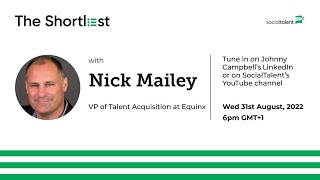
A podcast episode (Shortlist #113) in which Johnny Campbell interviews Nick Maley (VP, Talent Acquisition, Equinix) about building "career pathways" to hire people in transition (military, athletes, neurodiverse candidates, refugees, etc.). Nick describes shifting from screening-out to screening-in for transferable capabilities, creating landing spots, partnering with external programs, re-engineering interview/onboarding processes, tolerating early failures, and iterating to product-market fit. Outcomes reported in the transcript: early pilot ~10 hires first year; program later scaled to ~700+ hires via career-transition channels; Pathways channel yields ~2x higher diversity and ~50% lower cost-per-hire versus traditional channels. He cites partners such as DoD Skillbridge, military programs, athlete transition programs, and plans to expand work on refugees and neurodiversity.
Chapters
Welcome, welcome. Welcome to episode 113 of the Shortlist. My name is Johnny Campbell. I'm your host for the podcast and live broadcast. And this is, as I said, episode 113. We've got a great guest joining us in just a few moments to talk about a topic that I'm really passionate about myself, as I know our guest is. And that's about how do you create career pathways for moments of transition? Those of you listening live, by the way, as we do, broadcast this live on LinkedIn and YouTube every Wednesday, you're more than welcome to join us. We love to have your comments, your thoughts, your interjections, your questions. For our guests, do so using the chat and we'll do our best to respond to them. Any links we reference for anyone, we'll put them out live. Of course, those of you listening live for the most of you do listen on your podcast, we'll put them in the show notes. So let's get back to creating career pathways and those moments of transition. So first, finding the right talent, as all of us know on this show, is one of the toughest things an organization must do right now. And there's a huge need to expand the scope of hiring beyond traditional methods and mindsets. There's this skill shortage. There isn't enough talent to go around. We have record low unemployment rates in the likes of the US where I think we're at a near 50 year low. And you've got to tap into town pools that are perhaps being underutilized. So to do this, barriers have got to be broken down to create access to employment. But what does it actually look like on scale? And how can companies become more innovative in their approach to create talent pools from areas that perhaps, as I said, are underutilized? So this week we're going to be chatting with, I'm so delighted to welcome onto the show. I've been wanting to get him on the show for quite some time. Nick Maley. And Nick is the VP of Talent Acquisition at Equinix. Nick has seen huge success in creating career pathways for individuals who maybe taking a pause from work, maybe they're transitioning from a different industry, maybe they're entering the workforce for the first time. I'm going to be talking about how this changes the kind of standard playbook for hiring and maybe the role of training driving that approach and the importance of looking for soft or core skills when interviewing, which is not what a lot of folks are used to. So we'll take Nick off mute. Nick, you're very welcome. It's great to have you. First of all, where are you joining us from? Tell our audience a bit about yourself. We're who are Equinix. Why are you here today? Why do you think? I'm so excited to have you here as well. And then we'll get into the, into the topic.
Hey Johnny, thank you so much for the invitation to participate. I was delighted to chat about something I'm really passionate about and innovating within talent acquisition industry. And so I'm talking to you from Redwood City, so heart of Silicon Valley and of course from, from Equinix. And we are a leader in colocation data centers globally and you know, global growth. 6, $7 billion company which has seen pretty significant growth. I think it's now something like 77 straight quarters. 78 quarters of, of straight growth. And so we've done really well. Continue to grow globally as there's more demand for digital services around the world. As folks want to continue to connect and use all kinds of online systems and solutions, our business will then in turn continue to grow and develop. And that, that really means that we're going to be hiring. And. So thank you. Look, thank you for the invitation. Delighted to chat with you about this. And you asked me briefly what's going on. I'm wearing a Landmark hat. Landmark College is, is a college. I dropped my son off last week and it's the number one college for individuals that are for neurodiversity and so individuals that might be on the spectrum or have a learning challenge, ADHD or dyslexia and other things. And so I think that sort of plays nicely into what we'll be talking about, which is creating pathways for individuals and thinking differently about talent. Many folks graduating from Landmark, they learn differently and they operate differently in the workforce. And it's probably in part why this is so near and dear to me. My own son is on the spectrum and will find himself looking for opportunities.
In the near future. I'm not sure I told you before, my wife is a primary school teacher, has taught kids on the spectrum for 20 years now and very passionate about it. And again, an area close to my heart and to lots of the team here at Social. Nick, give us a bit of context and maybe paint a picture as to the type of skills that a business like Equinix hires for, type of market you're hiring in and maybe what kind of resources in terms of team, colleagues, support. You have to do that. Just to give us an idea of, you know, the scale of this, maybe even the volume of hiring that you do.
Yeah, look, I mean there's. We hire all areas. They're very technical areas where you have to have real depth and understanding, networking solutions. And so we will hire very strong, I would say network engineers, DevOps engineers as you go up market, full stack software development. So there's a very significant core heavy, I would just say engineering, deep technology. But that's not all that we hire. We're also looking at technicians. We've been looking at, I'd characterize it as unskilled labor. And we will train and develop people and grow them to be technicians and be able to work say within the data center. And then like I think any major company we, we hire, you know, across the board in areas like I'll say gna, legal, finance, HR marketing, sales. And then of course in all of those areas there's analyst enablement roles and things along those lines. And so it does really run the gambit. It's. We do, we do joke around about how broad our job architecture is. I think we have like 1400 some odd different jobs, which is pretty, pretty significant for a company our size.
I think even that variety or number of roles is challenging. But I had a conversation with a leader last week who was sharing an insight in his business as to what the hiring managers thought was a volume role. They hired a very typical role that was like 60% of the hiring. Therefore the spec was the same. The business called it a volume hiring role. And he was talking to a senior hiring manager, a C level person in the business. And he asked the hiring manager to explain, what do you mean by volume? Like, well, it's kind of the same job over and over again. It's easy for you guys in ta and he's saying, yeah, but like we hire in every city across the US and they were hiring all over Europe. He goes, do you know that that role was the same spec? When I go to hire in this town versus this other city, I have to approach completely different. So while it might look like it's the same job, when I go into all these different locations, how I need to find that talent is radically different. Town by town, city by city, state by state, country by country. So added to the role complexity, which, you know, you're not saying you have volume, Rex, you have that complexity with so many geographies. So talk to me about which is the hardest. 1400 different role profiles are, you know, maybe 100 plus locations that you got to hire for cultures and backgrounds.
Oh yeah, it's the hundred And I find it's the locations, it's the I talk about recruiting motions. And first, what you want to define is how, how you recruit and pipeline talent, whether it be new to career or executive. And defining that, that's sort of controllable, which is, you know, what are the channels you're going to leverage to attract talent? How are you going to, you know, interview and assess that talent and bring it on board. And so while I talk about 1400, you can kind of bucket them into 22 areas and then define skills and then assess for them. But what then happens is that you get into the uniqueness of actually trying to attract talent in highly competitive areas. And there's always uniqueness around the channels you really have to exploit in order to win talent. And it's very different whether or not you're, you know, if you're competing for Talent in Germany vs. Japan vs. Singapore or Bangalore or in the Valley. And so, yeah, they're very different dynamics, channels and different things you have to kind of put in play. And it's dynamic where, where it will shift quite a bit. And there are times where, you know, your, your digital approach, whether it be just marketing, may be successful and it's defining channels, but other times you, you need strategic sourcing to engage and, and at times you just need your leaders to engage. Right? They're, they're no longer responding to, to recruiters, but they, they want to hear from actual leaders. And so each, each market has its, you know, unique challenges is what I'd say. And they, and they shift.
And a quick shout out to some of our live audience. We got Rob, Sandy, Erico saying hello in the chat. It's great to have you here and anyone else listening live. Thank you again. Love to hear your thoughts and comments. Nick, this ain't your first rodeo. You know, you've been VP of TA Intuit and plenty of other businesses. And I'm sure, like, like many of our listeners who've been in this industry for a while, we recognize that there is a traditional approach to hiring, which is you get a wreck or a spec from a hiring manager. You talk to her about what she needs, and your default is to go find somebody who does that role in a similar way, maybe slightly junior spec or, you know, whatever it might be, just working for somebody else. And so therefore you're really kind of going, hey, this other company employs them doing this same role or the role just before that. So they're probably good enough. I'll assess for the skills that match. And I'LL move the person in. That's kind of what most hiring is to treat your ta. But what we're talking about, when you tap into various unexploited talent pools where there might not be that match, they haven't got that exact job title, working for your competitor set in the same location. Talk to me about what's different in the hiring process. Where does, where does it begin to verge from your traditional way of hiring?
I find it's almost sort of an inversed approach in driving change. If you're really looking at a new channel like pathways, and you're, you're right. Which is traditionally, you're looking at, you're screening people out, focused on skills, capabilities and experience. And when you start to look at different pathways, you're actually screening in and you're kind of narrowing in on what, what are capabilities that are key? What are those transferable skills that you can bring in depending on the nature of the role, and what are things that you can then teach and develop? And it's more of a. You're moving away from I'm hiring someone or getting hiring someone, that's sort of plug and play. And it's a lot more around how am I going to develop and grow? And so it does put more onus on the businesses that you're partnering with. And look, it obviously opens up sort of the candidate pool, but more onus on leaders to really be thoughtful about how you're onboarding and developing and growing people. And I think it's important when you're thinking about going down this road that it can't just be an acquisition play. It has to be talent management play, if you will. It has to be far more balanced and thoughtful about bringing in talent, developing talent so that they really can flourish. And so it's. I, I characterize it as sort of an inverse sort of approach.
How do you enable a TA professional to hire that way? You know, how do you scale it so that she has an understanding of what's trainable, what's not trainable, how long it's. It takes to train somebody up, how long it takes that organization to train somebody up. What are the kind of, as you said, the, the, the kind of, the softer skills, if you like, that are required here. And then what are the, the influencing skills to then have the conversations? The hiring managers try and challenge their assumptions about how they should hire. Like, how do you scale that? How do you make sure that your TA team know how to do that consistently across the business, across all those.
Role Types I always like to liken it to building a product or service and sort of, you create sort of this mvp, you test it, you get feedback and you iterate on it and you grow over time. I will have to, just to be frank, I have experienced quite a bit of misses in both companies. Last couple of companies I've worked in and developing this and there is a lot of trial and error and you have to, you have to understand that going in it's an environment in which you should anticipate that there's going to be some failures and things aren't going to work out. And so I think the first, first thing to know at the onset is that this is not going to be a flip the switch and just scale. It's. And I go to like, you have to find the right, if you will, product market fit and then grow it. And so it really is true. So the first thing we did was sort of looked at what would be ideal landing places and for people that are either making a career transition or were unskilled and looking at our people have taken a pause or there's, there was, you know, we were like, where do we, where are we hiring new to career and how are we growing and developing them? Because they're getting a lot of support. And that became sort of some of the natural areas that we would lean into. And so these areas where we'd start folks, start folks off looking at what sort of solutions that we provided as an HR organization to onboarding and solutions that the businesses provided to make them more productive very quickly. And so those are the sort of, the first things we did was looked at some of those areas as landing spots for folks where we could start them. And we knew we could really make an investment in growing and developing them. But look, I want to share that when I think about pathways, there's a whole bunch of different channels that we use. There are channels that did not work out, there are partners that didn't work out. And when I started this initiative, getting buy in from senior leaders was relatively easy. When you're sort of sort of saying look at, look at the marketplace, look how inflated salaries have become. Can we look more broadly at talent? We first looked at adjacent industries where there's career transition. So people in different industries but had transferable skills. And in the, you know, the response from senior leaders was relatively receptive. It was sort of getting into the line managers because their work and their jobs changed pretty drastically and their investment and the time investment they need to make. When we first Started off, we just as you kicked off the call, you know, our teams weren't interviewing the right way for these roles. And we, we had a lot of misses and we got a lot of feedback from our partners. We were looking at people the way we always had and I guess maybe embarrassed, but it's a good learning. Like we were interviewing the way we always interviewed. We had to actually shift both the spec. We had to shift the way we interviewed and, and how we hired. And that took engagement from senior leaders to look at sort of what those critical needs were for those roles that we thought were transferable. Meeting with and spending time with line leaders and giving them, if you will, sort of permission to hire people based on some potential in different areas versus experience. We had to retrain people who are interviewing to think different, differently about talent. That was the other thing. And you know, initially we missed. We, we'd bring folks in, we interviewed them and, and we weren't getting hires and we didn't understand why. We did a deeper dive and we found out, okay, it's, it's the way we're interviewing, so we need to shift that. And then we brought in senior leaders. They were part of sort of the debrief meetings we had on interviews and sort of, they helped coach their line leaders on thinking differently about talent and thinking about, you know, the capabilities that we could develop and how we would develop them. And that took that, candidly, it took some time. But then once we were able to do that and then define sort of better define what the new interview process was, what the new capabilities were, we could then begin to scale. And that's what I mean, like trying to find the product fit. It's like, how do you actually do this successfully? We started very small. I mean, we had maybe 10 hires in the first year. And we invested a lot of money in partnerships to make this happen. So the ROI was not there. And there was, you know, there were sort of raised eyebrows internally. You have to justify why you're doing this. Today we'll be hiring in north of 700, some odd folks. They're coming through career transition. So we've been able to scale it, but it's really first it's defining where, it's defining what are the capabilities. We had to re engineer the interview process for folks and we also had to find the right kinds of partners in areas. So there are areas where we could go and engage folks that were returning to work that had taken a pause in other areas, but they had perhaps they had an engineering background. Program management background. And candidly, those were actually easier to onboard and engage. And so that was a channel. And there were specific areas where we knew we'd be successful in onboarding them. And we define that area. And then we expanded what we're doing there. Then we did the same thing, say, for technicians and operations, looked at what specific roles we thought would be successful, evaluated the skills, and did the same thing. But we went through a couple partners before we really landed on the partner that really would work for us. And a lot of that tends to be some of our military programs, programs as well as programs for military spouses. And we're doing that globally. And so we're working with programs like Skillbridge and identifying, you know, different folks for all kinds of roles. We had needs to ensure that we're delivering on some of our government requirements around disabilities. We partnered with athletes career transition. They transition professional athletes that are sort of retiring into new roles. And we work with them almost exclusively on Paralympians. And looking at, we've identified again, landing spots for them, we've found some wonderful areas in sales and sales enablement and in our care organizations where they can have significant careers. And so when I thought about, when you think about pathways better back up, I We created sort of a portfolio of different partnerships and different areas from which we were going to source. We identified sort of landing spots. We then identified how we would train and develop them for each of those areas.
I guess what I'm hearing is that's where the scale comes from. Rather than just be, hey, we have a general approach that's screening in versus screening out. Let's just see what happens there. You've built up learning in how to, for example, best assess that cohort. And then there's probably almost, not deterministically, but there's probably a pathway that is most obvious for those folks into there. So therefore we have a process that, of course, somebody could take a different pathway, but this scales because you don't actually have to fundamentally change absolutely everything. And you're not coming up with blank states every time. You're coming up with, okay, I am. I have interviewed and assessed and presented someone like this before. Many people like this before. And as. As it became more successful to your point after the first year, it probably became easier as you had wins as that scaled up and you could tell the story of, actually, we've hired this person another year in the business and doing really well. Or did that play a part in it?
Nick it did, I'll have to say Give credit to one of the senior leaders on her team. What she ensured that we did for each person we hired is she got quotes from both the hiring leader as well as the person we hired really talking about how important it was for the candidate in particular making this transition and the impact and what you find for folks that have been making this transition is that it has a significant, significant life experience and powerful, powerful stories in providing, you know, new opportunities, new pathways for folks. We leverage those and we would share that, those stories with community. And when I say community it's internal commun share with other managers the experience of the manager and hiring individual. We'd share with that community internally, you know, the candidates experience and the individual's experience. And that really created over time, I think increased awareness, understanding and empathy for folks. But they also were seeing as you were like the success of these individuals and the commitment these folks have within the company that they're working for that has provided new opportunity development and sort of the flexibility as well for them to make that transition into a new area. And it's become now a critical path for the business to meet their deliverables by the end of the year. So this comes from a, you know, something that we felt like we wanted to open up because of the necessity in the market to. This becomes the sort of the critical path for talent in some of our key business areas going forward. And it's a, you know, it's a part of our or core to. I should say not a part core to our strategy in a number of areas.
One of the things I really love about this story of pathways and success, Nick, is this didn't. Doesn't sound like this started as a DEI initiative as it could do. And that would be a noble reason to do it to kind of say let's increase the diversity of our organization, drive more inclusivity. This is a strategic way to solve a talent talent acquisition gap and a tight labor market. It happens to have amazing positive consequences I imagine for diversity and more inclusivity. Have you or your colleagues measure that? Do you look at that other knock on effect to go, you know, is the business just much more inclusive, more diverse, more open minded because of the fact that you probably have a much more diverse workforce and diverse in more ways than other workforces than most.
Yeah, I, I think that's a. It's a great question. It is our most diverse hiring channel. That wasn't the initial driver. It has become sort of as you said, the knock on effect that was. And, and it is leading to a higher engagement from leaders as they're seeing the success in, in. In this initiative and hiring channel. But now, now there's understanding that not only are you hiring great talent, but it's also more diverse, is super compelling and we're seeing a lot more engagement. And now it's sort of building on itself, which is fantastic to see. So here's something that we had sort of really worked hard at, sort of, you know, getting in place and after it being successful, now we're just seeing it, seeing it grow on it on its own. And it's super effective in terms of diversifying the, you know, employee population here, which has been, which has been fantastic and is great. And we talk a lot about how we can better scale this program more broadly than it is today and ensure that we're. In fact, I'll just share. It's two times more diverse. So the propensity to hire historically underrepresented minorities or Women is 2x3 through our Pathways channel than any other channel. And so just from a, if you think about channel performance and meeting any of these dio DEI sort of objectives that different businesses have, this is a sure fire way to make that happen.
And not that this was your intention, but you did mention the economics. Let's say year one didn't make sense and there were some raised eyebrows, understandably. How are the economics looking today? Like if you're looking at this purely from a CFO's office and she's saying, well, you know, is it worth all the investment in opening up these channels? Can we not just hire more recruiters or outsource it to some headhunters or POs at a high level. Talk to me about the economics of this channel now that it's more up and running.
Yeah, far more, far more efficient than a traditional talent. It's half of what a traditional acquisition cost of acquisition would be. It took a lot of investment to get there. But I'll give you an example. Like we work with DoD Skillbridge program. DoD Skillbridge program covers the cost for the first six months for an individual doing an apprenticeship or an internship. And so, you know, in terms of depending on your, you know, your different business needs, that basically means that person can come in, train and develop for free for you for six months. And by the time they've essentially ramped up you and are, I would say, super productive and effective in their role, you're then transitioning them in and just. And so depending on the different kinds of programs you're looking at or want to create. They can be significantly less expensive than a traditional acquisition model. That's not, that's not where you start. Like, you have to know that there's, it's like anything that you're starting in a new business or a new channel, significant upfront, upfront investment. And I'll be frank, we had partnerships that we invested in that were not successful. We just couldn't make it work. And that's the part of where you have to be willing to fail and see it through. I think that we believe, and we say talent is everywhere, opportunity is not. We're going to see this through. We did and ultimately found sort of the right partners. We then defined how best to sort of source in different areas internally and that. And then these areas just became far more efficient for us than your traditional model.
So you said so far, twice as diverse, half the cost. You alluded to loyalty earlier on. Is there a measurable improvement in attrition as well and longevity? Or is it too early to understand that that's, that's another benefit?
Well, I would say my past life would tell you you're going to have lower attrition in doing this in previous companies. But I've only been in Equinix a short time, about three years, so I'd say it's probably too, too soon to say. But the company should anticipate lower attrition as well. I mean, you're going to have higher, higher retention rates. And part of that is based on the commitment the company makes and the investment in the individuals. And there's a higher level of commitment that individuals in loyalty, if you will, that individuals will place in the company that has taken a chance in them and invested in developing them.
Last week at Social Talent, we launched a new course on hiring neurodiverse talent with our partner Theo Smith. And in that, Theo explained a statistic which I've looked into and it's unfortunately true that when it comes to diversity, for example, only about 4% of publicly quoted companies actually make any effort or claim any effort to focus on neurodiverse talent. And when we see as a business, Nick, organizations who come to us to understand about our diversity, equity, inclusion solution, many of them say, please tell me what you do beyond race and gender, because race and gender was unbelievably important. Aren't the only areas of neurodiversity. You mentioned our diversity and different channels. You've mentioned former athletes, you've mentioned the military, you've mentioned those who are neurodiverse, others perhaps we haven't mentioned. I'd anxious to know where else you see talent. I know you said it's everywhere but sometimes people don't have the imagination to really get into the specifics. We look at, for example, those who were formerly incarcerated. We look at refugees, look at individuals from different socioeconomic backgrounds who don't have the same opportunity. So where else are you seeing talent? Either that it's worked so far or your team are investigating as new pathways.
Yeah, well, look, I would tell you but it's going to cost you. The. I think we want to expand into looking at neurodiversity in particular is one of those channels that we really want to explore. I would just take a step back. When you look at each of the channels, we do resource them and there is a component of ensuring that you have someone really dedicated to a specific area. Right now we're spending a lot of time with the refugees. That is a very, very challenging area. As you can imagine, there are many folks looking for work but their situation is very fragile and dynamic. And so that's an area that we're working on currently and looking to grow neurodiversity is. And looking at how best to partner and defining and sort of what that would look like for us. And when I say that it's the, what are the areas how would we engage in? Pipeline, if you will. Talent. It's defining what I call that recruiting motion which is not yet defined. Whereas these other areas are, you know, finding the right fit within the company. An area where we can land individuals and they can have successful, successful long term careers. And so those are the, those are the two that we're going to focus on in the short term. I'm, I'm sure there are others that we can look at but I think, you know, it's sort of you, you don't want to, I, I don't, I don't recommend that you go broad and try a whole bunch of different things, but you focus on a couple and then as you get a certain level of scale or product market fit, however you want to characterize it, then you move on to the next thing. So those are the two that we're going to start working on. Then we're actively working on the refugee and then neurodiversity would be the next.
For those listening who hear your accent, I might anticipate this is a very west coast of the US conversation about channels. I want to go back to your first comment, one of your first comments around just the complexity of locations and can you share any insights as to some of the differences in channels and the different areas of opportunity based on geography? Have you seen any patterns or any differences really? Of course, some are the same. In every market there's opportunity. But you know, for example, well, they're very big.
Like a lot of these folks aren't creating LinkedIn profiles. Right. And so much of the, if you look at your traditional sort of professional recruiting team there, I don't know what the dependency is, but there's a certain level dependency on leveraging things like LinkedIn or Intello or whatever, you know, whatever those other solutions are. And so in engaging with, whether it be like the military or engaging with like professional athletes and things like that, we, we leverage partnerships more so than not. And then we do leverage things like we'll, we'll go on Facebook and was it zing in Germany and some other other different kinds of platforms in order to engage more broadly with individuals than, than sort of traditionally what I see different organizations using.
So it's probably, I don't, I don't mean to use this, this phrase derogatory way. It's more low tech. It's more, less about running a Boolean search string on a database and more tapping into a network, having a phone call with an organization that's tapped into a market and then trusting their recommendations and the work that they do. Is that fair?
It is, it is. You're absolutely right. Yeah. And we work with a lot more different, A lot, I would just say we work with a lot more organizations but nonprofits and into other organizations to help us with pipelining the talent as well.
So if a TA leader is listening to this and she's saying I need to do what Nick's team are doing, talk to me about the role of your peer group and the wider talent organization because obviously this isn't something you're claiming you do on your own. And I know it's something that you don't do just by yourself. You have a whole learning organization, different parts of the organization that have to work together. How do you get them involved? Any advice or tips you can share to other TA leaders that say you are trying to engage in this kind of strategy?
I think the first thing you have to be willing to do is make trade offs within your organization. What I would tell you is you're not hiring recruiters. You're probably hiring change leaders into the organization. People that are patient and are going to work really closely and consult with business leaders. And I think that's sort of the first thing it's the, this is probably not your, your traditional approach and, and so you have to be willing to make the trade off and so I'm sure there are individuals on your recruiting team that can do that, but they, it's a, it's a different approach and they have to be willing to shift and then you as a leader need to be willing to make the trade off and see it through through. That's the, I think that's the first thing I would, I'd say alignment with you know, your E staff or business leaders of course is critical in other, in any major initiative. But this is a significant, significant change and change management professionals, if you have them would be key in pulling in to be a part of, of the process. The other thing is it can't just be an HR program or it will fail. And so pulling in, depending on the setup within your organizations, your talent management professionals, but also within the businesses there, there are typically training and development leaders and specific programs in place pulling them in to get buy in and understanding what can be delivered for, for individuals becomes super important. And so it's like any other major initiative you might be rolling out in a company. You need to bring in key stakeholders and stakeholders that have, if you will, they're going to have stake in the game. So talent management L and D professionals in the business, client services like your HR business partners to understand sort of what's happening, how they can help in terms of capabilities and skills that you want to focus in on. Obviously your key business leaders that becomes critical and then communication is super important now. Being able to communicate and give updates on what was successful and what wasn't successful and why is key. Bringing them in might create more drag so you might not move as fast. But bringing leaders in leaders actually started attending debriefs and that's where we sort of determined hey, we need to interview differently. We're going to, we're going to rework the way we interview. And so when I say alignment you also want them to commit to this, these leaders as well and participate in, in these things. And that's really how you sort of get it set if you will or harden, you know, this new process or practice in the business, I think that was, that was pretty critical for us. So willingness to make the trade off, bringing in key stakeholders, really pulling them in into areas they're probably not used to participating in. Normally it's very much slow to go fast very early on and there are going to be times where things don't work out and I would that's just don't give up. It's sort of find the either the right partner or the right area and and or be willing to shift the way you're assessing and what capabilities you're looking at.
I love how faced with the challenge of a skills crisis and lack of talent pools out there, you managed to halve the cost of acquisition from a channel, double the diversity drive, better engagement and skill development in your own team, better inclusivity and probably happiness in the workforce, anecdotally reduce attrition. It just genuinely seems to be so much so well worth the effort. But I think what you're saying is it's not going to be a quick win. This isn't a give me results in three months or six months and it does require very strong leadership that keep pushing and as you say keep going on even in the face of failure, adversity, perhaps lower turns at the start. I guess if you look at any great innovation today you look at the sequencing of the human genome which you can do for 100 bucks today. It used to cost millions but yes, severance and scale make it, make it, you know, give you the affordability and the return but you're not going to get it at the start. You have to push through that. Like I feel like I've, I've been greedily asking you and stealing tips from you for the last 45 minutes but I'm going to be greedy for we are at the end of the show. Can't believe we're at 45 minutes already and we're at that point where I have to pause and ask you one more time if you can to leave our audience with one last tip, one last piece of advice. Whether it's advice that was given to you by appear somebody work with or just something you've gathered through your own experience that you can leave our listeners with today.
Yeah, look talent acquisition I think is the most rewarding job in a company. You are creating careers for people that are life changing and super impactful. I would say my, my advice is courage of your conviction is really it seeing something through and really going for it. Have no like I just have no regrets and I think about the path, initiative, courage of your conviction. For me it was making trade offs in the team to make this happen, seeing it through and having you know, no regrets about that. And so for, yeah so for each of you it's the same have the courage of your conviction.
Nick, it's been a pleasure hearing the story of pathways success. I hope many listening or and even one person listening might take the inspiration to say we can do this in our organization and follow your lead. I think it's been a pleasure and thanks so much for taking the time out. Now your schedule is insane but hopefully it's been well worth it and we're going to get the return and hear about how somebody else did the Nick Mayley pathway journey in the future and offers talent and opportunities to much more under service markets and folks out there.
Wonderful. Thank you so much for this opportunity. Really appreciate it Johnny. Thank you.
Thanks Nick and thank you for listening and joining us here again this week for hopefully what's been a really informative episode. I know I've really enjoyed the conversation. I think it's a fantastic story and highly replicable in your business, in your TA team. If you are like most companies out there, struggling to understand where you're going to find all this talent from, here's a way to do it that will lower your cost, will double your diversity in the long run. But it's not for the faint hearted, only for the brave. So thanks for listening. We're going to be back next week with another fantastic show, again focused on the future. And we have the wonderful Christoph Niebel, who you may remember from one of our first shows many, many years ago. He's the president of Pontoon Solutions, really looking at scale, enablement around recruiting and supporting services for businesses all over the world. And Christoph is going to be sharing his vision of leading a workforce of the future. And Kristoff, if you haven't heard him already, is really a disruptor. Not afraid to shake things up. Real visionary in my opinion, on the way he thinks about talent and the future. Not afraid to take chances. You'll hear his vision and what he's doing at Pontoon and how he's working with Pontoon's clients on next week's show that's going to be broadcast live on the 7th of September. You'll catch that at 4pm UK Irish time. It's 11am in the east coast and it's 8am on the west coast of the US. Or if you can't join us live, please do check the podcast which will drop in your in your podcast app come Wednesday evening, Thursday morning. Until then, take care.
Sam.
More from Johnny


Where Does Your Hiring Stand? Diagnose It with the Maturity Model | SocialTalent

Where Does Your Hiring Stand? Diagnose It with the Maturity Model | SocialTalent






NEW CONTENT - How to use Generative AI for Recruitment Marketing with Glen Cathey | SocialTalent

NEW CONTENT - How to Use Generative AI for Sourcing & Recruiting with Glen Cathey | SocialTalent

NEW CONTENT - How to Unlock the Power of Generative AI with Glen Cathey | SocialTalent