Creating Sustainable Talent Strategies for Long-term Business Success with Virginia Tirado
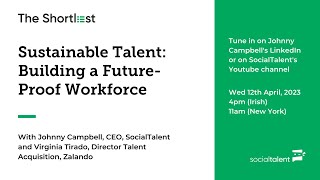
A recorded episode (episode 136) of Johnny Campbell's Shortlist podcast (recorded April 13, 2023) interviewing Virginia Tirado (Director of Talent Acquisition at Zalando; formerly head roles at AWS and Amazon). The conversation reframes "sustainability" to include talent—treating people and human potential as precious resources—and argues for internal mobility, upskilling and holistic workforce planning (people, process, technology) to reduce waste from churn. Virginia describes Zalando's women-in-tech six-month bootcamp (first cohort of 20 graduates who were guaranteed roles if successful), advocates cross-functional workforce planning (TA, HR, finance, business partners), and critiques rapid layoffs in tech as short-term and damaging. The episode emphasizes measurement, leadership buy-in, and long-term investment in people as part of an ESG-style agenda (diversity, wellbeing, purpose).
Questions this video answers
Episode 136.
April 13, 2023.
Director of Talent Acquisition at Zalando; formerly head of commercial technology recruitment for EMEA at Amazon Web Services and head of executive recruitment for EMEA at Amazon.
Six-month bootcamp; first cohort of 20 women graduated and were offered roles if successful.
Chapters
Sam.
You're very welcome. It's episode 136 of the shortlist. I'm Johnny Campbell. I'm your host for today's podcast and live broadcast and the CEO and co founder of a company called Social Talent. And today we're going to be discussing sustainability. In particular though, we're going to be talking about sustainability, sustainable talent, and how you create sustainable talent strategies for long term business success. You've no doubt heard of sustainability in the context of our environment. You perhaps work in an organization that's focusing on sustainability in the context of the environment, on perhaps how you're basically driving more sustainable usage of energy in your business, how you interact with your customers and the world and your products. But not a lot of people talk about talent when we talk about sustainability and how you actually build a dynamic and sustainable talent ecosystem that sets organizations up for current and future business success. Our guest today is going to help us dig into this topic. I'm delighted to welcome a good friend, Virginia Tirado, who's the director of talent acquisition at Zalando. And prior to Zalando, Virginia was the head of commercial technology recruitment for EMEA at Amazon Web Services or aws, and before that the head of executive recruitment for EMEA at Amazon. And Virginia, to me has been somebody who has epitomized the example, what it means to operationalize things in talent. So a lot of people talk about ideas. To me, Virginia is somebody who actually gets stuff done and turns that into practice. So I'm really keen to dig into this topic with her. Virginia, it's such a pleasure to have you here. You're very welcome. Perhaps you could introduce yourself, explain where you're joining us from, a little bit more background on you, your, your personality, your family and why this is a subject you're so passionate about.
Thank you, Johnny. I'm super excited to be here. So, as you said, I'm Virginia Tirado. I'm originally from Venezuela. I grew up in South America, but I've lived my adult life half in the US and now half in the uk. I'm actually speaking to you from my little London flat where I'm very excited to actually be enjoying some interesting weather. Spring weather, but hopefully it's only going to keep getting better. I have been with Solando for the past three years and I've had the opportunity to do some really cool things around talent at Solando. And I think that the topic is quite relevant today as we look at the ambiguity that continues to happen in the market and all the changes, particularly in light of the layoffs in tech and so on. It's like, you know, the questions we keep asking each other as talent executives is, you know, can we be doing things a little bit better? What can we learn? And how do we actually prepare for the workforce of the future? So it's obviously a topic that's very close to my heart and that I, you know, take also lots of time investing in looking at how to advise my stakeholders and our company to do things better in this space and love to share some of my lessons and maybe, you know, learn a few things from the audience as well.
So when we talk about sustainability, and by the way, the audience who are listening live, those of you on LinkedIn and YouTube, you're very welcome. We'd welcome your comments and thoughts and questions for Virginia as we go through the broadcast. Any links we might share, we'll put them in the show notes for those who listen to the podcast as well. So, Virginia, when we think about sustainability, again, most of us think about the environment and we think about renewable resources. We think about great examples. That one that was mentioned to me last week that I love and I saw in a. In a restaurant in Amsterdam was a toilet where the wash basin was on top of the toilet. So your water came out, you wash your hands, and it fills the toilet. And I loved it because rather than the water being wasted, it went into the cistern that then was flushed, that cleans the toilet. And I just love that kind of reusing of water, you know, a resource that is becoming increasingly more precious or we talk about solar energy and different solar energy sources around sustainability, but we don't often talk about people in the context of sustainability. So walk me through why you think that is. And, you know, at a high level, what is your kind of view of what sustainable talent is or isn't?
Yeah, it's a really good question because I think that, you know, we particularly, over the last three years, you know, the world has changed at such a pace that perhaps we do things that are part of our sustainable talent strategy, but we're not aware of it. Right. And I think that it's really understanding the reason. We protect our planet and we protect wonderful resources like water. Right. They are precious to us. Right. When you think about people and human potential as precious resources, you realize, particularly in many of our companies, that, you know, what would you be doing without people? I mean, people. When you think about people, profit and planet, you know, without people, how do you drive or improve any of these aspects Right. So the conversation has changed because as you see more and more our own ESG agendas or strategy, right? Environmental and social and governance agendas, we are worried about dni, we are worried about well being and balance, about trust, transparency, empowerment, growth, organizational purpose. All of these different things are asking, are making us ask the right questions. And it is questions around how do you do this without bringing people on board? And I think the way I see sustainability, if you think about the actual ESG agenda, when you think about the employee engagement and the empowerment, when you bring these three things together, you start thinking about the workforce of the future and you see this sort of juxtaposition of all of these or basically the junction of these topics coming together and it is changing really what people want and what we can give everyone in order to retain that, that engagement, right? So at the end, sustainability is about reducing waste. It's about becoming much more conscious about the environment. And that environment is not just the planet. It's really everything from our supply chain, from our, you know, our office space. From every angle that you think about it, there is inter, you know, there's interrelation that, that really comes to life in the workplace.
So I'm an ex recruiter, right? That's my background. I worked in recruiting. And recruiting is for the most part everywhere in the world about hiring external talent to come work for an organization. I did this, the people I worked with did this, I trained people how to do this. And if you think about an organization, an organization typically has a need. They're growing the sales team, they're growing the engineering team, they want to develop new products and they say, well, let's get new people to do this. And they go to market and they find talent typically from some other organization that they spend money to bring into their own organization. And in the same breath they have a whole lot of people exiting their organization. And the number one reason that people say that they move on from jobs is around the world is lack of career opportunities. So you have this dilemma, which I've always found fascinating, whereby we are constantly trying to bring in all these external resources whilst we are churning through talent who already work for us, who have had loyalty to us, who have certainly at some period enjoyed working for us, no doubt have delivered for us, many of them, and they're leaving because they don't have any anywhere else to go. And it seems that this is, this is kind of wasteful, you know, one of the most basic wastes in there because, you know, to try and bring somebody New in, onboard them, acclimate them to our culture, environment, get them to know, settle in, deliver. You typically don't get delivery of anything worthwhile within 6 to 12 months in most professional roles. So there's a lot of effort put in to try and bring something in. Yet there seems to be a lot less effort put into trying to keep something that already works extremely well. So, so how do you connect those two challenges? The challenge to get people to do things that they're not doing today and then the challenge of people leaving us because they have no opportunity.
Yeah. So I think, you know, there's some great companies out there that already are leading the way in some of the, in how you think about this, right. I mean we've been talking about the gig economy and we've been talking about internal mobility and we've been talking about having, you know, skill sets and how the world that's outside, you know, once you bring it in, you know, what do employees want today? But I think that, you know, as humans, sometimes even the way we think about things, you know, I'm in the fashion world with Zalando and you know, I was with Amazon before and the innovation side of things, one thing that we may be doing wrong in many places is that we always think that new is better. And when we have, you know, as a recruiter, right. When you have a, when you intake a role in many companies, you know, you don't even take the time to look at, you know, do we have people internally that could be doing this and you're thinking, okay, I just need to go outside, I'll publish this role and get a bunch of applications and if some internals come in because we, we just don't stop and really look at it holistically, right. When you, when you look at some of the, you know, I've got teenage kids and I've just come back from Paris and it's quite interesting. My, my 17 year old daughter did a lot of shopping, but all of her shopping was around vintage. And you know, going all to all these amazing shop, it's a new way of looking at things, right. When you think about shopping, it's not necessarily what you thought you would do is going to a secondhand place, right. And it's giving, you know, if you think about that same concept and bringing it bring into, you know, giving life or a new opportunity to an old piece of clothes, right. Think about how exciting it is to, you know, the sense of accomplishment when you've done this, right. But think about actually Transferring that into what we as recruiters can do for talent, for our wonderful talent that like you said, knows the company is probably being, you know, courted by externals, right. For other offers and, and sometimes doesn't feel internally the recognition because they may not be aware that there might be a role that is open, that there's something else that they can be doing. And their development opportunities are only sort of taken into account twice a year when they have a performance evaluation or conversation with their lead and not beyond that. So I think that those that are doing it well, that are really thinking already ahead and moving talent, really looking at the internal talent with that precious resource lens. There's many great companies out there that are doing it. Unilever, for example, or if you think about SAP, has an amazing strategy around people sustainability. It is about understanding how much you as a company have already invested in that talent and the return on investment you have by upskilling or reskilling some of that talent. There's a lot of data, Johnny, out there to show that when you actually give somebody the opportunity, and I'll get into a little bit later into what we've done around women in tech and the agenda around upskilling women talent at Zalando to give them an opportunity to do work in the tech field. You raise engagement, you raise loyalty, you raise also the retention period of that, of those folks within. So your investment, you know, is, is actually extended in time as well by getting that additional return, you know, and not having that churn. Now I think that one thing that we can do about this is really, again, because we are data driven in many, you know, and that is super important is to really show this value, right? Show what you've invested, how many years somebody has had in the company. What does that mean? How does that translate? And sometimes just putting some numbers will also help your leaders understand that new is not always better, although there is opportunity for new talent and we do need to have a percentage of that coming in. But I think it is about having those conversations about showing that they're not mutually exclusive, that, you know, there is place for new talent. But there's also an opportunity for us to think about talent going forward in a way where, you know, you can renew yourself. I've been very lucky. I mean, we've only talked about my experience at Amazon and at Zalando. But, you know, I worked for many years for a company like Oracle, which I felt, you know, that the sustainability of talent was something that I've lived in my career Much, you know, earlier because I was given the opportunity to take on brand new careers within the company. And I had a wonderful 16 year, 16 year journey where I ended up, you know, moving from law into business operations and then, you know, business operations into, into recruitment. And that's how I ended up where I am today. And I would forever be grateful. Right. And always think about those opportunities even after moving on. So I think that it is about that.
So what are some of those obstacles? Like if the benefits are obvious? We've mentioned them many times in this show before. What are the big obstacles? Why don't enough companies do what Unilever or SAP are doing?
Well, I think when you think about business transformation there are three areas to think about, right. You always think about technology, you think about the process and you think about people. And many companies are really good at investing in the technology, maybe rethinking about the process and looking at people, but doing it in a way that you have a flywheel that truly supports your process requires that you do some planning on a long term. What happens today and especially over the last three years is that every couple of months we end up having something new hitting us, right. And then we move on. We have a strategy, but we move on from the strategy to, you know, tend to the most recent, whatever crisis is. And I think that if we, if we're going to be successful at changing the way we go around talent, we really do need to think about workforce planning for the future very differently. And it has, you know, it takes time. I mean when you think about Unilever, for example, you know, or SAP, I mean these are companies that have people strategies, right? They that actually feed their workforce plan and they have either long term, you know, investments on early careers, they have long term investments on upskilling programs. They, it is about really looking at this not as quick fix. And I would love to talk a little bit more about, you know, some, some of the things that I've seen today on what's happening with layoffs in tech. But I think eventually it is about that. It is about understanding clearly where you want to be as an employer, what it's going to take to take you there and then work backwards but truly stick to it and not drop it as soon as a crisis comes up.
So that workforce planning piece is interesting because I know most organizations definitely develop a hiring plan. They often talk about a workforce plan. But for most of the TA leaders certainly that I, that I have spoken with, there's a hiring plan. It's very Focused on external. It gives them a headcount number and they go off and work on that for the year and, you know, to whatever degree of accuracy, but it's not really ever connected to L and D and other parts of the business to really kind of look at what I think you're pushing out, which is a more holistic workforce plan. So define to me what a. What a more holistic workforce plan looks like, who gets involved in building that, and what are kind of some of the outputs of that plan.
Yeah. So by no means can I really say that, you know, we've got it down to a science and we're experts or perfect at it. Right. I think there's. It's. It's still a process that it's evolving. And like I said, we do also have other constraints. Right. Every. Every company today is facing a number of other factors that perhaps, you know, need. Force you to take a, you know, take a pause and rethink. But when you look at workforce planning, I think it's important that, you know, you work very closely with not just your business stakeholders, but I think as supporting organizations. One thing that has been super important for us is to come together in all our central functions, right. Whether it's talent, acquisitions and your business partners on the colleagues from HR as well, with your finance colleagues, really thinking about, okay, if this is where we need to go, right? And these are some of the things that we consider strategic, whether it is, you know, we want to hit a certain diversity goal, we want to have this amount of people in leadership, you know, under these underrepresented minorities, etc. We also want to make sure that, you know, we understand what percentage of our revenue we're going to be spending, you know, on payroll, etc. So let's think about that and start working backwards and say, okay, within three years, this is where we want to be. And how do we do that? You know, first of all, if. If we, if we just are given a number as a TA function from our finance folks and we are not working together to understand how we get there, you know, what are the things that we're going to do, how do we make. Make sure as ta, we also help with some of this agenda, right? Be happy to take on targets around our internal mobility and ensure that we actually know, work on those targets. Right. And so on. You need to break it down. You need to also understand what role you want to play and how you partner, how do you make others accountable. So when we work together on a strategic plan, for our workforce and even our blueprint for our recruiting strategy. We also make sure that I have validated this and work very closely with my business partner. Whether it is looking at my attrition, looking at my promotion velocity, whether it is looking at my DNI targets, whether it is looking at what are the things that are going to be important for me this year and how we're going to get there. And I think that if you do have that plan where you truly are thinking about it strategically and holistically, you can make some really good progress. Now, if you just execute and deliver a number that's been given to you, then this is where you get into trouble, right, because you're not having the conversations and you may end up in a place where you know you'll have to make some difficult decisions at the end of the year.
On a previous episode, I shared with our listeners an initiative that Amazon have had running for a few years around upskilling internal talent to be software engineers. And one of the stats I thought was really uplifting, I read recently was that something like 62% of the folks who've gone through that program came from their hourly workforce. So they were taking two thirds of the software engineers that were literally creating from scratch came from a population that you wouldn't necessarily think are software engineers. And on average, their salary went up double in this transformation. And I bring that up because you mentioned earlier on some of the initiatives you've run in Zalando, for example, with women in tech. Tell us a little bit more about those initiatives and how you've created sustainable talent within Zalando already.
I think that's a great, you know, it's a great way of bringing this to life, this topic to life, right? To see how you can make this happen. So when you think, for example, about DNI and you think about underrepresented minorities or just gender, if you just look at, let's start with women in tech, which is an easy one to measure, and it's probably, you know, as important as other underrepresented groups. At Zalando, we don't have an issue when it comes to women. Right. We've shared this out. When it comes to diversity, you know, our workforce is pretty split. And similarly to Amazon, when you think about this, I was also part of very early days at Amazon of looking at how we worked with increasing, you know, diversity in our tech world. And. But when you actually de average the information so that population, as you go into the tech space, you realize there's less representation in the tech jobs and more specifically into certain job families within tech. So you probably won't have an issue with product design, but when it comes to software engineering or applied science, we are underrepresented. And what a great way of thinking about where can you get talent that is already invested, understands the culture and actually wants to see Salando succeed. Well, within the same ranks of Solando, there were many Salandos that already had aspirations to eventually learn to code or were teaching themselves coding. And we opened up a program where we actually initially just looked at it for Solando women and invited a cohort of women to apply to this program where we put them through a six month boot camp but wanted to make sure that at the end they would have a job. So what we did is before they go into the program, we already had hiring managers that agreed that if they were successful in the boot camp, we'll give them a job at the end. And I'm super happy to say that we've just had our first cohort of 20 women graduate from this and actually are actively already working in, in this space. And it wouldn't have been possible without our leadership. Right. Because I think that this is also super important for some of these things to be effective or become reality. You know, you, you need change in, in leadership, the way that leaders think about some of these programs. You need change in the culture, the way the hiring managers think about how they are going to support, you know, women that are coming from a different background and actually didn't go to university for four years to study computer science, but went through this for six, six months and give them the same opportunity. And then that employee engagement. You need employees that could believe in this program and want to be part of it. And by doing that, Jonny, you see that it is possible you actually have shifted, you don't have an issue with the population, but you are shifting the population, the talent to where you need it most. And you're also, you know, now have trained these, these women to be even more productive at Zalando because they're engaged, they're excited. If we hadn't done this for them, they would have probably continued on their path but eventually gone elsewhere. And I think that that is that the bit that is exciting about thinking about how, what are the ways we can think about, about, you know, bringing the sustainability of talent agenda. Right. When, you know, when you look at some of the data out there, you know, there's the World Economic Forum and you see all these data, you know, about how Many millions of jobs we're going to have globally in like less than seven years that basically we won't have anyone to fill them. And it is about understanding what those skills are, right? So imagine in this great layoff that we currently have today, if companies can think about better ways of doing this. It's like, you know, what can we do with this talent? Some of the talent that's getting laid off, you know, can we retrain them, can we upskill them so that we don't lose all of this valuable talent but because we are acting without a long term strategy many times and we're rethinking how we need to prepare for some of these things. A lot of these decisions are taken quite quick and sometimes people find out that, you know, like you see the examples of Google and others where people just found out when they showed up at their office and you know, they had no email. If instead, you know, you spend some time thinking about bringing TA, for example, to the table to have the conversation and bringing your talent managers and your business partners, partners and looking at, you know, this in a holistic way, can you think about doing something completely different? I was very curious. I let this, I read this article that came out at the beginning of, of March in Time magazine about how, you know, you know, basically big tech, you know, has this layoff all wrong. And I was curious to see that. There are studies in research where it's been shown that three years later when many of these companies do these layoffs, they end up not having the financial benefits that they thought they would have because eventually they have to rehire people, they have to retrain people. But not only that, when you've gone through a layoff, you have now demotivated employees. People that are worried, their productivity goes down, they're disengaged, they're probably looking for another job. They and your customers will also suffer because you've got, you know, it's like a domino effect. And even though there's data and we know about this and we've been going through this for years and especially in tech where, you know, companies like Google always said, you know, we're going to be a different type of business, we're going to show corporate that you were different, right? And they still end up doing this, I think there's some lessons there for us to think about. How do we actually want to approach this in the future? Because it's just insane. You know, we keep going through these waves and there is an opportunity for us to do definitely things differently, but how do we make it happen? And I think that that's the kind of conversation I would love to engage with others to see, you know, how are they tackling it.
I agree that there's a real challenge there and the data is consistent over multiple periods of recession going back decades, that organizations that held on to the bulk of their staff, sacrificed short term profit to hold on to their people, came out of the recessions booming and that growth more than made up for the short term temporary losses. Whereas organizations who cut, particularly those who cut deep to try and protect profits in the short term, always, always fell behind. Because the other companies that had held onto the talent, to your point, they would come out of the blocks, you know, racing because they have all this pent up talent waiting to, you know, take advantage of a growing market. And so despite the research, despite this becoming something that's taught in business schools, you still see this, I think shareholder pressure to, to cut costs, to cut staff. And to your point, that leads to, you know, the businesses, the business is impeded in terms of how it can grow coming out of a down period, but also reputationally it can be extremely challenged, especially in the kind of open media world we live in today, where it's not just the people you laid off who won't come back to work with you, it's everyone they know and who hears about that layoff, you know, that makes it all the more difficult from a brand perspective, employer brand perspective for those organizations. So when you think about the current round of layoffs in tech that we've seen over the last near year, tell me about any examples you've come across where organizations are doing it. Well, like what's a good way to exit some.
More from Johnny


Where Does Your Hiring Stand? Diagnose It with the Maturity Model | SocialTalent

Where Does Your Hiring Stand? Diagnose It with the Maturity Model | SocialTalent






NEW CONTENT - How to use Generative AI for Recruitment Marketing with Glen Cathey | SocialTalent

NEW CONTENT - How to Use Generative AI for Sourcing & Recruiting with Glen Cathey | SocialTalent

NEW CONTENT - How to Unlock the Power of Generative AI with Glen Cathey | SocialTalent