Discussing gender beyond the binary in the workplace | with lisa luxx
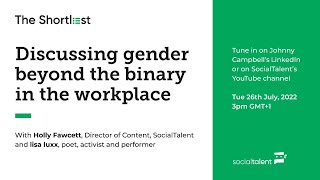
Lisa Lux, a poet and activist, talks with Holly Fawcett about gender beyond the binary at work. She uses she/he pronouns and explains why dress codes, gendered language in policies, and who gets spoken over in meetings all matter. Real fixes: let people self-identify in HR systems, protect non-binary workers in policy, and make pronoun practice normal instead of performative.
Chapters
Hi, everybody, and you're so very welcome to this week's edition of Social the Shortlist. My name is Holly Fawcett. I'm the director of content here at Social Talent. And today we're going to be discussing Gender beyond the Binary in the Workplace, which is a really interesting a title, I suppose, certainly for those of us who would think of gender as a reasonably binary option between he, she, et cetera. But now we know there was obviously lots of exploration outside of that, and it's a topic that not many of us are terribly familiar with, but I know a lot of us have questions about it because discussions about gender are everywhere in society. As we continue to make a lot of progress about things, we're building out our understanding about, about how people experience life. It's essential to keep those conversations going, particularly in our workplaces. Gender identity and gender expression form a vital component in how people show up in their lives and, of course, at work. And it's important for companies, for leaders, for organizations, for colleagues to be informed if we want to have and create inclusive work environments. But it can be a tricky topic to navigate. So to help us with this, we are delighted to welcome Lisa Lux to this week's episode of the Shortlist. Lisa is a poet and an activist whose work has been broadcast on Channel 4, on BBC radio and with TedX. We're going to be chatting about different forms of gender identity in the context of the workplace. We're going to be examining gendered language, clothing and policies in workplaces as well. Looking forward, looking at expressions of allyship. So, Lisa, you are so very welcome to the show.
Thank you very much. I'm really glad to be here and to be in a space where there is curiosity around this as well, lots.
Of curiosity, of which I am one of those curiosity people. So, Lisa, your pronouns, as you can see on your screen, or she, he, can you explain what those pronouns mean and how you experience your own pronouns?
Absolutely. So it took me a long time to kind of come out as she, he, though I was experiencing it and expressing it in my more intimate circles and my queer kinship, as we call it. But the way in which I experience that is I like to play within the binary. I like to watch cowboy films as a kid, and I think that's the moment when I first realized that gender was a thing. Being like 7 years old and watching these cowboy movies. And all of a sudden gender became a concept to me that I obviously wouldn't have been able to word then, but I realized that I would Never be the men on the screen. And so thus came this split in me where I was always part cowboy and part not. And it's taken me till later in life and a lot of journeying with that to be able to start to reconcile that divide and be able to be public about using he and she and the fact that I move between them. And at certain times, I feel much more in my masculine, and at other times, I like to play within the feminine. Now, you know, there's much to be said about how I am reinforcing a binary here, and I'm doing so as a playground and in a very experiential way. But you would refer to this identity that I'm expressing to you as gender fluid. So it's about that fluidity and moving between pronouns. I often say my gender. It really depends which way the wind blows. You know, some days I wake up and it's that, oh, big man today. You know, and it's all just very playful. It's very playful.
I think everybody wakes up in the morning and on the way the wind blows experiences how they want to express themselves that day. Sometimes we wake up and we feel, you know what? Today is a day we're going to go all out and. And dress up. I'm really gonna make, like, an effort today to look done, shall we say, whether you identify as gender fluid, male or female or masculine or feminine, whatever those words mean to you in. In that, you know, sometimes we do have those occasions, or the way the wind blows, sometimes they're like, oh, I'm just gonna be a pajama day today, you know, Is that what you mean? That sometimes it could just feel a little bit more like, this is how I want to express myself today?
Definitely. I would say that it's that it can be more innate than that, because it can be a sensation that I feel in my body. And I talk about this notion of a. Of a phantom body, which is this sensation that there is a. What would be. What would be, you know, considered a masculine body. About the way that I move from that day and the way that I feel my body and sensation that I have, and I find myself holding myself different on those days. And, and. And it's. It can be a very physical experience. But at the same time, I really like that you use this example because it brings us closer to understanding that we all have this nuance in the way that we navigate the world. And sometimes, like you say, sometimes you want to dress up. Now, I'm very aware as that we Also, even subconsciously consider this in terms of our safety in the spaces that we go. Like, I have some. Some friends who identify as cisgendered female friends. And we can. We can break down these words after, but let's just say they. They don't identify as queer who will talk about going out late at night if they need to go to the shop or run an errand later in the evening, that they will wear more masculine clothes and square their shoulders. And so we are all, in some way, navigating society through pushing and playing with gender. And that's always been a part of society. We've always played with that. We've always known that gender is this paradigm, this ritual in which we set up as a. As a social organism, and that it's ever changing and that there have always been individuals who play into it, who play against it. I mean, we. You know, we saw it right back in Shakespeare. You know, we've got long histories of people navigating the. Yeah. The social constructs through queering, basically.
So you're using the word queer a lot, which is wonderful, because it does have. I do have a question about. About queerness and queer. Queer, full and everything else. But this word used to be. Used to be a bad word. It used to be a word that was highly derogatory, and it's almost been. I don't know. Am I right in saying it's almost been recaptured by people in the LGBTQ community who say, no, no, this is actually. This does very much represent who it is that I am. So can you maybe define what you mean by queer today versus maybe queer 40 or 50 years ago, when it.
Was very much considered a bad thing? I can. And I'm gonna. And I'm gonna respond to this kind of drawing on a lot of queer theory as well. Now, I want to acknowledge the fact that older members of the LGBTQIA community will certainly have their own feelings about this word, and that that's completely valid. However, the way in which I personally write about and theorize and experience queerness is not as a noun. So that is to say, I don't use queer as my identity. If you've picked up on. On what I've been saying, I've been talking about navigating. Now, to me, queer is a verb. So queer is the way that I orient myself in society. So that is to say there is furniture set up in society, and it is set up. You know, let's say our social world is a room, and somebody has dressed that room and Somebody has put the furniture down and around in that room and if you flick off the light, if you're very familiar with that furniture in that room, if that furniture was put in place for you and that. And you have had a long standing relationship with the way that room is set up, therefore you are probably cisgendered white and have forms of privilege which that setup has afforded you. Right. So you can check off that lie and you can walk through that room probably without tripping up or falling over something. We know this when we've lived in one house for a long time that we, we become very familiar with the, with, with how things are arranged. Some of us that furniture wasn't really set up for us. So we have to reorient ourselves and we have to find new ways to navigate our way around that furniture. And we do this with language, we do this with expression and various other ways. So for me, queerness is part of my politics. It's the way that I move through the social fabric. I move through this, this, this communal space that we have rather than it being a noun. Why is that really important to me? Because queerness is, I like to say, the indefinable. So it ought not have a definition. Why? Because once something has a definition, it can generally be co opted. And if it's co opted, then it becomes finite. And what queerness is about for me and my community is about the infinite. It's about the endless possibilities. And you can't have endlessness, you can't experience endlessness when you have a definition and therefore a box around something. So it's this idea of dis. Identification as well. Which is why I like the slipperiness of she he. You know, kind of consistently evading what you thought you just caught me in. I like that. I really like that. Because it feels very Internet.
Yeah. And unexpected and unpredictable and therefore imagine Imaginative certainly allows a lot of space for imagination, as you say. It can be.
Yeah.
Interesting. And a space where people can draw new conclusions and create new things. And I really like that space. That sounds interesting to have.
It does. And we all want that, do we not? Especially. You know, you work on a project, you work on, you build your own organization, you have hopes, you have aims. Would you not want for the notion of infiniteness to be like, central to that and imagination? Like. Of course we would. We all want that. Like, it's very much core to our, to our life drive. We're so afraid of, of end of the ending. We're so afraid of the finite actually you know, infinite is really part of like what we, what we long for in life. So in queerness, in the, that we're integrating that into our social life and into our professional lives is, is really about embracing values that we, that we, that we all long for, even if we're not recognizing them in this particular movement, even if people are not quite recognizing it in this. That's one thing that I want people to understand is really central to it. Even, even, you know, get past all the obstacles of getting things right and wrong. Central to this is the feeling of openness and infiniteness, you know, so I.
I mean, I like that you're putting that into a work context because that is important, right? Why is this important for us to be or to recognize and understand what gender in the binary form, as well as gender in a very non binary, open, endless form could mean for the workplace and for how we navigate work. Because, you know, sometimes those things are, are in conflict with one another. Also sometimes people think that they're inappropriate to discuss at work. You know, I personally don't agree. I think it is appropriate to discuss things at work because they relate to how we are human and therefore it's a very human endeavor. But can you maybe talk a little bit about how and why organizations really could look at understanding gender a little bit more? Maybe some examples of where organisations are very rigid in their thinking and how that's perhaps not the way they need to go forward?
Yeah, absolutely. And one thing I'll say to speak to the notion of these conversations being inappropriate in the workplace is I think people tether in their mind gender with sex. And I don't just mean with the sexed body as in with male or female, but they tether it to the act of sex for some reason. And that is problematic in the mind, in the fact that they're thinking like that in the first place. Because you are, are being identified as man or woman if you're consistently being deemed within your kind of. You. The way in which you enact in your intimate, in your intimate moments, in your intimate time, that's. That shouldn't be in the workplace in the first place. You know, that shouldn't be how you're thinking about a cisgendered person in the first place. So why would you do it? To me, you know, it's. My gender is not to do with that. That's not, that's. They're not the same thing. You know that there's, there's people who consider themselves queer who still maintain relationships that are inherently look heterosexual. You know, it. That's. It's not what we're talking about. And, you know, we. Gender is already a massive part of the workplace. Just because people aren't talking about it doesn't mean that it's not right at the heart.
It's of.
Meeting rooms are right at the heart of policy. So two examples, one being dress code. You know, I mean, not every cisgendered. And. And so by cis, I mean somebody who goes by the gender that they were assigned at birth. This is what cisgendered means. So not every cisgendered person feels comfortable in the gendered office workwear, you know, and that doesn't necessarily have anything to do with gender. It could do with. It could do with physical discomfort. It could do with, you know, your own idea of expressing yourself. Let's consider how much gender is a trend. How long ago was it when it was considered very masculine for women to wear trousers? Not that long. Now that so many women wear trousers, does that mean that all women have become lesbians? Does that mean all women are now identified as men? No, it means that the gender trend changed. So gender trend is consistently. Gender is trend, and it's consistently shifting. It's not fixed. It's social, it's socially constructed. And we are consistently returning to it and playing with it as communally. It just. It just usually happens very subtly. And all of a sudden we're all wearing trousers. It usually happens through advertising. It usually depends on what's. What's profitable. So what we're talking about is taking it back into our own hands and making them decisions for ourselves. So there's dress codes which need addressing, so to speak, and degendering. And there's another example that I want to bring in, or let's say two more. One is the gendered language that's in policy, which doesn't include, you know, the broad spectrum of how we consider, how we consider ourselves. And it also sets up quite a strong power dynamic between men and women in. In the first place. The final one, and I want to put this in a situational one, is how often do we hear about women feeling that they've been spoken over in a meeting room? You know, I mean, this is. This is stand. This is one thing that we consistently hear about gender in the workplace, that we was crazy and said nothing about that. You know, that's. Oh, no, have we lost Lisa? That is something that is coming from some.
Am I back? Yeah, sorry, we missed your last sentence there, Lisa.
I'm About. Yeah, yeah. I'm just saying that this is something that is coming from, from, from cis, CIS people, assisted folk who are experiencing this, this power dynamic. That's gender. That is problematically gender. That's the same conversation that we're having. What we're saying is, all right, imagine that we just, just take all that gender out of that room and the ideas that each person is putting forward for that project or that meeting have a higher value than whatever organs they have underneath their clothes. Because I don't think that is particularly radical, you know, and I think that we would all argue that that would make for better workplaces. There are some men who may not argue that, but I think the rest of us could strongly outnumber them.
Yeah, that's not me. But also I think, you know, this is why it's so important for us to, you know, when we think about gender as something, everybody. We all have an identity of some kind, I suppose, or whether that identity.
Is in the non binary and the.
Exploratory, the infiniteness, or that we decide to go for a binary identity. And that's, that's how I identify me personally. I identify as a woman, and I was born a woman. And that's, that's just, it's. It's in Asian to me and in the same way that it's an Asian to you to be, to be queer in she. He. But the, the gender door certainly opens up that I'm understanding that those ideas, those ideas that one has in a meeting or about a project or about a product, for example, the, the innovation that comes with exploring ideas for people who have different experiences of life is where innovation comes from. If we think about like just something as simple as the laptop that you're currently, or the mobile phone that you're currently using, or watching this podcast or listening to this podcast from. The extraordinary majority of the innovations for that particular product that you're currently using to hear our conversation have come through. For example, assistive technology, which is, you know, largely for people who have some form of disability, like text messages, for example, was designed for people who are deaf or hard of hearing and therefore can't take a phone call, but can communicate using text messages. All of the assistive technology we have on our phones, like being able to enlarge the text on our screens. Same reason for people who are visually impaired having things read out to us, for example. Otherwise it could be, you know, speech to text is another example of people who don't have the physical capability to type things. All of those kinds of innovations come from where we find the differences between the lived experience of the different people who we try to serve. And we realize that those technologies, those innovations actually have much broader appeal. And so, yes, when we take away the lens of where the idea came from, it is still really important to have ideas that come from all of those different places at the same time, because that's where innovation really comes from. Yeah, but you're right, those ideas are what really stand forward. But it's, it's about looking into what is unique about me, that intersection of all the different things that I have, that you have, that we live in, that could therefore open up a different portal to this tiny little nuance of an idea that actually, if we were to go travel that this way, this would be unique and different and therefore interesting and new.
And I really like to, just to interject on that, I really like that you've brought in, you know, disability access and these things that often aren't unmentioned, like you've said. And there's some really good content on social talent that centers these conversations. But let's just think about, for a moment about all of the furor that happens around gender neutral toilets. We already have gender neutral toilets. They're called disabled toilets. Yeah, you know, we've had them. There's always been a third option and we're just now naming it something slightly different. And it's the linguistics that are getting people up in arms. But it's been there, so it's always been there. We've had it. You know, and again, it's that thing that's at the, for, that's at the, at the forefront. I also want to pick up on something else you said to slightly contend it, which is you said that you were born a woman and you still identify as a woman. Now, what Simone de Beauvoir, the French feminist, said is one is not born a woman, but becomes one. So what she means by that is that we learn how to be the gender that is, that is put on us. So a good example of this is the presence of intersex people. Now, a lot of people don't bring them often into our conversations. If you're an intersex person, you're born with both male reproductive parts or female reproductive parts. There's a mix of bodies that are present in the intersex person. Now, still a, a, a doctor, the hospital at birth will decide which gender you're going to be and they will assign it to you because we're currently and I, and I can't stress that enough, currently living in the two sex model now that only came about in the 1800s. Before that we had the one sex model where men and women weren't considered to be different sexes that it were they. There was just, it was a, it was an inversion of body parts as they called it. They weren't quite what. There was no such thing as a two sex model until after the 1800s. That's quite recent actually. And so there's no reason for us to believe that that's not going to shift again in the next hundred years or so. But I think the point of the, you know, bringing up the, this notion of the intersex person and how agenda is put upon them, whether or not it is scientifically, let's say, accurate, I really blast this notion of gender and science being one and the same. And this idea that it is very much a learned behavior and it starts with language and then it goes with, you know, film. I talked to you about watching films as a kid. You know, we learn a lot from films, we learn a lot from advertising, we learn a lot from our parents, our family members, where we grew up. I saw a snippet of Travis Alabanza's new book this morning where they say that they don't feel that they were born inherently trans. They believe that the world made them trans because of the options that were given in the world and the world made them choose that that was the only way in which they could live by naming, by using that word, by naming themselves through these means in order to be able to live the life that was authentic to them and real to them. It wasn't something that they were born with. It's something that they became through the obstacle course of life. Yeah.
Or where the furniture is positioned in the room, so to speak.
Yes, yes, yes, yes, exactly that.
Yeah, yeah, yeah, that sounds really interesting and I think you're right. It is very much how we. That societal, not imposition, but certainly that influence is very, very important. And to bring it back to a workplace kind of topic, like the workplace in itself is another society for the vast majority of, of industrialized time, shall we say. Yeah, yeah, just thought of that there. But for the vast majority of that industrialized time and industrialized work, women were not often seen in the workplace. And if they were, it was in a, it was a very specific role that they often had. And so I suppose the societal behavior and norms that came from that are probably still being felt today. I think we can all agree that workplaces tend to be a little bit on the more masculine side. You have to be professional and have this particular standing, for example.
And also just to interject there, there's no such thing still as time off for menstruation or rarely it's starting to come in in some countries I think. But you know, the, the work, the way in which you're expected to work in that very consistent manner is very akin to the way that the male body biologically works. The way that our workplace, our deadlines, our hours are set up, don't really fit with somebody who menstruates, you know, because we, because we have these ebbs and flows. We, some of us get incredibly fatigued, some of us get really, really ill and yet there isn't space for that. So you're right, it's like 100% right in that, in that respect. Yeah.
And look, if we're going to talk about making workplaces more, more open in order to, to take, take account for people who have these different experiences and different ways of expressing themselves and make it a little bit more inclusive, bit more inclusive, I think we can, we can make baby steps across the way. Yeah. Are there, are there maybe one of them. Like for example, you're just suggesting there in terms of having time off from menstruation or you know, more, more flexible, flexible time around that period of life, I suppose. Soft point on it. But like what, what kinds of things would you love to see inside workplaces from a policy perspective or could just be at an individualized workplace level that could make the work more open for all different forms of gender identity?
Yeah, okay, let me talk about policy and then I'll talk about culture about like workplace culture. So first of all, in terms, in terms of policy, you know, we need to see non binary or gender, gender queer, gender non conforming protections in discrimination and anti harassment policies. There needs to be a zero, you know, zero tolerance culture on, on, on discrimination of any form. And we'll talk later about what that might look like. I'll talk about it after I go through policy. Employees and including senior members of staff need anti harassment training. And a lot of that comes from education because so much harassment comes from confusion, which is something that we're, that we're kind of addressing here and you and I spoke about very briefly before we went on air, this idea of allowing for confusion in order to educate through it because so much pain is caused through confusion. Dress codes, I've mentioned that, you know, they really need to perpetuate a Freedom of expression. I'm not saying that, you know, you have to welcome people in, to dress in radical, in radical ways that might push against the image of a company. Not my business to say that about your company. What it is my business to say is that gender dress codes just don't really sue anyone. They're not comfortable, they're not working after, you know, people. So there's all that, I mean there's also so, you know, pre onboarding, if you think about before the hiring or during the hiring stage, there is the blind cv, right? So that people send in their CV without their, any indicators of their ethnicity or their gender, their orientation or any such things as that. But what often happens is then once you bring them in, you still haven't created a culture on the other side of that that protects these people. So how do we protect gender non conforming people? Okay, one way, give people the opportunity to give employees the opportunity to self identify on human resources platforms and, and these internal systems. So simple.
Yeah, you're right.
So simple. So simple. Remove gendered specific language from, from policies. Very, very, very simple. Including that, that, that list of pronouns on, on internal systems and on HR platforms also needs to include the opportunity to not say and choose not to say. I don't always want to say. I don't always want to have to come out again to a computer. I don't always have to be coming out. There has to be the opportunity to evade these things as well, which is incredibly nuanced because a lot, a lot, a lot of, a lot of organizations now are encouraging us to have our pronouns on our emails or our Twitter bios. Now I'm someone who belongs to the queer community who didn't do that for the longest amount of time because I couldn't, I couldn't explain my gender in two syllables. It felt something so much bigger to me that I felt I was dumbing it down for the comfort of others. You know, when you go around a room. So this is. Now let's go into culture. When people meet for the first time in a meeting room or in workshops that are held in the, in the workplace training and we go around the room and we say our name and we say our pronoun and that's wonderful, that's a wonderful step forward. That's great. But there also needs to be space for people to choose not to say because. Coming out is a western concept. Okay. And a lot of us don't just come. Well, nobody comes out once in their lifetime. You're asked to come out again and again and again and again and again. And it can be quite exhausting. And it can put you back in a box that, remember, I'm trying to evade or when I'm saying that queer is a verb. Now, allowing for that space for people to feel a conversation is recognized, but also ensuring that it's not being done in a tokenistic way, like, oh, better ask you your pronouns, because that's what we do now. But actually understanding that there is a lot of nuance in that. And some people won't want to share. They might want to share with a couple of their closest workmates. They might not want to share with everybody. And we can't start outing people at that same time because of the repercussions that could cause them professionally, at home, in their social lives, in their family lives and what have you. So holding all of this nuance would have to be part of that training. That makes sense because I tried to say a lot in a very bullet.
Point, but it's, it's, it's. I mean, to be fair, it is a weighty thing to try and do.
More from Johnny


Where Does Your Hiring Stand? Diagnose It with the Maturity Model | SocialTalent

Where Does Your Hiring Stand? Diagnose It with the Maturity Model | SocialTalent






NEW CONTENT - How to use Generative AI for Recruitment Marketing with Glen Cathey | SocialTalent

NEW CONTENT - How to Use Generative AI for Sourcing & Recruiting with Glen Cathey | SocialTalent

NEW CONTENT - How to Unlock the Power of Generative AI with Glen Cathey | SocialTalent