Employee retention tactics to reduce “talent waste” with Lee McQueen
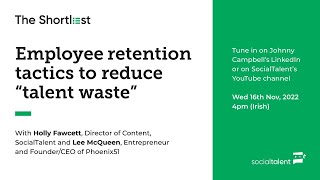
A Social the Shortlist episode (YouTube, Nov 17, 2022) where Holly interviews Lee McQueen (founder/CEO of Phoenix51, founder of Raw Talent, former winner of BBC's The Apprentice). They discuss 'talent waste'—the costs and cultural harm of hiring without retaining—and methods to reduce it via competency-based assessments, aligning hires to company values, screening-in (vs CV screening-out), digitised assessment (Phoenix51), and internal mobility/training validation. Lee cites industry cost estimates for bad hires and explains using data to reduce bias and improve retention.
Chapters
Hello, everybody. And you are very welcome to this week's episode of Social the Shortlist. Today we are talking about employee retention tactics to, to reduce, quote, talent waste. As we know, the world of hybrid and remote work and interviews has revealed pretty major flaws on the standard employee retention handbook because most organizations, they fall into either the trap of treating the symptoms of high levels of churn and being reactive rather than focusing on fixing the root cause of turnover. And then that causes a dangerous cycle of investing time and resources in hiring, onboarding, training, only for that employee to leave again after the first year. I want to know, are you stuck inside that cycle? Joining us on the shortlist this week is none other than Lee McQueen, who calls this cycle of talent waste. Lee is an entrepreneur and the founder and CEO of Phoenix51. He's also a previous winner of BBC's the Apprentice and he's the host of the Talent Waste Show. So, joining me on, on this podcast in the next couple of seconds together we're going to discuss what, what talent waste is, how to mitigate this with proactive retention strategies and how aligning candidates with the culture and the values of a company can make the biggest difference in hiring and retention. So, Lee, you are very, very welcome. Thank you for joining me.
Hello, Holly, thanks for having me. Thank you to all the viewers and listeners as well. Appreciate you having me on today.
Lee, can you give the folks listening or watching here, those who are watching live, a quick background as to who you are. I'm sure I butchered most of your CV here or skirted past some key moments.
Not at all. Let's not worry about the cv, that's irrelevant. But yeah, so for me, I've got, oh, Show My Age Now. 22, 21. 22 years of recruitment experience. I've been in the recruitment industry for that long period of time. I work for one of the. The big business process outsourcing companies Capita for about eight years. I ended up being the managing Director of the IT Recruitment Division. Turned over 32 million pounds at the time when I was, when I was operating now. And one day one of my team put an application form across my desk. I looked at it and thought, what's this? And it was an application form for the Apprentice. I thought, why not? So I filled out the application form. A few phone calls and a few interviews later, I ended up beating 20,000 candidates to get onto the show at the time. And 12 weeks later I ended up winning it. So, yeah, I won the Apprentice back in 2008, which was an amazing Experience worked for Lord Sugar and his son Simon for two and a half years. We built a digital media business called amscreen from the ground up, which was an amazing experience for me. But one of my key drivers was to start my own company. Holly. I always wanted to run my own business and I'm a bit of a late comer to being that entrepreneurial spirit, if you like. Eleven years ago, I left and I set up, I set up Raw Talent. Raw Talent was my second business that I set up. It was a recruitment business focused specifically on early careers. And what we wanted to do is we wanted to bring a bit more diversity into the sales aspect. So the major players at the time were graduate focused recruitment businesses. So anybody that was looking for early talent was grad, grad, grad, grad. So I said, no, let's open the talent pool and look for grads and non grads and let's higher based on behaviors and competencies and rip up the cv. And that journey has been the fantastic one. And it really led us to two years ago, during a global pandemic, stupidly or brilliantly, we decided to set up Phoenix 51, which is a technology platform that digitalizes and virtualizes people assessment. And that came out of the work that we've done globally with my recruitment business. So that's, that's where we are today. So, yeah, it's been quite, quite a whirlwind journey, to be fair. Holly.
It sounds like it, actually. I think starting a business with, with Lord Sugar can be, shall we say, intimidating. Do you mind me asking, is it really 12 weeks? Like it literally is week on week, or is it like more like five weeks?
It's seven, actually. Or six, to be completely exact. It was six, six weeks and four days. So the process is actually quite condensed, which, if you think about it, makes it even harder. One of the hardest things I've done in my career is go on the Apprentice and win the Apprentice. There's no doubt about it, you know, the Apprentice alumni or the winners of the Apprentice will probably come on and say the same thing if you had them onto the shortlist, for example, because you're giving up everything, you're giving up your job, you're giving up a career, you're going into the unknown and then you are under pressure from the minute you walk through the house, if you like, the minute you walk into, into the, into the boardroom. And that was tough. It was, it was a tough scenario. But I've always been the sort of person that kind of wants to Challenge myself. I'm, I work hard. So that's one of my core, core kind of inner beliefs is you have to work hard. So I had a strong work ethic, but I didn't know if I was good enough to, to, to be other people, to pit my wits against other people. So that's why, that's why I've done it. I wanted to go and learn from the best. You know, Sir Alan, or Lord Sugar as he's now known of course, is probably arguably one of the best entrepreneurs the UK seen for certainly over the last 50 years. So, you know, why not go and learn from the man that's been there and done it? And that was my journey, really.
Yeah. And did you feel that it was an effective way of assessing your and everybody else, all the other participants, skills and abilities in order to get that job?
Yeah, 100%. And I think that if you think about what my idea for raw talent a couple of years after I won, when I set my own business up was to, to not, not reinvent observational assessment, because that's been around for years. But actually the gold standard of assessment is to do a competency based interview, to do a role play, to do a presentation, to do some sort of group, group activities, group tasks. And actually, if you think about the Apprentice, that's what it is. It's what it is. Observing every single week. Has these individuals got the right behaviors and competencies that I want in my organization, in Lord Sugar's case? And I took that idea and said, well, hang on, why can't we give that to our clients? Can't we build a service that we would start to drive sales academies for organizations that were looking and watching and seeing, Has Holly got the right behaviors? Has Lee got the right behaviors? Has John got the right behaviors? And if we see them, if we can test them, then we hire them and it gives us that better retention rate. And that's what we found over the last 11 years. We've got some amazing data points that we now have obviously in our platform around what works well, what doesn't work well in certain sectors and certain industries.
So that's fascinating actually. It's really, it's lovely that that's such an experience, such a pivotal moment in your early career, shall we say? Because I know you're 22 years in recruitment there at the stage, which is still a young man, but you know, that very pivotal moment, having such a monumental impact on your, on your entrepreneurial journey and then on the, you know, the potential assessment and Opportunities that now talent more broadly is able to get. So that's, that's amazing. Congratulations.
Thank you. And I think, I think with that as well, is that so I didn't go to university, so my background is, you know, I grew up in a council house. My Dad's a Milton, 42 years. Mum's a recessionist. Nothing wrong with that whatsoever. But the reason why it's relevant is because they're workers, right, they're grafters. So that's why I'll get the work ethic from. But I didn't have, I didn't create the opportunities during my education to be able to go on to do A levels, to do universities, totally on me. It's no one's fault, but didn't have a bad thing. It was just. I was the class jester at school. I didn't, I didn't get on with school and there'd be people out there watching or parents that are watching with their children and so on and so forth that had the similar situation. And back then, apprenticeships, for example, weren't as sexy as they are today. I mean, apprenticeship now you can do most things, it's brilliant. You can do apprenticeship in dev, you can do apprenticeship in marketing do. Back then you couldn't. It was more know. Is more kind of, you know, carpentry or, you know, or trade, electrician trade, that sort of stuff, which again, there's nothing wrong with. It's just that's wasn't. I wasn't interested in that type of thing. So, you know, for me at that point, if, if you didn't go to university, you'd already failed. So I was walking out of school going, oh, okay, so I'm on the back foot already. And I just think that, you know, if you fast forward like 20 years, that's now completely changed and now there's people, there is different alternatives to university. Not that university is bad, I'm not saying that at all either, don't get me wrong. But it's opening up opportunities for people that learn differently or are different in other ways that still can showcase their behaviors or their competence to do a role for your organization. And that's what Phoenix, for example, is all about.
Yeah, I think it's probably one of the most pivotal shifts in British politics policy because it's, it's not universal across other, other countries, particularly across Europe. There's only some small pockets within Europe, especially within the United States, where it's, it's basically university or nothing for professional careers. But being able to like incentivizing apprentices, apprenticeship programs for professional type of careers. Like you say you can do an apprenticeship in marketing, you can do an apprenticeship in accountancy rather than having to go to, to college and do a four year degree and then go on to do graduate studies in order to get those things like it' really the avenues to get to professional careers now have broadened so much. So talk to me about talent waste in particular because I think this is really interesting. Definitely the as you keep, as you've referred to ripping up that cv, the traditional avenues like going in from university are, you know, are no longer the only way there. So what is talent waste? Why are you so passionate about this?
Well, I think talent waste is a, is another pandemic if I'm honest. But people just don't realize it is there. Talent waste exists in businesses, globally. The premise really of talent waste is that if you're hiring a bunch of people, one person or 5,000 people, doesn't really matter the number. If you're hiring people but you fail to retain them, you're wasting talents you've done all that hard work on. I've identified Holly, we've interviewed Holly, we've put Holly for an assessment, we've onboarded Holly, we've given all of things and bought you into us and you've had a fantastic experience and all that. And then seven months later, Holly leaves. That's really expensive. It's expensive for Holly. It's expensive in terms of didn't work out, you've got to go and do your job search again. It's expensive for your team internally because they're like, okay, there's another one's gone, there's another one's come, there's another one's gone. So it doesn't really breed the right values or culture. And it's definitely expensive from a, from a monetary perspective for the businesses hiring because it costs between 12 and 30,000 pounds for every bad hire. So CIPD will state it's around 12 to 30,000 pounds per bad hire. And Harvard Business Review states that there's 80% of, of the issues that we face in our businesses are around bad hires, right? So when you look at them two, them two stats together, you're thinking, wow, there's some big numbers here when you put it into a number. Let's just quantify that a little bit. So say for example, let's take the minimum value there, £12,000 to hire. So I'm not talking about recruitment agency fees, I'm talking about Time, resource, onboarding, technology, staff training, all of that entire process. So that's 12,000. If you're hiring 100 people this year and you're only going to retain 50% of them or 60% of them, that is a huge amount of money, 360 grand for example, that is literally walking off your bottom line if you can't retain them.
People.
So this business is, we've been involved in some of our clients performance before, before they were clients, of course. People that we speak to during the podcast as well that are sitting in board meetings saying how can we generate more revenue, how can we get more on our bottom line for our shareholders? Yet they are wasting talent. Every year, 100 hires, only retaining 60 of them in year one, 40% of them are leaving 360,000 pound of cost that they don't see because it's not us, it's not, not a cost that's visible. Does that make sense, Holly? So there's so much that comes around with that talent waste piece. And if we could fix it, if we could say let's improve our retention rates from 60% to 70% to 70% to 80%, not only does that have an effect on our monetary like the crude way of looking at it, we've saved money. But the other thing that it's doing is creating pathways for individuals within the business. So therefore Holly doesn't leave. So therefore Lee's happier as Holly's teammate. And now we can start to see a team bonding and a culture growing within our organization. And that for me is the key point.
Oh, definitely. I think there's, I probably have a hundred questions now for you off the back of that, but certainly there's, yeah, there's so many more positive winds to retention than just simply, as you say, the saving of having to do recruitment costs all over again. But also like your, I mean if, especially in, in one of the organizations that you founded with regards to raw talent for, for sales organizations, when your account manager is constantly changing because they're churning out, your customer is less likely to actually stay with you as an, or as a, as a client, so. Yeah, exactly right. All of your retention, both from your customers and to your employees as well. Really important. Do you think though that retention, particularly after that kind of, you know, the first six month honeymoon period of your new job or even maybe, you know, the first two years of your new job, like we kind of think like two years. Oh yeah, that's a tour duty. That's okay. You know, we were allowed, allowed go off and leave. While they certainly are allowed to go off and leave, we, we do want them to stay. But what are the things that is leading to retention problems? Is it that assessment piece, is that the interview failed? Is it the onboarding thing that failed? Did we not do white by them at some point during the transition to career mobility? Like what, what's, what's the factors for, for churn?
Yeah, it's a brilliant question. I think that there's, you know, if we dissect it a little bit, it's probably all of the above or aspects of all of the above. So, you know, I, I, I, I've got a philosophy that, that when a disaster happens or something happens that you don't want, it's not just one thing that causes. It is an amalgamation of a few things. And it might only be that 1% of the problem is the interview process, but 10% of the problem is the assessment process. So it's amalgamation of all things. If we break that down, where it really starts for us or for me, is your core values. So as a business, if you've got, say, four core values and you're hiring against them, core values, regardless of the job role, regardless of the people that you're bringing into your organization, they should all share the same core values because then you're giving yourself the best possible chance for people to stay culturally in your business. Most people, when you do an exit interview with people, most people don't say, I'm leaving because I don't get paid paid enough, that most people don't say that I am. They do leave because of them reasons, but most people don't. Most people leave because of their leader or because of their boss or because of ultimately their team around them. And what we're talking about here, you can talk about it saying it's a bit, it's a bit woolly, it's a bit fluffy. You can talk about that, but it's culture. We're talking about the culture of the business. And so these are our core values and you might stick them up on the wall and they're great. But do we live and breathe by our core values? Because if we do, that means that we're hiring people into the business. I'll give you an example. Oh, I've got dark. One second. Live. There you go.
If you sit still for too long.
I know I need to stop waving my hands. I'll give you an example. So when we started to build out war talent. War talents, core cultural value or core why, if you like was that we don't hire based on cv. It's wrong. We hire based on behaviors and competencies. Now that was, that was our metaphor and our mantra and ultimately we've taken that into the Phoenix 51 business. But why that's relevant is if somebody who is absolutely brilliant, really, really good, great standard on LinkedIn, great standard in the, in the industry, come for an interview at Raw Talent, but they firmly believe that we should be hiring on a cv, we wouldn't hire them because they go completely against our core value. So your face is quite, quite surprised there, in a sense. But that's the bit that people. Oh, it won't make much difference. We can change. Holly, you can't. If it's a core belief, Holly won't change or Lee won't change. And that's why it starts at your core values. So once you've got your core value set, you can get a real strong set of competencies out of what them core values are. So in other words, if one of your core values is team, to be team centric, then communication might be one of your core competencies that goes with that value. And therefore one of your core competencies running through all of your hires, regardless of your business, should be communication. And then of course, from that competency, you've then got set of behaviors. So how do we then measure whether or not Lee or Holly is good in communication? And that's where the interviewing, the assessment comes in, where you're really starting to test and show and see and observe. Have we got them core behaviors that essentially roll up to competency, that essentially roll up to values. Does that make sense? So, yeah, that's the bit that really starts. And once you've found that and a lot of people, Holly, organizations, sorry, I should say, they're scared probably seems too long a bigger word, but they're a bit apprehensive because it means that you're screening people in and not screening people out. And most organizations, from a recruitment perspective, screen people out. Right, let's have a look at their cv. Have they got a degree? No. Let's screen them out. Okay, let's have a look at their cv. Have they got five years experience? Experience? No. Let's screen them out. But what we're doing is saying, okay, let's not worry about your degree or let's not worry about your experience per se. Let's worry about, has Holly got the core competencies that fit into our values? Yes, she has. Right now. Let's have a conversation about has she Got the skill set. Do you see what I mean? So there's a fundamental difference between screening in and screening out. And for some businesses that is impossible. For some businesses that doesn't work when you're hiring for tens of thousands of people that maybe over the Christmas period in retail you just need people to come in and you know, temp for that Christmas period and you know, for that demand maybe you don't need to go into this detail, but from a permanent perspective, when you're looking to grow people within your company over a long period of time, that's when this, this method works really, really well.
Yeah, Yeah. I would argue to say even though even for temp positions like for a 13 week Christmas peak period for example, or over the summer period, if you're doing summer jobs or any of those kinds of things like those individuals will still have an impact on the customer, especially if they're customer facing. Right. So your values have to be lived through. Right. They're definitely not something that let's lower our bar in order to get people in the door but ultimately making sure that we're still aligned the whole way. I think, you know, that piece around employee and company culture, there's, there is a propensity I think for organizations obviously to, to match past behaviors as in past experience and like tell me about a time you did XYZ versus learning agility and the kind of, that kind of core competency of learning agility and being able to demonstrate potential. How do you, how does any organization, particularly something like Phoenix 51, which is trying to digitize this service for organizations to do this at scale, really look at the potential of an employee where they may not have had the best training, they may not have been terribly well prepared, they may not have had access to this particular skill building or even, even the mindset to understand that the CV is no longer relevant. And you know, they just have never been exposed to an argument as to what, what could be the alternative. Right. How do you educate somebody on or how do you decipher the potential of an employee at an early talent or even kind of mid experience kind of level as well in order to see whether or not they're going to be right for our culture?
Yeah, I mean again, even, even that mid size, even that, you know, even that senior side of the things as well. You know, it is relevant across them key areas. It's interesting actually because my business partner, my CO founder of Phoenix51 is Chris Winsheart. He's a business psychologist and that's important because he brings the science wrapped behind how we do certain things and how we score the gold standard or the platinum, if you like. The top step of that assessment piece is around competency based interviewing. So competency based questions, we haven't reinvented them, they've been around for a long, long time. But actually scoring them against them, key competencies and values and then having a data set to be able to say, actually this is Holly and this is what Holly scored against them, key competency behaviors. This is Lee and this is what Lee scored. Now, a lot of businesses, Holly, you might be surprised this or not. I don't know the, the watching audience and the listeners. But so many people still use a pen and paper, they still write things down, they still interview even on teams. Today there'll be people around the world that have gone on to teams. Hi Holly, how you getting on? Let's do a 40 minute interview, throw some questions at each other, write some stuff down. Yeah, I think that's quite good. Yeah, that's. And I'm not being derogatory, I'm just saying that that is what some people are doing. So to put a structure around that and digitalize that structure, we don't use AI. We're not asking the computer to say yes or the computer to say no. This is still human interaction. But it's human interaction through an automated platform that enables you to see data analysis on strengths and weaknesses where they need to, where they could improve on certain areas, which gives you the toolkit for want of better expression to be, to be able to develop that individual. Like you mentioned before, Holly, if you've got a mid, I don't know, mid person coming in, somebody's got a few years experience and you know, they're, they're, they're in their kind of, I don't know, further fourth role it might be they still need to be able to develop, you still need to be able to learn. So how are we deciding where their areas of development are? Using a tool such as ours. But you know, there's other tools out there, of course, but using a tool such as ours enables you to have a better data driven decision. But ultimately it's still your decision as a human. You still make the decision in the end to say, do you know what, I can see Holly's data set and I can see that she's scoring brilliantly here, here and here. You know, in a commercial, awareness is maybe a little bit low, but that's okay. I know that now I'm going to train Developer, but I'm still going to hire Holly into the organization. Just think about what, what that breeds as a culture. All of a sudden now you're, you've created a career pathway for Holly. Holly now knows that the learning development before she even gets into post is that commercial aspect. So you'll probably come on, when you do come on board and start your onboarding period with us as a new organization, you've probably done a lot of work in the back end to work on your commerciality. So there's so many positives that comes with that. And what we found over time, especially in early careers piece as well is over time people want knowledge. That's what retains people in the organization. It's not necessarily just a monetary piece. Even in sales, 20 years ago if you said to a salesperson what's the most important thing to you? They'd say money. And everyone would be like, yeah, it's all about the money. It's not about that anymore. It's about development. It's about how do I get better, how do I learn. I want to be around good people. And if you integrate me into a, A team and half the team in six months leaves, what do you think I'm going to do? And, and that's the bit that's, it's the byproduct of that, I don't want to say bums on seat, but it's a byproduct of hiring that individual into the business and then losing them so quickly because of them. Key things that we've talked about aren't happening.
Yeah, I, I, I think, I would argue that some, there are a lot of sales people out there who definitely want the money and who are hired because, because they want the money. If you want, you will go after it, you know, but on that, on that bit around the, the data piece, right, because that's definitely an area where we see an awful lot of, of in our sort of unconscious bias, slash, very conscious bias. You know, when you, when you make a pros and cons list about anything like a decision on, on who you're going to, you know, you're deciding between whether or not to go out with this person more long term. You know, after a couple of dates or whatever else, you're making that pros and cons list. Ultimately if after whiten out all your pros and cons, the cons start outweighing the pros. But ultimately your, your heart, your gut feel is like, oh, but I do actually really like this person, you'll Start kind of thing. Actually, that con isn't really that important and this one isn't really. You start. You will actively start justifying your decisions. So how do you prevent that? When the data is fairly obvious and fairly clear and pointing you towards. We think this person will be a good employee for the business based on their assessment. We think this person probably wouldn't be a good employee for the business based on their assessment. But ultimately, that system, one kind of gut feel, they had a great interview. They made me laugh. We got on great. Those are really powerful emotions that people feel. And they can, they can and do override the system. How do you prevent that? Or is it possible even to prevent it?
It's a really good question, Ollie. I think that. I think gut feel is important in the world for people in the world of business as well. I do think it's important. I think that we've come a long way, probably in the last five years, maybe 10 years around that cancel culture and canceling certain things out and making sure that everything has to be. And actually the old way never worked at all. And that old way was gut feel. I'm somewhere in between. I think that science should be there to help make the decisions. But ultimately that's why the computer is not saying yes or no, because it is ultimately the human decision. All we can do as a platform is show, is show. You hold the mirror up, really, I suppose, and show to you these are the key areas that are needed for development. These are the reds, these are the ambers, these are the red flags. If you still want to hire that person. Holly. Because your guy is saying, actually, I think, you know, I think Lee's going to be good. I probably wouldn't be, by the way. But if that's the case, then that's up to you. But don't be foolish. Don't be foolish to not use the data to train and develop in the areas that the platform is showcasing you or the process is showcasing you. So in other words, you're looking for an 80% or 85 percentile. Sorry. Of entire scores. If you've got eight or nine different key competencies, you want to see 80% of that individual hitting 80% of them. That's deemed good enough or that's what good looks like in your business. And therefore you're hiring that individual. They're still not 100%, but because no one's perfect. So you could assess to the cows, come home and you'll never get somebody that's going to score 100% every single time. And that's right, because there's no one that's perfect. There's always room for that learning. So to eradicate some of that kind of that gut feel versus that data piece or to bring them two together to set benchmarks of what we know in our business that this percentile is what good looks like. We know that because we've got data on, on hiring. These people in the past or these people with these behaviors in the past typically do this. So then we can start to assess the potential of them hires coming in. And that's how you would start to kind of eradicate that. I mean, the ability to be, for you and I to be interviewing at the same time. Say you're my boss and you and I are interviewing, I don't know, Andrew, and I'm looking over. What are you saying, Holly? I'm being influenced by you. Or you might make a comment, I'm being influenced by you because you're my boss. I'm thinking, all right, I better score. That needs to be gated. That needs to be stopped. It needs to be me scoring that individual assessing or interviewing that individual. Yes, at the same time as you, but in a gated process. And that's again, that's quite important because that unconscious bias starts to creep in, in them aspects as well to actually say, all right, by running the data data driven decision, we can start to see if there's any trends in the data. Lee always hires the same sort of people or Holly always hires the same sort of people. Is there a pattern there? Is there a trend there? It's quite powerful stuff from a overall business point of view as well. So that's kind of some of the key things that would, you know, a data driven approach would start to eliminate.
Yeah, it definitely showcases accountability. Right. So if, for example, you always agree with the hard decisions that I make, you know, that's a very, that's a big red flag from that HR may be able to point out and go, look, we believe you're actually, you are leading the witness, so to speak. And it's, it's, you're, you're, you're not doing a great job in terms of being objective.
That's exactly that, exactly that sort of thing.
So, yeah, talk to me about internal mobility because we've obviously spoken about the, the filling of the bucket and now we want to stop that bucket from, from leaking at the bottom. But one of the big reasons that employees leave, aside from poor onboarding experience and poor value matches, you know, they're, they're in the business two years. They do align with the organization's values, clearly, because we've assessed them well and they've done well. But now it's time for the next step and it's not going to be here for a range of reasons. And those reasons are usually down the lines of there are no opportunities that I can see. They're not obvious to me. I don't know how to apply to an internal position. They're never advertised. I never see them until, until I look on, you know. Indeed. Or, or, or the job portals that I'll advertise internally. For example, my boss might prevent me from going, right, they're hoarding me. They're saying, oh, you're too good for our team. What if you leave my team, we won't be able to do anything we want. And that's, that's then gone. Right. Or they are being passed over for promotion because of. Not from merit, shall we say? You know, merit is not how people get their job. They get their next job through, through their network and having others advocate for their merit, which may or may not be true. So how can this, or can this system be used and these similar tools and everything else be used for an internal mobility perspective rather than just the acquisition of people into the business?
Yeah, again, thank you. Brilliant question. Yeah, absolutely. Of course. And I think what helps specific platform doesn't do is it doesn't flag up to a hiring manager in the US that there's a. As an individual in Ireland who's perfect for that job. It doesn't do that. But what it does is. Community an opportunity to assess their current staff. And that's really important because, yes, I'm in a. So you're a candidate and we've assessed you now you've come into the business. But how do we then develop your career path during the, during your employment with our business? And actually if I'm your line manager, why then use our assessment tool to assess all your ongoing career. I'll give you a couple of examples. One of our clients is actually using. It is in a sales environment, actually. But one of our clients is using our platform to assess sales individuals in real time. So they're going out on sales meetings or live sales calls and they're, they're assessing their, their key behaviors and competencies against what that job needs to do and feedback in real time. So what's happening is when they're coming back to do that again or again next week, week after month, after whatever it continues improving. Develop your career path or business. And one of our other businesses actually took a broader view. One of our other clients, sorry, a board of you, they had 150 managers that were in their business that were all at different levels. So they were probably mid managers, maybe 70 to 100 UK, kind of sort of, that sort of area. And what we did is we used the platform to actually drive some, some assessment around where they are actually at within their career. What would they need to do in order to get up to the next level, which was account director, I think, at the time, and how far away they were, what that essentially meant when Holly had been there for six months, who was Lee, who he is? When Holly got promoted, Lee wasn't worried because I knew where I needed, I won't get in that promotion. And these are the key reasons why. Similarly, if you reverse that, the trouble with not knowing what that benchmark is is that Holly's the better individual. Lee gets promoted because he's been there long, longer than Holly. Holly then says, well, there's no point me standing here, right? I might as well leave. Lee's now in the wrong job. So he ends up leaving after six, seven months. And then Holly's team can see what has happened and said, well, actually, if this is the way the company works, then I'm going to leave. So all of a sudden, just by making that again, that one decision, whether it's a hiring decision or promotional decision, we've created a massive issue in the business. And that's where organizations, and not all organizations, of course, but a lot of organizations are not seeing that problem.
I can see that as being a hugely valuable piece of insight, though, whether it's me as a learning professional or me as an individual. Right. Because trying to be able to validate the training initiatives that we deliver to our employees, for example. So, like, obviously, in every single organization there are training initiatives, whether they are formal or informal, right? Whether it's like you're sitting beside me and we're learning through like some tacit information sharing, we're, you know, we're on the. Both on the same sales meetings and therefore you're kind of learning from me, for example, or I'm going through a formal training course, whether that's on something like social talent or if it's something, you know, where you're actually going off to a college or something. On those lines, those kind of formal interventions, there's very, very little, there's very few evidence based, kind of like on the job sort of validations of how that, how that intervention is actually proven out, how has come out in the wash. Because of course every individual will take that training and do their own thing with it. They're going to, they're going to put their own spin on things. It starts to spin off a whole load of other innovations in their own mind. For some individuals course, particularly the most, the more creative ones or, or certainly the most experienced, whereas others are just going to take it root and branch, go, yep, that's great. I'm going to do the things precisely what I taught my training course and do nothing else. And so from learning from, just from a validation of training, that sounds amazing. But then it's like it's the data for my own performance, right. So like I have a smartwatch and I've used a smartwatch for years and I rely on that to tell me how many steps I've done today. The, the fact that I haven't stood up in the last 37 minutes and I need to stand up now for a minute at some point during this hour, all of those data points which says if you do these things you will be healthier, but without that, without somebody monitoring that performance at a reasonably unintrusive level. Right. I don't know where to make good choices or good alternative choices to what my instinct would tell me.
Completely. And again, it goes back to my crazy point right at the beginning, which is I find it completely crazy why people are still using a piece of paper and a pen to make handwritten notes and make judgments on the most important asset that you today, which is your people. We have all these devices. I have the same Apple Whoop. Anybody got a whoop strap that talks about your health and it makes all these, all these things that we have in our lives. Most of the clients that we're working with, most of the people watching this and they have data points all over their lives on their phone. They have key data points, stand up, sit down, too loud, too quiet, all these things. Yet when we go into hiring process, where's that CV that was invented? Yeah, can I have a quick squiz at that? Oh no, you're not good enough. Really?
What?
Based on a two page cv because you've got a couple of paragraphs. Doesn't make sense, does it, Holly? To be honest, it doesn't make sense. So actually to put our platform and there's other platforms out there, of course there's other interviewing platforms that are different to what we do and so on and so forth. But you know, in the recruitment technology space. Of course there is a lot of them aren't wearables. You can't wear them and sell persons behavior in this. But. But we can still get some really strong data points at what come back to a date. Dating you mentioned made me smile.
Yeah. Oh goodness. I think we have lost Lee unfortunately. I really hope that Lee is able to rejoin us. We were losing him based on I think it was Internet connection. I'm so sorry everyone. Hopefully we'll be able to get Lee back if we don't before in the next two minutes because we thankfully are also towards the end of our show. Let me tell you about details for our episode next week. So next week, Wednesday 23rd November, which would be 4pm Irish time or 11am New York time, that is GMT versus EST. We'll be joined by Dimitri Julius who's the head of special projects and he was previously the chief people officer at Icon. And what Johnny Campbell will be talking to Dmitry about would be how to identify a bad workplace culture before it's too late. Which kind of stems on very, very nicely from what Leah was saying about us trying to prove a manager or manage in rather people based on their cultural alignment to our company values. But ultimately I think it'll all go from there. Ultimately the screening in versus screening out P is going to be key both for talent and for those employers as well. Lee, are you back? I hope you can. Can you hear us? Hello? Hello? Lee, can you hear us? Oh Lee, I'm so sorry. The line is really, really, really tough to hear. I'm really sorry, I will have to call time there as our. Well, our time is up. But secondly, I'm really sorry we couldn't get Lee's last piece of advice. What I'll ask you to do is to share that last piece of advice. We'll put it either into the show notes if you're listening back on this in the podcast or into the the chat in the live LinkedIn and YouTube broadcast for this podcast as well. Thank you so much everybody for for joining us for this really riveting conversation with Leigh McQueen. I've learned a ton by the way. I hope you all have too. And we will see you next week for that talk with Demetra Julius Talk how to identify a bad workplace culture before it's too late. Thank you everybody. We'll see you next week. Bye.
More from Johnny


Where Does Your Hiring Stand? Diagnose It with the Maturity Model | SocialTalent

Where Does Your Hiring Stand? Diagnose It with the Maturity Model | SocialTalent






NEW CONTENT - How to use Generative AI for Recruitment Marketing with Glen Cathey | SocialTalent

NEW CONTENT - How to Use Generative AI for Sourcing & Recruiting with Glen Cathey | SocialTalent

NEW CONTENT - How to Unlock the Power of Generative AI with Glen Cathey | SocialTalent