From Hollywood to hiring: The importance of embedding diversity | with Suzan Vulaj
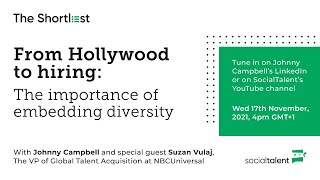
A podcast episode (Shortlist #76) hosted by Johnny Campbell featuring Suzan Vulaj, VP of Global Talent Acquisition at NBCUniversal. They discuss how media (Hollywood/TV) can normalize diversity, NBCUniversal’s initiatives—particularly around disability inclusion and a pledge to audition more disabled actors in partnership with the Ruderman Family Foundation—and how talent acquisition can create access and opportunities to improve workplace representation. The conversation also touches on broader D&I issues (age, sexuality) and internal programs like Meet the Moment and digital accessibility efforts.
Chapters
Sam, You're very welcome to episode 76 of the Shortlist. My name is Johnny Campbell. I'm your host for the next 40, 45 minutes. I'm also the CEO co founder of Social Talent. And we're going to be discussing today, from Hollywood to hiring, the importance of embedding diversity. I'm going to just tell a story first before we kick off as I found this profoundly interesting when I heard this many years ago, but I wasn't aware of it at the time. But I was a kid and you should probably know about me. I worked in a video store from when I was 11 till 18 and I was obsessed with movies, still am today, was in the cinema last night till 11:30 at night, my popcorn away. But I love movies, I love tv, I love entertainment. And I became obsessed with TV movies, movies particular over that seven, eight year period of my teenage years working in a video store, watching all these movies over and over and over again. And so I love the impact that Hollywood and the movie industry can have. Bollywood as well, or anywhere that you're making great media and entertainment. And many years ago I heard the story of the origin of the concept of the designated driver. And the designated driver, which we all probably know today, is one where somebody designates themselves the driver. So that if you're in a setting where people are drinking alcohol, someone says, I'm the designated driver, I'll drive folks home. That wasn't always the way. I know my parents generation, everybody just went to the pub and drunk and everyone drove home and it wasn't terribly good. And there were lots of initiatives to try and drive that influence, drive the, this idea of somebody not drinking and driving everyone home. And it wasn't catching on very well. And back in the late 80s, early 90s, a bunch of folks representing lobbying groups trying to, you know, reduce the amount of deaths through dangerous driving and alcohol related deaths went to some of the big studio heads to try and see how could they use Hollywood to influence this. And the concept was introduced on a few shows like I Believe, Law and Order and Friends eventually as well, and other shows, the Cosby show as well, where a character was introduced in these settings who's going to be the designated driver. And its influence was unbelievable. It became something that people just use. They knew this concept, the designated driver because hey, it's in the movies and TV shows and how we normalize things can really go a long way to people accepting something is just the way it is. And Hollywood can be a really important or can play a really important role in normalizing things and in advancing the D and I movement today. You know, visual mainstream representations of diversity can really help massively normalize conversations and promote a lot of inclusion. But it's also never been more important for companies to truly embed this same tactic in their own organizations to kind of learn from Hollywood and how they push for greater diversity, diversity and inclusion in the organizations. So TV shows, movie shows are evolving. We see it all around us to authentically represent kind of broader spectrum of humanity. And we're hoping organizations will follow suit. So today we've invited on the show our very special guest to discuss the impressive way that NBCUniversal, a massive media giant, you may recognize them from the producers of this poster that sits behind me. For those of you who watch the video feed of the podcast do the Right Thing, a spikely joint from the late 80s, our, you know, Jurassic park from the 90s, our friends from the 90s as well, behind so many big movies and TV shows and entertainment vehicles that many of us may know have enjoyed over the years. But joining today is Susan Village, and Susan is the VP of Global Talent Acquisition with NBCUniversal. And she's going to be chatting with us about NBC Universal's Meet the Moment initiative. And we'll get to this later in the show, which is a kind of series of internal sessions that promotes education on various topics like implicit bias, social identity, belonging, creating, access, and also how important L and D has been for people, managers and hiring teams in the company to help consistently further the diversity and inclusion cause. Susan, you're very welcome to the show. It's wonderful to have you. I wonder if you wouldn't mind giving us a bit of introduction to you. Where are you joining us in the world today? You know, bit of background as to your career and why this topic is particularly importance to you.
Sure, sure. Thank you, Johnny, so much for having me. I'm excited to be here. I'm Susan Bulai. I am currently the vice president of Global Talent Acquisition at NBC Universal. I'm dialing in from New York out in Rockland county, which is we're headquartered in, in New York City. And for me, this topic and I'm again excited to be here to talk about this, the DEI and what we're doing because it's so embedded in what we do with regards to talent acquisition. Right. We as recruiters, and I believe I'm a recruiter at heart, help guide people into and within the organization. And we of course want, you know, our organization to represent the community that we live in. So happy to chat more about this.
And I've already made a faux pad mispronouncing your sue name. Susan. That's my name, Susan. So my apologies for that. That's not, that's not a good start. But I'm going to make up for that. Susan, I want to jump into some news articles and I want to start with something that made the news earlier this year from NBCUniversal and it was in Forbes and it was how NBC Universal are making what is a bold stand in a pledge to audition more disabled actors. So we'll share the article for those of you listening live on LinkedIn and YouTube will welcome your comments and thoughts will also put into the show notes and in this article, Forbes reported on a foundation place called the Ruderman Family Foundation, I believe it's called, which was a pledge or more like a call to action to hold the industry, the TV and movie industry accountable for making more change. And if I understand correctly, what this meant was providing more opportunity at the, at the level of auditioning for roles within, within the studio system, within the TV shows and movies out there. Wonderful. Can you walk me through what exactly this means, what's happening and what, what, what it's trying to achieve as well?
Sure. So in terms of, you know, organizations like the Ruderman foundation and ourselves, you know, setting the tone around DEI initiatives like, like this is extremely important. 15% of the world's population are living with a disability. That's 1.2 billion people. And every step that we take and other organizations take is a step closer to achieving inclusion in the industry. My talent acquisition team doesn't necessarily recruit for the folks that are in front of the camera. We have a dedicated team of professionals that do so. And I have to say I'm very proud of the work that they're doing. But as the article mentioned, we've partnered with an organization called the Ruderman Family foundation, which is a philanthropic organization that is committed to inclusion of children and adults with disabilities. And organizations like this hold our company and others in the industry accountable for the work that we still need to do to see systemic changes. In the article, we mentioned the pledge that we will increase the number of auditions for actors and actresses with disabilities in TV and film. The pledge represents a group wide commitment across a number of businesses. At NBC Universal, we have our Universal Studio Group, our NBC Network, our Universal Film and entertainment team, and our Peacock streaming service. So we hope in doing so, in taking this pledge and taking the stance that others will Join us striving to create more opportunities for people with disabilities.
I think it's an important point to make, which is the access to opportunity. I remember a few years ago one of my team reported on something here in Ireland Susan may not be aware of, which was we ran local elections many, many years ago that were being influenced because the funding for the political parties who are putting candidates into the election was going to be curtailed or caught if you didn't have a certain level of representation for female politicians. Because there was whatever the level of female versus male politicians in Irish society was X and Y. And so therefore to get the funding, you had to make sure you had enough female candidates on the ballot. So most of the parties put more female candidates out that year. And you may have argued before that that you know what the right amount of people are being voted into politics in Ireland based on, you know, who wants to go and work in politics as a woman and as a man, etc. What was really interesting was that the rate at which women got voted in is exactly the same as the rate at which men got voted in. Overall, the numbers across those local elections the first year it happened and we massively increased the amount of women in politics because we had a mechanism to give more people opportunity to be considered in the first place. So arguments. And you get this in recruiting a lot. I know, Susan, I'm sure you've come across where folks would say, well, you know what, you know, we are what's out there, you know, so it's okay. But actually the real kind of influence you can make is give folks the opportunity to be on the ballot or at the audition or on the shortlist. Like does that translate to you in your recruiting world? Do you see that? You know, once you give opportunity and access, you do see the results pull through over time.
For sure, for sure. And like you said, it's about giving the opportunity, right? And being self aware of what's happening and what's going on. I have to say, you know, I just wanted to share a little plug here that Comcast NBC Universal was rated one of the best places to work for disability inclusion by the Disability Equality Index earlier this year. One thing I'll share is that we at NBCU have an accessibility director to role in our organization and she also serves as a global advisor to our ERG called MyAbilities. And her role is basically to help create a more accessible environment right at NBC Universal across all of our businesses to educate our product organizations around digital accessibility. So like some Examples are like the Olympics website, our career website, our application process, some of our mobile applications is just making sure that we're taking into account that this is fully accessible. Right. To all. And this sort of creating this inclusion is. Has to be this an ongoing training effort. We have to have continuous leadership support. There has to be continued commitment and an open mindset, right. That this is something, that this, you know, these initiatives are something that don't happen overnight, Johnny.
Right.
They take, they take time. And this is always a work in progress. And I think understanding that, right. There's no like one action that we can take today that will fix everything, right. Or that'll change everything overnight.
Yeah, I think it's important. And it's also, I know we've been talking about disabilities for the last few minutes and we'll focus on that a little bit as well. We also recognize the range of elements by which people are discriminated out there in the employment market. We've got a listener live at the moment, David Brennan in Boston, just commenting on how, you know, from his perspective, discrimination is at an all time high against gay. You know, he's described gay men like him in the Boston area desperately struggling to find a job and also his age. So ageism and potentially his sexuality coming into play. Really sorry to hear that, David. It is.
More from Johnny


Where Does Your Hiring Stand? Diagnose It with the Maturity Model | SocialTalent

Where Does Your Hiring Stand? Diagnose It with the Maturity Model | SocialTalent






NEW CONTENT - How to use Generative AI for Recruitment Marketing with Glen Cathey | SocialTalent

NEW CONTENT - How to Use Generative AI for Sourcing & Recruiting with Glen Cathey | SocialTalent

NEW CONTENT - How to Unlock the Power of Generative AI with Glen Cathey | SocialTalent