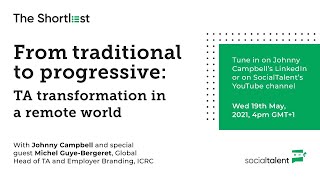
This is a recorded episode of The Shortlist (show 51) hosted by Johnny Campbell, featuring Michel Guye-Bergeret, Global Head of Talent Acquisition and Employer Branding at the International Committee of the Red Cross (ICRC). The opening discusses how COVID and global conflicts have accelerated TA transformation, and outlines ICRC's unique recruiting challenges (deploying staff to conflict zones, language/cultural fit, long-tail pipeline building, and high-stakes assessment). The host frames Michel as a modernizing leader who introduced data analytics, AI and market intelligence to improve recruitment for humanitarian operations.
Chapters
Sam. Hello and welcome to show 51 of the shortlist. My name is Johnny Campbell. I'm your host, CEO and co founder of Social Talent and if it's your first time on the show, we really welcome you. We talk about talent topics here every single week and we have a guest or guests on who hopefully will enlighten you and us as to the topic we're talking about today, which today for show 51 is from traditional to progressive. We're going to talk about TA transformation in a remote world. TA transformation is a theme we've talked about several times before here on the show because it's happening constantly. But in the last year, perhaps even more than ever, as the rule books got ripped up with COVID the pandemic, a cessation of hiring for several months, then that restarted for a lot of industries, is still restarting or waiting to restart from others in different parts of the world. So really, it's been a crazy year. So there's so much to talk about around talent transformation and this week's guest is going to bring a brand new perspective, one I suspect you haven't heard before, but with some very universal lessons. Quick reminder for those of you who are looking to find out more about our background catalog and what's coming up next, you can find out all you need to know about the show by going to socialtalent.com the shortlist we're a weekly show we do broadcast live on LinkedIn and YouTube. So if you do happen to have the opportunity to join us, which is typically 4pm in the UK, you can figure out what time that is in your part of the world. You can join in the commentary and the chat live on LinkedIn or YouTube. And if you're listening now live, we'd encourage you to join in later and say hello, tell us where you're listening in from, and to direct any questions you have to our guest through that live chat. We're also a podcast. If you're listening live, you can catch up with all of our shows on Apple, Spotify or wherever you listen to your podcast, just check out the Shortlist. You'll find other shows there. So back to transforming ta. So it's, you know, it's a difficult thing to do in any time of year, right? But when you are working for a humanitarian aid organization who, for example, right now is looking at the conflict between Israel and Palestine and asking yourselves, how do we get people on the ground? Recruiting looks different and talent acquisition looks different. Whilst many things may be the same, you have this very different mission of your organization and that drives a lot of different behaviors and it's kind of probably one of those benefits being you don't have trouble finding purpose in your role but you do find yourself changing things quite regularly as the world changes without you getting a vote essentially when you're working for humanitarian aid organization. So joining us today is Michel Guy Bejeret and Michel is the global head of TA and employer branding for, I'm going to say the Red Cross. And you're going to think, oh, the Red Cross, those people who like, you know, they help you if you faint at a concert or a football match or they help crowd control. But actually he works for the international committee of the Red Cross known as the icrc. And I'm going to get Michelle to explain a little bit more about who IC orc are. And Michel's known on the international stage as an innovative, analytical and strategic TA leader. And he's taken that approach to the team at ICRC over the last three, three and a half years to really improve the way that they deliver talent acquisition services to the organization by infusing everything from AI data analytics, market intelligence to his approach, but really by enabling a non entrepreneurial attitude amongst the team, amongst the members that actually make up the talent acquisition team that work with MICH across the world. And they are a global team not just because they are working distributed in a distributed manner since COVID but they've been that way since day one. So Michel has done a lot of work with his team and he'll give credit to his team most, I think for the work that's been done the last three and a half years under his stewardship. But we're really interested to get into what it's like to do transformation in that kind of an environment. But Michel, welcome to the show. It's pleasure to have you. I've been excited about this episode for some time. I was wondering if you could introduce yourself and particularly ICRC and give us a bit of context as to who the organization is and therefore what does a talent acquisition team do within that kind of an environment. And we've temporarily lost Michelle there. That's all right. Michelle is somebody I've known for a long time, even before he joined icrc. And we've had the pleasure and social talent of welcoming the team at ICRC to our offices back when we all had offices a couple of years ago and getting to know what they're doing and we've been working with them for several years. The team were able to share some fantastic stories around what you might call real long term recruiting. The skill sets that ICRC hire for. You know, if you think about who they send into war zones, they're sending in people who might have medical backgrounds, logistics backgrounds, management operations backgrounds. And of course you have to have a very specific experience. You have to be willing to go into a war zone and you probably have to have language skills and maybe cultural backgrounds that are right for that particular war zone or that conflict zone. Because obviously sending somebody in from a certain religion in the middle of a religious conflict is going to cause potential problems. So there's a lot of issues to deal with when you're hiring for an aid organization and when you're trying to deploy people across different parts of the world really at short notice. And it takes a certain type of person as well to try and take up that initiative to join someone like an organization like International Committee, the Red Cross. It isn't for everybody. So in speaking to the recruiters that work with Michel and have worked many of them since before Michelle joined, I learned about how they really had to mine talent in a way that I haven't seen other organizations have to do and have this long tail approach where you might reach out to talent in a traditional organization for a job you're hiring for right now. Yes, ICRC have vacancies they need to fill right now, but they have to build long term pipeline several years in the making. And they also have to kind of test that somebody really understands what they're getting into. So if you imagine that you're recruiting for a role, somebody is going to go into a war zone or conflict zone. They're going to have to work with either side impartially or both sides impartially and deliver on their mission. And they're probably not going to see home for many, many months. They're going to have to work in very unusual conditions. They're not going to have the luxuries and trappings that you'd expect perhaps of someone with their background or career. You need to know that there's somebody who has the attitude and aptitude to be able to cope in that. So from an assessment point of view or an interview point of view, it isn't as simple as, you know, send out a codility interview and then do two rounds of interviews and then they pass the behavioral interview you're in. There's a lot more involved. And the complexity therefore of hiring for such an organization is pretty, pretty amazing. But you can imagine that an organization like that, which is an ngo. It's funded by many, many governments. You know, you could imagine there's a lot of politics in there. You probably wouldn't think of ICRC as being super innovative, embracing of technology, forward thinking. You might think they're a team of executive headhunters who probably have their own scars and badges, who do things the old school way. And that was the case to a certain degree, many years ago. But what Michel's done, and when he rejoins us, hopefully he'll be able to share with us more, is he's brought in the right amount of modernization of that process, looking at data analytics and intelligence, because obviously there's an amazing amount of effort that goes on in that recruitment, recruiting team that therefore could be wasted. And that's where you bring the benefit of data and insights and intelligence to a team like that, is to understand what patterns do we see in the talent we're hiring, how can we build better assessments to understand if someone is going to be a success? The worst thing you want is first year attrition. First year attrition in a corporate environment might mean that, you know, we don't get the return on the investment. The person leaves their sales job after four months. But first year attrition working for an aid organization like ICRC might mean that some cracks in a conflict zone in the middle of nowhere, with no way of getting out of there quickly, and that is a massive danger, poses a massive risk, or worse, they're unable to perform their job in the middle of a critical.