Hiring critical talent: The evolution of executive recruiting | with Simon Mullins
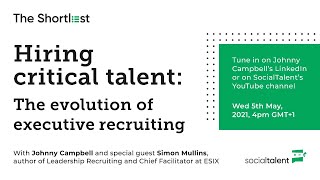
Interview (May 6, 2021) between Johnny Campbell (Social Talent) and Simon Mullins (Chief Facilitator, eSix) on the evolution of executive recruiting. Key points: executive search originated post-WWII and has evolved from solely C-level hires to a broader ‘critical talent’ remit (including hard-to-find individual contributors and diverse leaders); mature organizations pursue long-term talent mapping and courting (often years) combining internal succession planning with ongoing external talent relationships; diversity at leadership levels is a top priority and requires holistic efforts beyond sourcing (pipeline, ERGs, integration); many large organizations are building in-house executive search capabilities to capture strategic value and manage spend, while still partnering with external firms for specialist, capacity or confidential needs; and effective executive attraction centers on impact/legacy messaging rather than just compensation. Practical advice: adopt a high-touch, consultative "trusted advisor" mindset and treat recruiting as solving business problems.
Chapters
Sam. Hello and welcome to show 49 of the shortlist. Welcome. My name is Johnny Campbell. I'm going to be your coast host for the next 40, 45 minutes or so. In addition to my hosting duties, I'm also CEO and co founder of a company called Social Talent. If you're listening to us live today, you're very welcome. We'd love to have your live comments and opinions in chat. You can do that on YouTube or on LinkedIn where we broadcast the stream live. If you're listening to the podcast, don't forget we include any notes or links in the show. Notes of the Podcast if you're not listening to the podcast, you should check it out. We're on Spotify, we're on Apple, or anywhere you find a good podcast. If you're listening to the podcast, you should check out the live show once in a while, come ask us some questions, say hello, join the conversation. We'd love to hear you. So today's topic is Hiring Critical Talent, the Evolution of Executive Recruiting. Really excited about this topic. It's one I've been following for the last while. We've got a great guest who's got significant expertise in this area. But before we dive into it, I want to quickly remind all of you that you can find out more about our last 48 shows and the next 50 by going to socialtalent.com the shortlist where you'll find the list, a catalog of all of our previous shows and upcoming link shows as well, and links to the podcast and the previous videos and all that wonderful stuff as well. But let's get into today's show show 49 just short of our milestone 50 which we'll have next week and I'll tell you more about at the end of the show. So looking into the history of executive recruiting, it actually has its roots in post war Europe in the mid-1940s in the US as companies in both Europe and the US began to companies began to adapt to kind of this post war prosperity. And there was a growing for business leaders which was kind of a catalyst for the growth of the function of executive recruitment and executive recruiting firms. And the profession has grown exponentially since then. And whilst it still has its foundations in the search for what you might call C level or executive talent to fulfill those senior roles, there's been an immense evolution of what it is to do executive search. And it's also something that's moved from being very much almost exclusively an external process to being something that a lot of large organizations are doing internally and building internal executive research teams and executive search teams. And our guest today, because I think this is the most appropriate person in the world to perhaps have on this topic, is Simon Mullins. And Simon is the author of Leadership Recruiting, which you can find on Amazon, and he's the Chief Facilitator at eSix. That's eSix, the executive search information exchange, which Simon hopefully tells about a little more about in a couple of minutes. And I want to talk about how that lens of executive recruitment has broadened. What has it broadened from and to, because I think, you know, my sense of it is that it's no longer just about seniors in expensive salaried roles. It's about critical talent. That critical talent may not be a leader, she may be an individual contributor, but she's critical, hard to find, and therefore the process are kind of customers around executive search are more appropriate to that. I'm interested in diving in with you, Simon, on that, but perhaps you can perhaps start by introducing yourself, explaining your fantastic career in executive search, where you started from, how you got to where you are today, a little bit More perhaps about E6 as an organization, who you work with and what you try and who you surround yourself with day to day in terms of for these ideas and information.
Well, absolutely. And thank you so much for having me on the show. I appreciate it. Yeah, no, again, my name is Simon Mullins. I'm talking to you from sunny Seattle and it actually is sunny at the moment, which is somewhat rare over here. But I've been around this space for a long time, decades unfortunately. Started up recruiting in London technical space for a while and then went to Hong Kong for a couple of years. And in Hong Kong I managed to get some experience with mid level executive recruiting and so on. And from there I went to the U.S. which is probably almost. Well, it's 24 years now. So 24 years ago, came to the U.S. and because at that point I realized brand new market, big space and everything else, I decided I needed to get into what we would call a pedigree organization. Some people might differ on that. But anyway, so I joined Korn Ferry over there, spent seven years with Korn Ferry in Boston, or over here, I should say seven years with Korn Ferry in Boston and then Silicon Valley. And then I was lucky enough to be recruited by Microsoft in 2004 to join them and help them build out their executive recruiting function. They actually had. Microsoft already had a starting of a function to a couple of three folks were on it and then we built it up to almost a couple of dozen over the years and it's now I think twice that. So I've been around the space. So the great thing is been in startups or small organizations. I've been in boutiques, I've been in various places in the world. I've been in, of course one of the, in fact the biggest executive search firm in the world left them as a, I think they call it like a client partner or something. And then of course then helped to build one of the most, or certainly one of the earliest executive recruiting functions in a corporate environment and then left there seven years ago, joined this organization called E6. Now E6 has actually been around for 25 years, exactly our birthday. Now think about it, it's our birthday this year. It was founded by a gentleman called David Lord 25 years ago. And it's a networking organization. It's community, it's networking, it's collaboration of corporate executive recruiters. And I make that important definition because it's not such firms, we're not paid for by such firms. We're not sponsored or anything like that. It's all corporate membership. It's a membership organization. And we have roughly 100 members now. And they're brands that you'd recognize, you can see them on the website. But very large banks, very large, various commercial organizations, industrial of course, technology, and variety of other organizations. And we're actually now much, much more global than we were. So we have organizations across Europe who are our members and we for them create meetings, networking events and webinars and so on. But we also create benchmarking studies which I'll probably refer to today. We've been doing that for 15 plus years and we have a great time. And those organizations, many of them are in Fortune 200, if not most of them Fortune 200 or Global 200. And so I get to learn from those folks to your point. I get to learn from and listen to and hopefully help facilitate the connection between those folks. And they're all very senior people who are leading the executive recruiting function in their organizations. And they're not always massive too. Some of them are starting startups. We have a couple of tech startups in, in Europe for instance. We have some earlier stage technology companies in the west coast of the US but most of them are very much larger organizations and it's been a lot of fun and it's a pleasure to be able to serve that group and learn from them and listen to them and hopefully help them improve their function.
So I'M dying to dig into some of the differences between, you know, executive search and traditional, let's say recruiting. But let's frame it around a couple of news articles that we've been looking at recently that I think are great at informing us as to what's working and perhaps maybe not what's not working. And let's kick it off with our first news article. Niall, you can roll our news credits. I mentioned you before we went live, Simon, that I started reading this particular article from a Harvard Business Review HBO when my print edition arrived. I still read the print edition and it's a lengthy article. So what I'd recommend for anyone interested in the executive search world. It's a good article that describes one firm's particular process in a lot of detail. And it's titled the Former and current chairs of MasterCard on executing a Strategic CEO Succession. And that's Richard Hayner Thwaite and Ajay Bangal, the former, actually Both now former CEOs of MasterCard. And I wanted to kind of get your sense of this article as it describes, yes, one company's journey on, you know, replacing two CEOs, essentially, and the process they went into, particularly the most recent process when Anzej moved into the chair role. But I wanted to get your sense from the member firms you work with. You know, first of all, perhaps you could summarize what, you know, what are the salient points of the process that Masters Carr described in the article for our listeners and viewers and then maybe you can highlight which of those are most similar to the typical process you'd see certainly at the executive level in the member firms you work with.
Yeah, absolutely. And it's. Well, I wouldn't say typical. That's a challenge to answer. That as typical is not necessarily very easy to answer because different organizations do different things. But I'll, I'll try and summarize it as much as. Yeah, the, the methodology they talked about is exactly how an internal search operation, internal team would address it. So they did the audit of exactly what's there in terms of, you know, the talent in house. They all, they. Well, except I would say they're missing a piece, but we'll come back to that. They did the audit of the in house talent. They did a review of what was needed, you know, the sort of the, the future proofing of the organization and then they went to connect with that talent, review that talent and of course, eventually bring a shortlist to the leaders who are involved. And that's great. And it's exactly what an internal team would do. As it happens, they look like they use an external team. So they used one of the big five search firms and I think that's all good. The, the deal that I think they missed here, if I may, is that they didn't really, they weren't in touch with folks externally all the way through. It felt a little like they did a kind of a cursory view. I mean, again, maybe I read the article wrong. It was a long article, a great article, but a very long one. May it felt like they did a kind of a cursory external view, but their arching overarching intent was to be internal talent focused. And that's okay, that works for many, many organizations. But, but they. So they. I would have thought that it would have been a better job and some of the more advanced organizations would be to have had an overarching, sorry, a view of an overview of external talent all the way along. What was fantastic about this is that they said we're going to focus on succession from day one, from the day that the CEO started, which is amazing. That is a rare thing actually, frankly. And that was amazing to have done that. And yet I would suggest, and I believe the more advanced organizations, what they're doing is they're doing that, but not just in house. They're doing that and they're looking at external talent. They have a function inside who is working and it could be a search firm, but ideally in an in house team who is working on finding out who's out there, assessing them, bringing them to make relationships and connections with the senior leaders, with the board members and so on over time and making it a very long term succession plan which includes external talents as well. Hopefully that makes some sense. It does.
That was one of the things that really jumped out of me from the article was the amount of time it took. The process was very lengthy and it reminded me of a conversation I had recently with a friend of mine who was telling me about his organization and how they attracted their chief people officer who joined them just before Christmas last year. And this is a, you know, a star chief people officer and they had courted her for a year and a half. And he explained to me the process and it begun with not a direct approach but a kind of, you know, our CEO thinks you're awesome, would love to network with you. And there was a connection with, you know, where their head office was based and where this person had a home. And then it moved and progressed forward from a couple of zoom calls to let's go for a walk at the beach and just chat. Just want to get your opinion. They built a relationship. I was, you know, it would have seemed perhaps quite accidental to the candidate but extremely deliberate from the. The person who was in charge of the search was actually the VP of TA for the organization, took it upon himself working with the CEO. But himself and the CEO were very deliberate about their approach with this candidate plus others that they, you know, I believe employed a similar process to perhaps not the same depth. And it struck me that the amount of time and the length of the process was fascinating and perhaps very different to those of us who are more in what we might call non exec or non critical talent searches. Is that typical? You know, certainly at an exec level that's kind of C level to have that lengthy a process to identify or court because the identification didn't take them that long. It was the courting that took them long. That's typical in a process like that.
It is typical of what I might, again, this is going to sound a little rude, but of perhaps the more sophisticated organizations and it weaves in so many. This is the irony of the situation is that people talk about executive recruiting as if it's different to like, I don't know, regular staffing or regular volume recruiting or whatever. And it isn't really. It's just that we put emphasis in different places. So the idea of a year and a half is, in my opinion and my, my experience actually is quite short. I mean we, I've, I've seen hires made after three to five years of, of courting, as you would say. And that courting process is a very, is a very complex methodology which I'll come back to. But yeah, in some of the organizations that, well, not always necessarily the larger organizations either. They don't have to be massive to have funded this kind of a thing. So it could be medium to small to large, but they have to be more sophisticated. They have to have a long term vision, they have to have sponsorship, they have to have, and I'll come back to this over and over, I think probably long term vision, long term idea of sponsorship and support for this kind of a function because it doesn't necessarily bring results and rewards instantly like most TA functions do. Right? I mean, okay, within about a few months it can take a long time. And so it's a complicated thing to set something like that up and have someone's trust to say, yes, we're going to have a team working on something. You're going to pay for that team. And you're going to see anything for two years. Yeah, okay. But the product is huge, and the product is the future of the organization. So back to your question. As I say, I've seen things happen over three to five years, not necessarily on an irregular basis. Now, again, that doesn't mean. That doesn't mean it's. Every organization is doing that kind of a thing. But the more sophisticated ones are. And we just heard actually from a large organization, I want. I can't disclose, but where they have a team, they're focused on connecting or finding out who the talent is. Right. That's mapping. That's talent mapping. That's all charting. Not particularly unusual. But then what they're doing is they have their senior leaders. They'll actually arrange connections like you described, with the senior leaders and its external talent, and that'll slowly evolve over time because, of course, people like to hire from their own networks. So if we seed those networks with people that we want to eventually bring into the organization, hence, you know, it could be, it could be underrepresented groups, it could be people in, you know, AI technology, It could be people in a new type of automation or whatever it might be. If we are seeding those networks and building those networks through us being program managers and our leaders being the connection, we can have those programs working really, really well. They're all going to the same conferences. They can have coffee together. We can have two or three of our executives meet these external players and really hone down on the ones we want. And yes, that can take 1, 2, 3, 4, 5 years.
I have a comment here from Simon Wilkins saying it strikes him as a kind of a GH Smart approach, referencing the Jeff Smart exec search kind of advisory business. I think, you know, I've heard this type of approach used. Several years ago, a friend of mine was in LinkedIn and she was at the time telling me about how LinkedIn had a similar approach for, for looking at succession planning and making sure they had maps. At least two to three talents, typically external for each role, and they use the same process. You described their assignment where they would introduce those individuals to the network of execs, put them in the network, bring them in, kind of get them used to the company. There isn't a direct role just yet, but it's like, we want to get to know you, let you get to know us, Coffees, lunches, different members of the exec team. So if and when there is a need to try and pull the trigger on Succession planning. We, we have candidates, they know us, we know them. And it is that long game approach which I think is maybe one of the, one of the defining characteristics of exact search. But before I get you to answer that one, I'm going to go into our second article, Simon, because this is an article from Forbes that was published last month by John Hall. John hall is a founder of a calendar integration company and he writes an article called Trends and Executive Recruiting that will help you get the best talent. I thought it was very exciting when I saw this and maybe you are as well. It's like brilliant. Some great insights. And he references one particular exec search firm. Before I comment on it, what were your thoughts on the amazing trends and insights that he shared so excitedly in this article in Forbes last month?
Well, I think those trends were amazing in 1966. That was. No, I'm sorry, I'm being super facetious. I'm probably a little arrogant. No, I wouldn't suggest those are trends one. Frankly they're not actually that particularly pertaining to executive recruiting either. They're general good recruiting contract or thoughts or comments, whatever. And so I wouldn't say the trends at all because they've been going for a long time. And I know you didn't ask this, but I'm going to go further forward with it because I felt I wasn't quite sure who the article was written for, quite frankly. It wasn't really for startups because anybody in the startup world would probably be doing something like that already that he was describing or at least they may not have the words for it, but they're doing those kind of actions. And I don't know if he was even talking to the business leaders either, you know, as opposed to the recruiting function. I don't really know, it just seemed, forgive me for being rude, but again it sounded a little bit arrogant and condescending. It just seemed a little over basic and I wasn't quite sure who was. If you talk to a recruiter and said, hey recruiters, you should be focused on being as unbiased as possible in your assessment. Like, well, yeah, we're working on that. We've been working on that for a long time. I was surprised anyway. Yes, I could go on. But yeah, it was, it was nice, useful basic steps. I wouldn't suggest it trends and I wouldn't suggest it's probably new to most people listening, quite frankly.
Yeah, I'll quickly summarize for those of you who haven't had a chance to read it, but he says Start with an organizational audit, use unbiased screening procedures, prioritize diversity, standardize your search process and conduct a comprehensive search and then offer equity in your company. It's not really a great article if you want to teach yourself the secrets of executive search, by the way, looking for a secret. We have a quick question in from Vishal Aval, who's listening, wants to know. Simon, what are the best way to approach executive candidates? Seems like a good practical question. There may not be one single answer, but perhaps you could give some insight into methods, perhaps that. That work to approach executive candidates.
Yeah, absolutely. In fact, this came up on a call the other day and that was. It was something that our own team, when I was way back in the day doing this, you know, as I say, etching on stone, long, long time ago. But the kind of opportunity, or, sorry, the kind of approach we would take is actually one that you referenced earlier on, Johnny. So the conversation that your TA leader had with, I think it was Chro or something, it's when one makes that first call, in my opinion, what we're actually doing is we're saying, hey, we just love to connect with you, we'd love to network. We don't have an open role now, again, a luxury situation depending on the culture of the organization, depending on the time you have and so on. I get that. But we're just trying to find out what it is about that person that they might be interested in looking at something else one day. Not today necessarily could be three months, six months, 12 months, you know, two years down the line, what it is that motivates them in general, you know, what are they not getting where they are? What is it that motivates them? And this is not generally about compensation. Compensation, you know, comes up maybe once in a blue moon, but it's not really often a problem. It's about impact. It's about, you know, how are they, what's their legacy going to be, especially at the senior level. But most importantly, back to the point, you know, what's important to you? We'd love to network with you. I'd love to connect with you. And by the way, we have a couple of senior leaders who would also love to connect with you and it would be great for you to network with them. You know, they're. Why not? Who wouldn't, right? I mean, especially in this titan, complicated world, you know, we need to make sure our networks are strong. So if we open it that way. The problem again is that most of us in many cases are hurried we're rushed. We haven't got time for that. We've got to get to the candidate shortlist and so on. So that takes some time.
I'm going to quickly remind anyone else listening. Thanks. For those who already have submitted questions live, but we'd love to hear more of you have them comments or questions live on LinkedIn and YouTube. I hinted Simon, towards my personal opinion of one of the differentiators between exact search and normal search. Let's say call it is perhaps the investment in time. But, but can you, can you maybe outline from your experience working with the members in your organization what, what, what is different about executive search? What are core differences? And then what criteria do the member firms you work with typically use to decide whether or not to use that process or a traditional process like where do they draw the line? What, what is the criteria to say this is going to follow the exact search process, this is going to follow a different process?
Oh yeah, it's a great couple of questions that actually. So I would say the difference when it comes to a tactical or practical level is literally it's super high touch. White Glover used to say, you know, low volume, high intensity. And, and those are the differences now that's where. And actually back to kind of the overarching premise. Keep using the word overarching today. That's where, you know, it goes back to the first commentary as it doesn't necessarily mean it has to be cxo, you know, chief whatever officer. It can be that it's a space that's really, really critical to one's organization and that could be underrepresented groups, diverse groups, whatever it might be. Or it could be as I said before, you know, new talent in a new space. You know, we're in the, we're in the car making business and we want to get into chocolate and we don't know anything about chocolate. So we're going to start bringing in chocolate focused talent which is critical to the organization. So it's less about. It's the certain band of hiring, although it is in many cases, but it's not necessarily always about that. It's more about the high touch white glove, strategic impact, low volume and high intensity, which are, you know, very glib statements. But to practical side of it, you know, the amount of times I used to hear you make how many hires, how few hires, I should say a year, you know, I'm making 200, 300, my team's making three, six, you know, thousand hires a year and you're making 50 you know, and I get that it's complicated, but it is a very high pressure situation. It's super exhilarating to have the CEO or the board or something looking over your shoulder. But it's also exhausting. You know, there's no, there's no kind of time off. I mean, in my experience anyway, maybe not everybody's, there's a lot of weekend work. We have to be available whenever the talent's ready to talk and so on. So, you know, I'm waffling a little bit. But you know, it's all about long term, it's about high touch, sometimes opportunistic hiring. So not necessarily when there's an open wreck, there's a lot of gray and trying to figure things out. But it's all these things take vision, long term perspective, mentorship, sponsorship and so on. But much less about process and technology, much more about consulting and empathy and EQ and so on and so forth. I threw a bunch of words in there, hopefully some of them will stick.
I think what I like is it kind of connects back to an episode we had a few weeks back with Kevin Blair from Celonis who talked about his prioritization model. And in that Kevin talked about how he advocates for organizations to develop this matrices a nine block. It was the example he gave where you would look at the, the criticality of the role and its importance to the business on one axis and the other axis is how difficult is to hire this talent for that particular company. And the ones that are high on both, you know, would get the white glove treatment. So again it's rather than saying there's an exact search function that we use for certain grades of roles, it's actually looking at every role in the business and just looking at on that nine block type approach to go when you're in that super quick critical and super difficult category, that's when you look for teams who work on much, much lower volumes but much higher touch, more resources, longer term planning and you go deep on that. But if I look at an area that you touched on there that I imagine has come into play for exact search in the last while our critical talent has been the area of diversity and it's been driven by regulatory changes as well. Where you employee pressure, but investor pressure might be the number one driver, that's the requirement to have more board diversity, more senior leadership diversity for the members that you work with. How important has that become? How high on the agenda has that been to have diverse talent? And that being a real thing that they're going to the exec search team to try and deliver upon.
Yeah, it's, it's. Well, we've, we do a survey, I mentioned already, I think we do a survey and we have done it for 15, 20 years or something and for the last, I'm making this up, I'd say at least five, six, seven, eight, maybe even 10 years. We asked them what the priority, well, we've been asking them for a long time what their priority is for the coming year and for the last seven, eight, ten years, whatever it's been diversity, diversity has been top of the list by far. And the second priority as it happens has most recently been opportunistic. Well actually pipelining and mapping and so on. And I think those things are probably connected quite frankly because of course everyone's trying to figure this out and there, and we've done a couple of years now of survey specifically just on how folks are trying to find underrepresented talent at the leadership level, what their methodologies are, how they're, how they're measuring their own teams, how they're measuring success, what they're trying to find, which of course differs around the world. And it's really hard. I mean, I'm stating the obvious, especially for this audience. It's really difficult to do. There's no silver bullet. And I, I recognize, you know, I'm frankly male, pale and stale, able bodied, you know, the whole, you know, I've got nothing. I'm completely on the positive side from the point of view of all benefits, as it were. But this is what I'm hearing from our members that it's, it's, it is difficult to do but doesn't mean we shouldn't keep trying. And we are going to keep trying. And you can tell what they've been doing the last couple of years is trying all sorts of different approaches. The often often approach, of course, often used approach is that they're working on diverse slates. Every slate has to have some level of underrepresented groups in it, whatever that might be and that defines. But the overarching, kind of again, overarching method message here is that it's a holistic approach. We're going to keep working on different things but it's not just about recruiting. It's got to be also about talent management. It's got to be also about integrating and working with employee resource groups or whatever that might be called. It's going to be working with the leaders and using some of these methodologies like long term connection Networking events, building their own networks, but to this end and making sure that that diversity and equity is completely woven into everything we do because it's very, it's going to be less about finding somebody to put them on a pedestal and have them on the website. I mean that's important, no question. And everyone should continue to do that. And at the same time we also need to buy to build. So as opposed to buy versus build, we need to buy to build as well. So bringing folks in who will help change the culture at a mid level, at a senior level, not necessarily always on the pedestal because you know it's going to take a while and that's probably the only way because otherwise we're putting someone on this, as I say, this kind of crystal matchstick pedestal and there's a risk for them as a risk for the organization. It's not great experience. So it's going to take some time. But it is to answer your long winded answer there. But it is to answer your point is it's a super high priority. It's on every conversation. We talk pretty much every week with our members at some level or other. Every conversation we're talking diversity.
I'm going to ask you about another trend, Simon, and this is maybe a longer term trend and that's the trend towards executive search moving in house. Obviously it's been the driver of your member firm the last 25 years. But can you basically speak to me about why do you think more organizations and again I'm assuming that we're seeing more organizations build executive search functions. You mentioned Microsoft being one of the earlier teams. I think you're right there. Why do you think organizations are doing it? What's the business case for it? And then when would you still perhaps work with external search firms? What would still be the case for working with external even if you have an internal executive search team?
Yeah, I want to jump to that point first because that's something that people not misunderstand. But we, perhaps they don't. We don't make it clear enough. We are not saying that organizations or corporations should stop using search firms. By no means is that our premise or mission as well. And it's a big business. That's a 16 billion US industry by the way, as far as our measures say executive recruiting, now it's just a search firm spend. That's not of course, all the TA spend and everything else. So it's a big business. It's not going away anytime soon. But I do believe that our in house functions should, should work in strong partnership with them. We're not trying to replace. And to your question, you know, often when we ask this question actually as well, we ask in our survey every year, okay, what makes your choice? Okay, if you have a hybrid scenario where you're using search firms as well as you have an in house or direct team, what do you use as a criteria to choose? And it changes every other year, which is weird. Sometimes it's about capacity they just don't have, you know, suddenly there's a blow up in demand and we have a team of 5, 10, 20, 40 people on the in house team. We just don't have the capacity to take on X number of searches at one time. So we'll use a search firm some places sometimes actually it's actually about the ability to take on. Why, why do, why do a general counsel search when you're only going to do it once every six years? Use a specialist firm for that because you're not going to need to build a talent pool, a connection with a lot of external players for a role which isn't necessarily mission critical unless you're a law firm. A role which isn't necessarily mission critical to your organization, better spent your time and focus and energy building community around product management or whatever is critical to the future of your organization or diversity for instance. So that's the second use is, you know, use them for extra, you know, build on capability. And then the third time people using search firms, which I'm not necessarily, I don't necessarily agree with, but I, this is where I differ from the members, is that they'll use them from a confidentiality perspective. Sometimes if you're doing a board search and quite a few of our members by the way are doing board searches, they're actually doing the board work with the board who are with board members and hiring board members for the organization which is, which I think is huge. But not everybody's doing that. And so it's sometimes safer to use a search firm on behalf of shareholders to do board work or to do the chief financial officer or to do a super confidential search. Some people believe that's the way to use a search firm. But we find that even organizations that say they have a sophisticated large in house team, they're still using search firms, you know, 10% of the time or more. And that's going on. Well, I mentioned why they're using them, but it still goes on. It's good to partner with them. And actually many organizations now are having search firm days or Bring the search firm in, they'll have business leaders talk to those search firms as partners. They'll have a compensation overview. Talking to the search firms as partners. So it's a partnership. Sorry, did that cover your bunches then?
Definitely. On the second question, I'm wondering on the first, the trend towards moving it in house, what driver there and the business case do you think for doing that?
Thank you, I apologize. So yeah, so the, I can go on and on as you can tell, you're going to keep, keep me managed here, Johnny. So yeah, the business case is, is again somewhat complicated unfortunately. Many people start with saving money. I actually try and avoid that and I try and you know, forever. I talk about it, I just generally don't talk about that. I don't, I don't believe it's about saving money. I believe it's about long term value. It's about huge impact. It's about external succession, connection and integration with the internal success session. It's about strategy, it's about helping the business leaders be more informed about what's going on. And not necessarily about talent, but actually what's going on externally in general. Because so many of them are not necessarily very connected externally. So that I believe is a bigger business case, higher strategic value, great succession, really getting a diverse set of leaders and diversity in the broadest sense, diverse set of leaders into the organization wherever we need them. That I think is the highest, highest case, business case as it were. Now it is also about saving money in many cases. There are some organizations spending 10, 20, 25, $30 million a year on executive search firm fees. And that's okay if that's their model. But even you know, so and again, to be clear, this is where I have to define. Having an in house team does not necessarily mean having a team that does direct hiring. Having an in house team might just be a team that manages that spend. Because some organizations, in fact many organizations, unless they've got a handle on that, they don't know how much search firms are being used or how many search funds are being used, how much is being spent. They have no idea, no take on that. So it's key to grab that as well and manage that and start controlling those contracts and manage them on behalf of the company, not behalf of the search firm. But also as I say, then there's obviously going to be cost savings in that because if you're, if you're doing proper standard contracts with all those folks, then there will probably be cost savings. But I would always towards the strategic Value, impact, as I say, succession, and so on and so forth.
If, if anyone's listening to, to this show or podcast and they're in a more traditional recruiting role at the moment, what would you recommend or the steps they could take to perhaps move into exec searching or critical searching, whatever you want to call it, or whatever name it evolves into? What are the kind of core things that the stepping stones that would be required to make a career jump into this more specialized area?
Well, that's interesting because we actually are hearing. I just popped something out recently on LinkedIn. We're hearing that it's tougher and tougher to find great recruiters. Full stop and demand is kind of difficult right now, which is, which is of course a good thing on many counts. And so to move into that space, obviously you have to have the environment. It's hard to say I'm going to start doing kind of a high touch white glove experience when I've got 60 Rex or 80 Rex or 100 Rex. So, you know, one has to have the support to be able to do that because it's difficult to give a proper consultative experience to so many hiring managers. But having said that, we talk about things like consulting skills, asking. So there are a number of quite great questions out there, or should say consultative questions out there. And we're actually doing a second book, as it happens, on this, this very thing right now. So great questions, understanding how to kind of own the room and really as the cliche, I know, but become a trusted advisor. And I think you've got some, probably some great classes on your, on your platform, I'm sure, about these kinds of things, but it's about owning the room, understanding that you're actually here to solve a business problem, because this is what we are. Right. So I think it's partly about mentality and I might answer your question, John. I don't know, I'll get there eventually. It's partly about mentality. It's about, it's about the fact. Owning the fact that we are. What's his name? Is it Heimdall? A guy in. I want to come with all now, but in Thor, who kind of sees ahead, sees the future, owns the bridge, owns the future of, of, you know, the talent, as it were. And I see us as that role. So if we start to feel that way and think that way and we ask the right questions, you know, there's great books out there, David Meester's Trusted Advisor book, we quote a lot. There's, I think, a Book by Block called Flawless Consulting. You know, if we become more of a consultant and start thinking of ourselves in that way and, and also using our tools in a better way, quite frankly, we have this job description. Quite honestly. I know at least my history was, oh, quick, get it done. Cut and paste from something else. It's not great. Shove it out there. Well, actually that's a contract. If we start to use that as okay, this is what is going to be looking like. This is how we're going to focus on the market. This is what that we can use this as a template for the future of success of this potential hire. We can use this as a template to, you know, make sure that everyone's on board when it comes to interviewing so using our tools as they are today in a more consultative fashion. And I'm not sure if I really helped there, Johnny, but yeah, certainly great training classes on social talent, I'm sure.
No, it does help. So nada's saying our producer in the back saying Heimdall, the gatekeeper. I'm too sure if that was the name you're looking for.
Yeah, I think it's time to. I know. I just see him as Idris Elba, quite frankly. Idris Elba in all the, all the Marvel. I've been going back over the Marvel films recently and I just love his role. He's such a cool.
I like that image. So if we're saying our viewers saying that recruiters who are already developing better business partnering, ski partnering skills, becoming more of that talent advisor trusted advisor in their role already, they're already on the journey to becoming what is the current kind of or having the criteria or skills required for executive search. So if that's the case, do you see going forward and I know questions about the future are always a bit out there, Simon. Right. But I'll put you on the spot before we close to kind of say, you know, what do you think are, what do you think of the future for this? Like, do you think that what we currently call executive search is going to just really grow because we're going to apply these high touch methodologies to more roles? And if so, does that mean that what we currently do for really senior difficult roles will have to evolve as well? So two kind of questions that are highly related, the future of the executive search piece and then perhaps does executive search have a different future in itself as a kind of niche for the top of the top of the roles?
Yeah, it's great. It's a really great question. I do So I mean, you know, this is all in my mind anyway. This is all woven towards or woven in with, you know, recruiting automation or you know, all everyone's fear about AI taking over the recruiter roles and those kind of things. Well, there's a lot of, I'm sure still and again, you'd know better than I, a lot of process, a lot of activities that could, probably could be taken away and made done by a robot or a machine or whatever. And so I wonder actually if frankly this, this is the methodology that's going to be going or I should say this is the way that all recruiting is going to be going to much more of that, as you said, talent advisor, trusted advisor kind of direction. I completely agree. I think that's the way all recruiting probably will be going because we'll get away from some of the more process heavy and kind of ability to be automated type of aspects of the roles, which is great. And so if we all take on that mentality of we're literally owning the future of the organization, I think that's probably the direction that all recruiting will go. So I don't know exactly what you said, but I think that's where it's going to go because I think we as experts will have to take that mantle. And quite frankly as business leaders, business leaders need us to look at this as a business problem, not a finding bodies problem. And I think we do in many cases, but not always. And I know I'm kind of, I was perhaps parted to this as well. But you know, it's all about taking on the business problem which happens to involve people. And I think that's probably the direction the recruiting function is going to go anywhere and I see it's already going that way. So it's not necessarily rocket science or not something novel that's been not been said already. The executive recruiting end though my belief is, and I don't know if I have any real data for this, is that more and more large organizations, not necessarily large sophisticated organizations, which is by the way happening, it's taking on executive recruiting or direct senior leadership hiring themselves and it's happening at all sorts of levels and they're going to get more involved in knowing the marketplace, knowing the talent, where the kind of the hard line between external and internal talent will start to soften when talent leaves the organization, joins a competitor, they'll stay in touch with them more. We're already doing that. I think in many cases. It used to be no one would do that. Now of course we'll be in touch with them and they're calling them boomerang hires when they bring them back. So this, this, this sort of saying that the CRM or the, or the candidate tracking or prospect tracking stops at the end of the company. Actually no, it will probably go. And when the, when they leave the company we'll keep an eye on them. When they come back to the company, we'll keep an eye on them. When they leave again, we'll keep it, you know, that kind of thing. So this kind of weave I believe is going to be more and more happening. I think the external search firms themselves, that industry, it's probably going to shrink. I, well two things are going to happen. One, I think it's not going to be so many large organizations and it already is that way anyway. You know, a few large and a lot of small. I think we're going to see still a lot of small experts who are all specialists in their various marketplaces. I see that perhaps the biggest organizations and they're already doing this are going to go only towards a very high end board level stuff. They're going to move away from that kind of C minus 1, C minus 2 level which I think is already happening in many cases. And that's why we see them getting into leadership development and assessment because they're recognizing that that whole executive recruiting space is shrinking in my opinion. Now it'll always be there, don't get me wrong. But I think companies are going to take control of their old town of their own talent. Companies are going to take control of the future of that talent and really harness that strategic value that they can grab from having an in house team.
Great story here by the way, from one of our live listeners, Shirley Willis, who's saying she made this move two years ago and it was about being more confident, having the belief that whatever level I can provide the best high level service as a trusted advisor was the trusted advisor was the term she used. Her recruiting then naturally moved into working only high talent, high level talent acquisition and, and she just recently started in a TA management role having developed those skills. So wonderful to hear that. Shirley, Shirley's kind of coming in from England with that comment and I think that's exactly the route or route as the Americans would say that many folks who are kind of going into trusted advisor, talent advisor right now and learning those skills, you're developing into this area. But as Simon said, maybe the whole industry is going this way anyway. Maybe just to do recruiting you'll have to do what executive search does today, you'll have to be at that high touch because the markets are that tight. And I was reading today, this week that in the US or parts of the US, McDonald's corporation restaurant, we're offering to pay $50 for people just do an interview. It's got that tight. I'm not saying that we're doing high touch for everyone who works at McDonald's just yet, but it's getting higher touch the lower down you go every day as the market gets tighter. Simon, I can't believe we're at the end already. We've hit on our 45 minute mark quite quickly. I want to thank you for your time. And before you go though, I want to just tease one more tip out of you. And that's basically the tip for our shortlist, our shortlist of tips from all of our guests we've had on. So far we've got approaching 50 tips and I would love to add yours to that. And it might be a tip or piece of advice that you were given once in your career that you feel obliged to pass on or something that you just learned yourself from your own experience, you think would benefit our listeners. So over to you, Simon, for your tip for our shortlist.
Certainly, thank you. And yeah, it's very difficult to have one. But anyway, I'll, I'll work on one. So I think one thing that struck me over time and I, and I just love to quote this, is that when one's talking to, and I think it might be the same on all levels, but one's talking to executive level folks. The example here is basically we used to provide them a PowerPoint of their compensation and benefits and their stock and the projection of their stock and everything else. But the one thing that they really focused on and lingered on and they really wanted to hear more about was the impact they were having. Well, they're going to have if they took on this role. So I think it's something that I forget. You know, it's that I used to forget anyway, when we're talking to senior level candidates, ironically, it's not really about the compensation. It's about what they're going to have an impact on. You know, they're going to have an impact on the product or the market or the company or whatever it might be. That was the bit that really, really excited them. And it took me a long time to realize that was such a key thing because I was always thinking is all about compensation or stock or whatever it might be. But no, they really wanted to know about what their impact was going to be and their legacy and that kind of thing. If we keep that in our minds and find out what their motivation is first, the rest of it will fall into place.
It's great advice and I think it brings me back to the story I shared earlier on about my friend who told me about hiring for a cpo. And he said this person that they eventually attracted, she would have attracted a massive salary from them. They knew there was three other companies competing. They all paid great money or the others may have paid better, but she was such an in demand talent that she was going to get a good income anyway and therefore for her the incremental extra shares or our salary weren't the issue. But to your point, it was about the impact. That was what they worked on and the CEO worked with her on is sharing the impact that they felt they could make and the difference they could make and get her excited about that. I think that's not just for C level execs or anyone. You know, for all of us once we get to a certain level, you got to have ballpark the right salary. You're not going to work for nothing. You've got to pay the bills. But if you're going to be okay and you're in, you know, you're as they say at the races in terms of salary. It does. I absolutely agree with you become much more about impact and it's a message I think all of us in the talent acquisition and talent space should remember. Whether it's trying to attract somebody in or retain them or encourage them in their jobs is that that is the better. That is the better intrinsic motivation that purpose statement. So it's great to have you. If anyone wants to find out more about E6 and your member firm and its benefits or how to join or how to get involved, how can they reach out to you or where can they find out more information about E6?
Absolutely.
Yeah.
Well I'm Simon@e6.org so esix.o r g or it's www.e6.org esix.o ig so feel free anytime and we'll always chat and connect anyway whether you know, whatever it's about. Happy connect because it's a small space and we always seem to find each other and bump into each other somewhere around the world anyway. So it'd be good to connect.
And Simon, I'm very excited particularly right. Hopefully in the next few months bringing your knowledge and courses to the socialtown platform for our users and the teams that are using social talent and want to develop further from a trusted advisor or talent advisor into the exact search world or develop their teams or build a business case. I'm really excited about working with you on that, Simon. So we'll have you back again, no doubt, when those courses are live and we have more insight in terms of how this industry evolves. Thanks for joining us, Simon. Wish you a good morning in Seattle as we close out our day here in Dublin and we'll talk soon.
Super, thank you. Take care.
So for those of you who enjoy this show, we'll be back next week. Next week is our 50th show. I'm really excited about that. And joining me will be Salma Elwerdani. Salma's coming back. I love having great conversation with Salma. She hosts her own radio show on Radio London in the UK with tens of thousands or hundreds of thousands of listeners. So we'll have a smaller audience for Salma. But she's somebody who has a fantastic perspective on recruiting, particularly recruiting in the diversity context as well. She's going to be talking about stripping it back and how you create conversations around diversity and the topic of language. You know, a lot of folks just are uncomfortable as to talking about diversity, what to say, what not to say, what have I put my foot in it? And Sam was going to take us through a bit of a guide around how you have conversations around diversity and, you know, dispelling some of those myths and giving us some good advice and hopefully it's a real one that you'll come on live for, for Q and A. So, so do come join the show. We'll be live on Wednesday 12th May at 4pm UK time, Ireland time. That's of course, 11am on the east coast of the US and 9am, 8am, sorry, on the west coast of the US but don't forget, if you'd like to be involved in more of our events, we're running a live event later this month. Socialtown Live is back. We'll be talking about onboarding in the virtual world. That's@socialtalent.com live. You can find out more about the live event, which I think kicks off tomorrow week, if I remember correctly. Nope, I'll tell you why it's going to be the 20th of May, and that's at about this time that we normally broadcast this live show, but on a Thursday, 20th of May, free event for you to register if you're interested in the topic of onboarding in the virtual world and pre onboarding. Onboarding. What's happening? What are the trends that we're seeing in large organizations? We've got folks joining us from IBM, from Celonis, from tons of different organizations who'll be kind of giving their insights. Simon Hague from Dublin giving his insights as well and stories. So do remember to register for that@SocialTown.com live. But until then, you want to find out more about the show, go to socialtalent.com the shortlist. Hope you've enjoyed today's show with Simon. Don't forget that advice. A purpose. I think it's one that will permeate through the recruiting sector. We we look forward to having you back next week for show 50. Until then, stay safe.
More from Johnny


Where Does Your Hiring Stand? Diagnose It with the Maturity Model | SocialTalent

Where Does Your Hiring Stand? Diagnose It with the Maturity Model | SocialTalent






NEW CONTENT - How to use Generative AI for Recruitment Marketing with Glen Cathey | SocialTalent

NEW CONTENT - How to Use Generative AI for Sourcing & Recruiting with Glen Cathey | SocialTalent

NEW CONTENT - How to Unlock the Power of Generative AI with Glen Cathey | SocialTalent