How Innovative Tech Can Transform Your Talent Management | Johnny Campbell & Peter Hogg
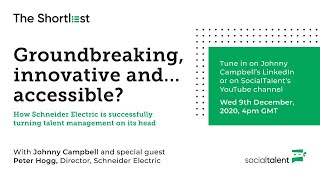
Peter Hogg, Director of Talent Acquisition at Schneider Electric, describes the company's Open Talent Market, an AI-driven internal marketplace that matches employees to jobs, mentorships, and short projects. The platform removes time-in-role requirements and manager approval to increase mobility and upskilling across the organization.
Questions this video answers
December 10, 2020.
About 135,000 employees and turnover of about €28 billion.
Launched in East Africa on April 15 (referenced in the interview).
47%.
60,000 hours.
Chapters
Sam. It is Wednesday 9th December. We are getting closer to the holiday season, our Christmas, as we call it here in Ireland. And I'm really excited about today's show and our next few shows as we round out our free first year of the Shortlist. It's been a fantastic year. We've had some amazing guests and we are excited about our lineup next year. The themes, wow, the themes have really been diverse, from diversity itself to internal career mobility to what's happening in the world of sourcing to remote working. We've covered many, many topics and we're not going to run out next year because there's so much going on in the talent space right now. It's a hot time. The change coming out of the pandemic recession won't stop for many, many years. So we're looking forward to having continued more guests joining us on the Shortlist Week. Don't forget, the Shortlist is a live broadcast on YouTube and LinkedIn, but also a podcast available on Apple, Spotify. And wherever you find your podcasts, you can find more about our schedule. You can subscribe for alerts by going to socialtalent.com forward/the shortlist. And for some reason, if you're listening on your podcast app and you can't find old shows, you can find links there. Or if you're watching live and you want to see what else have these mad people done in the past, you can see lots of our other interviews with some great speakers on that link as well and you can access them there. So into today's show. So I'm really excited to be joined by an old friend who I haven't seen in a long time, firstly because he moved. Damn you, Peter, for moving. And second of all, he hasn't been able to see pretty much anyone like all of us because we've been locked in our homes and home offices for the last nine months. But that's given an opportunity for our next guest to really kind of explore something new that his organization was already exploring. But I think Covid gave them more time and space to do this, and I think it probably came at the right time. Groundbreaking, innovative and accessible. That's what we're here to talk about today. And we're going to talk about how Schneider Electric is successfully turning talent management on its head. And we've all heard the heard the old adage that bad managers are the reason why people leave their companies, right? But the science of the data behind this, the great HBR article published a couple of years ago Based on some Facebook research says that, yes, you know, bad managers don't help, but it is actually dissatisfaction with the job that is the main culprit with high attrition rates. Of course, why this is important is obvious, but it's less obvious. How do you fix that? How do you address it? And Schneider Electric, which are one of the largest engineering and energy companies involved in that sector, a company that you may not know much about. In the last 10 years, as they've evolved and transformed in so many ways across their business, they've pioneered or in fact also won awards for how they're addressing this problem around talent management and internal mobility and skills development. And joining us today on the show, I'm delighted to welcome Peter Hogg. Peter is the Director of Talent Acquisition for Middle east and Africa, based out of Dubai, although you'll notice he's not an Emirati by accident. And he's joined us to tell us not just about the why, but crucially, the how you do this. Peter, welcome. Wondering if you could tell our audience a little bit about yourself, how he ends up in Dubai and about Schneider, its business, in case our audience aren't familiar with it. And then we'll get stuck into today's topic.
Johnny, thanks so much for having me. It's great to be back on camera with you and I'd love it if we could do it face to face like the old days. But I guess with me being in Dubai, this is as good as it gets, right? So. Hi, everyone. Nice to meet you. My name is Peter Hogg. I'm the Director of Talent Acquisition for Middle East Africa at Schneider Electric. Schneider Electric is an energy management and automation company. We're one of the largest companies in our sector. A lot of people haven't heard of us. We are about 135,000 people. We have a turnover of about 28 billion euros and we're spread out all across the world. So my, my time with Schneider is now about six and a half years. I spent the first five years in the UK leading and developing the talent acquisition function there from pretty much from scratch up to a. Up to a standard and level of maturity that we were all very proud of and really looked for the next opportunity in my career, felt that it was time, probably five years was too long in that role and, you know, had a really open conversation with my manager and said, look, I think I'm going to do this for another six months and then I'm going to do something else. And exactly what that something else was. I Didn't know we were very open and transparent. Maybe it's in the company I hoped it would be, maybe it wouldn't be. And here I am in Dubai. So about a year and a half ago I relocated from south of England from Worthing where I lived to Dubai with my wife and my five young boys. It was a really exciting move, a great adventure, something that we were ready for. Although if you'd have asked us a year before we came here if we'd have ever done something like this, we'd have said no. And here I've got a team of me plus 10 others spread out across Middle East Africa and I'm learning tons about what it means to recruit in this, in this new and exciting market.
Well, we've got live audience members logging in from India and plenty saying hello to Dubai. So thank you all for joining in. Those of you who are listening live or watching live, we'd love your comments and questions from Peter around this topic, our insights yourself. So please do jump on YouTube or LinkedIn with your comments and we can share them. But first, and relevant to our topic today, let's jump into this week's news. Peter, We're going to start this week with this Forbes article, Peter. There's many of them knocking around, right? But this one I thought was maybe a little bit more interesting. I'd love to get your opinion on it. And it's a self proclaimed futurist called Bernard Marr. Let's not comment on that job title for a second. And he's talking about the 10 biggest business trends for 2021. Everyone must be ready for my question to you Peter, is what did you see on this list that made you go, yeah, that's a trend I'm seeing. And what's not on the list that you think should be on the list?
Yeah, I guess something that we've been talking about and thinking about for a long time, certainly before we started talking about COVID and pandemics was something which I call an age of acceleration. That means that things are just speeding up. The talent market's speeding up, economies are speeding up, people's expectations are speeding up. And so a lot of the stuff that came out in the article around data as an asset, for example, I'm just trying to think of the article around innovative business models and I think there's drive for sustainability. A lot of this was already going on actually. And yes, it's been even further accelerated by the pandemic and the crisis I think. But I think it was already Happening and actually already happening at quite a good pace. However, there is a bunch of stuff, I think, which has really hyper accelerated through the pandemic. I think one of the best examples actually is working from home. So much debate, healthy debate about homeworking. Is it here to stay? Is it the future? Honestly, I don't even know the answer to that. I think if I speak to Schneider Electric's experience, we haven't seen a drop in productivity. I've spoken to a lot of other people in the industry who would say the same. I think what we need to wait and see is, whilst it may not be having an effect on productivity, maybe it's having an effect on creativity. And I think that's something we really need to look out for. And so as leaders, we really need to monitor that situation. Think about how we implement hybrid models and things like that.
Yeah, I think there's some obvious predictions here, you know, that we all relate to someone's maybe we disagree with. There's talk about being more locally focused than globally focused, which I think is very much true. In the short term, it may not be a trend going forwards. And like any of these things, none of us can be certain whether remote working will be there or not. It's just a case of do you believe or do you see the data supporting your hypothesis? And certainly, no matter what anyone says, we're likely to be in this situation for the next year or two years, as we literally will not have our populations inoculated fast enough for it to change that much faster than that. Right. So it is going to be something that's going to be around for some time. I think what I've seen, Peter, the acceleration you spoke of, I wholly agree. There's nothing terribly new. It's just all about accelerations of existing trends. And one has been that move towards particularly TA teams being asked to take a bigger role or join a wider team that focus more on what the actual problem is, which is talent.
Right.
And I think that's very central to our conversation today, which is solving talent problems without necessarily using acquisition as the only way to do that. And I think it's fascinating that your team has been involved in that for the last 18 months. But let's say, critically, it's not just the last eight or nine months. It's been going on, well, longer than Covid and the pandemic. And that's a really important point I want to jump straight into, if you don't mind, the next article, because I think that takes us on the next Evolution of this. It's an article from IT Pro Portal. Never heard of IT Pro Portal. But you know what, the news article suited our topic so that's why we chose up here. Let's be honest, these could be three people sitting in some bedroom. I have no idea. They could be a huge company with groundbreaking news. But I actually did like this article. It's from last month and it's called From Hire to Retire. Data is the key to preventing staff attrition. I think it's probably most speaks to your topic today. Tell me about data and its role in predicting attrition, which I guess is central to the. Probably the why behind the initiative that Schneider Electricity launch with the open Talent market system.
Yeah, I mean I actually, I don't know who IT pro, whoever they are either. Now it's left the screen. But I did read the article and I actually thought it was quite good, well written. And as I read it I was sitting there thinking, you know, I've heard about this stuff. I actually don't know anyone who's really doing it. Really what the article focuses on is, is really grabbing any data you can lay your hands on, be it your, be it your sales data, be it your, your satisfaction survey data, productivity data, your appraisal data, all this stuff pulling all together, aggregating it in a really smart way and using it as a predictor of attrition. And as I read the article I thought, you know, we're not really doing that. I mean it's relevant to what we're going to talk about today, but it kind of takes it to a whole other level. I'm sure there are companies out there who are doing it, but I think they're probably still in the minority. Having said that, with the technology available to us and the amount of data points that we'll have our hands on and the fact that it's all in the cloud, I think this is one of those things which could accelerate very, very quickly. The question then will be how will individuals respond to that and react to it if they know that these data points are being used in that way? I think it could be interesting to see how that evolves culturally within organizations.
Yeah. The first thing I liked about this article to step back before addressing that comment is the analogy they used around your customer 360 approach and how you use all these data points to try and predict churn analyze churning customers. But why don't we take the same approach in our teams, churn in our internal workforce and try and be more Predictive and use the data, which resonates massively with me as a software company that that's what we try and do from a customer point of view. So why, why aren't we doing it from an internal talent point of view? But it did raise the question because I think there was one point in the article where they talked about being able to zoom in and focus on a person who's likely to churn or have attrition. That scared me a bit. You know, I'm like, do I want my boss getting a report from some AI driven machine to say Johnny's thinking of leaving? I'm going, what? Knowing there's an error, error rate. There's always an error rate with these things. What if it's wrong? My boss now has written me off as Johnny's on his way out. I think there's a danger in high level data to say your churn as an organization or as a team will likely look like X. Then saying Peter Hogg is going to churn. That's where I think I find it difficult. To your point, accept that these will be culturally kind of embraced in most organizations.
I think something else that came to my mind was that we don't have enough salespeople in hr. Right. This is an article written from the mindset, as you rightly point out, someone who's super customer centric, probably from sales or account management background. If we were really diversifying the skills within our, within our HR teams and seeing greater mobility, cross discipline within our organizations, we'd see a lot more of this. It would happen more organically, I think. And so that's an opportunity for us as HR people to hold the mirror up.
I think one thing that when I think about data, I go back to, I was in Helsinki last November, last year, November 2019 at a conference called Slush. Ever heard of Slush, Peter?
I have heard of Slush. I know, yeah.
It's a mental big tech conference. It's weird. It's in, you know, middle of winter in Helsinki and it's kind of crazy and 40,000 people go there and it's really industrial and loads of tech startups and big businesses there. Really good fun. My first time going last year but I saw a great presentation by a company called Peak On. Have you ever heard of Peak On? Their kind of employee engagement software. And the CEO who's a fellow Brit, Peter, was on stage talking about a particular thing which was the nine month warning. So they use employee engagement software across all their customers and they've Identified this, this, this magic time, which is nine months before someone quits, they see this correlation and engagement falling and they kind of use this data point and they can tease out the warning signs. And I thought it was really interesting. And the point today, the big point of his talk was people leave unchallenging work, not a challenging workload. Because an alternative hypothesis was that people are overworked and they move on. He was like, no, no, it's when they're not challenged. I want to take that point and dig into the, maybe the project that you've been involved in for the last 18 months. I want to be. You could maybe pull back and tell us a little bit about that at a high level first. Tell us what is the open Talent Market system in a Schneider context, why it was implemented. Give us maybe a high level as what was the logic behind this? How does it actually work from an employee perspective and what's it trying to solve?
Great. Okay. I just want to address your point about the nine month warning there for a second. Maybe you haven't been there, Jonny, but I have. You know, I've been there. When I was in that phase, when I knew that my productivity was going down, I knew that engagement was waning. Even more worryingly, maybe I even felt that those in my team or those around me could feel it. And occasionally we talk about it. It's not a good place to be and we need to be self aware enough to be able to, to dig ourselves out of that situation and keep progressing. Right, keep the work interesting and challenging, not just busy, because we've all got plenty to do. What has really worked for us at Schneider Electric and something I think we can be very proud of is we're creating. Maybe we've created, but we're certainly creating a culture where you can talk about that. So I could say to my boss, I'm only going to do this for another six months. I can feel myself becoming less motivated, less productive. And I don't feel I can push myself in the right way, not the way I want to. I don't feel like a lot of organizations that I've worked for have had that sort of culture where you could be that open and not sort of break cover and break loyalty. So that's a culture of sort of learning and people development of employability, mobility, which I think is something that companies could think very hard about and something we thought hard about here at Schneider. So why OTM then? Otm, Open Talent Market. We really were setting out to address a couple of Key topics. One was attrition. So from our. And look, the data that comes out of candidate exit surveys, you know, leave a. Surveys, exit interviews, we call them. Right. The data that comes out of exit interviews is never going to be great because it's highly subjective. But what we did learn from that Data was that 47% of people who leave our business were leaving because they couldn't find the next internal opportunity to meet their expectations or their development needs. And people who are going to come back and return the survey with a comment like that, these aren't those who aren't motivated. These aren't those who are getting ready to retire. These are our best people. Right. These are those who want to keep the development curve steep. So that's something we have to take very, very seriously. So we face losing our best people to the market because the market can offer opportunities that we couldn't. So that was really the key driver. I think in addition to that and kind of allied to it is the fact that we, like a lot of organizations today, have got our own targets around maybe women in leadership, women in sales, early career digital profiles. And these are categories within our organization that we monitor very carefully. And we seek to find some balance and diversity amongst those categories. Okay. And what we could see was actually, these are the categories that we're leaving. These were the categories that weren't maintaining that steep curve. Back to the Harvard Business Review research that you referred to earlier, the people leaving Facebook weren't leaving because of bad management. In fact, it said in the report, the management of Facebook is quite good. They were leaving at the point the curve started to tail off. And that's exactly what we experience here at Schneider Electric. So that's what we set about to adjust or to address with Open Talent Market. So if I just take a moment to say what Open Talent Market is really. It's a piece of software. It's a portal. You can log in and you have access to three different kinds of opportunities. Internal jobs, nothing groundbreaking about that. We've all got them on our intranet. I guess the difference with Open Talent Market is that it will match you to open jobs proactively through artificial intelligence. So it's kind of a career portal on steroids. Right. The second thing that it offers is mentorship matching. And there's a lot of tools and startups out there who are doing just that. So Open Talent Market does that for us internally. People who are looking for a mentor, people who want to be a mentor think they've got something to offer the system can match those people up via AI or we can search the database proactively as individuals. That's the second thing. Interesting, perhaps not super groundbreaking, I guess we had an element of that in our business already not quite so sophisticated. But the piece which is really interesting and really disruptive in my opinion is around what we call part time projects or gigs. Essentially within our talent philosophy we freed up, we've given people the right to free up 10 to 15% of their time, their capacity to work on projects outside of their, outside of their day job or outside of their typical scope. And so if I as a manager need additional capacity or skills in my team, I can go to otm, I can create a project, people can apply to that project or be matched to it via artificial intelligence. And I get capacity. And the individuals who join my team or do a project with me will do it specifically because they're trying to gain something from that project. Some experience of talent acquisition, for example, or HR or assessment or something they're interested in. And it really helps people make those jumps, cross discipline that they might want to do, but they're really strong to do successfully in the timeframe that they're going to be satisfied with. So it's been massively transformational for us. Really exciting.
It's interesting James Meli made the point around exit interviews. You're saying, sure, the best data on levers is a comprehensive exit interview. But I think you made the point that it's very subjective, it's only one data point. But even there you guys saw that internal career opportunities or internal project or skill development opportunities was really important. And that was something. Actually that last article we looked at, it's a bit corny, but I did kind of like the reference. They talked about not having just career ladders but career trellises so you can go across and you can develop. I think it's really important. You know, we meet Bev K on the show a few months ago. Bev talks about, you know, the seven different types of opportunities you can provide to an employee. You know, upwards being only one of them, but there's six other types you can go for. And you know, working on projects is one of those. And it's a really valuable way to develop someone's career because I think a lot of managers sit there going, I know my team want more opportunities, but I have no jobs promote them into because they're stuck on this idea that that's the only way, that the only way is up as, as Bev says. And it's not. He is that, you know, opportunity to work with a different team. Can you tell me about some of the experiences firsthand you've had with individuals that have taken projects with your team? Like, I'm really intrigued to understand what type of projects, how does it work, how many hours they put in, how does that work with the, with the team you already have in place? These are things I'm dying to know more about. Tell us, Peter.
Look, we're in our relative infancy, okay? So I'm going to give you, I'll give you a couple of examples. They'll be very close to home because we're in our relative infancy. We launched Open Talent Market in East Africa on the 15th of April, just as we were talking about lockdown, in direct response, quite frankly, to what was going on in the pandemic, to kind of address the balance between the supply and demand of labor within our organization or of capacity within our organisation at a time when some teams overnight got crazy, crazy busy and others had no work, had nothing to do. Right. So otm, I guess, is the perfect tool for addressing that balance between capacity and utilization. Speaking personally, we were all in my team, we were all super busy at this point with lots going on broadly across HR and talent acquisition at the time. And now I've been told overnight I've got to launch a project like otm, which sounds simple, but it's not. There's a lot of change management behind OTM because it's not only the tool itself, which is relatively straightforward and intuitive, actually there's a much deeper talent philosophy that sits behind it. Some real changes that we've had to make to the way that our managers think about talent, about their human asset, about ownership of that asset, but how they develop that asset. This isn't stuff that will come naturally to a lot of people and at times can be quite disruptive. So we've had to put a lot of time and effort into how we manage the change and implement the tool. So I thought it was a perfect example to lead by example to create a project in OTM and to pull in some additional capacity, which is what I needed to be our OTM project rollout lead. Right? So someone to come in and lead the rollout. Why not? Because there's so many aspects to what we're doing in terms of promotion, comms, change management, training, etc, etc, data analysis, you name it, all this stuff. And it's just stuff that I didn't have the capacity for. Now this is an example of me ta OTM you could take a very similar example of a project in hr. I don't know, sales team that are doing it, push into new segments, finance team at year end, you name it. There are lots of different examples of where this could happen in a different context. I create a project in OTM and really the way I sell that project is I position it to someone who would be interested in getting some exposure to, to talent acquisition or hr. And I put the project out immediately. The system will match people via the AI. So as a line manager I can immediately see profiles that I might want to contact. And then over time, people then have the opportunity to proactively approach the role or apply. So after the, after about three days, I've got 25 profiles. I take 25 profiles down very quickly to five that I want to interview. Those five are from all over the world and from different background. So I've got people in there from Russia, Latvia, Paris, India and Dubai, I think is where they came from ultimately. And just think about that from a diversity point of view. Forget the CVs these guys had or the backgrounds or the teams that they were sat in. I mean the cultural diversity that comes with that. Right. Ultimately, I ended up hiring a fairly senior finance person with a sales excellence background and data analysis background from Russia who was interested in Middle East Africa as a zone, was interested in HR as a function, and actually, and I hope I'm not saying too much, actually had a quite specific objective to move to Turkey, which is within my region. So this was the perfect opportunity that gives our opportunity to get exposure to hr. Not just hr, but some of the leadership team within HR and the leadership teams within our clusters, our cluster presidents, our cluster leadership teams, who we're trying to influence to get this project rolled out. So a great opportunity for that person to get the exposure they're looking for. But for me, you know, as a recruiter, perhaps I could underestimate the benefit of having a finance person in my team for a while. Right. The analytical skills they bring, the data skills that they bring, the project management skills that they bring, which I'm not saying that they don't exist among recruitment populations, but not in the measure that I found it from this person. Right. At least not in my experience. So for me, that's the perfect example of how this thing works. That person gets an opportunity for exposure and development. I get the skills that I need. If that person from Russia were to apply for a HR job before having undergone a project or two, they'd probably be unsuccessful. There'd be someone else who's got more experience if that person is trying to bridge the gap towards their HR entry point. Do a couple of projects, develop some track record, develop your network, demonstrate your intent. You're much more likely to be successful when you go for your next opportunity.
Ryan, deco Jerry Crisman's comments and Jerry's going to be joining us on the show next week. But Jerry says Electric's OTM practice sounds like an excellent adjunct approach to reskilling and upskilling strategies, as well as affecting retention and engagement outcomes. And it does. And diversity inclusion, as you mentioned there as well. You're bang on there, Jerry. I think the question I'll ask you now, Peter, because you alluded to earlier on, is the software and the principle is bang on.
Right?
I think everyone would agree this is a great thing. It's a great initiative. I can see how it solves the problems. As you said, the software is intuitive. It's not complex. Talk to me. The people challenges, because I think that's where you typically have challenges around behaviors, around leaders. I imagine like anything, this in theory should be. This is wonderful. It solves our problems. Everyone's on board and makes it happen. That's not usually how it works, though. Peter, can you walk me through some of the challenges that maybe you came across or you're aware of across the business with something like this? And how does one overcome them? Or how have you guys overcome them?
Well, first of all, otm, you know, it wasn't a thing. No one knew about it. This is not something that people can identify with quickly. So we had to, we had to show the business what it is. We had to tell the story of otm. We had to train people and expose people to OTM very quickly because we set ourselves some very aggressive targets. People aren't automatically enrolled in otm. People have to proactively go in and do it. So we have to very quickly tell the story of OTM and encourage people to go in and apply, but not apply, sorry to register. But not only do we need them to register, we need them to register to a high standard if we want the AI to do its job. Because if we have people just going in there and importing their profile from LinkedIn, which they can do in two minutes, not developing the profile, not telling the system about their preferences, etc. What we're going to end up with is a bunch of people who have a poor experience because the AI basically doesn't work for. So we've had to go through Quite an intensive promotion exercise and it was great fun actually. I mean I personally trained over a series of a number of webinars. I personally trained over 2,000 people. And the response was just amazing. Right. And we very quickly saw that these people started landing in the system, starting to have an experience. That's the one half. Okay. But the other half of the system of course is the opportunities that exist within the system.
Right.
If we just have a system full of people but no projects, then they again, they very quickly become disengaged and just think it's another white elephant. Right. So on the other hand, we've got to sell the system to line managers, help them understand that there is an alternative to recruiting and hiring freeze. We have this massive pool of talent within our organization. We can draw on that pool to pull in the skills and the capacity that we need. In the time that we ran OTM up to the end of October, we unlocked 60,000 hours, I'm not joking. 60,000 hours of capacity through OTM, through people doing gigs. That's globally by the way, that's not just in Middle East, Africa, but nonetheless it's quite an impressive number. Okay. And so we've got to explain to managers that, you know, recruitment isn't your only option. That's the first thing. The second thing is that, you know, there is a propensity as a manager if, perhaps if you're less forward thinking to see it as a threat because not only can you pull talent in, but talent can leave your team. People can say, I'm taking my 15%, I'm going to go work for HR, I'm going to work for Peter Hart, whatever. So that was potentially seen as a risk by some and I'm not convinced we heard the real story on that because OTM became a very fashionable thing very quickly. Everyone's talking about it, leadership is promoting it. To be a naysayer was not fashionable. And we had to try and cut beneath that to really understand what people's true feedback was from a, I guess a team leadership point of view because. And the disruption that potentially could go with that. So and with that we took away hiring or line managers authority to approve people leaving their teams. So previously a line manager would have to approve mobility out. We've taken away that authority as a kind of unnecessary barrier to mobility. Right. If someone wants to tender their resignation, they don't need their line manager's approval. So we didn't want to, we wanted to put it on the same playing field. We also took out the Fact that we used to have a policy, I think a lot of companies do, where if you want to interview for a job internally, you have to inform your line manager. We took that out. So there's no need to inform your line manager about what you're doing. We take out all these arbitrary barriers that take away the confidence of people to apply to mobilise because they'll do it on the outside otherwise, right? So we have to develop that culture. And really a manager has to look at themselves through different set of eyes. They have to really understand their team. I say to my team, no surprises, right? I want to know what your career plans are. I want to know how engaged you are. I want an open dialogue. I want to know how I can support you in your next career move. I hope I won't be too surprised by what my team pulls on me in respect to otm, but if I wasn't such an open manager, that could happen and I might lose sleep over it. So these are the sorts of changes and challenges, sort of culturally or philosophically, that we've been grappling with.
I think it's important to probably anyone listening who's thinking, this is great for my organization, we should do this. My experience with you, Peter, over the years and Schneider Electric is you guys have a culture of this. I know many years ago, talking to you and then talking to your boss Petter, at the time, and kind of going, you know, Petter saying, I have conversations with Peter about when he should take my job, and I talked to my boss about when I can take her or his job. And, you know, it's an open culture around movement. It wasn't always the way. I believe in Schneider. Again, talking to some of your colleagues who were there even longer, that's. That's relatively new in the last decade or so, but. But that culture begun to come first, I think before you guys did this, I. And I know lots of companies who aren't willing to break down those barriers. They still, for internal career mobility purposes, require consent from the manager. The manager can gate or block those things and they are. They are real impediments and they'll never get this successfully working without that. How have you balanced, you know, notwithstanding the fact that now you've solved for that, people can go apply for whatever they want and they don't tell their manager and they can just get on with it. What about, you know, abuses in the system? What I mean from that is, what if somebody, as a manager tries to get more out of the allocated time from the individual or, or the manager. Whilst they can't object to it, they're putting that person under pressure to not work as much for a different team. Has that come up yet and if so, how have you guys solved for it or what are you thinking about, Johnny?
I guess we'll see how this thing plays out. I've not seen any examples yet of exploitation. I'll look out for them and I'll let you know for sure. But the other side of this is that a manager, if I as a manager potentially can lose my team through full mobility or through gigs in a part time gigs, that's a problem unless I myself position myself as some sort of talent magnet. Right. I need to have a bench of talent. You want to work on my team. People who see what we're doing in talent acquisition, maybe even see what I'm doing personally as a manager, maybe get feedback from my team. I'm speaking personally, but this is any manager within Schneider Electricity or within this ecosystem. People need to be able to see what teams and managers are up to. So they want to get on the bench, they want to be on the subs bench for what comes next. And that can take away a lot of the anxiety that might come through losing people in your team. But it also means that there has to be good behavior, right? You can't start exploiting people and expecting to have a bench full of the next generation. And I guess this also is a really exciting way of solving for things like succession planning for example. I can tell you right now that there are, I won't tell you how many, but a number of people, not a huge number, but enough of people from other disciplines within Schneider Electric who have approached me and said, Pete, I actually want to pursue a career as a recruiter. That's what I want to do. You know, I mean in the UK we had exactly the same scenario. You know what happened? We had someone resign our business from our customer care center. It's kind of the first line customer care center within our business. It's like a call center, but it's technical. Anyway. We had superstar on that team who one day tended their resignation out of the blue. And I got a call from that person's manager who said, this person's just resigned. They're going to go and join a recruitment agency. And she said, look, will you talk to them? Because they're a high performer on my team, they're a star player. If they want to do recruitment, surely Pete, they need to come and do it with you, right? And long story short, I was able to talk to that person, talk to them about talent acquisition, talk to them about the opportunity to, to progress their career into talent acquisition over a longer period. I didn't have a vacancy at the time. You know, I did. John, you're going to love this. Again, this is not. I've not pre thought this at all, but you're going to love this. I gave, I actually gave this person. So I gave them good exposure to my team. They came to my team meetings, they became the recruiter for the customer care center. Essentially, I buddied them up with a member of my team, that part of the business. And you love this, you know, else I did, I gave them. This is the honest truth. I gave them a social talent license.
Sales alert. Sales alert.
This is honest truth. I gave that person social talent license and said, look, I can't have you on my team right now, but this is good quality recruitment, development, training. Take it, use it, Use it while you're eating your dinner and doing the ironing and just absorb it, right? Make the most of it. Long story short, six months later, someone left my team through promotion. I got vacancy and it was obvious this person was going to get the job. Right? That's exactly how open talent market works. And you need to have a bunch of people who want to join your team you can kind of offer some exposure to while they're still in their day job waiting for that Right. Opportunity, I think is there.
That's a really interesting point because is there a roadmap for this? Or maybe you guys have already thought of it where you're also introducing learning in advance of taking up a project. Because I get this is very much about actionable, you know, on the job training, getting your work placement for, you know, 15% of your time. Has there been talk about how you'd couple that up to replicate what you did in the. Call it the, the old world of just asking someone to do some training and then coming back to you. Is there a way to kind of go, hey, I want to go? After that, you're. The AI says you're not quite there yet, but here's some learning you can do and when you're ready, you'll be a better match and how to be a better match. Is that something that's in the roadmap.
For this kind of a project that's already, that already exists. Right. That's good. Quality development, ongoing development, discussions between manager and team member. Right. So of course, like everyone else, we have one formal development Conversation every year where goals are set and there's some appraisal around it. But that's an ongoing discussion, a dialogue, I guess, between the individual, their manager, and I guess HR as well. I always say to my team that the individual really needs to be the owner and driver that conversation. I'm always open, willing, you know, keen to support, but that person needs to own and drive it. At Schneider, we have another philosophy. We call it 3e. And so when everyone sets up their development plan, everyone should have a development plan. Everyone should, should have a path they want to take, be it linear, be it non linear. And they should, they should look at their development from a 3e perspective. Education, experience and exposure. And so during the course of their development, during the course of their day job, how can they get the experience they need? How can they get the exposure that they need? And maybe they need to take on some additional education as well, be it social talent, license or whatever. That's been in our business for a long time.
I like that three approach because I think what you guys are doing seems to be very much bridging that, you know, you know, that gap, which is, you know, people talk about internal career mobility. We've had several guests on, during the year talking about that, but it's kind of going. You have this experience in job one and you're applying to job two, which is a different job, family, and there's a disconnect. I guess you give some of the opportunities to get a little bit of that, prove themselves in a project, get success. So when they go back, they're not going back. Having never done that. To your point around a finance person applying for a HR job, on the face of it, internally, you might get rejected. A finance person who did two projects in HR very recently in my region, who got strong feedback from the line manager person responsible for that, that's a different, different thing. They've proven themselves. Somebody else was able to take a small risk on them and they took a small risk on the skill. We got to see the result and we can extrapolate from that. Would they likely work out in the internal move? I think it's fascinating. Have you, Peter, you begun to use this because I guess talent acquisition is your core team. Have you and your team begun to sell this when trying to attract new talent? Is it something that you've kind of said, let's pitch this because people are going to love this?
Well, that's what I'm doing right now. To anyone who's listening, that's exactly what's happened. Sales alert. Right. That's exactly what's happening right now. So the answer is yes. And we've always worked very hard as recruiters at Schneider to sell the full pitch. Right. To sell the full value proposition. With the full value proposition comes, you know, the development that comes from an international organization. I'm an example of someone who's mobilized internationally against the odds, by the way. You know, a lot of companies wouldn't mobilise me with five kids and the school fees that go along with that and the mobility costs that go along with that. Right. So, you know, I'm an example of the fact that we have the capacity, we have the power as a large global successful organization to make those kinds of dreams come true. Right. OTM. And we talk about 3e as part of the proposition when we're selling to candidates. OTM is it just really, I guess it just gold plates demonstrates that it's not just talk, it's real. It's something that everyone can get their hands on. It's accessible to anyone.
Yeah, I really. I think it is an appealing thing for someone coming in to go, this is real. We have this approach. Even if the job isn't perfect for me, I have opportunities not just to move internally because that seems a bit distant and it seems probably difficult to do and you probably have to be there a certain amount of time, but you. You can just go work 15% of the time a different project. Are there restrictions around that? Do you have to have practical things like only when you're up and running six months can you apply or how does it work?
It's a great question. So one of the other things we did as part of our New talent philosophy was we took out time in the role as a constraint. So we used to have a policy clause that said before you can mobilize, you have to have been in your role for two years. I mean, how ridiculous is that, right? I know a lot of companies have it, but the world is speeding up in the expectation of Gen Z. But actually others too means that they just move faster than that. So we take that clause out. There is no time in roll policy at all. So, yeah, things within OTM are definitely moving faster.
If someone listening to this is thinking, we need this, or else they've been tasked with trying to come up with something that solves for the same problem. What will be your top advice, piece of advice or piece of advice around this particular project? If somebody else wants to look at internal mobility, reskilling, creating a gig economy Internally, a marketplace like this, because I guess you could buy software, but software I imagine isn't the solution. Right. It's part of the solution, but it isn't the solution by itself. What are the most important factors to consider to make a project successful, in your opinion?
That's such a tough question. I think you're going to be very clear about, about what you want to achieve from it. Okay. We wanted the benefits of primarily solve attrition, solve high value categories leaving our business. You know, if we just consider that the best quality people are those that are most likely to leave. Okay. Under often typical circumstances. So attrition, high value categories, cost of recruitment, cost of attrition, taking that into account, diversity came into it was a big topic. I mean just imagine we don't have enough women in our salesforce. I'd love to see lots of technical companies that do. Right. We don't. We can use OTM to start to bridge gaps like that as we, as we get some of the high performing, great quality, highly talented women in our business getting the exposure they need to sales. You know, that was a. Sales is just one example. That was a, I guess a key driver as well for otm. The other was. And Jerry called it out. The great Jerry Christine. He called it out upskill, reskill. Right towards our digital future. The business is becoming more digital all the time. It's what our customers expect of us. We talk about digital profiles often not even knowing what that means this time next year. And so we need a way of keeping people in the business and developing them quickly enough, but also recycling them quickly enough as the business evolves and changes. Right?
Yeah. It's a fantastic initiative. It's one that I hope to see many more examples of out there as you come out of the pandemic and looking at trends, you know, making more use of your internal teams, giving them more opportunities. It solves business problems. To Jerry's point earlier on, it also drives more engagement. It solves the issue of inclusivity and diversity or can do. It can hit so many buttons. It's a cross team project. I imagine this isn't something that any one team TA on its own or talent development L and D can't be the only stakeholders. This I imagine has been a cross team, collaborative project in the business.
Yes, absolutely. Yeah, absolutely. So it's been driven by TA and HR more broadly. We're very proud of that. Didn't have to get driven by ta. Could just as easily been driven by talent management. But we got it and I'm very proud that we did. And yeah, but it's something that has to be has to get the engagement of the whole company right to develop the philosophy and the culture that sits behind it. And it'll fail without that. To your earlier question, without that culture and philosophy, if you're not ready for it, it'll just fail. You'll have lots of people who had high expectations that came to nothing and maybe even they had bad it didn't just come to nothing, but they had bad experience through no or poor feedback, for example, or poor experience on projects or line managers not playing by the rules as you called out earlier, by not giving time and space. If those things didn't happen, the whole thing would fall on its head. It would cause an engagement issue that might be hard to recover from. Not just in the short term either in the longer term, I think as people lose faith in development opportunities within.
The organization Peter, it's been fascinating hearing about this project. It's an award winning project. I must reiterate. Again, thanks for sharing it. We're at the point where I need to ask you once again for advice, but this time perhaps more generally, if you can leave us with your advice for our shortlist of advice, advice from our guests, advice that you might share from your own experience, or advice that's been shared to you in the past that you want to reshare with our audience. What would that be?
I think there's so many things that I could share, but I think as recruiters, as talent acquisition specialists, we need to look at ourselves in the mirror as professionals, as organizations, as HR teams and look at what artificial barriers we put in place to mobility. We've already spoken about timing, role we've talked about, we've spoken about permission or approval to apply, we've spoken about approval to mobilize and things like that. Look at yourself in the mirror. Look at these artificial barriers to mobility and see what you can do to start to remove some of those barriers and see what it does for your organization. See what it does for your for how competitive you are in the talent market. See what it does for your talent flows. When you look at your talent flows in LinkedIn, for example, and see what it does for your attrition. I think that is something which I'd love to see more companies doing.
Yeah, I think this year has told us that we all have to be brave and try different things and I think it's trying to break down those artificial barriers like you say. Peter. Peter, thanks so much for joining us. It's late in the evening for you. I'll let you go. Probably like me, I have four boys. You're probably just finding an excuse to avoid them and let bedtime be done. So we'll let you go back to bedtime. Thanks for joining us and we hope to have you again the new year. And thanks for being a regular contributor as well in the comments, not only as a guest, but also as a listener.
Thanks, Johnny. It's been great. Take care.
So I'm really excited about next week. We've had already he's been logged in listening live to this week's show and I'm excited about what we're going to bring next week. Just a quick reminder, though, if you want to get our calendar of events and subscribe or find out any previous shows, you can do so at socialtown.com forward/the shortlist. But next week, that's going to be Wednesday, 16th of December, probably one of the last weeks in work you'll do before the holidays, I hope. But please, please come to us because we want to tell you about the biggest thing to affect the talent industry in 2020. And no, it's not just something from some other list. It's not what you think, I promise you. I was stunned and amazed by this when it was brought to us by our guest who's going to be Jerry Crispin. If you don't know Jerry, you surely aren't working in the talent space. Jerry is the sage, the wisest man. I dare call him God in the talent world. And if you don't know Jerry and haven't heard him, you're missing out. Jerry's going to be joining us on next week's show. I'm privileged to have him on the show. We're looking for him to be sharing this really, really important insight. If you work in talent and you don't know what I'm talking about, I guess you don't because no, it's not virtual working. You need to be here. Please join us next week. Jerry's going to give us some insight into something I guarantee you don't know about right now, which you're going to need to know next week. So do join us in the show. That's again, 4pm UK Ireland time. That's going to be 11am on the east coast of the US, 8am on the west coast. Do catch us up if you can't make us live on your podcast or go to social.com forward/the shortlist for more information. We'll see you next week.
More from Johnny


Where Does Your Hiring Stand? Diagnose It with the Maturity Model | SocialTalent

Where Does Your Hiring Stand? Diagnose It with the Maturity Model | SocialTalent






NEW CONTENT - How to use Generative AI for Recruitment Marketing with Glen Cathey | SocialTalent

NEW CONTENT - How to Use Generative AI for Sourcing & Recruiting with Glen Cathey | SocialTalent

NEW CONTENT - How to Unlock the Power of Generative AI with Glen Cathey | SocialTalent