How to build a diverse workforce | with Kris Clelland
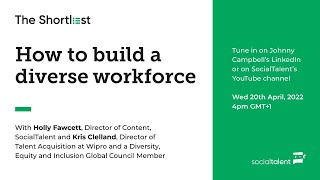
A recorded Social Talent Shortlist interview (YouTube) featuring Holly Fawcett and Chris Clelland (Director of Talent Acquisition, Wipro) discussing practical tactics to build and retain a diverse workforce. Topics covered include sourcing/diversity tools, inclusive interviewing and panels, management training for diverse teams, retention and pay transparency, and Wipro’s diversity outcomes and hiring practices in Australia/ANZ and globally.
Chapters
Sam. Hello, everybody. And you're very, very welcome to this week's edition of the Shortlist by Social Talent. Hi, I'm Holly Fawcett from Social Talent and I am taking the hot seat for this is my last week before I go on my personal vacation and week we'll have the main man, Johnny Campbell will be back to bring you through our next round of guests. But it has been an absolute pleasure to take you through for the last two weeks and this my third week and I have a real, real wonderful topic to talk through, which is around how to build a diverse workforce. Diversity is a massive passion topic of mine and so I, I'm really, really looking forward to this conversation with none other than Chris Kaland. So I really about driving diversity, equity, Inclusion, I think is unquestionably critical work for all of us in Talent Acquisition, but of course it is not easy and I think we need practitioners and those who have been through the war wounds to give us real technical, tactical advice. I think every single stakeholder in the company obviously has the role to play, but us in Talent acquisition and hiring leaders as well, in particular, we hold huge sway in this arena. We are in Talent acquisition, we are the gatekeepers and obviously our business leaders are the decision makers when it comes to what kind of talent is going to be brought into our business and how they're engaged and how they're nurtured when they actually come into our organizations. So joining me this week on our show to dive into this topic is none other than Chris Cleland. Chris is the Director of Talent Acquisition at Wipro and is also a Diversity, Equity and Inclusion Global Council member. We're going to discuss the importance of building diverse interview panels, how to create inclusive job ads, and why management training in particular needs to know how to lead and enable a diverse team. So, Chris, you are so very, very welcome. Would you like to to introduce yourself, tell us where you're from, what you do, where you are right now. Turns out we're only down the road from each other.
Yeah, absolutely. Thanks, Holly, for the quick introduction to everyone else who's live. Nice to virtually meet everyone. I hope there'll be some chats and questions and stuff thrown my way. As Holly said, my name is Chris, Chris Cleland. I'm one of the global directors of Talent Acquisition for wipro. For those of you who don't know Wipro, we are a huge Indian systems integrator, 244,000 people globally across 65 countries. And I have the very lucky task. Even with a Scottish Accent of looking after Australia, New Zealand and other parts of Asia Pacific, Middle east and Africa. I'm from Scotland, from the west coast of Scotland. I've been in Sydney for almost 10 years. I've married an Australian, I've bought a house in Australia. So I'm not moving anytime soon. And very coincidentally, as Holly said, I'm in Dublin right now. I've come home from our family event and my sister lives literally a five minute drive from Hawley, which we just discussed. So yeah, I'm in sunny, sunny Dublin, as you can probably see from the background for the next couple of days. I've been here for three weeks and I go back to Sydney at the end of the week.
At the end of the week. Well, I hope you've had a lovely couple of couple of weeks for your family event. It's a, it's nice to be able to go all the way around the other side of the world to come.
Back to some family.
But since you are all the way over at the other side of the world, it's actually a perspective that we don't really get to hear very often. I think in the British Isles in particular, certainly in the United States, we don't really get to hear what's happening down under, what's happening in Australia, what's the market like particularly for diversity and is there any, anything that you can see that that's happening maybe is, are you chasing innovation or are you being, are things happening there that are very innovative that you wanted to share? Yeah.
So Australia is a bit of a strange one. Holly, with respect of technology, seems to be somewhere between sort of three to eight years behind the rest of the globe. And it's quite strange because Australia, from a business go to standpoint, Australia sit globally number four in the go to market arena in terms of the dollar value of business that you can go after in Australia. And we only sit behind North America, Germany and China. And a lot of people don't realize for a country of 26 million people that there's so much business to go after and it's quite a strange one to witness. When I first got there, I got involved in the tech market quite quickly. I'm from an engineering background and then I, like most people, I kind of fell into talent acquisition. I don't think too many people choose talent acquisitions straight off the bat.
It chooses you, Chris. It chooses you.
Absolutely. I think I've only met maybe a handful of people in my life that have chosen talent acquisition straight out of uni or straight as their first job. But it is quite a strange one because the CTOs, CIOs and senior technical people that I know globally from being involved with companies like AWS and Zip and setting up TA globally for a lot of large and medium sized businesses, it still sits about five years behind the curve. And it's so strange because quite a lot of the large tech players like the AWS's, Google, Microsoft, Accenture, Deloitte, EY, like the big consulting firms, have head offices for the whole of Asia Pacific in Australia. But if you look at the operations that they have in China, Japan, Korea, Singapore and the rest of sort of Asia Pacific, the technology sits way ahead of the technology that that Australia has. And that's because the infrastructure was built in Australia for about 100 people and they haven't thought to change it in the past 100 years. So it really is a strange one that what we do from a talent perspective I think is so far ahead of the game. I mean wipro, I've created almost a center of excellence for TA globally in Australia. And there's a lot of things that we do way better than other countries. And on the diversity piece, our gender diversity Globally out of 245,000 people is 39.8% and the global average in IT is around 1617%. Social media hiring is 33%. Our disability hiring per capita of headcount is above anywhere else in the globe. Our age diversity hiring is also per capita above anywhere else in the globe. So we've kind of created a little hub in Australia that most organizations focus on, not just the stereotypical male versus female in diversity. But it is difficult because the talent availability in Australia is so small countries larger than Russia, but we've got 25 and a half million people in the whole country. So the talent availability, especially during COVID has been super tight. But the business side of any tech industry, they don't realize that. They seem to think great talent grows on trees and we'll just go out and find it immediately. But for the past two years we've been fighting against the AWS's, the Googles, the Microsofts, the organizations that are willing to just throw money at people to get them in. And we have to differentiate ourselves to get diverse talent in. But we're trying very, very consciously to change that. It's not subconscious in any way, shape or form. And the main reason for that is that we tend to comfort hire. And what I mean by comfort hire is that as a 76 year Indian business, we tend to go after the demographic in every single country that know who Wipro are or have at least grown up knowing something about Wipro, whereas the rest of the globe haven't. So it is very much a conscious effort to hire diverse talent in the Australian market and the global market for Wipro right now. And I've done what I can. I've brought in diversity tools. I implemented Hire Tool and now Hire Easy. I did that AWS as well, just to give people, I guess, a little bit more of an edge forward with regards to diversity AI sourcing tools. But I'm having to consistently look at new ways, new vendors, new partners to increase the diversity because it's not easy.
I can imagine that it's. Well, I know from experience that it is not easy, however, to get to as close to parity I think as anybody is at this stage in terms of your gender balance throughout the organization, to be first in the world in terms of your diversity of people in the organization with a disability, for example, those are. That's knockout stuff. Chris. So congratulations, first of all, well done.
Thank you.
As we say in Ireland, Bulabus, that's phenomenal. So with those particular tools, maybe just dive in a little bit there because some real gems. I think we can elaborate from here. You're mentioning you're using Hire Tool now Hire Easy. What other kind of systems that you have to put in place and is it simply just filling the top of the funnel or is there other systems that you have to put in place throughout the rest of the funnel as well to get diversity into the organization?
Yeah, I mean I don't think it's just top of funnel. I think you could throw as many females or diverse diversity talent across age, sex, sexual orientation, disability, etc. Etc. Into the top end of funnel. But it doesn't necessarily mean that they get hired at the bottom end. I think in most organizations that I've worked for for the past 10 years, I've also had to look at things, all of the what I would call the simple little things like diverse talent pools, diverse panels. We really struggle. Organization is growing quicker than we can get business. Sorry, we're growing quicker than we get business in. So our main issue as a consulting business is that we don't have enough people for the amount of business that we've got. So getting interviewers in general across the globe tends to be quite difficult at times. So adding diversity into that panel is something that I always look to do. But also adding diversity into the internal shortlists and long lists that we give to hiring managers. And I've said to my teams, if you don't have at least one culturally ethic, gender, et cetera, balance in your shortlist, don't submit it. And they said, but wait a minute, there's great candidates in here. And I said, yeah, but you can still find great candidates and still have diversity. The other things that I've had to try and work on with the business is things like interviewing, interviewing and then management. The reason for the management piece and I won't name any clients here, I've been in multiple meetings with some of our largest clients across Asia Pacific and one of the existing executive team from the IT sector jokingly brought into conversation, yeah, but you're just a male Indian organization. And I said, wait a minute, you've got 600 members of staff from us as a consulting business with you right now and 33% of those are females. I said, so that tells me one of two things. Either you don't know, either you don't notice really capable technical females in your teams or you don't know how to manage them. And he was completely shocked when I mentioned that. Even though it was a joking comment from his side, I still made it quite a serious note because it's those sorts of things that have got to be noticed. So I'm running through just now. I've devised an interviewing at wipro program which has just been rolled out across emea. It's been rolled across UK and Ireland, Germany, Benelux and there's one more country I'm forgetting, Sweden maybe. And I'm now rolling out in small focus groups across Australia and New Zealand as a starting point. And some of the largest points in that are diversity, are unconscious and conscious bias. And particularly being a champion of both of those types of bias. Don't be scared in a group of people. If you're in a group interview or a panel interview and you notice someone bringing in even 1% bias, don't be scared to after the interview is to call them out on it or don't be scared to call yourself out on it. Be a complete champion of the fact that not anyone's perfect and no one does things perfectly. I think in the tech industry interviewing has almost become a tick box exercise and people go into interviews with 30 questions and it's basically a yes, no, yes, no. And how did that person compare to the last hundred people I've interviewed? No one tends to interview on general cognitive ability, the ability to upscale across scale the person when you bring them in. And I Think that's a huge mistake. And what I did this at aws and I've done it recently with wipro, is run people through training and let them know. And I said to them, how would you interview? Give me an example. So run through a mock exercise and tell me how you would interview. And then I say to the person at the end, okay, I'm from a technical background, even though my technical aptitude now is probably a shaky 1%. But even at 1%, I could pretty much tick box exercise a yes, no or a short scale answer to what you've just given. I said in 15 out of your 30 questions, or probably 20 out of your 30 questions, you've actually tried to find out why. Don't know. And it's quite intriguing that in the tech industry, over 90% of interviewers spend more than 80% of an interview finding out what someone doesn't know. Now please tell me what that gives you with regards to hiring someone. It really doesn't. It gives you no excuses or no leverage to hiring the person. The only thing that it does is gives you leverage as to why not hire the person. Absolutely. And I've said that to all of our interviewers. The fact that you don't even know you're doing that during an interview, if you find something, and I've explained it to them in a social setting, imagine sitting with a group of colleagues and work over lunch and you throw a little, a little bomb into the middle of the table and it just explodes and the topics of conversation come off of it. I said, imagine doing that in an interview. That's the way you should be interviewing. Throw in little seeds and let them sprout. Let the person talk about what they're passionate about and what they're good at. So I mean, to answer your question short, no, it's not just filling top of funnel. Everything that filters all the way through is equally as important. I mean, especially for me. I've been in tech industry for 20, 21 years and I've seen the good, the bad, the ugly with regards to how people interview. And I could probably count on two hands out of the 100,000 connections and contacts that I've got in the past 10 years, how many people are really, really good at interviewing? So I think as, as diversity evolves, the way that we find diverse talent and the way that we engage them and bring them in also has to evolve. And it's all of the little things right throughout that process that I think need to change.
Yeah, 100, that 90 figure of figuring out what it is that can just don't know. Is that a general figure or is that that just within? Within.
So I did, I did analysis through it wasn't at wipro, it was at aws. I went through our analytics team to find out some interviewing statistics and it's over 90% of interviewers for at least 50% of an interview will try and find out what someone doesn't know and then they'll try and dig deeper into what someone doesn't know as opposed to finding out the one thing that they're strong at are the two things they're stronger and asking 20 follow up questions to dig deeper in that respect they tend to do the opposite. They'll go through figuring out based on their own experience how does this person compare to me? And I think that in itself is a huge mistake because then you start to filter into the same as me mentality that person knows everything I know, so they must be great. Well, not really because great people come from terrible companies and terrible people come from great companies. So I absolutely hate the same as me mentality. I hate building a team full of people that look and act and are from the same backgrounds because then no one learns anything from each other. And I've also said that to many of the exec members at wipro. Can you give me your two best people in your team and tell me what background, what technical background, what aptitude, what educational background are they from? And most people in tech will give you two people that are almost exactly the same. Why wouldn't you give two people that are the opposite of each other? Because then they can learn something from each other. I know I'm diving into.
No. Oh gosh, no. This is, I think we could say is we have plenty of fodder certainly to chase down a few other rabbit holes. This actually might be a nice, a nice interesting segue into our first article. So as the format of our shortlist we look at what's happening in the news and this article from it's actually from about two weeks ago within Forbes, maybe three weeks ago in Forbes four tips for well intentioned companies. I love this phrase still struggling to build diverse workforces. It was quite a useful handy little article I think of g really useful and insightful strategies for as they mentioned, well intentioned companies. Because I think of course all organizations who are looking to diversify their workforce are certainly, you know, they have the intention but they aren't necessarily going about it the right way. But they mentioned four things that I Think you certainly have have kind of touched on some of them. The four areas that they mentioned were job descriptions, bias training, inclusive culture and diverse hiring platforms. You touched on, on bias training and to an extent as well, diverse hiring platforms but also inclusive interviewing. Are there other components that were vital when we were looking to diversify your workforce in particular, was it really that kind of interviewing, like showcasing what it is that people actually look for in that interview rather than simply just put them through, you know, what is unconscious bias?
Yeah, I think, I think there's a multitude of things here and I know that I mentioned that our business tend to, tend to comfort higher and I'll give you a few examples. My very first Diversity and Inclusion Council meeting, which was a Global Diversity and Inclusion Council meeting, I was sat in a virtual room on Microsoft Teams with 11 people and 11 people who were all of Indian background. And my first question was okay, I'm the only non Indian person in this group. This is supposed to be a Diversity and Inclusion council. Have we not thought about adding diversity to the council? And I then my second question was can I ask where everyone's based? Because my natural thought from some of the meetings that I was in was I guarantee you one person's based in the us. One might be in the UK or Europe, one will be in Asia Pacific somewhere. And funnily enough, every single person in that DNI council was actually based in India and from Indian origin. And I said wait a minute, first protocol here has got to be for us to build a diverse council to be able to brainstorm on how we build diversity overall. And that was one of my very first sort of go to is when I joined the Global DNI or DEI Council. Wipro do just call it dni. I've tried to change the name but I hit my head against the wall sometimes. So but building that diverse workforce, a number of the exec meetings that I've been in with people right across the Americas, right across Latam, Europe, Asia Pacific, Middle East, Africa, etc. Are from Indian background. And that's never necessarily a bad thing in the tech industry because with a country of 1.7 billion people, some of the best technical professionals do come out of India. Undoubtedly some of the best technical professionals that I know from the last 10 years are from Indian background. But from a talent acquisition perspective, we comfort hire. We go after the one demographic or the one ethnicity of person globally that knows of Wipro or has grown up knowing something about Wipro so we don't have to explain who the Organization are. But a lot of people then don't realize. And when I interview people from Indian background, they don't realize that we are no longer just an offshore body shop. We differentiate ourselves from most of the Indian traditional competitors in Australia right now we've got above 70% localization. We operate in 69 countries and in more than 50%. Sorry, in more than 61 of those countries we've got more than 50% localization. A lot of people in the external market still just think you're an offshore body shop. And it's amazing when I speak to people from Indian backgrounds that they don't realize that we are fit. Almost 40% diversity. They don't realize that we've got such a high percentage of disability age, sexual orientation hires in the organization. We've got over 380 ethnicities globally in the organization. So it's educating the external world through talent acquisition to consciously go after diverse talent. And my teams do it as well. In Anz, I've got onshore and offshore teams for Australia, New Zealand, and 90% of the shortlists tend to be from Indian background. And I say to them, it doesn't matter whether it's a conscious effort to get diverse talent into your short lists or your long lists, consciously put them in there and then let the business decide whether or not the person is strong enough. Don't discredit someone just because you think it's easier to go after a certain demographic. So when I first went into wipro, it was one of the biggest things I noticed straight off the bat. Every single shortlist that was being put forward, we hire 200 to 400 people. A quarter in ANZ was that 90% of the shortlists were from one demographic. And that's not necessarily a bad thing. If everyone is scarily strong. I'd never discredit someone just because of their ethnicity, their race or whatever. But I think consciously we need to work on diversity overall. The other huge mistake, and our business does it as well because we're in it, is that most of the IT sector see diversity is just male versus female. It really, it really gripes me that it's, it's the main focus and that people don't look at the other 13 or 14 indicators that fall into diversity.
And the intersectionality of that as well.
Which.
The intersectionality, sorry, of all of those.
Say that again, sorry.
The intersectionality of all of those factors as well. So I think in terms of those.
Statistics, I don't think enough businesses do that.
I'm so sorry. Chris, we seem to be talking over one another. I do apologize if I'm speaking over you.
That's okay. Go. Go for it.
Go for it. I think the, the numbers piece, what you're hinting at there as well, you know, making sure that you have diverse people on your, on your short lists, you know, how does that compare with making actual hiring decisions? So you're saying that clearly the best person for the role, if they're the best person for the role, doesn't matter what ethnicity they are, what gender they are, et cetera. That's. That's the most important thing. How has the business reacted to. When you do increase the diversity of that panel and a different type of hiring decision is made based on what they would have considered in the first place, what probably they had predicted to be in the future, does that impact the manager's management of that person when they come in? The person that they thought would have been the best person for the role ended up not being the one who was hired or didn't come through to the top.
Yeah, that's a pretty. It's a, It's a very good point. And now, as opposed to just teaching the interviewers how to interview, the one thing that we are now looking at is external organizations to actually come into the organization and teach diverse leadership. So teaching the leadership how to die, how to manage diverse teams, something. I mean, for a business of 76 years, we predominantly, for 50 years of that 75 years, were solely Indian. And people got used to managing the exact same teams with no diversity. I mean, very recently we've brought in a few neurodiversity hires, which no one's ever had to have those types of people in the teams before because it's a very sensitive topic. But to be able to manage that type of person if they are autistic or any of the other sort of indicators that fall under any of the spectrums, it's very difficult if you've never done it before. So we're now having to look at external means to bringing organizations in to help manage diverse teams. And it goes back to that point I made about that huge client I had a meeting with. And I said to them, look, it's not a bad thing. But that shows me when you're saying that we are just X, that you need to either be taught how to notice very capable, diverse people in your teams or how to manage them. And I said, that's not necessarily a bad thing. And it's not, because a lot of people haven't ever had to to manage such diverse teams as they have to now, especially with it being such a focus globally in any industry, especially in the tech industry. And now that we've got our diversity and gender to a certain point, now we need to start focusing on everything else around it. Yes, having gender diversity at the percentage that it's at is almost unheard of in a business of our size, but it still could be better, and diversity will always be that way. Someone said to me a few weeks ago, what happens when you get females to 70%? I said, well, then we'll need to focus on males and backtrack on that hiring piece. So, yeah, I mean, it's never easy. And I'm not a professor of any of these subjects, by the way. I've sort of learned from my own mistakes throughout the past 20 years of where I've went right, where I went wrong, what I've done right, where I could have bettered it. And I'm happy to hold my hand up whether it's using. I mean, I've increased our agency usage from 9 to 29 vendors across Australia, New Zealand. I've brought in RPOS for the first time in Anz history. And I'm now looking at external organizations to help us with that diversity management piece or R and D piece for leadership. I'm no stranger to thinking that you can do all of this stuff in house because I don't think any organization is equipped for that. So, yeah, I mean, it's all of these little things that now that we're getting the diversity to the sort of levels that we need it to be now, we need to look at ways of managing it and retaining it. There's absolutely no point in my teams going through such a stress to bring the talent. And if we then don't retain the talent or we don't treat them the way that they should be treated to keep them in the organization. And it's something that our organization is extremely proud of. I mean, we've got 240,000 people. And when I joined in March of last year, the business went 188,000 people. So we grew by almost 55,000 people during the great attrition, which is unprecedented. And the average tenure across our 240,000 people is 4.9 years. Now, when you consider that 80,000 people are almost brand new to have an average tenure of 4.9 years, it shows you that every second person I speak to says, like I say to them, how long have you been at Wipro for? And someone said the other week, only 11 years. I'm like, what do you mean by only 11 years? That's an incredible time to be with a business. Yeah, but we, we've got a lot of those people in the organization. It's now just about doing the right things to retain them.
I can't, I can't disagree with that in any shape or form. And as somebody who only recently celebrated their 11th anniversary in an organization, I can attest, yes, it is a very long time to be in one place. Oh, thank you very much. But you know, with that in mind though, I think those, the types of strategies that we have to come up with with as a talent acquisition professional, it's not usually our game. Right. We don't usually have to think about retention strategies. Although of course it is the better thing to do from a, from a.
Strategic point of view.
Right. I won't constantly have to fill the same seat over and over and over again because that's, it's very boring if anything else. But ultimately, you know, making those recommendations around. Well, yes, but making those recommendations around career paths. Right. And where people can go not just upwards in a ladder format, but certainly a much more broad lattice type of structure where they can, you know, they can go forwards, they can go sideways, they can go backwards, they can go, you know, onto client site and go native if they wish. But it all is about their development and anything that's going to keep them here for a long period of time is wonderful. But again, we don't normally get to talk about that kind of thing with hiring managers or with, with business leaders or HR very often. How did you get to have those conversations at wipro? Was it just because of your seniority or is this something that they're actually looking, they're looking for that kind of insight.
I mean from a personal standpoint, I think it was expected given the nature of our organization and how large the remit is from each of the directors of talent acquisition. I think at various points in your career and I've been in organizations, I've been in the startup in the scale up world where I've luckily had the chance to take organizations from a few hundred people to a few thousand. I helped ZIP and the buy now, pay later market grow into four or five new countries in such a short space of time. And at aws my remit was initially Australia, New Zealand and then it sort of expanded into Asia Pacific. I did a lot of work in the US and a little bit in EMEA across. In fact, I Was in Ireland a few times with AWS doing some work. And I think as the blast radius of your role grows, the more hats I think that you generally have to wear. And I mean from an unselfish standpoint, I don't think HR should be the only department that have to be involved in retention strategies because ultimately talent acquisition are involved in most of the net growth in the organization of bringing headcount in. Why shouldn't you have some sort of involvement in retaining the people that you've worked so hard to bring in? So I don't necessarily think that I put my hand up to say, oh yes, please give me 30 hats. I think I just ended up in that space. When I joined Australia, New Zealand in talent acquisition at wipro, there was only six people onshore and offshore and talent acquisition in the past 12 months. The team is now 26. And right now I've got 19 open headcount to grow the team by 19 more. I mean, that kind of shows you the rate that the business is growing at. Even during the last two and a half weeks of me being in Ireland and Scotland, we've hired six people, a couple of very senior managers, a couple of leads and a couple of principal recruiters. So the team in general is continuing to grow. But when I came in with only six people, there was no way I was letting the guys hire as many people as they were each quarter. And some of the team are doing as much as 40 hires a quarter, which is just incredible to work that hard to get that many people in. Absolutely. And especially with such a talent short market in Australia, New Zealand, and with all of the borders closed at that point in time, everyone was fighting over the same talent. So for the team to work so hard to get to that many hires and me not to put my hand up and say, you know what, I'll help with the retention strategies, I think would be pretty naive of me after watching the teams work so hard to get the hires in. So like I kind of put my hand up to assist with it. In my first 11 weeks of Wipro, I did the first national refresh of our salary grids for the first time in almost 10 years. We tended to do it per state and not in fact in any general frequency. And then we started working on the niche categories. We then started working on leveling guidelines and exactly what that looks like to each department, whether it's technical or non technical. So we've now got a very good scope of bringing someone in X and showing them that, yes, you can go through that normal sort of old fashioned ladder path of analysts to engineer to senior to principal to architect to whatever. But realistically, in Wipro we've got a very good training regime. We've got huge departments globally that cross skill and upskill people for completely free of charge if you're an employee. And we also do that before people even join. So if someone needs upskilling in their four or eight week notice period, we will put them through courses so that by the time they join, we've then got them very close to the billable consultant that we would like them to be towards by the time they come in. But ultimately at Wipro I've explained to so many people you don't have to go through that boring old path of going through the rungs of the ladder. You can come in here and expand in any direction that you want to. And I think that's part of how we retain people for so long, is that you don't have to go down the stereotypical boring path of I'm using engineering as an example, engineer, senior engineer, principal engineer, etc. And I think that is important to most technical people because they want to learn something new almost every every week and every day and to build on people's general cognitive ability to do something they've never done before. From a consulting business standpoint, it makes so much more sense than most of our competitors pigeonhole people into the areas that they know perfectly because they think, well, why wouldn't we? Because we'll get the most money out of them. Think about it from a simplistic standpoint, reverse engineer that thought process. If we cross skill and upskill every single person we have, if a client goes bust, if a project finishes early, if a project goes bust, We've then got 300 plus clients in Australia that we could put that person into as opposed to having to look for the five or six clients in the skill set that they came into Wipro with. So I mean it allows the person and the professional to develop, but it also allows us much more leeway to put the consultants into way more clients than we would have done before they came on board. And it is. A lot of people don't reverse engineer that thought process. And banking is a good example of it. We've got so many banking consultants that are so scared to move out of banking because they're almost institutionalized into the BFSI market or industry and they come on board with Wipro and the first client we'll put them into is non BFSI and They're like, what are you doing? And we're like, well, we're pushing you outside your comfort zone. And we'll put them into energy and utilities or telecoms or whatever. Something that's not bfsi, just to see how they, how they react to it. And I think that's important because it keeps 100% and we don't even have to do anything to help the person grow because they're then helping themselves because they're in an environment they've not been in before. I know I'm segueing into something that you didn't ask, but.
No, actually you're segueing into a lovely segue. For our second article, I'll just bring up Aaron Daniels comment there. That it was. That's a fantastic way to shake up retention and attrition. Left leaving that comment on our live LinkedIn stream. I completely agree. I think that's as you were describing earlier, the blast radius of your role. I think that's a lovely description actually, instead of career lattice, it's the blast radius of your skills. I think that's great. I'll definitely use that in the future. But yes, my segue, my segue into our second article. Thank you for that. This is from CNBC's Make it blog, which is that New York City business group groups say that a salary transparency law would actually make it harder to hire diverse candidates. I called I'm not allowed curse on this podcast, unfortunately. But I call bananas on this article or certainly on the premise of what the business groups were saying that it would make, you know, making salary bands mandatory and visible on job descriptions and job posts that that would make it more difficult to hire diverse talent? I think that's bananas. Am I wrong that making salary transparency the case and by law that would make it more, more, more hard to hire diverse talent?
I mean, from a Do I agree or disagree with this one? When I read the whole article, I think I'm the same as you and I'll use your terminology. I think it's complete bananas. I really don't think making it transparent would make hiring diverse talent any difficult. I think in today's market, especially during and post or semi post Covid, I don't think it can get any more difficult to hire talent in general, let alone diverse talent. I just think the ways that we hire diverse talent have to continue to evolve. I think the platforms, the tools, the methodologies, the strategies that we use will consistently have to change. And if you look at, even if you look at little things like diversity and inclusion, job titles in the past 24 months have went up by 91% across all industries. I think that's an amazing statistic that more organizations are now bringing in professionals with specific D and I titles to allow them to drive diversity across the board. So I don't think making it transparent, I mean I know a few organizations, I know I mentioned to you earlier Holly, that that at aws, every single person's banding and Amazon across the board, across 960,000 people or whatever they are now is completely transparent. So you know every single person's band and you also know where everyone sits in the band. So with 10 or 15 minutes research you could probably work out what every single person around you salary is roughly going to be. If you look at the rate at which AWS and Amazon have grown in the past 10 years, clearly it hasn't been an indicator to struggling to hire talent or diverse talent. So I agree with you here Holly, that I don't think making it transparent would make it more difficult. I think salary parity within teams has become more difficult during COVID times as skill sets become a lot less prominent or prominent in the market and it's definitely more difficult to find niche skill sets. I also think that almost every skill set is niche in this market. I think that the non niche skill sets like testing, business analysis, project management, development, engineering have all become niche especially with the borders closing. But yeah, talented mobile is probably the bigger one, 100%. I think parity is probably making it more difficult than transparency. I think salary parity, as much as people shouldn't speak about salaries, when you're in huge teams, people end up speaking about salari salaries and hiring externally is always going to drive a higher salary to get people nowadays than it was even sort of 12, 24, 36 months ago. So I mean I don't think it would make it more difficult to hire diverse, diverse talent. I think talent in any market right now is difficult. I think it's got enough problems as is without Forbes coming out and saying that that it would make it more difficult to hire just because of salary transparency. I think like anything, it would drive people to leave an organization if they found out that someone was on 20% more than them for the exact same role. But that's going to happen in any market whether it's transparent or not.
Yeah, so talk to me a little bit more about that. So I think the retention piece that you were talking about only a few moments ago with about really exploring lots of different industries Particularly in an area like consulting where you, you get to be able to move into lots of different kinds of areas and pick up so many additional skills and experiences. And that makes you more valuable, I think, as a candidate to an external role, but to be retained inside your organization. If we were to bring in somebody, if we were to buy experience rather than grow it ourselves, as you're saying, it does demand a higher premium, but that pay inequity and the pay parity level as you're discussing is, is always a very tricky tightrope to balance across, particularly in hr and when we do decide to offer somebody a higher salary. So the premise for this particular article is, what business groups were saying was that if we were to actually offer the right person, so say, for example, they wanted to hire somebody who came from a diverse background, a different ethnicity, et cetera to the team because there are fewer of them, they themselves could possibly demand a higher salary. And therefore, if we put the salary band being too low, the salary maximum being too low, that therefore they wouldn't be interested in the role. But surely, like whoever is going to demand the salary for the role, that should be what's broadcast. But also if, if another person in the organization also does the same job at the same level, at the same level of experience, they should similarly get the same or similar salary. Am I right? Am I right in that? Or is that, am I bananas?
Yeah, I actually do think you're right. Yeah, I actually do think you're right. And I think as part of an external salary benchmarking exercise, you then have to look at internal salary benchmarking and bringing the internal teams up to a certain level. That is not going to allow everyone to say, well, wait a minute, these 10 people that have been hired externally are 50% more than me in salary. So I'm just going to go externally and get the same. I think. Yeah, I think it's a difficult and a touchy subject, regardless of what organization size or scope or scale you're in. And it's always going to be because, I mean, it's even the same in talent acquisition. Talent acquisition salaries, I don't think I've ever been as high as this. And when I was at aws, I helped grow the teams from tens to hundreds across Australia, New Zealand, and genuinely, at wipro, I've never found it this difficult to hire recruiters into my own teams. And it's just because the market is so buoyant. And for the first time, I think in talent acquisition history, recruiters don't want to leave agency because they've never earned this much before. They've never had this much bonus because talent acquisition at that first point of COVID went from people in talent acquisition and recruitment agencies becoming redundant. And then literally within six months, talent acquisition was the biggest focus in the globe for any organization. So I don't think it's. I don't think you can pinpoint it across sector or designation categories, etc. I think every single industry is seeing this. Salaries are getting higher and higher. But I still think, and it's something I'm truly passionate about is that I will not pay someone based on a skill set that they don't have. I won't bring someone on in a salary based on what someone in the external market has told them they're worth. I think there still has to be a certain aptitude and a certain focus on what is the capability versus the demand and versus what the person could bring to the table. And then the salary has to fall into that as well. A lot of organizations are going after people that they probably wouldn't have hired two years ago and paying them 100% more than the salary two years ago. And for me, I mean it's got to be sustainable in some way, shape or form. It's the reason why we are continuing to grow and nurture internal talent. We're going. I mean our graduate programs at wipro are absolutely massive because we're trying to nurture and we're trying to create more sustainable forms of bringing talent and that we can then nurture and cross skill and upskill. But I mean, the salary piece could be an entire segment of itself. I don't think it's a. I don't think it's an easy topic and, and most organizations are seeing this, that they refuse to pay people 100% more than they would have two years ago for the, for a skill set that they haven't even changed. They've still got the same skill set they had two years ago, but they won't double the money.
Yeah, yeah.
It's a difficult one.
I can imagine it is very difficult. And it's as I say, it's such a political issue as well inside organization. Organization. So about whether we disclose salaries, whether we make them transparent in terms of like well, this, this is what each band is and inside the band these are the different levels. For example, what, what happens in, in Amazon. But yeah, I mean, salary transparency is sometimes the difference between you knowing your best friend's salary, which does happen. I mean People form friendships in organizations, right? So salaries get around. But that sense of injustice and unfairness I think is the one that we want to always avoid. And if we're going to bring people into the organization, which is obviously our prim talent acquisition, we are acquiring more talent. You know, they're, sometimes they're leaving their, their current company to join ours because salary transparency, what didn't exist, or they were earning less than their, than their colleagues. So I think going back to some of those retention strategies that you were talking about earlier, particularly for diverse talent, you know, when there are salary discrepancies between colleagues and sometimes that can fall along gender lines, sometimes that can fall along class lines, cast lines even, and different ethnic lines, for example. You know, some people demand more or, or command more because they've negotiated stronger at the beginning of their hire or whatever silly reason managers can come up with as to why somebody is earning more than their colleagues. You know, people do leave to get the salary that they are worth. And it's, it's very short sighted of us not to be able to back pay or to at least, you know, compensate our colleagues who are in the organization, especially when they're in the organization over four and a half years. That as a tenure is enviable, I think in the industry, to be very honest. But with that loyalty does not come salary benefits.
Correct. And I've explained this to a lot of people where they accept a salary. And I've done this with friends, colleagues and people just in general business where at the point of you joining an organization, you have negotiated a salary that's comfortable for you and you've negotiated to a point where it's comfortable to you, to your family, to your living means, to your external life outside of work. But then someone joins six months later in the same job and they're on a higher salary than you. And you find out and you then start to say, well, I'm leaving if I don't get whatever. My question to the person always is, if that was the case before you joined, before you accept any offer, negotiate to the point that you know is going to be comfortable for you. Don't let anyone else's salary around you depict you being less good or more good at the job that you're trying to do for the organization or the impact that you're trying to make at the point when you accept should be 100% comfortable for you and your living means, or else don't accept it. And I've said that to people that I interview where they say, yeah, but someone in the external market told me that I'm worth X, I say, yeah, but comparative to your current salary, we're still offering you a 50% increase. So the fact that you're looking for a 60 or 70, an 80% increase because of what one person told you you like, it's all of that sort of stuff for me. It then becomes personal. And I've said it to so many people. Don't let other people sell. I mean, I've hired people in many organizations on higher salaries for me that report into me. And I've done recently in wipro with a few hires across Asia Pacific for people in Talent Acquisition. If I was annoyed by someone else's salary and a lot of people get to that sort of hierarchical mindset of, of I need to be the top of the tree. If I bring in 15 people that are two ICs to me that I know if, God forbid, if I drop dead tomorrow, they could take over my job, that means I've done something right by bringing in people that are more capable than me in Talent Acquisition. That takes stress away from me. It doesn't give me more stress because I'm worried if they'll take my job. If they want my job, I'll give them it. And I've always had that mentality as a leader. Hire people that could take your job tomorrow. Don't hire people that know less than you or know exactly the same as you. Hire people that know different things so that everyone learns from everyone. But always hire predecessors to your own role if they're a. If they're a minus one. And I will always do that. Like, I've got so many people in my teams that literally I could just say to them right now, here you go, here's my job. Have it, it's yours. And I'd be more than happy for them to take the reins. I've got so many junior people in my team that I've said to them within 10 years, I cannot wait to report into you because you will overtake me at lightning speed. And most of them will. 100% they will. But a lot of people get stuck into. When you said about discussing salaries between each other, don't accept something in the first place if it's not comfortable to you. And then if someone else is hired in a higher salary, so be it. So be it. You've accepted what is comfortable to you at that point in time. Don't let other people's decision to negotiate further or be off a tire Affect what you do in work, you're the only person that can affect that. And some people, some people still get annoyed by it, but I can understand why people would get annoyed by it. I'm just not one of those people.
Well, I mean, that's great that you're not one of those people. And as I, you know, obviously this is a conversation about diversity. Diversity is going to happen in terms of what people want from their jobs. And sometimes they, the top thing that they're looking for is definitely that salary, but usually it's like the third thing, right? Having the right manager and learning environment, growing in their role and, you know, having an impact in what it is that they do. Those are usually the top two things that people want from their job. Salary is usually the third thing or fourth thing even. And so I think it's useful to have. There you go. But like, you know, pay parity. So pay people enough so that it takes money off the table. I think that's the key thing. And then, you know, motivate people through drive, through passion, through purpose, etc, and you're definitely going to get the, the best out of your, out of your people from there. Chris, can you believe it? Actually, 48 and a half minutes, I've absolutely whipped through this conversation. I can't believe it has gone this fast. And we both speak very fast as well. I think we've gone through quite a lot of words in this as well. This is very, very helpful. Chris, thank you so much for your, your really useful insights and the, the breadth of experience that you've, that you have and I think the impact that you've had, particularly in the Anz region and Asia Pacific, what you're delivering in terms of diversity is remarkable. So as I said earlier, congratulations. Like that is phenomenal. I know your work is not yet done. You definitely have more to do. That's it. We'll strive for parity and equity as much as we possibly can, but you are doing extraordinarily well. So where can people reach you if they want to. Wanted to connect with you or chat about diversity tactics with you, or are they allowed?
Yeah, absolutely. And I'm not the sort of person where I pick through people that add me on LinkedIn or connect with me on LinkedIn. I will accept everyone because each individual person might have five mates or five mates of mates that might be susceptible to something that I post so everyone can connect with me on LinkedIn. I can't remember if my name is Chris Cleland or Christopher. It might be Christopher With a key. I'm sure LinkedIn will find you under Chris. It probably will, but I also have a business Twitter account and a business Facebook account if anyone's on other social media. So I'm more than happy for people to connect if they want to.
Awesome. And as we finish up every show we ask for, just bleed it all out of here, right? What's the one last little thing that you'll be able to give us? So we have a short list of advice that every talent acquisition professional comes through here. So would you be able to share your best piece of advice that you'd like to share with the talent acquisition community?
Oh my goodness. I think the one piece of advice that I probably give more or to more people in more teams is talent acquisition is not a perfect science. Talent acquisition can always be better, can always be worse, can always be different. And each individual person and team does it slightly differently to the next. There's no such thing as perfection in talent acquisition. It can often be a thankless job or a thankless task in talent acquisition because regardless of how good you do, it could always be better. So I think for me is the best piece of advice I can give in TA is don't strive for perfection because perfection and talent acquisition does not exist. Each individual person will do something slightly different to the next. But if you get to the same end goal or a better end goal than the last person, then you're doing something wrong.
Right?
A lot of people try to be perfect and it's really difficult in TA or recruitment in general. So that, that would probably be my best advice is don't ever strive for perfection because it does not exist in ta. There's so many different ways of doing things.
That's it, loud and clear. Thank you so much Chris. And I agree by the way. I think, yes, the more different routes we have to find our way to the end, I think that's you just find more, more and more ways to be, be to be successful. So that's always going to be a good thing. Thank you so much, Chris. This has been so educational and very, very helpful. The recording of this podcast is going to be on our our podcast channels and for those of you who want to listen back, there is a podcast. Next week with Johnny Campbell will be live at 4pm on Wednesday. The what date in April is that? I think it's the 29th. Anyway, Johnny will be back next week taking the hot seat from me again while I get to go on my vacation. So I don't, I'm not going to be listening. I'm going to be on holidays. I I will miss you all but Johnny will take back with the reins from there. But then the following day we'll have our Social talent. Sorry the following week we'll have Social Talent Live. Social Talent Live is our is our premier event that we run once a quarter and this month's or this quarter's topic is on engaging and retaining top talent in 2022. You have to pre register for this event but it is completely free. Socialtalent.com and this event will be run for about 90 minutes. We have three different panels, fireside chats, presentations and discussions on engaging, retaining top talent in 22. So really, really topical thing to have but also as I said, completely free to join us. It'll be live from 4pm Dublin time or that'll be 11am New York time or 8am Los Angeles time. But please join us live for that socialtimes.com live thank you everybody so much for your attention and we'll see you next week. Thank you.
More from Johnny


Where Does Your Hiring Stand? Diagnose It with the Maturity Model | SocialTalent

Where Does Your Hiring Stand? Diagnose It with the Maturity Model | SocialTalent






NEW CONTENT - How to use Generative AI for Recruitment Marketing with Glen Cathey | SocialTalent

NEW CONTENT - How to Use Generative AI for Sourcing & Recruiting with Glen Cathey | SocialTalent

NEW CONTENT - How to Unlock the Power of Generative AI with Glen Cathey | SocialTalent