How to drive a culture of hiring | with Kelly Jones
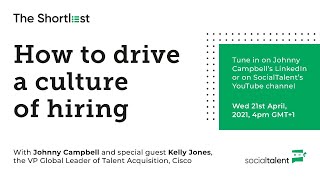
Transcript of a Social Talent Shortlist interview (Show 47) with Kelly Jones, VP Global Leader of Talent Acquisition at Cisco. The conversation defines and explores ‘hiring culture’—making hiring everyone’s responsibility—covering Always Be Recruiting (ABR), recruiter-as-coach, enabling hiring managers as ‘talent magnets’, onboarding integration with TA, measuring hiring culture, skills-based hiring and diversity & inclusion as embedded system practices. Kelly also shares leadership advice about delegating to develop others.
Chapters
Sam foreign. Welcome.
It's almost the end of the month. Well, we're not doing too far. Welcome to the Shortest. I'm Johnny Campbell. I'm your host for today for this show. I'm CEO and co founder of Social Talent. And if you're familiar with this show, you're hopefully familiar with our format, familiar with our voice as well. This is Show 47.
Welcome.
We're coming up on our 50th show. It's been almost a year since we started broadcasting and after last week's quick break, we're back, back on the show, back on LinkedIn Live, back on YouTube Live, back on your podcast on Apple, Spotify or wherever you find your good podcasts. We've got a great show and a great guest lined up for you today and a topic that's really near and dear to my heart and that is around what is a hiring culture and how do you build a hiring culture? Hopefully this is something for anyone in leadership or talent acquisition or talent role. You'll kind of appreciate the importance of this topic as it's going to come up in your career, in your job. You'll probably see the difference. We're trying to define the difference and look into what you know what, where that is going, who's doing it well, how do you do it well and our guest today will really hopefully help us with that. Quick reminder, for those of you who want to check out our previous shows, our future shows, you can find a bit more about the shortlist by going to socialtalent.com the shortlist where you have a repository of all of our previous shows. You can get links to our podcast there. You can watch the live video shows of all of our guests which also broadcast on LinkedIn and YouTube. By the way, if you're listening live on LinkedIn or YouTube, we love to get your comments and questions. Josh Rock is alive. I'm bringing it on. Hey Josh, good to have you on the show. Anyone listening live, please do put your questions to our guests. I'll do my best to pull them out there, put them to our guests live and have some interactions and some real learning. But let's get into the meat of what we want to talk about today. So how do you drive a culture of recruiting? So it's a deep seated trend in many organizations that hiring is someone else's responsibility. You know, hiring managers often look to recruiters or the HR department to fill the void, secure top talent without kind of realizing the important role they also play in the process. Recruiters moan about hiring managers. Hiring managers moan about recruiters. It's always somebody else's problem, always somebody else's responsibility. But in reality, hiring should be everyone's responsibility. At least that's one of the beliefs of our guest here today. It cannot be left up to either one person, one team. It really is an organizational imperative and often one of the most critical things an organization can be successful at is great hiring, particularly in the knowledge and technology economy we live in today. But how do we do this? Joining me today on our show is Kelly Jones. Kelly is the VP Global Leader of Talent Acquisition at Cisco and she's going to be speaking to us about the importance of partnerships and the need to enable hiring managers to become what she refers to talent magnets in order to build our culture of hiring. Kelly, welcome to the show. I'm hoping you can introduce yourself to introduce yourself to our guests, maybe give them a bit of background as to you as a leader, professional and also perhaps just in case they haven't heard of Cisco, a bit of a background on Cisco.
Great. Thank you so much. I'm so excited to be here on this particular topic because as you know, Johnny, I have a ton of passion around this as a foundational element of how you do hiring well. So thank you for the invite. I'm really happy to share any insight I have. And my name is Kelly Jones. I am the lead of talent acquisition for Cisco Systems. Cisco, for those of you don't know, is a organization IT infrastructure networking based in San Jose, California. We are a global organization that does hiring at scale across the world. So we hire about 20,000 people a year at Cisco Systems. So we have a pretty significant organization and it takes a village to do this. Well, I've been working in the recruiting field for longer than I'd like to admit because it puts a bit of a date on me. But I have, I started as a sourcer and I worked in the IT services industry. I actually owned my own company for a few years doing IT placement as well as contractor services. And I've been at Cisco for a little over 10 years and in that 10 years I've had multiple jobs. One of them that I'm doing right now is leading the talent acquisition organization. And but I've been in and out of TA in my time at Cisco which has given me an ability to ground a little bit in some of our of our business strategy. So I'm really excited to be here talking about this today and thank you for the invite.
A pleasure. We've got the Comments coming in fast and furious already. Jacob Mattson. Hey, Jacob is saying, he's quoting something I believe from Spotify saying welcome to Spotify, the place where we have 3,000 recruiters. How's that? Well, every single employee at Spotify is a recruiter. And we've got a good friend, Donald Donahue joining us from Dublin saying such an important topic. Well, from Kildare, actually the best people managers are great, great talent scouts and ambassadors attracting great talent to the organization. Well, with those great comments to start us off, let's get into the news this week. Niall, over to you. Well, so let's have a look at the news here. Actually, we're going to go back several years. We're going to cheat a little bit for this one here. This is an article from SHRM at the Society of Human Resource Managers in the US and it's from Patty McCourt. Patty McCourt was, was the head of HR in Netflix from 98 up until about I think 2012 or the early 2000 and tens. And she's written so many articles and a famous deck on recruiting and hiring and a fantastic speaker. She's spoken in Ireland several times at the Town Summit as well. And this is an article that if you haven't read it, you should. It's called Patti McCourt always be recruiting and it's by our good friend Roy Maurer. And in here she basically talks about how leaders in tech companies in particular should really get out the checkbook and fix the gender pay gap. And she also kind of, you know, talks about this AV or always be recruiting philosophy that they held at Netflix. Kelly, I'm going to go to you and ask you for your opinions on. This is an article I've read a couple of times over the years. Great to have a refresh this week to read it. What is your, what is your opinion on the AB or philosophy the always be recruiting, which is kind of, I guess what a hiring culture is perspective that Patti puts forward in this article.
Yeah, I am a big fan of abr. I'm also a big fan of organizations fixing the gender pay gap. But but to abr, I think it is critical to the foundation of having a good hiring organization. And the reason is in reality talent acquisition organizations and recruiters don't hire anyone. Leaders make all of the hiring decisions. Recruiters enable the process. Great recruiters influence and streamline the process through their business knowledge and their skills and their coaching. But ultimately leaders make the decisions. So both the ownership and a level of measurement on the quality and the experience, I think has to live with leaders in order to get this right. And this is a sentiment I'm starting to see more from some of our best executives making their organization really accountable for this result because it's a partnership with a recruiter for sure. But having managers have some emotional buy into it and take ownership is critical to even have start to talk about having a culture of hiring.
Yeah, it's funny, I'm not a huge sports fan or follower, Kelly, but I've always kind of looked at sports analogies around recruiting and particularly look at teams, right. Team coach or manager. And you know, she's going to look at her team and realize that having a great recruiter, bringing great people to her team is critical. And having the ability to train and bring the best out of those people are critical. You know, in that extreme kind of support sports scenario, the priorities of a leader are really clear. Why is it you think that it often gets blurred and lost in the corporate environment or the work environment where the priority over recruiting and developing staff is kind of lost sometimes. Why is that you think?
You know, I've observed this over years and my theory is it really is the most precious commodity that every leader, manager and executive has is time. You know, if you want to do something nice for your executive or your leader, give them some time back. And so the tyranny of this is being good at hiring. And having a hiring culture takes time. You have to be willing to allocate time to prep for interviews, manage passive candidates, actually care about the process. And I think time is the one commodity that people generally don't have and have even less of post pandemic. So it really comes down to time and priorities. And I feel like it's easier to compartmentalize this stuff and say, well, a talent acquisition organization, does hiring check. I don't have to worry about that. You know, they're going to bring the game on that side of it. So I think it's time to answer your question, Johnny. I don't think it's misintent. I think it's, it's, it's time.
I think probably there's parallels there between other departments in let's say the traditional people or HR realm, for example, talent development. You can't just say, well, the talent development department are going to develop all my talent. A leader is probably the most important person in developing our own talent. I guess their support team, they're the experts. And Patty McCourt references a concept concept in that article. I'd love to get your opinion on Kelly, to see if it's something you've been able to enable in Cisco, which is the idea that the talent acquisition team should be there to coach the business leaders in all of the things they need to know about talent acquisition. I guess it's saying that whilst we recognize the importance of the leader in that role, the TA team can take responsibility for coaching, how to be a better business partner, how to interview better, etc. What's been your experience of that? Is it something that you see the best talent acquisition professionals being able to do?
Yeah. And so when you think about recruiter capabilities and what is a good recruiter, what is a great recruiter? You know, good recruiters can fill roles. Great recruiters actually enable business processes. And so when you think about how that recruiter is viewed, if you have a team that has this is our work and then our recruiter comes in when we have an open position and helps us, that's not really a partnership, you know, that's kind of a support on as needed support structure. So in my opinion, the best recruiters are absolutely those that show up at coaches because recruiters do bring a level of insight as to the external marketplace as to not just the process, but some of the things that we need to coach leaders on in terms of how to show up in your interviews and really sell those candidates that you want. So it's 100% coaching, it's enablement of the process and it's coaching. And then the other thing I think that is critical is if recruiters are an extension of that team that are there to help leaders enable their objectives, then they're going to be able to get these leaders on board a lot easier with what they're asking them to do. You demonstrate that though, by showing your knowledge. That's the other part. You know, I often tell people a complaint you hear a lot from leaders in traditional HR functions is we don't have a seat at the table. And one of the things I always try to articulate, and it's the same with recruiters, bring value to the table and you will be at the table. So the recruiter coach concept I think is really critical. And us showing up and reminding ourselves that we're the ones that have the PhD in work and in hiring, so we need to be at that table influencing the process.
I know we've talked about this before around how do we better balance the lack of time of hiring managers and influence and coach them to drive those outcomes. Patty McCourt refers to in that article, this concept of, you know, it's a bit, has a particular bias from a cultural perspective. But, you know, I think we all get the idea of, you know, that the best place to recruit is on the side of the soccer pitch. That, you know, if people have that awareness everywhere in the organization, that having conversations with other people inside the soccer pitch might be your best source of talent. That's how you actually might be able to recruit people. You know, what, where have you seen this work out? Well, you know, and where does it extend to? Is it just leaders and managers or is it literally everybody in the organization should be having that mindset of the side of a basketball court, the side of a soccer pitch, you know, at a rock concert, that I'm always alert to who's around me, who am I talking to, and could they be a good fit for my organization? Where does it end and how do you enable that?
Yeah, I think you've achieved a culture of hiring when you can reasonably say that everyone in your company feels like it's a part of their job to find the next great hire. Because if you think about what culture is, culture is something that happens kind of every day, you know, and you have to be intentional about what your culture is and shepherd that and people will opt in and out of what your culture is. But for a hiring culture, you have to be very intentional around that is what you're doing. And I think the, the idea that everyone in your company feels like it's their job to find great talent, it's not really even just leaders, you know, I think that it's everyone. But I think there's also an element around that, not just in how we think about who looks for talent, but how we think about talent. And one of the things that we're always reminding leaders is the historical. I have a 20 point checklist of these are the 20 things that I want to see this candidate doing right now on this resume so that I can in a very linear way map them over to my job description. We have to stop doing that because the other part of that culture of hiring piece is we have to look at individuals and understand that individuals are not one dimensional. And if you hire really smart people, and we hire a lot of engineers at Cisco, so if you hire really, really smart engineers, are they programming in Python now or not? Shouldn't necessarily be the first gate question. You know, we should realize that we're hiring largely for learning agility, emotional and mental agility, and the ability to transition skills. So it certainly Is everyone in your organization feeling responsible for it? And I find when people are aligned with your culture and love where they work, it's easy to do that because you run into people all the time that you can tell your story. And part of what we enable our recruiting team and our leaders to do is tell their story. Why are you at Cisco? Why did you choose this job? Why did you choose this team? So that's a long answer to say 100%. I think there is definitely something there around. Everyone should feel like it's a part of their job.
I love that you've teased out two kind of high level concepts there. One is the ability to understand what skills or competencies or attitudes we're actually hiring for. And then second, the ability to sell through storytelling. They're critical skills that if you're going to have a hiring culture, everyone needs to be able to comprehend. It brings me nicely to our second article, which is much more current from Harvard Business Review and it's from the latest edition published the March April edition I think, and it's entitled Re Engineering the Recruiting Process or Recruitment Process. And I'm going to tease out a couple of things here relevant to your last point, Kelly, I think are worth mentioning again. One is they point to a Gartner study that's found that 29% of new hires, only 29% have all the skills required for their current roles and that positions filled today will require up to 10 new skills within 18 months. There's a lot to unpack in this article, don't get me wrong. But to get to your skills point, you know, if you only hire for the rec, you're missing the big picture and we're not seeing the future view of this and being able to more subtly look for what you really need and that partnership process. Going back to again, the Patty McCord article and the kind of concept of business partnering is that not only are we coaching perhaps the rest of the business in how to understand the skills and also how to sell the organization through storytelling. There has to be an element of influence to say we are the experts and know what's available. We also understand the trends and skills. We have the company's bigger picture in our, in our, in our line of sight and we're therefore influencing what even the requirement is because again to your point around, we're solving a business problem. We shouldn't be filling a wreck. You know, again, where do you think the world is today in that maturity from, you know, your typical here's the wreck go Fill it, get me the 12 skills or as close to as possible. Thanks very much towards that true partnership. And then second question on that. What is the key way to unlock that if you are more of the former?
Yeah, it is a great question to where is the world around this? I feel like just from my travels with my peers and other organizations, the world is about halfway there if I had to put a number to it. I think the goodness is there are a lot of companies now that are recognizing and in truth, I think the pandemic drove some of this, the disruption in the higher education system maybe drove some of these conversations around what are we actually hiring for and moving towards more of a skills and capabilities hiring program versus a 20 point checklist. I think the world's about halfway there. I think the companies that are nailing this though are doing really well. Because what the data says around this is if you will put a focus on an element of reskilling or an element of upskilling for your current employees or for new employees coming into the organization that maybe don't fit kind of your traditional hire, your retention rates for those employees are higher, your engagement rates for those employees are higher. And anyone who's ever led a team understands the difference in the level of kind of workflow you get from someone who is fully engaged versus someone who is just kind of there to do their job. So I feel like the world is probably about halfway there on the skills transition. But I also think that the conversations that a lot of companies are having around social justice and how do we recreate the channels in our organization to ensure that we are creating multi channels that are very inclusive? I mean, our mission statement is essentially power inclusive, growth for all and all is all. And so how do you figure out how to amplify your non traditional candidate channels and really get people out of their head a bit on what they've seen work and what they think works and some of the ways that we've done that is with data. You can always move engineers with data if you start with data. But to your comment earlier about storytelling, I think that is equally if not more powerful. Our primitive brains are wired for storytelling. So when you can take a narrative personal around how you have been able to take someone who might not look like a traditional candidate and put them in a role and have them flourish. I mean, I personally can think of multiple examples where I've put people in roles that if you were just looking at the paper you would say why would you do that? That's not the person, I would think would come and lead this function or do this job, and they just flourished. So I think that it's. It's the. Certainly getting people to think of it more like this, but also being able to go at it both with data and with a little bit of narrative storytelling.
Yeah, I think it's. You're so right in terms of, you know, opening up people's minds, perhaps different types of skills, which typically opens their mind up to different pockets of the population that perhaps are underserved, haven't been noticed before, haven't been given the same opportunity. And I feel like in the article hints at this that, you know, the pandemic was like, you know, both of us can probably remember listening to vinyl records, right? You've got a vinyl record playing in the background for ages. All of a sudden someone whacked the side of the record player. They had that big noise as it skipped, and when it settled, there was a new record playing. And we're like, what the heck happened here? And I feel like that new record playing is about culture and talent. You know, somebody changed the record without us noticing. We don't know what it is and we're trying to catch up. But it's an opportunity. I think it's a huge opportunity to reset. And a lot of the elements that were mentioned, this article talk about the different ways organizations are having a reset, which is more, I guess, an acceleration of things they were probably doing. And as you say, looking at more diverse talent pools, I think there has been a perception perhaps by some that the market is very much an employer's market because we had a pandemic and recession. Whereas the reality, and I think you're feeling this is quite the opposite. And the article points it out that in some areas it's harder today to find talent than it was January last year, despite the pandemic and recession. I heard stats that said the actual employment market in the US grew by 14% in the last year in terms of overall jobs against a backdrop of a perception that we were going to lose jobs in the economy because of automation, etc. Are you feeling this pain at the front end of this as an organization? Certainly not the pain that, say, were you feeling this trend that it's even harder, you know, to find talent or there's less talent or there's more competition for that talent?
Oh, 100%. And I think it's a lot of factors, it's not necessarily one. But I think what you're seeing is, and for us, we've always had an ability for people to work remote. You know, enabling remote work has been easy through the WebEx product. We're used to working remote, you know, collaboration technologies, interviewing remote. But when that opened up to the rest of the world, one of the big things that happened was location became a lot less important. So it used to be that organizations were looking for the best person in a zip code or in an area code. And what we've seen and what we've heard through our clients is organizations are now realizing they can hire anywhere. And so it's really good to be able to do that because it unlocks you getting the best talent around the globe versus the best talent that's sitting in a city. The negative is there are gainers and losers in this from a talent standpoint point. Organizations that have had remote work as a strategic differentiator are now competing with everyone where you might have been competing with a smaller set in the past. So I think some of it is that. But I think there's another element around everybody being at home. For the most part, over the last year, people are bored. You know, there's been a lot of articles out about the mental health issues and other things that come up. I think people are not seeing a lot of variety in their personal life. And so how do you create variety and how do you create newness? You change jobs. So there's a lot of, I think people. And there's a ton of data now around the people are saying that when the pandemic starts to open up a little bit and things open up, a large percentage of the workforce is going to be out looking for another job. Because the third thing I think that's come into it is in every relationship you have in life, when things are difficult, you learn who people are. And it's the same thing with companies. When things are. When things are easy, it's great for everybody to be great. It's easy. When things are hard, you learn who people are and you learn who the organization is that you work for. And I think what's also happened during the pandemic is there's been a variety of responses and amount of support that employees have gotten from their organization. And I think you have a large amount of employees that are going, nope, this is not where I want to be culturally, it does not align with my values. You know, things being difficult as they have been over the last year, because something I've noticed, Johnny, and I don't know if the audience has seeing this as well, even though people are not going into the office as much anymore. Globally, you should argue that, like your commute time is down, you have more time. The opposite has happened. What I've seen is like time and work has expanded to fill that time and much more. So people have a lot less time on their hands. So how their organizations have been supporting their ability to work from home, in some cases, work from home with your whole family there and the flat with you, which is quite challenging. You know, that's not. That's not the work from home. That is, I'm in my nice quiet office and, you know, I don't have a commute and I get my coffee anytime I want. That's lightly managed chaos. And so how organizations have supported this, I think is also driving a little bit of people's decisions. Do I want to stay or do I want to go?
Yeah. The second article we brought up from HPR mentioned a survey of 2,800 job candidates, and they said 60, 65, 6, 5% reported halting the application process because they found some aspects of the job are the company unattractive. I think, you know, that plays into one of those. Those trends you're talking about there. I want to ask you a question about your specific role, Kelly, because back in the Patty McCourt article at the start that we referenced, Paddy talks about, obviously, and we both agreed, I think the alignment to the business challenges what you want a good TA partner to be looking at, not just filling the wreck. And I noticed that you've taken on responsibility for onboarding as talent Acquisition. Can you perhaps walk us through where that connects and why do you think onboarding would sit naturally with somebody who's responsible for talent acquisition? And is that a direction you think others might go in, other organizations might go in the future?
Yeah, it was interesting because us taking on onboarding within the talent acquisition facility function, it wasn't something that we. It wasn't very intentional that, yes, we should do this, and here's why. It actually happened from the pandemic. It was one of those things. Like many, and I'm sure others have experienced this as well, the pandemic accelerated some things we should be doing already. You know, when I look back, I'm like, ah, this is probably something that we have allocated the time to do it before. It would have. It would have helped us equally as much. But onboarding came in out of a bit of a necessity because although I mentioned we're used to working virtually, interviewing virtually, doing all of that. The onboarding and the informal part of it where you get that collaboration that happens with your co workers is really, really critical. And one of the things we noticed right away was although we kept hiring, you know what employees were missing as they were coming in was that cultural immersion to teams equipping an employee with a laptop and benefits and all the tactical things of onboarding is relatively easy, but it's the cultural immersion part that was hard. So the reason that we stood it up and felt like it lived in there were a couple of things. The first is the recruiters have remarkable insight to the strengths and development opportunities of those candidates. If you think about the time they spend going through a candidate slate and working with a candidate through the process, by the time that person starts, they know that candidate fairly well. And so our thought was we could, through an onboarding program, eventually have it set up where it is Persona based. So if I have someone who comes in and interviews for a leadership role and there are five critical things we're looking for and they have three of them. To my point earlier about not having the 20 point checklist, the two things that we have a development plan on, how do we integrate that into their onboarding plan so that they come on and then we also have a path into our learning organization that goes boom. And these are the two things as part of your onboarding plan, because we've identified them as things that you want to try to accelerate. And so part of it was that being able to have that connection. And then there was another part of it that was really about experience. So like a lot of talent acquisition organizations, we have a ton of metrics. You know, we can measure everything in our process. We can measure from the moment, you know, someone enters in and sees us to the moment that they start with us and everything in between. And experience metrics are the same. Experience matters. And if there are a lot of recruiters listening, they know this. Everyone you interact with is a brand ambassador for your company, for better or for worse. So the experience you provide to both the selected and the non selected and your new hires, it matters. And so we were trying to also connect the experience that we try to provide during the process with their day one experience to ensure that it was positive.
I think it's both reasons are fantastic and it fits with this philosophy of, you know, TA increasingly moving towards, you know, seeing the business problem as the challenge. And I know a peer reviews on a call, I think that three of us were on with some others in the last year described his goal, our target that the business gave him as A TA leader was find the best talent and get them ramped up as fast as possible. And again, it was the latter part. You know, the first part is kind of a traditional TA go, but the latter part is perhaps something that the business is forcing, which is saying someone who just starts isn't good enough. We want them at the level that we hire them for, want to be capable and the onboarding process, that smooth transition from hiring process to now employee, so critical and it can go so wrong because the handovers, things get forgotten. The information exchange is not there. The level of detail around care perhaps might not be there because of that or certainly not aligned, let's say. So I love the move. But if I look at, let's say looking at the leadership skills back at the kind of overall talent acquisition kind of hiring chain, if you like. I know that you're a big believer in enablement and you've been really supportive enabling your direct TA team, but you've also been trying to drive the enablement of the hiring managers to recognize their time, that their time poor, but also to give them the skills on scale. Why don't you tell me a little bit about the project you started there and what your philosophy is and where do you see that going in the future?
Sure. And the great thing is the project and the philosophy all grounded in this concept of hiring culture. And so some of the things that we've been focusing on are around enabling our leaders to not only be great interviewers and not only be great at assessing and selecting talent, but be great at identifying talent and to, I think I used the words earlier, becoming a talent magnet, becoming a talent influencer. That's something that your organization has helped us a lot with. How do we start to drive that conversation and create capabilities? Because I will say within Cisco, and I imagine this is the case for other large enterprise organizations, we have people who are naturally great at this. You know, the sales organization, the sales and marketing team, they're naturally great at this because they are, they are good storytellers and good networkers and they tend to think this way. And then we have other areas of the portfolio where they might not have a natural skill. With this idea of continuous recruiting, being comfortable approaching people around what we do here at Cisco, it's just, it's not from a place of misintent, it's from a place of lack of knowledge. So what we've opted to do is really ensure that all of our leaders and eventually employees are trained on the ability to do this basically. And we're doing it through a badging system and we're doing it through being able to look at also a hiring manager measurement that says that this is a part of that. We look and say how well are you doing hiring? Because my comment when we started was around recruiters don't actually hire. We enable a process, leaders hire and so the quality of that process has to live with a measurement responsibility, at least proportionately with the leader. And so we are actually looking at doing this with all of our leaders. How do we train them to not only select well, but to attract the right talent and to become a talent influencer. And the way that we're actually doing this is we're going in and we're. You have to spend the time and we're going in one to one and having them with the training, but then also workshopping some of the things around. And this is what this looks like with your social profile, you know, this is what this looks like with your LinkedIn profile. You know, these are the ways that we measure this. And then as we start to see the positive result from it, it's self fulfilling and then they keep going. But the other thing that's really helped is we've done some external hiring recently in the executive population and a lot of them are coming and with different ideas and putting this healthy pressure in the system for us around how we should operate from a talent acquisition standpoint, but even more importantly what they're expecting from their leaders. So we're asking leaders now to say it's your responsibility to have five or 10 passive candidates that you're talking to all of the time. And these might not be people that you have a job for today, but these are super sharp people that have capabilities and the character of what we want, a Cisco.
How do you think? Because I know it's complex and not always easy. How do you think the business, the board, the executive team can eventually measure the success of this and the success of having a hiring culture? What do you believe should be the metrics and what do you think can be measured today and how easy is it to measure those types of things?
Yeah, I don't think it's easy to measure those type of things, but I do think there are things that people can start with. I think starting with looking at things like how many referrals are you getting from your leaders that are coming through the process? And I think that's important. And I say coming through the process because in the space of employee referrals, any of us who've worked in recruiting, know that more is not always better. You know, you're looking for like a quality over quantity. In this case, you know, what you don't want to do is spin up a ton of work where you're calling, you know, 100,000 people that you don't have a job for. But the targeted referral piece, you could actually look at it through number of referrals that come into the organization for. We're also looking at how many people are badged and not just interview training, but talent magnet and talent influencer. What percentage of your organization is badged in that? We're also looking at the experience metric of the candidate. We interview all of our candidates, selected and non, to understand their experience. And the questions are specific. And we have some specific questions around the interview process and the hiring manager that interviewed them. How did that process go? That should be part of it, the experience that the candidate has going through the process. So I don't think it's easy. And my comment at the top about, you know, you have a hiring culture when everyone feels like it's their responsibility. That's a difficult thing to measure because it's sentiment. But you can get tactical around some of the results to say, are we driving the activities that are reflective of having a hiring culture?
Do you think it's possible one day or have you seen this anywhere you've worked or any colleagues you've spoken to in the past? Do you think it's possible to KPI leaders outside TA on this type of thing? So whether it's the amount of people you sourced for us or referred to as our many network that got hired by Cisco, like is that a thing you think that we should be looking towards? Have you ever seen it work? I haven't. I'm just going to say that yet. But what are your thoughts on that.
There are organizations doing it and using different metrics. I do think it's a thing you should do. And I say that because people in general do what they are measured and paid to do. And if you just go out and say this is important on top of the 50,000 other things leaders are trying to do, it's just noise. And so if you really want to pull it into some action, you have to have a measurement around it. But what I will say is it also has to be important to the senior leaders of an organization. If it's not important to the senior leaders, it's not going to be important to their staff. You're going to have some people who naturally do it, but for the most part, it is not going to make the top five around things they're trying to do. So I would actually say I think it's incredibly important some companies are doing it. I haven't talked to anyone that has a measurement that I'm like, yep, that nails it. But I think there are people getting closer to it. And when you measure it, you draw attention to it. You know, people look at it, you have actions around it, and you're not going to move the needle unless you have some kind of measurement, in my opinion.
I guess it's like we mentioned very, very earlier in the conversation around the Patty McCourt article where she talked about equal pay. You see organizations that publish this publicly, that drives the pressure. It's like, okay, we're now showing you what it is. There's a gap. Now the pressure is on us every time we republish to make it closer and close that gap. You know, exposing these things is the start, I guess. Great comment here, by the way, from Peter Stevens, who's listening live saying best source of referrals and best sourcers are happy and engaged employees. I remember many years ago speaking to a friend of mine who's chro of a technology firm here in in Europe saying that he went, he was the head of TA originally and he went to try and drive an employee referral program and build it and he bought technology. You know, the usual thing, you naive, you think I'll buy the tech and that will fix it. And he quickly learned that actually to fix referrals, he had to drive employee. He had to try and make people happier in their jobs. And when that was solved, they would get referrals from that, which I think is important. So I think, you know your description of the hiring culture when everyone feels responsible for hiring, when everyone is referring not for volume but for quality. And again, back to those two metrics where we understand what the business is hiring for and why, where we're going, what the skills we hire for, why that's important, but also that we are enabled to sell, tell the story. Because that might not be comfortable to everybody in the organization. But if I come back and focus just on one last topic here and to bring back to the social justice comment you made earlier on, what do you think is the best way to layer this for both TA folks and for hiring managers and anyone else involved in the hiring process? Because I was on a live conference yesterday and I surveyed the attendees as to one of the most important skills to do their jobs today. They were TA folks. So sourcers, administrators, managers and full 360 degree recruiters. And nobody ranked DNI as their top. In their top three or four priorities. But then I asked them, what do you think are gonna be the most important skills for the next three years in the overall industry? And DNI came out as number one. I was surprised with this disconnect. Maybe I shouldn't have been that it's gonna be the most important thing in the future. But it is not important for me right now. I see it being more important for organizations. I see more and more people getting into it. What are, what are the critical ways to start that process? You know, what's the most effective way to really drive some change there? From your experience with hiring managers and or TA folks?
Yeah. Well, I've seen that work well and I've seen it not work well. So I'll kind of break it into those two buckets if that. If that's all right. So right now I'm in an experience where it's working incredibly well. And I have to share. Share. You cannot underestimate the impact of when you're looking at trying to increase diversity on teams and do hiring around social justice and other pieces, you have to be brave as an organization and be willing to have difficult conversations. And so a little bit of it is getting leaders comfortable with having uncomfortable conversations. And this, I absolutely believe, has to be modeled from the top. So one of the things that I'll give you an example of it working well. So at Cisco, when the murder of George Floyd happened about a year ago, one of the things that we instantly did was started talking about it with a high level of transparency. Transparency is at the core of our culture and we talk a lot about who we are and what we believe in the world and who we want to be in the world. And so we unlocked a conversation with leaders where leaders who might not have been comfortable in the past talking to their employees about certain topics, started doing it. You know, you almost have to give people permission to start to get uncomfortable in the conversations that they're having. And so that unlocks something in our organization. I can tell you we have had great success with the D and I efforts. I actually, had I been in your meeting, I would have put it in the top three. But it's in the top three for a lot of reasons. There's certainly the element of if you want to enable inclusive growth for all, you really have to have a focus on that in your talent strategy. But even more importantly, and I Know, everyone knows this, but diverse teams perform better. The one thing you really want to avoid is consensus. And I've been on those meetings before where someone says something and everyone goes, yes, yes, yes, yes, yes, yes, yes. And that's terrifying because that does not drive great results. That does not take you forward. And so being able to have a conversation about. And when I say diverse teams, I don't just mean that in a very kind of linear, you know, women, people of underrepresented backgrounds. I mean diverse teams, full spectrum, some that are visible and some are not. You do unlock things in performance when you bring people into the conversation that have a different background and that disagree with you. And so how I've seen it work well is when you have a brave leadership team that's willing to unlock something and have a transparent conversation. And then the second thing is you can't have D and I as an objective that's owned by dni. It's a little bit about, it's a little bit like the conversation we're having about hiring. And I've worked in organizations before and this isn't a knock, but if you have a diversity sourcing team that sits outside your recruiting team, they are not going to be wildly successful. You've got to embed everything that you want to do in all of your steps of the process. So the way we focus on it at Cisco is we have fairness embedded into every step of our recruiting and hiring process. And we measure it. We know who's coming in when, we know how they're advancing, we understand everything in that part of the process. And if Kelly is passionate about D and I and leaves Cisco tomorrow, that goes on because it's not a person, it's embedded into the system. So I think it has to be embedded into the system to make process in areas or progress in areas. Where I've seen it fall down are when it's again seen as like something that the D and I people do or it's seen as a temporary effort. You know, we're going to do this now. You know, we have this push going on now and it has some kind of a shelf life, you know, that is incredibly short sighted. You know, we have to be thinking about this in, in the long term. So I hope that answers your question. That was kind of a long answer.
No, no, it was passionate, which is what I was hoping for and I've been 100% agreeing with you and I think it does touch on the other areas of, you know, people development and it highlights that no one department who perhaps might be the expert department, whether it's talent acquisition, talent development, the D and I department, they're not responsible for that. They are the experts. They're the consultants that have to work with the rest of the business. And that critical partnership is so important. You know, whether it's a hiring culture driving a culture of inclusion. It isn't a department. They may, you may have experts and it's trying to see them as experts who work with us, you know, the expert consultants, which is what I guess the TA team are who understand the deeply, hopefully what works, what doesn't work in those areas. But really it's a failing if you only keep that expertise in that department. Your job is to make that, you know, a reality across everybody in the organization. It's not just a TA goal around hiring. I would argue it's in everything to do with talent that you're trying to drive those cultural things around inclusion, a talent development, a skills development culture. Really the job of the support our kind of expertise functions around people of which TA is one of, is really to drive a culture across the organization so that the organization could technically do it without you. That's probably the ultimate, you know, measure of success, is that we're not needed anymore. The business is so good at this itself. It will never happen. We're okay, we'll still be in a job. But they're so good at this now that they don't even need us anymore.
Yes, I love that idea. Working yourself out of a job or into a much smaller scale job because so much of it is embedded in the way we work.
Exactly, Kelly. I can't believe we've rattled through so much already. I thank everyone for their comments and chat and questions. We haven't got to get to them all. My apologies if I didn't get to your individual comment. If you're listening live, Kelly, at that point of the show where although you've given us lots of insight and advice now thank you for that so far. I'm going to ask you to go one more. I'm going to ask you to leave us with one last piece of advice or insight for our shortlist. We ask everyone who comes onto the show for this and it could be something that you have been given by somebody throughout your career, advice you've taken on board and used, or advice you just have to give others from your experience. Could you share with us that piece of advice for our shortlist, Kelly?
Yes, Actually, the best piece of advice that I was ever given was In a moment where I was earlier in career, and I'm just going to pass it on. It's not mine, but I'm going to pass it on in the spirit of paying it forward. I was early in career and I was trending from that, moving to an IC to leading a team. And when you are at that point in your career and as you continue to advance into different leadership roles in your career, you almost have to recontract with yourself about how you get work done. And the piece of it, and what I mean by that is the piece of advice is, I got was every time you jump in to fix a problem, when you should let your team do it, you are taking away someone's opportunity to learn to be you. And it was, it was advice I got when I was going on PTO and I met with my boss and I said, okay, I'm out for the next week, but here are all the things that are coming up and here's what I've done to cover them all. I've got all these things taken care of and nothing should come up. And, and, and there was a pause in the conversation and Paul, my boss at the moment, said, kelly, you realize that whoever's backing you up next week has an opportunity to learn to be the leader of this organization if you allow them to do these things. So in your desire to take care of things, you've basically hamstringed their ability to learn these things. And it was powerful advice, and I kept it with me. And those of us that tend to not want to send out a lot of action items to others often feel like we can just do all these things our own. So I guess the advice in summary is make sure as you're progressing in your career, you're thinking about the others. You're thinking about the others that are on your team and with you. And how do you create opportunities for your team to learn to be you and for others to become uncomfortable in some of the jobs. Don't allow yourself to overwork and do the work that you should allow others to do out of a weird sense of ego or I have to be involved in it.
Absolutely love that. Such a simple concept. So true when you're reflective on it. Rashonda saying, great nugget. I think the audience really loved that one. Kelly, anyone in any job can take that if you're in any sort of leadership role as advice. And we don't, we don't do it too often. I know I don't do it often enough. You try and you think you're doing the right thing by covering. But actually, again, back to skills development and engagement. The best way to engage people is to give them opportunities, to give them opportunities to learn, to grow, to develop, to do it differently, to try something, something else out. So, Kelly, wise words. Hopefully our audience will take that. Thank you so much for joining us and sharing that wisdom. I'd love to have you back on again because I know there's 101 topics that we could talk about all day long. So I really appreciate you taking your time out. You've got to go back. You have 20,000 hires a year to go after. You've got hiring managers to enable and coach teams to develop people to try and do your role and give them opportunities. So I'll let you go back to it. Thanks for joining us today. We'll have you on again and we'll see you soon. Thanks, Kelly.
Thanks so much.
And for those of you listening, we'll be back again next week. Thanks so much for joining us on the show. You can find out details about all our shows@socialtalent.com the shortlist. But next week, that is Wednesday, 28th of April. If you want to join us live, it's at 4pm UK Ireland time. I'll be joined by Dougald McIntosh. He's the managing partner of TalentIn. Dougal's someone I've got to know over the years working for the RPO and MSP world. He's a provider to the recruiting industry and he's got a really great broad perspective on talent. I've had the pleasure of hanging out with them for a few nights in a villa in Spain, back when we could all fly and shoot in the breeze with a bunch of other talent folk as well. I know that Dougal is a smart guy, very clued in as to what's happening in the talent world. Trust me, you're going to enjoy the conversation. We'll be talking about shaping talent strategy in a post Covid World. Again, the record player scratched. A new record is playing. You don't know what it is. Dougal's going to give us a guide to how you shape talent in that post Covid World. Join us next week on the Shortlist. If you subscribe to our podcast, don't worry, your episode will pop up next Wednesday evening. But if you want to check us out live and join the conversation like so many did today, you can join us at YouTube SocialTalent or on my personal LinkedIn company, LinkedIn profile on LinkedIn, which is JohnnyCampbell but until next week, hope you take Kelly's great advice. Think about the next time you're taking personal time off. Are you trying to cover all the roles? Are you giving opportunities for others to learn whilst you're away and grow and nurture? That's a really great piece of advice. We'll see you next week.
More from Johnny


Where Does Your Hiring Stand? Diagnose It with the Maturity Model | SocialTalent

Where Does Your Hiring Stand? Diagnose It with the Maturity Model | SocialTalent






NEW CONTENT - How to use Generative AI for Recruitment Marketing with Glen Cathey | SocialTalent

NEW CONTENT - How to Use Generative AI for Sourcing & Recruiting with Glen Cathey | SocialTalent

NEW CONTENT - How to Unlock the Power of Generative AI with Glen Cathey | SocialTalent