How to prioritize wellbeing in periods of change | with Sara Andrews
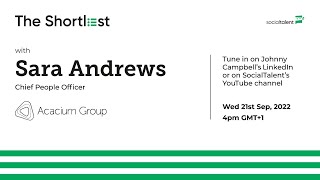
This is a transcript of Social Talent’s Shortlist (episode 116) — an interview between host Johnny Campbell and Sarah (Sarah) Andrews, Chief People Officer at Acacium Group. They discuss why employee wellbeing must be prioritised during rapid societal and workplace change, who is responsible (HR, managers, and employees themselves), practical programs Acacium uses (mental health first aiders, wellbeing champions, EAP, resilience workshops/coaching), how to measure impact (engagement surveys, verbatim feedback, turnover), and the business case (talent attraction/retention and ESG expectations). The interview closes with advice to treat change as constant and offer a broad, equitable menu of wellbeing options.
Chapters
Sam.
You're very welcome to episode 116 of the Shortlist. I'm Johnny Campbell. I'm the CEO and co founder of Social Talent. I'm your host today for the next 45 minutes or so. For those of you joining us live, you're very welcome. We, we do broadcast live every Wednesday afternoon, European Times, Wednesday morning in the US and the evening in APAC. And you can join us on YouTube or LinkedIn any Wednesday. Join the chat live and put your questions to our guest or to me or your comments in the chat box. And we hopefully will get some of those today as well. But we're here today to talk about how to prioritize. Well, being in periods of change. It seems like the world is moving faster than ever. You know, from coping with the aftermath of a pandemic and facing economic uncertainty to technological advances, social unrest, a war in Europe, recessions. People are dealing with a lot today. And it's no wonder that reports of burnout, stress, quiet quitting, anxiety around the increase in the workplace employee resilience is being tested. And it's difficult to perform your best in such an overwhelming atmosphere. And organizations are trying to figure out, well, how do we prioritize where wellbeing fits in? So joining us on the shortlist today to chat about this and how to perhaps solve for this is Sarah Andrews. Sarah is the chief people officer at the Acacian Group and she's passionate about creating positive employee experience. On this week's show, we're going to be diving into this topic, examining how leaders and managers can champion wellbeing while looking at the positive benefits this has for an organization as a, a whole. Sarah, you're very welcome. Thanks so much for joining us. Before we kick off, perhaps would you mind sharing with our audience a little about yourself, where you're joining us from today, what do you do and perhaps for those who aren't familiar with the Acacian Group, what the business does and its size and focus as well.
Hi Jonny. Yeah, great to be here and thank you for inviting me. I'm chief people officer for Acacium Group. We are a collection of 23 different businesses that work across the life science, healthcare and social care space. And we do that globally. We have a blend of staffing solutions and service solutions and we're one of the world's biggest global healthcare, social care and life science providers of those services into both public and private settings.
So what we throw on a typical day of someone in a casein group looks like, are you, are you staffing Hospitals. Are you staffing nursing homes? And where is this happening?
Yeah. So, as I say, we're a global organization. We work in the life science sector, so staffing into big pharmaceutical companies, supporting trials of medical devices and medical technologies, as well as drugs trials and all of the certification that goes along with bringing those to material market. We work in the healthcare sector, both for the NHS in the uk, but for private hospitals elsewhere in the globe. We've got a big organization called Favourite Healthcare Staffing in the United States and so we staff into healthcare settings and hospitals and then we have a business that works in the community as well. So we're providing community care and looking at patient flows from hospitals into care which could be in intermediary settings or in the home and is a wide variety of complex care in some cases that need different clinical skills and where we take the clinical risking in looking after those patients. So it's a really broad, purposeful organization.
Anyone listening to the podcast today or watching live might think, okay, Sarah's the Chief people Officer. I know her gig. I have a fair idea of how she probably got here. But you didn't get here the traditional route. You didn't start life in the HR world or as a recruiter or working in comp and bends. Tell us a little bit about your unusual route to this role.
Yeah, so I started life as an apprentice. That's kind of another thing I'm fairly passionate about, is bringing early careers, talent into the workplace in the right way. So I started life at Jaguar Land Rover. I started as a technical apprentice and spent four years in overalls, a hard hat and boots, learning how to do an engineering drawing, how to use a lathe, a milling machine, you know, to wire things and how to connect things electrically and also how to fabricate things as well. So I then went on and did my HNC and HND in mechanical and manufacturing engineering and then sort of ended up with kind of my career at Jaguar being at the Castle Brumage plant in their paint shop. So responsible for all sorts of facilities changes and improvements. But really kind of the heart of what I was responsible for was for process improvement in some way, shape or form. And I think, you know, that that early kind of career for in what was sort of Six Sigma and black belt and process improvement and statistical process control back then, those kind of underpinning principles have stayed with me through my career, really. So I brought those into program management and program director roles and then into the world of people management as well. So I've been lucky Enough to work internationally in France, in. In Sweden, in China and in the US as well, when Jaguar was owned by Ford, which has just been a real privilege to get that international experience. And, yeah, a lot of those engineering principles kind of find their way through into how we design work today and how we design organizations today day. So a very, a very different route into human resources, but one that I feel has served me well as well.
So I think it's fascinating and it is unique.
Right.
It's not the typical route, as the Americans would say, into this profession. My experience is that folks like yourself who come from a different background into a profession like this have very unique perspectives and typically do things differently. But before we talk about what you might be doing differently, I'd love to get your views on when we talk about care and we talk about, well, being. Talk to me about why should we focus on this right now. What, in your opinion, are employees having to grapple with? What are they struggling with, what's happening? What are the big themes that. And does it differ around the world, for example, and to different types of people in an organization the size of yours?
Sarah? Yeah, I think the world is changing at such a pace. And you outlined some of those changes at the beginning of the call. You know, we've got, you know, most recently, constitutional change. We've got economic change. We have got, you know, change within the workplace. We've got social change. And I, you know, sort of really feel that that spills over into work because work and life is so much more connected than it ever was before. So, you know, most organizations around the world are embracing some kind of, you know, hybrid working model and, you know, are spending time working away from the office as well as working in the office. And so those sort of hard lines that we perhaps used to have, where you'd finish a day's work and you'd have a commute or a drive or a journey home and a time to decompress. Think about the day, gather your thoughts, get yourself ready for the next day. Those lines are much more merged than they ever used to be. And I think that compounded with the change that we're seeing within businesses as well as the world at large, you know, need us to think just a little bit differently about how we can do what we can do as employers, to look after people and to equip them with, you know, some of the skills and the coping mechanisms and, you know, a way of looking at things that just helps them navigate a world that is changing in some ways. Almost faster, I think, than we can keep up with it. And we see that particularly in young people. You know, there was a Panorama program last night actually about, you know, mental health in young people and how they, you know, the sort of 18 to 24 year age group has perhaps been impacted more than any other age group, you know, with the pandemic. And so, you know, if we want to be a business that is different, is differentiated, that really cares about, you know, all of our people, Stakeholders, Partners, partners, then we've got to kind of, I think, think differently about the challenge of the change that, that we are all experiencing and how that might manifest itself in an individual's well being.
Who, in your opinion is responsible for this in an organization? Is it the job of HR to lead and run all the wellbeing initiatives or does anyone else have a bigger impact or responsibility, do you think?
Well, I think it's fair to say that for a while, absolutely, HR professionals have taken that lead, particularly through the pandemic where we did some things very differently to try and support people with coaching, with resilience mechanisms, to deal with a whole range of different circumstances and situations because, you know, because people's homes were suddenly their offices. And I think, you know, the HR function stepped up to that place. I think it was our opportunity to demonstrate what we could do and how we could add value and help and support, which I think, you know, broadly speaking, lots of organisations, including my own, you know, did incredibly, incredibly well. I think now that we're sort of particularly post pandemic, but nevertheless, still dealing with all of these other global changes, I think the thinking is shifting a little bit. Certainly in my organization we're really now trying to equip managers and leaders to be able to have better conversations and good quality conversations with their teams so that they can be supported in a way that works for them. I think we're also beginning to recognise that one size doesn't fit all and that everybody is in a different place and a different space. And so the challenge for managers is how do we acknowledge that and vary our leadership style so that we can accommodate difference because everybody experiences change in a different way. I think a great example for us in the UK and probably globally was the passing of the Queen. It's, you know, people experience that in a very, in a very different, in a different way. And, you know, as leaders of the business, we tried to make sure that we were empathetic and caring and understanding, regardless of where you sat on that emotional, emotional spectrum. And then I think you know, there's a role for managers in, you know, helping employees with change and that is, you know, particularly workplace change is something that we absolutely have a role to play in. But ultimately what we've been really exploring is because change is so individual, we can play a role as an employer, but actually where we've got to is to really start to think about how we help our employees take ownership for their own well being, because it's different for everybody. And so there's a level at which we can support as a business. But would we be better off really thinking about what it is that we can do to help employees recognise signs and signals of their well being, think about, you know, how they respond to change and you know, how they deal with change to give them and help them understand their mindset and explore how they might benefit from a broader growth mindset and that ability to adapt and pivot and respond positively when change happens. And also to help them understand their levels of resilience and what, you know, what the mechanisms are that help them individually manage change when it comes along. So I think there's a role that organizations play, but we're definitely exploring a broader piece around how can we help employees be empowered to take responsibility for their own well being.
I wanted to start with the leadership piece for a second because I know, for example, here in Social Talent, we in our employee engagement surveys ask a question to do with, you know, we ask something along the lines of would you feel comfortable going to your manager with a personal issue or crisis? And we use that as a metric to understand whether there is that trust there and that the feeling of probably that safety and that well being. And when it's absent, of course we want to try and address it. And when it is absent, you know, we find that a lot of leaders really are uncomfortable like they're personal style is just not to maybe do with, you know, when they first joined the workforce and what the culture was then, etc. But this really don't think that it's right to be talking about personal stuff in the workplace, because maybe they don't do it, they kind of don't do that and therefore they feel that nobody else wants to talk about it. So how do you work with leadership on scale to create an environment where leaders are armed with the right tools to have those conversations, to be able to drive that safety with their employees, with their colleagues, so that they can understand the different issues, notwithstanding the fact that they are different, will react differently. How do you create the environment where somebody who is deeply upset about the Queen's passing can share that with her manager in a way that her manager is going to understand.
Yeah. So I think for us, we try and create different routes for employees to have those conversations because not every manager is built to be able to do that effectively. And I think we have to recognise that some leaders and some managers just won't be comfortable with that. And so what we've tried to do at ACM Group is to build different routes and different channels for employees to have those conversations in a psychologically safe space. So to give you sort of a few examples of that, we have mental health first aiders who are distributed, you know, that they sit in all parts of our business and our employees can contact them, you know, at any time just for a conversation. We've got, well being champions in all of our businesses. So again, you know, they're a safe psychological space if someone feels that their manager isn't the right person to go and talk to about a particular, a particular issue regarding their well being or that they want to keep it a little bit more private and personal and they don't want to share it, you know, in their immediate work environment. So we try and have some kind of, some networks where we create that safety for employees to have those conversations in a way that's comfortable with them without it needing to be just their manager.
I'm going to ask anyone listening live if they want to comment or suggest things that work, things that don't work in their workplaces around this issue. But I'm going to ask the question to you first, Sarah. We talked before we went live on air about what were perhaps the early stage versions of wellness and care in the workplace, which were, you know, yoga events, trying to have wellness days, meditation, unmasked, things that were props done online for those of us who work from home during the pandemic. And many of these initiatives started in the pandemic. Many others started before that where organizations decided to ban, you know, fizzy drink machines and snack bars and replace them with granola bars all around and fruit. You know, what works, what doesn't work. When it comes to some of those things, which I think most of us are listening to, a conversation about well being. That's how organizations have reacted to. What's your experience? Does some of that stuff work? If so, what works and what doesn't work?
Yeah, and we did the same thing. You know, we have, you know, we have kind of fruitful offices, we have movement Mondays and well being Wednesdays and lots of social connection groups. We used, we use our internal social media platform for like minded people to connect together. Whether it's, you know, because they love walking or because they share a love of kind of, you know, their dogs and their pets. And I think they've all got that, I think they've absolutely all got their place. But I don't think they're the solution to the problem of how do we help people cope, become more resilient and have the tools in their personal toolkit to deal with, to deal with change. So I think they've got their place. I certainly know in my organization if we were to remove any of them, people wouldn't want to see those sorts of initiatives go. We had a little kind of session in our London office where puppies were brought in and there was puppy therapy. And people absolutely love it because it's a social connection and it's a social connection around things that people share an interest in. Of course, physically we want to make sure, you know, people look after themselves, get enough exercise, eat as well as they possibly can. So I, you know, we've not taken any of those things away. I think they all have a place and a space in the workplace, you know, to look after people. But I think what we're really exploring at the minute is that that's part of the solution. It's not all of the solution. And there's something deeper than that which is around how people experience their work, how they find joy in their work, whether their work is meaningful to them and whether they're empowered to take control of their work environment in a way that enables them to, to manage their work in a way that works for them. So I think, I think all of those initiatives, if that's the right kind of terminology to give them, create a great workplace. Of course they do. But I think what we're really kind of turning to now is, but does that really make the difference or differentiate us or solve the problem? And I think the conclusion that we're coming up with is there's something deeper than that that is much more of an emotional connection than some of those initiatives. So for me I definitely keep them, but I think that was just the starting point of the conversation and exploring how well being and change that we're all experiencing is interwoven.
You mentioned resilience and it reminded me one of the presenters on our platform, Dr. Mary Collins, which chartered psychologist herself a few years ago. We met for t in Dublin 5, six years ago and she was working on a project in the Royal College of Physicians in Dublin, where she was looking at the analysis around students who were now called Generation Z. Right. As one of the labels given to this group, based on when they were born and their studies at the time showed that this group had record low levels of resilience. And that's a. There was a generational aspect attributed to that or a correlation certainly with the generation, for whatever reasons in the Western world. And that resilience, perhaps where you start with the generation is maybe expanded into just all of us with, you know, the monarch dies, we have a war in Russia, you've got economic depression, you've lots of things happening in different people's lives. How do you build resilience in professionals? Because we're talking about people who are not in school anymore, they've left academia for the most part, they're in a workplace. And again, you know, how do you do it and how much of even that is. The employers call it responsibility. I know we talked about you have to teach someone to fish and you have to build resilience. But, like, how do you do it day to day? What does it look like? Is it online sessions? Is it classrooms? Is it providing funding for them to go find it themselves? Is it all of those things? How have you rolled this out?
Yeah, well, we've sort of. We've sort of tried a few different routes. Definitely there's a training element to it, and I think, you know, having people in a room talking about that, rather than sort of typical training delivery and allowing people that sort of psychologically safe space to express, explore what works for them, what doesn't, what they'd like to see, what they, what they don't. You know, there's definitely a place for that. We've just reinvigorated, you know, some, Some workshop sessions on, on resilience for those people, you know, in our organization for whom they, you know, they feel that that would. That would benefit them. So. So I think. I think there's an element of that because, you know, building that resilience is often based on mindset, how we approach things, how we choose to deal with things, how we recognize the triggers that will be different in everybody and explore some of those coping mechanisms of things that you can deploy and skills that you've kind of learned to help you cope better. So I think training's definitely got its place. It's certainly something that, that we offer within. Within our organization. We've also had some external coaching as well, so we had a professional who offered some group and individual coaching Sessions based on resilience. And they were really, really well received. You know, just that sort of small group of six people being able to, being able to talk, share and learn from each other, you know, was, was really valuable. So we've had, you know, people that we've brought in that are specialists, you know, in that area. And we have, we've done that as well, which has worked, which has worked really, really well. We've got, we've got a number of things around the business that you know, that people can turn to. I mentioned our mental health first aiders are our well being champions. And I think the other thing that we take really, really seriously is employee feedback. So we do have a culture of feedback and a culture of I think sort of open conversation and we listen to that feedback very carefully and try and really understand and unpack what employees are trying to tell us so that we can put mechanisms in place to deal with that. And I think, you know, back to the point about one size doesn't fit all. I think there is a variety of tools that are needed because not everything will suit everybody all of the time. We also have an employee assistance program which is a global EAP for us which all of our employees can use if they need to pick up the phone and talk to somebody and you know that they'll be pointed and signposted in the direction of other benefits and services that might be able to help them. So I think in the same way as we have a variety of well being initiatives because different people need different things at different times and will engage in different ways, so too with resilience we tried to build, you know, a, a broad offering of support mechanisms and things that will help employees in ways that suit them.
Simon's asked a question on LinkedIn. How do you designate the mental health first aiders and wellbeing champions within the business? And it's a great question, how do you identify who should be those people?
Yeah, so we don't identify them, they volunteer. So and we are overwhelmed with mental health first aid is there is a real appetite for people to want to take that, to take those roles. We try never to turn anybody down on the basis that they volunteered. So our job is to facilitate their training and to enable them to fulfill that role in the business. And the way that we sort of capture those volunteers is quite often through new starters joining the business. So we have a sort of an onboarding process where we talk to our new starters around, well being generally mental health first aid specifically and what we offer to train people to do that. And we, yeah, we have a really, I think we're just privileged. We have a really keen, enthusiastic group of mental health first aiders who are passionate about what they, what they do. They create a safe space. And, and we do that at a group level so that people in one part of the business can very easily access, you know, mental health first aiders who might, by day job, work in a different part of the business. So it's, but, but it's, it's all by volunteers. And we're just incredibly lucky that I think, you know, we catch people as they join us and we just open up that conversation.
And that might be a requirement, actually. Somebody doesn't know me, doesn't know my team. I won't see day to day, but I want to help me. Another topic that often gets brought up around this issue is, you know, how do you adjust your reward system or your comp and bend systems both to incentivize the right behavior, provide flexible options for folks, but also make sure that you're not unintentionally driving KPIs that perhaps might promote poor health. So, you know, many organizations, you know, would real, you know, have realized the last couple of years that they have inadvertently rewarded hard work in terms of extra hours. So, like, well done, Sarah. She burnt the midnight oil last night and got it over the line. I'm moving to a culture to go. That's not good. And we don't want you to do that. And in, you know, previously we would have signaled nice job for working late or working the weekend. Just trying to change the culture to go. Please don't promote that. Don't, you know, you're, you're, you're, you're signaling that this is what we want others to do, and this is not what we want because it's, it's not, not part of our philosophy or even, you know, in the reward structure. Making sure that you are designing reward structures that incentivize the right behavior, not the wrong behavior, or providing benefits that allow for more flexibility. Have you explored some of those things, found some of those things in your business?
Yeah, absolutely. You know, I think any business, you know, you know, has to drive performance. You know, that's what keeps us all, that's what keeps us all kind of in a, in a job at the end of the day. But I think there's a real cultural element to that. So one of the things that we have done this year is we've appointed a culture and inclusion director who Looks after all of our activity in the diversity and inclusion space, engagement, well being and social value space to try and bring all of that together. Because so much of that activity is all connected to well being. It's around the culture of the business. I think we've got a really clear purpose and a real clear set of just three values. And one of those values is putting people first, another is always by your side. And I think genuinely the leadership team try to lead the business by those values. We weave that through all of our communications, we weave it through all of our policies, we weave it through all of our learning and development activity. So it's a real constant through everything that we do, that we bring everything back to purpose and bring it back to values. And I think that can go a long way to really embedding the culture that you want to see. Of course, like any business, we have those times where, you know, that midnight oil needs to be burnt, a job needs to be done, something has to happen. But I think as leaders, it's making sure that that isn't the norm and that people can, they can go that extra mile and will do so willingly when it is genuinely needed for, you know, for a one off, unique business purpose. I think when it becomes the expected and when it becomes the norm, then that's culturally, you know, when there's, you know, when there's something that we, we need to, we need to think about. We, we do drive and we do incentivize our teams both to perform, but not just our sales team and our recruitment teams, our staffing teams, you know, we equally reward and recognize all of the support functions as well. So we have a specific set of awards that are designed for, you know, that the back office functions and the support functions to make sure that they feel valued in that journey as well. I think we look long and hard at the hours that people are working, any additional hours that people are doing. And I do hear around the business, you know, leaders actively encouraging their teams to log off and switch off, to not be contactable. You know, when they're on holiday, if that's, you know, if that suits them and if that's what they choose to do. So I think, you know, when it comes to sort of building that into the culture, absolutely, you know, that is the responsibility of managers and leaders and that is something that we really can be responsible for and take care of, is creating, creating that right culture, respecting those differences, you know, acknowledging that some people may choose to have a phone on when they're on annual Leave. But other people just absolutely want to switch off. And I think that's been a real. It's a real different way of coaching managers because in times gone by, we would have coached managers to be fair and consistent. And I suppose what I'm sort of describing there is that concept of being equitable that, you know, it doesn't have to be the same thing for everybody because everybody's circumstances are different, people are at a different time of life, have got different things going on inside and outside of work, have got different personal drivers and personal motivators. So I think to keep that balance, it's, you know, that having that sort of psychologically safe space, that culture of trust where people can genuinely say, this is how I want to work and this is what works for me personally and for managers and leaders to respect that. So I think that trusted, you know, that trust in that respect are crucial to building a culture where everything doesn't have to be the same, but it does have to be equitable.
I know from my perspective, I look at some of the legislation that some European countries have brought in over, you know, banning the ability to message after hours or weekends or on vacation. I'd be more stressed not being able to access the information. I want to be able to choose what to do with it and not feel pressured in a workplace. But again, I think we see it too often. There's only one way. People absolutely don't want to be able to see stuff in the evenings or weekends or I think it's the difference might be just they shouldn't ever feel compelled to action that stuff. But people want different things. They. Some want to see the information, some don't want to see the information. To your point around, you know, there isn't a one size fits all.
Yeah.
When we talk about this careful balance of being people focused and performance focused, I think it is a careful balancing act. Talk to me about the business case for all of this. Like at the end of the day, right, whilst you and I are going to do this kind of thing because it's the right thing to do, you know, stakeholders, investors in an organization, shareholders, they want to know this is a good thing to do. Typically measured by performance and measured by numbers. It's not why, again, people like ourselves do it necessary. But what is your understanding of the business case of having this kind of a really focus on, well, being a focus on career. Does it drive those business benefits in your experience?
Well, I think first and foremost, you know, globally, we're experiencing the challenge with attracting Great talent. And in, you know, in our businesses in Australia and in the us, you know, the challenges are the same as they are in the UK in terms of finding and securing talent. And certainly one of the things that we've experienced over the last 12 months is the first question is no longer what's the salary? What's the bonus? The first question is, how are you going to take care of me? How are you going to make sure that my well being is prioritised and how are you going to give me or empower me with the flexibility to work in a way that works for me? And we hope that that is, you know, absolute sort of empirical evidence that, you know, that our talent attraction team, you know, will, will tell stories about, you know, it's that there is a shift in the talent market where it's no longer acceptable to tick a few boxes just to say you're doing the right thing. I think, you know, great talent is now really testing businesses because they have choice, they can choose where they want to go and work. You know, in lots of the developed countries particularly, there's more jobs than there are people. There's really key skill shortages and talent shortages. And so we've almost got this sort of perfect storm of, you know, of coming out of a pandemic, having had the biggest kind of social and workplace experiment ever with, you know, with working from home, moving back to, you know, a different model of working and a different relationship between the employee, the employer, home and work that's shifted forever in one way, shape or form. And I think the talent that we all want to bring into our businesses is changing that narrative. So I think for me, that's one of the first business reasons as to why we've moved away from doing some initiatives that are helpful to really thinking a bit more deeply around, you know, how do we really care about people and recognize that wellbeing is different for different people in different roles, different countries and at different times of life, and how do we really, really think about that? So I think, you know, I think the talent, you know, the talent debate is front and center of all of that. You know, of course, then nobody wants to lose people. So if you've got a culture that thinks that they're entering into a workplace that really puts people first, that's always by their side and that wants to care and develop and nurture great talent, but when they arrive, it's somewhat different. There is no hesitancy in walking straight back out the door because people, people kind of will vote with their feet. So, you know, and there's a business cost to that. You know, there is a cost of turnover and a cost of lost talent and additional pressure that goes on to teams. When talent, you know, leaves an organization, there's a time to competence, of bringing new people, you know, up to, up to speed in a role. And all of those have got absolute, tangible, quantifiable business, you know, a business financials attached to them. So I think kind of that's, you know, that's one of the other narratives. I think genuinely and certainly we see this in our organization. Our parent company and our stakeholders and shareholders are putting ESG so environmental, social and governance metrics right at the heart of the business in a way that we've never seen before, force. So not only is talent on one side telling us what they expect from us as an organization, we've also got shareholders on the other side also, you know, adding to that narrative and saying we expect you to be a responsible and sustainable organization. And, and that has a value creation to it in a way that perhaps wasn't before. So I think the ESG agenda, along with the wellbeing agenda, has sort of moved on from ticking some boxes to say that you do some things to really embedding it into our culture and thinking about how we make it part of the fabric of who we are and part of the fabric of our culture. It's just how, how we do things around here. So I think for me those are three sort of real business drivers. Attracting talent, making sure talent stays with us and doesn't leave. And then the external business narrative from shareholders and investors where it's front and center of their investment conversations.
How do you measure it all works? How do you know month to month, quarter to quarter that you're making progress?
For us, there's a number of ways that we measure it. I don't think there's one way that gives you a definitive answer, certainly our engagement survey. So we, we do an annual engagement survey of our engagement survey. We split five of those questions into really measuring engagement and the commitment and the emotional connection that our employees have with, with our organisation. So that's one way of measuring it. But within that we also have experience questions as well. And a section of that is all around wellbeing. So we again can take feedback not just in terms of numbers, percentages and scores, but people really want to give us their verbatim feedback. We did a mid year survey about six weeks ago and we had in an organization of about three and a half Thousand people. I think we had somewhere in the order of about 9,000 comments across all of our well being questions. So I think if you've got the right culture then you know, your teams and your people will be quite comfortable in sharing their thoughts, their feelings, their feedback, their suggestions and wanting to engage with the business on, you know, on that journey. So that's a number of kind of ways in which we measure it. Of course we measure turnover the same as every organization does and will. And I think it's a blend of all of those together. I think that's where human resources is really also moving from that data based approach to analytics and insights and blending some of those indicators together to try and understand a deeper picture around what that really means for us as a, as an organization.
I'm going to use one of our listeners, live listeners, has asked a great question. Let me spin it on a more personal level, Sarah. Do you think, you know, we need a direct ROI for this or is doing the right thing enough for you?
I think fundamentally it's doing the right thing. I think for me and for my business that is at the heart of what we do because that aligns so strongly to our values and our purpose. The business that we are, the sector that we work in. So I'm not an advocate of return on investment because I think some of it is, is intangible. If you try to measure every single thing in terms of a return on investment for a particular initiative, I think we'd struggle. But if you look at the overall business picture, so if we look at our overall business performance, we look at our engagement surveys and within that our well being surveys, they're all indicators that what we're doing is moving us in the right direction. So I'm not a massive advocate around a return on investment per initiative, but I do think it's really helpful for leaders to be able to draw insight from the data that surround us to know whether what we're doing is what employees want.
It's the perfect balance between the engineering brain which might push for pure measurements, to maybe the HR brain which look at the culture, the feeling, the sentiment in the business as well. Sarah, thank you so much for, for walking us through the journey that you've taken the business through in the last couple of years, what you've learned as a team and an organization. I think it's a real, it's a real guideline or playbook for others to perhaps use if they're looking to mature their playbook, if you like, around employee engagement and well being, which does, as you've already demonstrated, deliver the results. Nonetheless, I'm going to ask you one more question, if you don't mind, Sarah. We ask this question of all our guests who come on the show, and that is to leave our audience with one additional piece of advice. And perhaps it's related to this topic, perhaps not. Perhaps it's something that was passed down to you by somebody else, or it's something you've garnered by yourself through your career. What advice would you leave our audience with today?
So I think probably something around, you know, changes is the only constant. And the world is going to continue to change both within the workplace, outside of the workplace, you know, in our, you know, in our personal lives as well. And so thinking about how we, how we deal with that and how we equip the people that we, that we work with to deal with that, I think is, is probably for me one of the things that we're thinking about most. So I think in terms of kind of advice, what I've really learned over the last year or year and a half is to move away from a standard set of things that you expect everybody to engage with and to recognize that you need a broad spectrum and a blend of opportunities, initiatives, solutions, cultures, because we're all individual and we're all different and we all respond and react in a different way. And so I think as business leaders, you know, my bit of advice is we need to think, you know, an awful lot more deeply around, you know, how we create an inclusive organization that, that celebrates difference, but also help our managers develop the skill set to be able to, to lead people differently.
I think you don't have to eat everything at the buffet to have a great meal.
Yeah.
And we'll pick different things and, you know, it's better than going to the restaurant that serves one meal, which is what we've been trying to do for too long and it hasn't. Thank you so much for your wisdom, your advice. It's been an absolute pleasure to have you on the show. I know you're super busy. You've got a lot of challenges in the businesses you're solving, a lot of challenges, but no doubt more to go after. We'd love to be back again to talk about more of your insights and again hear more about your fantastic career today. Sarah, thank you so much.
Thank you for having me.
A pleasure. And thank you for listening. It's been a pleasure to have you join us, whether it was live for your questions. And thanks to those who have posed their questions. George Simon others today live on the chat. If you want to do so live to our next guest, you can do so by joining us live when we broadcast on a Wednesday morning afternoon evening, depending on where it is in your jurisdiction. You can find out more by going to socialtown.com the shortlist. But next week we have something special coming up next Thursday, not next Wednesday. If you want to join us live, you can do so and you're very welcome to so at Social Talent Live. Social Talent Live is an event we run every quarter or so and next week on Thursday, which is Thursday 29th September, we'll be running at around the same time as we go live on this show. We're going to be running Social Talent Live focused on a topic that's dear to our hearts, which is how do you elevate and innovate in talent acquisition leadership? That's going to run from 4pm UK time till 5:30 which is 11am start on the east coast and 8am start on the west coast. All done by 9:30 on the west Coast. We have a plethora of great guests joining us to kind of dive into what it is to basically elevate and innovate in TA leadership. And we hope you can join Michelle Guy Berger from Sita, Yasser Ahmad, global VP of talent. We're booking with HelloFresh, Rupesh Panch, Sara, who's Global Head of Executive Talent Acquisition with Uber, Lisa Kocher, who's Global TA Academy lead Avanade and Joe, each the global Head of people and Talent in tons of organizations. Joe has worked on on on the east coast with great guests, great panels, great speakers. You can register by going to socialtown.com live for the live event next week. That's 29th of September 2022. Until then, we'll see you on the next podcast the week after. Talk to you soon.
Sa.
More from Johnny


Where Does Your Hiring Stand? Diagnose It with the Maturity Model | SocialTalent

Where Does Your Hiring Stand? Diagnose It with the Maturity Model | SocialTalent






NEW CONTENT - How to use Generative AI for Recruitment Marketing with Glen Cathey | SocialTalent

NEW CONTENT - How to Use Generative AI for Sourcing & Recruiting with Glen Cathey | SocialTalent

NEW CONTENT - How to Unlock the Power of Generative AI with Glen Cathey | SocialTalent