How to set your TA Vision & Roadmap
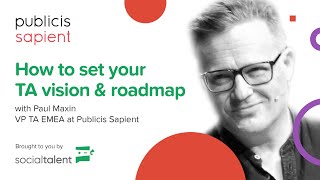
Paul Maxson argues TA leaders need cross-functional teams and a maturity model to align hiring with business outcomes, not just cut cost-per-hire. Small teams of 3-10 people should engage in honest debate to set priorities and baseline capabilities, then iterate. He cites Teresa Barrera's employer branding work at Publicis Sapient as proof that where you sit in the org affects how fast you move.
Chapters
So I'm Paul Maxson. I've been around the block a few times. As Johnny said, I've been with Publicist Sapient for a couple of years now. Sapient as an organization has been in existence for nearly 30 years and was acquired by the French publicist group three years ago. And what Publicist Sapient does, just to put things into perspective, is that we work with established companies, end ups, as some people might call them, to help them realize their future in a digitally enabled world. And we do that through changing the way that they work and changing the way that they serve their customers. And this talk will be very much about how, from a perspective that will be drawing on lots of different perspectives to join up, how Talent acquisition can realize the vision for the future. But it should never be in isolation from either the business or the business objectives. And Publicis Sapient has an objective and a purpose to help people, not companies. People thrive in the brave pursuit of next. Now, what presentation would be complete without an iceberg analogy? Virtually every presentation I've seen for the last 30 years has got an iceberg in. Mine's no different. But there is an inconvenient truth. Most companies are great at their core business, but not great at reimagining the future of their business. Talent acquisition, recruiting, hiring is no different from any of that as well. So Publicis Sapient, the company I'm with, work with clients in reimagining the future of their business. We have to. We're a bit like the cobbler's children who have no shoes though. So we've been very, very good and we have wonderful clients that we do deep work with in transformation. But we've been quite challenged really in the way that we transform ourselves. So I would contend that we've been fairly cavalier with our own brand since the. Since Publicis acquired Sapient, we've transformed from a marketing services organization into a business consultancy and a digital business consultancy at that. And that's a transformation in terms of people, the people that we hire and develop into the business. And it's made a fundamental difference to what we do. But when we talk about transformation, how many here have been through some kind of transformation within your own business? Yeah, most of you have put your hands up. Do you want to keep your hands up if you've actually completed that transformation? Wow, okay. Very few. Part of my contention is actually, I'm not even sure if transformation actually does complete. It's a continuous journey. And that's the scary part of it. It has no end. So when you're setting a vision for the future, there's a dynamic of what you've got to achieve in the future and the vision being connected to the business, but also a realization that the future is permanent and unless you continually transform, you'll be overtaken. So I don't know if you've heard of Alvin Toffler, an American futurist, but he wrote that the illiterate of the 21st century will not be those who cannot read and write, but those who cannot learn, unlearn and relearn. That applies to companies, that applies to all of us. That applies to talent acquisition as both a capability and a function. And it's essential that talent acquisition, I'll keep on repeating this, is connected with the business. So when we're setting a vision for the Future, whether that's 2020 and scarily, I just learned, that's only 12 weeks away from the previous presentation. So some of this about setting a vision for 2020 has got to clearly go out of the window because it's never ending. But we have to unlearn and we have to relearn. We have to change the way that we do things. I've been around the block a few times. You know, years ago, I used to work in a recruitment consultancy in the 1980s. I wore a suit, a white shirt and a tie. And clearly I've changed myself somewhat. So I've got some slightly wacky shoes, skulls over my shirt. And three or four years ago, I worked for the Financial Conduct Authority. We all have to transform and reflect the organizations and the people we work with, but without losing who we are and ourselves. So let's start with a team, putting a team together. Again, talent acquisition should not be in isolation from the rest of the business. So it's important that as a leadership team, you come together with representatives, with leaders from the business across the business. We're all part of the business. Talent acquisition is within the business, not of the business or separate from the business. So this is a fairly typical team effectiveness and performance model. You form, you storm, you norm, and then you perform. But the storming bit is really, really important. It's not just about brainstorming, it's about having honest conversations. So, for instance, you need to push and nudge your colleagues, and they need to push and nudge you. So, for instance, I can recall in conversations when we were setting up our cross functional leadership team, part of the storming conversation metrics, we will always measure, we're always interested in cost per hire. Why are we Interested in that? Why are we interested in cost per hire? Whether it's €1,000, €5,000, €10,000 to hire a Java engineer, in terms of paying a fee, it's kind of irrelevant because what we really ought to be doing is looking at the value of talent acquisition and the value of, of the people that we're bringing into the business. So a cost might well be the cost per hire, but actually if that hire is leaving the business in six or nine months, not integrated because you've tried to do things as cheaply as possible, then you're effectively like the urinal of recruitment. You're flooding into an open drain and everything's going out. So in realizing the value, you look at the salary, the value, the income that those individuals and those teams are bringing in in terms of revenue for the business. It's not to say that people are commodities, but we have to find a way of looking at value that goes over and beyond something simply as cost per hire. Just using that as an example. But it's about open and honest conversations. And in terms of affecting a team, you've got to go down into the nitty gritty and the challenge and the real challenges before you can come up and norm and then perform. So I always look at cross functional teams, absolutely important for talent acquisition as it is for everything else. But we have the five key behaviors. So trust. You can't have conflict, successful conflict without trust. And you can't have outcomes without commitment, accountability and results. And I'm talking about outcomes rather than outputs. So got to be small enough, three to 10 people to be effective. You know, in the same way as if you've got, you know, 50 or 60 people reporting to you, it's not effective. It's got to be a small enough team and a cross functional team, they've got to be trust, regularly engage and be productive. Always leave a meeting with a clear cut, active, specific agreement and decisions and always be focused on team number one. So put the collective priorities and the needs of the larger organization over and above your own department. Whether that's talent acquisition, whether that's engineering, whether that's finance and accounting, whether that's sales, whether that's marketing you need in order for. So going back to the point of creating a talent acquisition strategy in the future, it shouldn't be created just by talent acquisition. You need a leadership team that's cross functional and across the business. So in terms of visioning for the future, what does success look like? Well, the reason that you've got to have something that's cross functional and across the business rather than just within talent acquisition is people have different ideas and perspectives and you have to have all of those perspectives into the soup in order to have something that's going to be effective. So this is scary now that it's by the end of 2020, 2020 vision, given that we're so close to 2020. But I would also contend because transformation is never ending, it won't end in 2020, we'll continue. There will be further iterative iterations of it, 2022, 24, 26 and so on and beyond. And it will change and it will evolve. And in two or three years time, if I was up here having a, if I was ever invited back, I'd probably be having a different conversation and different outcomes with you because of all these external factors and that it is never ending. However, in creating a vision we looked at a maturity model and I know linking it up. Johnny talked about maturity models to open these sessions yesterday morning. And we use within Publicus Sapient the most established part of our business is our engineering function, data engineering. So we stole their framework. I know that you'll see in the next slide there are other frameworks around maturity models and there's the Burson model. Josh Burson, who spoke on the main stage earlier today has one for talent acquisition. But we started to look at this, this isn't actually what we had as an outcome, but this is based on a maturity model that other parts of our business were using. So it did look at the financials, it looked at enabling people. We looked at some TA talent acquisition enablers and ways of working and in terms of using an agile and Scrum methodology as well, we wanted to test be speedy backlog management and not have continuous improvement effect innovation. So it's very much around an agile architecture using the same methodology. And if you then use that methodology and see where you are, you can actually start to measure a baseline. This is an example baseline of where you are. So if you've got four or five stages within your maturity model and you want to know where you want to get to the best place at the starting point of where you want to get to is actually to on this type of diagram measure where you are and you come to a collective view to realize your baseline. So this is the Burson model by Deloitte. We stole that a little bit to see how that might work for us. The level one is reactive tactical recruiting. Level two is kind of a standardized operational recruiting. And then where we really want to get to is something about an integrated talent acquisition. So integrated talent acquisition for us was the starting point because the leadership team of that I'll go back to that is a team from right the way across the business. That's the only way that we can have it fully integrated and then something that we'll strive for in terms of level four. So what we find is that in some areas we're kind of down here, virtually. In no areas we're up here. And arguably if you do get to your level four, you've got to start it all again. So level four then becomes the new level one. Otherwise it's not being iterative and you've got to think of something else. So then we had our sort of own storming in terms of where we are within the maturity model. So, you know, level one is like panic reactive recruiting. Most roles are unique and there's no collaboration, no partnerships, mis hires. Level two, some standardization and some planning. Level three, a bit more integrated. We're using common tools and systems. We've got a strong and active employer brand. And I should. Employer branding is different in many companies. Two years I've been at publicist Sapient. I mentioned that Sapient has been at the beginning was cavalier with its brand until really about a year ago when we finally hired our global chief marketing officer, Teresa Barrera. And from a corporate brand perspective, the investment that's gone into that corporate brand has been really, really significant. But this is an outcome of working with leadership teams from across the function. Because the employer brand sat under brand, which meant that it sat under marketing. And because it sat under marketing in, because it sat under marketing, it meant that all of the external client work, that something in our studio would take priority. So from a, from an employer brand perspective, if we wanted to generate some, generate something out into the marketplace, it used to keep on going down and down and down. So with Teresa Barrera on that leadership team, I could say, well, you know, actually the employer brand and the expertise from talent acquisition should sit within talent acquisition. And then from that moment on, something changed. We hired a director for our employer brand on a global basis and it was quicker for her then to develop her team in specific countries with freedom within the brand framework to operate than it was actually to have that discussion in terms of the storming with Teresa at the time. I've gone, I need to go back. Oh, well, maybe I'm not. There was another chart in there, but never mind. But basically speaking, that chart was one around being continuous. So I talked about the levels of the maturity model. Don't use that as the only thing to do because as you go up the levels, you'll need to create new levels. So you have a hypothesis, you test that hypothesis, then if that works, then you action it and then you keep on going through that virtual circle because you'll have other hypotheses as a result of the outcomes that you find. So that's me. I've probably spoken for just about the allotted length of time. I'll certainly be around for some questions or conversations. Should, should anybody want to challenge me, please do. And I think coming up in a few minutes is Lars Schmidt, who was also a great speaker. I once had the opportunity to introduce Lars and said he was from the future. So in reality he is from the future because he's the next person up. Thank you for listening. Thank you for engaging. And as I said, I'm hanging around. I'm not going nowhere fast. If anybody wants to to chat with me, please feel free to do so. Thanks a lot. Thanks for having me.
More from Johnny


Where Does Your Hiring Stand? Diagnose It with the Maturity Model | SocialTalent

Where Does Your Hiring Stand? Diagnose It with the Maturity Model | SocialTalent






NEW CONTENT - How to use Generative AI for Recruitment Marketing with Glen Cathey | SocialTalent

NEW CONTENT - How to Use Generative AI for Sourcing & Recruiting with Glen Cathey | SocialTalent

NEW CONTENT - How to Unlock the Power of Generative AI with Glen Cathey | SocialTalent