Neurodiversity: Broadening the definition of talent | with Theo Smith
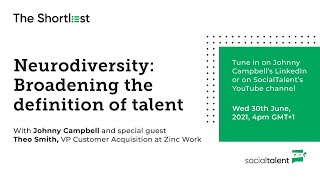
Episode 57 of The Shortlist (YouTube/podcast) — host Johnny Campbell interviews Theo Smith (VP Customer Acquisition, Zinc Work) about neurodiversity in hiring and workplaces. They define neurodiversity broadly (dyslexia, ADHD, dyspraxia, autism, Tourette's, etc.), cite prevalence figures (reportedly ~1 in 5 people), highlight that few companies include disability in DEI (quoted ~4%), and discuss practical barriers in job descriptions, assessments, interviews and open-plan workplaces. The episode concludes with actionable advice (ask candidates what adjustments they need; design assessments relevant to the role; build inclusive environments) and a plug for Theo’s book, Neurodiversity at Work (release early August).
Questions this video answers
Episode 57 of The Shortlist (YouTube/podcast).
Theo Smith — VP of Customer Acquisition at Zinc Work.
Approximately one in five people (~20%).
The episode references a Fast Company stat: 90% of companies claim to prioritize diversity but only 4% consider disability in those initiatives.
Neurodiversity at Work — spoken release date early August (August 3rd mentioned for some territories).
Chapters
Sa. Welcome Everybody to episode 57 of the Shortlist. I'm Johnny Campbell. I'm your host, CEO and co founder of Social Talent. And welcome today to today's show on Neurodiversity. We're going to be talking about broadening the definition of talent. Before we get into that, I want to welcome all of our returning listeners to show 57. Hopefully you've heard most of our shows. If it's your first time listening to the show, if you're on our podcast recording or if you're watching live, you're very welcome. We are a live show that broadcasts every Wednesday. We broadcast on LinkedIn and YouTube and you can join us live and we really welcome your contributions and your questions on chat on either LinkedIn and YouTube and we also come out as a podcast on Wednesday evening, YouTube, European time as well, every week and you can find us there. Any references we make to links, et cetera, you can find in the show notes on your podcast. Want to know more about our back catalog? Please go to socialtown.com the shortlist where you'll find links to our back catalog, podcasts, all sorts of wonderful weird stuff. An email. You can subscribe to all that great stuff and you'll find the video links as well in there. But back to this week's show on neurodiversity. So kind of be an accepted fact that an organization's people are its biggest asset. Every company says this right and having a diverse workforce lends itself to greater innovation and performance. We all get that. We've talked about it many, many times before. So attracting, engaging, retaining top diverse talents should be number one concern. But what if I was to tell you that many of the basic elements of recruiting and hiring are hampering your ability to find some of the best talent and candidates there? People who have neurological conditions often struggle to fit the conformist profiles that are sought out by employers. Things like inaccessible job descriptions with company jargon or standard interview procedures can all be a challenge for the neurodiverse and believing credible skills and attributes that they often possess. So how do we correct this? Well, on the show today, we welcome Theo Smith. Theo is the VP of Customer Acquisition at Zinc Work. Anthea is also a podcast host and author of a fantastic upcoming book called Neurodiversity at Work. An expert in the field, he's going to be giving us some background on neurodiversity in the workplace, as well as some actionable advice on how to make processes more inclusive and open so organizations can benefit from this Talent pool. Theo, tell us why this topic and maybe give our audience a little bit more background on your own career. Maybe you might start explaining the wonderful background you have in this fantastic field of recruiting as well, as well as your background in neurodiversity.
Thank you so much, Johnny.
Yeah.
Wow. It's been. It's been a long journey, a journey of kind of exploration and kind of finding out about myself, who I am, not just in terms of the work that I do, but as an individual. Right. So way back I started out in recruitment and that was because I kind of got into a lot of trouble in school. Didn't really pass exams, didn't really turn up school that often at the time. I didn't really know why. And here I am all these years later, kind of talking passionately about the thing that impacted me most, which was the neurodiversity movement, being neurodivergent or neuro different. And the recruitment career I've had has been incredible. But I have probably had challenges as part of that process, understanding where my strengths lie. Basically, about three years ago, I went down to Whitstable and I heard somebody talk, Ed Thompson of Eptomize about the neurodiversity movement and what was happening. And I sat there ignorant to what this was. I thought, ah, neurodiversity, something else that's linked to diversity. Oh, you know, we're struggling to get our heads around the rest of it. Right. And. But then all of a sudden I realized, oh, hang on a minute, possibly talking about me because at 21, I was diagnosed with dyslexia. And then about three years ago, after this talk, I went on the journey to understand that ADHD impacted me as well and a variety of other things. So the reason why I'm so passionate about this and the reason why it's important that we have this conversation now is that so many people are disabled by the recruitment processes, by the assessment processes, by our work practices, by our work environments, by our built environments. Right. It's crazy. We're putting up so many barriers to people and we've not even been aware that we've been putting these barriers in place. And now, at the point where we have the greatest opportunity to make the difference, we still have individuals who are becoming barriers to embracing neurodiversity embrace as an incredible positive movement. And they can do that just by ignoring the fact that it's a thing, or they can do it by disarming those people who want to do kind of evangelist work around this subject. By not allowing them to. By restraining their arms within organizations. So I want to make a difference here. I want to start to open up the dialogue, make this kind of a common theme that people are talking about. And that's why it's so important.
I love that. Because I think we often forget that the world around us has been designed by the vast majority. And it's not that they're intentionally trying to make it difficult for different segments of society. So they probably just don't have any perspective, understanding as to that Somebody might approach a web page differently to them. They might think differently when it comes to an interview. They might feel different levels of anxiety because something in the process, again, you get a bunch of people who are, you know, conformed to the majority way of thinking, and they're probably not going to see these things. They're going to be blinded. They have blind spots in these areas. I want to dig in and maybe start, Theo, with digging into a. What I thought was a really good article published in Fast Company, which obviously means we're at that point in the show, Theo, where we got to get into the news. Theo, we shared this a few days ago, and I think you've had an opportunity to read it. And for those listening and watching, Fast Company published an article a few weeks ago, and that was titled, Companies are Leaving Neurodiversity out of Their DEI Conversations. And that's a mistake. And I found there was just so much in this article that I learned about Theo that was new to me. So. So several things was that I think it was a great, great, great start at the tart. At the start of the article that talks about how 90% of companies claim to prioritize diversity. Only 4% consider disability in those initiatives, and neurodiversity is a subset of that 4%. Yet what I found was fascinating. I think it says that one in five of us has some sort of neurodiversity. And there's lots of. From dyslexia to dyspraxia to ADHD to autism, there's lots of different, different things that would fall into that category. And then the outcomes for individuals who are neurodiverse just aren't that favorable. Tell me about your thoughts. Reading this, knowing what you know, and having gone down the journey, you've gone, theo, what did you learn from this or what it did? What did it hammer home for you?
Yeah, I mean, you mentioned something important there, the different facets of the neurodiversity movement. Right. And I won't like over labor, that point, because people can go and research that and understand it quite quickly on the Internet. But that's the reality that you can be adhd, dyslexic, dyspraxia, dyscalculia, Tourette's, autism. However, a lot of people actually have many of those and that's the added complexity around this. Right, so what we've got here in this article, I think, is a really good point. And what it says is not only are they leaving neurodiversity out, which you mentioned, but that it's a subset. So 4% of companies, they value diversity. I mean, that's so low. That's so low. But we've got a bigger problem here. It's not just a subset, but we've got this kind of medical paradigm or legal paradigm that exists within organizations at the moment. But when I went to my GP and mentioned around being adhd, their questions were around, do you want drugs? No. Good. Are you suicidal? You know, basically they wanted to, like, put me in this set of, why? Why are you here? And if it's not around, you want to take your life, you need drugs, basically go away because you're not getting support. So if we've got. If we at GP level have got that kind of response, right. As somebody who's quite knowledgeable, I worked for a particular organization, there was a specialist in the city at this time, so I was able to influence on that basis. But if that's the response of a gp, then how do we expect HR departments to respond differently? And what we've got is a challenge here, and the article highlights it by just that percentage figure, right. Is the HR departments go, right, One's the thing, we don't want to deal with disability, but two, if neurodiversity fits into disability, we might consider it because there are things like access to work, There is pressure, possibly from leadership or government organizations, whatever it may be. However, there's a huge sway of people who don't see ADHD or autism as a disability. Right. That's not to say that it isn't right. What I'm not doing is I'm not going. Disability doesn't exist. It's not important. What I'm saying is they don't identify as that. So I don't tick the disability box, right? Which means what opportunities for help am I getting? There's two reasons why people don't do it. One, through discrimination, I'm not ticking that box because of that percentage mark there. And two, because I don't see myself as disabled, I see myself as differently abled. Right. I don't have a hidden disability, I have hidden abilities. Right. And what's happening at the moment that it highlights really is that people are not interested in those hidden abilities. And we can get more into this in a second because it's too complicated in their mind, right? And disability could mean additional legal implications, like they could go to court more often by encouraging people to talk about this. And their non disability is, well, they can't access funding, therefore they may have to pay for it themselves and actually they're not interested in that. And I think these are two really important things that we need to consider and they need to drastically change in terms of the mindset of organisations.
Do you think that one of the challenges is on a practical level that neurodiversity isn't visible, that it isn't something that people can see? And do you think that organizations therefore prioritize areas of diversity that they can see that are super noticeable? Is that perhaps one of the challenges?
Well, yeah, I think it's exactly that. I think there's a fear. There's a fear because of language and terminology and all the other stuff that's going on, I think, you know, basically. And this kind of thing around disabilities, right, does give them a lot of fear because how, what can they do about it? They can, they can't, they can't sit in a room like with a lot of other stuff and go, that person's in a wheelchair. Therefore we know if we're asking them to do X, Y and Z, we'll have to make sure they can get there theoretically in that wheelchair, right? So. So that is easier for somebody to get their head around. But what they forget is they just ask the person anyway, you know, how can we help you? How can we support you? What can we do? Then, you know, they would, they would just make it so much easier for themselves, but they don't. They get caught up in kind of this legal thing that goes on and I think that's what we need to consider, right? So we need to consider that HR functions probably getting advised by lawyers around what they can and can't do. And then the challenge with that is there's a lot of fear because a lot of these lawyers are still trying to explore what the legal parameters are around this. It gets wrapped up in disability broadly. But ultimately, let's come back to what we're trying to do here. A human being, a person like me, all I want is, I want a job I want to be able to do my job, and I want to be able to do it well, right? And all I want from the employer is for them to help and facilitate me to do that job. And in many cases, Johnny, all they need to do right is earlier on in the process, talk to me and understand me and not label me. But think, how can we get the best out of Theo?
I love that. How do you get the best out of somebody? Is probably the most important approach. You can have to ignore the labels and everything else, the legals, just to go, here's somebody who has potential. How can I get the best out of them? It's interesting. I think one of the things I got from the article, and I'm gonna just hammer it home, is that one in five individuals have some sort of neurodiversity. And it means almost all of us, if not all of us, are within one, one degree away from somebody within neurodiversity. We probably all work with somebody quite closely who's neurodiverse. We may have a family member as well, a neighbor, all of those things put together. I know for myself, I have a wife who's for the last 20 years, taught children on the autistic spectrum in a special unit in a class up the road. So we've always been kind of very exposed to that community. I have one of my four children with dyspraxia diagnosed last year. And as you mentioned, one of the challenges that comes up is that intersectionality, which is there isn't one thing going on. You know, high likelihood is that you could be. You could be a black woman with adhd. And it's like, well, which angle is the diversity team going to take with me? Which of my areas of diversity will they focus on? And they tend to only pick one, and the others are ignored. So you want me to feel like I belong, bring my whole self to work, but you're not seeing me in my widest sense. You're picking a label of diversity and working on that. So that's a challenge, right? But maybe, Theo, back to the recruiting lens that you came into this topic with. Can you maybe start with, you know, the application process and interview process for somebody who's neurodiverse. And again, I gotta caveat this by saying, I know you're not speaking for every single person who's neurodiverse. There's loads of different types of neurodiversity out there. But if you're thinking about. About somebody who perhaps could be categorized as neurodivergent neurodiverse. Walk me through some of the types of obstacles that they might face in a recruiting process that you've uncovered or seen yourself.
Yeah. So it can happen at the very earliest stage in terms of language and the way that you communicate with somebody. And that can happen any stage in the process. Right. So if you're thinking of all the different touch points in your recruitment process, if you use like company speak, right. If you use words that might have a particular meaning to one person but very different to another, if you're not basically directing your communications, right. You risk that person not understanding what's being asked of them or disconnecting them from that process because they think, actually, I'm out. I don't know what's been asked of me. Therefore, there's a lot of fear, anxiety and stress that goes around it. So often companies are scared to ask what a candidate might need based on the fact they might ask for something that is outside of their control or outside of their ability or is that costly. What I can tell you is often they are not. So in my previous organization, Nice. Basically we just implemented something really simple which was asking as many stages as possible. It wasn't a lot, but it was like three different stages. Is there anything we can do for you? Is there any way that we can help you? You have your ability to click the disability button and we can make reasonable adjustments on that basis. But is there anything else we can do to give you great experience? And I think that's the difference. Clicking a disability button at the very beginning stage is one thing, but that's a very different thing to at the key stages of the process going, how can we help you here? How can we help you here? Right. What can we do for you here? Because that gives a candidate a point. Like for me, I don't know what's going to happen in three stage time. Like, I've gone through the interview process, but it's a three stage interview process. But I didn't ask for help here. But now you're telling me I've got to do a psychometric assessment and whatever else here. I'm starting to panic, right? And I'm starting to wonder whether there's some kind of. Whether you're putting some math quiz or something in there. I'm going to fail at that. Let's stop now, right? I'm not getting that job no matter how experienced I am. So I think we do a lot of these things. Sometimes in the best intention, we think we're doing the right thing. But we inadvertently turn people off and it is just by asking them that we can learn. Because it's at that point they can say, can I have a bit more time before the interview and can you provide me with the questions? Right, questions, no. They could go on Google and search them. Well, in most cases, no, they can't because they're complex. They take some thought, experience, consideration that is way beyond the 15 minutes before that interview. Right. Are you able to ensure that their environment is safe, that they can have an interview? You know, a lot of us are working from home now before. Somebody may have come on a bus that may be on the spectrum. For example, they may not be used to spending time with other people, they may not like public transport, huge amounts of anxiety around that. They may then walk into a very busy environment, lack a glass of water, just a simple thing, no access to a toilet, and all the different opportunities missed for that person. They then get put in a loud, noisy environment where the questions from the interview are not specific, they're generalized, and that person just goes. And then you sit there and wonder why they don't talk and why they don't go into much detail around questions. So, you know, there's a huge amount that we can do with just about what reaching out and asking people, what can we do for you as an individual?
And almost everything you've listed, if not everything you've listed there. Theo, just good advice for anyone. It's like, you shouldn't have business speak internal acronyms on your job specs. You should be considerate of everyone's anxiety and stress, potentially coming into an interview situation or coming onto a call. You should be really digging into the questions you're using to make sure that they're actually relevant to the skills and competencies required to do that job, that the assessment you're going to use is appropriate. Appropriate in every manner for the role that the person is going into. If it's got a math test, you got to make sure there's math in the job and the math you know, doesn't, you know, the math that's required wouldn't allow you to use a calculator. If that's one of the assessment rules, for example, like, tie it together, be practical about it, sit it yourself, get someone who's currently doing the job to maybe walk through the interview process and the assessment to go. That's not really relevant to what we do in this job. I think it's just about being more human and being more considerate of others. And, you know, stopping and thinking a bit more.
But.
But you mentioned a couple of things there that I found interesting. So the anxiety piece and the stress, perhaps going into an interview or a situation or having your assessment process set up incorrectly. What kind of neurodiverse individuals you think are most affected by our lack of thinking in the process that we've designed?
Well, I think everybody is in different ways. So, you know, if you put a lack of thought and consideration into the environment, there might be a group of people impacted more by that. And what we've got to remember is when you talk about intersectionality, you're right, it may be that somebody is on the spectrum, but they were brought up in a care facility, for example, so they may have other things that impact them in terms of that environment and the way that they feel and, and the stress and anxiety they get when they sat in front of a panel of people, because they may have done that in other situations in their life when they were young and therefore have all kinds of stress and anxiety around that. So this is what we need to consider. And again, that comes back to your point around. What's good for one can be good for many, because if we're improving the environment, it can cross across other areas of DEI broadly. So I don't like to label it and to streamline it too much that who would fit into this box and how it would work for them. I guess what organizations need to think about is what they can and can't do as part of that process rather than exactly what group of people they can put into it. So let me give you an example. Some organizations have job descriptions, person specifications and adverts that are signed off the top of the organization in a large organization. And they signed off because they probably paid a lot of money to have them created as part of this big workforce plan. Right. So it's really difficult for them to change them even though they're not fit for purpose. Right. So they can't look necessarily at that street yet. That may take some time. They've got to come down a few steps and think around the early communications and engagement and that personalized part of that process. So whereas if you think about the smaller organizations, they can change some of their job descriptions, persons classifications that are not fit for purpose because they're too long. They don't make sense. They have all this jargon in it. They can go and change them immediately. They often don't because they push it to the manager and the manager after manager after manager just overlays this information with extra information so it becomes more complicated as it goes on. So I think they need to organizations need to be focusing on areas of the work stream that they can change, they can impact on. So as a recruiter or a recruitment lead or the HR leader, what are you responsible for? What can you change? And then how you can change that in your small way before thinking, okay, I can't do anything because I'm handcuffed by the structure and the formation of the organization. Sorry, what you asked, you didn't.
I want to bring in a couple of comments because we had a direct comment back which I think is great for Madison Daly. Just wanted to say she wanted to comment to you. Theo. Such a great point. When we design for accessibility, the modifications support everyone, not just those with a specific disability. And you're dead right. There's no point in going down the argument of this type of neurodiversity versus the other type. Just try and consider modifications for everybody. Which brings me to another user commenter. Listener Isabel Blumrick has asked and she joined the conversation a bit late live. She's not sure if she understands neurodiversity correctly. Is it just used for autism? I actually want to take that point because I've seen this. I think it's an understandable question, Isabelle, because when I've seen organizations talk about the efforts that they put around neurodiversity, almost exclusively it's around autism and almost exclusively a subset of that individuals with Asperger's. And it's around high functioning mathematical skills and how we're hiring people on the spectrum who are with Asperger's who are highly functioning when it comes to mathematics into engineering and STEM roles. It's a great story and I wouldn't hold that back. But even in this area, as you said at the start, that is not given enough attention as it is disability, neurodiversity as a subset of that, a lot of the attention can go to just even one sub segment of a sub segment of a sub segment. That's a real challenge, isn't it? Like, is that your experience as well?
Yeah, absolutely. So this is a big challenge of the neurodiversity movement that has been heavily focused on autism. And that is not to take away from that. And it's important. And let me just throw a stat that it was something like 80% of people who are autistic were not in full time employment but wanted to be right, but a lot of them would part time. Also a proportion of Them were in part time since the pandemic. National autistic societies come up with like horrendous stats that are like less than 40% or something of people who are autistic are out of work, right? So the pandemic as men, those people in part time work lost those jobs and now they've got to go through the process of trying to get jobs again when that's one of the most anxious things for somebody who's neurodiverse to have to do, right? So let's not underestimate the impact on people who are autistic. And I'm passionate that comes under this because they are also marginalized by the HR practices, recruitment processes. And let me just tell you that ADHD ain't popular, right? Disruptive Asbo, you know, somebody who gets into trouble like 50% of people in prison. There's been a number of studies across the world that show disproportionately there are more people in prison who are dyslexic. Like it's 50 odd something percent of prisoners are dyslexic. Now if you then look at ADHD again, disproportionate amount of people who are ADHD get in prison. Now this is bad, right? This is really, really bad. So they may not be in employment, but they're in prison. Like we need to do something about this. So that's why neurodiversity as a movement has to consider all aspects of the neural difference, right? Minority, however you want to term it. The reality is the brain is wired slightly differently and it was coined, you know, 30 odd years ago that basically neurodiversity is like biodiversity. So our brains are wired differently for a reason. We needed people who could sit in a cave and work problems out in detail for years. I know people are going to do doctorates, right? Or we, we needed people like me who would jump off a cliff and think, have I got a parachute? Oh yeah, I got a bag, it may be a parachute. Well, I'll pull the cord halfway down and we'll figure it out from there. We needed these people, right? We just thought and moved quick and just did stuff. They jumped in the water and got eaten by the shark. Nobody else jumped in the water again, okay? They found other ways to fish around to make up of the human brain. So these people, and this is my point, I'm not disabled. Even though some would, would say that that is important for them. That's okay, right? But in my mind we are disabled by a wide variety of Things. Our parents may have taken drugs, we may have not been looked after properly, we may have been in care, we may have ended up in prison and we may be ADHD and we may be dyslexic and we may not have gone to school. That is complex. Right. So that person may not be the same as me, although we both may be ADHD and dyslexic. I've gone on a bit of a rant there, but I thought that's important to kind of frame the complexity around this and that we're moving away from that just being about autism, which is great.
Yeah. It's so important to make that point, Theo, which is if you focus on one segment of this wide area, it's just. It's not going to work. One, because so many individuals have that intersectionality of other issues and differences that might be holding them back in their lives and professions. And therefore, if you're only tackling one, you're not actually getting to root cause. You focus on just making sure that you have modifications and accessibility and thought for everybody. In the most broadest sense, you'll probably hit all the different barriers that each individual is facing and it just drives a better. A better hiring process, a better work environment for those individuals as well. I want to use a couple of examples just to throw in here. I know that you mentioned about your own challenges in school and hey, it led you to recruitment, which is brilliant. Right, which we need more great people like you in recruiting. But I know my own nephew, he wasn't diagnosed with dyslexia until he was 12 and he had to go through all of primary school not knowing why he found it difficult and being frustrated with himself and his teachers, frustrated with them. And it was very late diagnosis, but he kind of disconnected from school and he left school early, earlier than he probably would have in secondary school because he hit that kind of wall. And I absolutely feel if he had been had the diagnosis earlier, not so someone could give him a label, but someone go, ah, that's the way his brain works. We can do something with that. We can teach him in a different style. It's going to be great, but it's late. And when you don't know how someone is different, it means that you can't realize their full opportunity because their work environment. One of the examples in the article given, which I thought was really good, was thinking about, you know, someone with. Who's neurodiverse might need a lot more quiet time or space or just breaks between, you know, chunks of Work to reduce anxiety or move on or get rid of distractions. And we tend to build a workplace for everybody, right? I don't mean in a good way. We build it for the median, the average, as opposed to all the different flavors that are out there. And like we talked about hiring, but talk to me a little bit at the workplace, Theo, how is the workplace of today, or at least yesterday perhaps, often set up poorly for individuals who might be neurodivergent?
Well, you just said exactly there. And it's like a reflection of the education system, right? There's 30 people in a class for a teacher. How is that teacher able to properly give individual sports rubbery? And it definitely depends on whether that's in a city or whatever it may be. So people get left out and we can see that reflection in the workplace. People get left out and that environment is built in a way that's conducive for some. And as long as that business is performing, our organisation is performing, they ignore some of the issues, they ignore some of the. Some of the things that they should focus on changing. And sometimes it's too late. That's the reality. Sometimes it's when they start, the performance starts going down that they panic and think, oh, my goodness, what have we done wrong? And, well, you know, it's really simple things like we've now got open plan. I always remember, you know, you watch American dramas before Britain in our old buildings that were all, you know, small little rooms, HR department in one room, Finance in another room, procurement in another room, you know, nobody'd ever see each other, right? So what an incredible place that we just take all the walls down and, you know, you have this sea of, you know, little boards that can give us our own space maybe and reduce noise together. Isn't that brilliant? But we still don't talk to one another, for goodness sake.
Right?
But the challenges with that, of course, is it can massively impact on people's mental health and well being broadly across everybody. Because, like, I love people, but I love people too much, right? So if I'm in a room full of people, I never stopped, like running around the room, like talking to people, getting energy on people, I'll collapse at the end of the day. How much work did I do? I'm not too sure. I spent too much time running around more people. So, like, that balance for me is important to be able sometimes to extract myself out of that and go, now I need to do focused work. So, you know, it can impact on some of these adhdi Me, in that context, on somebody who's on Spectrum, it might be that their work is disrupted all the time. So they like to hyper focus in and they don't want to be talking and engaging with lots of people. It makes them feel uncomfortable. They may want to talk in another way, engage in another way via text, via Slack. And these are why tech teams are pretty cool now, right? Because they're finding alternative ways to talk with one another. That doesn't have to be going and talking somebody, it could just be dropping them a message. And that's the thing. Going and desk dropping somebody, which I love to do, desk drop them, hey, let's chat about this problem I've got. Let's figure it out. You know, for somebody that might be hugely disrupting, I might have just, I might have just taken their work. I've just taken it and thrown it in the air and gone.
There we go.
Come and talk to me and then I don't want to talk to you. I got hours of work I need to focus on. I already had two hours, I was supposed to do it. I now have to start all over again because you completely blow my mind in terms of what I'm focusing on because I take a journey to get where I need to. So I mean, if you think of kind of the work environment in that context around individuals, the way that they work, the way that they feel, a high proportion of people who are neurodiverse, who on the spectrum also have Tourette's or percentage of them, one in three or whatever it may be. Now we assume Tourette's is, you know, shouting out a swear word because that's what we see on the news or whatever, some program, right? No, actually Tourette's can be an involuntary sound or tapping or whatever it may be. You know, I didn't even know the things that I did related to that when I was a kid. These kind of funny sounds and twitches and things that I did that related to that. But now I can look back and go, oh, right, okay. It makes so much sense. But imagine somebody in a work environment, they want to focus. They've already got the challenge of some of these things that may be impacting them, right? And then they've got the frustration of having people watch them and I've seen this comment about them and then not realize that they can see what they comment about him on this private chat. Now, like imagine that. Imagine that type of workplace life is difficult enough. And then you have the impact of this work environment that every single Day crushes your sense of well being and purpose. And you know what, these are good people who do fantastic jobs and they should be respected, but instead we allow them to be crushed by the environment.
You know, as you're talking, what's really hitting me, Theo, is that you brought it up earlier, but it didn't quite hit me when you said it. Lots of people think differently, work differently, have preferences around the environments they work with, how they work. They don't necessarily consider themselves neurodiverse or have a label. They don't ever want to go investigate it or need to. And you don't need to have those different styles and kind of go, how do I make sure that all of us get the best out of each other? And kind of going, listen, you know, if Theo's the type of person who, you know, taps his foot, taps the table constantly, makes this kind of whistling noise as he works, or just needs peace and quiet or is quite a loud person, needs to rub off other people, how could we, if that delivers great work, how do we facilitate that and then let this other person not be hampered by that? Let's just get to know each other and figure out how do you, how do you make everyone work to their best potential and also, you know, enjoy the workplace they live in, they work in? Well, we do live in our workplaces a lot these days as well.
Right.
But you know, it's. I want to make a couple of shout outs here. Joanna Lit1 is just making a shout out to her colleague Mariam Gurganitz, who introduced Neurodiversity group at Solando sc. And a big props to Mariam and the fantastic team at Zalando and all of the different affinity groups that they have there. I want to just commend Isabel Blomrich, who's to going, commented and told us, shared a story with us I think is really brave. And she's not alone. She's perhaps the only one who's shared the story with us, many of us, and I include myself in this. She's saying she's ashamed to reflect that she recently discriminated against an applicant when she made a rash judgment about her in the interview. In hindsight, she may have had a neurological or physiological challenge and she quickly concluded she was not resilient and perhaps kind of weird and just feeling really sorry with that. And you know what, it's amazing self reflection. We need more of that. I've been there, you've been there, Theo. We've done it. Like I've talked to so Many countless people who, when you describe somebody, and perhaps this is the upside of giving someone a label, so to speak, is they. We do have a group of traits that we can describe and, you know, it's not just an anomaly or someone who just is lacking a skill. You go, that's just the way their brain works. And we've all interviewed somebody like that and we've all in haste said, oh, not suitable, poor communication skills, couldn't make on a second. Does the job require someone making eye contact? Not everyone's good at eye contact. Lots of narrative. Are you really creating the right scenario? Are you assessing the right things? Thank you for sharing. There's many of us like that. Pio, you're going to jump in, I think, to share that you've also done it, I'm sure.
Yes, yes, yes, exactly that. So this is not, you know. No, no one of us can stand on this pedestal and say that, well, I hope not. Because we're human beings, right, and we make mistakes. Like I said, there was a point where I diagnosed with dyslexia 21, as a mature student with no formal qualifications, going into uni as a mature student. It was at that point I was like, ah, right, okay. And then it was all those years later at 38, that I was like, oh, ADHD. How much discrimination? As I probably, you know, what had I done as a recruiter? Because if I'm honest with you and Johnny, you probably see this. As a recruiter, you were taught this stuff. You know, use. Use your gut, use your instinct. Well, guts and instinct are bloody awful because gut means they're not looking at me or they don't shake my hand or they're not chatty like me. That's my gut. Then I can't connect with them. That's rubbish. That means I only put people forward for jobs that I can connect. And that's a positive thing because they may well challenge the status quo. Look, and it doesn't mean that you have to only bring people in that you don't immediately think, I get, you know, but this is the beer culture. Like, can I have a beer with this person? Do they support the same football team? Did they go to a good university? Did they tick, tick, tick, tick, tick, tick, tick. Like, throw that stuff out the window and let's just think as human being in a very difficult situation, interview, not normal. No matter how well we've done it, it's probably still poor. Let's be honest, we have all kind of other factors that impact the way that we do these things that are outside of our control, but then we have to find ways to improve it. And that can be a period of time and that can be about self reflection and self change and self improvement as much as it can be about the environment, the technology and the people that we work with.
I think you're so right. It's important for us to have that self reflection and say we move on, we change.
It's important.
It's actually really good that we change. You can. You might have been that person two years ago, two days ago, but you can have a realization going to change that. And you mentioned the interviewing piece and the culture piece. It's funny. I was out for dinner on Saturday night outdoors. Only place I could have dinner. Brilliant to be out for the first time in a year and a half in a restaurant or outside a restaurant anyway. And I was with two good friends. And one of them is, he works in a massive company and he's very senior and he's super smart. I obviously respect his values. And we dug into a topic that I'm going to talk about, which is interviewing how to do it right. What I've learned over the years, what I've changed over the years from the. From the speakers we have on our platform, what they've taught me. And we got down to it and he went, you know, but like, there's still the whole bit where you have to have to get the team fit and know they're a good, good culture, fitness. I was like, what? Excuse me? He's like, you know, the bit, you know, everyone. All that stuff's great about your assessment process, your questions, your values, behaviors. I totally agree with that. But we always have to have the bit of, you know, subjectivity over. I just know what works well on my team. I'm going, no, dude. Like, no. Just know. I know we've always done it and 99% of people do it, but it is wrong. It doesn't work. It doesn't. The science is there, the evidence is in. This isn't new. I get it's hard, but we cannot interview like that. We cannot assess like that. It's of kind to be difficult, but you got to recognize that you can't rely on those old good instincts, as you say, Theo, because they are absolutely marginalizing a whole bunch of people who aren't in the club, aren't, you know, part of the great media norm. And it's brilliant. I heard a great tip from our good friend John Vasiliko. I was watching one of the training videos he recently added to our platform and he talks about, you know, recruiters should challenge the hiring team to give extra points for what difference someone brings to the table. I was like, I love that. So rather than points for are you a good match for our culture, which we all know is a terrible thing to do, what if someone isn't different? They don't get the points that somebody who is would get. What extra difference can you bring? What's new and unique about the way the person thinks? Their background, their environment? There are ways to design processes that really give much fairer opportunity.
Wouldn't you agree? Yeah, definitely. And I think that's what we need to do. We need to be creative around, you know, what we do within our work environments and how we just be more inclusive. Right. And, you know, it's just, I think now is the time for organizations for people to start to make that change as well. I think we've just got to got to get up and take action. And if nothing, Covid has taught us that, right, we need to take action and take it now.
So let's take some action. We're at the end of the show. I can't believe already we've tons of comments coming in, keep coming in. I think we could keep chatting, our audience could keep chatting live. But here we must draw to a close. A couple of things I want to just comment upon, first of all, Taking Action, the book is out next month. Is it our. Well, I know we're not quite July until tomorrow, but it's out in August. Tell us more about that. What's it called? Where can people Find it?
So the book is Neurodiversity at Work. It's like drive innovation. Anyway, that's not the important bit. Neurodiversity at Work. You can find it Amazon Waterstones, every bookshop you can imagine and you can go and pre order it. So August 3rd, other than the US it's out late August, so you can get it there then pre order it now if you'd like to. But the really big thing about this book is the journey. The fact that we have looked across the whole process, right, from kind of education into employment. We've thought around the prison population, as I mentioned, around the other challenges and then, you know, assessment on boarding the full gamut, right, to what the future of workplaces look like. But we've not just relied on our own selves. Professor Amanda Kirby and I, a perfect mix. And when we talk about intersectionality and different types of minds, in many respects we're very similar, but she's been a gp, a professor, a researcher.
Wow.
You know? Yeah. I kind of knocked around recruitment for the entire. But together, together we've created this book and that's important. And we've included others in the narrative, so included over 30 people in writing this book. It was going to be like a 60,000 word book. It's 110,000 words. And if it's not incredible, it is an incredible journey for somebody who's dyslexic, who didn't get qualifications, who kind of probably shouldn't have written a book. But here we are. I wrote one. So if anything, go have a look for that reason may give you a laugh.
I can't wait to read it. And hey, well done. It's a massive feat, I believe, to write such a, such a book. I only wish I had the patience and the stamina to do it. Maybe one day I will, Theo, follow in your footsteps. But I'd be proud to follow in those footsteps. The Theo last word on the show today. As always, we ask all of our guests to leave one tip for our short list of tips, the shortlist of tips that we've been gathering over the last 50 plus episodes. I'd love to ask you for one more tip. You've given so many today already. But your final tip for our audience listening. And it could be a tip or piece of advice that's been given to you during your career or something you've learned through experience. What is that tip, Theo?
So I'm going to nick a phrase here just to keep it simple and you'll all understand it. Just do it. So you know, the reality is, I don't know how I wrote a book. I just did it right. I don't know how I survived through Covid with certain challenges with family. As the rest of you will understand, we just did it. I don't know how organizations turned from being in a work environment to a kind of digital environment overnight. We did it right. So the reality is we can achieve far more than we believe we can. And with regards to neurodiversity, we talked about who it impacts. Yes, it impacts 20%, probably more. But remember, my wife is not neurodiverse, but she's impacted by me, my family, my kids, what we go through. Right? So we go from 20 to 30% to 30% to 50%, like you said before joining to everybody. So whatever you do, whether it's neurodiversity, whether it's, I don't know, changes in your life, right? Just do it.
Theo, thank you. I'm so glad we had this conversation and you joined us in the show. I get users agree and live listeners agree. We hope to have you back, Theo. Well done on the upcoming book, well done on making it through Covid. And while I'm just doing it, it's a pleasure to have you my friend. Well, thank you all for listening. We'll be back next week. Please do join us again next week. We'll have a live show again next week. We have a fantastic. Sorry, we have a summer special coming up next week. We're going to be basically talking about the new world of leadership and I'll be introducing a panel of four, four leaders from four of the biggest and most kind of exciting companies in the world to talk about leadership kind of post Covid, what's changed? What's going on as well. And we'll dig into the week's news as well on that show. That's gonna be Wednesday, 7th of July at 4pm and that's UK time, 11am in the US East Coast, 8am in the US West Coast. And you can find out what time it is by googling for your particular location. But we'll be live on YouTube, YouTube and my LinkedIn profile. And you'll be able to find the podcast next Wednesday evening on Apple Spotify on the 7th of July. Thanks for listening. Hopefully that's given you the background information and desire to just do it. When it comes to neurodiversity, don't focus on any particular level of our type of neurodiversity, but just try and make the interview process, the hiring process, the workplace more equitable for everybody and take time to consider everybody else's neurodiversity, whether they tick a box or don't take tick a box. We're all a little bit different and we should be proud of that. We'll see you next week.
More from Johnny


Where Does Your Hiring Stand? Diagnose It with the Maturity Model | SocialTalent

Where Does Your Hiring Stand? Diagnose It with the Maturity Model | SocialTalent






NEW CONTENT - How to use Generative AI for Recruitment Marketing with Glen Cathey | SocialTalent

NEW CONTENT - How to Use Generative AI for Sourcing & Recruiting with Glen Cathey | SocialTalent

NEW CONTENT - How to Unlock the Power of Generative AI with Glen Cathey | SocialTalent