Performance-Based Hiring with Lou Adler: The Key to Better Hiring
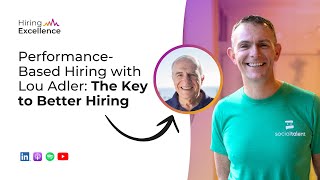
Lou Adler talks with Johnny Campbell about performance-based hiring, which focuses on what candidates can actually do instead of credentials. The approach cuts through traditional resume screening and can be faster with AI tools, though most companies still hire the old way.
Chapters
Once I take that skill and say, what does that look like on a job? And I say, would you see the person? Oh yeah, sure. And that's the idea, is that people, and just like hiring managers, they don't care about the skills. It's. You got to get them off the idea of skills and say, what does that look like on the job? And once they do that, it's of course I would. I mean it's like, it's a no brainer.
Hi and welcome to the show. I'm Johnny Campbell, CEO and co founder of Social Talent. And this week I'm really excited to have on the podcast Lou Adler. I'm talking with Lou about performance based interviewing. Lou, you're very welcome to the podcast. It's a pleasure to have you here. I wonder if you could give our audience a little introduction to yourself and your background, if for some reason they'd be living under a rock or all of their recruiting career and have not heard of you before.
Well, Johnny, let me thank you very much. In fact, I think I'm trying to go behind and go back into the rock. So I've decided to come out. But actually long ago, many, many years ago, before most people were born. I became a recruiter in 1978 and prior to that I actually worked in industry and manufacturing, engineering and finance and planning and all that kind of stuff. So when I got into recruiting, it was unusual. I did it because I really didn't like my group president, hated him. He and I fought every time he came down. And I, then I, and then you had the corporate politics. I said, now I'm going to do something different. And I decided to become a recruiter. And almost within a week or two, I realized this is in 1978, the process was broken and it took me probably 10 years to figure out the right way to do it. And then eventually it became training and books and all that kind of stuff. And we can get into that in the podcast. So my background's a bit unusual. I didn't aspire to become an HR person or a talent writer or recruiting it. I kind of fell into it. And it's an interesting experience nonetheless and I'm trying to see if I want to go back under that rock again, seeing what's going on.
So Lou, when I started my recruiting career more than 25 years ago, I read your articles, your books, I saw you speak as things like YouTube began to become a thing. I saw you a bit more and then had the pleasure of finally meeting you several decades ago. When I started going around the states and hearing you on stage and you've been somebody that for our industry has been one of those practical, no nonsense talkers around what works, what doesn't work, and given hundreds of thousands of people, millions of people, advice in our industry. This is something, you know, it's a topic, performance based interviewing that maybe folks on this show haven't heard before. They might be going, what's this? It sounds like something I know. Is this the same as behavioral interviewing? Is this not what we do all the time? You know, we get so many buzzwords and phrases thrown at us in this industry. You get confused sometimes. Do they all mean the same thing? Walk me through what performance based interviewing is. Because just to clarify for our audience, this isn't something you're selling or peddling because you need to create some new business, right? You are, you know, you could, you could retire forever and never have to speak about recruitment again. You do this because you give a shit about this. You care about this topic. You think it's something that people should be paying attention to not because they need to buy more products, but because they need to do hiring better. So walk me through maybe the difference between what most people might know as behavioral or situational interviewing versus PBI performance based interviewing.
Okay, so let me kind of a little bit, of course, redirection performance based hiring. Performance based learning is a subset of the entire performance based hiring process. So what I advocate is performance based hiring. Performance based entering is a piece of that. The core of performance based hiring though, is a job analysis. That is the fundamental difference. And I think if I go back in history to when I mentioned 1978, I'm going to go back to the first week of 1978, the day I became a recruiter. I had given six months notice. So this was not. Was emotional and I quit. It got unemotional and I really thought about it and decided to do it. So my first search project in 1978 was for a plant manager in the automotive industry. Making automotive components, machine products, assembled, it doesn't matter, that's what they were. I went out and met the president of the company. President of the company gave me a job description. I talked to him before that. I knew I was going to become a recruiter. He gave me the assignment right away. So it was not hard to get the assignment. And I knew the president because we worked together. He gave me a job description handwritten. But skills, experience, competencies, 10 years, got to be results oriented. Good communication skills, hard driver, all the stuff that you still see today. And I looked at Mike. Mike is now 85. And I talked to him about a year ago. I said, mike, this is not a job description. This is a person description. Let's put the person description into the parking lot and tell me what you want the person to do and if the person's successful over the course of the first year. It just came naturally to me that you should never use a job description. Why would anybody use one that's looking for a person? I want to know the work first. So I always say, let's define the work before we define the person. So he said, oh, I want. Nobody's ever asked me that question. I want someone to turn around a manufacturing plant. I said, fine, let's walk through the manufacturing plant. My background had been, I'd been through dozens and dozens of plants, so it was easy to walk through. It had labor problems, machining problems, layout problems, warehousing problems, procurement problems. We identified them all. That became a performance based job description. That then became the essence of what we look for. A person who could do that work. And if they did all that work, that plant would have been turned around about 10 or 15 margin points in a year. We hired a person four weeks later. And in more than two to 2,000 search assignments, I have never, ever used a skills based job description. I just asked the hiring manager, this is not a job description, it's a personal description. What does a person need to do to be successful? And then all the components, how we. So performance based hiring is. We define work that way. We look for candidates who are motivated to do that work and competent to do it. We interview, which is the performance based interview. Can that candidate do that work? We then close the deal, which is the recruiting piece. Can this candidate, does this candidate see this job as a career move? And then that becomes the onboarding program? Because we already talked about it and then we got to deliver on the promise that that's performance based hiring. And it started that first week in January of 1978. It was hard to do. It took 10 years to refine it. I retired a couple years ago and it is hard, Johnny, as you said, to do that first piece of defining the work as a performance based job description. It takes time. So two years ago, when I saw AI came out, I just said, create a performance based job description using these kinds of principles for this job. And it comes out instantly. Then I can go talk to the hiring manager almost right away. So that that was really the turning point of the Tipping point of how it all turned out.
But if I'm listening to you, right, and I'm a recruiter or running a recruiting team, a recruiting leader, and I've done it the one way, I've done it all my career, I'm thinking, Lou, this is interesting. It sounds like there's merit to this, but like, really, do I need to change what I'm doing? Like, why? Why do people need to? Or do they need to change what they're doing? What's wrong with behavior interior? It's different. Maybe it's looking at the skills, the person you know. But is it broken? What are some of the, in your opinion, weaknesses of the approach most of us take? And then the reverse is what are some of the strengths you get out of performance based hiring that you just do not get from the current process?
Okay, so. So let me give you my ending question, which I suggest every single hiring manager and recruiter ask before they make a job offer. You ask the candidate, Johnny, are you aware of the performance expectations of this job? Before I make the offer, forget the money. Are you aware of the expectations of this job? And why do you see this job as a career move? That's question one. And if you can't answer that question, it's 50, 50 chance you'll be satisfied and successful in this job. Even though I've done this huge behavioral interview. Conversely, with that, I asked the hiring manager, Simon, who's our producer. Simon, is the candidate you want to hire, Johnny Campbell, aware of the performance expectations of this job and why is he qualified to do it? And if either of those questions are vague, you have your problem with hiring. So that's the end game. But now I'm going to zoom out. If Gallup puts together an engagement survey year after year, and I've done it for 25 years, it's based on their Q12 engagement survey with the world's best managers do it has not for 25 years. The fully engaged employees are only 35, 30 to 35% of the whole entire workforce. Only a third, 17% are fully disengaged. So you got 70% who taking jobs because it's based on skills. They go in. I didn't know that was the job. I didn't know this was this. The person's a good person, but you don't hire a good person based on their skills and behaviors. You hire them because they are motivated to do that work. So now we can get into why all these assessment tests looking at skills are flawed. Because they don't predict performance. They don't predict the situation. They don't predict do I going to work with the manager. I don't work. Can I fit with the politics and the corporate culture. All of those things are missing when you use traditional behavioral interview unless you define the job up front as a series of performance objectives. So that's the case I make.
So let me dig into that. Right. Can you give me a specific hard example where the performance based hiring approach identifies something you should assess for that would not otherwise be picked up in a traditional behavioral interviewing process where you read a job spec. Can you give me maybe use the Platinum Leisure job or any examples where you go. That's one of the key differences.
Okay, so let's kind of take. I'll just take a financial director of financial planning. This was a job that we talked about yesterday. Traditionally it would have said five years of budgeting and planning experience, MBA from a top school. Results oriented, the ability to do deep data analytics and be an Excel supermodeler. And you would have us and proactive and you know, results oriented, team based and humble. You know those kinds of criteria. Well, what if the job requires someone to so if I did it my way it would turn out hey, the candidate within the first three months has to or over the first year has to build a digital platform to manage worldwide operations for all our plans that upgrade our new system to incorporate AI into the budgeting and planning and forecasting system. So that's, that's the real job versus the other thing. So I interview a candidate for this job. Oh, got good MBA, understands finances, worked three years at PricewaterhouseCoopers. Understands budgeting. But when I am really good at Excel modeling. But when you put them in the job. So I didn't know I was supposed to do all this work. Nobody told me that. And I thought I need three people to do it. No, this is an individual contributor job. So lack of clarity around job needs is. I mean if you read Gallup's book World's best Managers it's clarifying expectations up front. Defining the work as a series of performance objectives. If the candidate doesn't know that, it's a surprise when they get in the job. So if you, and you look at why do people underperform? That wasn't the work I wanted to do. I'm competent to do it, but not motivated to do it. I don't like working with this manager and I don't have the resources the time to do it. I mean so when lack of role Clarity is the number one driver for disappointment and dissatisfaction and turnover. So to me that's the difference. And you can, yeah, I think candidates are great candidate but not going to fit with this, with this person. It's lack of that surprise on day one is the fundamental difference between. Now I believe in behavioral interviewing, but it's slightly different way than most people would use it. But we can kind of talk about it. That's a different lack of oral clarity.
Why aren't organizations doing this more? You make a convincing argument, right? So why don't you think everyone just goes, you know what, let's try Lou's approach. Performance based hiring and all of its different processes make sense. Why is it that it isn't the industry norm? Why is it that 50 years later people are still doing it the crappy way?
So let me kind of give you the bureaucratic answer. So when I go into a company and have these conversations, we can't change our job descriptions. It's impossible. We have all these written, we've done all this work, it's OD approved and all this, oh, how would you possibly do comp and benefits? We can't do that. When I talk to. So when I look at it, the bureaucracy of it and the legal aspects of it, people say no, I can't do that. Even if I offer let's do an A versus B test. The success we've had is when I can talk to the CEO of a small to mid sized company, say 200 to 1000 people, CEO says we're going to do this. We're not going to approve recs until we get a performance based objectives. And those objectives will tie to our business plan, our operating plan and this individual manager. And I'm not going to get a rec approved until you can justify why this person's qualified to do this work. So at that level it's easy.
So.
And I've been having these challenges ever since 1978. I can, I personally and recruiters have been certified can get a individual hiring manager to go forward. It is hard to do that work to build a performance based job description for that director of financial planning that I just described. I have to kind of rough it out. I then got to talk to the hiring manager, he or she changes it, then we talk to the team, then we get agreement, then we go to comp. And then it's, it's four hours worth of work. I could right now just with what I said to you, give you a rough idea of what a performance based job description if you were the hiring manager and you'd look at it and say, no, I want this point. No, they don't do the international stuff. We already have. This is what the job looks like. We could paint a picture of that job in 20 minutes and start recruiting and hiring people and interviewing, hiring people against that. And then by the time you're done with the whole interview process, you talk to three or four or five people, it's clarified in four weeks from now. It's the exact one that meets the criteria of that specific candidate. AI enables that process. That's why I just kind of gave up and I said, this is hard work. Spent a lot of money training people as a recruiter, made a lot of money doing it. But it's not easy to scale that concept. AI makes it easy to scale. And this is the problem I have. AI is trying to scale a broken process of, hey, we're assessing people on their skills, on their video interviewing, on their facial techniques. So that's easy. And you can put technology, but it's not predictive of performance. The candidate still doesn't know what the job is until he or she gets there. And if you don't solve that problem, you'll solve no problem. So that's the pitch that I make, and I believe that's reasonably true, what I've said. I actually have talked to the number one lawyer in the U.S. labor lawyers, been in front of the Supreme Court, and he buys into the process. He can't believe that people don't want to do it either. So.
How do you square the circle on organizations that adopt techniques like Amazon's famous technique of the bar raiser program, where fundamentally the organization is trying to make hiring decisions not based on the specific role they're coming in for per se, but based on the person's suitability for the wider organization. Because obviously, you know, the traditional method is what's the job? And you're saying we go through the performance of that job. But programs like Amazon's bar raiser program are deliberately designed to try and remove the decision from the direct hiring manager. Because maybe the second or third job this person is going to have will be very different and we want to hire for the organization. So. So can you square that circle where you have an approach that says, know either we want to hire for the wider organization, like the bar raiser program, or some organizations who say we hire for values first, we want to align to the values. We focus less on skills or less on role fit. As long as somebody can work in our environment, we think they can do anything. Have you come across that and how would you reconcile?
No question. I think the issue is now you kind of take a look at it. So let me kind of go back and then come forward. Somebody the other day asked me, how did you develop? Was I. I was the same idea. It took 10 years to figure this out. I said, well, in my own mind the job analysis was the most important. And I started reading all the research about interviewing and Schmidt and Hunter and actually talked to the couple of these people who've written these research reports. And it was very clear that if you're going to interview someone, you had to do a job analysis. How that pivoted from a skills and competencies is unclear. A job analysis is what does this person need to do? How do you do it? How do you lay out the workflow? How do you do this? It doesn't matter what the job is, truck driver or chairman of the board, you can define it. That was lost. So that was one thing that and it was almost intuitive because I had been in so many different jobs in 10 years, did pretty well, but there's a lot of different jobs. But then I started as I was working with some pretty very capable people. I mean I was working with chairman and I had been at the corporate headquarters and worked there at one of the 35th largest company in the country. And I was making presentations to those people. So and dealing with really sharp people. So I started, they became my clients and I started sitting in on interviews and listened to how they interviewed people. They always dug into the person's accomplishments. So I started benchmarking how the best people decided to hire the candidates and differentiate. And it was obviously smartness, it was resiliency, adaptability, potential growth. But they dug into the person's accomplishments and understood how they grew over change. Now I didn't do that at first, but after you talked to 10 or 20 or 30 people and listening to their results said, oh, this is this common thread here. Then I started talking to some real good people. The tide is a top 25%. The people who Amazon wants to hire, who raise the bar, how do they make decisions? And I don't know, none of these PhDs or other people talk about you got to talk to candidate makes a decision, he or she has to decide that this is the job. So you got to put their filters into the process. How do they make decisions? They don't make decisions because Amazon wants a bar raiser. They make a decision. Is, is this going to Be a potential career move for my company or I don't work there and can I make an impact and I can convince my wife and family and my mother and my grandparents and all this stuff that this is a better job. And we're going to move from Duluth, we're going to move to Seattle to do that job. And that's a hard decision. So if you don't get into the decision making mindset of that candidate and that candidate's decision makers and help, you have nothing. If you can't close the deal with a bar raiser, who, who cares? You gotta. So, and I think most people in this space don't understand what you've been a recruiter, you know what it is like to close. So you gotta take a look at managers. How do they make decisions, how do candidates make the decisions and what's the common thread? The common thread is a work and not work workers. That's a career move. And if you do it right, you're gonna, you're gonna raise the talent bar. This account is motivated and competent to do that work and sees it as a two to three year opportunity. So now you've met everybody's unique needs. So Lou, let me throw your circle.
Let me throw a hotcake at you. We live in a time when one of the big buzz phrases at the moment is skills first hiring or skills first organizations. And I've been personally skeptical of some of this in the last couple of years. You know, as my good friend Kevin Blair said on stage a couple of months ago, I've never met a hiring manager who doesn't want somebody who's just done the job before and want just the skills. But, but, but, but, but when we talk about skills first hiring, that's the first time I really start thinking about doing a job analysis and understanding. Okay, well, I'm not going to trust the job spec. But, but what is the job? What do you need to do? And then turning that into skills and competencies, is that the same as what you're saying? That you do a job analysis and from the job analysis you then analyze the top four or five skills or competencies that are required. Is it experience? Is it the same? Is it different? Walk me through that.
I think your puzzle is exactly the right puzzle. Skills in my mind is just another HR phase fad that's going to wind up three years from now to be a waste of time. It's the big, the new thing. AI is a new thing. So I'm going to go back to a search project I have, which I think clarifies it. It had to be 2000, just when the Internet was starting to boom. I had a client in Silicon Valley, president of a company, and there was a board member I had worked with, member said I worked at a huge corporation at the corporate offices. So I met a lot of pretty remarkable presidents and division presidents and up and comers. So one guy at that company was the chairman of the board of this other company up in Silicon Valley and he said, Lou, we're going to hire a VP sales and they're not hiring the right person. Can you do your shtick with this? Define the job at least they're not going to use it for recruiting, but can you at least have them define the job? So I go meet the company and I wanted the search project as the VP sales and marketing of a up and coming Internet company. And I met the president and he said, I want someone with an mba, got it from a top school like Stanford, has to have an msa, has to have results or any. And he went on his litany of things of what he wanted and he looked at me as a recruiter, says, you have never done anything like that. Why are you even here? Why does Howard want me? And he, for 20 minutes he was really putting me down. I mean, I mean I was sitting there, thank God I was from born in the Bronx, New York, so I could take the heat, but he didn't want me in that room. And he said, I don't need this board telling me what to hire and why they're putting this stupid recruiter in my face. And I said, Lee, let me ask you a different question. You hire a person and this person starts a month from now and this person is great and you want to give this person another chunk of equity and you want to give them a bonus and you got to get in front of your board and prove it. What has the candidate done that would justify what you want to have happen? And he stone silence. What do you mean? I said, yeah, what does success look like? I said, that's a real good question. And then he said, I need to have someone put together a three year marketing plan that really goes in a detailed level of the individual products that shows the change of products. I've got about 80 to 90 engineers, probably only hire 10 more, but I want this laid out in real great detail. And he went into this whole thing, 20 minutes, he told me what he wanted. So I just said, what if I could find someone who could do that work but didn't have the MBA from Stanford. Probably wouldn't need an mba. Hard to do it without a double E degree. But maybe not the double E from Caltech or Stanford again. But could absolutely do that work. Would you at least see the person who's put together a complicated three year product plan like that? He said, yeah, I just told you I would. I mean it was like all this idea of skills experience. He said, but I really need someone who's a great communicator. This is the skill. So what does that look like on the job? Oh, great question. We're going to be talking to these VC folks and all this. And he described what great communication looks like. Other people want this other skill. They got to be real strong in 10 years of SE. I kind of remember this one from before that, but got to have at least five years of SEC and public reporting background. I said, what does that look like on the job? Oh, they got to put the quarterly reports together. What if I could find someone to do the quarterly reports within the 10 years? Oh, that'd be good. Once I take that skill and say what does that look like on a job? And then I say, would you see the person? Oh yeah, sure. And that's the idea is that people. And just like hiring managers, they don't care about the skills. It's. You got to get them off the idea of skills and say what does that look like on the job? And once they do that, it's of course I would. I mean it's like it's a no brainer. And yet when I show you the HR conceptually. Oh, I can't do that too hard work. So you take any skill whatsoever. So in some way your question, Johnny was exactly right. You're puzzling. How do these two pieces connect? Yeah, they need skills. I don't know how much they need enough to do the work. Is it five years, one year? Is it code? I mean so they're real good in this skill and this skill and they've never done that, but they've shown the ability to learn that. Okay, that's. I'll, I'll take that. You'll be able to learn. That's how you raise the talent bar. So those are the, that's the difference. So.
So Lou, let me Luad lure you. If I'm a head of recruiting, head of talent or business leader listening to this and I have adopted performance based hiring for the last 12 months in a small scale and I'm presenting to my board or my boss in 12 months time on the evidence as to why we need to adopt this across the business. What am I presenting, Lou? What am I sharing in terms of insights, data, roi, things that are better about this to my board, my peers, my boss.
Okay, you have just. Thank you Johnny, for that soft. I don't know if you planned that. That is a softball question. But I just did a course on LinkedIn learning on how to use data analytics to justify HR change. So let me kind of go through a few pieces. Number one, you got to have an A versus B test. Number one, you got to look at did I improve turnover? So that's number one. Turnover is that for that class of job you have A is goes through the old process, B goes through the new process. The results you should see are if you use the Gallup Q12 or any type of engagement survey or equivalent. The Gallup Q12 talks about performance, engagement, job satisfaction, the ability to grow and develop host of criteria. We'll look at that criteria in the control group which is going through the traditional and we're going to look at the new group. So we reduce turnover, we improve job satisfaction, we improve performance and we have a quality measure as well as a job satisfaction level. So there's five or six metrics we could do in an A versus B test to validate it. Now here's the kicker, the Moneyball kicker for non revenue revenue based jobs. Non revenue, not sales and engineer, manager, whatever. Let's just take a three to four year staff professional with the high volume hires. One way to convert that into money is to use what we call the contractor billable rate. So you take for every hundred thousand dollars. If this person was a contractor, financial analyst, engineer, marketing analyst, and this person was working at McKinsey or Accenture, you would out. You'd bill those people out at three times their base salary. Three times their base. So someone's making 100, you bill that person out at 300. After you pay the person salary, the 100 and the overhead, you have 150,000 gross profit. So that's the starting point. If you make a perfect, perfect hire who meets all their performance objectives, you make 150 grand. Now have turnover, well, you multiply, you got 25% turnover. Well, you only made $120,000. Now if you have lower performance, well, you're down to 10 grand. Now if you have dissatisfaction, you're down to $100,000. If the person raises the talent bar, you don't make $100,000. You make $175,000. So now you can start quantifying the decision. So now I'm in front of the board and say, here's what we just did. We hired 20 people using the Adler's process or performance based hiring and 20 people the other way. The impact of the 20 people we hired is they generated 980,000 or 1.4 million in profit. Adler's Group, 7.8 million in profit. It's probably not that far apart, but that's a way to do it both. And you can say, here's a turnover difference, here's a satisfaction difference, here's a performance difference. And I think it's pretty clear cut how you do it, but you have to do an A versus B test. And we've done this. I've also, and I've talked to case studies with people who did it because of, as part of that course on LinkedIn learning, I talked to some pretty remarkable people who did similar type studies. Not necessarily exactly what I said, but similar would drive human performance.
So let's say the board's in, my boss is in. Right. You did mention a couple of times that AI, our latest generation of technologies, is making this significantly easier. So how could somebody listening try this if they're going, you know what, I think Lou might be trying to sell me something. So I want to give this a go myself. Like, where could they start, Lou, and talk to me about how AI makes this better. I know you've built a tool, maybe you can share something about that. But you know, how can someone use the technology to make this much easier than they could have, let's say, five years ago?
Yeah. Oh. So here's the issue. The good news, bad news. The bad news for me, the good news for everyone else. I've written with ere, LinkedIn, hr.com over the past 25 years. 2,000 articles written, five books. Sadly, that's all on the Internet. What AI does is it brings it all together in a seamless fashion. So when I first went to ChatGPT two years ago, plus I just said, what do you know about performance based Hira? And it knew some, but it didn't know everything. You go today to just a basic chatgpt and say, can you create a performance based job description for this job? Cut and paste your job description and convert it into a performance based job description using performance based hiring. You will get instant results. I've created our own ChatGPT called PBH GPT where we've located, we put some knowledge around it that's better than what's on the public Internet. But I don't know if it's that much better. Quite frankly, I don't know if it's much better. We have rebuttals for recruiting. We have some other interesting things that not available to the public through the books and all that. But it's. I don't know, I gotta tell you, I'm not. Sadly, the sad news is I don't, I can't make any money on it. It's already out there. Nonetheless, you can go to ChatGPT and do what I just said. Convert this job into a performance based job description. Cut and paste it some. And I just tried out Deep Seek on Monday, just came out on Sunday, tried it on Monday. I didn't even have to cut and paste it. I just put the URL up there. Convert this and I. What did I do? It was a software developer, some medical device company, I can't remember. I just said convert this to a performance based job description instantly. Did I said, how could I find this person? Instantly came up with sourcing ideas. Convert this into a more compelling email to a candidate.
Did that.
I have uploaded LinkedIn resumes. You know, you go to LinkedIn Recruiter, you take a resume of Johnny Campbell, you make a PDF. Is Johnny qualified for this job? It did it instantly. The sad, this is where I say the sad news is I don't get anything for that. I get, hey, I get to talk to Johnny Campbell once every four years. That's about. And I get to show my old book, which I get about a dollar and a half when people buy the book. So. But, but I'm 78 years old, Johnny. But you can see I'm fascinated by this. This is. I gave it up. I said it's just not worth this. I believe performance based hanger is really good and I can go head to head with anybody and we'll outperform them. There's no question. But it's hard work. It is not hard work now. So now I'm having on my podcast I have a woman which I'll introduce you to her. Hilke Schulman. She wrote a book called the Algorithm and she goes in and says all of these AI inspired screening tests and assessment tests are fundamentally flawed. I'm talking to her on Monday. I'm looking at some of these tests and actually studying the statistical validation. The statistical validation for a personality test. It only represents 10% of the total job. 98, 90% is all this other stuff. Can a person do it? Is he motivated? Can he Work with a team, and then you start looking at. And yet you look at all the HR vendors just spending all of this money on HR tech. And all of a sudden this weekend, Deepseek comes out and changes the rules. You don't need to do all of this stuff. So people are spending money on AI and you gotta be careful. It's changing almost weekly. And that's the scary part, which is the kind of part for me is I don't need to worry about it. I'm just fascinated by. It changes and I can play with it. But I look at. If I was an HR vendor, I'd say, you know, you gotta be careful what you're doing, because this whole thing could blow up very quickly in going in a direction that you don't need to go. But I think at the core of it is we trying to make this flawed process of skills, experience and competencies and trying to predict how can someone do that? Well, the predictors are, do I want to do that work? Is that work motivating? Can I work with the team? Can I work with the manager? So when you start thinking about all the problems with hiring, people are ignoring the solution. The solution is, hey, look at how good people make decisions, how good people thrive, and then build a process around that. And I think that's. That would be my message for this whole talk. Well, that's. That's where I'm spending my time on now, anyway. I'm going off on a tangent, Johnny.
No, it's passion, Luke. You know, and this is the point. This is why I really wanted to have you on the show. Because, you know, I think what you're asking people in the recruiting industry to do is to stop for a second and think about the fundamentals that we have relied upon through our entire careers to ask ourselves, were we right? If we're here to try and assess, to find and assess, recommend the best talent for different jobs, are we doing it on a bed of rock? Are we doing it on a bed of weak wood that's rotting, that doesn't work, that gives false results, like, it's just a stop and challenge ourselves. And I know you mentioned obviously that of course you'll take checks in the post if someone wants to send you a check for. For hard work done. But, you know, you're very generous here and sharing with us that folks can just go on to ChatGPT and begin to do this themselves. But I think one thing that we discussed before the show, Lou, and if you don't mind me saying, you're keen to hear from people who want to experiment and try this or who have tried it, who might listen to this podcast and do their own experiment themselves, their own AB test case, who might put this into place. Because again, it's not about trying to sell a product. You're just passionate about trying to make sure this gets out there, that people use this. So if people want to know more, want to share with you what they've done, maybe they've tried this already, maybe they attended one of your sessions online or watch your LinkedIn course in the past and they've actually tried this on scale and have results. How can they share that back with you? And what kind of people do you want to hear from?
Well, let's do this. I'll hear from everybody. I mean, I literally. So I. It's Lou adlerconcepts. Com Lou adlerconcepts.com and you can reach out to me. I'd urge you to join our Moneyball for HR webcast program. If you look Moneyball for hr, just search on it, you'll find the link. We have a program where I have Hilke coming as our guest panelist on 26 February 9, 2025. But I think the idea that I also kind of surround it with somebody just signed up for that webcast from Australia and in the checklist because I asked, hey, send us a URL and we'll show you how it works. And there was somebody looking for a space, designer space for a college campus in Australia. And to me, so what it goes is, hey, we're a college of got 20,000 students, we got a space of this many acres, but we really want to redesign our classrooms for the modern day and the whole learning to make it a learning space. And that's what the opening said. And then it said, if you're interested in this job, don't apply. Just send us something you've done in that arena where you've really understood the complexities of doing that for a learning environment. And we'll get back to you right away. That was the job posting. I sent it back to Nathan. I can't do it. This is superb. This is the way it should be done. Put duct tape over the apply button, tell people what they're going to do and ask them if they've done it. And now you're going to self select out. People are going to describe it and they want people that I can't wait. I've looked at your campus, I've looked at aerial shots, I've done this, this, they'll probably only do the half the job. I mean, so it's. You think about how good people change jobs. You want to raise the talent bar. Okay, well, how do good people accept jobs that are talent raisers? Now you benchmark all your work around them. And I think that's. We've been focusing too much on people on the. But hey, you want to hire good people. Understand how good people, they don't apply to job postings. They find somebody they know. They get referred. Now sometimes they do apply to job postings, but they'll go around the back door. Oh, I saw this posting, but then I found somebody at this company. I mean, that shows some cleverness and some resiliency. So I think when you benchmark the group you want to hire, that changes everything. And you also benchmark how the best hiring managers already raised their talent bar. Lou, I've talked to folks at Amazon. I met John one who's there. I even tried to hire him 25 years ago. I'll tell you that too.
So, Lou, I love those examples. I love what you've shared. I can't thank you enough. It may have taken us five years, but it's been such a pleasure to get you on the show and to share I know your life's passion, something that you really believe we should all pay attention to. And all you're asking people to do is give it a try. Lou, it's been an absolute pleasure. We hope to have you again. Maybe back on the show once we get more feedback from folks who are trying it out, we'll put a link to that podcast. You mentioned your podcast in our show notes as well. So whether you listen to us on Spotify, Apple or wherever you are, we'll put link to Lou's podcast on the show notes and we'll hopefully have you back again. Lou, I know you have so much more to share on so many topics and it's always a pleasure to chat to you. Thanks for joining us.
Thank you very much, Johnny. I really appreciate it. It was a lot of fun. I do appreciate it.
Likewise, and thank you for listening and joining us this week. We'll be back again next week with another great show on hiring excellence. And in the meantime, don't forget to subscribe whether you listen to us on Spotify, on Apple or wherever you find your podcasts. Talk to you soon.
More from Johnny


Where Does Your Hiring Stand? Diagnose It with the Maturity Model | SocialTalent

Where Does Your Hiring Stand? Diagnose It with the Maturity Model | SocialTalent






NEW CONTENT - How to use Generative AI for Recruitment Marketing with Glen Cathey | SocialTalent

NEW CONTENT - How to Use Generative AI for Sourcing & Recruiting with Glen Cathey | SocialTalent

NEW CONTENT - How to Unlock the Power of Generative AI with Glen Cathey | SocialTalent