Recruiting through a crisis: Balancing work and the war in Ukraine | with Anna Stetsenko
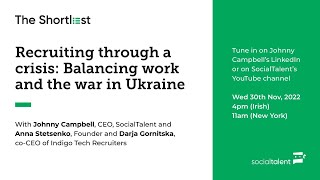
Anna Stetsenko and Dasha Gonitzka from Indigo Tech Recruiters, a Ukraine-based agency, describe how they kept their 25-person team operating through COVID and the 2022 war. They shifted to remote work, reduced headcount, and now fill 70% of open roles outside Ukraine while supporting staff with mental-health resources and flexibility.
Questions this video answers
Episode 125.
About 25–27 people.
Approximately 70%.
United States, United Kingdom, Switzerland.
indigohire.com
Chapters
Sam, You're very welcome. It's episode 125 of the shortlist. I'm Johnny Campbell, your host of this podcast and live show and also the CEO and co founder of Social Talent. Today we're going to be talking about recruiting through a crisis. Many of you may be doing this right now, many of you perhaps have had to do this in the past, but in particular we're talking about how do you balance work and the war, in particular the war in Ukraine. For many recruiters, the past few years have presented numerous challenges with the pandemic remote working, moving to zoom interviews. But could you imagine dealing with a war on top of all of that? It probably seems unimaginable for most of you, and yet that's the painful reality for Ukrainian based businesses. How do you stay motivated, continue to engage candidates, continue to deliver a fantastic service during a war if you're not safe to do so every day? Joining us today on the shortlist are Anna Stestensko and Dasha Gonitzka from Indigo Tech Recruiters. Anna is the founder and Dasha, the co CEO and chief operating officer of the Tech recruiting agency based in Ukraine. We're going to be talking to them about what it's like to balance recruiting with the ongoing war, how they manage to stay motivated and motivate their teams, how they stay productive through a crisis, what you can learn from their experience through this crisis and how they've leaned particularly on diverse hiring and education for their continued success. And before I introduce our guests, if any of our listeners would like to donate to support Ukraine, Anna's brother Andrew Stetsensko leads an initiative that raises funds for medical and humanitarian aid for Ukrainians. Andrew is also the founder of the job board and recruitment agency Relocate Me and Glossary Tech, a solution that helps make complex tech definition clear in CVS. You can donate by going to the GoFundMe website that's live on the screen. If you're watching live or in the show notes gofundme.comf medical hyphen and other humanitarian aid for Ukrainians, you're going to need to go to the link in the show notes. If you're listening to podcast, trust me, you're not going to find that yourself, but do take the take the time to click on that, find out more and donate. Ana and Dasha, you're very welcome to the show. Thank you so much for joining me. Could you please perhaps introduce yourselves, explain to our listeners where are you joining us from and why did you get into recruiting?
Sure. Johnny, thank you so much for invitation. And before we start our introduction I would like to share a story how happened that we are here in the first months of war. We understood and I guess it's one of the my main lessons during the war. If I would like and I don't know how to help myself, I can help other people. And it's really motivated and you know, it gives me sense of life. Not only me for all team, for all our team. So we understood that more than 6 million women forced to leave their houses and cross the border and stayed around the world in Europe, in United States, in Canada. We understood as recruiters they very soon they will have question how to find a job, how to, you know, to connect with local communities. And we start to ask in our network and our colleagues maybe you can share information, maybe you can share a job, maybe you can give us some piece of advice. And I wrote to Bill Borman, a good friend of Ukraine and he supports Ukraine a lot and we hosted few through Kyiv and Turviv also before the COVID and he made our connection and he shared you our story and you gave free access to social talent platform and after half a year we decided to see results how it was and we understood that 1,000 Ukrainian recruiters joined to social talent platform and we got brilliant and amazing feedbacks about education and how it was supportive, how they became confident how they could find a job. They shared with us its tools, stories. So I wrote you just to say thank you and you invited us here to this podcast. So thank you so much and for that opportunity to for education opportunity for Ukrainians and we are here and few words about myself. I'm Anastasia a little bit personal personal information said I'm an artist, I'm a traveler traveler I really like one way trip style so just buy a ticket and to travel somewhere and I saw the word from Japan to Antarctica in that way. So yeah I'm passionate Buddhist and I try to practice Vipassana meditation during 10 years. Sometimes it's better, sometimes it's worse But I still trying to be, you know, balanced and mindfulness and about Indiga I founded that business 15 years ago. We celebrated our fifth university two weeks ago and I guess we are leading agency in Ukraine and specialize in tech recruitment. So what else? I guess that's it for beginning and please Dasha.
Yeah, thank you. Thank you for inviting us. It's really great to be today here with you. My name is Daria Dasha. I'm happy mother of two girls and I love learn and encourage everyone to do the same same. I'm in IT business more than 20 years already worked in international companies as well as agencies with focus on grow, effectiveness and scaling. And I joined Indigo about one year ago. We where we are and I'm sure we will be number one agency in Ukraine. But we in in a good way. You know we are ambitious to continue grow and continue presenting Ukraine all around the world provid the best in class service.
So.
Happy be with you today. And I can say that if you're talking about us as a company and as a representative today, we always really, really basic value for us is caring about team. And you know we saw that Covid was the bigger challenge but at that time we worked remotely all the time. So for us it was okay. This is quite something new. But still we can handle our teams because they used to work remotely. But having new challenges at the beginning of this year it was really high level of uncertainty and we all the time was thinking how we can support our team, how we can care about our team, how we can keep business alive. So I guess this is questions which we can share our experience and discuss today with you.
Thank you both for those fantastic introductions. I'm really keen to understand maybe for context for our listeners. Tell me Ana about the business before COVID You know, what was it? How many people working there? What kind of role roles were you recruiting for? What kind of customers? Maybe mention a little bit about the impact of COVID but wondering if one or both of you could then tell me about when did it all change with regards to the war and what was the kind of immediate impact of the war on a business that I imagine at that point was beginning to recover out of COVID beginning to work with customers as they'd be going to rehire after the slowdown in 2020. So maybe can you paint that picture for me? Give me a view of what did Indigo look like as a business for those listeners who don't perhaps know the company?
Yeah, sure. Before the COVID I guess we had 25, 27 people on board and we have different services and we had different services. So we organized HR event. We have our own recruitment school and sourcing school and school for hiring manage. We organized several survey for sea level and even now we try to do this even during the war and share information, actual information with the market. What else I would like to share? We would like to find new way how to do business even I would like to share a small story about my partner and Co Owner in Diego, Katya Sichuk. She came to Indiga as a CEO because I thought that it would like, you know, step back from operation management and to focus more on strategic level. And few years we worked together as founder and CEO. But then we understood, you know, like in each partnership, if you go want to go further, you need to change something. And we understood that I would like to invite her to my business and to share the partnership with her. And we decided to celebrate it, you know, like, because it's partnership and we have special place in Ukraine where a couple organize their merits and sign, you know, to if how to say Dasha can help me to translate.
I guess promises will be good promises.
Yes. So in betting wars, you know, everything like this. So we decided to go in that place and shareholder agreements there and we invite our team, our partners, our clients. Just decided to celebrate it. It was such a nice experience for us how we celebrate our partnership there. So yeah, we always by I show this example that we always try to find unique solutions and unique way to, you know, to present ourselves in the market.
Tell me then Dash about, you know, what was the immediate impact on of the war? I imagine, you know, there's a period of wow, this has happened. And then there's a massive change and then there's a period of okay, now we need to still figure out a way to come together as a team in a business. So to walk me through that timeline perhaps and what exactly happened? How many people were impacted? You know, how long did it take before, you know, the initial shock and change and the personal impact for everybody. And then how long does it take to get the business back up and running?
Yeah, we remember when we have like a call, virtual call with the whole team in the time of like New Year. And we all discussed that the situation become more and more with more intention, with more higher risks of this happening. And we say that, you know, a lot of partners of Ukraine support us, but we still think it not happens. It can be true. In 21 century nobody is doing politics like that. Even the, you know, scenario, which can be worse, we try to be prepared, but we still try to support each other. So hey, let's think if worse happened, where you will go, how you will care about your team? Do you have enough plan to. To act in in the worst case scenario? And we try work on business continuity planning. We try to support our team. We created different, you know, surveys. We even agreed who can come to home apartment from different cities of Ukraine. And still we would try to Be positive because it just can happen. It's not, it can be true, you know, and we, we all remember this day in the morning of February 24th, when everyone realized that it's actually happened. And no matter how good you prepared, you can be prepared for everything in this case, because nobody faced such challenge and such like it's war in our times. And even like, I don't know, like 50 years, 100 years ago, the, the business and the world is different. And our first reaction was definitely to find someone who is on the phone, on the call with connection, Internet connection, and ask, hey, can you check that everyone on the way or moved already? And about, I guess two weeks, we just tried to realize what is happening. Someone who didn't plan to move from the town, cities where they lived, they moved to other countries, but initially they're not planning to do this. Someone stays where they are, for example, in Kharkiv. A lot of team members from Kharkiv and they stay there for like weeks. And we all the time check with them. How you doing? How you feel? What are you hearing? Maybe let's like move to Kyiv, we're here or let's move somewhere. Part of the team, they went to abroad from Ukraine, parts still stays in Ukraine. As we with Anna and number of team members. So first weeks really were really stressful because we just. Our focus was to make sure that everyone's safe. And we in two weeks we realized that more or less team on the way or already in the safe place or they stayed where they are. And like we just check in, how you, how are you doing? Do you need some help? Do you need anything from us? So I guess that somewhere at the end of March, beginning of April, we realized that like those who stay in safe place, they continue to do business, they continue to talk to their candidates. And a lot of candidates at that time actually were from Ukraine. And sometimes we shared this story on the call. Anya, do you remember that sometimes even candidates they sitting and can't just stop crying. And sometimes this was the case because we all, especially if it's Ukrainian to Ukraine. And we try to support each other and we give this time for everyone who is on the call, who need this just to support each other and say, hey, everything will be fine, we're together, so just happy to be here with you and support you whatever time you need. It's not a problem. I think that in. During all this time we. We accept choice of each team member. Because someone even right now, they back to their homes and this is not always safe place to stay, but this is the choice of, you know, individual choice. And we all have different conditions and reasons and at the beginning of the summer I guess realize that, you know, the what happening, it's not only influence Ukraine, it's actually influence the global economy and a lot of other countries. And we give our time, I guess to steal different businesses, they react immediately, you know, to continue operating and working. They make tough decisions much more earlier than we during the summer when we realized that, okay, we're here, we continue working, we care about our clients, we have business to do, we still were focused on our team and we have different yoga classes and psychologist, online classes just to support everyone. So and make sure that everyone have this time to stabilize and continue working. And we, we were really impressed how team doing with this. Most of them still, you know, balance this emotional state, professional duties and supporting their relatives and still stay really, really strong. And it is encouraged a lot. So we leave this three months of summer and I guess that in September, right Anya, we realized that, okay, we made sure that everyone stays safe, we support the team as long as we can, but it's actually time to make tough decisions. So we reduced our team partially in September, but still we have a lot of plans. We're doing all we can to continue expanding geography, but still say that we have global agency, but we are the core team from Ukraine. So this is the picture of how we lived through this month.
Tell me how it is today, because today, you know, I understand that you're delivering services to businesses in many parts of the world. Finding great talent, finding candidates. Anna, to your point, the business was founded on the basis of finding solutions by fixing problems for organizations. And despite the, you know, insane crisis that many of us listening will never be able to comprehend, the reality is as a business owner, the best thing you can do for people is provide them employment, provide them opportunity to provide a service to businesses so that people can earn an income. And you and Dasha have done that and you've managed to get the business back working. So tell me today, who are you working with? I mean, what kind of companies, where in the world, what kind of roles you filling? And walk me through what it's like because I hope and I understand, I think that it's, it's just like everywhere else, you know, in the job part of it. You may be living in an environment that has massive uncertainty and risk, but you know, your team are recruiting, they're getting on with it, they're finding great talent for Great companies all over the world. Is that the case today?
Yeah, yeah, it's like this. And our clients now mostly based in us, uk, Switzerland still we have and we're really proud the client that you have client in UK in Ukrainians continue to hire and grow their businesses in Ukraine. Yeah, it's I guess our 4 location where our client bas based.
And in terms of the talent you're finding, you know, tell me, walk me through like modern recruiting for those who don't understand it, you know, US companies and others, are you finding talent from Ukraine for those companies or is it a case of you can find talent anywhere in the world for companies anywhere in the world? What's the mix today?
Yeah, before the COVID our branding was like Ukraine for the world. So we invited different companies to Ukraine and tried to create opportunities for them. And even we tried to calculate that we're not feeling like 1,500 vacancies from Indigo, but we also created 2,000 workplace for different companies. Not that we filled vacancies, we just invited these businesses to Ukraine and started to help to open offices them here in Ukraine. But after Covid, we understood that a little bit fragile to focus only on one location. So we started to work over the globe and Europe and Singapore and Latam and Canada and United States. So yeah, I guess now 70% of our vacancies it's outside of Ukraine.
So tell me about, you know, the teams that you have always had and you know, what is what makes them different to other recruiters? Because I imagine living through such an enormous crisis builds enormous resilience. And to me recruiters, great recruiters, have always been resilient. Maybe it's a different level of resilience. But what has most impressed you about the team and how they've been able to continue to deliver for their customers? So that would be to Dasha or Anna, you know, both of you, what, what do you think has defined your team or define the type of recruiter that works in your business.
Sometimes because you still should stay positive, right? We're joking that everyone including our team in their cv, they can write like Ukrainian and it will tell us a lot because it's really, you know, even if you at that time or during this nine months or even right now all the time outside of Ukraine and we have such team members because when you're working with Indigo and in it, you know, you can be really flexible and part of our team at this time were outside of Ukraine, but still you care about your relatives, you care about your country. About your friends and you know, all the time you should stay focused. We even tried to manage approach when somebody for example not online so other person can support and join, for example interview. But we hear that we're doing okay if we not taking some day off, if we're not taking vacation. We are really responsible for providing services for care about our clients and talk with our candidates. Those who right now in Ukraine sometimes because outages they not always according to the schedule. And sometimes they or our candidates, they just like joining with bad sound or bad like video quality of video. And they just agreed. Don't worry, it's not a problem. Let's talk later. Let's talk today. So we, we are here and everything is fine. So I guess that they learned how to not only balance their like emotions and stay professional and focused, but also how to support those who on the call. Sometimes even candidates outside Ukraine, from Europe or from us they just, you know, they can't start conversation without asking how you're doing. So please like if you need some anything, some time or anything to start or we need to rescale, it's not a problem. And they are surprised that even like from the side of our team we say we're doing good. Thank you. We hear from you. So how are you today? And this is really, you know, what we can say that we learn how to live with this. And even now when sometimes we can be without Internet, sometimes we can be without light or as Anna mentioned at the beginning, we still, I can say this, that we still feel that we, you know, we as a nation together and we should go through this and we believe in our military forces and we really in Ukraine, a lot of volunteers and many of us who do business during the day, in the morning or in the evening or during the weekends trying to volunteer and support our military forces. So I guess that this is the spirit of nation.
I love that I'm going to take the opportunity just to make another quick plug. I mentioned at the start of the show that Anna's brother Andrew leads an initiative that raises funds for medical humanitarian aid for Ukrainians. We have shared a link in the show notes and the chat. It's a GoFundMe page and that will be, you know, if anyone wants to volunteer it but you know, to put their money where their mouth is, so to speak and help support Ukraine and federal Ukrainians. Please, please go find that gofundme page which is in the show notes and the link and your contributions will be very welcome. I'm going to Go back to you and you mentioned the fact that obviously the war came straight after the first crisis being covet for the business and that although you had some remote working, you had, you know, you went, you went more remote and remote became a big thing, a bigger thing, I guess for the business. And thank you for mentioning the project that we got to work together on for helping other Ukrainian recruiters and so proud of you and the team for helping a thousand plus recruiters to train online. But that's been a big theme. It's that the remoteness, I guess three, four years ago we were also office focused. Learning was an office task as well. You know, you ran your own sourcing and hiring manager academies as well, which I imagine was largely in person. Talk to me about how the, the online element has really helped get a business like yours back on track, you know, and how people can learn, they can deliver services, they can communicate and the power of that and you know, your thoughts on the, the, the importance of remote to our profession, to recruiting, to making sure that more people have the opportunity to work in this industry. Folks from different backgrounds.
Yeah, yeah. Thank you so for this question because we started to work remotely in 2008 in that crisis. Yeah. And understood that it's better to work remotely. And we looked really weird to the market and to our clients because can you imagine in 2008 remote team. And yet I'm trying to sell remote. And we tried to feel vacancy remote. And when our clients visited Ukraine, they asked, do you have office? They said no. We didn't say how, how can you work like that? But yeah, so we saw it in 2008 and in that period it was a problem to find people who can work remotely. So no one could work remotely that period. So we started to teach how to work remotely, how to collaborate remotely, how to organize processes remotely, how work in, you know, everywhere remotely. But after a few years, team felt like it's really good. It's enough that you can combine job and rest so you can manage your schedule. So for us it's like our normal for years to work remotely.
Wow. Wow. It's it. I remember back to when myself and my business partner founded our recruitment business in 2008 and we just turned on Skype. We lived in different parts of the country from home and we turned on Skype 8 in the morning and turned it off at 7 o' clock at night and constantly in the background. And that was, that was, that was our zoom, you know, I guess likewise to yourself. We were filling jobs in Every other country apart from our own. And you know, it was so important to have, you know, voip for phone calls because international calls were still very expensive in 2008 and you had to find a way to still do interviews and then use Skype when you could with. With certain candidates. But only a certain percentage of people would even know how to get onto Skype in 2008 and be comfortable doing an interview. So yeah, it was different time very much to what it is today. I'd love to understand from. So Tazaja, from your point of point of view, talk to me about the importance of diverse hiring for Indigo Tech recruiters because I know that's a big part of the business and the culture and what both yourself and Anna are passionate about.
Yeah, I think that the good start here just few words. Maybe Anna would like to tell more because this is really great project. We. We have like school for. For sources and a few years ago there were great project for women in the like for. For more adult audience. And we're really proud that not only we were able to train and learn and give them new profession but also we hired one of them to our team and in. In this way we you know we support that team can be and should be actually really really different and different point of view and different approaches can help business actually to see to like different cases from point of view which helps to find the best decision. So this is the one just like quick example and if you would like to add something about school maybe this is a good time right now or I can continue.
Yeah it was such a great project. We had a fund charity fund in Ukraine who organized like rest for LDA people like 60 plus and we leave information that we would like to organize a school for them. Who would like to join? Please come. And we received 50 applications and yeah so we choose like 1010 people and was such interesting experience because when I asked Tim and we gave mentors for each person who studied our school and when asked him how. How is it for you? And they. They told us that you know, it's such a great. I sometimes I felt that I'm not a mentor. I still learning and it was really interesting experience because Ukrainian it. We still see that we have ageism. It's like fear for young people like people 55 + it's complicated to find a job here. So I show that still no borders, no limits and recruitment for everyone and it for everyone.
I think that's not just Ukraine unfortunately. I think those biases exist in most parts of our society. It's inspiring to hear how, you know, as a business and individuals, you've helped break down those barriers, which is remarkable. I want to shift gears, if you don't mind, and talk to you about being leaders in, in this crisis. And the closest I've come was obviously, you know, the, the pandemic. And you know, to me, you know, February and March 2020 really tested me and my leadership skills having to deal with that and having to downsize a team. Dashi mentioned obviously making very difficult decisions to cut some of the team because that is the only way you can still provide something for the rest of the team. These are difficult decisions. What did you both learn about yourselves as leaders through this crisis or what are you still learning about yourselves and from that? What advice can you give to others who are leaders listening to this podcast that you think apply to any crisis, perhaps, or just how you manage or lead a team or a business?
I guess I can start that all the time. I think that you know, the precious power to move your businesses, your people and you should be honest with them, transparent and you know, share your challenges and share, share. Even if you don't know what to do honestly at this moment, you can share in team. At some point they can help and say, hey, let's just try this on, let's try that or we are happy to, you know, take work on that project or test this idea. So you know, when, when you feel the support from the team and they feel your support, this is the, the most important you. You can give them. And I think, I think at the beginning we say that caring about team and caring about clients for sure this is what helps us to keep business alive and definitely our client at the beginning they are also worried how do you doing right now? But also like do we, do we able to. To continue? Can you do the same? Can. Can we help you? And this is also really, really encourage and you know, gives understanding that you, you're not alone but you still focused, you're still professional and your team with you. So be transparent, share everything, discuss openly and at some point made decision together because when everyone knows what is happening and everyone ready to move and sometimes, you know, make these tough decisions, people will understand and support you. And this is the. I think this is the very right thing to do and the. The hardest to do, you know, excellent.
Evergreen advice for any leader in any situation. Anna, for you is it similar anything else you can ever have learned about yourself?
I agree with Dasha that we have through values and it's care deliver and improve. And even during the war we saw that it's a tribe balance. That this value is not just words in our sight. It's our truly belief that when we care about people and about client, when we start still deliver results for our team, for our client, for society, when we always improve our skills, you know, it's quite a stable situation, even if everywhere it's very uncertain. And I also would like to share, you know, this story really inspired me. Maybe you know that ancient Greeks, they have, they had two types of navigation and they call like that the first navigation and the second navigation. The first navigation was when they sailing along the coastline, you know, the sea landscape and everything. It was more long and more but more predictable way to move in the sea. And the second navigation, it's when they started use sky for ceiling for sealing shipping. Shipping, I guess. And for me it's great metaphorical story when in hard crisis and uncertain time we can use second navigation. So for me the stars it's our beliefs, our values, our merits and our better way of future and our way of better ourselves. So yeah, we try to navigate, we know to use second navigation now during the war, during this crisis.
I love that.
I guess it's my, my advice for our audience also. If you, you know, in hard condition and you can see borders and landscape, please use second navigation.
I love that and I love the care deliver improve ethos as well. I think it's, it's fantastic. I probably preempted my coming soon last question about advice Anya to give to our teams. But I was wondering if you wouldn't mind addressing what I expect is perhaps a fear or you know, maybe it's just an uncertainty that a lot of people have perhaps about doing business with Ukrainian companies. Is it something you've come across? Do you find that despite the fact that nearly all of the world wants to help Ukraine, people are reluctant or uncertain about how to engage with the Ukrainian company or can they? Will the business be there? Is this business able to function? What is your experience and what is your advice for people who perhaps want to help but have that nervousness?
I think I can thinking about your question, I can say that if we trying to be, you know, if we thinking only about like business and this stuff, you all the time you can manage and balance and if you see risks and you worry if this is possible to work with Ukraine, you still can balance. You can have some part there and some part outside and you will manage your risks, stuff like that. But if we're talking about, you know, supporting Ukraine and people who still manage to deliver and still manage to be online in time and doing their job. This is kind of like, you know, social responsibility even in some, in some way. We can see to this case because the war will end and Ukraine will become even, even more beautiful country. And we truly believe that a lot of investment and a lot of businesses will continue or won't start to work with Ukraine and maybe doing this as the early birds. This is good case for businesses to think about this because then in few months or even years, you know, the, it can be harder. So we still really encouraged to these people here, not afraid. So businesses shouldn't be afraid to work with Ukrainian candidates from Ukraine.
I love that. I love that. I guess Ukraine has been known for the tech or STEM talent over the last couple of decades and being a major source particularly to European companies and increasingly to us and other businesses to hire from and hopefully the, the, the pandemic. One of the positives of the pandemic can be the openness to work remotely, hire remotely as well. And that employers will still see Ukraine as a fantastic source of talent and Ukrainian companies as a fantastic source of great services. But to your point, Dasha, get in there early before you know when the war ends because the wars, wars always end, that you're getting into the ground floor, getting then early to work with these companies to show that loyalty and as you said, that kind of corporate social responsibility. That's great advice. We've already preempted this. But at the point of the program where I ask our guests to leave us with one piece of advice for our audience from, you know, their own experience. So that has been handed back down to them. But I might ask you, Ana, to repeat that for those who are waiting for the end of the show for that piece of advice. Perhaps I can ask you to rephrase it and tell it again because I think it's wonderful advice that it's very much worth re sharing.
Okay, I have one more advice for our audience because we would like to organize grand tour event after Ukraine win and after Victor. We already discussed it with Bill Borman and I would like to invite everyone to join Ukraine when we win this war to true Kiev. It will be grand, grand, true, an amazing event. So please guys, join and support Ukraine in different ways.
For those of you who don't know the true events, the recruiting on conference that the brilliant Bill Borman set up 12, 13 years ago, that I was at one of the early events in Manchester which inspired me to set up Social Talent with my position business partner Vince and has had a huge impact on the recruiting community around the world. You haven't been to a true event. This should be your first opportunity when we will have true Keev next and Anna and D. It will be a pleasure to attend with you as hosts and we can't wait until that date and we look forward to happen soon and I'll certainly make sure to share that with our social talent audience and our shortlist audience as well. I thank you both for taking the time out of your busy day because you're running a business, you're delivering services, really good services to bring customers all over the world helping fantastic talent and candidates and a quick plug. If any organizations want to reach out and understand a little bit more about Indigo Tech Recruiters services, where can they find out more.
Where they can find it?
Where can where can any of our listeners find out more about your services? What's the best place to find out more about your business or get in contact.
Our website indigohire.com our LinkedIn. Please join. You can find us everywhere in different social medias. Please find us.
Awesome. And we'll share a link to that as well. Thank you both so much for taking the time out to share what you've been doing. We've got some fantastic comments I want to just quickly share before we finish up. We've got Sasha Gaikin who is saying thank you so much for this event and shared her perspective as a recruiter in Israel and has colleagues as well who are dealing with similar situations and companies, you know, using more remote workings as well. And again with your positivity, Sasha's in agreement with that. There is no choice. We must be optimistic. We've got Barbara saying Ukraine has shown remarkable resilience. Any company in the world will be lucky to hire your country's amazing tech talent. Thank you, Kathy Iverson. Great to have you on again, Kathy this week. Inspiring. Thank you for sharing your story. And then Katerina saying thank you for the podcast. It was a pleasure to watch and tons more comments. So thank you both for joining us, sharing that story and it's inspiring and be a pleasure for any organization listening to work with both of you and your teams. We hope to have you again soon when we announce through Kiev at the end of the war.
Thank you. Thank you guys.
Thank you so much and thank you for listening to the podcast on the live show this week. Hope you really enjoyed that. Hope you gave you an insight perhaps into a different world of recruiting that isn't your every day, but hopefully there's tons of lessons for you in terms of working in a crisis. And I think two fantastic leaders who've displayed nothing but admirable qualities through enormously difficult crisis and still built resilience in a team showed empathy first for their team, their customers, their candidates and hopefully you can do the same in your business and your job every day. We'll be back next week with another brand new show. We're going to be talking about how Talent Intelligence data combats reactive workforce decisions. We've all heard about Talent Intelligence and I'm going to be joined by my go to person for many years on Talent Intelligence who is Toby Kolshaw and Toby is now working with Amazon and he's the Talent Intelligence leader at Amazon and he gets to play with lots of stuff around town Intelligence and can share with you his insights on how to best approach this and what to use. We'll be going live with this. You want to join us for the live chat and ask Toby any direct questions live you wish to on Wednesday, 7th of December at 4pm UK Irish time. That's 11am New Court, New York, 8am in the west coast of the US or you can listen to the podcast when it drops on the evening of the 7th of December on your Apple podcast, your Spotify or wherever you listen to your podcasts. You want more about the show, you can find out more on socialtown.com forward slash the shortlist. Otherwise we'll see you next week. Take care. It.
More from Johnny


Where Does Your Hiring Stand? Diagnose It with the Maturity Model | SocialTalent

Where Does Your Hiring Stand? Diagnose It with the Maturity Model | SocialTalent






NEW CONTENT - How to use Generative AI for Recruitment Marketing with Glen Cathey | SocialTalent

NEW CONTENT - How to Use Generative AI for Sourcing & Recruiting with Glen Cathey | SocialTalent

NEW CONTENT - How to Unlock the Power of Generative AI with Glen Cathey | SocialTalent