Reskilling leaders for hybrid working | with Linda Jonas
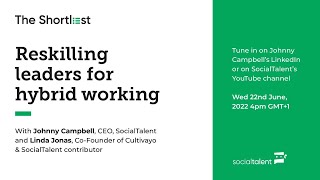
A ~45-minute YouTube podcast episode (host: Johnny Campbell) interviewing Linda Jonas (Cultivao) about reskilling leaders for hybrid work. Linda draws on a decade of remote experience and presents a 'cultivation mindset' — the belief that people are "hardwired for success" — and a 3C model for hybrid leadership: clarity (set expectations), care (support and radical candor), and connection (avoid isolation). She emphasizes intentionality, regular 'check-ins' as a primary tool, cautions against surveillance-style productivity tracking, and advocates co-creating flexible working models and prioritizing self-care. Practical guidance includes shifting from input-focused measures (time at desk) to outputs and designing inclusive communication and meeting practices.
Chapters
Sam.
Welcome to episode 104. That's 104 of the shortlist. My name is Johnny Campbell. I'm your host for the next 45 minutes or so. I'm also the CEO, co founder of Social Talent. And today's show we're going to be talking about reskilling leaders for hybrid working. Yes, this is something we have to focus on. We all know this, we felt it. For the last two years, flexibility has been a constant ask from employees even prior to the pandemic. So when that genie got let out of the bottle, very few people wanted to return to the traditional ways of working. Hybrid and remote granted that elusive kind of work life balance or whatever you want to call it, and gave people a touch of control. They could perform to their best and cannot feel tethered to a desk or a location or a commute. But if Hybrid is here to stay, it's important that leaders are brought up to speed on how best to support this mode of working because things have changed. We called in an expert for today's show and a friend of social talent, Linda Jonas. And Linda is the co founder of Cultivao, a consultancy that works with enterprises and teams around the world to basically help them develop their leadership skills and styles towards this modern hybrid working identifies what are the differences between the old way of leading and the new. And she's contributed to our own social talent platform with her business partner Jason Lawrence, with fantastic content around leadership that we in Social Talent as a leadership team also went through and have been thinking a lot on how we develop our own, our own skills. So in this episode I'm going to ask Linda to discuss with me the importance of reskilling managers for long term success. We're gonna have a look at the role empathy plays in leadership and hopefully some tips on how to support managers. They don't burn out on how to build connection even if you are far away. And Linda, you're far away. Ish from me today I'm in Dublin, you're in Berlin. You're very welcome. I was wondering if you might start by introducing yourself to our audience, maybe explaining a little about how you got here and your own hybrid working journey. So story as well.
Sure thing. Hi Johnny. And hello everyone. Thanks for joining us today. Yes, my name is Linda Jonas and I first started to work remotely in 2011. I was based in Australia, the founder of the company was based in Germany and most of our clients were in the San Francisco Bay area. When I took up my first team in about 2012 there was certainly no guidance on how to manage remote or hybridly and I had to learn the hard way. So I am pleased after spending 10 years in the performance management and feedback space to now have dedicated the last couple of years to helping managers impact their teams, create better environments and help HR to sort of upskill the whole organization to perform better as a whole. And yes, I am, I'm now based in Berlin, but if you hear a funny accent, I am German, I have Polish roots, I studied in the UK, I lived in Australia for 10 years and I have that passport too. And I worked mainly with Americans. So if my accent is all over the place, you know why I love that?
I think that gives you much more credibility. You're not just a one country, one culture person, like you've lived and breathed so many different cultures. And leadership is something that extends cultures. Particularly today when a lot of us manage teams from all over the world. They may actually be all over the world these days as well. I thought we'd start, Linda, by jumping into an article that was published in Fortune recently on this very topic and it was published by Betsy Leatherman and it's called the Pandemic Has Redefined Leadership at Every Level. Meet the New Hybrid Leader. And I thought this was interesting. There's been lots of articles like this, Linda, I'm sure you've read many of them. But in this the author talks about five particular traits that she believes the new hybrid leader needs to have. I'll list them out there. Relatability, authenticity, vision, curiosity and motivation. That they're key. I wonder if you comment on whether you believe they are also the five traits. If there's six, if there's seven, if there's four, if they're similar and then maybe share with me how different are they to perhaps what we would have expected from a leader in a non remote environment three years ago.
Yeah, there's tons of articles and there's tons of great words that you can put around what is sort of needed for hybrid workers, for hybrid management right now. So regarding the article, there's nothing wrong with those words. I also find them maybe not as, as pointy as they could be. And I think that they touch on a lot of important things without calling them out explicitly. So the whole like relatability, that to me is like, oh, are we coming from the same school or something? This, this word doesn't quite gel with me too well. But the content about relatability goes into the authentic human, which is then also the second piece like Authenticity is great, but in there they go into how important it is to be vulnerable. And yes, it is important to show vulnerability and be human, but that is not necessarily authentic for everyone. And yet it is really important to build it in, to foster connection, vision. Of course, big word, always important has been, still is. Curiosity, for me, is more of a tool. They really talk about care in that and the curiosity about the person. And if. I mean, curiosity is great for a lot of things, and if you look at it with the realm of how can we help our individuals get better, then curiosity is important. But I guess curiosity is more the tool rather than. Rather than like what we actually need, which is the care for people and motivation. I mean, that. That sort of went into the realm of you need. If you're motivated as a leader, then your team is automatically motivated. And I think that there is a lot of more mechanisms behind it. So, Joni, there's nothing wrong with those, but I think. I think that there's more how that.
Like, if not those five, you've had time to think of this. You reflect on this. You've worked with teams. What are you. How would you model this? If somebody wants to sit down and have a quick flashcard summary of the things they need to think about, how would you put that together? Is there a quick list? What does it look like in your words and your experience?
Yeah, there is. So the way that Jason and I look at this is fundamentally the right mindset, first of all. And if you're asking about the difference of managing traditionally in hybrid, the difference is obviously in a hybrid or remote work environment, we. We don't see each other as much. There's a lot of shorter touch points with each other. So we need to be way more intentional with what we're doing. And that is sort of the biggest difference. And there are some skills, obviously, as well, that are needed for that. But let me just start with that mindset and let me just ask you, Johnny, have you ever met someone who you believe, who woke up in the morning and thought, boy, I really hope I screw up today. I really hope I disappoint as many people as possible and make a big mess. Have you ever met someone like that?
They don't exist.
Well, I think what does exist is people who then become disgruntled and then they turn into something. But really, at the core, people want to succeed and they want to do their best. And this is sort of what we call the cultivation mindset, is that if you really believe and trust that people want to do the best, then your role as a manager is to give them what they need and to take away the obstacles so that they can become the best version of themselves and, and, and succeed. Because we're hardwired for success. So I think this, this mindset is particular, is always important for any management, be it the, the traditional way, hybrid or remote. But in hybrid and remote, this becomes even more important. And then for that we also have like a 3C model as we call it, like a couple of words to remember easier and to focus on because obviously there's a lot to look at. But what a hybrid leader particularly needs is clarity, is to create clarity. And that is in every sense how we work, how we communicate, what is expected of you, what you expect of me. Because uncertainty kills engagement. And so this is really the one thing that we need to be crystal clear. And when we're at home and we don't see each other, we don't see how other people are working, we need to be crystal clear about as many things as we can. So I think clarity would be one of the things that leaders need to know these days and learn and improve on. The second is care. So in this article, I mean, it's sort of under the curiosity lens and I agree with the fundamentals of the article, but care is a little bit more than the curiosity, right? It's compassion, it's the help and support, it's the radical candor, the right conversations that we have. And it's a lot about the well being and just helping the individual to enjoy, enable the performance to be at their best. So care is the second C of the three Cs and then the third one is connection and connection. And I think this is what the article leads itself to with authenticity and the relatability. But the goal really is to create connection. And connection was already a big issue when we were in the workplace. They're frightening stats when you look at them today. How many people felt disconnected and lonely even when they were in the workplace. And that certainly got worse and enhanced now that we're at home and further away. So how can we build connection and bring people together and avoid isolation? So Those are the three Cs clarity, care and connection.
You add the cultivation mindset, you got a fourth C potentially there, right? I particularly love the cultivation mindset. It's been something that resonated with, with me once we begun the training just over a year ago here in Social Talent and we all went through this program and you know, that idea I relate to it very simply in my head as to you have a flower or you have a plant and as long as it has sunlight and water and it is weeded appropriately, it will grow and it is there to grow. And this idea that we are all there to succeed and grow, that's our natural state, if you like. But it's the lack of sunlight, water and the lack of tending to the weeds that can cause us to lose that and to wither on the vine essentially. And you know, that image really resonated with me and gave me clarity as to that general role of a leader. But I guess what's absent in the three season that and I'd be interested in your thoughts on whether it should be absent, if it's needed at all, are some of the traditional elements like how do you have a high performing culture? And motivation, which was mentioned in the other article, is absent from that. Is your belief then that if you have a cultivation mindset, if you have that clarity, if you have that kind of collaboration and everything else in the team, you have the three Cs in the cultivation mindset. Does the rest just come because there's elements of traditional leadership that aren't necessarily obviously part of those. Call it four Cs.
We could extend the seas way more or we can look at the sea sort of underneath that. But the fundamental belief is yes, if the cult, if we believe that people are hardwired for success and we give them what they need and we remove the obstacles and we give them what they need is the care for the clarity and, and the connection. And we have like the most important tool of a manager is a check in. We check in with the people to see what is missing, what they need, and then can provide and sort of help them. Then there's a lot of intrinsic motivation. There's the self motivating that comes from that. You don't need to be there as a cheerleader on the side to motivate and scream necessarily. But like the motivation then comes. And of course there are other ways to enhance motivation, but I think the clarity as well, the part of clarity is sort of what are you accountable for, what is expected of you. And in that there is a lot of the hard facts of performance. And this is what is expected of you, this is what you expect of us. Are we delivering that or not? This is the whole performance piece. And then I also mentioned radical candor as part of the care piece because it is, you know, to care for someone deeply means that you also should be as radically honest and direct as you can to really help that person grow. And this is not an easy conversation to have. And again, so this is the traditional management. It's not an easy way to have, but it falls under the bucket of care for us.
And that might be where there's weeding needed to be done, where you have to have somebody share with you. This is something you're not strong at or that is a weakness of yours, you know, but it can be improved. It can be worked on. But, you know, not doing that, not caring to be that transparent, leaves that in place. That weed is growing and strangling, perhaps the potential of that person. I'm going to be. I'm going to, if you don't mind and be perhaps a bit cheesy for a minute. And we have a live audience, so if anyone's listening and can empathize with this, tell me, tell me in your comments or if you disagree and you think I'm a crazy fool. And you can also tell me in your comments. But I love movies. I'm a big movie fan. I started my career in a video store. I went to see Top Gun Maverick at the weekend. Have you seen it yet?
I have not. I have seen the original version.
Oh, the original is just so different to this.
Right.
I love the movie.
Right.
But that aside, long story short, one of the big messages I got from it was kind of as a coach or a leader and a student, which is kind of the Top Gun Maverick and the students on this assignment. One of the big messages of the movie was that you need to believe in the person. There's several stories told that belief was really important. And you know, I'm listening to what you're saying about that cultivation mindset and you know, the articles mentioned of motivation because motivational speakers and motivational leadership are everywhere. It's like you got to motivate, you got to be positive.
Right.
And you know, I. We had an employee work of us years ago. They used to talk about this positive mental attitude. You know, PMA will solve everything. And it doesn't. It just doesn't solve everything. That's right. You know, but. But this idea of belief, you know, if somebody has it, they may lack belief. It's almost their natural state would be to achieve, to perform. But they do need someone to believe in them. You know, this was kind of. Maybe it's just me. That's the central message I took from this cheesy Hollywood movie that I really enjoyed. But it, to me, it fits in with that mindset. Which is, you know, I've used the analogy and I don't know whether you'd agree with this of a sports coach, you know, an Olympic sports coach. Let's say that the job of the coach is not to get up there and, and run the race or whatever it is, swim the lengths. The job is, that is, is, is for the coach, first of all, to make sure they have the right person on the team. Right? That's really important. You got to do the selection and make sure you have the right people you can believe in. That's important. But you got to make sure that you just for them to flourish and you fight for them, take the obstacles out of the way, give them what they need, but not to run the race for them. And those Olympians perhaps need motivation. They might need belief, but they don't need motivation. They are self motivated enough to, to go be gold medalists. And that, that version of leadership. Well, first of all, tell me if you think that's crazy or that does align with your motivation mindset, but if it does align, that perhaps is absent or certainly was absent to a large degree before the pandemic, I believe. What do you think?
Well, I think we've been talking about the servant leader for some time now. Empathetic leadership is a new buzzword that comes up. It really depends on the company that you're looking at. I think it became more mainstream that we finally in 2022 realize or you know, over the last two years that these are actual human beings that we have at work and they're not machines. And so those human beings, they actually the well being is important. Like that's a topic that has been become more and more important over the last 10 years. But I think latest with the pandemic hitting, it's like, oh yeah, right. If people then sleep well, if they're, if they're not well, then it doesn't matter how amazing and brilliant they are, they just cannot perform well at all. And so there's something more that we need to look out for here as the whole human. This is great to see that this became mainstream. So this is a nice way that we're going. The sports coach reference has been there for a while as well. Personally, I love it. We're using it as well with Jason for a bunch of things because really this is the idea of not looking at past performance, of not putting someone down and going like, remember last year when you lost that race? Like, oh yeah, that's not the way to motivate people or to bring them forward, but to be forward looking, to help people in the moment with the right nudges to, you know, give them what they need at the time to succeed and to help them achieve that bigger vision, that sort of, you know, winning that race, that tournament, and going towards that common, shared, very clear goal as well. Easier when you're a soccer team and you want to win the championship of what the goal is than necessarily in businesses, always. But. But the analogy there is brilliant. And I think there's some really great sports coaches that have brought out a lot out of. Out of individuals who may even not be the best individuals individually. Right. Like, if you think back a couple of years ago, Iceland in the European Championship in 2016. I don't know whether there are any soccer fans here, but like Iceland drew with Portugal, right? You have a Ronald, whatever, Ronaldo on the one hand, sort of a star player. And then you have a bunch of people from. From Iceland, a lot of them who don't even play professional soccer, but are dentists or whatever. But because of the team spirit and how they work together and, and the fans that supported them and the whole surrounding, they went on to sort of beat England and whatever, like went really, really far, which I think is an incredible story. If we just bring the right people together and help them to perform well with each other, then we can achieve a lot. And sometimes one and one can equal 11 as well. So it's really like, how do we bring whole teams together and help them succeed? And this is kind of what we're trying to do at work, or should be trying to do at work too.
I guess the inverse is correct as well, that you can bring a bunch of superstars together. And again, not. I'm not a big fan of soccer. I know very little about soccer. But from my friends and colleagues who do support soccer, many of the big, certainly the big English teams and even some of the big Spanish teams have brought together the best players. And it hasn't worked. You know, whether it's a lack of probably his lack of leadership or I'm poor selection that a bunch of superstars, 11 superstars doesn't beat, you know, on paper they should. They don't beat everybody because that gelling doesn't happen and the coach or leader is so important to that. I want to go into another topic, if you don't mind. And then it kind of stretches into another article that was published this month in Harvard Business Review around this topic, and it's an article by Gabriella Mauk on How can you build visibility into a hybrid workplace? And I guess what this article is really all about, our piece of research is around measurement. And that's a big question that came up for debate in the last two years. Maybe it's still being debated. Linda, I remember very early in the pandemic, an advisor of ours coming to me and saying, johnny, we need to build, you know, measurement software. It's going to be huge. You know, you can track what people are doing on their browsers, how many, what time they logged in and logged off, how many keystrokes they took. You know, performance management is going to be huge in this way. It's like, oh, no, this is like Orwellian, you know, 1984 kind of stuff, you know, or Terry Gilliams. Brazil is like, no, I don't want this world. But managers, traditional managers, let's say managers, who weren't born into this hybrid world, they have been wondering how they measure performance. Like, I talk to people in Ireland in particular, and I hate to say it about my own country, but the Irish leadership, most Irish leaders I speak to are just way behind on this. They tell me, you can't really manage people if they're all remote, Johnny. You know, it just doesn't work. You know, I hear you. Maybe you've made it work or you think you have in your company, but, you know, big companies don't do it. I'm going, well, we work for companies with 200,000 employees and they're making it work. And you don't know what you're talking about. But there's this fear and this kind of I have to see, I have to have something to look at. And this article is trying to address how much do you do? How much do you actually have to have and what does that look like? So I'd love to maybe get your thoughts on the article, but more importantly, the bigger context of visibility on whether it's inputs or outputs or your thoughts are in this kind of hybrid model.
Yeah, it's. It's funny really, that when we think someone is dedicating their time and spending eight hours putting their bum in that seat and just looking at a monitor, that, that is performance. But if we don't see them, then that is the absence of performance. Where, where to start there, what fundamentally is broken is that we inherited the management model and management model that is very, very old, that is coming from the 1920s, 30s, where work was very different, the work environment was different, where we really tried to turn humans into how Gary Hamill Calls it like semi predictable robots. So the whole of management is there to turn humans into machines. And then now, you know, fast forward and a lot of the jobs that we're doing, and granted not in all of them, but in many of the cognitive jobs that we're doing, what we're trying to get out is like what makes us human is what makes us particularly good at work. But we're still using the same mechanisms that we use there. The eight hour shift, for instance. Right? Eight hours a day. That is because a day a factory had three shifts, 24 hours split into eight hours. Those eight hours are completely arbitrary. And that is something that has been bugging me for the past decade. That we still think that this should be the norm and we're not questioning it. We're finally now we got to a point where like, oh, maybe, maybe the time isn't the only thing that, that we're measuring and maybe the eight hours aren't right. But so the, the traditional model is broken on how we look at performance. And in, in the US it's also called compensation. We're compensating people for the time that they're away doing other fun things to owning them at work. This is not working. So I would say a lot of the things have been broken before, but we were used to it. We were used to just trotting into the office and sitting there. I'd see sometimes people just hang out in front of their laptop just to be in a little bit longer and then it looks like, oh, that person is staying really long every day or whatever. And we perceive that this is performance. What is exciting about today is that we get to look at what is it actually that we want to achieve together and how can we best achieve that and how can we get the best work done? So coming back to the article or coming back to your point about the visibility of like looking at someone's desk, like, no, when did we ever think that was okay to just spy on people and just say like, oh, if you're sitting there, then you're working or tracking the monitor. Where's the trust there? If you're not extending the trust to me and if you're controlling and monitoring me, then guess what, you're not getting my best self there. And, and it doesn't feel quite right and good to me. And, and already like we're, we're in a very different relationship. Like work as a contract. I give you this, you give me that, and that's where it ends to, to where, where we where humans thrive and that is like we'll work as a relationship where we work together. So I think there's a lot of software and technical advances that are super helpful. For instance, scheduling meetings. Right. If you have an international team in different countries, when is the best time to meet or when someone is available. Like there's amazing tech that when they look at all of our individual systems they can help us find gaps and not just in the right direction, but a lot of the other work. Visibility I would argue is much better done by speaking, by having a relationship. I don't need a tool or why would I need a tool to help me tell that someone's daily schedule has changed when I can have a meaningful relationship with that person and know that whatever the childcare system has changed and now they're not working from 8:30 but 9:30 in the morning. Like I don't need a system to prompt me to show me like there's something going on. I need to know what my team is up up to and speak with them and what works best. So yeah, I'm not a big fan of tech that is helping to make the work visibility for insights. I think that can be done in a very different way. Yeah.
There's a point in this HBO article or actually there's a diagram and if I was recommending to our readers skip to the diagram. Right. It's kind of a, it's a three by three, it's a four by four. But it basically maps out three areas. Informed, engaged and empowered. Measuring trust and across the matrix of transparency, access and action. And this part of the article did interest me because I can just give you an example on transparency. It contrasts an informed approach which they say is the baseline to trust. Employees will be made aware via written communication of what data is and isn't collected. Okay. But then they have engaged transparency which is data is anonymized, aggregated and shared with employees. Baselines and goals are set across the organization to empower the highest level of trust. Leaders provide recurring updates to the organization sharing the relevant data progress against goals and upcoming actions. I know it's kind of, it's an interesting way to look at it to go. You know I looked at that one. Oh yeah. Because there's an argument in the article about some data could be really valuable. It could give insights which could help the care element, let's say to pick one see out with. With your employees. But it could of course be used for harm. But I love that idea. Well actually if you anonymize it, aggregate it and you're looking at patterns. They can give insights that actually can really help everybody. And so there's a way that data can be used for positive good if you like, you know, rather than saying all data collection on your inputs is irrelevant. I think there is something there. I'm guessing there's something there. What do you think?
No, of course, of course. Again, like the advancements of technology are amazing and it's crazy to see what the HR tech market is working on as well in terms of people analytics and the predictions that they can make and sort of the areas that they can highlight or network analysis. Right. Who's working with whom, where are silos? There is a lot of data that is very helpful. And what I like here as well, it's a this table but also right at the top it sort of calls out like to look at individuals, do you need universal flexibility, variable flexibility, case by case flexibility, fluid flexibility, like where do you stand? So I think, I think there is a lot. This is a very worthwhile article to read by the way. This is good and there's a lot of data that can do well, but for some of it, like I'm just worried about it being a gimmick or us relying too much on, on the systems as well. And one of the examples was like oh, you can, you can then learn when your employee sort of changes the work habits because the tool can tell you and you don't need to wait for your next one on one. I was like, well that may not be the best example of why data is, is needed and what a system should be telling you. But for sure it's incredible the data that is there and the access that it can give to, to all of us to work better. Looking forward to seeing what else comes there.
I'd agree. And for those of you listening to the podcast, you can find links to the articles we've shared so far in the footnotes. Whether it's on Apple, Spotify, wherever you listen to your podcast and those listening live, you can see it in the chat on YouTube and LinkedIn. And we've got a question come in. That's come in a comment slash question for you Linda, from David Fitzgerald who's listening live on LinkedIn is the issue to train managers and he's put that in capital letters and to help the employees adapt to output based management over time. Over time based some reprogramming needed on all sides. So I guess the thing rather than being a thing about developing leaders, I think David's point is, do we not have to do both? It's both the leader who needs to develop and also her employees. What are your thoughts there?
Yes, both need to develop, but it starts with the clear expectations. And, and if we say we're looking for time and this is what we want from you, then you will get the time. And if you're looking for output based results, then this is sort of what we're talking about. So I think it comes from training the managers to look at the right clarity, to set at the right expectations and then for the employees to adapt to that. Because, you know, I mean I, you know, we all maybe had that moment where we think like, oh, we're so busy so we must be so productive. But really it isn't, it isn't necessarily about the time that we put in, but we can't take the time out completely either. It's not just the output. You know, one example is always like a travel agent in 2020 could have done whatever they wanted to sell trips. It was just not possible to reach their targets and their goals. But they might have tried something. It's not the time that they put in, but maybe the creativity, maybe the learning, maybe the other thing that they have done. So I think it's not just the output as well that we create, but how did we get there? Was it ethical? Did we learn something? Did we, you know, not just the what, but also the how that we need to look at. And absolutely, it is tough. It is not easy to measure performance by any stretch of imagination and it certainly didn't, didn't get easier.
Now culture is really important in this, Linda. It's a common kind of thing that's popped up recently as a lot of companies went back to the office, if not full time, maybe only two, three days a week. There's been this issue that's popped up in several articles. I'm sure you've come across it yourself or heard it or experienced it, where employees are looking at the policies which says you can work from home x days a week, it's no problem at all. But they see leaders, particularly senior leaders, going back into the office much more, maybe four or five days a week. And there's that cultural pressure then to turn up this fear that my boss is in the office more than I am, even though I technically don't have to be. You know, she's in there and you know, my, I heard my other colleagues going in four days a week now as well. I'm still doing too. What if for that next promotion, I don't get considered because she's going in and she's seen, you know, talk to me about culture and its role and this kind of issue that's kind of coming up more and more again at the moment.
Yeah, Number one, obviously culture is super important and there's different cultures. In some cultures. This is what we're doing, so you better follow. What I'm doing might be the culture or it is explicit. This is what I'm doing because this is what I need to do to do my things best and this is my preference of coming in. But you have the freedom to do whatever you want to do and there is no repercussions. So I think, I think, you know, the cultures obviously vary, but. But you bring up a really important point and that this is how really the presenteeism, I think it's called, right? Like, are people who are seen to be working? Are they. Are they. Then do they have an advantage for career development? For do they. Do they seem to be. To be. Do they seem to be seen as more productive? Do we give them more information, share more information with them? Right. Like some people go to the office because they fear that they're missing out. But again, this is. This is the fundamental. That isn't quite there. There isn't the clarity of how do we communicate, what information is shared, where and how. It shouldn't be accidental. Because I'm in the office, I pick up that this project is coming up or I pick up something else. This is the rethinking and the reskilling and the retraining and the rearranging, how we work to put those mechanisms in place, that it doesn't matter whether you're in or not, that you know what's happening, that we know whether you're achieving the things that you need to achieve, that we know whether you're ready for the next career move or not, and that we know what you need to do to actually get to the next point or not and not just go and whatever and be seen in the office. So is that a cultural change? Probably. We need to be way more intentional about including everyone.
There was a quote at the beginning of our first article that I really liked. I'm going to read it again. That absent a guidebook, most resorted to freestyling. This is managers with varying degrees of effectiveness. Managers eager to master this new work from home world were driven to work faster, increase efficiency, and strive for something better. It didn't work. So if that's true, that you know, at the start of this, we didn't have a guidebook and we're all just thrown at it, which maybe is true. What's your sense of the amount of companies, percentage of companies, organizations that are deliberately upskilling, retraining their leaders, looking at these issues, you know, enabling employees? If David Fitzgerald's comment, you know, is taken on boards, just, just really actually actively doing something to try and improve everyone's skills, to change the processes are, versus the companies who are just going, can we just let it go back to what it was? You know, are we waiting for it to go back to what it was? Because we still want to deal with this.
I don't know any statistics and impossible for me, for me to guess there what, what that is. But you, you hear of some famous examples of companies who are like, no, that's it, you know, we had our fun, now we're back to work as if we weren't doing anything in the last two years before and that hurts. And, and, and no one wants to hear that, that, you know, while we were struggling and working so hard, we didn't actually achieve anything and we had this taste of flexibility and now you're telling us to come back. So yeah, those aside, I think a lot of companies are working on it and are trying to create new structures, but a lot of it is still coming from like the structural point of like, okay, we get it, you want flexibility. So now we do three days and two days or something and this is not helpful. This is now the new five day rule, is now a three day rule or whatever. We really need to go back to the drawing board and see like how does everyone's work get done best? What does that mean for, for the time like I hated it when, when we had a bunch of phone calls but not enough phone booths in the office. And, and, and really like you were always struggling to sort of find, find a spot to take your phone call. It is so much easier and better to work from. Do we need a pandemic to show us that or could we have learned that earlier that really if we. Thank you. If we need to take a phone call, we need the space and that might be better in a different environment. So I think it's a lot of relearning of what is the job at hand that we need to get done. How can we enable people to do that best? What is the personal preference and style and how can we support people? And that's, it's, it's not easy. But I mean the only way is just to try and learn and experiment and sort of look at the individual roles and not try and put like overarching new systems for people that limit them in another way and, and have those conversations and co create with people. Just sit down, co create, experiment and, and see what's, what's working. Yeah.
You referenced earlier, Gary Hamill in a quote around, you know, how we spent maybe hundreds of years trying to mechanize people and you know, adapted this, you know, factory approach of three shifts of eight, and we've tried to just impose that in the world and how we woke up to the fact that we're all people. Has that awakening perhaps made or given us the fertile soil? If I'm going to borrow your cultivation analogy for a second, then has it given us the fertile soil to actually be much more inclusive by default that we don't actually. Maybe if we are genuinely leading in this way, we don't have to remember to be inclusive or have a separate inclusivity drive that being people first focused is naturally inclusive. Is that something you'd share the opinion on? Is it different? What are your thoughts around that inclusivity and leadership going forward from this kind of hybrid perspective?
I think the silver lining of those really tough last couple of years, to varying degrees, tough for different people, the silver lining is that, yes, we have the opportunity of now rethinking how we create work and how we make that work from, for everyone at that workplace and create working models that actually work for what it is that we want to achieve while sort of also allowing the human beings to have a life next to it. So absolutely, this is the fertile ground. And I think that's why it is such an exciting time to be in HR right now as well, and why a lot of companies are playing with this sort of new opportunity to reshape how we work. And there's, there's so much to tackle and there's so much to rethink that we're just now realizing on how broken it was meetings were broken, how many useless meetings that we have in offices just because we're here. Oh, let's, let's go and meet without kind of thinking, why do we need to meet? Could we do it in a more efficient, effective other way? Right, like that or whatever. Like we had so many, so many things were happening or working by accident in the office that now we realized no, to really set them up and to really make it work for everyone, we need a different system. Like, was a meeting inclusive when some person was always quiet in the back. No, it wasn't. Is it now inclusive when we have, like, remote meetings when everyone is. Is there and we're not asking everyone to partake? No, it's not. Hybrid meetings, even harder. So we just need to. And we learned now that we need to be way more intentional with how we set up communication channels, meetings, set expectations, create our boundaries, what sort of rituals are important to us, what protocols we need. This is really giving us a chance to sort of start from the drawing board and say, if we want to achieve a need, this, how do we get there? And what are, what are the things that we need to put in place and explicitly design to make it work? So, yeah, I think, I think it's a massive silver lining and I'm, I'm grateful for that in a way.
There's one word that I want to probably remember from today's conversation, I encourage others. Is that intentionality. Right. That, that, that is probably the biggest difference in my opinion between pre pandemic and post pandemic leadership. Whether you're a hybrid or not is intentionality. You put on different things and there's different models. You know, you mentioned three Cs and the cultivation mindset. There's five things in that Fortune article, and lots of you have different models. But I think intentionality, Intentionality is. Is common across all of them. It won't happen by accident anymore. If it ever happens by accident. You have to be intentional. You've shared so much with us. And for those of you who are social talent customers on the, on the podcast here today, you can check out Linda's training content by just checking out your library. Look up our authors and find Linda Jonas and tell us what you think. I know, it's fantastic. It's helped us massively programs in there. But perhaps for those who can't access you, can you leave us with one last tip for our shortlist, our 104th piece of advice that perhaps has been given to you during your career by others. Or it's perhaps something you've learned yourself and want to share with our audience here today.
I wanted to share something different, but now how this conversation went. There's. There's one thing that I would love to share as an advice. No problem. I can do too.
Of course you can do anything you want then.
Because coming back to your summary, yes, it is. It is the intentionality with a hybrid word. It is the clarity. And there's one tool that I briefly mentioned earlier that is the best way that we can Sort of enforce the three Cs as well, or not enforce but like live the three Cs and support the three Cs and this is one thing that we've been doing earlier in traditional work as well, but that is even more important in a hybrid work environment and that is the check in to regularly dedicatedly check in with people. So this is, this is sort of one hint that I would have for everyone is to really just check in with folks on a personal level how they are. Because when we're working remote we don't, we don't know how someone shows up, we don't know where they come from, what happened before in their day, where they're standing and, and we don't see the body language in the office or we don't see any of the physical cues that we used to see. So we need to be way more intentional with the check in. So this is something to build into all of your meetings and cadences and with your people. And then the other thing from experience, selfishly I'll share, not selfishly at all from experience I'll share with everyone is to look at self care, to really prioritize self care and look at yourself. Remember those days when we're sort of on planes all the time going to quite conferences. I think I met you in Paris at some conference right in the beginning of the plane of, of, of the, the stewardesses would always like do the safety instructions and share that you need to put your own oxygen mask on before you help others. And I think this is not only important when it comes to some emergency on a plane, but really we should be ready with our own oxygen mask and we should look after ourselves and help ourselves to feel good, to bring the body and brain which is our most important tool that we bring to work to keep that as well as we can and to be there particularly as leaders and managers, to be the best version of ourselves to then be able to help others as well. So prioritizing self care is something that I unfortunately have seen over the last two years. Many people not take too seriously because they had so many other priorities, so many other people to look out for. But really if we don't focus on ourselves, it's not sustainable to just help others. So prioritizing self care.
I love that Linda. Can't thank you enough for sharing your wisdom and insight. Today's wonderful conversation I thoroughly enjoyed as have many of our audience and surely our good friend as well. Just saying she's so thankful for your sage advice. Linda, if folks on the podcast want to know more about your work, want to engage you, work with you and your colleagues, where can they find out more about you or how can they connect with you?
LinkedIn is the best way to connect with me. For instance, Linda Jonas or Cultivao.com is the website that Jason and I have. And for anyone who is on the social talent platform, I'd love if you'd dive into the content that we have there and gave us some feedback on that too.
Linda, thanks so much. Really great having you. Let's have you on again soon. Take care.
Thank you Johnny and thank you all.
For listening and joining us for episode 104. If you'd enjoyed that, let's come back next week. We want to hear from you next week on Wednesday. We usually drop our podcast on Wednesday evenings. On Thursday, Podcast Apple or wherever you find your podcast or we broadcast live at 11:00am Eastern, 8:00am west coast U.S. and that's 4:00pm UK and Ireland here in Europe. We'll be back next Wednesday, 29th of June, where we'll be joined by Annie Bonetta. Annie is a senior consultant at Recruiting Toolbox. She's also a contributor to Social Talent Platform where she's going to be talking to us about reducing bias in the hiring process. Annie has a wealth of experience as a talent acquisition leader and professional in this space and she works with some of the biggest companies in the world to try and help them reduce bias in the hiring process. And we use her techniques and that those of our colleagues in Recruiting Toolbox here in Social Talent and she's going to come and join us next week to share some of those with you. So if you want to reduce bias in your hiring process, only place you've got to be is with earphones in next Wednesday 29th of June or soon after that for your latest episode of the Shortlist. Until then, thanks for listening. We'll talk to you next week.
More from Johnny


Where Does Your Hiring Stand? Diagnose It with the Maturity Model | SocialTalent

Where Does Your Hiring Stand? Diagnose It with the Maturity Model | SocialTalent






NEW CONTENT - How to use Generative AI for Recruitment Marketing with Glen Cathey | SocialTalent

NEW CONTENT - How to Use Generative AI for Sourcing & Recruiting with Glen Cathey | SocialTalent

NEW CONTENT - How to Unlock the Power of Generative AI with Glen Cathey | SocialTalent