Rethinking the Role of TA: Moving Beyond Recruitment | with Anne Carrigan
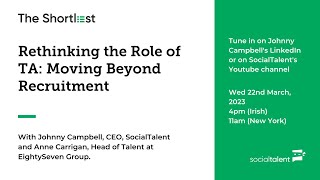
Transcript of a SocialTalent 'Shortlist' podcast episode (Ep.135) hosted by Johnny Campbell with guest Anne Carrigan (Head of Talent, 87 Group). The conversation argues that talent acquisition (TA) must evolve beyond transactional recruiting toward a broader talent function—covering internal mobility, talent development/L&D, talent mapping and strategic advisory (talent business partner role)—to make organisations more resilient during volatile markets. The episode includes practical examples, scaling challenges, and advice for TA leaders and individual recruiters.
Chapters
Sam, You're very welcome to episode 135 of the Shortlist. I'm Johnny Campbell, I'm going to be your host for the next 40, 45 minutes. I'm also CEO and co founder of Social Social Talent. And on today's show we're going to be digging into rethinking the role of ta. Moving beyond recruiting. It's a topic that we've touched on several times before and surprise, surprise, it's going to be a topic we come back to as it's very topical right now. We're seeing a lot of change in this space. We're seeing a lot of movement on from, you know, organizations that just siloed things like talent acquisition on its own as a solution to a more joined up approach to talent acquisition to deal with the skill shortages crisis. We have the ever changing economic environment, lots of changes there. To dig into today's topic, I'm really, really excited to welcome somebody who's very outspoken, doesn't hold back, gives her opinion even if you don't want to hear it, but you're going to want to hear it. I'm delighted to welcome Anne Carrigan. Anne is the head of talent at 87 Group. She's worked in some of the biggest organizations in the world from her home in England and across different geographies and time zones with telecoms in, in the BBC in industry, pretty much you, you name the industry, Anne's worked in it. Initially from a talent acquisition role like myself, from a recruiting agency background, initially moving into in house, moving from a recruiting role into a much wider talent role. Ann has seen a lot in her different roles, her different industries. We're not going to ask Ann the secrets that she can't reveal publicly on a podcast today, we are going to ask her opinion. And you're very welcome to the show. Perhaps you can introduce yourself, explain why you love interim, why that's your passion and what you think you're, what you know, your expertise is.
Thanks, Johnny. And yeah, I am quite outspoken. Most people that have probably met me in the past would say that as well. So I'll just caveat everything with everything's my opinion, right. And you know, I love a good debate, I love a good conversation, but just to give you a little snippet of my background, I hate to actually count the years. It's probably 25, 30 plus years now in talent. You're absolutely right. Started in agency, which many, many people in TA did. So I did the usual route of the high street agencies moved into it recruiting. If anybody remembers the Y2K crisis that was happening, all our laptops were going to crash at the year 2000 and then really sort of moved in house probably about 15, 20 years ago. And I've just found my passion. You know, I absolutely love talent, Talent acquisition, broader talent, talent management. I think you mentioned, Johnny, about interim. I love interim because I think you can make a real impact really quickly. I think you have less of that needing to embed into an organization. And usually people hire an interim because they need a quick fix or they need something to hit the ground running and they're not quite sure where they should really be focused. So actually an interim brings a big bag of tricks to play. Just from a sort of personal perspective. Like I said, I've always loved talent and I think over the last few years I've seen a real shift, particularly in talent acquisition, hence why we're talking. Johnny and I know that we've been trying to talk for quite a bit a few years, but I have seen a real shift and hopefully we can just dig into that a little bit today from a personal perspective. I'm a big extreme sport fan. No surprise there. I love riding my motorbike, but when I'm not doing that, I'm probably, you know, weeding my garden and growing vegetables.
I cannot think of two more contradictory past times, but I love those contradictions. So. And from a background in, we used to call it resourcing, recruiting. Talent acquisition has many names. Right. But for the most part, right, the industry, the job was go hire folks who are not working for an organization to come into an organization, attract them, assess them, negotiate their terms, bring them in, move on to the next role. Why do you think that very established model that's been around for two decades has begun to change? What are the drivers of it? Because it has begun to change. We see this in A lot of our peers in the industry have done what you have done, which is to step away from a pure siloed recruiting role into a much broader talent role. But you might actually also define that, like for listeners going, what do you mean? Like talent, talent acquisition, what's the difference? Maybe you might explain what this broader talent role is and maybe give me your opinion as to why the change has happened in the last few years.
Yeah, so I think there's a number of reasons. Firstly, why it's happened and I think short term, I think you can go back to, you know, pandemic. My pandemic really changed people's idea of work and what they wanted, you know, we saw that massive, you know, everybody was working remotely. And I also think it gave people a bit of an opportunity to stop and reflect on what they wanted in life. Right? People wanted more of a work life balance. Maybe they were going to take the opportunity to pursue a different career. It really gave people time to stop and reflect. I think more recently you're seeing big economic changes, right? You're seeing people talk about a looming recession. And I think, you know, you've seen it on LinkedIn, you know, how many tech recruiters are suddenly out on the market. And I think the shift for me has come where in a buoyant market and when business is booming and people are in growth mode, talent acquisition on its own, which is what you said, the recruiting, the go to market is critical. But when it's not boom time, businesses often don't see talent acquisition as a strategic function. They see it as a transactional function. I need to grow, I need to go and get that talent boom time. You're a critical team boom time. When it's not boom time, suddenly you don't become that critical team. So when I talk broadly about talent, it's not just about the go to market strategy, it's about how do we retain the great talent we've already got in an organization. How do we connect what we're looking for? Because we're still maybe hiring, but just not at that volume anymore. How do we connect that with our internal talent and see, is there some growth opportunities for that internal talent? And actually, should we be looking at different types of talent streams? I think when the market's quite volatile and it was quite uncertain the way it is today, it's not always about, let's just get that job description, which is a list of things that Bob used to do before we left, right? And we'll go and find that. Actually, from a talent, you know, point of view, I think we need to start helping educate our business around, well, how do you get that talent? You know, do you get that talent internally? Do we develop that skill internally? Do we look at contractor market? Do we look at the interim market? Do we look at bringing in graduates? You know, so actually it's less around taking that job intake and saying, oh, I've got to rush to market. But it's having that broader conversation to say, well, where is that talent? And that's where I'd like to see talent acquisition start to play. Then you do become more critical to an organization when it's downtime. And because you play a key role in how do you retain and develop staff as well. And I'm not saying you become trainers, but it's about how do you connect across the organization.
So six, seven years ago, I first got introduced this idea by a fantastic talent leader called Jen Carpenter, who was with Accenture at the time. She's now with IBM. I heard her speak to this topic and what they were doing at Accenture I thought was really interesting. I dug into it and started finding more customers of ours that were beginning to move into this. But after about a year or two, I realized at the time anyway, a lot of what they were doing was putting the teams together. So talent acquisition, L and D, maybe dni, leadership development, td under the one group, but they still technically were working in silos, right? They still, eventually there was a hiring plan. And I often talk about the hiring plan, which is the kind of thing that most organizations large and small use as an annual process. What's our growth, where are we going with our strategy? How many, what different roles will we need? A bit of a calculation hopefully around attrition levels and so on, so forth. They come up with a plan. They're the kind of roles we need. They're the kind of numbers and about 50%, that's correct. 50% of it's nonsense. And the company never knows which, which half is nonsense. And they give that to talent acquisition team and say build a plan around acquiring that talent. So I'm assuming that's not how you do it in a joined up talent approach. So if not, what is the right approach and how easy is it to do that on scale in a big organization?
Well, I'll give you a really good example. A few years ago I was working with a CEO and a big global organization. And you know, whether I'm leading a team or not, I'm often still very hands on. And I still recruit, particularly at the very senior end. I would still, you know, actively recruit. And I remember getting a phone call from him one day to say, can you come and talk to me about this role I'm trying to fill now? He gave me 30 minutes and you know, usually I'm like, you want a bit more time than that to really dig under what it is you're looking for. But you know, I, I went to the meeting, but three hours later we were still having a conversation. And because that conversation broadened his thinking around actually, do I want that role? So I get your point, which is around the recruiting element, but unless you can start to change the conversation. And what I did with that individual was really start to uncover what was he trying to achieve in his organization, what was it he was trying to achieve. And actually by the time we got to the end of that conversation, it was quite clear that there was some capability gaps and hence why he was trying to hire. Now what he hadn't had was a conversation with anybody about how do you plug those capability gaps. So it was an easy exercise for me, and I'm not saying that was me, but. But to bring in the relevant experience to help have those conversations around. Well, actually we're trying to plug some gaps here. We actually don't need to recruit. Now as a recruiter, you're probably cutting your nose off despite your face, because I'm saying actually you don't need to recruit. What you need to do is think about your organizational shape and the skills that you've got and what's missing and then how as a talent development function, we can support you to build those skills. And it was quite clear what came out of that was a whole OD piece of work, wasn't recruiting at all. Now, like I said, three hours later, we were still having that conversation. And nobody had had that conversation with him previously. What they had done was say thank you, I'll take that job description and here's a big list of things that you want and I'll go to market. But that left about another 25 people in his team that were still short on capabilities and that was completely siloed. So you're absolutely right. There's bringing a lot of teams together. But it's. I think people talk about TA having a seat at the table. Actually, I think TA is sitting in the middle of the table because they're the people that can start to have those conversations and draw in the other expertise from around the HR or people function.
I have a couple of comments and questions read out here. AD Sharma is listening and saying we need to start thinking of human sustainability as we are for all, focusing on environmental sustainability. And I totally agree with that. In fact, it's the topic of our next show. But Jennifer Sullivan has a question for you. She's curious an what questions you asked during that three hour conversation. Maybe a summary or theme to your approach. I think that'd be really good insight to share with our audience.
Yeah, I think the first thing is understanding what they were trying to achieve. So what's the sort of it doesn't need to be the corporate vision, but it needs to be that business divisions, you know, strategy Their vision, what is it that they're trying to achieve? I think there's also a number of really easy steps that you can go through unless you understand that regardless of whether you're going to market or you're looking internally, you're just taking a list of requirements. So really understand what it is that they're trying to do. Is it about growth, is it about new markets, is it about new skills? So it's asking some questions around what they're trying to achieve. I think the next bit is around the capability within the team. So why aren't we filling that role internally? And if it's a huge gap, why have we got that gap? Why are we not trying to develop the internal skills to be able to feed into that pipeline? I think the other thing is about, you know, what is the team saying today? So there was a lot of questions around what makes somebody great? What makes somebody really successful in that team? That's not a list of requirements. A lot of that is around behavior. So what are you looking for and can we help you develop those? So there was a lot of questions, but it absolutely started with vision, strategy, shape of the organization, what they were trying to achieve, where the gaps were, how we were going to plug those gaps. You know, I've had similar conversations since where the right answer is we go to market, but we go to market at the same time that we then connect with our learning team or our talent development team to say there's a gap here, right? There's a gap because we're going to have to keep going to market because they're two years or three years out from being ready to move into that role. So hopefully that sort of gives you a bit of an idea of the type of questions.
Well, hopefully that's good answer for Jennifer. Thanks for the great question. I get that approach and I think as, as experienced recruiters, you know, count myself and yourself, hopefully everyone else listening, you know, you become very good at asking questions. That's the job, right? We say what's the job of a, of a great recruiter? Is they ask great questions. It causes me problems because I get into taxis and I end up stuck listening to big long stories because I ask lots of questions, right? It's what to. But how do you scale that though? Because you going into a conversation with a senior level executive and you're a senior person, you have seen that perspective, that's one thing. But what if there's 150 recruiters and you've got hundreds, if not thousands of Hiring managers with thousands of roles, how do you scale that so that. Because if everyone has that question and pushes like you pushed, which you're right to push, you end up maybe having a very different approach and you end up having a team that kind of can't do anything with that information. It's all very well to understand. Here's how you solve it. You need skills, but if they're only tasked with recruiting, how do you connect the dots?
So I think it's really interesting. So if you look at the broader, let's call it HR function, people function, there's so many different elements of that function and often one of the first things that I do when I go into an organization is spend time with the HR director or the HR business partner. And I'm always surprised how few have what I call a talent map. So you have really mapped out the shape of the organization and you're absolutely right, Johnny. Going back to your point, what they say is here's a forecast of 50, 100 roles that we want to recruit this year, but what they've not done is connect that. And I think there's a really easy four step process which is the old build, buy, borrow and bounce. Right? So are we building the team? And if we are building the team, how, how are we building that team? Right. That's really simple. If we then say, well actually we're going to go and buy that skill, there's a really easy connection with talent development. That doesn't mean the recruiter has to do it. There's an easy connection with talent development to say, look, we need to build this skill in the organization. The long term vision is that they want to have X amount of whatever and we just don't have that capability. The other bit for me is, and I mentioned it earlier, is around the borrow. Because often a hiring manager has a need at that point in time. That doesn't mean it's a long term job role. Right? It might mean actually I just need somebody to do this project for me. And that's around then connecting with your HR business partner to say, is there anybody that's looking for internal mobility? Is there anybody looking for a stretch role that might want to move into that opportunity? And then going back to my other example, it's not just about capability. Sometimes it's around poor performance, right? And managers don't want to deal with the poor performance so they just keep hiring above it. And again, I think for recruiters that's a really easy conversation. It's to say to A manager, are you building? And if we are building, how are we going to build it? And let's get all the expertise in. If we're going to go and buy the skill, absolutely fine, we can go to market and this is our strategy around that. But actually is this a long term role or is this a short term piece of work? So I don't think it's a difficult conversation when you try to scale it. It's just about bringing some rigor to those conversations that everybody starts to get into that rhythm of having similar conversations.
Question back from AD Sharma, who's listening live? And when we think of building capabilities, do you think companies L and D teams or talent management teams should proactively work on building capabilities? Some of the major corporate firms also don't have a plan around this and Jennifer Sullivan backing that up saying, totally agree. A lot of time organizations don't have the capabilities at what's missing within the various teams. So how would you respond to that question around, do you think companies L and D teams or talent management team should proactively work on building capabilities?
100%. 100%. So you know, I come back to the economic, you know, situation and when it's a bit volatile, when it's a bit uncertain, it's not about externally recruiting. Often it's around how do we retain talent. Right. And a lot of that is around personal development, skills development. Now you know you're going to ride out a recession. We always do, you know, and unfortunately a lot of organizations that do the start stop will then just rush to market again to try and hire. But actually if you've got an L and D team or a talent development team that can spot the gaps, spot the gaps a year out, two years out, three years out and think about what interventions they need to put in place to support those gaps. You know, regardless of whether there's a role at the end of it, you're going to retain your staff, right? Because you're investing time to develop those skills. It's really interesting. I've worked with an organization, big global organization, and I, I met with them a couple of months ago and I heard a really frightening statement. And their L and D team tell TA they're not allowed to poach their staff. That's the same organization. The same organization is so siloed that the L and D team and the talent development team believe that TA are poaching staff when they look internally. And we've got to switch that on the head. You know, our best talent is already in our organization, we retain talent that's already in our organization. Not by just leaving them, by developing them, giving them opportunities, giving them growth opportunities. So there's a fundamental role that L&D, TD, whatever you want to call it, have to play in this. But I think that's where TA and TD play really closely together. Because if you've got a talent development team that are developing people, whether it be technical skills or professional competencies that don't match the conversations that TA are having around growth, there's such a massive disconnect. So they have to work really, really close together.
We had asked, because we're a skills platform, right? We train and educate people and people ask me about upcoming skills, where the skills going in recruiting. And it's an obvious question. I tire of it because, you know, when I look at the skills, you know, the skills haven't changed that much in recruiting. It's about the fundamental structure of recruiting that I think is the opportunity and an idea that we've been playing around with and talking to people about. I'd love to get your opinion on it. And I haven't, haven't teed you up in this answer. God knows what. God knows what answer.
God knows what I'm going to say.
I look at the HRBP model that's emerged over the last two decades, right, where we've tried to devolve centralized HR back into the business, back into the leaders, but then given support with the HRPP so that the leaders can be more empowered to do their HR work. But we have someone who's an expert to try and support them. And I look at a role less of a talent acquisition advisor, which we've moved to this TA advisor role in the recruiting team. To me that hasn't gone far enough. I see more of a role for a talent business partner. So not doing your HR policies and your performance management, your compensation, but who is, who's not particularly skilled at just, you know, just recruiting or a talent developer, L and D. But their, their job is to understand all of those elements and they will be the person that goes into that meeting you mentioned with the CEO and go, hi, I'm your talent business partner. Talk to me about your problem. And I am empowered to go to whatever colleague which might be a development colleague, it might be ld, it might be somebody in recruiting. I'll be your conduit, but we'll work together on the solution and then we'll figure out which, which part of the organization needs to help us. Do you one do you agree that that could be a thing. Have you seen it anywhere working? Why does it not exist more? If you agree, why doesn't it exist more than it does today?
So I think it's really interesting. I think it's part of the challenge that you've seen in the market. So TA have always played a role, unfortunately that sort of sat behind a business partner, which I've always found really quite odd. You know, the. The business partner with the greatest of respect have a role to do. But they are not the talent Expert. And I 100% agree with you. I think the talent person is the critical person in an organization going forward. I think often HR BPs get sucked into operational stuff, right? So they're on a day to day basis. There's people problems that they have to deal with. I would love to see TA really elevate themselves to be talent advisors or like you said, the talent business partners. Now I've seen IT operate in different guises in different organizations where it's worked really well. You're absolutely right. Is where TA are the first person to have that conversation. When people are talking about budgets, when they're talking about growth plans. I saw an organization, I'm going back a few years, but I remember a tech firm, they actually wouldn't even open a new office without talking to TA because they wanted to know could we find the skills there. This was a big global organization that said we're thinking about opening an IT hub in X. Actually we need to talk to talent acquisition. What you have to do though, you have to have a great CEO, great cpo. You know, you have to have really strong stakeholders that see the value in ta. But that's about building relationships, right? And if I look at usual TA models, you know, they flow down. You've got a head of TA and then you've got teams of. What you don't have is people with space to have the conversations. That's the crucial thing. And that's what I used to always think my role was as the head of TA was just spending time talking to the business and opening those doors for those types of conversations. I'm absolutely with you. There's lots of organizations today that saying actually talent shouldn't even sit in hr. Talent is so crucial. You know, you look at it now, you know, we've gone through talent shortages. You know, people's way of working is different. We'll go through a recession, we'll come out of it, it'll be growth again. Actually talent needs to sit directly into the CEO. My view, My view is, and it's really, I find it really, you know, I think it's quite sad that there's not more talent people sitting on boards because fundamentally that's the most important thing an organization has.
Right?
There's talent.
Yeah, you can do HR folks, but they typically look from a legal risk and compliance perspective on, on their perspective. You mentioned that the reporting structure. Right. We, we do business with cognizant and very interesting. I was quite surprised when I, when I first met my fed them for the first time ta reports into supply chain in cognizant because that was interesting because they're looking about it's look at their people business. It's the supply chain. So they look at the supply chain. But, but you know, when we're talking about, when we're talking about that, that, that integration and you're talking about the different resources, like we look today at a market where there's kind of the guts of a recession in certainly industries or countries. Right. It's a bit of a crazy time out there in the market. Right. Even though people aren't out of work, they have less money in their pocket, they're spending less, all that kind of stuff. So it's a different type of recession that we've had before. But you look at teams that were ramped up last year based on the headcount plan, let's be honest, the hiring plan, and they're being your commentary tech recruiters. They're being scaled right back now because the headcount has changed. If you had a team that were more talent oriented, you'd look at, well, let's say my team of talent advisors or talent BPs. How many talents do we have? Like 20,000, 200,000, whatever. That's your team you maybe you'd supplement if you wanted to grow or swap out. Then recruiting gets supplemented with, you know, an external resource solution or you up maybe your sourcing team. But this kind of core role of a talent business partner in today's economy, they just be doing different things, working on more talent development than acquisition. And when they need to, they can switch back to acquisition. There was a comment earlier around a level of progression within the organizations from Jennifer Sullivan. But do you see there that this, this model not only is fundamentally better for the organization, but it allows much more flexibility for the actual people doing the role and less risk to the volatility of the markets when they hiring goes up, hiring goes down. You know, would that help where we are today?
Yeah, I think unfortunately A lot of TA teams, exactly as you said, are built on volumes of external hiring, you know, and that's where you get the higher and fire. Like I always go back to, you are the critical function in growth, but you're not important when you're, you're in, you know, slow down. But actually you need to make yourself a more strategic function. So you're absolutely right. You know, retaining great staff, developing staff, mobilizing staff. You know, a few years ago we started looking at gigs about how we could move people to upskill them into project work. So I think you then become far more important to an organization when you're not perceived as, oh, that's where I go if I want to recruit externally, you know, and I'll come back to the shape of the team. I think, you know, TA is often really under invested, right. It's usually it's a wreck per recruiter and they're, you know, they're, they, they're busy filling those wrecks. But actually you can get great sponsors in the business that allow you to almost outsource the non volume stuff, right? The non value stuff. I mean so actually your team become a really integral part of the organization. You know, you are the connector across the organization. You know, I'll go back to that conversation I had with the CEO. You know, I knew people across the organization and I was able to say to them, hang on a second. Have you thought about know Mary? I don't know her. Because they weren't in that business line. And particularly when it comes to downtime, you still need some skills in the organization. But how do you know about that? When you're focused in your service, you have to go to your talent advisor to say, I need somebody who's going to help me do this project for the next few months. So I do think there's value for, for TA to have that broader lens of thinking and not just rush to market. You know, I did, I did a talk a while ago and I've just said the best thing a TA person could do is just pause, just pause, have a conversation. Why are we hiring it? Why could we not fill that role a different way?
So I have a question I quickly ask, which is Marta Seraphin's asking. She's coming. Super interesting meeting. So she's talking about you on will it be recorded? Yes. Podcast available tonight and you can find a recording of the video on YouTube. Marta, if you would need to drop off or share with your colleagues and your last role, you work with the large organization of the UK in a talent role. So, you know, if we're both in agreement, totally lined up on the value of this, this is the way to go. We should have these talent business partners or talent advisors. We're all singing and dancing and hugging each other. If it was that easy, sure. Wouldn't everyone do it? So having been in that role, coming in as an interim, what are the challenges of deploying this on scale? Why isn't everyone doing this? It would seem so obvious.
I think a lot of it is down to ta, I have to say, a lot of it is down to not being able to have the conversations that you need to have at the level now. You know, I always talk about this, having the seat at the table, having the right level of conversation and you have to have us really supportive, you know, CEO or CEO or coo. But it's not done in many organizations because it's become so siloed and nobody actually wants to trigger the change. So, you know, I go back to that point that I made around, you know, don't come poaching our staff. Well, hang on a second. You've got 20 walking out the door because they're not got an opportunity. So I think there's a couple of bits for me, if you go into an organization, it is about finding your sponsor. Right? Now that might not be the top of the tree, right? But you've got to find some sponsors and start at some level. So give you an idea. The, the last role that I worked with, I work with my talent development team to create what we call talent maps. Really simple, right? Let's just go into an individual business function or service line and map the talent. That's a lovely value add, right? We're not asking the business to give us anything. We're going to map that talent. And that's a number of things that could be down to their performance ratings or whether they're a flight risk or there's somebody ready for. But we're going to map it out for that organization. Now you start doing that, that becomes a really valuable piece of work that obviously you need to keep it updated. It's really interesting when you start doing that. For one area, there's almost that social proof that the other business lines want to know, okay, well what are you doing for them that you're not doing for me? And it's almost that sort of trickle effect that you can make it happen. But TA has been operating the same way it's been operating for 20 years. It needs a big change I've seen some organizations get it, and they've started to make those changes where they bring all of those functions together. But I think we've got a long way to go. It's a really big challenge, you know, but it's down to the person spearheading it as well to really drive that value.
Is there a challenge when it comes to budget allocation? Because often, you know, the strategy or the behaviors of an organization or a team are driven by where the budget goes. Like, how does it work when you want to try and be flexible so that you can have a person in an advisory role who might advise against acquiring talent and more towards developing talent, but that's probably a different budget. And again, if you are steering people away from one budget to another, then that budget, a holder may not get the budget next year. Like, how much does budget allocation? How much of a role does that play in steering the behaviors from the top down?
I don't think budget is. I think the challenge that you've got is often when it comes to the recruiting budget, people have got a finite pot, you know, that they want. Now, it depends how the model set up. Either TA pays for that out of a central budget, or it gets, you know, assigned back into a particular, you know, business unit. Actually, I don't think budget's got a big place to play when you're having that level of conversation, because, okay, you know, if I'm talking to a CEO and I can actually deploy talent that we've already got into the organization, that's a win, win. Right? That's a. That's a. That's an easy gig for me to have that conversation. So I don't think budget comes into it so much. I think there's often the, oh, I got 20 vacancies signed off. I must go and fill them. You know, it's in my budget, and if I don't spend my budget, I might not get it next year. But actually, it depends how. There's never a one size fits all with budget. You know, sometimes it's central, sometimes it's sitting in a particular business unit. I've never seen that as the big challenge. What I have seen is the more that you do internally, I think there's a worry that TA will lose their own budget and they'll have to go through some cost savings because we don't need all these recruiters anymore because you're not going to market. But then the flip side is that is, well, just don't be a recruiter. Be more than just A recruiter.
So when I talk to people about the challenges of implementing this, lots of things come up and I'll list some of them to you and I'm interested to go and get your opinion on are there essential building blocks that kind of. You just have to have in place to make this work. And I'll share some of the challenges that maybe are these building blocks that have been shared with me. You look at skills, right? You talked about, you did talent maps. A lot of organizations are focused on trying to figure out how do you map the skills in the organization, get a taxonomy, commonalities around the organization. What do we call a skill, where do we house all that information, how do we maintain that, get that updated. You've got mobility challenges around rules that perhaps prohibit talent poaching as it may be perceived that require manager approved for talent to be moved on, that have restrictions on where we move people. You've got, you know, just awareness, challenges of, of roles and opportunities. You've got a lack of systems to basically manage. Who's available for a stretch assignment? Who has the skills for that? Connecting those two together like, like some of those do sound to me like genuine challenges. Like are there fundamentals that you go, hang on a second, if you're going to get do this, here's a couple of building blocks to get right and the rest of it doesn't matter. You'll figure out like what's your advice?
Yeah, I think one of the really interesting things that I've seen probably over the last five to 10 years is the lack of OD skill in organisations. So they don't know how to map that organization or it's understanding or what's the skill that we're looking for. Stop worrying about the job description for the moment. Now I've worked in an organisation that's done that really well, but it's a hard piece of work to literally go out across and I think it was a 10,000 strong organization and map the skill. Not the job descriptions, not the job families, the skills. So actually there's a bit that's always missing for me is around that understanding how to create or how to, you know, design an organization. So that's a big stumbling block for me. You absolutely hit the nail on the head with internal mobility and I've seen so many organizations that almost bed blocking people, you know, they're holding on. This is great talent. I can't lose this talent. Well, actually you are going to lose that talent eventually because that talent doesn't want to sit in that same job for the next 10 years. They want experiences and it's almost giving the sort of the proof of doing it the wrong way to, to some of those individuals. You know, I remember Ph Creative Google Day happened. A great, great analogy that they played back to one of their clients, which actually, a poor experience was actually hitting the bottom line, you know, by, you know, it was crazy. It was like 7 million that they were losing this client because actually they weren't developing their people and mobilizing their people. And that's a big blocker, right? It's about people saying, I'm keeping that talent. Unfortunately, that talent will eventually leave if. If you don't allow it to move. So there are some challenges. You're right. I don't think technology is. Is a big issue. You know, fundamentally you're just moving somebody if you've got a good talent map, you know, where you can move people. And if you're having those really good conversations with your, you know, your stakeholders. Actually it's a HR process to be able to mobilise and move somebody because they're staying in the organization. Right. You might have slightly different changes to terms or bonus, but that's just an operational piece. It's more about facilitating that conversation to start mobilizing talent.
So if you're in a TA function and your TA function is siloed today and you're listening to this interview and you're hearing your advice on, you're thinking, I 100 agree with that. This is the way forward. What would you recommend for a TA leader as the next steps to try and get on the road to doing this? Who do you have to convince? Who do you have to bring together? What is the right way to do? What's the right business case? You know, does that person, is that person the person to try and bring this all together? Like, what's your recommendation?
So I think the first thing is go to get. Get to know the learning team, get to know the talent team, get to know the talent development team. You have to start those conversations, otherwise, you know, you can't go in as a sort of consolidated voice to your hiring manager. So get to know those teams, get to know what's on their radar. You know, often they are, you know, driving development programs that are very disconnected to actually what the business wants, you know, so you need to understand what those are. And even as a TA person, I'd want to know what they are because that's part of my pitch when I go to market, is to be able to say, well actually you can join the organization and this is all the, you know, learning opportunity that you get. So the first thing is, is to really understand your own function and how, how you can operate with everybody else. I think the next thing is it's not about a business case, it's about starting those conversations. But you know, I would always say, and there's a little bit of advice that I say to people, find your sponsor. Find the person that wants to have that conversation with you. You know, you're never going to do the whole organization in one go. It's just never going to happen because it's, it'll need to be a big top down comms and that never works. Start to find your sponsors because those people become real advocates for what you're trying to do. And it spreads, right? And I go back to my, you know, my, you know, example. I've had numerous of those since it spreads and I've had phone calls afterwards, oh, I heard that you just spoke to Chris. Could we have a conversation? You know, I know you're looking at how we can hire these skills. So my advice would be understand what your own teams can do and how you can work together. Then you can go as a bit of a more unified voice out into the business.
Same question, but directed towards an individual contributor who is a recruiter, a talent acquisition professional who currently just has that remit, isn't a director, isn't a manager, isn't a senior, isn't running the department. What would you advise that recruiter about her skills and what she can do today to make herself more recession proof, more valuable to the business?
Very similar, right? If I'm sitting there as a recruiter, I want to know what we offer to our candidates. I want to know that. So it's almost like go and listen to what the employees are saying, right? Most organizations will have some form of pulse survey or an employee voice survey. Actually have a look at that. What are people saying? You know, is it, oh, I don't get enough development opportunities or there's not opportunity to move across the organisations. Suddenly when you start to talk to your hiring manager about that vacancy, you become much more knowledgeable, right? And you'll say to the home, well did you know that you know, 60% of our people are looking for an internal movement? Do you think this could be an opportunity for them? So it's just about broadening the thinking instead of saying, let me just take that job description, yes, Mr. Hiring Manager, off I go. It's about having a Broader conversation. You know, recruiters, they know what's going on in the market as well. You know they're the most valuable source of information for an organization. Bring that to the table, bring those insights to the table and say look, I know we don't do internal mobility and we're only looking to hire this but did you know in XYZ company they do it this way? You know, so it's just upping your game in terms of the conversations that you have.
I love that that value add you reminded me of. I think maybe I may have shared with you previously but we used to work with Flex or Flextronics as they used to be. And your example there about the insights, their TA team were brought in on pitches for outsourced manufacturing business because before they pitched they need to price, you know, what is it going to cost us to make the new iPhone for example. And they'd have to understand where can we put a factory, can we hire staff there? What's the cost, what's the attrition levels? It was integral and the TA team will be brought in to go. Well hang on, how do we do it at the right margin, give us a new location that we could do it in. And they use that, all that data and insights to drive commercial strategy which is, I think that's where you want to be. You want to be less of a. Yeah. You're not just you know, plugging a hole every time and once we don't need any holes plugged, you're gone. It's like you're integral. Yeah. Because the skills, the skills are transferable. We've seen last year tech recruiters being the most in demand, people getting 100000 pound basic salaries which is nonsense in, in the recruitment market to being unemployed.
It's crazy but I've seen exactly that. Jolly. So again I go back to an old client that I worked for. TA was absolutely integral to pictures and they used to take one of my recruiters with them. So my recruiter would go on a pitch that to win new business because actually most of the time the clients want to know about what are you doing, how are you looking after your staff? You know, they're interested in your diversity, they're interested in your mental and their health well being of the organization. So you know, for me that was great that she used to go along and do the pitches, you know, with the sales team. They just saw it as such a valuable role that she had.
And that's a topic we didn't get to Touch on maybe. It's one last question I might ask you. And is there a benefit for bringing more equity, more inclusion into the organization by bringing these resources together around identifying better opportunities for mobility and talent development?
Of course there is. I mean, that goes without saying. You know, I'll take you to the most black and white version of that. You know, I did some data a couple of years ago for a client and approved that every single woman that left me back filled with a man, you know, and yet we were losing huge amounts of females within the organization because they were getting no development opportunities. Opportunities. That's a really simple example. But that's how valuable the data is that actually arm your TA people with that, you know, when they're in talking to their business. So I don't just mean it from a gender perspective. I mean, I'm broad from a diversity and inclusion perspective. But actually that's really valuable. You know, things about. And again, I go back to the employee pulse. You know, there's often certain demographics that, you know, are not quite as comfortable in an organization because they can't see where their career path is. And actually that's TA's role can help them do that. Look, do you know that we've just hired somebody into this role? This was their path through the organization. This is the skills that they developed and help them develop those skills.
And I'm really hoping that in two, three years time we sit back and go, do you remember we talked about this just being a thing people should do and now they're doing it. Isn't it wonderful?
Wouldn't it be great? Wouldn't it be great?
Maybe it'll be five to six years and not two to three years. That's probably the only difference. I'm sorry. Glad you joined us for this chat. It's been super interesting. We've had great engagement for our live audience. And thank you so much for those who joined us live 80, Jennifer March as well. But I have one last question for you. We ask all our guests to leave us with a piece of advice. You've given us about 10 so far. I gotta be greedy and push for one more. If there was one last piece of advice you'd leave our audience here today with, what would that be?
Be brave. Be really brave. Go and have some conversations. You know, don't worry about not having all the information, but start the conversation. You know, what's the worst thing that you could do? You're not going to give such bad advice that people are not going to look internally or not going to recruit externally. So my number one thing is probably be brave. The second thing is know your worth. Right ta know your worth and know that there's so much more that you bring to the party today than just filling a job.
I gotta squeeze one last question in for Hillary Jenkins. So Hillary's just curious how one could learn more about how to start talent mapping.
Oh, there's lots of papers out there and I'm not going to name drop, but you know, you can literally google it and it will start that process for you on how to do it. If not, Johnny will send you my details and you can always connect in with me and I'll, I'll give you a few more tips.
And to remember Anne's advice, be brave, Hillary. Take a plunge. Open a few articles, discuss it with your colleagues. What can you lose? Great feedback still coming in from the live comments. And thank you so much for joining us. I can't wait to have you back again. We'll talk soon.
All right, brilliant. Thanks.
Thanks, Alan. Thank you for listening. Thanks for joining us for today's great conversation. This is one I'm sure you're going to want to share the podcast with some colleagues, hopefully to inspire an army of brave talent business partners or talent advisors which will hopefully be the future of our industry. We're going to extend that conversation on our next show, which is not going to be for a few weeks. We're going to be taking a break for the next couple of weeks as we head into Easter and there's some traveling. But we're going to be back with a live show in about three weeks time. That's on Wednesday 12th April. It's the first Wednesday after Easter for those of you celebrating easter, that's at 4pm Irish time, 11am New York, 8am the east coast of the US I'll be joined by Virginia Tirado, who's currently director of talent acquisition at Salando, the massive big Berlin based online etail fashion show driven by tech. And she's going to be bringing up a topic that one of our audience members brought up today, which is sustainable talent. We're going to kind of continue the flow from Anne's conversation today to talk about how we build a future proof workforce. And little hint and tip, she's going to bring in some of the same ideas that Ann discussed here today. Thanks for joining us. We'll listen to you next time. Sa.
More from Johnny


Where Does Your Hiring Stand? Diagnose It with the Maturity Model | SocialTalent

Where Does Your Hiring Stand? Diagnose It with the Maturity Model | SocialTalent






NEW CONTENT - How to use Generative AI for Recruitment Marketing with Glen Cathey | SocialTalent

NEW CONTENT - How to Use Generative AI for Sourcing & Recruiting with Glen Cathey | SocialTalent

NEW CONTENT - How to Unlock the Power of Generative AI with Glen Cathey | SocialTalent