SocialTalent Live: TA Maturity Models
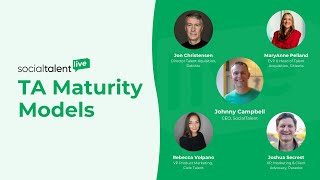
Johnny Campbell hosts interviews with talent leaders from Deloitte, Citizens Bank, and Paradox on TA maturity. Jan Christensen discusses metrics-first approaches; Maryanne Pellant covers candidate surveys and tech stacks including Oracle Recruiting Cloud and generative AI; Joshua Sechrest and Rebecca Volpeno break down RPO economics at scale, where Cielo handles 500,000 hires yearly.
Questions this video answers
March 14, 2025
About 18,000 employees
Spire ~160 employees; Amazon ~700,000–800,000 at time referenced
About 4,000 hires in a year (for data/transcription roles)
About 3,000 employees and roughly 0.5 million hires per year
Chapters
Sam sa. Hello and welcome to Social Talent Live. This episode is on TA Maturity Models. I'm Johnny Campbell, CEO and co founder of Social Talent, the world's leading platform for enabling hiring excellence. So let's let, let's set the scene. Today, talent acquisition is evolving fast. With shifting business needs, emerging technologies, increasing demands for efficiency, recruitment teams are under more pressure than ever to deliver. But without a clear framework to assess where you are today, how can you possibly chart a path to where you need to go next? This is where the concept of a TA maturity model comes in. More than just a benchmarking tool, these frameworks provide a roadmap for organizations looking to move from perhaps reactive hiring to a truly strategic, high impact talent function. In this event today, we've gathered industry experts and top TA leaders to explore what hiring excellence looks like at different stages of maturity. How companies are structuring their talent functions to scale effectively, and what practical steps you can take to advance your own TA strategy. Where does your organization stand and how can you level up? Let's find out. So what's on these yellows today? Well, to kick off things, I'll be speaking with Jan Christensen, Director of Talent Acquisition at Deloitte in Luxembourg. We'll explore what it takes to build a talent function from the ground up, the challenges he's faced and the key learnings from early stage hiring functions. Next, we'll move into the mid maturity stage where I'll be joined by Marianne Pellant, EVP and Head of Talent Acquisition at Citizens bank in the U.S. a company that's navigating the growing complexity of scaling talent acquisition. We'll discuss how they're optimizing their processes, structuring their teams and tackling the challenges that come with expansion. And lastly, we have our final interview for the session where Josh Seacrest, VP Marketing and Client Advocacy at Paradox, will sit down with Rebecca Volpeno, VP Product Marketing from Cielo Talent, who is at the advanced stage of hiring maturity. Joshua and Rebecca will dive into the sophisticated strategies, tools and processes that high performing TA functions use to drive business impact and stay ahead of the curve. But before we move on to our first panel, I want to emphasize that we want to hear from you. This is not a one way conversation. If you've been here before at an stlive, you know we welcome audience participation. We're going to run several polls through the session and we'd love to hear your thoughts and comments on the chat. Maybe to kick us off, we'd love to hear where you're joining us from I'm joining from my office in Dublin, Ireland. I'd love to hear where you are in the world today, what continent you're in, what city, what country. As we always welcome a very lively and internationally diverse audience to our ST lives, we've got Sven kicking us off from Berlin in Germany. Hey Sven. We've got James in Fort Worth. Good to see you. Jim in Texas in the US as well, folks from Chicago. We've got folks from Dallas, Cincinnati, Ohio. Thanks. Good to have you here. Scott, Good to have you here. Jennifer and Dee as well. Where else are you joining us from? We'll make sure to keep in mind that our audience is very international and we'll make sure to share as many examples and articles in the chat as possible as well. At the end of today's session, we'll be giving you access to our new Hiring Excellence Maturity Model tool, an AI powered interactive free assessment you can use to scope out where your hiring maturity currently sits and with recommendations for further growth. We're super excited about this, so stay tuned. So what I want to do though, before we do that is get started with our first poll. So we're going to be asking you to participate and give us your feedback. And our first poll question I'm going to be asking you is just to rate yourself on your hiring technology stack. So how would you describe your organization's hiring technology stack? You'll see the poll has launched. You should see that on your screen or to the side. So dig into the poll icon if it hasn't popped up and we're looking to understand. Do you rely mostly on spreadsheets and manual processes? Do you use an ats, but maybe it's not fully integrated? Do you have ATS and a CRM and some automation but lack kind of advanced analytics? Or maybe you have tools that are fully integrated with data driven insights? Or perhaps you have AI powered tools that continuously optimize your hiring strategy. So have a look at those five options and think where do you best lie in terms of your tools and your core system at the moment? I wouldn't spend too long over that. Give us your instincts on how that's going. We've got a bunch of you already voted. About 20 people have voted already. Have a look at that. Where do you lie? We'd love to get your feedback because we can get a sense of where this audience is in terms of their overall maturity on that maturity model. And this can be the first of five polls you run to try and get that feel. So I'm going to give you about folks about another 10 seconds to answer that poll. Please jump in on the side with the poll icon if you haven't already. We'll close that poll out in 5, 4, 3, 2, 1, 0. Okay, so let's close that poll. Let's add it to the stage. So it seems that the majority of you, maybe no surprise, are sitting slap bang in the middle. You've got an ats, the CRM, but some automation. Slightly less of you have an ats, but it's not fully integrated. Tiny number are at the Most advanced, level 5. A smaller number again maybe 19% are at level 4. Majority at 3 and 2. So it seems that we have from a tooling perspective, most of us are in that two to three band, a few pushing into four. Tiny, tiny number or at the extremes of that. That's really interesting to take into our first session as well. So let me pull that across here and I want to get one more poll question before we get our first guest on. And this is around your your how you track hiring success. So I'd love to know when it comes to your KPIs, what which best describes how your organization tracks hiring success? So that's going to be our poll number two. So do you consistently track hiring metrics? Sorry, we don't consistently track hiring metrics. Do you track basic metrics like time to hire, cost per hire? Do you measure things like quality of hire candidate experience alongside some of Those more operational KPIs? Would you describe it that you have predictive analytics to optimize your hiring decisions? Are your hiring KPIs directly tied to business performance? Are they continuously refined? So think about your KPIs that you manage your report on within your teams. How would you best describe them under those five categories? So again, look for that poll icon. Bring that poll up. Look at that again from more basic or sorry, no, no. Hiring metrics all the way up to really advanced, more dynamic hiring metrics that are very much tied to business performance. What we'll do is close that poll again in five seconds. Let's try and get as many as voted in the first and we'll close out in 5, 4, 3, 2, 1, 0. So let's have a look and see how we're polling on that one. So it seems that again, let me just close out this poll. Let's add that to the stage. So the vast majority, you again are falling in the middle with very few going past that. So tiny number at 4 and 5, the vast majority at 3 and 2. So it seems that, you know, you've got a huge number who don't track anything or have basic metrics like time to hire, cost per hire, a little bit more than that, are doing quality hire candidate experience and those metrics and that seems to be in our group. Super interesting. Thanks a million for sharing that. It's going to be super helpful as we go into our first conversation. It's a pleasure to welcome joining us from Luxembourg, Jan Christensen. Jan is director of talent acquisition at Deloitte in Luxembourg. Jan, you're very welcome to today's stlive.
Good to see you. Thanks for being here and thanks for having me on the show.
Not at all. So Jan, would you perhaps start by sharing a little bit about your career? Maybe says a little bit Lloyd in Luxembourg, but maybe a little bit the other roles you've had over the years and maybe just give us a high level comment on maturity as it affects some of the businesses you worked in and some of the TA teams you've led over the years.
Yeah, so just my background as well. It's been recruiting my whole career. Started out agency recruiting in Silicon Valley back in the pre.com days. So that kind of dates me just a little bit. Moved to Amazon in 2010 up in Seattle and then from Seattle moved with Amazon to Luxembourg, which is where the EU headquarters are. After a few more years with Amazon I was total of nine years. I went to a small company called Spire. Big difference. Amazon when I left was seven or eight hundred thousand people. I joined a company with 160 across six or seven offices around the globe. Left there last summer. So I was there for just five years and joined Deloitte starting in January. So definitely seen a wide spectrum of things that are advanced, some of it at Amazon, things that are starting from ground up and that would be at Spire and then now here at Deloitte. I haven't been here long enough to really make that assessment yet. Where we're at, obviously that's what we're looking at. But I think most of the stories and things that we talk about today will be from my kind of both the Spire and Amazon days. And just reflecting really quick on what you were saying as you were going through the polls. And you know, the thing is, is you're as an organization, you're never just at for everything at one maturity. I think it's different for each because you're going through that. Like our ats, I would put us at three or four but for metrics I would probably put it like two or three. And so there's no way you're going to be in the same for everything. You get used to where you're at and then what do you do to move that particular part forward?
So I love that point. When we were building out the maturity model, one of the key things was to understand that there's different aspects of maturity. And to your point, you're not at a three as a whole organization or a two or four. You typically are at different levels of maturity at different aspects. And some of them are interconnected, some of them perhaps not. And when I first share with you, Jan, this concept of how we broke out, the five dimensions being toolings, your tooling, your KPIs, your org structure, your processes and capabilities, one of those jumped out at you and you said to me, that's where I'd always start for you. Would you mind sharing which of those five was the one you said you'd start with and why?
And that's metrics, because. So using Spire as an example. So when I joined, it was 160, 180 people, something like that. There was two recruiters, there was no process. We had an ATS. Of course the big complaint was nobody's getting hired, which of course isn't true, but that was what everybody was perceiving. And so the first thing I had to do is really figure out what is happening. And so I spent a good first month digging through the ats, figuring out the metrics and being able to use that to start driving some of the conversations, like, here's where recruiting's at, but also using those metrics to figure out where is something wrong, what do we need to. Where do we need to adjust? And so there was things we used at Amazon. We used recruiter productivity. So I kind of brought that over to, into Spire. It could be time to hire, which we didn't use at Amazon. At least when I was there to. We were really using it there. And so it's, it's looking at each one of these and they tell you a different story about where things are at. And they kind of give you an idea of, okay, where do I dive in to figure out what I need to do? Just thinking about Spire, time to hire was one of the areas. And of course it's never fast enough for anybody. But the. It was interesting to go through and say, okay, at each stage, this is how long we are taking to do something. But we all know, those of us in recruiting all know, of course that it's not necessarily the recruiters that are holding things back. There's the business as a part, there's accountability there too. And so it was sharing that with the business. And that's where there really was some eyes kind of wide or opening wide saying, oh, we can help with this, or this is our part in it. Some of you still take some influence to get them to do that. But that was just an example of where I was using a metric to actually drive some performance and some change in the business there.
So what are the challenges, Jan, when somebody is listening to a panel like this or they're reading a report or a maturity model and they hear one company, for example, Amazon might say, this is what we do. And often times it's tempting to say, well that's what Amazon do, so we need to copy it. But you know, your experience I think has been different, you know, with different businesses, some very different types of businesses there. You know, what, what's your view on, you know, the type of KPIs you report on and then the business you're in and where it's at, like how, you know, how much variance is there there, how much have you seen across different organizations?
I think there's, there's baseline KPIs that we should have everywhere, right? I don't really care where you're at. And there's time to hire is probably one of them in my mind, recruiter productivity to make sure that we're using the recruiters and they've got the tools and things to be productive. And if we're investing in more tools, are they becoming more productive? For me, the candidate NPS or the candidate surveys, candidate experience surveys or are really critical because they also give you a lot of insight. What's happening in interview process. Another one that I started in one of the groups I was in at Amazon, but it really didn't roll out until I was in Spire is a hiring manager NPS score because you have of course, and I'll speak for myself, most the managers that I hear from that just contact me on their own is more because something's not working right and that can get hard on recruiting teams. But what I found is with the hiring in hiring manager NPS score, so there was a survey, went after every hiring manager after they hired somebody and all of a sudden we start seeing it expire. The scores were actually relatively higher. NPS was 60 ish or something like that, which is pretty solid for the hiring manager side. But if you went with the complaints which you were only hearing, you would think we were like below zero. So using that to say, you know what, we are doing some things right now, let's take whatever comments we're getting and improve on that or figure out what we need to do. But that one also shut down. A lot of what I was hearing from the business about recruiting isn't doing what they need to do.
So one of the other elements we discussed when we talked about maturity of a team or the type of processes and even the org structure that was set up within that, um, and it's not always linear. There isn't a. This is the, always the way to go and this is the one structure that works for everything. You've worked in scale ups, you've worked in established businesses, you've worked in tech, you've, you know, moving into, I imagine in Deloitte a lot more early in career hiring. Walk me through the kind of your view on what are the right processes or structures for different types of recruiting. Maybe give me some of the examples of where for one type of recruiting it's this process and another type of recruiting you'd probably do it differently.
Yeah, it, you know, that was one of the big learning experiences I had when I left Amazon to go to Spire. At Amazon, everything for me, I don't.
Know, it's just my mic.
No, it doesn't say I'm on mute. You're good. Okay. So Amazon was very different than, you know, from a scale point of view than you would see at, at, at Spire. And it took me a little bit when I moved over that I can't, I didn't, it wasn't. I kind of knew this was going to happen but the instinct was to go to the same things I'd done before. But at Amazon it was the first role I had was leading a team of recruiters really focused on a very, very tech heavy focused business. And so the vast majority of what we were hiring were software engineers and we had to think about how can we build out the teams we needed to. And so part of that was okay, do we need to open offices in different places? We used to send recruiting interviewing teams to different countries in like low cost areas that people would want to move to the US and so that was a whole different way of recruiting and we called it event recruiting and it worked well. We got a lot of engineers that way. But then as I moved into, I moved over to Europe and I'm in Europe where we were pulling the people out to go to the US doesn't work the same. And so we had to rethink about how are we doing our recruiting for the engineering populations. And there was, to be fair, it was a lot more branding type things. But then followed up with there's just a lot of peer headhunting happening. And then the last role I had there was very much high volume recruiting in that we were hiring a bunch of were called data analysts and they were. People might remember when Alexa was getting started that the Alexa is recording everything you say and so people were actually transcribing and then they would put those that information back into the models to help Alexa become smarter. That is very much a high volume. We hired like 4,000 people in a year across various countries for different languages. And the recruiting model for that was very different in each country we were each country we were in. And so we had to think about that one differently. In some of the countries it was purely through outsourced firms to help us bring their contracting firms to help us bring people in quick enough. Others were where we had just on site recruiting and there was just constant turnover and they were doing that. I come to spire and now the volumes are so much less. It's very different. And I didn't have even enough recruiters to handle the volume that was there. And I really had to think about how do I set this up. And I, I ended up setting up so that we had one person dealing geographically with the US because they could cover that from a time zone point of view. And then I had. Because more of the hiring was happening in Europe, more I had three recruiters in Europe focused on the hiring in Europe, but over time, by the time I left we had changed it to functional recruiting. So people were a tech recruiter global or people were a sales recruiter or business recruiter, but on a global basis. And it just is what had worked as the business shifted. So you want to. You think about how do you need to be aligned again to solve those business problems.
I think this is what we observe when it comes to maturity is that as you mature you realize that there are different processes needed for different types of hiring, perhaps different geographies for different business lines. And that is fluid that can change depending on market availability of talent. How difficult it is for your business to hire those folks or not the business priority of those roles may shift as you move into new markets or different strategies as well. But one of the important things that you, I know shared with me, Jan, I'd love you to maybe talk about was on the capability Side was the importance about being able to communicate with data and to be able to kind of build trust. So talk to me about that capability, that muscle within a TA team and your experience there.
Yeah, so I had. Amazon was really strong. Generally, I'd say not every single person like this, but generally Amazon, the teams are very strong on using data. There was just a huge push for that and you would go into any meeting you had with a manager, you would. Or senior leaders for the, for the bigger meetings, it was all about the data and you were showing what you had done to either increase the volumes, the steps you were taking to. And so there was, you know, how you're progressing against the targets. It's what are the steps that you're taking to it. So you're coming in constantly with some form of data. Not necessarily just a single number, but some form of data. When I got to Spire, the two recruiters I had at that point were, to be fair, fairly junior. And they didn't even have the confidence to use the data, much less. It wasn't that easy getting out of the ats and they hadn't taken time. But once I started using this data with the leaders in the company, there was a while recruiting knows what they're doing and that was a really. For them, it was a comforting feeling. And when I actually left there and then the person who was backfilling me, I had one of the leaders come to me and say, it just isn't working like it was before. We're not getting the information. So having that data is an important thing. And just one quick story I think here from Deloitte in that I was meeting with one of our partners and, and he had kind of complained, not complained, but he was talking about how he had some very difficult to fill, like tax roles. And I thought, well, okay, we can figure this out, figure out where the people are. So I come back to my office, kind of play around with talent in LinkedIn, Talent Insights, and go back to his office and show him, say, here's what LinkedIn says, here's where we're going to find these pools of people. And he was super excited about that. It's the first time somebody had come to him and saying, here's how I can help you. Here's where we're gonna go find people. Not just random searching on LinkedIn. And so this particular recruiter's on holiday that I was, when I was talking to him. So he said, what do I need to do next? This is, well, you and the recruiter can sit down, you guys can play with this and figure out where the right pool of people you are and then walk through each of the profiles and figure out which ones are the right ones and then she can contact them. But it was that kind of using again, data that builds that confidence, builds that trust that we're here to advise and help them. And that's where as a team here I want to get my team to. And as I've my spire team is the same way. Amazon, a lot of it was already there, so it wasn't as much moving the needle to the right.
But I might ask in a general sense that from a capability of leadership, John, to kind of finish up on, you know, if you have somebody who's navigating this transition, wherever it is, on that scale, you know, what's been your learning as, as Joshua has pointed out in the chat. Brilliant. To be able to have worked in different environments from massive scaling and massive volume to smaller volume. What's. Are there any kind of singular pieces of advice you could give to somebody regardless of where they're at around how do you navigate that change through these different levels of maturity?
Yeah, and there's one thing, and this is one of the things I love about where I'm at now is I love dealing in ambiguity. So I don't know the answer. Right. And so but what I have to do is go find out what that answer is. And so when you come into a new place or you're in a situation, you just don't know the answer, start asking questions, start doing research, start asking, start interviewing some of the business. What would you like to see in talent? What would, what would great look like to you? What are some of the things that you think are missing? What does work well? And so you can things like where are the pain points? What are the types of people, whatever. There's a lot of things you can ask to kind of build this picture for yourself and then that. And that's what I did here is I built this picture for myself of what's going on and now I can put together the story, the framework to go drive where we need to go.
We could probably continue this conversation for another half an hour.
I love talking about that stuff, but.
I know we got to move on. It's been a pleasure to chat to you. Say thanks for sharing those insights. I think you've got questions and comments that we're not going to get to. Unfortunately this just this time, but perhaps if you have time, you wouldn't mind jumping back into the chat and the questions. There's a few there for you to try and help our audience. Jan, thank you so much for starting us off and sharing those insights.
You bet. I'll just go mute and hang out and watch.
So thanks Jan. And quick reminder, for those of you who may have joined us late, we'll be sharing a recording of this event with everyone just in case you missed it so you can get a full listen to Jan's chat. So let's go into our next poll. So next poll we want to understand is how is your talent acquisition function structured within your organization? Again, to Jan's point, we're never one level on everything. We're typically a different level on different areas. So is TA decentralized with minimal standardization? Is TA centralized but operates separately from the business? Are TA partner? Do they TA partner with hiring manager but they lack strategic alignment? Is TA embedded in workforce planning and talent strategy or is TA a key driver of business strategy directly influencing company success? So what would you rate talent acquisition in your organization? Where do you think you lie on those scales? So for those of you who haven't jumped into the polls, they're on the right hand side. You can jump in and find your polls. We encourage you to participate in that live poll. And again we're asking you how was your talent acquisition functions structured within your organization? So is it decentralized, minimal, standardization, centralized? Is it partnering with the hiring managers? Is it embedded in workforce planning strategy? Or is there a key driver of business strategy directly influencing company success? So let's get your votes in and let's close that out in 5, 4, 3, last minute votes. 2, 1, 0. So let's add our results to the stage. So where is our audience going on this one? I'll close out our poll. So this one we're seen to be much more mature. So only a small number here in 1, 2. Again majority at number 3, but we've significantly more folks at number 4 and 5. We've got about nearly 40% of our folks listening here at level 4 and 5. Still the vast majority, just under half of you at level three. So again, proof to Yan's point that we're not all at 2 or 3. It depends on the area and certainly when it comes to your org structure seems to be a lot more maturity in terms of the org structure here as well. So I'll close that out remove from the stage. Which brings us on to our next interview. As I mentioned earlier, I'm delighted to welcome Maryanne Pellant the EVP and head of talent acquisition at Citizens, a bank in the United States to join us here today. Marianne, you're very welcome to your first st live, I believe.
Thank you. I'm incredibly excited. Thank you Johnny and hello ta friends. Nice to be here.
Marianne, where are you joining us from today? And for those of you who those of our listeners who are not perhaps familiar with Citizens, because we have a huge number who are outside the US Tell us a little bit about citizens, the organization and your team.
Sure. So I am in the very smallest state in the United States right now. I am sitting in Rhode Island. Our headquarters is Providence, Rhode Island. However, we are a super regional bank that aligns against New England and the Mid Atlantic region regions. We have about 18,000 employees. We deal with both our commercial customers and our consumer customers and we work with all levels of candidate. I'm sorry, I always get say candidate instead of customer. You know where my heart is. So from a customer standpoint, we every segment we manage. So and we, you know, truly believe in our credo, which is ensuring people are living up to their potential, both for our customers, our colleagues and our communities. And so that's we live and breathe that here.
So what kind of hiring volumes are we talking about per year on average? And I appreciate it fluctuates. And what kind of skills are you hiring for?
Sure, so most people think banks and they think tellers and bankers. And yes, we do plenty of that. But we also are building and transforming our technology, our data, our digital platform forms, digital marketing as an example. So we do all types of emerging talent, executive and leadership early career programs, as well as the traditional banking roles you think about.
By the way, Jan is just making a point that I just got to point out to you, Marianne. Luxembourg is smaller than Rhode island, so.
But it sounds way cooler. I'm not gonna lie.
It does. It has a certain attractiveness to it for sure. So maybe Marianne, for, for those listening who aren't maybe familiar with that kind of scale and that kind of environment and I want to add in, I think there's a particular nuance to hiring for an organization like Citizens bank because you have this perspective where you tripped over it yourself. Candidates are customers. Every single candidate who could apply to Citizens could be a customer. I think there's a particular difference there for consumer oriented brands around how they do ta because I think you have to have so such a candidate focus. So maybe if you don't mind Starting with your KPIs and your metrics, what do you Measure. What do you like to measure? What are you not measuring that you'd like to change? Sure.
So you can't see the whole thing behind me, but this is a giant sign in our interview suite around Candidate Promise. We started our transformation with ensuring we stacked and aligned to how we were going to ensure we differentiate ourselves to the market by increasing and improving candidate experience. We want that to be a distinction for us here at Citizens. So no surprise our data illustrates that. We look at what our brand, how it's resonating out into the market. So we look at the things like Glassdoor and. But beyond that, we do just in time, candidate surveys. So we identify at every point in the recruiting phase, we're asking how we're doing. So it's not just the people who get hired. We really want to understand how we're showing up for our audience because of that very same thing, Johnny, is that no matter how people, you know show up, they are potential customers or customers are. So if we don't hire them, we want to ensure that they still leave feeling that Citizens is a great brand. Beyond that though, we do look at staffing demands. You know, the traditional KPIs like time to fill. We look at capacity, how many recs per recruiter, we look at what are some of the other like our source of hire and we look at how we're doing from an efficiency standpoint. So those are, those are parts of this. And Jan actually talked about something. We do a hiring manager survey as well. However, it's not an nps. We actually are checking to see that our recruiters are delivering as talent advisors. So we're looking to see whether we're showing up the way we've committed to. So it's less about them liking us, but more in terms of are we delivering value.
I love that. So really checking on the process and are you delivering on the process and the promise, so to speak. I'm going to put a question to you, if you don't mind, Marianne. That was actually initially for Jan, but I think it's relevant to the point you make. And it's from Peter and he's wondering what would be the benchmark response rate. Maybe you could answer that from the candidate perspective, but also from the hiring manager perspective. It's a question a lot of people often ask if they haven't started surveying before.
So we've received between a 20 and 30% response rate. And according to our HR analytics team, they feel very good that that's a solid response rate. We are careful Though in looking at individual survey results, how many each of the recruiter gets right? Because I think Jan had mentioned if one person can say it's awful, you know, you don't want to paint the picture that that person isn't doing their job. It could be one bad experience. So we look at having between 20 to 25 surveys before we really look for trends and opportunities. So that's where we've been targeted from a benchmark standpoint. In Glassdoor, we also rank ourselves against other US banks, and so all of our reporting and our metrics are aligned against that particular benchmark. But anytime I can get an external benchmark, I use that.
I love that I've actually used that example with others. I may have stolen it from you, Marianne. Where somebody has given me their Glassdoor score within a certain industry and they're maybe proud of it and I've gone great. Who are your biggest competitors? And they've listed five companies. I've gone in and found their last door scores and say, you know what, you're fourth from. You're fourth out of five. How do you feel about that now? It's like, oh, I think the number on its own might not be terribly relevant. But how do you, how do you, how do you compare to people that your candidates are probably also going to be interviewing with? That's what perhaps matter.
Look at where our, our location is too. So we don't just look at the banks, we look at who are we competing with in the markets in which we serve to ensure that we're also. Because, you know, it's great for tech talent and digital talent and data talent. They don't have to choose banking, they can really choose anything. So we want to ensure we're, we're double checking.
So I'll ask you about.
I'm so sorry, I have to, I have to do a slight brag only because my team worked incredibly hard. But we were. To your example, we were number nine in candidate interview experience. We've now moved up to two. So it is something to ensure. Right. Like those who fall behind or afford 4 out of 5. You can pull yourself up, but it helps knowing where you're at and where you're starting and what you need to do to get there.
And this echoes jan's point on KPIs. Data is so important because how do you know you're getting better? How do you know you're improving unless you have this data? I want to ask you about processes because obviously this is one of the elements on the Maturity model we've looked at in terms of reactive all the way to adaptive. But maybe through the lens of candid experience, what role has building that importance on the candid promise had on the design of the processes you have? Miss, maybe you can walk us through some of the processes. You know, explain if they are different for different types of roles or parts of the business and maybe what role has candid experience played there, if you don't mind?
Candid experience is a lens we put on everything here. It's whether we do move forward with a technology, whether we adjust a process. So candidate experience is one of the first lenses we put on anything. We also look at recruiter experience because we also want them to feel like they have the capacity and the capability and hiring manager experience. But from a process standpoint, we actually have segmented processes based upon the needs of the organization and their strategic relevance to our direction forward. So not surprising from a recruiting standpoint, we try to drive as much consistency and speed speed into those high volume roles. So our tellers, our bankers, our contact center, those are areas where we think we can get quality, but we can get it at a much higher speed. Where in areas of those emerging skills, we take a much more thoughtful approach and ensure that candidates are brought along the way in a more human interaction. Right. Technology helps on the volume side to keep the candidates aware, but on the more emerging critical roles, we ensure there's a human bond that's happening.
I love that, I love that. That probably leans into different capabilities. I know this has been a big passion of yours in terms of looking at the capabilities of not just the recruiters, but everyone involved in hiring. Can you maybe share with us about some of those emerging capabilities? Like where you're at in maybe the last year or two, what capabilities have you brought in and what are you still looking to bring in or what are you looking forward to in terms of, hey, our capabilities are heading in this direction. So where are you coming from? Maybe where are you going to in terms of capabilities?
So and you're speaking about our TA team, right? Not about our organization.
So yeah, so when it comes to hiring. So again, starting with the TA team, which generally in terms of capabilities to hire for the organization.
Yeah. So the TA team, you know, we've gone in the last nine months, we're shifting from order taker to talent advisor. And, and we are in the middle of that journey and we are excited by it and have done an incredible amount of work to upskill our team which are doing great, great work. We observe, we create, we coach, we require a lot of practice from our team. And I think that talent advisor, it's about using data, it's about advising and influencing, not just, you know, showing up and being responsive. Right. It's beyond that. And I think the skills and what we're seeing happening in talent acquisition from order taker, and I hate using that term, so please don't misinterpret what. I'm not trying to dismiss the work that they do, however, the talent advice, I really think we're seeing that transition not only in talent acquisition but across talent pool. You know, looking at data, being able to utilize technology, be able to solve problems, being able to influence and be agile, always learning. Right. Those are the skills that we're seeing evolve within any talent organization or talent pools that we're looking for. So I think all skills are continuing to be important, but I think the evolving need to be, you know, working in partnership with technology and data I think is a critical, critical one.
So one area I'd love to kind of expand on a little bit is maybe your tech stack because you mentioned obviously this need to evolve, this capability to be a business partner and we're seeing this with hiring teams that are trying to I guess bring in tech. And we talked, you talked about automation in parts of your hiring process as well. You're a regulated business though, so maybe the expectation is that, you know, more highly regulated organizations are maybe slower in terms of their tech stack. But would you mind sharing with me the maturity of your tech stack, where it sits now, what you're experimenting with and why and perhaps where you see that going in the future?
Sure, we are definitely on our journey, but I feel really confident in where we are today. I think we all at least who was here through COVID 19, the proliferation of TA tech was something I had never seen before and it was perfectly aligned to investments that we could make. And so we were able to really start to transform our tech stack. So we automated our interview scheduling. We have a chatbot, there might be a vendor who you'll be talking later, who we work with around that we use pre hire assessments and video interviewing. We just are, are outlining AI matching that's currently underway as well. And we use Oracle recruiting cloud which is really their Oracle's new model and putting a lot of new technology. And just yesterday at Citizens we launched Generative AI. So we again to regulations, you all might be well ahead of that, but for us we're really now starting to embed that into our Practices. Where I'd like to go is to get more optimized, where you have less of individual platforms and really have one kind of super source so that the data can flow and can ultimately get even more efficiency out of the process.
So I have a question here, Marianne, just to go back to a topic from Dom Walker. How have the business leaders embraced the change from order takers to becoming talent advisors, I guess from the recruiters? And how do you train your team to have those crucial conversations with the business if they push back?
Yes, really great question. So part of our transformation was to talk to the business about what we're doing and why we're doing it. That helped with having accountability. Right. So we're telling them, here's why we're doing it, here's how it's going to value, and this is how you can. How you can expect us to show up differently. That also helps our recruiters feel confident to walk in differently than they did yesterday. And so it created a buzz and an interest, and it created an opportunity for people to come in and start behaving differently and showing the value pretty quickly. So that would be how we went about it. And, Johnny, forgive me, I've lost the second part of your question.
That's all right. This is my fault for asking two pronged questions or sharing two pronged questions. So really the question just to bring it back up on stage here from Dom was how have they taken it? And how do you train your team to have those crucial conversations with the business that they push back?
Yeah, training is so important, and it's really important for you to understand where each member of your team is. Some people will be able to adopt this, have done some level of it already and can get there quicker. And so there's also another vendor who might be hosting this call that I also work with. From a social talent scene standpoint, we have been very structured in the learning journeys that we've had the recruiters take and the leaders take, and we do it together. Leadership and recruiters. And then we hold weekly meetings to talk about how does this look? We learn from one another, the leadership coaches. We spend a significant amount of time ensuring we're building confidence, incompetence before we put people in an uncomfortable position. Listen, change is uncomfortable. Right. But we want to ensure that they have a level of confidence and competence before they move into that situation. So we've been doing this for nine months, setting the expectations starting in January. So they had a good six months to start practicing and getting comfortable before Those expectations were led and the recruiter scorecard changed drastically this year. We actually are only holding our recruiters across accountable to the behaviors in which we expect. For talent advisors, we've actually taken time to fill away. We've taken their source of hire. We really are testing them for their behavior to help to transform how we show up.
Marianne, you've given us a wealth of information in 16 or 17 minutes so far. Even Joshua saying love how you segmented various roles, how the process and your team change your approach, your use of tech parole as well. There's lots more comments, maybe questions for you to dive into and celebrations and applause now. And I give you applause to your team and to yourself as well for a real best practice in terms of how you're navigating that maturity and driving the business through that, I think you're doing a wonderful job. Mariana, thank you for sharing so much detail on it over the last 20 minutes. I really appreciate you coming on the show.
Thank you, Johnny. Thank you everyone.
So that's wonderful and thank you, Marianne for that. We going to go into our final poll, our final two polls now in a second. And our penultimate question I'd like to put to the audience is to understand how standardized and or scalable are your hiring processes. So this is our fourth poll and we're trying to dig into the fourth element of maturity around processes. You know, answer me this right when you look thinking about your own hiring, is hiring ad hoc with no formalized process rec opens, just do what you want. Do you have some structured steps but it varies by department hiring hard to manage? Do you follow a standardized hiring process but just struggle to keep it consistent? Are your hiring processes well defined, scalable and data driven? As in there's a reason it exists and it's built on feedback, on information. Or do you continuously optimize your hiring process based on data, feedback, best practices? So it's much more dynamic and always trying to be the best. So where would you land on that scale of 1 to 5? Having a look at those. Do jump into the poll, give us your answers. Love to get your feedback. You've been brilliant so far in our first three polls. What we'll do is get your instinctive answer on that. We're going to close that poll out in under 5, 4, 3, 2, 1 and let's see where we at. So last minute, last chance to vote. Okay, let's close that poll added to the stage. So again here we're seeing vast majority in the middle, but actually again, just like our Previous poll actually a decent number in four and some in five as well. Only a few of you in one or two, so that's really good. So a lot more maturity around this. So we're all kind of starting at the middle there. Much more around processes. Just a reminder, tools and KPIs were all much more towards the start Org structure and processes were pushing a little bit more down the middle. So again, to Jan's very first point, we're not all at the same stage for absolutely everything. So that gave me a chance to ask one last poll question for our audience. And this is on our final topic, which is on capabilities. So the skills of your organization around hiring, not just your recruiters, but overall. So are you on the earlier, you know, one stage where hiring managers and recruiters received little to no training? Maybe it's number two, recruiters are trained, but hiring managers lack any structured training. Is it part three, somewhere in the middle, both recruiters and hiring managers receive some structured training. Or is it four, you have a strong culture of continuous learning and talent acquisition across the business. Or is it 5? Your industry leaders and hiring excellence people ask you to speak at conferences. You're continually innovating and upskilling in this area. So again, last poll question, I promise, before we go to our final panel, who are eagerly waiting to be introduced to the screen, how would you rate yourself on that scale of 1 to 5? I'm going to ask you to quickly give us your last vote on our last poll here. You'll be very good so far and close that out in 5, 4, 3, 2. Final chance, 1, 0. Let's close out that poll. We'll add it to the stage. And again we're seeing surprise, surprise. Most of you are in the middle, but actually split between two and three then. So very few of you who have little or no training, 30% saying recruiters are trained, not hiring managers. 40% saying some structure training for both recruiters and hiring managers. And then good quarter of you saying you have a good culture of continuous learning in talent acquisition was brilliant and it's great to have you here. So with that on our last poll, and thank you all for joining us on those polls, I'll move on to our last session. In our final chat on this month's Social Talent Live, I'm delighted to hand things over to Joshua Sechrist from Paradox. Joshua is VP of marketing and client advocacy of Paradox, but formerly the head of talent acquisition at McDonald's, which is worked in Abercrombie and Fitch. So he is one of us in terms of being in this market, as is his guest, Rebecca Volpeno. Rebecca works in Cielo Talent. I'm sure she'll tell you more about Cielo if you're not familiar with it. And I think you'd be super interested to understand her perspective on scaled hiring as Joshua has a great conversation to talk about what perhaps maybe the higher level of excellence looks like. Joshua, I'll hand it over to you.
Awesome, Johnny. Thank you. Hi, Rebecca.
Hey, how's it going?
Hi everyone. This is so good to. I'm so excited for our chat. I'm going to start with a quick story that's going to then set up how we're going to really structure this because I love this topic of maturity model and I think the holy grail for all of us as TA practitioners and strategists is driving ultimately revenue and business results off of all the day to day work that we're all doing doing. So Johnny gave me a nice little layup of. Before joining Paradox, I was head of global talent acquisition at McDonald's. That was over frontline restaurant hiring as well as corporate hiring. Rebecca, do you remember how many hires we were doing per year?
Oh my gosh. Yeah. Probably more than Cielo combined.
So how many are you doing per year?
Let's see.
Half.
Half a billion. Wow.
Wow. Yeah, so we were doing 2 million. And that's predominantly restaurant hiring. And it was 120 countries and about 40,000 restaurants. And that just keeps kind of growing and growing. But the anecdote I wanted to share because I think it ties really nicely and it's why I geek out so much chatting with you is when I came in, I heard that we were understaffed by about 20% of our restaurants were understaffed. You say, oh, that's probably pretty common in quick service restaurant. If I say QSR to this group, I mean quick service restaurants, fast food. And so like what's the big deal of that? And what we were able to see is there's essentially a vicious cycle within a restaurant. So if you were understaffed, then it led to more turnover, slower ticket times. Right. Like longer lines, slower ticket times. And ultimately we could quantify the revenue loss per day by being understaffed by one person. I can't give you McDonald's exact numbers, but the QSR numbers were essentially $500 on average. You lose per day by being understaffed by one person because you're not getting food out as much, you're slowing things down. Our time to hire, when I was stepped in, was 21 days. So $10,500 per hire. Essentially, that was being lost from a revenue standpoint. So we brought this data to our cfo. We were able to say, hey, we've got really good data that supports that we need to be hiring faster because it's actually revenue driving. And so what we were able to do is we were able to automate a lot. Got that down to about three days. So a recoup of about $9,000 per hire for the business, resulting in, yeah, you do that math, it's over billions of dollars, a billion dollars in revenue. And it was just really exciting and interesting because it was this like, oh, my gosh, TA as a business and revenue driver. And so I think that segues into, like, can't wait to pick your brain. I think everybody can't wait to hear from you, because Cielo, I mean, you and your. Your executive team peers are running an organization where your revenue is directly tied to talent acquisition results. Right? I mean, your business model that we're going to dive into is. Is hiring and actually driving revenue off of that. So we're gonna dig in, really kind of starting there, and then we're gonna kind of pull back as much as you're willing to share. I told Rebecca I'm gonna hit her with some hard questions, but obviously she can't divulge all data and results. But maybe let's start with Rebecca, your background and your role at Cielo and give us just a touch of what Cielo is, and then I'll kind of dig into the business side for sure.
Well, and when I think of McDonald's, I always think of billion with a B. So I know you were doing some substantial hiring and also serving many customers across the globe. So for Cielo, for those of you who don't know who we are, we're a global talent acquisition partner. We're about mid market enterprise. So hundreds of millions in annual revenue and close to, I would say, a half a million in hires every year. And that's all of us in talent acquisition. So 3,000 employees globally. About 70% of those are recruiters or individuals who are directly in front of candidates and hiring managers. And so, as Josh mentioned, you know, we are an entire organization of talent individuals, a recruiting team. So probably one of the largest globally, if I had to guess. And because it's all we do, we spend a lot of time, obviously, looking to figure out how we can do things better, how we can make sure that we are optimized at scale and really in that, you know, highly advanced talent maturity model. For me personally, I've been in HR technology for the last decade. I spent a lot of time trying to understand different applicant tracking systems, how they connect with HRIS tools and other LMS systems. Then I moved into a client success and support role where I got to spend a ton of time with, with our clients and our candidates to really understand what do we need to bring forward in HR technology to make all of these things really happen and to provide this best in class candidate and hiring manager and recruiter experience. I then moved into our product team. So I helped our organization determine what types of products and services should we make available to the market. And then recently I've moved into product marketing. So I get to now share all of the great things that Cielo is working on in forums like this. So I'm really excited to be here and thank you.
You sit on our client advisory board, which kind of helps us advise on our product roadmap and sort of what we should be prioritizing, what we should be building. So a lot of the cool things we bring out, usually it's tied to exactly what TA leaders need. And it's always fun, fun picking your brain. I love this. The Cielo model of right. It's how would a TA leader operate if revenue is directly on the line? For all of us, it's directly on the line. But sometimes it takes a couple of dots to kind of showcase the direct impact. I mean, for you, there's some really interesting pieces around. You need to optimize revenue, you need to create margin, which means potentially bringing some costs down. But your ultimate product, your delivery and experience to your customers has to be a really great product. So there's kind of a balance. And I mean you all are having to think about this as entrepreneurs as sort of business C suite. Can you just kind of talk about that push pull of managing cost and.
Investment.
And how you're thinking about that relative to the experience you're delivering to customers and the hiring volume that you need to produce?
Yeah, well, and I would say one of the things that we continue to put at the center of all of this is experience. So when I'm looking at ways to implement new technology and what type of cost savings or different allocation that might mean for our team, we always focus on the experience first. And so if there is a bright shiny piece of technology that we could implement, that's to going, going to negatively impact those experiences of candidates, recruiters and Hiring leaders, we don't implement that. So this is not just a, okay, let's see how cost effectively we can do something and then, you know, let the experience fall to the wayside. But things that we look at, so using kind of experience as that, that same core, we look at that to determine where we can and should get better. So, so we mapped out across the recruiting value chain how much time resource, you know, is spent in certain parts of the recruiting funnel. And so we found that sourcing was a huge one. So was interview scheduling. So that could have been kind of coordinating a recruiter screen or a hiring manager interview. And we looked at these things where we're like, wow, we're really spending a ton of, ton of time and dollars in these areas. Not dissimilar to what you were saying about McDonald's. And then looking at technology to one make us more efficient in, in that area from, you know, a time and resources perspective, but also like, how can we make this experience a ton better for the candidate? So that's, you know, and Marianne kind of alluded to this as well. That's where, you know, a partnership with Paradox comes in. And we can automate a huge part of, you know, the administrative burden, but still provide an awesome experience for the candidate and the recruiter. So we're not spending, you know, a ton of resource in, in those kind of administrative pieces. So that would be one area that I would say, you know, aside from looking at, you know, cost reductions specifically, we still always lead with the expenses experience in mind.
Yeah, ultimately you need to deliver a high, high quality product. And I love that you're leaning on experience. One of the pieces is we saw automation being able to be kind of a game changer for us within McDonald's. One of the rules we basically said was we can automate as much as we want to, but the candidate experience, because for us There was right, 100% overlap the candidate experience with, with customers. The candidate experience had to also improve. And so we went from not tracking candidate experience to reporting candidate experience only from candidates who did not receive offers from us because ultimately those could be customers who were frustrated. But by doing that, it sort of held our, our feet to the fire on like delivering a great experience. We heard a little bit from Marianne. I love that conversation. And kind of talking about tellers versus, you know, corporate side. Can you break down just, I mean, what is your sort of your book of business? I mean, how much of it sort of is on this like high volume side versus corporate? And then how do you approach those experiences and processes different? Because I feel like that's a big part of what we're seeing from some of you all. At this, like, level five maturity curve, there are a couple things you're directly tied to business results. You're almost beyond KPIs that are just TA results. And two, you're, you're really sophisticated on kind of segmenting.
Yeah, so, so for our business, I would say we're about. It really is about half high volume and half kind of professional services or corporate hiring in terms of volumes. And the verticals that we are strongest in, where we have the most clients are going to be in healthcare, life sciences. And then we've got like advanced manufacturing and retail are kind of like our partners, our top four. And so what we've designed and I love this kind of in the, you know, the middle of the maturity model, you're kind of going for standardization, right? You're like, okay, we need all of these business units and our recruiting functions to be kind of the same with maybe little nuance, because we're really trying to drive standard process and efficiency. When you get to, you know, a bit higher advancement in the maturity model and especially with some of the AI tools that you can now bring in, you can start to like, weave nuance back into the process without it affecting kind of your operational excellence. So what we're seeing with generative AI specifically, you can introduce like hyper personalization into a specific candidate process or into a region, and it, it won't negatively impact the way that you're operating. So you're almost, it's almost like you're coming full circle where, you know, Jan started about like, hey, everything's bespoke and we're, we're really responding to the needs in the moment. You almost get the best of both worlds because you are relying so heavily on the technology to provide this operational lift that you get to start kind of adjusting it and fine tuning it to make, make it easier in certain places.
We always talk a lot on kind of the adoption curve, and it was interesting for me. I was one of the first to. I was the first user at McDonald's for the conversational ATS that paradox has. It was interesting jumping over to paradox because then you kind of saw sort of like early adopters, Cielo being one of them, and then as kind of more, more folks do that, so it's clear that, you know, is more. As you see more people adopting, it sort of gets more comfortable and it's easier to maybe bring to your CTO and your cfo. CLO is obviously like, very much on, like, the bleeding edge. You're always willing to kind of prototype and try new things, and you've got a leadership team that is like, really pushing us for that. I guess it seems like that's one of the things that kind of in this big RPO sort of market, gives you a competitive edge. You already kind of touched a little too, on experience and those couple things together that you're prioritizing that maybe give you a faster product and a higher quality product. But can you just kind of talk about this? Cielo's sort of been this gold standard within the rpo. How do you keep that competitive edge? What's the secret sauce from a TA standpoint? Help us break that down?
Yeah, sure. I mean, it's a big one to break down, but definitely. I think one of the things for us, and you're right, like, I think our organization was founded on innovation. Like, our founder, Sue Marks, was always trying to be kind of ahead of the curve, especially with technology. And so we've always had kind of this tech lean. And, you know, now staying ahead of the curve really does mean expanding into more techs. So generative AI, how do we start building some of our own things internally? How do we lean into strong partnerships with organizations like Paradox to make sure that we're continuously iterating on the process? So I love the individuals that kind of were in the poll that said, yes, we continually evaluate our process and we're always looking for the next best thing. I would say Cielo is right there alongside you. And where we get that information, like, where do we innovate, what do we iterate on? Is definitely coming from our client base, it's coming from our candidates. It doesn't mean that we always implement exactly what they're asking for. It might be that we, you know, obviously we take the sentiment and try and figure out, like, okay, this is the end goal, the outcome that they want or that we want, and how do we kind of work backwards from that and start designing with the end of that in mind? I would say, you know, I'm also also just really lucky to work with a lot of individuals who aren't afraid to ask some of the big, challenging and kind of, you know, hairy questions that are out there. I mean, perfect example, we have a conversation with our chief product officer probably once a month where he's like, what if there are no more resumes? What if there are no more requisitions? And so Some of us, it's like, whoa, okay, give us a minute to like digest exactly what you're asking, asking us to try and think through. But I think it's asking kind of those big questions of yourself, like having the courage to say, like, what if we did blow this whole thing up? Like, what would happen and what would we want to land at the result of that? So don't be afraid to ask the big questions. I guess I would say I think.
You'Re making a lot of us jealous though, with maybe the risk tolerance of your leadership team. I think sometimes those larger organizations, it's really hard to get it through legal, it's really hard to get it through C suite. So it's neat that you almost have this green light and it's, you're a fun one to listen to on stage and through these because it's like, because you have that green light, you're kind of getting to dabble in some stuff a little bit before maybe the rest of us, which is I think really, really cool. I wanted to dive into KPIs. What can you share? What, what would be unique to share? Kind of just knowing how much your TA team ties to ultimately the revenue you need to, to. To drive. What does that look like within Cielo? What are some of your favorites?
Yeah, well, and so kind of just before I get into that, so, you know, as I'm sure everyone now understands our organization, we're. We live and breathe talent acquisition. That's all we do. And so that is what drives our revenue. And so for us, we're generally compensated when a role closes. That is the measure of success for us. So we have to be like really operationally efficient throughout the process. But now when we look at like advanced talent maturity, it's not enough to just say like, great, we closed the role and we're done. But how are we starting to embed ourselves into the organization as the strategic workforce planning partner? How are we measuring? So to start to answer your question about KPIs, really trying to pick apart quality of hire, like what exactly does that mean? It's a bit elusive. And how are we going to measure that? So things like, you know, employee check ins and engagement throughout their 36, 60, 90 day mark, things like, you know, time to performance in their role, we're also looking at, and I don't know that this is a KPI yet, but something that we're trying to define a bit more is looking at what skill gaps are in your team. So, so before like maybe five or six years ago, we were looking at, you know, AI, AI matching tools or tools that would share, you know, okay, take this, these top 10 performers, or find me another candidate like this. We want a little bit more of the same because we know that this person is going to be a really great fit. What we're actually starting to do is take all of the profiles of the team that currently exists and, like, let's show us the gaps. So we're not trying to find another Josh or another Rebecca, although I'm sure that they're probably cool people. We actually want to find, like, who is the missing. The missing piece. And so actually looking at evaluating the skills within the existing team and coming up with the competencies and skills to find that missing link instead of more of the same and inadvertently kind of homogenizing our workforce. So not a KPI yet, I would say, but something that we're starting to infuse into our work to see if that drives a reduction in bias and ultimately help us with the overall quality of the team. We still use metrics, so I know a couple have been brought up today, but we still look at things like time to fill, although I would say that it's not a. A KPI that we use to measure the success of our team. So, like Marianne was saying, it's like, it's not about time to fill, it's not about source of hire. But we're still using that to determine, like, do we have operational health and are we still moving candidates through the process as quickly as we were now that we're kind of testing some things out and introducing some new ways of working working. But definitely quality is one that we've been focused on.
I think it's really refreshing to hear that because I think probably some of us who've been right in the business for decades now, sometimes when you hear rpo, the concern is on quality. And because it's like, oh, you can very much see that key metric is like sort of the faster you fill. To your point, as soon as that hire is made, that's when you get revenue.
Right?
And it's like, why people stick with you and keep coming back for more is the hires actually work out. So you have to be thinking about that piece. We are at the tail end of time, but I think we can cover this in a minute. And I just think it's really interesting because of kind of everything we all read on LinkedIn about automation and how does that impact the workforce. And I think we have a decision at the end of the day. And I think it was really helpful hearing you kind of and how Cielo approached this. You ultimately brought in a lot of automation into your organization to hire faster, better, stronger. That could have allowed for you to reduce headcount drastically and create, back to our kind of starting point, a lot more margin. You ultimately decided to not do that in and did something else instead. Can you just kind of walk through sort of the decision making process you did there?
Yeah, I mean, again, I think like, technology really allows us to do more with more. I think we always go into, you know, a conversation with a tech provider thinking, like, how is this going to make us more efficient? And that generally equates to a smaller team. I think some of us as TA leaders think like, is this going to decimate my team if I implement this? And then I won't have the people to kind of pick up the pieces if we need to make some changes. And so I think going into it and thinking about how much more can you actually get to opening the aperture and really figuring out, like, are we actually able to get to more talent? Can we start to have conversations around skills and competencies? And so for us, you know, it was really about, like, how do we, how do we provide this level of service to our clients that is more than what, you know, our competition is providing because maybe some of them are focused a bit more on cost. And we're trying to say, you know, this is actually going to allow them to do more things. And like, again, going back to Marianne's comments about like, becoming a talent advisor, we don't want our recruiters to be order takers and for it to be very transactional. We want them to be providing this level of service. So for us, it is about elevating the experience. It's not about the cost savings. I mean, they're there. I want to, you know, I want to be transparent with everyone. You know, you've, you, you put, there's going to be, you know, individuals on the team that move into other roles. And again, like, assessing skills and competencies is a huge part of that. But go into it with the.
The.
Mindset of, like, how can we actually do more with this technology instead of, you know, this, this meaning a lot less for us.
Well, and it's a sophisticated conversation and some of it's driven by your C suite and you all anchoring your key data points on the key, like, business results that are needed, which are like, pretty simple, largely revenue and margin. And by you anchoring the kind of overall team on, you know, on those. It actually allowed for a really helpful conversation of hey, we're at a point in time where we can increase productivity and increase volume, which could increase revenue, but we're going to need our cost infrastructure to go up a little bit. But the bet here in our numbers would say that creates more margin along with more revenue. Do you think we should go in that direction versus just staying at the same productivity level but reducing costs? Yes, margin would go up but ultimately there'd be, you know, less, less pie, you know, at the end of the day. And I think that's just like you all are thinking like it's, it's business people and within that it's really smart and savvy numbers. But also that your ultimate product you deliver, which for you is fantastic employees and a fantastic experience to your clients, has to be in place. Otherwise it's just, it's short term gains instead of long term gains. So yeah, it's always so wonderful picking your brain and thank you for the, for joining and hopefully everybody got a lot of this and a lot out of this. And I'll kick it back to Johnny to close out.
Thank you, Joshua. Thank you, Rebecca. I think we are all welcoming the Rebecca and Joshua podcast on hiring excellence which could come out of that. So thank you both for that and I can't believe it's time already. We're over time to wrap up but thank you so much for our audience for remaining. Huge thank you to Jan Christensen, Maryanne Pelland, Joshua Sechrist and Rebecca Volpeno. I also promised you all earlier that we were giving you access to our AI powered hiring excellence maturity model. Our team is putting the link into the chat right now and we'll make sure to follow up with an email. Do give it a go. We'd love your feedback. It's an opportunity for you to assess your own maturity and get real insights and tips on how to move on each of those levels and what great looks like. Looks like. If you'd like to hear more about us and our online training offering, you can Visit us@socialtalent.com our email salesocialtalent.com but don't forget to join us in May where we'll be having our next social talent live. To dig into the topic that Maryam brought up that is such a big topic this year, which is how to be a talent Advisor. And what does Talent Advisor 2.0 look like? We'll have a fantastic group of panelists, including my good friend John Basilica joining US that's on the 28th of May at 4pm UK Irish time. That's 11am on the east coast of the US and 8am on the west coast. Do check out Google for your time zone. We'll be following up in the coming days with an email containing a full recording of this session. So keep an eye out for that. I'll be sending you a fee based feedback survey right after this. Do fill it out to let us know what can we do to improve your experience on our next stlive. And last but not least, a huge thanks to our production team at Social Talent. Rashin, Simon, David, Holly, Niall, everyone who helped make what make this look easy. I know it wasn't and it was great hard work. Until next time, bye for now. Sam.
Kind of, you know, hairy questions that are out there. I mean, perfect example, we have a conversation with our chief Product officer probably once a month where he's like, what if there are no more resumes? What if there are no more requisitions? And so some of us, it's like, whoa, okay, give us a minute to like digest exactly what you're asking. Like having the courage to say, like, what if we did blow this whole thing up? Like, what would happen and what would we want to land at the result of that? So don't be afraid to ask the big questions. I guess I would say I think.
You'Re making a lot of us jealous though, with maybe the risk tolerance of your leadership team. I think sometimes those larger organizations, it's really hard to get it through legal, it's really hard to get it through C suite. So it's neat that you almost have this green light and you're a fun one to listen to on stage and through these because it's like, because you have that green light, you're kind of getting to dabble in some stuff a little bit before maybe the rest of us, which is, I think, really, really cool. I wanted to dive into KPIs. What can you share? What would be unique to share? Kind of just knowing how much your TA team ties to ultimately the revenue you need to drive. What does that look like within Cielo? What are some of your favorites?
Yeah, well, and so kind of just before I get into that, so, you know, as I'm sure everyone now understands, you know, our organization, where we live and breathe, talent acquisition, that's all we do. And so that is what drives our revenue. And so for us, we're generally compensated when a role closes. That is the measure of success for us. So we have to be like really operationally efficient throughout the process. Process. But now when we look at like advanced talent maturity, it's not enough to just say like great, we closed the role and, and we're done. But how are we starting to embed ourselves into the organization as the strategic workforce planning partner? How are we measuring? So to start to answer your question about KPIs really trying to pick apart quality of hire, like what exactly does that mean? It's a bit elusive. And how are we going to measure that? So things like, you know, employee check ins and engagement throughout their 30, 60, 90 day mark. Things like, you know, time to performance in their role. We're also looking at, and I don't know that this is a KPI yet, but something that we're trying to define a bit more is looking at what skill gaps are in your team. So before like maybe five or six years ago we were looking at, you know, AI, AI matching tools or tools that would share, you know, okay, take this, these top 10 performers or find me another candidate like this. We want a little bit more of the same because we know that this person is going to be a really great fit. Or what we're actually starting to do is take all of the profiles of the team that currently exists and like, let's show us the gaps. So we're not trying to find another Josh or another Rebecca, although I'm sure that they're probably cool people. We actually want to find like who is the missing, the missing piece. And so actually looking at evaluating the skills within the existing team and coming up with the competencies and skills to find that missing link instead of, you know, more of more of the same and inadvertently kind of homogenizing our workforce. So not a KPI yet I would say, but something that we're starting to infuse into our work to see if that drives, you know, a reduction in bias and ultimately like help us with, you know, the overall quality of the team. We still use metrics so I know a couple have been brought up today but like we still look at things like time to fill, although I would say that it's not a KPI that we use to measure the success of our team. So like Marianne was saying, it's like it's not about time to fill, it's not about source of hire, but we're still using that to determine like do we have operational health and are we still moving candidates through the process as quickly as we were now that we're kind of testing some things out and introducing some new ways of working. But definitely quality is one that we've been focused on.
I think it's really refreshing to hear that because I think probably some of us who've been right in the business for decades now, sometimes when you hear rpo, the concern is on quality. And because it's like, oh, you can very much see that that key metric is like sort of the faster you fill to your point, as soon as that that hire is made, that's when you get revenue.
Right.
And. And it's like why people stick with you and keep coming back for more is the hires actually work out.
Yeah.
So you have to be thinking about that piece. We are, we are at the tail end of time, but I have, I think we can cover this in a minute. And I just think it's really interesting because of kind of everything we all read on LinkedIn about like automation and how does that impact the workforce? And, and I think we have a decision at the end of the day and I think it was really helpful hearing you kind of and how Cielo approached this. You ultimately brought in a lot of automation into your organization to hire faster, better, stronger. That could have allowed for you to reduce headcount drastically and create back to our kind of starting point, a lot more margin. You ultimately decided to not do that in and did something else instead. Can you just kind of walk through sort of the decision making process you did there?
Yeah. I mean, again, I think like technology really allows us to do more with more. I think we always go into, you know, a conversation with a tech provider thinking like, how is this going to make us more efficient? And that generally equates to a smaller team. I think some of us as team leaders think like, is this going to decimate my team if I implement this? And then I won't have the, the people to kind of pick up the pieces if we need to make some changes. And so I think going into it and thinking about how much more can you actually get to opening the aperture and really figuring out like, are we actually able to get to more talent? Can we start to have conversations around skills and competencies? And so for us.
More from Johnny


Where Does Your Hiring Stand? Diagnose It with the Maturity Model | SocialTalent

Where Does Your Hiring Stand? Diagnose It with the Maturity Model | SocialTalent






NEW CONTENT - How to use Generative AI for Recruitment Marketing with Glen Cathey | SocialTalent

NEW CONTENT - How to Use Generative AI for Sourcing & Recruiting with Glen Cathey | SocialTalent

NEW CONTENT - How to Unlock the Power of Generative AI with Glen Cathey | SocialTalent