SocialTalent Live: TA Maturity Models | From the Ground Up - Hiring in the Early Stages
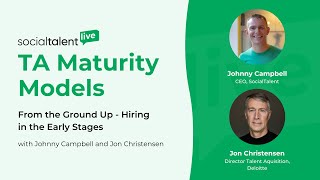
Jan Christiansen, Director of Talent Acquisition at Deloitte Luxembourg, walks through TA maturity across tooling, KPIs, org structure, and processes. Start with metrics like time-to-hire and recruiter productivity to find gaps. Use candidate and hiring-manager NPS to move past anecdotes, and build data fluency with tools like LinkedIn Talent Insights to earn business trust.
Chapters
It's a pleasure to welcome. Joining us from Luxembourg, Jan Christiansen. Jan is director of talent acquisition at Deloitte in Luxembourg. Jan, you're very welcome to today's stlive.
Good to see you. Thanks for being here and thanks for having me on the show. Not at all.
So Jan, would you perhaps start by sharing a little bit about your career, Maybe tell us a little bit about Lloyd in Luxembourg, but maybe a little bit the other roles you've had over the years and maybe just give us a high level comment on maturity as it affects some of the businesses you worked in and some of the TA teams you've led over the years.
Yeah, so just my background as well. It's been recruiting my whole career. Started out agency recruiting in Silicon Valley back in the pre.com days. So that kind of dates me just a little bit. Moved to Amazon in 2010 up in Seattle and then from Seattle I moved with Amazon to Luxembourg, which is where the EU headquarters are. After a few more years with Amazon, it was a total of nine years. I went to a small company called Spire. Big difference. Amazon when I left was seven or eight hundred thousand people. I joined a company with 160 across six or seven offices around the globe. Left there last summer. So I was there for just five years and joined Deloitte starting in January. Definitely seen a wide spectrum of things that are advanced, some of it at Amazon, things that are starting from ground up and that would be at Spire and then now here at Deloitte. I haven't been here long enough to really make that assessment yet. Where we're at, obviously that's what we're looking at, but I think most of the stories and things that we talk about today will be from both the Spire and Amazon days. And just reflecting really quick on what you're saying as you're going through the polls. And you know, the thing is, is you're as an organization, you're never just for everything at one maturity. I think it's different for each because you're going through that. Like our ats, I would put us at three or four, but for metrics I would probably put it like two or three. And so there's no way you're going to be in the same for everything. You get used to where you're at and then what do you do to move that particular part forward?
So I love that point. When we were building out the maturity model, one of the key things was to understand that there's different aspects of maturity. And to your point, you're not at a three as a whole organization or a two or four. You typically are at different levels of maturity at different aspects. And some of them are interconnected, some of them perhaps not. And I like to first share with you, Jan, this concept of how we broke out the five dimensions being toolings. Your tooling, your KPIs, your org structure, your processes and capabilities. One of those jumped out at you and you said to me, that's where I'd always start for you. Would you mind sharing with which of those five was the one you said you'd start with and why?
And that's metrics, because. So using Spire as an example. So when I joined, it was 160, 180 people, something like that. There was two recruiters. There was no process. We had ATS. Of course the big complaint was nobody's getting hired, which of course isn't true, but that was what everybody was perceiving. And so the first thing I had to do is really figure out what is happening. And so I spent a good first month digging through the ats, figuring out the metrics and being able to use that to start driving some of the conversations, like, here's where recruiting's at, but also using those metrics to figure out where is something wrong, what do we need to. Where do we need to adjust? And so there was things we used at Amazon use recruiter productivity. So I kind of brought that over to. Into Spire. It could be time to hire, which we didn't use at Amazon. At least when I was there to. We were really using it there. And so it's, it's looking at each one of these and they tell you a different story about where things are at. And they kind of give you an idea of, okay, where do I dive in to figure out what I need to do. Just thinking about Spire, time to hire was one of the areas. And of course, it's never fast enough for anybody. But the. It was interesting to go through and say, okay, at each stage, this is how long we are taking to do something. But we all know, those of us in recruiting all know, of course, that it's not necessarily the recruiters that are holding things back. There's the business as a part. There's accountability there too. And so it was sharing that with the business. And that's where there really was some eyes kind of wide or opening wide, saying, oh, we can help with this, or this is our part in it. Some of you still take some influence to get them to do that. But that was Just an example of where I was using a metric to actually drive some performance and some change in the business there.
So one of the challenges, Jan, when somebody is listening to a panel like this or they're reading a report or a maturity model and they hear one company, for example, Amazon might say, this is what we do. And often times it's tempting to say, well that's what Amazon do, so we need to copy it. But you know, your experience I think has been different, you know, with different businesses, some very different types of businesses there. You know, what, what's your view on, you know, the type of KPIs you report on and then the business you're in and where it's at. Like how, you know, how much variance is there there, how much have you seen across different organizations?
I think there's, there's baseline KPIs that we should have everywhere, right? I don't really care where you're at. And there's time to hire is probably one of them in my mind. Recruiter productivity to make sure that, you know, we're using the recruiters and they've got the tools and things to be productive. And if we're investing in more tools, are they becoming more productive? For me, the candidate NPS or the candidate surveys, candidate experience surveys or are really critical because they also give you a lot of insight what's happening in interview process. Another one that I started in one of the groups I was in at Amazon, but it really didn't roll out until I was in spire is a hiring manager NPS score because you have of course, and I'll speak for myself, most the managers that I hear from that just contact me on their own is more because something's not working right and that can get hard on recruiting teams. But what I found is with the hiring in hiring manager NPS score, so there was a survey, went after every hiring manager after they hired somebody and all of a sudden we start seeing it fire. The scores were actually relatively higher. NPS was 60 ish or something like that, which is pretty solid for the hiring manager side. But if you went with the complaints which you were only hearing, you would think we were like below zero. So using that to say, you know what, we are doing some things right now, let's take whatever comments we're getting and improve on that or figure what we need to do. But that one also shut down A lot of what I was hearing from the business about recruiting isn't doing what they need to do.
So one of the other elements we discussed when we talked about maturity of a team or the type of processes and even the org structure that was set up within that. Um, and it's not always linear. There isn't a, this is the, always the way to go and this is the one structure that works for everything. You've worked in scale ups, you've worked in established businesses, you've worked in tech, you've you know, moving into I imagine in Deloitte a lot more early in career hiring. Walk me through the kind of your view on what are the right processes or structures for different types of recruiting. Maybe give me some of the examples of where for one type of recruiting it's this process and another type of recruiting you'd probably do it differently.
Yeah, it, you know that was one of the big learning experiences I had when I left Amazon to go to Spire. At Amazon, everything for me, I don't.
Know, it's just my mic.
No, it doesn't say I'm on mute.
You're good.
Okay. So Amazon was very different than you know, from a scale point of view than you would see at, at, at Spire. And it took me a little bit when I moved over that I can't, I didn't, it wasn't. I kind of knew this was going to happen but the instinct was to go to the same things I'd done before. But at Amazon it was the first role I had was leading a team of recruiters really focus on a very, very tech heavy focused business. And so the vast majority of what we were hiring were software engineers and we had to think about how can we build out the teams we needed to. And so part of that was okay, do we need to open offices in different places? We used to send recruiting interviewing teams to different countries in like low cost areas that people would want to move to the US and so that was a whole different way of recruiting and we called it event recruiting and it worked well. We got a lot of engineers that way. But then as I moved into, I moved over to Europe and I'm in Europe where we were pulling the people out to go to the US doesn't work the same. And so we had to rethink about how are we doing our recruiting for the engineering populations. And there was, to be fair it was a lot more branding type things. But then followed up with there's just a lot of peer headhunting happening. And then the last role I had there was very much high volume recruiting in that we were hiring a bunch of were called data analysts and they Were people might remember when Alexa was getting started that the Alexa is recording everything you say and so people were actually transcribing and then they would put those that information back into the models to help Alexa become smarter. That is very much a high volume. We hired like 4,000 people in a year across various countries for different languages. And the recruiting model for that was very different in each country we were each country we were in. And so we had to think about that one differently. In some of the countries it was purely through outsourced firms to help us bring their contracting firms to help us bring people in quick enough. Others were where we had just on site recruiting and there was just constant turnover and they were doing that. I come to spire and now the volumes are so much less. It's very different. And I didn't have even enough recruiters to handle the volume that was there. And I really to think about how do I set this up. And I I ended up setting up so that we had one person dealing geography geographically with the US because they could cover that from a time zone point of view. And then I had because more of the hiring was happening in Europe. More I had three recruiters in Europe focused on the hiring in Europe. But over time by the time I left we had changed it to functional recruiting. So people were a tech recruiter global or people were a sales recruiter or business recruiter but on a global basis. And it just is what had worked as the business shifted. So you want to you think about how do you need to be aligned again to solve those business problems.
I think this is what we observe when it comes to maturity is that as you mature you realize that there are different processes needed for different types of hiring. Perhaps different geographies for different business lines.
And.
And that is fluid that can change depending on market availability of talent. How difficult it is for your business to hire those folks are not the business priority of those roles may shift as you move into new markets or different strategies as well. But one of the important things that you I know shared with me Jan, I'd love you to maybe talk about was on the capability side was the importance about being able to communicate with data and to be able to kind of build trust. So talk to me about that capability, that muscle within a TA team and your experience there.
Yeah, so I had Amazon was really strong generally I'd say not every single person like this but generally Amazon the teams are very strong on using data. There was just a huge push for that. And you would go into any meeting you had with a manager you would. Or senior leaders for the, for the bigger meetings, it was all about the data. And you were showing what you had done to either increase the volumes, the steps you were taking to. And so there was, you know, how are you progressing against the targets? It's what are the steps that you're taking to do it? So you're coming in constantly with some form of data. Not necessarily just a single number, but some form of data. When I got to Spire, the two recruiters I had at that point were, to be fair, fairly junior. And they didn't even have the confidence to use the data, much less. It wasn't that easy getting out of the ats, and they hadn't taken time. But once I started using this data with the leaders in the company, there was a while recruiting knows what they're doing. And that was a really. For them, it was a comforting feeling. And when I actually left there and then the person who was backfilling me, I had one of the leaders come to me and say, it just isn't working like it was before. We're not getting the information. So having that data is an important thing. And just one quick story, I think, here from Deloitte in that I was meeting with one of our partners and. And he had kind of complained, not complained, but he was talking about how he had some very difficult to fill, like, tax roles. And I thought, well, okay, we can figure this out. Figure out where the people are. So I come back to my office, kind of play around with talent in LinkedIn, Talent Insights, and go back to his office and show him, say, here's what LinkedIn says. Here's where we're going to find these pools of people. And he was super excited about that. It's the first time somebody had come to him and saying, here's how I can help you. Here's where we're gonna go find people. Not just random searching on LinkedIn. And so this particular recruiter's on holiday that I was, when I was talking to him. So he says, what do I need to do next? This is. Well, you and the recruiter can sit down, you guys can play with this and figure out where the right pool of people you are, and then walk through each of the profiles and figure out which ones are the right ones, and then she can contact them. But it was that kind of using, again, data that builds that confidence, builds that trust that we're here to advise and help them. And that's where, as a team here, I want to get my team to. And as I've my spire team is the same way. Amazon, a lot of it was already there, so it wasn't as much moving the needle to the right. But.
I might ask in a general sense that from a capability of leadership, John, to kind of finish up on, you know, if you have somebody who's navigating this transition wherever it is on that scale, you know, what's been your learning as as Joshua has pointed out in the chat. Brilliant. To be able to have worked in different environments from massive scaling and massive volume to smaller volume. What's. Are there any kind of singular pieces of advice you could give to somebody regardless of where they're at around how do you navigate that change through these different levels of maturity?
Yeah, and there's one thing, and this is one of the things I love about where I'm at now is I love dealing in ambiguity. So I don't know the answer. Right. And so but what I have to do is go find out what that answer is. And so when you come into a new place or you're in a situation, you just don't know the answer. Start asking questions, start doing research, start asking, start interviewing some of the business. What would you like to see in talent? What would. What would great look like to you? What are some of the things that you think are missing? What does work well and so you can things like where are the pain points? What are the types of people, whatever. There's a lot of things you can ask to kind of build this picture for yourself and then that. And that's what I did here is I built this picture for myself of what's going on and now I can put together the story, the framework to go drive where we need to go.
We could probably continue this conversation for.
Another half an hour. I love talking about but I know we've got it.
We got to move on. It's been a pleasure to chat to you. Say thanks for sharing those insights. I think we've got questions and comments that we're not going to get to unfortunately just this time. But perhaps if you have time, you wouldn't mind jumping back into the chat and the questions. There's a few there for you to try and help audience. Jan, thank you so much for starting us off and sharing those insights.
You bet. I'll just go mute and hang out and watch.
More from Johnny


Where Does Your Hiring Stand? Diagnose It with the Maturity Model | SocialTalent

Where Does Your Hiring Stand? Diagnose It with the Maturity Model | SocialTalent






NEW CONTENT - How to use Generative AI for Recruitment Marketing with Glen Cathey | SocialTalent

NEW CONTENT - How to Use Generative AI for Sourcing & Recruiting with Glen Cathey | SocialTalent

NEW CONTENT - How to Unlock the Power of Generative AI with Glen Cathey | SocialTalent