SocialTalent Live: TA Maturity Models | Mastering TA Maturity: Advanced Strategies in Action
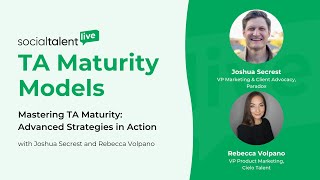
Johnny Campbell hosts Joshua Sechris and Rebecca Volpano to discuss how talent acquisition drives business results. McDonald's saw major revenue impact from understaffing and slow hiring. Cielo handles 500,000 hires yearly and measures success beyond time-to-fill, tracking quality-of-hire and time-to-performance instead.
Chapters
In our final chat on this month's Social Talent Live, I'm delighted to hand things over to Joshua Sechris, Sechrest from Paradox. Joshua is VP of marketing and client advocacy at Paradox, but formerly the head of talent acquisition at McDonald's, worked in Abercrombie and Fitch, so he is one of us in terms of being in this market, as is his guest, Rebecca Volpano. Rebecca works in Cielo Talent. I'm sure she'll tell you more about Cielo if you're not familiar with it. And I think you'd be super interested to understand her perspective on scaled hiring as Joshua has a great conversation to talk about what perhaps maybe the higher level of excellence looks like. Joshua, I'll hand it over to you.
Awesome, Jonny. Thank you. Hi, Rebecca.
Hey, how's it going?
Hi everyone. This is so good to. I'm so excited for our chat. I'm gonna start with a quick story that's gonna then set up how we're gonna really structure this. Cause I love this. This topic of maturity model. And I think the holy grail for all of us as TA practitioners and strategists is driving ultimately revenue and business results off of all the day to day work that we're all doing. So Johnny gave me a nice little layup of. Before joining Paradox, I was head of global talent acquisition at McDonald's. That was over frontline restaurant hiring as well as corporate hiring. Rebecca, do you remember how many hires we were doing per year?
Oh my gosh. Yeah. Probably more than Cielo combined.
How many are you doing per year?
See, Half. Half a billion. Wow.
Wow. Yeah. So we were doing 2 million. And that's predominantly restaurant hiring. And it was 120 countries and about 40,000 restaurants. And that just keeps kind of growing and growing. But the anecdote I wanted to share, because I think it ties really nicely and it's why I geek out so much chatting with you is when I came in, I heard that we were understaffed by about 20% of our restaurants. Were understaffed, you say? Oh, that's probably pretty common in quick service restaurant. If I say QSR to this group, I mean quick service restaurants, fast food. And so like, what's the big deal of that? And what we were able to see is there's essentially a vicious cycle within a restaurant. So if you were understaffed, then it led to more turnover, slower ticket times. Right. Like longer lines, slower ticket times. And ultimately we could quantify the revenue loss per day by being understaffed by one person. I can't give you McDonald's exact numbers, but the QSR numbers were essentially $500 on average. You lose per day by being understaffed by one person because you're not getting food out as much. Right. You're slowing down. Our time to hire, when I, when I was stepped in was 21 days. So $10,000, $10,500 per hire, essentially, that was being lost from a revenue standpoint. So we brought this data to our cfo. We were able to say, hey, we've got really good data that supports that we need to be hiring faster because it's actually revenue driving. And so what we were able to do is we were able to automate a lot. Got that down to about three days. So a recoup of about $9,000 per hire for the business resulting in. You do that math, that's over billions of dollars, a billion dollars in revenue. And it was just really exciting and interesting because it was this like, oh my gosh, TA as a business and revenue driver. And so I think that segues into like, can't wait to pick your brain. I think everybody can't wait to hear from you because Cielo, I mean, you and your, your executive team peers are running an organization where your revenue is directly tied to talent acquisition results, right? I mean, your business model that we're going to dive into is, is hiring and actually driving revenue off of that. So we're going to dig in, really, kind of starting there, and then we're going to kind of pull back as much as you're willing to share. I told Rebecca I'm going to hit her with some hard questions, but obviously she can't divulge all data and results. But maybe let's start with Rebecca, your, your background and your role at Cielo and give us just a touch of what Cielo is and then I'll kind of dig into the business.
Business side for sure. Well, and when I think of McDonald's, I always think of billion with a B. So I know you are doing substantial hiring and also serving many customers across the globe. So for Cielo, for those of you who don't know who we are, we're a global talent acquisition partner. We're about mid market enterprise. So hundreds of millions in annual revenue and close to, I would say a half a million in hires every year. And that's all of us in talent acquisition. So 3,000 employees globally, about 70% of those are recruiters or individuals who are directly in front of candidates and hiring managers. And so as Josh mentioned, you know, we are an entire organization of talent, individuals, a recruiting team. So probably one of the largest globally, if I had to guess. And because it's all we do, we spend a lot of time obviously looking to figure out how to, how we can do things better, how we can make sure that we are optimized at scale and really in that highly advanced talent maturity model. For me personally, I've been in HR technology for the last decade. I spent a lot of time trying to understand different applicant tracking systems, how they connect with HRIS tools and other LMS systems. Then I moved into a client success and support role where I got to spend a ton of time with, with our clients and our candidates to really understand what do we need to bring forward in HR technology to make all of these things really happen and to provide this best in class candidate and hiring manager and recruiter experience. I then moved into our product team. So I helped our organization determine what types of products and services should we make available to the market. And then recently I've moved into product marketing. So I get to now share all of the great things that Cielo is working on in forums like this. So I'm really excited to be here and thank you.
You sit on our client advisory board, which kind of helps us advise on our product roadmap and sort of what we should be prioritizing, what we should be building. So a lot of the cool things we bring out, usually it's tied to exactly what TA leaders need. And it's always fun picking your brain. I love the Cielo model of right. It's how would a TA leader operate if revenue is directly on the line for all of us, it's directly on the line, but sometimes it takes a couple dots to kind of showcase the direct impact. I mean, for you, there's some really interesting pieces around. You need to optimize revenue, you need to create margin, which means potentially bringing some costs down. But your ultimate product, your delivery and experience to your customers has to be a really great product. So there's kind of a balance. And I mean, you all are having to think about this as entrepreneurs, as sort of business C suite. Can you just kind of talk about that push pull of managing cost and investment and how you're thinking about that relative to the experience you're delivering to customers and the hiring volume that you need to produce?
Yeah, well, and I would say one of the things that we continue to put at the center of all of this is experience. So when I'm looking at ways to implement new technology and what type of cost savings or different allocation that might mean for our team. We always focus on the experience first. And so if there is, you know, a bright, shiny piece of technology that we could implement that's going to negatively impact those experiences of candidates, recruiters, and hiring leaders, we don't implement that. So this is not just a, okay, let's see how cost effectively we can do something and then, you know, let the experience fall to the wayside. But things that we look at, so using kind of experience as that, that same core, we look at that to determine where we can and should get better. So we mapped out across the recruiting value chain how much time resource is spent in certain parts of the recruiting funnel. And so we found that sourcing was a huge one. So was interview scheduling. So that could have been kind of coordinating a recruiter screen or a hiring manager interview. And we looked at these things where we're like, wow, we're really spending a ton of time and dollars in these areas, not dissimilar to what you were saying about McDonald's. And then looking at technology to one, make us more efficient in that area from a time and resources perspective, but also like, how can we make this experience a ton better for the candidate? So that's, you know, and Marianne kind of alluded to this as well. That's where, you know, a partnership with paradox comes in. And we can automate a huge part of, you know, the administrative burden, but still provide an awesome experience for the candidate and the recruiter. So we're not spending, you know, a ton of resource in, in those kind of administrative pieces. So that would be one area that I would say, you know, aside from looking at, you know, cost reduction specifically, we still always lead with the experience in mind.
Yeah, ultimately you need to deliver a high, high quality product. And I love that you're leaning on experience. One of the pieces is we saw automation being able to be kind of a game changer for us within McDonald's. One of the rules we basically said was we can automate as much as we want to, but the candidate experience, because for us, There was right, 100% overlap the candidate experience with customers. The candidate experience had to also improve. And so we went from not tracking candidate experience to reporting candidate experience only from candidates who did not receive offers from us, because ultimately those could be customers who were frustrated. But by doing that, it sort of held our feet to the fire on, like, delivering a great experience. We heard a little bit from Marianne. I love that conversation and kind of talking about tellers versus, you know, corporate side. Can you break down just, I mean, what is your sort of, your book of business? I mean, how much of it sort of is on this like high volume side versus corporate? And then how do you approach those experiences and processes different? Because I feel like that's a big part of what we're seeing from some of you all. At this like level 5 maturity curve, there are a couple of things you're directly tied to business results. You're almost beyond KPIs that are just TA results. And two, you're really sophisticated on kind of segmenting.
Yeah. So for our business, I would say we're about, it really is about half high volume and half kind of professional services or corporate hiring in terms of volumes. And the verticals that we are strongest in, where we have the most clients are going to be in health care, life sciences. And then we've got like advanced manufacturing and retail are kind of like our, our top four. And so what we've designed and I love this kind of in the, you know, the middle of the maturity model, you're kind of going for standardization, right? You're like, okay, we need all of these business units and our recruiting functions to be kind of the same with maybe little nuance because we're really trying to drive standard process and efficiency. When you get to, you know, a bit higher advancement in the maturity model and especially with some of the AI tools that you can now bring in, you can start to like weave nuance back into the process without it affecting kind of your operational excellence. So what we're seeing with generative AI specifically, you can introduce like hyper personalization into a specific candidate process or into a region and it won't negatively impact the way that you're operating. So you're almost, it's almost like you're coming full circle where, you know, Jan started about like, hey, everything's bespoke and we're, we're really responding to the needs in the moment. You almost get the best of both worlds because you are relying so heavily on the technology to provide this operational lift that you get to start kind of adjusting it and fine tuning it to make, make it easier in certain places.
We always talk a lot on kind of the adoption curve and it was interesting for me. I was one of the first to. I was the first user at McDonald's for the conversational ATS that paradox has. It was interesting jumping over to paradox because then you kind of saw sort of like early adopters, Cielo being one of them. And then as kind of more folks do that. So it's clear that as you see more people adopting, it sort of gets more comfortable and it's easier to maybe bring your CTO and your cfo. CLO is obviously like, very much on, like, the bleeding edge. You're always willing to kind of prototype and try new things, and you've got a leadership team that. That is, like, really pushing us for that. I guess it seems like that's one of the things that kind of in this big RPO sort of market, gives you a competitive edge. You already kind of touched a little too, on experience and those couple things together that you're prioritizing that maybe give you a faster product and a higher quality product. But can you just kind of talk about this? Cielo's sort of been this gold standard within the rpo. How do you keep that competitive edge? What's the secret sauce from a TA standpoint? Help us break that down?
Yeah, sure. I mean, it's a big one to break down, but definitely, I think one of the things for us, and you're right, like, I think our organization was founded on innovation. Like, our founder, Sue Marks, was always trying to be kind of ahead of the curve, especially with technology. And so we've always had kind of this tech lean, mean. And, you know, now staying ahead of the curve really does mean expanding into more tech. So generative AI, how do we start building some of our own things internally? How do we lean into strong partnerships with, you know, organizations like Paradox to make sure that we're continuously iterating on the process? So I love, you know, the individuals that kind of were in the poll that said, yes, we continually evaluate our process, and we're always looking for the next best thing. I would say Cielo is right there alongside you. And where we get that information, like, where do we innovate, what do we iterate on, is definitely coming from our client base, it's coming from our candidates. It doesn't mean that we always implement exactly what they're asking for. It might be that we, you know, obviously we take the sentiment and try and figure out, like, okay, this is the end goal, the outcome that they want or that we want.
And.
And how do we kind of work backwards from that and start designing with the end of that in mind? I would say, you know, I'm also just really lucky to work with a lot of individuals who aren't afraid to ask some of the big, challenging and kind of, you know, hairy questions that are out there. I Mean, perfect example. We have a conversation with our chief product officer probably once a month where he's like, what if there are no more resumes? What if there are no more requisitions? And so some of us, it's like, whoa, okay, give us a minute to like, digest exactly what you're asking us to try and think through. But I think it's asking kind of those big questions of yourself, like having the courage to say, like, what if we did blow this whole thing up? Like, what would happen and what would we want to land at the result of that? So don't be afraid to ask the big questions. I guess I would, I would say.
I think you're making a lot of us jealous though, with maybe the risk tolerance of your leadership team. I think sometimes those larger organizations, it's really hard to get it through legal, it's really hard to get it through C suite. So it's neat that you almost have this green light and you're a fun one to listen to on stage and through these because it's like, because you have that green light, you're kind of getting to dabble in some stuff a little bit before maybe the rest of us, which is, I think, really, really cool. I wanted to dive into KPIs. What can you share? What, what would be unique to share? Kind of just knowing how much your TA team ties to ultimately the revenue you need to, to to drive. What does that look like within Cielo? What are some of your favorites?
Yeah, well, and so kind of just before I get into that, so. So, you know, as I'm sure everyone now understands, you know, our organization, where we live and breathe, talent acquisition, that's all we do. And so that is what drives our revenue. And so for us, we're generally compensated when a role closes. That is the measure of success for us. So we have to be like really operationally efficient throughout the process. But now when we look at like advanced talent maturity, and it's not enough to just say like, great, we closed the role and we're done. But how are we starting to embed ourselves into the organization as the strategic workforce planning partner? How are we measuring? So to start, to answer your question about KPIs, really trying to pick apart quality of hire, like, what exactly does that mean? It's a bit elusive. And how are we going to measure that? So, so things like employee check ins and engagement throughout their 30, 60, 90 day mark, things like time to performance in their role, we're also looking at, and I don't know that this is a KPI yet, but something that we're trying to define a bit more is, is looking at what skill gaps are in your team. So before, like, maybe five or six years ago, we were looking at, you know, AI, AI matching tools or tools that would share, you know, okay, take this, these top 10 performers, or find me another candidate like this. We want a little bit more of the same because we know that this person is going to be a really great fit. What we're actually starting to do is take all of the profiles of the team that currently exists and like, let's show us the gaps. So we're not trying to find another Josh or another Rebecca, although I'm sure that they're probably cool people. We actually want to find, like, who is the missing. The missing piece. And so actually looking at evaluating the skills within the existing team and coming up with the competencies and skills to find that missing link instead of, you know, more of more of the same and. And inadvertently kind of homogenizing our workforce. So not a KPI yet, I would say, but something that we're starting to infuse into our work to see if that drives, you know, a reduction in bias and ultimately, like, help us with the overall quality of the team. We still use metrics, so I know a couple have been brought up today, but, like, we still look at things like time to fill, although I would say that it's not a. A KPI that we use to measure the success of our team. So, like Marianne was saying, it's like, it's not about time to fill, it's not about source of hire. But we're still using that to determine, like, do we have operational health and are we still moving candidates through the process as quickly as we were now that we're kind of testing some things out and introducing some new ways of working. But definitely quality is one that we've been focused on.
I think it's really refreshing to hear that because I think probably some of us who've been right in the business for decades now, sometimes when you hear rpo, the concern is on quality. And because it's like, oh, you can very much see that key metric is like, sort of the faster you fill. To your point, as soon as that hire is made, that's when you get revenue. Right. And. And it's like, why people stick with you and keep coming back for more is the hires actually work out.
Yeah.
So you have to be thinking about that piece. We are. We are at the tail end of time. But I have, I think we can cover this in a minute. And I just think it's really interesting because of kind of everything we all read on LinkedIn about like automation and how does that impact the workforce? And, and I think we have a, we have a, we have a decision at the end of the day. And I think it was really helpful hearing you kind of, and how Cielo approached this. You ultimately brought in a lot of automation into your organization to hire faster, better, stronger. That could have allowed for you to reduce headcount drastically and create, back to our kind of starting point, a lot more margin. You ultimately decided to not do that and did something else instead. Can you just kind of walk through sort of the decision making process you did there?
Yeah. I mean, again, I think like, technology really allows us to do more with more. I think we always go into, you know, a conversation with a tech provider thinking, like, how is this going to make us more efficient? And that generally equates to a smaller team. I think some of us as TA leaders think like, is this going to decimate my team if I implement this? And then I won't have the people to kind of pick up the pieces if we need to make some changes. And so I think going into it and thinking about how much more can you actually get to opening the aperture and really figuring out, like, are we actually able to get to more talent? Can we start to have conversations around skills and competencies? And so for us, you know, it was really about, like, how do we, how do we provide this level of service to our clients that is more than what, you know, our competition is providing because maybe some of them are focused a bit more on cost. And we're trying to say, you know, this is actually going to allow them to do more things. And like, again, going back to Marianne's comments about like, becoming a talent advisor, we don't want our recruiters to be order takers and for it to be very transactional. We want them to be providing this level of service. So for us, it is about elevating the experience. It's not about the, the cost savings. I mean, they're there. I want to, you know, want to be transparent with everyone. You know, you've, you, you put, there's going to be, you know, individuals on the team that move into other roles. And again, like, assessing skills and competencies is a huge part of that. But go into it with the.
The.
Mindset of, like, how can we actually do more with this technology instead of, you know, this, this meaning a lot Less for us.
Well, and it's a sophisticated conversation and some of it's driven by your C suite and you all anchoring your key data points on the key like business results that are needed, which are like pretty simple, largely revenue and margin. And by you anchoring the, you kind of overall team on, you know, on those, it actually allowed for a really helpful conversation of, hey, we're at a point in time where we can increase productivity and increase volume, which could increase revenue, but we're going to need our cost infrastructure to go up a little bit. But the bet here in our numbers would say that creates more margin along with more revenue. Do you think we should go in that direction versus just staying at the same productivity level but reducing costs? Yes, margin would go up, but ultimately there'd be, you know, less, less pie at the end of the day. And I think that's just like you all are thinking like it's, it's business people and within that it's really smart and savvy numbers, but also that your ultimate product you deliver, which for you is fantastic employees and a fantastic experience to your clients, has to be in place. Otherwise it's just, it's short term gains instead of long term gains. So, yeah, it's always so wonderful picking your brain and thank you for the, for joining and hopefully everybody got a lot of this and a lot out of this. And I'll kick it back to Johnny to close out.
More from Johnny


Where Does Your Hiring Stand? Diagnose It with the Maturity Model | SocialTalent

Where Does Your Hiring Stand? Diagnose It with the Maturity Model | SocialTalent






NEW CONTENT - How to use Generative AI for Recruitment Marketing with Glen Cathey | SocialTalent

NEW CONTENT - How to Use Generative AI for Sourcing & Recruiting with Glen Cathey | SocialTalent

NEW CONTENT - How to Unlock the Power of Generative AI with Glen Cathey | SocialTalent