SocialTalent Live: TA Maturity Models | Scaling TA - Lessons from the Mid-Maturity Stage
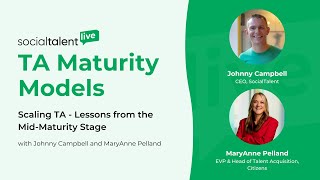
Recorded interview (SocialTalent Live) with Marianne Pellant, EVP & Head of Talent Acquisition at Citizens Bank, describing Citizens’ TA strategy and mid-maturity scaling lessons. Key themes: candidate-as-customer mindset and a formal ‘Candidate Promise’; segmentation of processes (high-volume roles vs. strategic/emerging roles); KPIs and benchmarking (Glassdoor, just-in-time candidate surveys); recruiter capability shift from order-taker to talent advisor; tech stack maturity (Oracle Recruiting Cloud, chatbot, automated scheduling, pre-hire assessments, video interviewing, AI matching, recent launch of generative AI); and measurement practices (20–30% survey response rate; target ~20–25 surveys before acting on trends).
Questions this video answers
About 18,000 employees.
Between 20% and 30% response rate.
They look for between 20–25 surveys before looking for trends and opportunities.
Oracle Recruiting Cloud (Oracle's newer model).
Generative AI (launched at Citizens).
Chapters
Which brings us on to our next interview. As I mentioned earlier, I'm delighted to welcome Marianne Pellant, the EVP and head of Talent Acquisition at Citizens, a Bank in the United States, to join us here today. Marianne, you're very welcome to your first st live, I believe.
Thank you. I am incredibly excited. Thank you Johnny and hello ta friends. Nice to be here.
Marianne, where are you joining us from today? And for those of you who, those of our listeners who are not perhaps familiar with Citizens, because we have a huge number who are outside the US Tell us a little bit about citizens, the organization and your team.
Sure. So I am in the very smallest state in the United States right now. I am sitting in Rhode Island. Our headquarters is Providence, Rhode Island. However, we are a super regional bank that aligns against New England and the Mid Atlantic regions. We have about 18,000 employees. We deal with both our commercial customers and our consumer customers and we work with all levels of candidate. I'm sorry I always say candidate instead of customer. You know where my heart is. So from a customer standpoint, we every segment we manage so and we, you know, truly believe in our credo, which is ensuring people are living up to their potential both for our customers, our colleagues and our communities. And so that's we live and breathe that here.
So what kind of hiring volumes are we talking about per year on average? And I appreciate it fluctuates. And what kind of skills are you hiring for?
Sure, so most people think banks and they think tellers and bankers. And yes, we do plenty of that. But we also are building and transforming our technology, our data, our digital platforms, digital marketing as an example. So we do all types of emerging talent, executive and leadership, early career programs, as well as the traditional banking roles you think about.
By the way, Jan is just making a point that I have to point out to you, Marianne. Luxembourg is smaller than Rhode island, so.
But it sounds way cooler. I'm not going to lie.
It does. It has a certain attractiveness to it for sure. So maybe Marianne, for, for those listening who aren't maybe familiar with that kind of scale and that kind of environment and I want to add in, I think there's a particular nuance to hiring for an organization like Citizens bank because you have this perspective where you tripped over it yourself. Candidates are customers. Every single candidate who could apply to Citizens could be a customer. I think there's a particular difference there for consumer oriented brands around how they do ta because I think you have to have such a candidate focus. So maybe if you don't mind starting with your KPIs and your metrics. What do you measure? What do you like to measure? What are you not measuring that you'd like to change?
Sure. So you can't see the whole thing behind me, but this is a giant sign in our interview suite around Candidate Promise. We started our transformation with ensuring we stacked and aligned to how we were going to ensure we differentiate ourselves to the market by increasing and improving candidate experience. We want that to be a distinction for us here at Citizens. So no surprise our data illustrates that. We look at what our brand, how it's resonating out into the market. So we look at the things like Glassdoor and but beyond that, we do just in time candidate surveys. So we identify at every point in the recruiting phase we're asking how we're doing. So it's not just the people who get hired. We really want to understand how we're showing up for, for our audience because of that very same thing, Johnny, is that no matter how people, you know, show up, they are potential customers or customers are. So if we don't hire them, we want to ensure that they still leave feeling that Citizens is a great brand. Beyond that though, we do look at staffing demands. You know, the traditional KPIs like time to fill. We look at capacity, how many recs per recruiter, we look at what are some of the other like our source of hire and we look at how we're doing from an efficiency standpoint. So those are, those are parts of this. And Jan actually talked about something. We do a hiring manager survey as well. However, it's not an nps. We actually are checking to see that our recruiters are delivering as talent advisors. So we're looking to see whether we're showing up the way we've committed to. So it's less about them liking us, but more in terms of are we delivering value.
I love that. So really checking on the process and are you delivering on the process and the Promise, so to speak. I'm going to put a question to you, if you don't mind, Marianne. That was actually initially for Jan, but I think it's relevant to the point you make. And it's from Peter and he's wondering what would be the benchmark response rate. Maybe you could answer that from the candidate perspective, but also from the hiring manager perspective. It's a question a lot of people often ask if they have started surveying before.
So we've received between a 20 and 30% response rate and according to our HR analytics team they feel very good that that's a solid response rate. We are careful though, in looking at individual survey results, how many each of the recruiter gets right, because I think Jan had mentioned if one person can say it's awful, you know, you don't want to paint the picture that that person isn't doing their job. It could be one bad experience. So we look at having between 2025 surveys before we really look for trends and opportunities. So that's, that's where we've been targeted from a benchmark standpoint. In Glassdoor, we also rank ourselves against other US banks and so all of our reporting and our metrics are aligned against that particular benchmark. But anytime I can get an external benchmark, I use that.
I love that I've actually used that example with others. I may have stolen it from you, Marianne, where somebody has given me their Glassdoor score within a certain industry and they're maybe proud of it and I've gone great. Who are your biggest competitors? And they've listed five companies. I've gone in and found their lastor scores and say, you know what, you're, you're fourth from your fourth out of five. How do you feel about that now? It's like, oh, I think the number on its own might not be terribly relevant. But how do you, how do you, how do you compare to people that your candidates are probably also going to be interviewing with? That's what perhaps matter.
We also look at where our, our location is too. So we don't just look at the banks, we look at who are we competing with in the markets in which we serv. To ensure that we're also. Because, you know, it's great for tech talent and digital talent and data talent. They don't have to choose banking. They can really choose anything. So we want to ensure we're, we're double checking.
So I'll ask you about.
I'm so sorry, I have to, I have to do a slight brag only because my team worked incredibly hard. But we were. To your example, we were number nine in candidate interview experience. We've now moved up to two. Um, so it is something to ensure. Right. Like those who fall behind or four out of five. You can pull yourself up, but it helps knowing where you're at and where you're starting and what you need to do to get there.
And this echoes Jan's point on KPI's data is so important because how do you know you're getting better? How do you know you're improving unless you have this data. I want to ask you about processes because obviously this is one of the elements on the maturity model we've looked at in terms of reactive all the way to adaptive. But maybe through the lens of candidate experience we what role has building that importance on the candidate promise had on the design of the processes? You have Mace, maybe you can walk us through some of the processes. You know, explain if they are different for different types of roles or parts of the business and maybe what role has candidate experience played there, if you don't mind?
Candidate experience is a lens we put on everything here. It's whether we do move forward with a technology, whether we adjust a process. So candidate experience is one of the first lenses we put on anything. We also look at recruiter experience because we also want them to feel like they have the capacity and the capability and hiring manager experience. But from a process standpoint, we actually have segmented processes based upon the needs of the organization and their strategic relevance to our direction forward. So not surprising from a recruiting standpoint, we try to drive as much consistency and speed into those high volume roles. So our tellers, our bankers, our contact center, those are areas where we think we can get quality, but we can get it at a much higher speed. Where in areas of those emerging skills we take a much more thoughtful approach and ensure that candidates are brought along the way in a more human interaction. Technology helps on the volume side to keep the candidates aware. But on the more emerging critical roles, we ensure there's a human bond that's happening.
I love that. I love that that probably leans into different capabilities. I know this has been a big passion of yours in terms of looking at the capabilities of not just the recruiters but everyone involved in hiring. Can you maybe share with us about some of those emerging capabilities like where you're at in maybe the last year or two, what capabilities have you brought in and what are you still looking to bring in or what are you looking forward to in terms of, hey, our capabilities are heading in this direction. So where are you coming from? Maybe where are you going to in terms of capabilities?
So in your speaking and about our TA team. Right. Not about our organization.
So yeah, so when it comes to hiring. So again starting with the TA team, which generally in terms of capabilities to hire for the organization.
Yeah. So the TA team, you know, we've gone in the last nine months, we're shifting from order taker to talent advisor. And we are in the middle of that journey and we are excited by it and have done an incredible amount of work to upskill our team, which are doing great, great work. We observe, we create, we coach, we require a lot of practice from our team. And I think that talent advisor, it's about using data, it's about advising and influencing, not just, you know, showing up and being responsive. Right. It's beyond that. And I think the skills and what we're seeing happening in talent acquisition from order taker, and I hate using that term, so please don't misinterpret what. I'm not trying to dismiss the work that they do. However, the talent advice, I really think we're seeing that transition not only in talent acquisition but across talent pools. You know, looking at data, being able to utilize technology, be able to solve problems, being able to influence and be agile, always learning. Right. Those are the skills that we're seeing evolve within any talent organization or talent pools that we're looking for. So I think all skills are continuing to be important, but I think the evolving need to be working in partnership with technology and data I think is a critical one.
So one area I'd love to kind of expand on a little bit is maybe your tech stack because you mentioned obviously this need to evolve this capability to be a business partner and we're seeing this with hiring teams that are trying to I guess bring in tech. And we talked, you talked about automation in parts of your hiring process as well. You're a regulated business though, so maybe the expectation is that, you know, more highly regulated organizations are maybe slower in terms of their tech stack. But would you mind sharing with me, you know, the maturity of your tech stack, where it sits now, what you're experimenting with and why and perhaps where you see that going in the future.
Sure, we are definitely on our journey but I feel really confident in where we are today. I think we all at least who was here through COVID 19, the like proliferation of TA tech was something I had never seen before and it perfectly aligned to investments that we could make. And so we were able to really start to transform our tech stack. So we automated our interview scheduling. We have a chatbot, there might be a vendor who you'll be talking later, who we work with around that. We use pre hire assessments and video interviewing. We just are outlining AI matching that's currently underway as well. And we use Oracle recruiting cloud which is really their Oracle's new model and putting a lot of new technology. And just yesterday at Citizens we launched Generative AI. So we again to regulations, you all might be well ahead of that but for us we're really now starting to embed that into our practices. Where I'd like to go is to get more optimized, where you have less of individual platforms and really have one kind of super source so that the data can flow and we can ultimately get even more efficiency out of the process.
So I have a question here, Marianne, just to go back to a topic from Dom Walker. How have the business leaders embraced the change from order takers to becoming talent advisors, I guess from the recruiters? And how do you train your team to have those crucial conversations with the business if they push back?
Yes, really great question. So part of our transformation was to talk to the business about what we're doing and why we're doing it. That helped with counting, having accountability. Right. So we're telling them, here's why we're doing it, here's how it's going to value, and this is how you can. How you can expect us to show up differently. That also helps our recruiters feel confident to walk in differently than they did yesterday. And so it created a buzz and an interest, and it created an opportunity for people to come in and start behaving differently and showing the value pretty quickly. So that would be how we went about it. And, Johnny, forgive me, I've lost the second part of your question.
That's all right. This is my fault for asking two pronged questions or sharing two pronged questions. So really the question just to bring it back up on stage here from Dom was how have they taken it? And how do you train your team to have those crucial conversations with the business that they push back?
Yeah. Training is so important, and it's really important for you to understand where each member of your team is. Some people will be able to adopt this, have done some level of it already and can get there quicker. And so there's also another vendor who might be hosting this call that I also work with. From a social talent standpoint, we have been very structured in the. The learning journeys that we've had the recruiters take and the leaders take, and we do it together. Leadership and recruiters. And then we hold weekly meetings to talk about how does this look? We learn from one another, the leadership coaches. We spend a significant amount of time ensuring we're building confidence and competence before we put people in an uncomfortable position. Listen, change is uncomfortable. Right. But we want to ensure that they have a level of confidence and competence before they. They move into that sit situation. So we've been doing this for nine months, setting the expectation, starting in January So they had a good six months to start practicing and getting comfortable before those expectations were led and the recruiter scorecard changed drastically this year. We actually are only holding our recruiters accountable to the behaviors in which we expect. For talent advisors, we've actually taken time to fill away. We've taken their source of hire. We really are testing them for their behavior to help to transform how we show up.
Marianne, you've given us a wealth of information in 16 or 17 minutes so far. Even Joshua saying, love how you segment the various roles, how the process and your team change, your approach, your use of tech parole as well. There's lots more comments and questions for you to dive into and celebrations and applause. Now I want to give you applause to your team and to yourself as well, for a real best practice in terms of how you're navigating that maturity and driving the business through that. I think you're doing a wonderful job. Mariana, thank you for sharing so much detail on it over the last 20 minutes. I really appreciate you coming on the show.
Thank you, Johnny. Thank you, everyone.
More from Johnny


Where Does Your Hiring Stand? Diagnose It with the Maturity Model | SocialTalent

Where Does Your Hiring Stand? Diagnose It with the Maturity Model | SocialTalent






NEW CONTENT - How to use Generative AI for Recruitment Marketing with Glen Cathey | SocialTalent

NEW CONTENT - How to Use Generative AI for Sourcing & Recruiting with Glen Cathey | SocialTalent

NEW CONTENT - How to Unlock the Power of Generative AI with Glen Cathey | SocialTalent