Solving the skills shortage with military hiring | with Karin Childress-Wiley
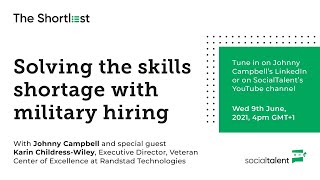
This is a June 2021 YouTube/podcast interview (Social Talent "The Shortlist", Show 54) where host Johnny Campbell speaks with Karin Childress-Wiley (Executive Director, Veterans Center of Excellence, Ronstadt Technologies) about hiring veterans to help solve the skills shortage. Key points: roughly 200k–250k veterans typically exit into civilian life annually (2021 larger due to COVID-related deferred exits); prime transition season is roughly May–August. The military today produces substantial technology talent (Karin cites ~25% in tech roles and up to ~50% tech-adjacent), plus strong pipelines in logistics, transportation/distribution, healthcare and manufacturing. Core claims: veterans bring trainability/learnability, resilience, leadership and high promotability; employers, not veterans, often need to change hiring practices (job descriptions, experience/education filters, ATS) to avoid excluding veterans. Proven employer strategies include on-base training/skills-bridge/apprenticeship programs (examples: Boeing skills translator and on-base training, Salesforce upskilling pathways, Microsoft MSSA), and use of veteran-specific sourcing (LinkedIn, veteran recruiters, referrals, MOS translators and emerging AI matching tools). COVID expanded remote-work opportunities—improving geographic flexibility for transitioning service members and creating broader options for military spouses. Practical next steps for TA teams: audit roles for flexible requirements; hire a veteran recruiter or champion; identify specific skill gaps and stand up short upskilling/apprenticeship solutions. Final advice: discard outdated stereotypes, focus on skills transferability, and build veteran-ready programs to amplify talent pools.
Chapters
Sam. Welcome to show 54 of the shortlist with your host, Johnny Campbell. I'm CEO, co founder of Social Talent and your host for this week's show and podcast on the shortlist, Show 54, where we'll be discussing how we're going to solve the skills shortage with military hiring. So military hiring is something that you or your organization may have been involved in a long time. You may do a lot of military hiring, really engage with the veteran community, or maybe something you're only interested in because you want to field jobs. Either way, we're really glad to have you on the show. I think you're going to be educated and informed, hopefully inspired with a brand new source of talent and a way of interacting with the community you may or may not be too familiar with. Memorial Day in the US has recently been honored and this obviously typically sparks a lot of patriotism for veterans. I was away for an extended weekend vacation and my eldest son, who's 12, who's obsessed with World War II, reminded me that it was, I believe, the 77th anniversary of the D Day landings over the weekend as well. And on Monday or Sunday, he'll kill me for not remembering that correctly. But you know, that shouldn't be the only reason for us to be talking about veteran hiring. Joining me today we've got the fantastic Karen Childress Wiley, and she's the executive director of the Veteran center of Excellence at Ronstadt Technologies. And in her view, the kind of military affiliated community, they come with a very attractive set of skills. And this has been well documented. I've talked to tons of recruiters over the years about that, that they're a crucial benefit for organizations. Actually, the skills that we're now told are the hardest to find, going to be the hardest to develop in folks, arguably are the ones that, you know, members of the armed forces have the most of. Right. And they're, they're highly upskillable as well. And so Karen's going to hopefully take us through, you know, why we should be hiring veterans, how transferable their skills are, how we can work with the veteran community and how if those of you who are looking to try and fill difficult roles or you're not finding the right talent out there, how you can maybe look at the veteran community as a great way to bring great talent into your organization. Karen, welcome to the show. You're joining us from where today?
Karen, I'm joining you from Pittsburgh, Pennsylvania.
Well, welcome from Pittsburgh, Pennsylvania. Karen, I wonder if you could tell our audience today why this area, what got you into working in the veteran space. What do you do today? Tell us about the venture, the Veteran center of Excellence in Ronstadt Technologies as well.
Great. Well, first of all, thank you for having me on your show. I know we go way back, many, many years, but this is our first time getting to be together on your show and so I'm honored to be here. So today I lead Ronsad's Veterans center of Excellence. Our mission is to operationalize veteran readiness across all of the Ronsad business units so that we're effective and efficient veterans into our ecosystem and, and then delivering them out to our clients. So really it's about being at the center of supply and demand for military talent through having strong partnerships with military programs and then building client strategies. So I'm really honored to do that for Ransod and proud of the work that we do here. But this is really not my first gig in the veteran space as you alluded to. So I've been in the staffing industry for about 20 years, most of that focused on veteran initiatives. Prior to my time at Ransad, I was with Military.com so why, why do I, why do I have such a passion? I come from a military family. My father, my grandfathers and their fathers all served. And so it was no surprise to anyone when I married a Marine and spent 16 of his 22 years of service married. And so really I've lived this experience with him. Our time together while he was active duty and our PCs's are moving around the country, his deployments, his transition from service and then also my time in staffing and understanding that the challenges of trying to build a veteran program, trying to understand military skills and resumes and this timeline of veteran friendly and veteran ready programs over the past 20 years, it has become both a personal and a professional mission that I am just so excited to be delivering here at Ron Sutton and the Veterans of Excellence and, and, and excited to talk about.
It on today's show and I'm hoping we broadcast live. For those of you who might be listening to our podcast on Spotify or itunes, we also broadcast this show live every Wednesday. And for those of you listening live, particularly any veterans that we have listening to the show, we'd love to hear from you. Give us a shout out and say hello. Or if you're in an organization that supports veteran hiring and has seen the benefit, tell us your stories. We'd love to hear from you as well. Karen. I want to dive straight into it. You know, probably because it was Memorial Day Last month there was a ton of press around hiring veterans, which is always great. There's been a couple of articles I want to dig into with you, and I'm going to ask Niall to roll our credits for this week's news. I want to jump into our first article that we shared with you. Karen was from Fast Company and it's on hiring heroes, why veterans make great Tech employees. This is published last month in Fast Company. We'll put a link in the show notes. We'll put it onto LinkedIn and YouTube as well. I was stunned at this. First of all, the article opens with a stat that says more than 200,000 veterans enter civilians at life each year. And I presume that's only in the US that's an enormous amount of people. I guess the article here is really the thesis is trying to interpret or decode the skills of military personnel for everyone else in the workforce to try and help folks like us in the recruitment field to understand what are the skills that a typical veteran has and therefore why they're highly employable. Tell us what you got from this article. What did you agree with, what was interesting? What backstep would you already know?
Yeah, well, first of all, I love this article and I love the position that it takes couple points, 200,000 exit most years, but this year that number has actually increased a lot because of COVID So last year when we went into lockdown and the rest of us went home and weren't able to go to work, the military froze movement. And so for a lot of people in the military, that meant that they did a one year extension. And so they did not exit the military at their normal time last year. They're now exiting the military one year later. So this year we're actually seeing a lot more people exiting the military than normal. So while it is between 200 and 250,000 normally, you've got a much larger group of people leaving the military this year. And they come in seasons and we are in military transition season. Sort of May to August is the time that you see a lot of people leave.
So you said seasons. Is there one season, two seasons? How does it work for those of us hiring? When is the right time to go? Okay, always is the right time to go after military talent. Right, but when's a really hot time to find more of them?
Yeah, well, I mean, it's possible to leave the military at any time, but typically right now, let's call it the summer season, is when most people will exit out of the military and they'll come up to this period of transition or terminal where they will know that their final date for leaving the military and they will be able to begin to start looking. They'll have that date that they would be able to be available for work and that time they start looking for a job and to move.
So the article opens with this concept of paper pitching to employers that vets actually make some of the best tech talents. From your perspective, could you maybe broaden out a little bit and tell us a little bit what's your understanding of the typical roles and the types of roles are sectors that military personnel typically go into? Because I imagine it's in many different sectors. But what are kind of the top sectors or top role types that most military personnel end up working in?
Yeah, yeah. So let's unpack that a little bit. The military of today, the military of 2021 is not the military of the past or the military of the movies of the way we may think. So about 25% of the people that are in the military today are doing technology roles. They're doing tech jobs. And then if you think about what I call tech adjacent, which is not an official job, but sort of roles that are tech related or where they're going to come in contact with doing tech work that may not be coded as tech, you could get up as high as about 50% of the people in the military are doing tech ish, tech related jobs. And so tech is the skill set that the military is producing today. Even those in what we may have historically called combat roles are still doing that through tech aids and through technology. Right. So technology are the skill sets that the military is producing. But beyond tech, think of the jobs that are the most in demand today. So transportation, distribution and logistics, healthcare, manufacturing. If you go down the hardest to fill jobs, these are the same skill sets that are being produced by the military. So the military moves things from point A to point B. Massive distribution chains. So those are the right kinds of skill sets. Massive health care system, don't quote me on this, but I think it's the third largest health care system in the US or something like that. Right. So producing health care workers.
And so if the skill alignment seems to be so perfectly matched to what the market demand is, is there any need to try and promote veteran hiring? Or does every vet get the job share he wants straight away?
Yeah. So it isn't that the skills aren't there. Right. And it used to be that the problem was that the veterans had a hard time positioning the job that they did in the military against the civilian skills. But I think we've really solved that problem. I think that the biggest problem today is actually on the employer side, that employers need to do a better job not translating skills, but understanding the skills transferability and understanding that job descriptions, years of experience requirements, even top 10 schools that you're recruiting from, or some of these very stringent guidelines that we put on recruiting that, let's face it, are making it difficult to recruit anyone. They're also excluding veterans from even just making the cut. Right. And so it's not that we need to throw veterans out or throw up our hands and say the problem's too big. It's that if we believe that veterans are the right audience to recruit to these jobs, we need to create a process by which veterans can make it through. And great strategies exist to do this. But really it's about understanding what is the gap that the veteran cannot fill between your job description and the skills that they possess and produce a program or create a program that can help fill the gap as opposed to just throw the veteran out. Because they don't, you know, they have the gap.
And there's some great examples in the article. I think it mentions Boeing and Salesforce come out as two of the organizations who are, who have really invested in this. You've worked with many companies, Karen. So how, how do good companies do it? Like the companies who are winning this, right. Who are really getting the best of them because they've been investing this the longest. What kind of things are they doing to try and help with that transferability of skills?
Yeah, Boeing is a great example. It mentioned in the article, Boeing's military skills translator. They were actually the first company ever to put a military skills translator on their career site that would allow a veteran to search for jobs based on their MOS code or the military occupational specialty. Thankfully, we've all sort of grown past that. Now. They do things like skills bridge programs where they're actually doing training on base, where they're teaching veterans the skill sets that their unique jobs require. So it's that upskilling. It's the Salesforce program that's the best. Companies are saying, we see your value, we understand what you did in the military. We see this small gap, this small wedge that you're missing. And so here is a program, a six week, a 12 week, a one year program that we will actually give you what you're missing in order to meet our qualifications. And some of them are doing it through like apprenticeship Programs where they actually work for Boeing while they fill that gap or some of them are doing it. Just the training programs like the Microsoft MSSA program. You'll go through this 12 week training course and then you are prepared or your gap is filled and you can move on. And some of these strategies, while fantastic for veterans, they can apply to a wide range of audiences that just might have that small gap that needs to be filled before they're ready.
I remember recently hearing from a friend who worked in the talent acquisition team in Amazon about some of the programs they've done around their military hiring. You know, they talked about obviously all of the things that they can provide, different ways they provide opportunities to fill those gaps for veterans. But they also spoke about what veterans give them and how they brought veterans in to teach leadership skills, to teach a whole bunch of teamwork skills to existing teams. They don't see it as a, or giving back. They see it as this is symbiotic. We are getting something and they're getting something. And I think that's probably where there's a real win win. Because to your point, it isn't just about filling jobs and hiring folks. It's about bringing in perhaps a diversity of skills, a different way of doing things that can really accelerate an organization's potential or a team's potentials as well. We got a quick comment in here by the way, from Jen Fernandez. Hey, Jennifer. She said she's worked with the US of Defence and the UK Ministry of Defence and hired ex military and vets for Afghanistan and Iraq. Great strategy. So great to hear a talent acquisition leader who's had great success on both sides of the Atlantic in hiring for different roles. So thanks for that, Jennifer. So really those gaps can be, to your point, short, they can be medium, they can be longer. There's lots of ways to try and bridge those skills. Do you get feedback from organizations from the other side though as to what organizations learn from working alongside veterans and what benefit they get from that? Karen, and if so, could you share some of that learning with us?
Yeah, and those are really in the soft skills department. And you hear the soft skills mentioned a lot. You know, tenacity, mission, focus. And I think those are absolutely of value leadership. You know, you just mentioned it clearly. But the one that stands out in my mind is trainability. Folks that have spent time in the military have become experts at being trained. There's a phrase that's used lifelong learner. They have become lifelong learner machines. They are highly trainable. It's not that they are trainable in the sense that you can just give them a bunch of information and they will follow it, but that they have adapted to become learning machines. Right? That they understand how to be lifelong learners. I think that that's something that's hard to teach and it's more of an aptitude and less of, you know, less of a teachable skill. And it's. I think it's something that's quite unique to the military community. Starts at boot camp and goes all the way through. And that once inside an organization, that trainability and ability to be constantly on the move is something that becomes very valuable. And that's why you see veterans make their way to leadership positions. Highly promotable, they promote faster. Non veterans, once they stay in an organization, we find that their teams get promoted faster. And there's also some really interesting stats about organizations whose teams are led by veterans that have higher gross profit margins and higher revenue. So it produces this exceptional outcome. And I think it's from this idea of just constantly being in learn mode.
It's funny, I remember you're talking about the learnability and that piece there. About four years ago, I heard the then head of recruitment for Accenture, Jennifer Carpenter, is now over at IBM talking about how Accenture, as a consulting organization at the leading edge of critical skills, had realized this several years ago that they needed to hire what they called LQ or the learning quotient. Because this chase for trying to make sure you have all the employees with the right skills, the new evolving skills, was one you'd never win. And it wasn't the skills you were looking for, it was the learnability. I think that's become the thing that's like, that's what I would, I would bet on for the future is not a particular skill, but the ability to constantly acquire new skills, to, to learn, unlearn, relearn and do it all over again. Being. Being so important, but resilience as well. We had, we had a great guest last week talking about generational differences. And one of the things that has emerged as a pattern in some studies is lack of kind of tenacity in some of the younger generations coming into the workforce at the moment. But I think to balance that, you look again at that veteran community when that agility, that tenacity is absolutely there in spades. You're not going to make it in the military without that. That's also true, isn't it?
I agree with you. Something that I say when I'm talking to customers is that There simply is not. We cannot recruit our way out of the skills shortage that we will find ourselves in. And it will only compound as the technology advances and the lack of skills to support that technology grows. The company that decides to invest in training wins. And I think that investing in veterans is a sure win because of some of these unique skills that we're talking about right here. And so if you're going to make the investment in training that, dedicating some of that training to veterans, yes, they do have some gaps, right? Maybe they've never done this for a civilian company before. Maybe they don't have the right civilian certification. Maybe they are missing that one small wedge of, of experience. But if you multiplied employee after that employment. And so, you know, that's the value proposition that I think that this type of upskilling represents. And then the other.
Oh, sorry, go on.
The other component of it. And you know, I think you were sort of dancing around on the edge of this is this idea that I've been talking about and sort of suggesting and that is veteran. And if you think about a veteran, yes, from a federal perspective, it is a diversity category. You are a veteran, but most people are not only a veteran. A veteran actually is just a, basically a job that you used to have. You're a veteran and you're a veteran and you came from a different socioeconomic background. You're a veteran and a gender, a veteran and an ethnicity, a veteran and an affinity, a veteran and disabled, a veteran. And you have a diversity of thought. And so when you invest in the veteran pool, you're investing in veteran. And I think that that is another way to add to this wide variety of upskilling and, and resilience that you can bring into a workforce.
I love that. I was shown a graph recently on a I was a customer call with all of their talent team globally and they were showing slides around again this idea of intersectionality. When you add, they showed, for example, the improved performance in teams with a gender difference, but then they added another layer, another layer, another layer. And what you keep getting to your point, Karen, is that the more you layer on the ands, you know, all of the research suggests better output, you know, better, better profitability, better growth, better innovation. All these things come in on top. So I think there is no downside. I want to flip though to our second, our second news stories for a second. Karen. This came from Forbes, from Dawn Graham and she talked about why you're missing out if you're not hiring military veterans, which great, great title for the article, but her kind of piece was more from the perspective of what military personnel need to do to try and solve the problem and bridge that gap. Want to get your thoughts on this Forbes article by Dawn Green?
Well, I think my first thought is I don't think that military veterans can or are the ones that need to solve the employer's challenge around hiring them. No more than I think that plumbers need to solve an employer's problem around hiring plumbers. Right. I think that 15ish years ago, when veteran employment was at an all time high and we really started focusing on the veteran employment challenges, we identified some weaknesses on the veteran side. We identified that they weren't writing the right kinds of resumes, that they weren't showing up at interviews prepared. We identified the veterans problem. And so we gave the veterans a mission. We told them they needed to transition better and they have risen to the occasion. And I really feel like for the most part veterans have achieved the mission and I don't think that the problem is solvable on their side anymore. They can't overcome the job descriptions, they can't overcome the experience requirements, they can't overcome the ATS challenges or some of the other things that are preventing them from getting to the finish line. So, you know, I think that we need to put it back to the employers to solve the problem. And then as the problem is, the new challenge is outlined to expect the veterans to rise to that occasion. So veterans need to be able to articulate how they're able to solve business problems, what their gap is and how they will, what they are willing to do to fill that gap, what they will be or do or achieve once the gap is filled. Right. So once we've redefined what the challenge is, we can expect them to rise to that challenge again, but they cannot solve this problem by themselves. So I think we need, you know, and we also need to throw out some of the old thinking that the reason to hire veterans is because they're heroes, because they're honorable. I'm not saying that they're not those things. Some of them are. But that's not the reason to hire veterans. Hire veterans because it's one of the best places to find Aero and Astro engineers. Right. You need to hire veterans because they've got 10 years experience in cybersecurity where a recent college grad just has theory inside cybersecurity. Right. It's the hard skills. So reaction. But there was parts of that article that I felt like were putting it back on the Veteran calling them and telling them to solve their own problem, which I didn't feel like is the 2021 vision for veteran employment.
No, you're so right. Because if you apply it to some of the other cohorts we've discussed in the show that individuals trying to hire for and that we see great, great results, you know, it isn't, you can't point to gender, ethnicity either. To say, you know, somebody in that cat, you know, call it a category needs to fix their representation of their experience. It does come down to, you know, it starts with the hiring manager. We've talked about this Karen before, how you have hiring managers who actually are going to manage the team that the person is going to come into and they will have a preconceived notion about what recruiting looks like and things like years of experience. You mentioned colleges that they look for, etc. It is the job of the recruiter, the talent advisor, to really break down those misconceptions, to open their eyes to talent, to focus on the job to be done, not on the skill to be found or the job spec to fill, to go, what do you need done? I'll find you somebody can do that. Just really explain it to me. What does the job involve, who does it interact with, what you want this person to achieve? Trust me to go find people who can do that, which isn't going to be there for years of experience and a list of colleges that they recruit from. We're seeing this as being the way to open up the door to tons of talent. But interestingly, I had a conversation with a talent acquisition leader recently, Karen, and she added that, you know, you also got to get the organization to open up the requirements, even mandate some of the requirements not specifically necessary to hire for diversity or hire for veteran talent, but recognize that if you are constantly, you know, grading a load of your recs at a certain level of years of experience of requirements, it just rules out a whole bunch of talent by nature of the demographics of that talent isn't there. And you have to think bigger. You're going to be more open to upskilling in the first six months, 12 months, supporting someone who's got the ability but is missing to your point, one or two skills. It's really important on skills. By the way, Don McCarthy's just commented live here that CMI, which is the Chartered Management Institute over in Europe out of the uk, provide free membership and support for current and ex armed forces personnel studying a certificate level. It's a great piece of insight for anyone hiring on the UK side of the Atlantic, we've got Pippa Rahm who's saying she works in the healthcare industry and typically do not have many ex military candidates applying for her roles. And she wants to know, Karen, can you suggest strong sourcing channels to find them? So great that PIP is seen as the recruiters challenge is brilliant. So one of the best groups online to target, you know, our ministry hiring conferences, our staffing firms. Is even that the right way to think about it in your opinion, Karen? How do you go find the talent pools if you're someone like Pippa who feels that the talent isn't coming to them and they'd like to source for more of that pool?
Yeah, well, so there are a lot of great ways and I think one way is to start on LinkedIn. As military candidates or service members are nearing the end of their transition, they're being coached to use LinkedIn just like any other job seeker. And so they are there on LinkedIn. And I do think that it helps to understand the military community and to have a better idea of what you're looking for when you source on LinkedIn. There are also staffing organization like Ransod and our Veterans center of Excellence and others that can help you specifically target into a veteran organization. And another way is to have veteran specific recruiters that can build up a veteran network because I think that you'll find that probably once you've done a couple of these things that your ultimate best source of veteran candidates will be referrals. If you think about the military community and the way that they work together, they tend to have gone to a similar school, been stationed in similar locations, and so you'll find that they are able to expand your network once you a couple in but specific to the healthcare industry in 2021 and 2022 we'll see a bit of a shift in the health care in the healthcare market in the military. And I don't want a tangent here, but just to say that there will be more people exiting the military from healthcare related fields than there have been in the past. And so if you haven't focused on hiring veterans out of the military for health care roles before, now is the time to figure out a strategy because we're certainly going to see a surge in people exiting the military with healthcare backgrounds and that's anywhere from doctors and nurses all the way down to the technician side.
I love your advice about making sure that you start with maybe having some veteran recruiters. It reminds me of a good friend of mine, Mike Bazinet, who is in the health care industry as a TA leader. And Mike built his entire recruiting team with fellow veterans and they hire a huge amount of veterans for the organization he works for. I also remember going to Israel for the first time five years ago to speak at a recruiting conference on sourcing. Every sourcer I met was ex military. I was like, what's going on here? And my, my, my good friend Yakov over there said, this is Israel. We have one of the best intelligence services in the world. What happens to those intelligence? And everyone here has to do military conscription and you have to do your two years. He goes, a lot of them work in the, in the intelligence services. And what do they do? They go on to sourcing and recruiting. It's a brilliant match. I was like, that's a really good idea. What a brilliant way to find sources and recruiters. You know, like literally they, they laugh at, you know, non military sources were, you know, hacking their way through Google. They're like, we can find the information, we can find the people. This is what we were, we were paid to do for many, many years. And it really just hit me about those transferable skills that aren't obvious on a resume, right. That you can't apply one with the other. And I did like one, one point that was, I think was valid in that Forbes article. I do take your point around Karen. I think the slant was incorrect. But the, one of the challenges that the article brought up was ets, right? And so our increased relying on machines to do some of the matching as we call it, get more efficient, more lazy, whatever way you want to look at it. There is a danger that the machines aren't, you know, they don't, they don't recognize these nuances that they, they, you know, it isn't the, your machine learning that drives these recognition algorithms, etc. They only go so far and they, they generally kind of recruit for maybe the 95% of matches. But there's so many matches such as military talent that perhaps gets overlooked by these things. You know, back to the, you know, who owns the problem. That's really the talent acquisition teams to think about. How am I, how am I sourcing? You know, what are the tools I'm using? Are they pre programmed to only go after the masses? It kind of comes back to those decisions the recruiter or the organization makes, doesn't it?
Yeah, well, and actually, and there are some AI tools that are beginning to write algorithms to match military experience to jobs. So they exist and it because we don't want to just throw out all of the technology when it comes to veteran sourcing. As well as you're using these AI tools, begin to challenge them. Great for my traditional sourcing. But now tell me, how are you going to match military candidates to these jobs and challenge them to write an algorithm that works for that as well? And we need to be thinking about that because they do exist. I work with folks at Rocket Mat AI and they have an algorithm that is written specifically to match military candidates to jobs.
I know the articles mentioned, for example, that you can enter your MOS code on Google to find your next job. So I didn't know this before we went live. That was out there. That's really cool that there are good innovations in technology that are helping both sides of the marketplace to find each other.
Yeah. And. And Military.com's original military skills, translator, they definitely exist. And I think that it does a good job making the literal translation. I don't know if Google would have connected the Israeli intelligence officer to a recruiting job or not. Maybe we should test it and see what it does, but it could at least start us part way down, down the pathway.
Tell me, Karen, how has Covid and the pandemic affected the opportunities and the environment for hiring or finding jobs for military personnel coming out? Has it been a good thing, a bad thing? Neutral? What's your sense of it?
Yeah, I think it has been good for veterans and great for military spouses. So I'll explain them separately. One of the challenges for service members as they exit was a geographic challenge. So when you think about going to that problem we were just Talking about with ATS's and job searches and recruiting, service members were sometimes challenged because they were not necessarily where they wanted to be when they were looking for a job. So they're in Florida. They're willing to be in, let's say, Pittsburgh and Colorado or basically anywhere. Right. And so there's geographic challenges. Which job do I apply to? Which recruiters am I talking to? And Covid has really opened up the idea of virtual interviews, remote work. And I think that it has broadened the flexibility of this idea of PCSing and transitioning. And where am I today versus where am I willing to work? Where you will hear service members say, well, I'm in Florida, I'm from San Diego, but I'm willing to work in these 10 cities. That's actually a possibility with COVID But for military spouses, this has been probably the single greatest moment for military spouses. Our Biggest challenge as a military spouse was that from a demographics perspective, military spouses are primarily women. And so our career challenges mirror, and our career backgrounds mirror those of women. So, you know, we're all educations, we're all occupations, we're all ages. But our biggest challenge is that we're not in control of our location. So we move around. We don't get to decide when and where we move. And so that presented some career challenges. So I'm working at a job that requires me to go into an office every day, and suddenly I've got a move from Los Angeles, California to Kentucky. Real story happened to me. And if my job didn't allow, you know, if that job couldn't be done, or my employer didn't perceive that that job could be done the same way in Los Angeles as it could be in Kentucky, that I lost my job. But suddenly every job in, in the United States, we just proved that it can be done remotely, the same job can be done. And we don't have to create portable jobs or mobile or remote jobs for military spouses anymore. We just proved that the model we were trying to create for military spouses is no longer necessary and that all of these jobs are viable. And so now the only problem for military spouses is that all of the jobs are remote. And so now they're competing with everybody for these remote jobs. But I think that that's a problem, problem that will actually work out in their favor. Military spouses can do these jobs from anywhere remote work from home. They don't. You know, the whole wide world of jobs has opened up to them. And I think that's going to be a fantastic benefit so long as those service organizations that are supporting military spouses can readjust their top tracks and get military spouses to understand that, you know, they're this new opportunity that they have and to adjust the way to search for jobs.
So it would seem to be for a bunch of reasons. You mentioned, you know, obviously, Covid, because things about freeze has led to what will be the largest kind of release of military personnel in a long time, many, many decades, this summer and into next year, you're seeing that it's a better time for. For making decisions because military spouses have never had so many options to choose from, which makes it easier for military personnel to find their own for own next move. Lots of things are conspiring to make this the perfect time. You said the healthcare industry is going to see the influx of folks coming in from military as well. So if now is the perfect time watch. What can organizations do and what do you advise they do to get ready to get involved? Like, if I'm a TA leader, a talent leader or recruiter and I'm listening to this or I'm watching live, I'm thinking, this is an untapped pool of talent. How did I not know about this? I'm up for it. What do I do next, Karen? Like, what do you do to get involved? To you mentioned in response to Pippa's question, for example, let's get on LinkedIn and do some searching, right? But what else can I be doing to really up my game in terms of opening up this fantastic, you know, great channel of talent for my business?
That's a good question. So starting from scratch, I think that the first thing that you can do is look out at your jobs, your occupations, the jobs that you have available, and with sort of fresh eyes. Am I doing something that is limiting my potential for veteran candidates? Sort of fresh thinking around, am I doing enough to really expose the military audience to these positions? So just sort of rethink that. You know, obviously there are certain roles where we want the right levels of experience and the right types of education. Right? There's certain things that cannot be flexible. But in areas where you can flex to think about that, to think about military experience in lieu of civilian experience, experience, to think about military experience in lieu of education. And so to start with an internal look at your ability to be flexible, I think the second piece is to, if you're truly starting from scratch, to hire in one veteran recruiter. And you know, if, if you're in healthcare, maybe that person doesn't have a background in recruiting, maybe they have a background in healthcare. Right? Or, or a veteran recruiter and, and have that person do some team leadership or team role model work to really give you some internal education about the military. If you're beyond that, you're maybe at stage two and you're thinking about how you go from being military friendly to really growing your program. I think it's time to start thinking about how do you bridge the gap, to look at the ways in which you can identify places where, if you could just fill one small piece, sort of that Boeing and Salesforce example that we gave, if you could just fill one small piece, you could do a lot more veteran hiring. Every time you recruit a veteran, you'd hire them extra, accept they lack this one certification. Can you stand up that certification program yourself? So do some looking at what is the reason, what is the gap and Are you able to fill it? And even just asking the question and getting the answer is the step before you move on to, well, how do I do that?
I love that advice, Karen. We're quite excited at Social Talent that we're going to be having Karen's new program on how to find and hire military talent coming to socialtown platform later this summer. So I'm very excited to see that and dig into that in more detail with the Karen, Karen, can you believe we're nearly at the end of the show? The time flies when you're passionate and hopefully having fun. And it is that time. And thank you for giving that advice to our audience on how to get started. But I was wondering if you could leave us with your own piece of advice for our shortlist. We ask every guest who's on the show to leave it with that one piece of advice that they have either garnered through their career so far that they want to pass on or perhaps was passed on to them by somebody else that they felt has helped them in their career and could help others listening. What would that one piece of advice be, Karen? Hmm.
Okay. Well, when it comes to veteran employment programs, I think my piece of advice is it's on you. It's time to throw out old thoughts on veterans, things like PTSD and stereotypes around veterans. They really don't have a place in veteran recruiting anymore. That veteran employment is about skills transferability, not skills match. And so my advice to you is set aside that old thinking and really jump in and figure out how can you build a program that will bring veterans in to solve your business needs. And when you do that, you will find that by starting with the veteran talent pool, you have amplified that talent base in ways that will be really remarkable to you.
That's great advice. In 200,000 new personnel coming into the market on a slow year and this year heading towards a quarter of many, 300,000 most likely coming into the workforce. I think now, now is the time. There's never been a better time. Karen, thanks for joining us with that advice. Your pleasure having you on the show. I look forward to hearing more from you as we launch your new content later this summer on the social platform.
Thanks, Karen.
Awesome. Take care and thank you for listening to this week's show. We hopefully that's given you insight in terms of a new pool of talent that perhaps you haven't looked into before and perhaps got you interested in knowing a little bit more. Karen is someone who's always going to be available to help and you can find her on LinkedIn if you want to reach out one on one for advice and she can help you there. Or reach out to our team at Social Talent and we can give you insight in terms of how you can build it on scale for your team. We're going to be back next week with another extra special show for the Shortlist. We're heading into the summer season, so we've got some best of panel interviews and guests coming up over the next coming months. So do join us again next week. That's Wednesday next week. That's a 4pm UK Ireland live time, which is 11am on the east coast of the US, 8am on the west coast. Or you can find our podcast most Wednesday evenings or at least by Thursday morning on Apple and Spotify. You want to know more about our show? Check out our back catalog and Apple at What's coming up next? You can go to socialtown.com the shortlist, where you also can subscribe to updates. I hope you've enjoyed the show and thank Karen for her time and joining us on the show this week and sharing with her with us those insights and we'll see you next week. Take care.
More from Johnny


Where Does Your Hiring Stand? Diagnose It with the Maturity Model | SocialTalent

Where Does Your Hiring Stand? Diagnose It with the Maturity Model | SocialTalent






NEW CONTENT - How to use Generative AI for Recruitment Marketing with Glen Cathey | SocialTalent

NEW CONTENT - How to Use Generative AI for Sourcing & Recruiting with Glen Cathey | SocialTalent

NEW CONTENT - How to Unlock the Power of Generative AI with Glen Cathey | SocialTalent