Stemming the tide of the Great Resignation | with Steve Mair
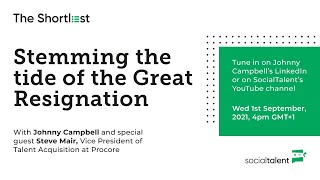
A recorded episode (Shortlist #65) of Johnny Campbell’s podcast/video featuring Steve Mair (VP, Talent Acquisition at Procore) discussing the phenomenon called the Great Resignation (aka Great Reshuffle). They cover causes (pandemic-driven reprioritization, retirements, vaccine-driven V-shaped recovery in the US), market effects (widespread hiring pressure, recruiter demand outstripping engineers in places, international knock-on effects like driver shortages), and practical responses (scale recruiting functions reactively, invest in leadership/manager development, embrace remote/flexible hiring and internal mobility).
Chapters
Sam.
Welcome everybody to the Shortlist. My name is Johnny Campbell. I'm your host for this live show and podcast and this is episode number 65. Are you thinking of quitting your job? Well, apparently half the world, if not more, is quitting, thinking about quitting their jobs and it's been coined the Great Resignation. And today we're going to be talking about that. Stemming the tide of the Great Resignation. We want to hopefully get everyone talking about this. We want to hear your thoughts on this. Are you feeling this from different parts of the world? And for those of you listening live on LinkedIn or YouTube, please jump in to the conversation. Join us by adding your comments, questions, whatever you want to put into your chat box on YouTube or LinkedIn and myself and our guest will take those questions and comments on board today. Those listening on the podcast, welcome. Hope you really enjoy the show. If you haven't hit the subscribe button yet, you should. We're a weekly podcast that goes out usually every Wednesday evening, Thursday morning on Apple, on Spotify and wherever you find your good podcasts. If you want to find out more about the show, our previous episodes, want to find some of the live stuff, find out where we broadcast live, find it, link to the podcast, anything like that, go to socialtalent.com the shortlist so let's get into this week's show. Stemming the tide of the Great Resignation. So millions of US Workers are resigning from their jobs in a phenomenon that's being called the Great Resignation. And there's other names for it are similar to it that have been bandied around by different CEOs and journalists that we'll discuss. But a variety of reasons have been cited from this for this great exodus, ranging from the effects of long term lockdown, which gives people more clarity on their future, has made them think about what's important to them, disgruntlement over poor working conditions, lack of flexibility that they're now seeing as perhaps the economy opens up and has returned to the office. And whilst it's largely been a very US centric issue over the summer 2021, the trend looks to be spreading globally. I received a white paper on this only yesterday talking about the great resignations coming to Australia and New Zealand in January 2022. So if it hasn't hit your economy, it certainly is heading that way and organizations are going to need to get ahead of the problems if they don't experience mass attrition and massive increase in costs of hiring. But how do you plan for this? So joining us on today's show is Steve Merry. He's the vice president of Talent Acquisition a Procore, a construction software company that's currently in a phase of rapid and I mean massive rapid growth. And Steve's going to be giving us a temperature check on what the great resignation means, what he's seen as an employer and as a lead of a massive recruiting team and growing recruiting team, what the different issues are, what the challenge of hiring recruiters is right now, the implications of this for the industry and how do we stem the tide. Steve, welcome to the show. I'd love you to perhaps introduce yourself your organization and maybe just tell us where you're joining us from this morning with that office block with some crazy outdoor lift going up the outside.
Yeah, I actually timed that perfectly. I got them to do the lift at the right time for the video. Thanks, Johnny. So, Steve Mayer, I work at Procore Technologies. We're a construction management software company, a global company. We are expanding rapidly which has made this issue front and center for me because there's nothing like higher attrition and the great resignation going on while you're trying to go through massive growth because there's. That doesn't make it any harder. So definitely seeing this challenge in my face every day. Originally I'm from Canada and moved down to the US over 15 years ago and been in tech that whole time and in recruitment. But I've never seen a market or a place like this. I've never been in a place or a time where on LinkedIn you see more openings for recruiters than you do software engineers. That to me if you had said that a year ago or two years ago, I would have said that's unfair, unfathomable. It's not even something we would joke about because it just seems so silly. That's our reality today. When I look at where the market is today, we're seeing more and more that the only way we're seeing that we can attack this in a somewhat reactive way. And I loved your point on Australia, New Zealand because there is a chance to be a bit proactive and strategic there. But reactively what I'm seeing in the US market is people are reacting through, for lack of a better term, a brute force model. They're basically adding to their recruitment teams and recruiters are grow that role is just growing in importance across every organization, especially in tech. But I'm seeing it across all industries right now.
Well, let want to dig in first of all to the causes and perhaps some of the opinions out there and there's tons of news articles. So I think it's right about time for us to cue the news. Steve, it's not hard to find news about this topic. Right. So we're going to jump into a Gallup poll on the Great Resignation that argues this is really the Great Discontent. And this data is a bit old, a few months old, because things are moving super fast right now in this and at the time that Gallup published this based on a May survey, they were saying that the May record, according to the Bureau of Labor Statistics, showed that a record number of Americans resigning. And I contrasted that with the previous 12 months, which was one of the lowest ever, you know, when people were afraid of their lives. Pandemic was rolling around the world. People wanted to hold on to their jobs. But 3.6 million Americans resigned in May, just gone summer of 2021. And at the time they were saying a record number of job openings in all categories. And this article by Gallup called the Great Resignation is really the Great Discontent. If anybody wants to check it out, we'll share links on the live channels and we'll put it in the show Notes. If you're listening to the podcast, this kind of really argument argument argues that this is about people being generally pissed off about their jobs and kind of giving a bit of a middle finger up to their employees in some respect as to having gone through a year, year and a half of a pandemic. And this is the reaction that they had time to reconsider their lives. They've been working from home, spending time with their family, etc. What's your take on this data and perhaps what's the the updated data since May that you've seen?
Yeah, so definitely on the updated. I saw PwC recently, last week actually released their most recent data that actually showed it's up to 65% right now in the US workforce are looking for a new job now and until between now and the end of the year. So that for one, I'm getting bolder. I think I can't get grayer, so I'm getting bolder. So it's a lot, it's a lot to take on. The reason I think it's called the Great Discontent. The great and there goes my phone. Great timing. It would also be more along the lines of I'm seeing the great Reshuffle is another name. And the reason being is what you nailed, Johnny. People have had time and in that time they've reprioritized. We've never had this in any of Our careers. Anyone that's in the workforce today has never had this kind of gap where you really got a chance to pause and reprioritize what's important to you. And so why the great reshuffle also works is because you're seeing people not go from job A to B. That might have been the normal path. And all of our hiring models and all of our HR models are built around, well, these people are moving to their. So this is how we work with it. People are going from A to L, they're jumping steps, they're changing careers, they're changing paths because they figured out, I don't want to do this anymore, I want to do that. And it is. That happens a lot at the beginning of people's career and sometimes happens at the end when people do consulting. But in our models in Europe and in the US and Australia, New Zealand, Singapore, that doesn't happen in the middle, it just hasn't ever before and now it is. And that's what's causing a ton of challenge in our models and just how we're used to building teams. And then the other piece to that is you're seeing a lot of people reevaluate their own life. The US the most, the other, most recent data showed that and it was actually on LinkedIn, I think just last week. The Great Resignation or the Great Retirement, sorry, where we missed our estimates and over 2 million extra people are, have retired in July of 21. So that's 2 million people that are at that 55 age plus have pretty good nest eggs.
They're.
If you think of the market, the market didn't go. The market dropped dramatically when the mark, when Everything closed in Q2 of 2020, but it's actually risen well above where it was prior to that. And so people's portfolios have gotten bigger, giving them a bigger nest egg and you're seeing more people retire earlier and that is causing a vacuum at senior leadership. That is really hard when you're in our roles to, to figure out and fix because all of a sudden people are taking someone that might have been two steps away from a role and putting them up two steps because they have a gap and that's just causing knock on effects. So I think the Great Resignation is a nice title for it because it covers all of it. But the reality is there's all these different factors happening all at once. And then the other challenge is, I think in the US why the US is seeing it first is just because of how the pandemic was managed the US dramatically was going down, having a hard time dealing with it, but then dramatically did well with the vaccine. So it's a V shaped recovery you're seeing in other countries. It's more of a U where it was managed a little differently and the vaccine was managed a little differently. So it's more of a gradual return. But we're already seeing an impact. Germany's now seeing it. They're starting to see that challenge where their workforce and the roles they used to get, lots of applications are starting to deteriorate and that's changing how they're going to hire and you're going to see it as a knock on effect. And I think you mentioned other countries are seeing it where they can't get lorry drivers anymore. And so all of a sudden it becomes really challenging because that has knock on effects on the rest of the market as well as inflation. So it's this double edged sword at the same time because inflation will put more pressure on wages too.
I'm going to put a shout out to our audience who are listening live, anyone who's maybe outside the US or even in the us Is this what you're feeling? Do you see this in your market? There's no way you're, you're listening in from and share that data with us. It's funny, there's tons of things you mentioned there that really make my ears kind of prick open their big ears as it is. Steve, for anyone watching the video cast. But yeah, the UK you mentioned that I saw last week that grocery stores can't get groceries on their shelves not because of Brexit which has been an issue in the last year and a half, but because they can't hire lorry drivers anywhere. And we talked about this being one of the early signs of this in terms of the areas. But you reminded me and a comment you made at the start of your response there, Steve, I used to teach folks about, you know, job advertising. I was saying use the data to kind of reach the market, reach the candidates when they're going to be most likely to look to seek for seek jobs. And Google AdWords data, when you look at the research would indicate that anyone who's gone away for a break at the end of a weekend, you'd have folks come back on a Monday morning and their job search activity would go up. But also on holidays, right? Different, different national holidays. A long weekend in a country would see a rise. And the real one that tested this was Easter because Easter falls on different dates every year. And so therefore you kind of remove the potential kind of seasonality by looking at specific dates where, you know, people shut down or went off for a four day weekend, five day weekend if you're in Europe or two months off if you live in Europe in the summer and you see them after taking that brief time to contemplate, they typically increase their job seeking activity. We just had folks at home for a year and a half, right? So what did we expect? You know, you see this when they take a long weekend. So you take a 40 weekend, you gotta get. You guys have Labor Day coming up this weekend. So you know you're gonna see it next Tuesday. Like you would always see it after a Labor Day weekend. But you're gonna see it amplified. It's like every single day, every hour is like the Tuesday after a Labor Day weekend or after Thanksgiving or whatever, because that is the market. Every hour, every day. Right now it's gone crazy. Tell me how you're feeling on the ground. Like, you know, running a team that's growing, it can be difficult. You'd imagine just retaining your talent and trying to keep up with typical growth. But Procore is a hyper growth organization. You floated on the stock exchange this year. The business is going strength to strength, doing more international. Like, how do your team feel this on the ground? Like, what does it mean to a TA team to have this kind of market?
Great question. And you're right. We are like if we were just in sustenance mode, it would be tough, but we'd be all right. But when you're trying to grow 30% at the same time, it's really challenging. Where we're seeing the most is roles that we would consistently depend on pipeline for. So you think of our sales development roles, our customer success roles, the roles that we would just tend to have large pipelines. And we had a great process for how we made sure people aligned to our values and got them through. And we're not seeing anyone. The applications have fallen off a cliff. And I've seen it now and I've talked to other TA leaders around the US and it's consistent across every TA leader and every industry now too. It hit some tech sooner than later. You're definitely seeing a bigger impact. And it's forced more companies like us who were not remote at all prior to the COVID to be pretty thoughtful about where our strategy is going to lie. Because if we're not, it is actually a knockout question now for so many candidates. And it's not if we want to it's if we want to grow, we have to be open. We have, we have to change our perspective. Fortunately, we're in a good spot as a company. We were already doing it, so it was great. But I am on calls every week with leaders who are. Their leadership teams are still fighting it, they're still holding on to. But when we get back to normal, not realizing there is no such thing as back to normal. To your point, like, what did we expect? I don't know what we expected coming out of this. We've never seen it before. We've never had a long weekend that lasted a year and a half. It was an amazing time. And I think 10 years from now we're going to look back at this and go, wow, that reshuffled and changed our whole paradigm. It's going to change how people evaluate work. I think you're going to see people evaluate vacations differently. I think you're going to see the mindset of how workers think about it. Probably hope. My hope is just maybe out of laziness to make my job a little easier. You're going to see more of a normalization because I think in Europe there's a better balance for how people think about vacation in their own time versus the US sometimes. And I think you're going to see that rebalance a little bit better. But it's going to take some time. And it's definitely. I'm seeing a lot of businesses getting dragged kicking and screaming to the how do we be more actual people centric?
Yeah, I've heard a good analogy that compares 911 and travel to the pandemic and the workplace. It's like things didn't go back to normal in travel after the pandemic. After 9 11, I should say, you know, flying on a plane was never the same again. Going to an airport was never the same again. And work will never be the same again. It's just different. Right. You become very used to it. No one really questions the security checks in an airport now because most of us don't actually remember what it was like before 911 because it's been around so long. Hopefully. Fast forward 20 years ago, do people actually go to the office five days a week? Was that a thing like dad or mom, you know, Is that what you did when you were older?
Yeah. And did you just go to the office because your manager wanted to see you doing your work? Even though they didn't Mike, they didn't add any value, but they just needed to see you typing on a keyboard? And that was how they evaluated you. Because that's the whole thing that changes here is actually our capabilities as managers and leaders because you, this is harder. This is not easier work. This is going to be harder. You have to get a better understanding of how do you evaluate your workers, how do you get make sure that they're doing what is like in your mind, a fair amount of work without micromanaging them, without trying to use tools but actually trusting them. And how do you build that trust and how does you make it a two way street? That's a much higher lift or harder lift for managers.
Leadership point is really important. It was in the article we just mentioned, the got up article, right, where they teased that it takes more than a 20% pay rise to lure most employees away from a manager who engages them, but almost nothing to lure somebody away from if they're disengaged from the manager. And to your point, knowing that, that you know there's a 20% differential required if you've got them engaged, you can save a fortune by just engaging them. That's normal times. Managers, as you said, are already struggling with this new skill set they have to develop. And then you added the other point, which is really interesting about the great retirement. There is less of them because a whole bunch of them lost that knowledge, that experience, you know, and we're probably going to keep losing it. So you look at where the opportunity is. Right. I think, you know, I've seen strategies in organizations where they're kind of saying, right, okay, we, we're going to have to, and I've heard the phrase a lot recently, we're going to have to hire for skills rather than hire for experience. This is in all different types of roles and it's typical of a market like the one we're in at the moment, particularly mentioned the US and other markets. But there is a challenge, an extra management challenge. Not as if they weren't already overwhelmed with having to do their job. God love them. You're likely now to have to bring in a workforce that's less experienced than what you are used to bringing in. A lot of managers just can't cope with that, can they?
Well, no. And it's not just that they have to develop the talent, they have to develop it remotely.
Yeah, yeah.
And so layering on top of what is already a hard role, it is going to make it harder. You are going to see like coming out of this, when I was trying to think of themes I'm really focused on is a much better focus on leadership development and management skills, because those are the companies that are going to succeed in the long run. Like when you look at how you're going to attack this in the reactive state is what I started with. You build out your recruiting function. You have to right now for our roles. We're not getting people applying. You have to build out sourcing. You have to look at different ways for attracting talent. You have to be a bit more creative. You're seeing companies now, advertising. I've seen it actually, I saw it myself this weekend looking on Amazon while I'm shopping. I'm seeing job ads now and that's crazy. It's crazy. But I get it because they're trying to go after the market differently. So you have to be a little more creative. That's the reactive answer. How do we make sure, like if I'm in Australia and New Zealand right now and I'm trying to be ahead of this because to your point, it's coming in 2020 or the beginning of 2020. I'm building on my recruiting team now. Get that team humming, get that machine running. That's how you at least put yourself in a good situation. But strategically, how do you deal with this long term? You have to start building and investing your leaders, your managers. You have to that leadership development and that how do you build good remote skills? How do you develop talent when you can't be there with them? How do you measure success? All of those pieces have to be at the forefront for the companies that I think are going to really succeed coming out of this in the next five years.
You're so right. You got to think bigger than just talent acquisition to solve this problem. You know, I, I, I speak, I speak to leaders on this topic. As you know, Steve, all the time. I spoke to a good friend of mine recently who told me half our team were decimated in TA at the start of the pandemic. Under pressure from the private equity firm who run, who kind of bought into their business. And now they've just released more wrecks than they've ever had in their history. And she's struggling to ramp up the team. And she'd gone to 99% direct. She's told the business that's gone. I'm using RPOs and agencies because I cannot get the team back up to the speed we want it to be fast enough because there aren't enough recruiters out there. And I was telling you before we went on air, I spoke to a friend who works for one of the big Tech companies. We all know who's been tasked with hiring an additional 1,000 recruiters, not for their current business, but for a business they're planning to grow and build from scratch. 1000 recruiters to then go hire all the STEM talent that they require for that business. It's unreal. Like, they're building an RPO business just to basically run an extra part of the business and sucking more of this TA talent out. But you're right. And it comes to now you're just.
Trying to scare me. I know, but no.
Are they in the same markets as your staff?
That's.
That's the big question. The thing is, everybody's in the same markets. I got a call from our head of engineering. He's based in Poland over the summer and saying, I got to shoot up everyone's salaries. Like what? He goes, it's a big, huge, huge jump all at once. I was kind of quite surprised. And he said, listen, we've never had this problem because our team are based in a smaller city that most of the big multinationals don't go near. He said, that was always the case. He goes, but now they don't care where they are because they embraced flexible working. So they're going, well, they don't have to be in the typical cities we hire from. They can be absolutely anywhere. And so everywhere, everyone's fair game to be poached for jobs that aren't even in your city. You used to think, oh, I can compete with folks who earn the same, you know, the salary in ta, let's say, in this city. But it's like, well, they could just work in a cheaper city or a more expensive city. You don't know where you're competing with. It's such a challenge. But I'm going to bring it on to our second article to come back to the leadership piece because. Because we'll never get done right. And this is from Fast Company, and the Fast Company article is called this is the New Battleground in the Fight to Retain Employees. And this article takes the same challenge that we just discussed, but leans on the point you made, which is that if you didn't lose your employees at the same rate, and I'd argue and go one step further, if you had better internal mobility, you could reduce some of the needs, which reduces the pressure on the TA team. And this is back to your comment around the role of a manager and how leadership needs to step up and really basically stem the flow. Because if you're hiring right at a 30, 40% growth rate, you don't want to be backfilling. 20% attrition, that's like, that's hell. As a teenager in the current market, keep attrition down and just leave me with growth, which is still challenging, but I'll go for it. But don't hit me with growth and attrition at the same time. You're doubling my workload. So, so like, what is your, what have you seen that's interesting? What companies are doing interesting things? What are your thoughts on leadership development even down to the leaders you work with? Well, describe to me the good leaders you work with and how they are being better leaders to reduce retention and really work and partner with ta.
So for one, as we've always seen with good leaders that partner with ta, it's, they own their own hiring, they own their team, they own the development of their team. And, and so, and what I mean by that is they're fully engaged, they're as accountable as I am for hiring and they truly demonstrate that to their team. And that's always the case when, you know, we're in a lead up to this. It's hard to Even remember what 2019 was like, but it was a war for talent. We'd been in a war for talent for almost, I guess, 10 years then. And we thought that talent had the edge. At that time, I think we weren't real. I think we were kind of selling ourselves on that because the reality is the company still could get talent when they needed it. That has shifted now to where the relationship actually to me feels the most equal it's ever felt in over 20 years where talent has as much if not more say. And so good leaders understand that and they're, they're leaning into their people and trying to help them develop and find their new role. Whether it's on their team and giving them opportunities, whether it's project based, they're actually spending time and they focus on doing more one on ones, not less. Now that you're going to be remote, they engage more with people. They're figuring out ways to stay creative with their team. They're not leaning back on what was their comfort zone. And the comfort zone, that's where I'm seeing the teams that are struggling the most are the ones that want to go back to. Well, when I could see everyone working, I knew I was getting a job done that's gone and you have to let go of it and embrace how am I going to understand what good looks like and how am I going to describe to people what good looks like to the individual one on one and to the team and understand and hold people accountable to it. So that's one piece of it. The other piece I'm seeing that really has resonated and grown recently is you're seeing people really value the relationship they have with the company and what the company and how the company is treating them in the ups and the downs. Like the companies that are struggling with whether it's remote first, whether it's how they even dealt with the pandemic. To your friend's point, when the PE firm got her to get rid of half their team, good luck getting recruiters now because anyone that knows that you are last on the list, I don't mean to make that harder on her, but that is the reality. How you dealt with people is really gonna come back to bite you right now. And how you deal with people and deal the real. The other piece we're seeing is managers that are good at managing burnout. And we're seeing this in Europe's getting it too, and all over the world. You're seeing this because you're not leaving your office anymore. I'm actually in my office for once, but you're not leaving it anymore. And so because of that, it's easy to work later, it's easy to work earlier. You don't have a commute, but you are working more. And the leaders that are doing a really good job are the ones that are understanding. How do I define that? How do I help you understand how to define it and take an active role in it? Don't put it on your shoulders like Johnny. It's on you. Figure out what works.
More from Johnny


Where Does Your Hiring Stand? Diagnose It with the Maturity Model | SocialTalent

Where Does Your Hiring Stand? Diagnose It with the Maturity Model | SocialTalent






NEW CONTENT - How to use Generative AI for Recruitment Marketing with Glen Cathey | SocialTalent

NEW CONTENT - How to Use Generative AI for Sourcing & Recruiting with Glen Cathey | SocialTalent

NEW CONTENT - How to Unlock the Power of Generative AI with Glen Cathey | SocialTalent