The history of recruitment | with Gerry Crispin
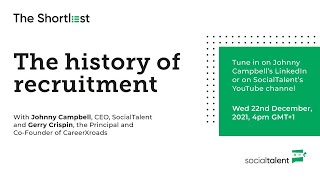
A recorded interview (Dec 23, 2021) between Johnny Campbell (Social Talent) and Gerry Crispin (Career Crossroads) exploring a crowdsourced "history of recruitment" (1900→present). They review key historical milestones (early recruiting agencies, the Shackleton job ad, civil-rights legislation), discuss modern drivers—DE&I, remote work, tight hiring markets—and reflect on technology’s role (job boards, social media, possible blockchain uses) and leadership culture in shaping recruitment’s future.
Chapters
Sam, You're very welcome to show number 81 of the shortlist. My name is Johnny Campbell. I'm your host for today's show and podcast and also the CEO and co founder of Social Talent. Today we're going to be talking about the history of recruitment. Seems like the right time. And as 2021 comes to a close, we really thought there'd be no better way to wrap up the season, this season of the Shortlist to welcome back for the second time of the show an absolute legend of the recruiting world, Mr. Jerry Crispin. Jerry is the principal and co founder of Career Crossroads. He's a renowned speaker, one of the first people, I think, to ever speak on the topic of Internet recruiting at a SHRM conference back in the 90s. He's an author and to be honest, a walking encyclopedia on all things talent and hiring and wine. And that depth of knowledge is what we're going to tap into today as we look to discuss the history of this recruiting and talent industry we all work in. Because Jerry's recently been editing a pretty comprehensive open source document of the top on this topic. And I think You've had over 41 contributing authors and you've built this, the beginning of what is a living compendium chronicling some of the biggest milestones in our industry starting from the 1900s right up to today, 2021, as we're broadcasting this and filming this. So in today's episode, I want to dive into this history. I want to hopefully get from you, Jerry, some of your best bits and your insights, look at maybe some of the more recent events in the industry, what's happening for the future and just wrap up the end of year. Because for those of you listening on the podcast, on a perhaps the recording of this, what you can see is I'm dressed in my Rudolph jumper for the festive and Santa himself, Jerry is sitting here with Rudolph, baseball cap, a big Santa beard, literally straight from the mall. Jerry, thanks for joining us. Straight from the Mall today for this Christmas episode of the short list. You're very welcome.
Hey, thank you. It's a pleasure to be here. Happy holidays, Merry Christmas and hopefully we're going to have a great new year.
So, Jerry, I want to get stuck into it, right? I want to jump in with a news article, right? I'm going to go with one. Is that time of year where everyone has their trends and they have their prediction. And so I want to take this piece from Glassdoor that's just been published and we'll share a link in the live show notes for those of you joining us live, by the way, hi. You're very welcome on LinkedIn and YouTube, love to hear your comments and thoughts. For Jerry, it's a great rare opportunity to ask him direct questions or to give your feedback of some of the history topics we'll talk about in the next 40 minutes or so or just your thoughts on this piece, which we'll share the link at now and in the show notes on the podcast. If you're listening to the podcast podcast. So the kind of economic research team in Glassdoor have put out their workplace trends for 2022, and they have four trends that they've highlighted, Jerry. The difficulty in hiring as trend number one. They think will persist into 22.
I don't hear you.
Oh, somebody muted me. Niall muted me there. Apologies for that. So the four themes they've highlighted, Jerry, are the difficulty in hiring. They're saying that will persist into 2022. Remote work will increase access to talent, organizations will continue to prioritize dni and there's a desire for community. What were your thoughts on these four themes? Are these the good four themes? Did they miss anything? Any BS themes in here?
What are your thoughts? You know, so I'll pick a couple. Desire for community. It's just a desire, you know, the reality is there's very little community when the leader of most companies is making 700 times what somebody else in the company is making. And there's very little servant leadership being taught to the top folks in most companies. And so community is still a long way away. It's not a trend that's going to be suddenly emerging in 2022. It is something that you can see as a desire, though, for employees to. To actually belong to something. So that's a key issue. And the other one I'll mention is prioritizing. DE&I. Prioritizing is one thing. Executing on that priority is a whole different thing. And in 60, 70 years here in the United States, we with with a lot of laws that provided much more access and accountability for DE and I results, we still have not seen the needle move as much as we as it needs to move. So we still need a lot of learning and a lot of leadership in terms of people stepping up relative to really executing on getting underrepresented groups more involved in our hiring process on that point in DNI. Right.
Jerry, you joined us about 13 months ago and you were highlighting for those who didn't perhaps pick it up or maybe if you've forgotten the show you highlighted a move by the Nasdaq to introduce what was, you argued, the first of probably many steps in sharing more data on talent data, particularly around dni. The initial initiative from Nasdaq quoted company was around board representation and diversity. And you pointed to an ISO document that had been published a year earlier that outlined further data and you demonstrated how the NASDAQ move was really just copying from that. And therefore we suspected other stock exchanges will continue to copy. It's over a year later and I've been having conversations with senior leaders, chros, heads of talent, heads of ta and they've told me that for the first time in their job history in the company there it's presenting in front of the board, presenting to the CEO and they're being asked about these kind of metrics. It would seem to be that a year ago when you predicted this trend, whilst the legislative change hasn't necessarily come on all the stock exchanges yet, it certainly is expected, you know, and so, you know, I know it may be the wrong driver, but you think that will help the dei cause if that goes further?
I think, I think eventually it will drive the DE and I cause because it will impact the income that a CEO makes. That's what's going to happen, it will impact the stock price. And so the reality, it's not just DE and I, but really how all employees are treated, represented or underrepresented. But DEI is going to be a piece of that. If the company claims that DE and I is important, important, but it's going to take a decade because the reality is you're going to have to see us a full cycle of investors moving money around the stocks of leaders in an organization based on the fact that a company is building an environment that people want to be in and that fundamentally they fully perform in and therefore they're helping that company lead the industry as a result of the kind of culture and engagement of the employee population. And that doesn't happen overnight, that happens over time. And it means getting the right leaders in place. And it means, you know, experimenting with the kind of efforts that actually move the needle on DE and I and engagement.
That brings me to call it forcing functions two and three. If legislative changes might be a forcing function around DNI efforts in the future, the tight talent market, which is the first trend that Glassdoor predicting will continue, and then the remove to remote, which has big implications on how people lead, what's expected of leaders, sense of community, etc. You know, would you agree with the opinion of the author of this article that the tight marketplace we've had for hiring in 2021, where it's, you know, call it the great resignation or whatever you want to call it, is that kind of persistent 2022 or is that a blip? And what's your second question being? What is there for your other opinion on remote working and its impact on again, that longer term contract between employee and employer?
Well, they're connected, Johnny. And so the reality is the degree to which the leaders in the company are listening to the employees about what it is that, that they need in terms of the agility for them to, to do their best work. You know, if they are, if they're young and in a inner city apartment, that there's three folks in that apartment sharing two bedrooms or whatever, do they really want to do, do remote work? They may want to do something different. You need a hub or you need something else. Right. So it's listening to employees and even employees who have to be at work because they are facing, customer facing, you know, maybe changing the way in which their hours are established different than an 8 hour, 40 hour work week. But it is listening to them and then getting the input and list and, and demonstrating. You've listened by building agreement with workers, which we haven't really done. That was what, you know, was forced with unions and we broke the unions and, and fundamentally we're probably not going to have the equivalent of unions back again. But, but there is collaboration among employees. There is more sharing of employees about whether this is the right place to work or not. And that's going to impact the quality of the candidates and the total ability of employers to hire candidates when you have everybody sharing. And employees will be sharing and collaborating a lot more in the future than they have in the past and leaders need to know about that. And that's going to impact whether or not we have a different kind of approach to remote work, which I hope we would do. And I think trends and difficulty in hiring have a lot to do with how we've created an environment that, you know, is top down and still command and control rather than a servant leadership approach to understanding what employee needs are and driving towards helping them meet those needs.
We had Jer Finn from at the time Twitter on the show a couple of months ago. She's a good friend the show, a Galway girl living in San Francisco and one of the VPs in HR and Twitter. And she at the time was sharing her belief, and I would share this, that we're at a pivotal kind of once In a generation, once every 20 years. Time for talent, where there's an opportunity for this to be like the moment we'll refer to for the last next 20 years as do you remember when it changed? And things accelerate in different directions.
Right.
In that context. You know, I love history from the perspective of what can we learn from the past to either not do again or are, you know, to learn from when somebody else is. Somebody has solved this. Like I bought the, the Art of war for my 13 year old son recently. He's big in strategy and, and war games. And I was like, listen, this was, this was solved 1600 years ago, you know, because it's old to me. You can't learn from it.
Right.
There's a ton of great stuff in there. You know, I'd love to get your thoughts going back to the history of recruiting and the project that you initiated this year, first of all, to understand why, why, why, why do this and why now? And just at a high level, what did it teach you in, in the research process?
And I, it really did blow my mind. We've spent pretty much this year on it. Obviously not dayto day and you know, etc, but, but many, many hours were spent this year. And I give props to Adela Schoolerman. She's the one who kind of called me or contacted me and said that she'd been, she's so she's a recruiter working for Edwards Life Sciences and she's a senior recruiter and she does a lot of tech hiring, for example. So her nose is to the grindstone. She's doing a lot of hard work. But she started asking questions, obvious questions about how do we get here? What, how did these crazy things evolve? Not just the technology, but our workflow, our processes, who we, who we go after and why we go after them versus others, etc. And, and the kind of bias that exists not just here in the United States, but everywhere in the world in different forms. And, and some of that bias is, is, is unconscious. Some of that bias is very conscious and we have to deal with that all over the world and it affects our ability to hire, engage and everything else. And she was wondering about that and she was doing a little research, sent me stuff that she had found and I said, none of this is very thought through. You know, it had, you know, funny things like, you know, what the, what the Legionnaires had done way back when. So, so we, we basically had a number of conversations and I said, you know, you're really inspiring me to do this because I've been in recruiting in one way or another for over 50 years. I'm very proud of the work that I've done and, and the profession that I'm in. But it's not held in real high esteem in a public, in the public forum. We should be moving the needle on that. And part of it is as a profession, we should have an understanding of who we are, where we've come from, what we need to do to get further and move the needle. And the history is one of those. That's when we started creating these milestones and we now have over 200. We're up to about 45 contributing authors. There's just an extraordinary group of folks like yourself who have, who have contributed pieces to this and, and we tried to put it together in a way that's consumable. I'm still working on a, on a website to be able to display it properly, but I've been sending copies of that around to all the contributing authors. So that, that was kind of the, you know, the, the inspiration, if you will, for why we spent time. And then I think the other question that that is relevant is why 1900? Right? You know, it basically is the history from 1900 to present. Why, why not, you know, 1800, why not 1700, why not, you know, zero, you know, that kind of thing. And, and, and there's a real good answer to that, and that is prior to the second industrial revolution, which, which occurred in the late 1800s, it was mostly in agrarian societies all over the world in one way or another. And the main way in which people worked were through family or tribe, through apprenticeship, which was indentured servants, in effect slavery and child labor. And my favorite example is in 1833. There was in the United States Congress passed a factory act of 1833. And in it they designated or restricted that number of hours of children under 13 to 9 a day per day, six days a week. So they get to rest on Sunday. So, so now, so I'm just saying that, and, and obviously if you were over 13, it was 12 hours a day, six days a week. So granted, you know, there's a difference between 1833 and 2021, but what parent, what parent would allow their child to be working nine hours a day? And I have to tell you that in some parts of the world that's still happening. So some of those things still exist in every instance of what existed before. What I consider more the modern day world of industry and then recruitment to those industries, if you will. But I Didn't want to deal with those. I didn't want to deal with, you know, a whole history that involves slavery. The fact that, that parents were, were actually the recruiters in the sense that they gave their children up to work for them, you know, to make enough money so that they could put food on the table. That, that's a sad, a sad history that I don't want to be writing about. Let somebody else do that. So I really wanted to focus in on things like, you know, towards the end of the 1800s in the UK, a guy named John Gabitis, he began recruiting school masters for public schools. And about 1906 in the United States, they actually, A woman actually formed an agency right after the San Francisco earthquake and fire because there were huge camps of people outside of San Francisco whose homes had been destroyed and whose work was no longer there. And it took her a year, but she, she actually helped put to work thousands of those folks by matching jobs to those individuals. And it was, it was not done to make a lot of money. It was done as a, you know, kind of a volunteer, nonprofit, whatever, but it was a formal agency. And so these little things started to accrete into, into what we consider to be, you know, formal ways that we start building work. Yeah. And then the, so that's, that's kind of the, the reason for the 1900.
Piece, I noticed, also, like to me, it's often quoted and shown is the first, what's claimed to be the first kind of job ad, which is the Ernest Shackleton ad, you know, looking for, for folks to, to come on the voyage with them, you know, as kind of like the, the early advertisements. And I'd argue they've gotten worse since then. That was a good, a good benchmark.
And I, but you got to love it, though. That was 1914. Yeah. And so the Shackleton ad, for those who don't know who Shackleton was, he had a, a boat Endurance that went to the. Was it the North Pole?
It was, it was Antarctic.
Yeah, Antarctic, South Pole. And, and basically it was one of the most transparent ads. It just simply said in a newspaper, men wanted. And it said something to the effect of, you know, months of darkness, bitter cold.
Men wanted for hazardous journey, small wages, bitter cold, long months of complete darkness, constant danger, safe return, doubtful honor and recognition in case of success.
You're going to love this. So now my, my immediate reaction to that is what is the modern version of something that transparent? It would be something like people wanted for, for decoding for a startup, you Know, visionary Stanford grad who's never taken a course in business. Friends and brothers of this, this young man who also are probably going to harass women and have never taken a course in how to manage people, you know, but, but if, for God's sake, if we can sell this app, you are going to make a shitload of money.
Yeah, yeah.
You know, we don't have the level of transparency about what you are getting into. In most work descriptions. We, we kind of, you know, pussyfoot around, you know, what, what that is and try to put the best foot forward. We should be pretty complete from a transparency point of view. And if you got idiots that you're going to work for, you probably should be describing that.
A few years ago, I remember a friend of mine, Lee, went into Head up recruiting for Tesla in Emea and he said this challenge, they were attracting the wrong people. The LinkedIn, Facebook, Google folks who wanted the next big thing. And it wasn't until they changed their messaging to messaging to be a bit more like Ernest Shackleton. It's hell to work here. You won't see your family crazy hours. But we're trying to change the world and make those, you know, this planet sustainable or get ourselves off it again with this unbelievable purpose. But it's. Everything else is horrible. Once they did that, they found their people, you know, they found people who were up for the cause who were willing to, you know, go through the heartache of what the work conditions were again. No. No canteen, no. No free coffee, no free T shirts, no swag. Just work. That's all we have to offer you. And you won't get paid as much as you're in your current job, which you could transform the world.
Well, we'll put a yoga map in the Bat Mac in the back room so that you can sleep in between your work and it'll be great. I, I mean, I love that. I think if you are as open and honest, as transparent as you should be these days, because if you're not, I can still find that out if I've been coached to do the right thing. So, anyhow.
Well, so, Jerry, there's so many milestones in there, right? And obviously there's probably slightly more newer milestones because that's what we all remember more and that the contributors who contributed are probably more aware of the last 20 or 30 years. But for you, what were some of the key milestones like?
Sure.
You know, you talked about the first, you know, the first woman post San Francisco Earth, Craig.
Craig.
Creating essentially a recruiting Agency, right. For, for not for profit. What are the kind of key milestones?
I think there's some themes, Johnny, some themes that come out that to me were in a bit of a awakening. It's not that I didn't know them, it's that I realized suddenly these things impacted the access we have to creating a more robust pool of talent that, that we didn't have before that. Examples of that 1924 there was a. Something called the Indian Citizenship act in which for the first time Native Americans in the United states were granted U.S. citizenship. Before that they had, if they were hired at all, they were hired as an immigrant to the United States. You have to think about this, the irony of that these are Native Americans. Right? So, so what was the rationale for that? Well, obviously like anything else, like not wanting to hire women for certain jobs, not wanting to hire people who are colored to different jobs, etc, there were laws in place that prevented them from being included as part of the population. And, and essentially the argument was, well, they were born on, on reservations and reservations were not part of the United States, so therefore they were not U. S. Citizens. So that, and so my point being now you start seeing a whole host of civil rights legislation that related to populations like Chinese women, blacks, etc, throughout the world, throughout the United States and, and our, our approach to whether or not they could be part of a population or should be considered underrepresented and considered to be given the opportunity as well as the information they need in order to get the job. And so that continues to this day. It's not like it's over, but it's, it tells you that we've evolved to open up pools of talent and those kinds of things. And then of course you have things that starts around 1989 in which Tim Berners Lee, who was British by the way, was working in the United States with MIT and went over to, to deal with, in Europe to deal with a number of fellow scientists and developed in effect what became the Internet. And so you have everything, you know, going from that point on. You had bulletin boards that were operating independent of the Internet, but you had to, we could spend an hour just talking about what you had to do in order to get on to that. But, but organizations like DICE, which today are still operating, DICE started in 1990, for God's sake know, as a bulletin board service. And you had, you had aol, you had, you had a whole bunch of things going on in the early 90s which are fascinating. The start of the new job boards that were on the Internet like OCC Career Mosaic, which was started by Hotis. You have then Monster and you know, Career Builder and all the others kind of came in towards the end of the, the 90s really in terms of their impact. So you have the start of all of that and then we've got, you know, dozens and dozens from 19 or from 2000 to 2021 that reflect, you know, the start of, you know, for example, your business, you know, in terms of, you know, you being able to begin pioneering issues about how we train people using the Internet when you can't be face to face or, or, you know, and how good is that and where, where do you do it and how do you do it as well as you do? So what I'm trying to do is to in, be inclusive in a lot of the things that have an impact on how we view where we are and hopefully there's some, some kind of theme that comes out of that or can be useful to others. But I do think it helps from a history point of view to, to better understand where, where we've been, what we're involved in and that it, it doesn't happen overnight. You know, change, change comes over time.
The context, you're right on the DI piece is really interesting. We talked about obviously glassdoors prediction for next year and maybe that's part of the larger ESG type trend that, that ref seeing in employment. But I know I, I, I sent you a quick note with a piece I thought would be interesting for the, for the history which was I, I again I only recently discovered was that in 1975 the term sexual harassment was coined by the journalist Lynn Forley, who'd been teaching a course about women and work. And on its own you might think, okay, a phrase was, was, was coined, big deal. But actually that then gave legitimacy to describe a behavior that have gone for decades or longer but that the, the language helped make it an issue and again drove that revolution. They're important milestones. Again, to your point for context, I absolutely agree.
I believe that. And one of the things that I studied when I was in graduate school was where power comes from. And part of it is, is your ability to, to describe it with language. So sexual harassment becomes a, makes it real in effect. Another one was knowledge worker which was coined by, by one of the, one of the, you know, the gurus of, of writing in those days. And, and then one other that I wanted to mention. Oh yeah, War for talent.
Yeah. McKinsey, 1998.
So you know, it's Those kinds of things. That war for talent still, still is resonating, you know, in 2021, in relation to a whole variety of things. And yet the context in which McKinsey described the war for talent, they described a series of companies that were winning the war for talent, most of whom no longer exist. Those companies have gone under, and in some cases, the leaders of those companies went to jail.
Yeah, but it's a different time. You think of. I remember when I was in recruiting, the book I was reading in my first job in recruiting was Jack Welch's autobiography. And to me, like in the time, at the time, the late 90s, Jack Welch was the epitome of what it's like to be a CEO and had.
To be a leader.
I think now you look back and say, you know, don't be Jack Welch. Right. Do not do what Jack did in terms of the style, because it doesn't.
I don't think I have that as a milestone. I'm, you know, I'm going to. I'm going to have to look at that. Because the one thing that became very real to most of us in, in recruiting in those days was that he would eliminate the, the, the. About 10% of the lowest performers in the organization each year, which certainly impacted replacement from a recruitment point of view, but also created an environment that again, would not be described as a community.
But isn't that what Steve Ballmer took that idea and brought into Microsoft when he took over from Bill Gates? And that's what Satya then famously got rid of because he said that culture was killing them. You know, it was. You didn't want to be on a team with other brilliant people because you might then be at the bottom. And therefore, you know, they didn't get a team collaboration. All this stuff that just changed the culture for 15 years and, and held them back because they didn't have that psychological safety which, you know, back then.
There's so much to add to the history. There's this, this color component of what are the stories underlying the milestones, which is really what we need to build out. And that's kind of why this document, which is really not a book, it's a document that's 54 pages, 55 pages right now. And fundamentally, all I'm trying to do is each quarter continue to add to it and then give that new copy, if you will, to the contribute or make it available to the contributing authors so they can make use of it however they like.
And something we're launching in social talent, a New learning path for which we strangely don't have today, which is welcome to recruiting. You're a brand new recruiter and we're going to be incorporating a link and some context to the history of recruiting because I think it's an important part of it to go, here's the history of the profession you've just joined. Read this as a compendium to what you're going to learn and you'll probably have somebody who's new to this sector and aren't aware of the nuances of how we got here. I think it's important to your point to know how we got here, to know what change is necessary and what's still going to change. You know, you look at the landscape we work in today, it is, it is shaped by these milestones. I look at, you know, like the late 90s, the, the world Wide web changed everything coming out of cern. But again, to your point, it wasn't envisaged to be the central one. It was going to be another web on the Internet, there'd be loads of them. And it just ended up the way it ended up. That fueled a whole bunch of changes to recruiting and every other industry. But then the late 90s noughties was fueled, I think by social media, which kind of that, that fueled a whole bunch of startups and technologies and again, most died, disappeared, vanished. You know, your Google pluses, your clouts, your, all the different apps that came onto Facebook for how to hire on Facebook that none of them worked and they vanished.
Right.
But that's fed another 10 years. Right? Job boards came in the first wave of the Internet, all the social stuff like LinkedIn then and that whole wave of on social move the power from private databases to public databases that we could all search. And again, if you look at the trends that are happening in the wider world today, there's the Talk of Web 3.0, which is blockchain powered. Even more democracy where, you know, the big companies aren't in charge anymore. The people both are in charge and can get the benefits of it. And you know, we're yet to realize that the execution of that in recruiting hasn't happened yet.
That isn't going to happen. There's going to have to be. So Blockchain, I think is a wonderful conversation that you probably should have a few people on to talk about, to be honest with you, in terms of how it might execute itself in, in recruiting. But I, I see it from a background check point of view where I, I can carry proof of who I am and what I've done and what I've accomplished in a way that makes sense. But the problem is each piece of that has to be, has to be proven, if you will, to begin with, before it's embedded in the blockchain. And the only way in which both the employer and the candidate are going to be trust. This will be, it's got to be kind of a non profit trusted owner, if you will. And I'm thinking that the universities that many people have come from could act as that. First of all, they can demonstrate through blockchain that you have graduated from that university. So, so an employer would easily accept that because it'd be, it would be so easy to, you know, to go and check it, if you will, rather than sending a note to the university and waiting a week or so to find out whether in fact that's been approved. So I, then they could have a service that adds things to, to that, that the employer then does not have to spend a lot of extra money checking or time. So I, I see potential in a variety of different ways and I'm sure there are a hundred ways that we'll see over the next decade or so emerge.
I guess you look back at history, what also is probably true is when you look back 10 years ago or.
More, you look over morning, nope, I lost you again.
I know what keeps happening to my mic there keeps muting. Jerry, you look back on the, say the last two ways, the ways that I worked in this industry and the first wave of the web and the second wave of social is that 8 out of 10 things failed. You know, that they were all equally hyped. They were all, you know, going to be the future. And you know, 20% of them, I'm guessing, worked out to be the future and they became mainstream and the other 80% just vanished. It just didn't work. So when you look at the innovation that's going to happen over the next few years, 80% won't work. It's probably fair to say we just don't know which part of it will work and which part of it will catch on. That's always the challenge when you look back at history, it's always trying to figure out of the innovation, what parts will last and persist.
Yeah, well, that's why we have investors. But the reality, they're the betters. They're the ones betting on whatever that product or service might be. But I, and I would, I would suggest it's probably more like 95% fail only because we don't, there's 80% and 20 that we see, but there's a whole bunch that are missing because they never get to, to a kind of a gestation stage, you know, that kind of thing. So it's fascinating to me at the.
Beginning of the pandemic, I think Sachin Adele said Microsoft something like, you know, we've gone through in, you know, one month or whatever, what you go through in X years or whatever the multiple was. Right. People say we're living in dog years at the moment in terms of the amount of change and innovation. And it's compressed, right. Everything feels compressed at the moment. So looking at the last, you know, nearly two years that point around, maybe this is a, A, a milestone event again that when this history hopefully gets updated in 10 or 20 years. Jerry.
Right.
That, that they're going to hopefully write about this time. What do you think will be the key things that you both expect and perhaps I dare say hope will emerge from this? What's the kind of new shape of the world that we're probably going to end up with, you'd hope from this moment of intense change?
Well, I love, I love the fact that you say hope because I think almost everyone who does crystal balling and I, I've done my share of it, ought to be held accountable for telling people how well they did the last time they made a prediction. So we tend to see 2022 trends and predictions, but no one's saying, and here's what I said in 2021, that just didn't happen yet, you know, that kind of thing. But I do think that we, we look at it from the, from what is the kind of world I would like to live in. That's my hope. Right. You know, so I'm, I want to predict the positive side of where I would like to be living. And, and one of those is to increase the ability for candidates to make better decisions to better understand how their work turns into a job, how it is packaged as a job, how their job is, is impacts their career. So what, you know, if I do this or if I train to do this and I get to do this, you know, does this help me, you know, explore possibilities downstream? And, and I need to do this in the context of my life stage. So if I'm, if I'm single and just out of school, there's a whole host of different things that I might be willing to do that I might not be willing to do. When I have a family, I have, you know, a significant other I have a family, etc. So as I go through a variety of life stages, I should be able to adjust a little bit how I think about that package called a job in relation to my, my career itself and, and the satisfaction that I derive from that. Not just. It's not the only thing I derive satisfaction from, but, but fundamentally, if I'm going to be spending a good portion of my life, you know, in work, it would be nice if I can get it to that point where it's, it is satisfying rather than just, you know, meeting Maslow's needs of putting a, you know, roof over your head and food on your table. Those two things are going to be critical always. But, but fundamentally that's not, that's not how you want to, you know, end your life. You want to end your life having at least achieve some degree of satisfaction around a number of other issues. And so I would hope that we will find more people able to make better decisions at different points in their life relative to that. And that means more transparency from employers, whether they want to give that transparency or not. I want to be able to know what the quality of management is for the person I'm going to work for. I want to know if he or she can manage me in my stage of life or in my, in and deal with my needs. So that, that would be one critical issue that I would hope to see is increased demands for transparency or access to that transparency on the part of candidates. But that also means a very critical thing that those, that those individuals have the ability to get mentors and coaches. And that's a trend that I think is coming out of this pandemic is a desire on the part of people in a lot of different stages, early career as well as executive, to have someone who can help you one be successful in the job that you've chosen to do, to wend your way in this organization and to, and that you can, you know, honestly go to and sincerely understand what they have to offer that helps you better use what you've got and.
More from Johnny


Where Does Your Hiring Stand? Diagnose It with the Maturity Model | SocialTalent

Where Does Your Hiring Stand? Diagnose It with the Maturity Model | SocialTalent






NEW CONTENT - How to use Generative AI for Recruitment Marketing with Glen Cathey | SocialTalent

NEW CONTENT - How to Use Generative AI for Sourcing & Recruiting with Glen Cathey | SocialTalent

NEW CONTENT - How to Unlock the Power of Generative AI with Glen Cathey | SocialTalent