The new world of leadership | with Johnny Campbell
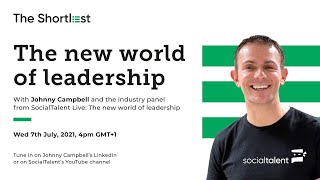
A 2021 panel hosted by Johnny Campbell (episode 58 of The Shortlist) exploring modern leadership in the context of hiring and the COVID-19 era. Four leaders from Twitter (Geraldine Finn), Robinhood (Richard Cho), Boston Consulting Group (Amber Grille), and the Wallace Foundation (Malka McDuffie) discuss empathy, vulnerability, psychological safety, authentic leadership, protecting leader wellbeing, gendered impacts of the pandemic, and implications for the future of work (virtual recruiting, hybrid models, employer branding, diversity accountability). The session highlights practical actions (communication, affirmation, compassion), the 'head/heart/hand' leadership model, and that empathy must be demonstrated through concrete actions.
Chapters
Sam foreign. Hello and welcome to the Shortlist. My name is Johnny Campbell. I'm going to be your host for the next 40 or 45 minutes. And welcome to episode 58 of the Shortlist. On today's episode, we're going to be covering the topic of leadership. Leadership means many, many, many things to do to each of us. And I want to particularly focus on leadership in the context of hiring. As a lot of you work in the hiring world, you're involved in talent acquisition, talent recruiting, and you might wonder, well, why are we talking about leadership? Are we talking about recruiting leadership? Well, no, I'm talking about the broader concept of leadership because leadership is so important in hiring because the teams we're hiring for, the new talent we're bringing in, they're terribly reliant on having great leaders in place to assist in the onboarding process, but also to engage those employees, make them feel belong, give them a sense of purpose and direction to actually deliver on the work they were hired to do. So leadership is critical in the context of hiring. Without the right leaders that you're working with, there's really no point in bringing a player or even b player talent into the business because if you have the wrong leaders, they're not going to get the most out of that talent. You're likely have churn and you're really not delivering on the promise and potential of all the work we've done in the hiring side of the equation. Last year, 2020 was of course, a crazy year. A lot changed, but particularly a change for leaders. Leaders had to deal with a whole new way of leading, typically remotely in the professional world. And we had to balance a new focus on the personal lives of our employees and what's going on with them and showing more compassion. So there it really was a time for leaders to step up. And many didn't. Many just didn't step up in 2020 and still aren't stepping up. But several leaders, many leaders did. And we want to try and examine on today's show what are the attributes of the modern leader? What makes it work? Well, as part of our special summer series, I'm going to be sharing with you a broadcast of a panel that I ran a few months ago where we had four fantastic leaders from Twitter, Robinhood, Boston Consulting Group, and the Wallace foundation join me for a discussion on what defines modern leadership and what's changed in the last year. So we're going to jump into that panel in just a few minutes, but as always, as we do every week, I want to first of all, pause for the news. Thanks, Niall. So in the news this week, I want to focus on one article that was published last month in Harvard Business Review. I know we go back to HBR quite regularly, but it has some great content in there. It's by an author called Ron Carrucci and it's called build you'd reputation as a trustworthy leader. Why is this a great article? Well, because Ron in the article talks about how he was involved in a longitudinal study, one that lasted 15 years and cover 3,200 liters that he's just summarized in his new book. Of course the guy's promoting his new book, can't blame him for that. But in this article, which you can read for free on HBR's site, you'll find his top tips. In fact, you'll find his four practices to master. I think these are really, really good tips because they speak fantastically to the new requirements of the modern leader and arguably requirements of leadership in general. But let me summarize for you because I think it's a great read and we'll put a link out for those of you listening or in the show notes as well. Number one is be who you say you are. And the author talks about how it's really important to not just kind of be trustworthy in the traditional sense, but you need to kind of values are, demonstrate them and then live up to those values day to day. People will not trust you as a leader and trust is so important today, especially when we're removed or removed from our team unless they understand what you stand for and then they see that day to day and they see that lived embodied in what you do. There's tons of great tips he even shares in the article and on that second thing is to treat others and their work with dignity, which is really, really fantastic idea. And he covers it under two strands. How do you create opportunities for others to shine? Use your reputation to shine a light on others and also be a safe place to fail. Make sure that when you are dealing with failure, you do that in a dignified that doesn't kind of demean the individual you perhaps might be giving feedback to, you know. Third is balancing transparency with discretion. So how do you make sure that you're sharing more of yourself and being more open, yet not open with the things that you should keep more guarded. The secrets are trusted information that others gave you. You have to strike that balance all the time. Set boundaries but also offer sorry, invite feedback and offer dissent as well. These are really important aspects of that. And then of course he brings it on to building bridges that unify how you need to work across teams. We know working across teams is critical to any modern organization, but how you build those that unity across those different teams is really important. Tons of great tips in there and it's a really, really good article. I don't have a live panel here to talk to, but it's a good jumping off point. And if you haven't had a chance to read this, do check it out. Build you'd reputation as a Trustworthy Leader by Ron Carrucci. And that's in the June edition of Harvard Business Review, June 2021. So let me bring it back to our panel because these topics and more are explored by four people who I think who have arguably a much better perspective than I do on this in their organizations. So joining me from Twitter we have Geraldine Finn. Geraldine has worked her way through the different TA recruiting departments at Twitter, working right up for Jack Dorsey in terms of some of the corporate VP kind of TA roles or HR roles for corporate H, working on Twitter's acquisitions and their HR needs as well. So she's really seen a broad range of leaders come through the business and through her career as well. Hailing from the west of Ireland, I'm delighted to be joined by Geraldine Finn of Twitter. Also joining me from Robinhood, an organization that if you're in the U.S. no doubt you've heard of in the Europe and Asia, you may not have. Robinhood came under a lot of fire earlier this year around more the practices of their users on their platform trying to I suppose game the system for and against certain stocks. And Richard Cho is their VP of talent acquisition and Richard is a veteran in the TA space and is dealing with massive growth and intense focus. So I imagine a huge spotlight on leadership qualities in Robinhood. Also joining me from Boston Consulting Group is Amber Grille. Amber has worked for large organizations such as intel and IBM leading their talent and talent acquisition teams. And then she leads the the leadership, sorry I should say the talent practice within Boston Consulting Group out of New York and has a really broad perspective on how leadership is evolving and what leading edge companies are doing in that space. And also joining me is Malka McDuffie. Malka McDuffie is with the Wallace foundation and Malka McDuffie has worked in talent acquisition and talent in lots of very large organizations across the US and now working out of the Wallace foundation has a real great perspective on leadership and talent as well as bring to the table. So I'm going to hand you back over to this panel. Really hope you enjoy our learnings on this and I'll join you again in a few minutes.
Welcome all to our panel.
Hi there. Thanks for having me. Hopefully you guys can hear me and no technical difficulties.
Absolutely.
Good to see you, Richard.
Thanks.
Mirin, you're working just great. I see Jer on my screen there. I see Amber.
Good evening, Donnie.
Hey, Jer, how are you?
Welcome.
Thank you.
Thank you.
Hey, Amber, Great to be here. Thanks, Johnny.
Hey, Mel.
Happy to be here. How are you?
I'm doing great. So it's really wonderful to have you.
We might try and get NAL to.
Bring all our panelists up on screen at the same time as we kick off, at the very least. So, folks, there's lots to talk about around this topic of leadership. I know each of you is personally.
Very passionate about this topic.
You work in organizations that take it extremely seriously and it's a big issue. And I've personally spoken with many of you on this as well. But I want to maybe start off and get into the meat of it. And Jer, I'm going to come to you with my first question. So we've heard about it today, right? It's come up in our first talk in the first hour when Jason brought it up. But the pandemic has increased both employee and security. But also what we hear is imposter syndrome for a lot of folks. Right. So what's your experience and opinion on how you deal with this as a leader and how do good leaders support their people and give the right support to people around this issue?
Yeah. Thanks, Dani. And credit to all the speakers earlier this morning. I think there's really valid content from everybody that links into this topic very closely. I don't need to say it, but just for a context like this, last year has seen people lose autonomy over the basic things in life. Like we don't get full decision making over the what we do, where we do that, who we're seeing. So there's a real loss of autonomy. And on top of that, people are processing a lot of perceived threats. So I love that concept of anticipatory grief. Recommend a read on that Kubler Ross model of grief and that term. And we're feeling a sense of loss about things that haven't happened and that might happen. So I think first of all, really leaning into that and understanding the full extent of it is super important. And then you got to meet people where they are the first and very much to what Jason was sharing with us earlier, you've got to lead with empathy, patience, compassion, like you really do. Everybody is going through something and quite often something fairly existential. And so you really must lead with empathy. This is about knowing your people, leaning into those relationships and actually actively listening and learning, looking for the cues and taking action about figuring out what that signal is that it's giving you. You've got to figure out what people are going through and adapt your support specifically to meet that. I think you have to get real and practical. That's just resources you give and provide to folks. Again mentioned in your earlier by your order speakers, but it's real. We've added a staff completely focused on wellness. We've got a team of psychologists genuinely leading with ready access to all of those resources and actively trying to engage people. It's not enough to send an email going, hey, call this line if you need to talk. You've got to actively engage people. And I think the most powerful piece of that is how you as a leader model behaviors and the practices that you introduce through your engagements with your staff. That's being vulnerable enough to share, you know, if you're struggling and how you're using those resources. But also it's about creating a safe space. Psychological safety is a huge part of that employee security piece. They don't see people, they're not engaging with people, so they don't have the cues to reassure them as much. So you got to create that space that is safe for people to ask questions and that they continue to feel safe. You also have to create a little bit of space for people to get away from the various existential crises they're dealing with. And that's a really hard balance to strike. I know when we talked about it, I talked about it in terms of transaction analysis and staying in that battle. Like creating the space being open, but also like some boundaries and some space if people actually just need to get away from it and focus on something else. And then a little bit of levity. I think there's a huge amount of value in the habits and the practices and rituals you establish for your team. My team meetings and the team meetings I'm hearing about the most have got some really different practice. Like we're doing guided meditations and team meetings now. Something I would never have considered a year ago. Like it's five minutes of social connection. Someone in the team will say, I'll lead a 10 minute guided. I mean it's phenomenal. And like silly things like dance outs at the end of meetings. There's a lot about bringing levity and humor into a heavy time and creating rituals around it so people come to expect it and be comfortable with it. So, yeah, that's where my head is on that at the moment, anyway.
So I love that you mentioned grief and, you know, trauma. I think they are the right words to bring to bear around this in the last year. And Richard, I got to go to you with my next question related to that. You know, it was a crazy year. We all know this. We're coming up in the anniversary for us here in Social Talent of the Year, the anniversary when we went remote, where things really went crazy at the end of February, beginning of March. It was a really year of crisis.
Management for a lot of organizations.
And that's a particularly unique thing. I'm wondering if you can share your thoughts on how leaders can effectively support their staff during such turbulent times, especially with the remote working aspect of most professional working as well in the last year. Can you speak to that for us, Richard?
Sure.
I think Geraldine did an amazing job talking about some of the frameworks that we also use. But what's unique about the remote work environment is you no longer have the physical tools where communities gather, even in times of crises, where they lean on each other. Because ultimately, when you're done with the call, when you're done with the VC shut off, you're back at home. And there are many individuals that live by themselves. They don't have other social connections. So the first thing is just starting off with the knowledge of empathy, that this is a very unique time. We talked a little bit about that. We are grieving. We're grieving the norm. So it actually puts extra emphasis on three things that I try to put extra emphasis on not only for myself, but for the leaders in my organization. And those three things are communication. This is a time where listening through osmosis is gone. If you miss the meeting, you can't just say, johnny, what happened in that last meeting? Communicate not only verbally in various meetings, but follow up with written documentation and also with a lot of empathy around, hey, I know you missed this, or I know you're three hours away or nine hours away. I just want to make sure that this is such an important decision. Wanted to spend extra time to make sure you understood it. The second is affirmation. I think, like I'm an amateur psychologist at times, as a leader in the organization, and I discovered during this time, almost a year away from being physically next to people, that there's a innate human desire to have some sort of affirmation. And they're not looking for, good job, Johnny. Good job, Geraldine. They're looking for, hey, am I pointing in the right direction? Is this okay? Are we safe? Is the company safe? Am I personally safe? And if you don't address that, because those are not typical things that you typically address in a work environment, then people left to their own devices start to start to think the worst. And we went through not only the.
Worst.
Environment when it comes to the pandemic and social distancing, but also the civil unrest that we seen and that the whole world has really resonated with and empathized with, along with Robin Hood. Brand itself has gone through some PR cycles. And so that affirmation has been tested throughout. So I always try to spend extra time to be in front of the organization, share with them my own opinion. Geraldine talked about vulnerability. I can't tell you how many times I've been emotional on calls just in this last year. And, you know, I'm an Asian male. I'm not supposed to show emotion. So, you know, being vulnerable is a important thing. Model that behavior and how to process and digest. Be as honest as you can, because that's the only way to really underscore affirmation. That's the only way you can to really be able to address that. And then finally, compassion. I talked about, you know, showing my own emotion to make it okay for. For people to be able to express themselves with frustration and so on and so forth. But for the first time ever, I haven't had. I mean, I can't tell you how many times I've had people on the other end just really breaking down because they're going through a lot. So that compassion is important. So those are kind of the three things to add to the phenomenal framework that Jarvan shared.
Yeah, I think two words there, the vulnerability and compassion. PB probably to my next question for Mel, if you don't mind, Mel, you know, what role do you think authentic leadership therefore plays in today's blindness? And did 2020 have a bigger effect on that? Did it change anything?
Absolutely. I think a key attribute of being an authentic leader is transparency, because where there is transparency, it breeds trust. And during a time where we thought a year ago that we were going to take a break from the workplace temporarily, and then we would be back within a couple of weeks and things would resume as normal, it turned out to be a profound turning point in the way in which we conduct business and the way in which we lead People. And so that type of monumental change and uncertainty really requires some element of relational transparency where team members feel like they have leaders who they can believe in, leaders who they can trust, leaders who have their best interest at heart. And we talked a lot about just being vulnerable. Normally, as a leader, we think that we have to be in control, and we have to appear to have it all figured out. And this is the time where it's okay to say, we don't have a blueprint for this, and we've not gone through this before. And I understand that you're scared. I understand that you're managing a lot at home. I am, too. How do we work together to figure this out? How can I support you when you're checking in with your team members? You know, making sure that you're not just checking in to see what work is getting done and how the work is getting done, but taking a moment to really understand, how are you doing? How are you managing everything at home and sharing a little bit about some of the challenges that you're having as well? Because I think oftentimes, while people are struggling managing homeschooling and getting their work done and showing up and being their best, they don't necessarily understand and appreciate that it's okay to share that with their leaders. But if we as leaders are also sharing the same struggles, I think it creates an environment for that kind of open dialogue and really placing emphasis on the health of our team members and not just the productivity of our team members.
Yeah. Jer had mentioned the top of the hour, the concept of psychological safety. And the more I read about that, it very much aligns with that traditional view of a leader now, which is, oh, she knows everything. She has all the answers. And the modern leader that most engenders psychological safety is someone who says, I don't know, let's find out. And you find the heroes in the organization, because you're not the one who has all the answers, but you facilitate the finding of the answers through others. And that type of style of leadership is certainly driving more safety. It seems to be one that's more needed, certainly in the now. So thank you 100%. Right. With that approach to authenticity, I'm going to ask Amber to just maybe chime in on this. There's a lot of transformation. To Mel's point, we thought we were going into this for a few weeks, and then we thought maybe for a few months. We're a year in. And for a lot of organizations, that has meant not a temporary change, but a fundamental transformation in their organizations or the way that they go to market or the way that they engage with customers. I'm interested to know, you know, what role does do leaders play in that transformation is particularly unique kind of post Covid world.
Yeah, thanks. And I think a lot of the team, you know, the panelists shared a lot of this around, you know, the role of the leader and their skills and characteristics. Maybe what I can do is just kind of share how do they hone in to their empathy and ability to adapt. I see it as three key elements that we like to share and talk about and I call it the three H's. So the first and foremost is the head. Really for leaders to envision the future and prioritize what now is required to succeed. So that means being able to set a really powerful vision and clear path to success for people that are to thrive in this work that they're going to do, I think is really important. The second is the heart, which many of you talked about the necessary skills for empathy, but the heart is really about inspiring and empowering your employees. What was really interesting in our BCG research was that before what happened with COVID what we saw with empathy was only one out of four leaders had high empathy skills. So now I think for leaders it really is starting to ask that question, how am I going to personally drive human centricness and inclusiveness and belonging to my company? So that heart and mind is very important. And it's not just pandemic, it's any changes that are happening. Being aware and talking about it because you might have different things that are happening all around the world, globally, right in one part of the country, the world. You have new year celebration with the lunar year in China and then you have another place in the world where you look at Texas and there's climate change, weather, people losing power. How do you ensure that your heart is in both elements of what's happening with your employees and empowering and inspiring them in difficult situations, but also successful situations. Then the third element is the hand. Now this means innovative and agile execution and capability. So really it's moving away from this command and control or one way communication to really soliciting feedback as leaders and suggestions more regularly and leveraging your team as thought partners is really important. So when you think about combining the head, the heart and the hands, these are what become strong practical leadership skills to develop this empathy and gain a perspective for the future to have a competitive advantage. So I do think this is the new norm of operations as we Think about the future of work.
I think that's really interesting. That research that you mentioned that you guys are conducting that showed only one in four, let's say, had that high empathy. I think there isn't a single person in the world who wouldn't hire for empathy or try to hire for empathy in a leadership role today. But we obviously weren't hiring for empathy around focusing on it in the past. And you're right, you know, Mel, she'll share in a second, I'm sure is in Texas and has gone through that in the last few days in the snowstorm. And in a particularly international world, as most of us work, where you have multiple offices and locations, there isn't just one issue. Covid is one of the strange things that was a global issue. There's so many micro issues you have to be on top of. I think that's a, that's an excellent point. I'm going to jump back to Jer for a second, Jer, because I'd like to maybe just expand on one of the areas we talked about, the role of the leader. And obviously we said the leader can't, you know, the new leader can't be top down all the time. You know, it doesn't have all the answers. But leaders are under stress, right. And they're under the same pressure. They're dealing with the same stuff as everybody else.
Right.
How important is it to focus on protecting yourself? You know, I use the analogy, you know, of you're on an airplane. It's like before you put the mask on your kids, put your own mask on first, otherwise you can't help them. How important is it for leaders to protect themselves in this environment as well, their own mental health, et cetera.
Yeah. Thanks, Johnny. And thanks to all the panel members. I've taken tons of notes already, so wonderful, the content so far.
Yeah.
To your analogy, like you can pour from an empty cup. Simple. And if you don't look after yourself first, how on earth can you help others around you? Like, it's a traditional, common, almost cliche, but an important tenet. Actually helping others around you. So when I'm talking to leaders across our org, I'm talking about like, are you being realistic of the expectations you have of yourself right now? I actually start with were they realistic before COVID to be honest, because we all hold ourselves to such a high bar. If you're not actively considering that and maybe adjusting that, like you're setting yourself up psychologically for a fail, whether you fail or not. And that's kind of crippling when you have all of these other cumulative issues and worries right now. I think we've all talked about it like that vulnerability and authenticity. You just have to get comfortable with not knowing all the answers or not knowing even as many answers as you did before. You've got to get comfortable with that. Being vulnerable isn't just how people perceive it. You actually have to be vulnerable and give yourself that space. Again that goes to the expectations. I also think creating that space to cut yourself a little bit of slack, practice some self care, give yourself new standards to work to. I think when you think about that, and there's an important piece here because you've got to give yourself time now to question how you did things before and what actually are the right and the new ways of doing things. Like I think about work in terms of inputs and processes and outputs. If you think about it, all of those are variable. Like you can change the time and the resource you put in how, what you do to that to get your output, what you're expecting. They're all variables. And we need to question that a bit more because again it goes back to that expectations. If you don't question it, particularly in a world where we're all virtual, you're not again not setting yourself up for success. And that's difficult to process. I think the last thing I would say as you do that and I'm very much focused on like yes, personal care, creating that space to question and feel comfortable with it. I would say as much as everything a lot of our work is variable inputs, process, outputs. I think the one non variable right now, and I think this is the greatest gift you can give yourself as a leader is just be entirely true to the practice of your values. The greatest gift you have to yourself or give to yourself is looking at yourself in the mirror in the morning and not kicking yourself, not questioning the core of who you are. So that's the non negotiable right now. And I think you've got to take those steps to enable yourself to feel that way in the morning. And that's what I'm trying to anchor people around some personal and self care to be vulnerable, not just seem vulnerable and like to really be okay with it and to question those expectations, how you do the work so that you create space and at all costs you avoid any compromise of what's really core to how you ground and center and validate yourself around those values. I hope that makes sense.
It does Jerry. That's, that's career Lasting advice that all of us can take regardless our roles. Right. Thank you for that, Mel. I can ask you because I think it'd be remiss of me not to ask it. You know, are there any unique challenges you think that female leaders face? And particularly coming out of COVID we've read a lot about, you know, unfortunately, some setbacks in terms of female participation in the workforce, particularly in leadership roles, with just everything that's going on. And it's a, as unfortunately seems to have more negatively affected female leaders. What are your thoughts on that or what is your perspective on that?
Absolutely. So, you know, as women, we continue to wear so many hats. We're mothers, we're wives, we're caregivers. And over the last year, we've become teachers and cafeteria ladies. And so you are seeing more women dropping out of the workforce because it has become overwhelming to balance all of that. And I think that as women, as we're wearing all of these hats, we want to master each one of them. We want to do each one of them incredibly well. And there's a limit to how much you can carry on your plate and actually be, you know, give 100% to each of those things. And I think that in order for us to get back into the workplace and continue to hold leadership positions and continue to ascend to the C suite, A, we need to be kind to ourselves. B, as organizations, we really need to reevaluate our practices, our ways of working, to ensure that we have policies in place that really allow for an even greater work life balance during these times. And post Covid, do we allow for flexible work schedules? There are some organizations that are still very much traditional, and I think that current times call for us to relax our standards in terms of how traditional we have historically been. And think about, is this a job that really requires someone to physically be in the office Monday through Friday between the traditional hours of 9 to 5? Or can someone flex their schedule and maybe have a hybrid approach where they work from home some days and they work in the office some days, but really evaluate, evaluating our practices, evaluating our policies, do we have an opportunity to offer supplemental benefits where we can offer child care support or elder care support as part of our benefits package? There are so many avenues that I think that we need to think about and consider differently so that we are creating a space where women can continue to grow and thrive in the workplace. And the other thing is, you know, just to be forgiving of ourselves, but as women who may not be wearing as many hats as others make sure that you are a support and resource to other women. You know, there is plenty of room for us around the proverbial table. And it's not about us or them. There's enough room for. For us and them. And so let's make sure that we are being a resource to other women. Let's make sure that we are being mentors and advocates for other women, and we're making room at that proverbial table for other women.
I love those comments, Mel. Thank you so much. And, you know, I just remember when we started Q1 this year in our own business, you know, I sat with my leadership team and just said, we gotta be realistic about the fact that our targets are probably not gonna be met because, you know, everybody's got kids at home, people are panicked. It's lockdown three. That was unexpected. You can't just force yourselves to go back to the original goals and say, well, they have to make it work. I think what we have to do is change as businesses to work around the people and the reality that they face. And to your point, that can be caregiving situations, just panic, all the different issues. It needs to be more of a focus on that. And then the business results come out of that, whatever they may be. And we tie it around that the thing that isn't changing are the people and their issues. Thanks so much for sharing your thoughts, Mel. I'm going to ask Amber as we kind of begin to come to the close, because I can't believe how much time we've gone through already. I feel like I'd love another 30 minutes, 90 minutes with all of you. Amber, future forward. What changes do you anticipate for the future of work? This concept that a lot of people said was coming and then many agree that in 2020 it arrived, and particularly about how we think about the talent market post pandemic.
Yeah, I think that's a good question. I would say future of work really requires taking both an intentional and a holistic approach. And I think there's key areas we need to question and ask ourselves. First and foremost, how to work really. And that's embracing disruption in a very different way now. And it also starts with asking, how have our customer interactions changed and how do we serve them better? So I think you have to have both the customer lens in this, but then also thinking about your employees. How are your employees going to be more productive, being remote? So I think you have to ask that question, how to work and embrace disruption. Second, you have to ask, how do we lead and this comes from that element of leadership, from empowering and inspiring and asking yourselves how do we support the well being of our employees and at the same time how do we maintain our culture? Because there is going to be these various models which takes me into that question of how do we organize to be both responsive and resilient. So this means new ways of working and having various working models, which I think many of our panelists shared about. It's not just really when you work, it's not just where you work, but when you work I think is important. So thinking about how the impact to our talent strategy is location, agnostic and various talent models. And then lastly I would say we need to think about smart environments, thinking about your real estate footprint, the technology tools needed for both the physical and a virtual environment and are your employees equipped with the right skills. So I think obviously there's that aspects of it and maybe to take it very specific into into talent itself because I know our audience is very coming from the talent industry. If we think about the trends just that are going to shape 2021 as well as beyond, what we realize is virtual recruiting is here to stay. Over 84% of organizations change their hiring processes these past year. So I think you'll see that that's here to stay. Both AI and predictive analytics will continue to play a large role in identifying and matching talent. You're going to see recruiting actually holding the business more accountable for diversity. I think that's a key trend that's here to stay and I think it's also candidates expecting companies to show and experience a diverse workforce. It's going to be another key thing. The other trend that we see is that employer branding now will really hinge on both empathy as well as empathy actions. I think it's now validating. We're talking about empathy, but now show it to me. And I do see how employees and candidates were treated during the pandemic is going to be really live and front center. I think that's going to be important. And lastly the trend for the talent side. Recruiters will really need to build these new skills to compete in what we see as the future of work. So I think there's a lot of things here to stay, but a lot that's going to shape the way we work, future of work and various models.
I agree with you on every point there. I think the piece around empathy and empathy action being an employer brand number one, we're seeing that already. It's a big thing. And Jason, in His talk an hour or so ago talked about how, you know, compassion requires that action at the end, and that's really important. It's one thing saying that you empathize, another thing showing that you have empathized and you've demonstrated that to your community, to your colleagues as well. I think that's going to be the thing that drives the winning organizations forward. Amber 100%. Richard, I'm going to go to you for our final question. Maybe I'll ask you to give some.
Of that vulnerability again.
When you answer this, in the last year, you think back about your personal leadership style and the events that have gone through your career in the last year. On top of COVID as you said, there's been other challenges. What key lessons have you learned about leadership in this past year?
Yeah, I think the first one is, regardless of how old I am, I haven't seen it all. This is unchartered territory for a lot of folks. And, you know, it's okay. You know, I think a panel has said this before. It's okay not to know. It's just in reality, in real talk, we talk about vulnerability. We talk about all those things, and we, I think we all read the same, you know, books to be able to show up as a leader. But ultimately it's knowing that, like, hey, no one's really written this book. The best thing you can do is show up as a human first, empathize for what people are going through. Because everyone touched on all the topics. It's uncertain, it's emotional. People are overworked. And it feels condescending when we say, oh, take the time, take the time. But there is no time because you're, you know, you're recruiting during the day, you're a mother, father, husband, wife. At night, you're, you know, school teacher. You're, you're all of those things. So, you know, showing up and truly backing up those words through action is going to be, is going to be the most important thing that you do. Lip service just falls short. And the larger the organization, the more you have to spend the time to be able to show that explicit action to your individuals in empowering them to also take part in caring for themselves as well.
Right.
So that is, I think that was probably the most important lesson. I usually go into these organizations with some sort of a blueprint in mind, but this last year was not. There's, there was no page in my blueprint of what to do in these situations. So you kind of made it up as you went. But you know, you took the human approach and that's probably the best advice that we have is just be authentic. Be human to your team.
Richard, thank you so much and thank you to Geraldine, thank you to Amber, thank you to Mel and Richard. Again, thanks to all your contributions. We've flown through this. I know we overran, but I really appreciate you sticking with us. Some really great insights there and we all learned from each other and hopefully you as well learned a lot from our panel.
Thanks to all our panelists. Really hope you enjoyed that panel discussion. We'll be back next week with a live show. If you want to find out more about that show, our previous shows, upcoming shows, go to socialtalent.com the shortlist. But do join me live next week on LinkedIn or YouTube. That's going to be the 14th of July at 4pm UK Irish time. That's going to be 11am the east coast, 8am the west coast of the US or you can check out the podcast that will be broadcast or dropped that evening, Apple, Spotify, wherever you find your podcasts. And I'll be joined by Kevin McNulty, an author and a consultant who wrote a fantastic book called the Gap, Navigating Times of Change. I'll be discussing with Kevin, what is the gap and what was his learning from his own personal experience leaving the military on navigating a particular difficult change in his life and how for any of us who are trying to navigate or making our way through a difficult change in our lives, or we're advising those in our teams to navigate their way through that difficult change. What Kevin learned and some of his insights on the Gap. So do join us next week for the show. Thanks for listening to this show. Hopefully it's inspired you think about leadership in a new way. And we'll see you next week.
More from Johnny


Where Does Your Hiring Stand? Diagnose It with the Maturity Model | SocialTalent

Where Does Your Hiring Stand? Diagnose It with the Maturity Model | SocialTalent






NEW CONTENT - How to use Generative AI for Recruitment Marketing with Glen Cathey | SocialTalent

NEW CONTENT - How to Use Generative AI for Sourcing & Recruiting with Glen Cathey | SocialTalent

NEW CONTENT - How to Unlock the Power of Generative AI with Glen Cathey | SocialTalent