The positive impacts of employee leave - with Jen Henderson
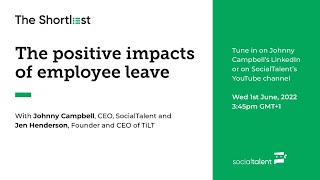
A Social Talent Shortlist episode (host Johnny Campbell) interviewing Jen Henderson (founder & CEO of Tilt) about the importance and impacts of employee leave. Jen describes Tilt as born from her personal experience with IVF and pregnancy-related workplace discrimination. The discussion covers evidence that mandated paid parental leave reduces first-year turnover, childcare as an effective retention lever, diversification of leave types (including bereavement/compassionate leave), the limits of written policies without supportive leadership/manager training, tensions between equity/standardization and personalization, and limitations of unlimited PTO (can reduce time taken). The conversation references Fast Company and Pew survey findings and contrasts US policy gaps with other industrialized countries.
Chapters
Sam.
Welcome, welcome, welcome. It's episode 101. My name is Johnny Campbell. I'm your host of the Shortlist and the CEO and co founder of Social Talent. And you're very welcome. This is our weekly show where we talk all things talent with gifts, guests from all over the world. You want to know more about the show? You can find out more by going to socialtown.com the shortlist, checking out our back catalog links to videos we broadcast live on LinkedIn and YouTube every Wednesday. And we're usually dropping your podcast app on a Wednesday evening, so haven't heard the podcast. Check it out. It's on Spotify, it's on Apple, it's everywhere you'll find podcasts. It's been a busy week coming up in the uk. We're in the uk. It's the Queen's Jubilee celebrations and June bank holiday weekend. So you're off for the next two days. Enjoy. If you're listening in the US You've had Memorial weekend and hopefully had a long weekend, a stretch, maybe taking some time off, because taking time off is pretty important. And that's what we're here to talk about this week, the positive impacts of employee leave. Never before has this work life balance conversation been more of a reality. We see it every day as we move beyond the specter of COVID because we kind of ignored it and that's how we got over it. It's clear that employees are still seeking to carve out careers that can balance harmoniously the personal needs they have and their family needs and their work needs. Work's an important pillar for all of us. For some of us, it's the most important thing. We love it, but it's only one facet of our lives. So it's really vital that organizations begin to recognize this and account for in their employee leave policies. And draconian measures will only serve to alienate potential talent and reduce our employee engagement. So joining us to discuss this is Jen Henderson. Jan is the founder and CEO of Tilt, a SaaS platform that focuses on leave management that you're going to hear tons more about. It's really exciting. I'm going to be chatting with Jen about the importance of employee leave, its link to boosting wellness within organizations, while also looking at the tricky waters of parental leave. Jen, you're so welcome to the show. It's great to have you. I'm wondering if you could perhaps introduce yourself maybe better than I have, and tell us a little bit about you, your history, what brought you to here Today and why this topic?
Yeah, happy to. Thanks for having me, Johnny. Jen Henderson, based here in the beautiful state of Colorado in the US with my family, my two kiddos, my husband, horses, dogs, the whole thing. I have found myself here in this state of time on a really interesting journey in that tilt was completely born out of a personal experience. I'm sure a lot of your listeners who are founders themselves can relate. I spent 15 years in corporate America, Fortune 500 companies and I loved it. I truly was your typical self described career woman. Promoted every two years, top of the nine box. And when I was really doubling down on my career, my husband and I were going through in vitro fertilization. Seven years. That lack of control and frustration accelerated my career because that thing I could control, right? And then we got lucky. We had one cycle that took and we got pregnant. And when I announced that I was expecting overnight, I stopped getting those invitations to the table and I stopped getting the stretch assignments and nothing had changed other than the fact that I was expecting. So it was devastating. But it was the first time that I really felt what was wrong with leave of absence in the workplace. Turn the other cheek, really got back on the horse because I was so elated to just be pregnant. And then five years later, a different company, a different stage of my career. This time when I announced I was expecting, I had a promotion taken off the table. And that for me was the straw that broke the camel's back for those here in the U.S. yes, very illegal. I did seek counsel, but you don't really hear what happens when that avenue is pursued in regards to signing away your story. And I wasn't willing to sign a release that I would never talk about what happened to me again for a payout in my term, it was short term gain, long term, nothing was going to change. And I think that was also exacerbated by the fact that my second child was a daughter and I couldn't stomach the possibility that she would experience what I experienced. So that was it. I have a very supporting partner and he supported me to take the leap into entrepreneurship and try to figure out what this is to bring a better way to do leave of absence in the workplace into the world. And we're five years old today and couldn't be more excited about the impact we're making with our customers.
Charmaine, who's listening on YouTube, took the words out of my mouth. She said, wow. Wow is definitely one word. It's amazing. As a father of twins born through ivf, I know what the heartache is like going through that and the joy if it eventually works. And to have that sucker punch in the gut from an employer who you're meant to trust, who you believe has your back, must be the worst thing in the world. And Charmaine's followed up with congratulations Jen, which is wonderful. I want to it brings me to our first article I want to have a chat with you about from Fast Company, published by Ron Gura in the last few weeks and its position. Ron's position in this article is that to retain talent we need to support employees through their hardest times. I think that's probably what didn't happen to you twice, right. You went through hard times and your employer was completely absent. In fact quite the opposite and they backed away from that. There's some really interesting stats in here I would love to explore with you. I'd love to get your opinion on this.
Right.
I hadn't come across this before, but the article says that in the US anyway when they looked at women who worked in organizations with mandated paid maternity leave, they were 20% less likely to resign in the first year of the child is born. So this isn't just an opinion. There's really good data that backs this up. What are your thoughts on this? You know the great data that's this in this Fast Company article, its position which talks about how you know the biggest names in techs in tech are understanding that they need to shift to be more flexible to really focus on work life balance. You know, is this finally the beginning of the end for the kind of situation you were put in by your previous employers or what are your thoughts?
Absolutely. I think that we are in a new era and no longer can these types of employee experiences be ignored. I do want to share some of your past guests have have noted from a context standpoint there's no silver bullet and the same remains with leave. There is no silver bullet or flip of the switch that will make this effective in an organization. But some really interesting nuances in relation to the article is leave of absence policies are now table stakes. They really pre Covid were looked at as ancillary or above and beyond benefits. Employers really got a gold star for having paid leave. That is no longer the case. If a company does not have paid leave they are way far behind the rest of the talent pool and what people are looking for. But the other really large misconception that we run up against all the time is this almost mentality that it's a set it and forget it. We've Checked the box. We've written a policy. Maybe we've gone, you know, what we consider the bare minimum of 12 weeks paid time off. Maybe we've gone above and beyond that and done 16. We're good. We're in the top quartile of this benchmarking. It couldn't be further from the truth. Because, Johnny, one of the things you and I talked about is we look to Europe quite a bit, actually, we look to the entire industrialized world because the US is the only country that hasn't passed legislation. So let's be honest, everyone is doing it better than us. But what we see is that the pain still remains. Because if you don't have the right leadership, if you don't have the right managers, if you don't have the right education around that policy, the implementation of it doesn't matter. The policy standing on itself is just a box that gets checked and the efficacy of it is for naught.
The article brought up several things. One was again, another Pew survey that said nearly half respondents who voluntarily left their job in 2021. So they did so in part because of childcare issues. I used to be a recruiter, J. Back in my recruiting days in Ireland, I was hiring accountants and one of my clients was rte. And RTE is the national broadcaster here in Ireland. They were the main. We call them BOG1 and BOG2 in terms of the two channels that most of us grew up with as kids in Ireland and RTE in their head office, they had childcare, they had a play school for staff. And I tell you, it was so easy to hire for RTE because they didn't pay better than anybody else, but they had childcare on site that was free for employees. And, you know, that was. It was weird. They seemed to get this really early. They got the point that they could hire the best talent out there in every department without paying more money by just having childcare. That this thing was going to be really important, wasn't part of their mission statements. Maybe they did other things wrong, but they just seemed to get it. And I loved recruiting for RTE because I knew that as long as the person had a family, planned to have a family, they were going to stay. And the retention of talent was amazing because nobody else offered that perk. And childcare is a big bloody deal. Expensive, it's hard to get. It's a disruption for your family. One thing I hadn't ever considered that the article brought up was, was the challenge around bereavement and having bereavement policies. And I sat Back and went, we don't have one in social talent will fully support anyone. But you know what? I haven't thought about the amount of time according to the article, it, you know, takes just to administer and manage that. And then most people who've had a, a recent bereavement, you know, will. Will. Will say that their productivity falls because obviously, you know, this is a huge in your life. You know, how common is a bereavement policy? Because maternity and paternity policies, there's problems there. But I'd never thought about things like bereavement policies. What's your experience there?
We're absolutely seeing an explosion of diversification and leave policies. You see it titled as bereavement compassionate leave and anything kind of of the like or adjacent. And what's really interesting about it is it's really not a cut and paste meaning. Typically you see bereavement specifically around three days and then you start to get into the nitty gritty of, well, who do we cover? If you've lost an immediate family member, what if they're not? By definition, families come in all shapes and sizes. And that becomes really hard when you get into the letter of the law, so to speak, around those policies. So there's a great trend in the world of people operation leaders who are really advocating for more flexible and personalized approaches to these leaves, recognizing that grief in particular is so unique to each individual for all the circumstances around it. So we strongly encourage our client companies to think about that and to not necessarily have it be organized only this, not that, and allow people to be humans and navigate that at their own speed.
How does a people operations specialist balance the need for equity? Because we demand equity across all the business, which typically gets interpreted as making sure we have standardized policies for everybody. How do you balance equity and standardization with that personal need to understand that everyone's circumstance is potentially different?
Yeah, it's not an easy nut to crack because, you know, hats off to our people operations leaders out there that there is a letter of the law that is required or consistency, I should say is a better way to say. With these policies, we tend to advocate for broader language, definitely more inclusive. A good example is anyone out there that's got paternity and maternity delineated in their parental leave policy, please make it one. All parents are parents and gender irregardless. And those types of inclusivity just in the language really allows people, operations and leaders, direct line managers, to apply those circumstantially and apply those as what those individuals need, some people don't want all of the time. We had an individual take a parental leave here at Tilt and we offer four months and they didn't want all four months, they wanted to come back in fractional capacity and that's their road to walk. And we support that. So again, that personalization element and keeping the policies broad enough to encompass all sorts of applications of that is our recommendation.
I share with you before we went on air and I'll share again, Jan, that, you know, whilst US companies may look to the rest of the world, as you say, are particularly European companies for their standards, there's nuance to that. So for example, in Ireland we, whilst you're entitled to six months paid leave and three extra months unpaid leave, that six months paid leave is not at the salary you're on, it's at what's equivalent to unemployment assistance, which is really hard to live on. You might go on, you may be the breadwinner in your family and you go on maternity leave and you're on 70 bucks a week or whatever it is thereabouts from the government. And that's what probably most companies in Ireland offer. They don't actually offer to make up your salary. It's completely optional from a company's perspective. So again, sometimes you can have the illusion of having support, but actually the support structures don't back it up. There's also been inconsistencies in European legislation and particularly in Ireland on things like adoptive leave, where there wasn't any time like you can you have a newborn baby that you delivered there six months, you didn't deliver the person back to work. It's like, hang on a second, this doesn't make any sense. This is crazy. One of the solutions that I've heard employers rollout and it comes to our next article, which was posted by the BBC last month, was this idea of unlimited paid time off. So it kind of catch all going, you know what, we're going to remove the cap. We've done this in social talent a few years ago as well. There's no cap and you can use that for different things and therefore that solves all the problem. And the BBC article positions as the smoke and mirrors of unlimited paid time off. So any a hint there? The article by Brian Lufkin is suggesting that this isn't as kind of clear cut and cool as you think it is. There's real challenges. What is your experience of that particular potential solution to this mess of time off? Does it work? Can it work? Does it sometimes work. If it does, when does it work? When does it not work?
Man? We've watched this phenomenon of unlimited or responsible time off ebb and flow here in the US for actually a couple years now, and what we've noticed is it is absolutely fallacy in a lot of applications for a couple reasons. One is that it actually has been proven to result in people taking less time off. That's due to a host of reasons. One is that there's not the role modeling from.
More from Johnny


Where Does Your Hiring Stand? Diagnose It with the Maturity Model | SocialTalent

Where Does Your Hiring Stand? Diagnose It with the Maturity Model | SocialTalent






NEW CONTENT - How to use Generative AI for Recruitment Marketing with Glen Cathey | SocialTalent

NEW CONTENT - How to Use Generative AI for Sourcing & Recruiting with Glen Cathey | SocialTalent

NEW CONTENT - How to Unlock the Power of Generative AI with Glen Cathey | SocialTalent