The Shortlist’s 2022 retrospective: Best guest advice
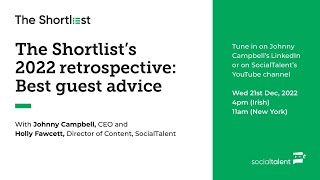
This is a transcript of a YouTube podcast episode (Shortlist episode 125) — a 2022 year-end retrospective hosted by Johnny Campbell with Holly Fawcett. The episode reviews notable guest advice from 40+ guests across 2022, organized into four core themes: wellbeing, diversity/equity/inclusion, talent-acquisition transformation, and leadership. Hosts play clips and discuss practical takeaways (e.g., check in with people, create space for the human, avoid assumptions, challenge hiring assumptions, internal mobility and retention, and fostering psychological safety). The episode closes with promotion of upcoming SocialTalent events and New Year well-wishes.
Chapters
Sam.
Welcome to episode 125 of the Shortlist. My name is Johnny Campbell. I'm CEO and co founder of Social Talent. I'm your host today for the Shortlist and today's special holiday season. Shortlist is a wrap up of 2022. We're going to examine all of the guests that came onto the show during the year. Over 40 unique guests joined us in 2022 and we're feeling nostalgic and want to kind of look back and say, What? What did 2022 stand for? What were the big themes? What was the best advice? Because every guest we've had on has contributed immensely to the shortlist of advice that we gather from everyone. They've imparted pearls of wisdom on all the topics that have shaped this incredibly uncertain year. Let's be fair and definitely a game of two halves. Or somebody said earlier on game of three halves. If we're talking about the World cup final, which was last week as we record this podcast. But I'm not going to do this on my own. I am not capable of doing this on my own and it wouldn't be an end of year wrap up without my fantastic colleague, Holly Fawcett. So Holly Fawcett, director of content Social talent, is joining me and also your fellow host on the Shortlist. Holly, welcome to the Shortlist. Our first time this year together.
It is our first time this year together and I'm not a body double for Johnny. We do actually exist as two completely separate people. It's rare that we are seen in the same place at the same time. But yes, very glad to be here as a guest, which is kind of cool rather than hosting to be on.
The other side and appropriately named for a Christmas themed show as well. Holly, wouldn't you agree?
I would completely agree, yes. I will be celebrating my 37th birthday tomorrow and for all of my other fellow Christmas babies, I feel your pain. I hope you get two gifts.
Yeah. So for those of you who are listening to this, probably on the podcast, if you're not listening live, it probably is already at least Thursday 22nd December. So join me. A happy birthday. I'd sing, but we might lose listeners.
Holly, don't think Been there before.
We've been there before. Well, folks, we're going to dive in. We've got tons of content to go through, lots of kind of clips to play you as well. Some of the best parts of the Shortlist this year. And myself and Holly, when we went through, and I say we went through, I mean, the fantastic David went through all the episodes, summarized it, pulled it all together and we just had to sit through a meeting of, of his recommendations. So all credit to David for doing this for us and for Simon for putting together all of the, the clips that you're going to hear today. When we look through this, we kind of came up with four unique themes. So we're going to talk to you through those big themes we saw during 2022 and take you through some of the best advice that we heard. Holly, I'm going to hand it over to you first for your first theme that you identified through the year and the quotes you felt that stood out for you, that you feel are worth sharing back with our audience on today's episode.
Yeah, so the first theme actually, which was probably surprising in a way coming from a talent acquisition podcast, that it wasn't about talent acquisition, but certainly was in the realm of, of HR and caring about one another. And that main theme was, was about well being. It was really surprising actually, really how much of a focus so many of our guests gave to the well being of their employees, the well being of the people that they serve, being at the forefront of all of that. So really it was, it was beautiful to see at the same time coming out of our kind of second and a half year of a pandemic to really look forward to, like how organizations are putting wellbeing at the center of their people services and their experiences with their employees. So we've picked out a couple of wonderful quotes, two in particular that we'll play in a clip for you. The first is from Jason Lawrence. Jason Lawrence is a founder, he's a well renowned author and social talent speaker as well. And Paul Phillips, who's the global TA.
Head for Avanade, make time every week to check in with the people that matter most to you in your life. Whether that's at work and if you're a manager, the people you lead should, whether it's friends, whether it's family, but like make time to reach out and ask people how they are to see what's going on. Like that connecting point is, you know, I think we're all on the back end of knowing what it feels like to be isolated from the people that matter most to us. And it sucks and it's had dire consequences. And we know we have loads of research that says one of the most powerful ways to maintain and improve our mental health is through better, stronger, more healthy connections with others. So make time to reach out and check in with people make time to connect with people, to get together with people. It very well may change your life.
It's actually. I'm actually going to share something I heard recently. We're doing a session around wellbeing, and someone shared a piece of advice that's resonated with me and really touched how we've been acting and behaving at Avanard. And something I feel that I need to do more as we move forward, and that is create space for the human, not just the task. So I think, you know, it's about how can we be more authentic and be more genuine about thinking, about being people first in some of our thinking? And this plays very nicely to what we've been talking about from a skills potential perspective, rather than a pedigree perspective. And I think the more that we can focus on creating space for the human and less about the task, the more successful we'll be moving forward. And I've certainly seen from an Avanar perspective, reflecting on our success in the near term, great dividends from us behaving in that way less about what we say on slides and more about what we do.
I love those quotes. Jason's one particularly hits me, Holly, because we look back at Christmas 2022, the holy season, and compare it to last year. There was a new strain of the virus running rampant last year, Christmas got canceled for pretty much everybody and travel was canceled. And we're back into lockdowns in many parts of the world. And I wonder how many people have held up that promise, that promise to check in with the people that matter most. I wonder, you know, whether it's on a personal level, people are still doing that. And maybe, you know, more relevant to this podcast on an organizational level, if leaders are still doing that with their teams checking in the level they would have checked in last year. What are your thoughts?
Well, obviously, I've no data to say whether or not individuals are feeling less alone than they were. And the depths of the pandemic, when we genuinely were just. It was a kind of fear mixed with isolation. And those two things don't go very well together. Of course, our brains make up stories of all types of things, and we tend to retreat into really weird places when that happens. And that can be very true of work as well. When you're isolated from your colleagues or you're isolated from the information, we can make leaps in our minds as to what's going on. And so this year saw the big the great resignation as well as the great rehiring and the great reshuffle I mean, the great, lots of things, but certainly in the great Resignation, people were just like, you know what? Actually I've had enough of my organization trying to put a carbon copy of our office into a virtual environment. They're not doing virtual very well. You know, everything has to be synchronous and that's not really how I work now. I want something that's a little bit more flexible. And we've seen people really and truly take. Take matters into their own hands when it comes to their career, which has been phenomenal. Right. We have truly seen people go into completely new careers. Right. They've taken lots of courses online, during the pandemic, et cetera. And it's given them huge career opportunities. And it's meant that organizations who didn't capitalize on that, who didn't check in with their employees, that those employees left. And so I think organizations have learned a lot of hard lessons this year where they've seen that kind of attrition, that kind of unforced attrition, and people just leave their organization in droves. So from a personal point of view, I mean, I certainly have made it my mission to make sure that I'm checking in with people, whether it's like a text message or a FaceTime call or hopefully seeing them in person. But I think we all have to be kind with one another as well and realize, look, people are going through different things and just, even just reaching out to say, hey, you don't have to answer this, but just to let you know I'm thinking of you. And when you've time for catch up, I'd love to chat to you. So there's definitely those kinds of moments to do so in work. I think it's really, really important that every employee feel connected to their business and feel connected to the information into the team. Otherwise you're, you're going to lose your great people. And this year, you know, it's going to be tough when it comes to, when it comes to hiring and finding the budget for hiring in some organizations. So retention is going to be pretty critical for me.
I think I'm going to call out just in the spirit of checking in and calling out. I'll call out a few hellos so far on our live stream chat. For those live hello to Stephen o' Donnell, who wishes you a happy birthday, Hol. I believe you're over 30, by the way. Quite sincere. To Chris Nowad as well, who's saying hello on YouTube and also to Mohammed Alijaz who says good afternoon as well, who's joining us on LinkedIn. So hello to you all. Thanks for your comments and we welcome some more for anyone listening live as well. If you have any good wishes or thoughts on themes for this year. A couple of the quotes that occurred to me as well from other guests. Jason Lawrence, his good colleague on our training on our platform, Linda Jonas was on the show during the year and she kind of expanded a little bit more on that concept of checking in with people by saying intentionality, clarity and checking in. Check in with people on a personal level and ask how they are and not just as a general statement. I know this is something that Linda and Jason advocate for and train leaders to do. To make it a deliberate part of your weekly or bi weekly routine with your team is a separate time to just check in with people versus and this is probably more towards Paul Phillips point, not just the tasks that are at hand and checking up on the tasks, but separately checking on the person and making that intentionality around. That is super important.
Yeah, 100%. I do love Linda. She is just wonderful. And I love Jason. Linda's check in method that they are advocating for, which is so simple and really easy to roll out. But similarly, when it comes to that human piece, there was a wonderful conversation with Jennifer Henderson of tilt. TILT is a, is an organization that helps people do leave of absence management in a much more human way. And I think what Paul was talking about, creating space for that human, not just the past, is really, really resonates with what Jen is saying as well. And that you know, when you are optimizing leave of absence management, which can be a huge headache for a lot of organizations and for a lot of HR teams to completely understand that. But of course, the human who's going through the need for leave of absence, whether that's because they're going to become a parent, that's because they have an elderly unwell family member, for example, who they need to care for. Whether that's because they are going to go traveling for a while and see the world now that we're, now that our borders have opened back up again and we're able to travel a little bit more. Whatever those experiences are driving the need for somebody to go on a leave of absence, the human should be looked at and should be dealt with as that human. And I know that there's so many people who have, you know, who have told their, their managers and who have agonized before telling their managers that they're on their more senior leadership team that they are pregnant, for example, agonizing over telling them that information because they fear again, kind of that absence of distance from the information. They fear that if they were to tell them this, that promotion opportunities would stop, that, you know, one to one conversations around the career would stop and that everything would be focused around the fact that they're leaving for a time. My gosh, in the grand scheme of things, in such a short space of time. And also they're pregnant, they're having a baby. This is amazing. So treating me as a human is really key. And Jennifer's story really struck with me around that well being and how much her career was just literally put a stop to it because she had revealed that she was pregnant. And after so long of trying to become pregnant in the first case, which was heartbreaking to hear that. And I know that she is one of thousands and thousands, unfortunately thousands of parents who have gone through that both, you know, from an IVF perspective, but also then to have that almost taken, you know, the joy of that being taken away from them at work. So yeah, it was, it was really. The human piece, I think is such a lovely theme to end on with all.
It overlaps with a second theme I'm going to introduce, which is a theme that arguably, you know, I'll admit we, we drove ourselves on the shortlist with our choice of guests and our choice of themes, and that is the theme of diversity, equity and inclusion or equity, Diversity, Inclusion or ied, depending on which or do you want to put that in? But unfortunately it may have been a theme that generally lost a bit of steam during the year with corporates and was less talked about. I think on the show we talked about it just as much as we had in the previous years, but that was probably more deliberate than anything else. But it continues to be an issue. I think we're seeing it as moving into the wider kind of ESG kind of category of issues being dealt with by organizations. You know, talking about sustainable talent, I'm particularly talking about equity. I think equity, to me, which was probably the lesser of the three in terms of how it was spoken a couple of years ago, was much more talk about diversity, much more talk about inclusion, a lot more talk about equity in the last year as being the thing that organizations are striving for, as being that kind of core center of D and I, if that makes sense. I've chosen two quotes to play back for our audience, just to kind of give a bit of context to this one is Annie Bonita. Annie is A good colleague, our friend John Vasilika over recruiting toolbox and herself a senior TA leader for many, many years who's worked in industry in the west coast of the US for a long time. And also Yasmin Sheikh, who's herself a disability rights activist, lawyer as well by training, who became disabled later in life and found herself in a wheelchair being treated completely differently than she had been the week before. And has a fantastic story and does amazing work. And as well, it's a pleasure to have both Annie and Yasmin on the social channel platform. But there's two quotes here I wanted to share with our audience, remind them of that. I think really kind of summed it up for a lot of the talk we had during the year on DNI on the show. So Simon, you might take it away there.
You know, I loved a quote from, and I could be pronouncing her name incorrectly, Lela Jana. She's a social entrepreneur who did great things and unfortunately passed away much too early. But she has a quote that many people utilize it. It says that talent is equally distributed, but opportunity is not. I think we need to recognize untapped and underrepresented talent globally where they're at. And you know, again, we need to find where people are and to open up our minds about, you know, the opportunities that people have or have, don't have, whether it's socioeconomic situation, where they live, etc. Not all the great, all the great tech talent is not centralized in San Francisco, California, you know, for example.
Yeah, that's very, very true. Talent is not. Sorry, talent is deeply distributed.
But opportunities, opportunity is not. I think it will be. And I've said this, a theme running through is don't make assumptions about people. I mean, I, as a wheelchair user, you, you, you may see me and a lot of people when they learn, when somebody has a disability or you can physically see it, you may make assumptions and usually about what I can't do. I'm going to plug my TED talk here unashamedly. Disability does not mean inability. Please do check it out. But you know, we do make massive assumptions. And this is just about, you know, it could be about race or gender, disability, things that we see, we, we have all these biases before that person's even said anything. So my main advice would be don't make assumptions.
Hear, hear. I think for Yasmin, gosh, that conversation was eye opening and was for Annie as well. My goodness, both were phenomenal around the subject of DE&I and kind of opening that lens of opportunity to people. But, yeah, gosh, the conversation with Yasmin, I was, I was hugely moved by that and educated as well, I have to say, particularly around some of the pieces around language of disability, for example. That's really important and important to be intentional around some of that. But, you know, when you recognize that anybody could become disabled at any point in your life, it's not something that you're born with necessarily. You could possibly become disabled even for a period of time as well. So the onus is there's so many people out there who are trying to make the world of work much fairer place because they have family members, for example, who have a disability, who maybe they have a child who has autism, for example, and they are passionately advocating for reform within their workplaces. I'm not making assumptions about people and really making sure that we reach out to communities where people feel that they are pigeonholed in some way and recognizing the talent that lies within the human, not the task, as Paul was saying as well. But, yeah, so, so, so important that we, that we open our doors to people from all walks of life and, you know, put them through their paces in a bit. You know, we can't just take the, the proxy of what school they went to, what companies they worked at before as saying, oh, you must be a wonderful potential employee if you worked at this company and went to this college or whatever. You know, we always can find amazing diamonds in the rough. That's where they, that's where they come from.
In the end, funny, we mentioned autism and those on the spectrum, and it's. It's widely suspected. He hasn't publicly confirmed it, nor does he ever have to. That Messi, who arguably won the World cup for Argentina last week. And you look at that talent that if ever there was an example that's so out there of the potential of people that may otherwise be put in a category and not noticed, not given that space, that air. You know, Messi is that person, right? You know, he's, he, he. He's just exemplifies all that is good about, about the sport of football, perhaps compared to Ronaldo, not to get too controversial, a live show where people might come in with their football opinions. But, you know, Messi is very much that team guy, you know, fantastic advocate you'd want, you want every young kid to turn out to be if they were passionate about football. It is about recognizing that talent is everywhere, you know, and we had, I recall a conversation we had on the show with Nick Maley, who's VP of talent acquisition over Equinix, he's on the show in September Time and he talked about the efforts that Equinix have, have gone into to, to find talent and where talent is not typically found, where the opportunity is not given to anybody. This point. And they didn't do this as a diversity initiative. They did this as a let's find great talent and find where no one else is looking. You know, why wouldn't you look where other people aren't looking? Why go why look for talent where everyone's looking? And it's really difficult go look for places they haven't discovered yet. And they found rich communities of talent with disabilities, underrepresented minority groups and they've, they've made fantastic hires that have outperformed their peers, have longer periods of loyalty in terms of their commitment to the company and it costs less to hire from these communities. Right. So, you know, not that we need a business case, but if there ever was one, it's there. I think that just, you know, again, back to the even Yasmin's point about not making assumptions about people. You and I spoke to a work colleague during the year, Holly, who was his disability around an illness that he has that caused real stress for him and worry and sickness when he had to go into a physical office. And remote working has just freed him of that and sent his illness into remission and completely changed his mindset. And you know, I know when that was shared with me, I just never even thought about somebody with that kind of a chronic issue and how the traditional workplace would make a difference. But I think that's, you know, to quote someone else who was on was on the show, Jessica Havens. She said if you're in a position of leadership, invest in yourself first around dei. Be open to the fact that all of a lot to learn. I have a lot to learn. I've been talking with folks who are much more intelligent and well read on this subject than I for the last eight years. I never stop learning and I want to have more conversations with more people because shining a light on stuff you've never seen before highlights just how much you don't know in terms of the empathy you need to show to people that you haven't thought about before and the opportunity that's out there in untapped talent pools. Well conscious of time. I know we could talk about that particular topic for ages. Hollywood. Lots more quotes in there. But tell me your second theme and our third for the show. That kind of Stuck out for you.
Yeah, this was definitely a year of tumult and strife amongst talent acquisition professionals. And there was a lot of really fantastic speakers who talked about reshaping or transforming their talent acquisition departments. And this was. It was a big enough team because suddenly for like a hot minute, recruiters were really, really, really important and were talked like the way it were. Like the CEO was like ringing up recruiters going, what's happening with talent acquisition? We can't hire people fast enough. Come on, come on. And suddenly recruiters were like, whoa, okay, we have all the power. This is great. Now, that did die down quite a lot in some instance, some firms. There are a lot of organizations who are still really struggling to hire, and recruiting is really showing up differently as a talent advisor, and that's really part of that talent acquisition transformation. So, yes, we have two great quotes. One from Andrew McGaskill, who is a phenomenal candidate experience advocate, and the other is Kevin Green, who is the chief people officer at First Bus. We'll hear from Kevin first.
Yeah, I think I would say challenge your assumptions and challenge what you've done. Historically, I think organizations get into patterns of behavior and I think this stuff is moving really fast around organizations. The environment is very volatile. Labor markets are really dynamic. Most organizations are experienced in this. And what it means is you need to change at pace. So you've got to try stuff, you know, fail fast, make experiments, try stuff, learn from it, iterate, go again. So I think the way that we manage and think about talent and recruitment has got to be a much more dynamic creative process rather than this is the way we hire and this is our, you know, it's been the same for five years. So I think my challenge to people is, you know, hopefully take some of the stuff I've been ranting on about for the last 45 minutes and, and try a few things, you know, try and get a bit more agile, get more responsive, try and think about different parts of the labor market and different offerings to attract people from it to your organization. But, you know, what's worked in the past isn't going to work in the future. And you've got to be much more thoughtful about this stuff.
Yeah, well, with regards to this mission specifically, my piece of advice for the shortlist audience is to never forget what it feels like to be on the job market. So what we see is what I call the etch a sketch effect, whereby somebody will be a candidate on the job market for a while and they'll be really in tune with what it feels like to not get good feedback or to be ghosted or be to be applying all day or to turn up at an interview and have someone checking their phone or late or whatever it might be on the hiring side and they'll be really aggrieved at this and it will be hurting them and, and it really demoralizing. But what happens is that when they land in role, this Etch A Sketch thing happens where they almost wipe clean that experience from their mind and they start falling back into the exact same habits that they were complaining about when they're on the job market. So what all the shortlist crew can do is commit to never forgetting the person behind that CV the human sat in front of than the interview and what it feels like to go through the ambiguity, the anxiety and the grieving process of a redundancy or a job search and make sure that you're paying it forward and that you're taking ownership of your role in looking after that person sat in front of you.
Gosh, it's amazing Andrew making that quote when just before a whole bunch of recruiters are probably going to go back out the job market and find themselves looking for a job. Right. Another very similar quote from Jeff Moore, who's the VP of talent over at toast, based out of Boston, ex Google. And Jeff said changing jobs is really stressful. It's one of the most stressful things you can do in your life and if you as a recruiter don't treat it with that level of reverence, you'll never be good at this industry. And it's just such a an important reminder, as Andrew says, to not forget what it feels like to be on the job market that if you're in this business of talent and talent acquisition, you need to think about what it's really like and maybe it's going to be healthy for some folks to experience it, experience the job market and know what it's like and maybe, maybe drive more humility next year when those folks go back into new roles in new TA and talent teams and start working with candidates again. You know, what do you think? You know, to Kevin's point around, challenge everything you need to do in 2023, what would you do differently? What would you recommend folks do differently or do more of if it's either already doing different things?
Well, yeah, certainly for Kevin, the level of influence and pushing the boundaries that he's able to do at first bus has been phenomenal because it has seen tremendous results amongst his HR teams. But ultimately I think the next kind of phase for talent acquisition is freely where for talent acquisition teams to be able to do things differently, they have to be looking at departments in their organization that do have power, influence, decision making, control. Like, what is it that, first of all, why do they have that? What is it that they bring to the table when they, when they are getting and securing this type of influence, they're usually bringing data and numbers, usually with dollar signs in front of them. Right? And this gets everyone's ears pricked up when they realize that there's actually financial impact against this. And talent acquisition is like, has a huge financial impact on an organization. It's an incredibly responsible job. Going back to what Andrew was saying as well, but understanding the human experience behind that and linking back in with what Paul Phillips was also saying about never forgetting it's a human, not just the task, but ultimately it's looking at those in the organization who do bring an awful lot of influence into different conversations and emulating that. Bring the data, go find the data. Something that Ellen Bailey actually spoke about kind of also in and around this team is having an opinion. And if you don't have an opinion yet about TA transformation, go find one. Understand where is our organization going? Why is it going there? Try to be that good, bit more strategic and start putting dollar signs in front of your, in front of your numbers. Link it constantly back to what the organization cares about, which ultimately is its bottom line, right. And, and where great talent can hugely drive towards that. I think that's really what I hope for 2023, that recruiters and TA folks do more of, do more of this year.
I was asked in a podcast earlier today a question that I get asked all the time, given the nature of social talent. And you probably get asked a similar question, Holly, and it's to do with skills that recruiters need in the future. What are they? You know, it reminds me of a quote from John Vasilika, who joined us on the show during the year as well. And, you know, wrapping up that theme, said, show up more with a voice, with a point of view, get curious, find allies in the business, understand the why and challenge, be willing to push back a little bit. I think that, you know, that sums up to me the type of recruiter that perhaps Kevin is talking about. They're challenging assumptions, they are looking at the solutions to the why and really understanding what the why is. As opposed to saying, oh, you want to hire that? Great. It's kind of saying, why do you need to hire that person? What are you Trying to achieve, digging into those, you know, have been called the softer skills we call them, the more the core skills that folks have across many different disciplines. I think it's. There's more of that and less of. You know, when you and I started in this business, Holly, we were teaching people sourcing skills and running Boolean search strings, the skill of the modern recruiter. You know, it is much more that consultative advisor pushing back and even just I think giving, giving more than just talent acquisition solutions as well. And by the way, good see John is listening live as well. We love that quote. John, great to have you listening live as well. And thanks for saying hello.
I think there's also an extra piece in there around being that more consultative type of recruiter is while you do have an idea or you've seen things before, don't get too attached to ideas because being able to be collaborative and you know, like in being collaborative in compromising a particular things, you're able to actually get much more healthy types of things going on. Right. You can start completely brand new initiatives that you've never would have come to when it comes to as being as a recruiter. But ultimately and a trait that Kathy Iverson has actually just put into our LinkedIn chat there around curiosity. That is hugely key, right? Not getting too attached to ideas, constantly listening for what's going on and being able to bring up these types of ideas in that moment in time. That's what builds your business acumen and that ultimately is what's going to pave your whole future in recruiting is just being. Just be interested in hoovering up different types of information and be ready to present people with them in the future. They don't have to be specific your ideas or your brand new information, but if you're able to be the, the sharer of information, that's, that's amazing.
And just a quick shout out to Garrick Chan, who commented earlier live when we were talking about the topic of diversity, equity, inclusion, saying, you know, when it comes to dei, I have learned to keep my mouth shut even though I normally have quite an opinion. I noticed that others also keep their mouths shut. It's mostly white people who carry the conversation. I think Garrick's point is about, you know, we should all listen more and take the time to listen. I guess when you're always talking, if you're the person doing all the talking, maybe you need to just be a bit more quiet and take more time to listen to other point of views, other voices. And I'd argue Garrick, you know, use your voice only to encourage others to speak. Perhaps I wouldn't. I wouldn't keep quiet. I use that voice, but only to give others the opportunity to share their voice. Perhaps those who aren't as willing or don't get the opportunity. Which probably brings me to my last topic and our last topic of the four. Holly. We could keep going for hours, but.
It is the last day of the year.
Come on, celebrate tomorrow. Right? So. So for me, you know, a big theme. It's a big theme of 2022 for me, but it's been a big theme pretty much since the beginning of the pandemic, and that is that of leadership and is showing that leadership. And there's been so many folks who've come on, on the show during the year who given really amazing advice that I think any leader could take, could take, and would make a great leader. Two that I'm gonna. I'm gonna signal out for playback in just a moment are from Rick Kelly, who runs Facebook here in Ireland. And Rick also runs Facebook, Facebook's global gaming business. Awesome guy with. With just amazing insight and perspective. And he's just achieved so much in his team around diversity, equity, inclusion. But it's the topic of leadership I wanted to signal. Signal him out for because I think his. His lessons are a lot more broader than that. And then Joe Gersten, our good friend and contributed to social talent platform, who's been a fantastic ally of ours as an organization and just really drives home that whole psychological safety piece. But does it, you know, from a. From a. From a place of education and just from a really good, you know, his insights are fantastic. He's super practical, gives great advice. So I'm going to finish off my last section with these two quotes from Rick and Joe. Over to you, Simon.
We all, as leaders have people we look up to and people we want to emulate and mimic some of their behaviors. But I actually think that I've learned more in my career about who I want to be as a leader from people that I saw that I didn't want to be like. So recognizing the behaviors in leaders that turned me off and ensuring that I don't emit those same type of feelings in other people. You know, one classic example I give is, you know, there was an individual that was a very senior person that sat about 25ft away from me for a couple of years in my early career. He would never say hello. He'd pass you in the hall. He wouldn't look at you. And maybe he was an introvert. Maybe he. But he wasn't because we, you know, we knew who he was, but he just didn't. Yeah. How hard is it just to smile, to say, hey, how are you? How's your day going? What's up, man? And, like, those little things without doing them makes you feel like, oh, like, you know, I'm uncomfortable around that person, or, like, does he not like me? Or what's the story there? And so, you know, it's one of the things that I've tried to always do is just like, it's so easy to just say, hi, man, how are you? How's your day going? You know, that type of thing is just being personable and being friendly. But the bottom line is, what can you learn from the people that you don't want to be like and ensure that you don't impart those same behaviors in your own practices?
Well, I'll keep it kind of relevant to the topic of inclusive leadership.
I think that one of the most valuable things that you can do is.
To ensure and prove that it's safe for your people to tell the truth to you.
Disagreement is a great proxy for diversity, if you value diversity. If you value differences, you should have.
A healthy, intentional relationship with disagreement. Start there. I love those two quotes. You know, I know it's you, Holly. I'm scared to ask you the question because you spent most of your career working in social talent, but I know that I have worked under leaders, many of them great, but a couple who I know, to Rick's point, I remember because of the things they do or did that I would never want to emulate. And that's actually a really strong thing. Just as we have our heroes that we want to be more like, like, there's folks that act as the kind of, you know, maybe the opposite of a north star, maybe it's the south star. Is that a thing of the people you don't want, don't be the Death Star, particularly the trait that's reflected there is. Is really important for you. Any Death Star that you've come across, and for the sake of Joe's point, happy with disagreement, if it's me as well, we'll take that as. As Death Star examples. But, you know, do you think those two quotes ring true to you? The thing about disagreement being a proxy for diversity from Joe and learning as much from people you don't want to be like as people you do want to be like?
Oh, yeah, absolutely. Look, you and I have had, thankfully, had a lot of Healthy disagreements over our 12 years in business together, which is wonderful to also be able to disagree and come back to work the next day and everything's still fine. And that's great. Truly, as an organization, I think we could always be better in disagreeing more constructively and with less emotion and things like that. And those are things that you have to learn. And that's kind of frightening for managers, I think, to have to learn how to do conflict well, because conflict is around us all the time. And what ends up happening is that we end up just keeping stone sometimes. Back to Garak Chan's point in the messages here on LinkedIn, you get into just talking less and, and just agreeing more because you don't want the hassle of conflict. And that's awful. But yes, unfortunately, I have had poor managers who I definitely have felt, you know what, I just never want to be like them. And that's, you know, especially when you get into your first manager managerial position, you're, you're often your only kind of North Star, so to speak, are things that I don't want to do. And you kind of know, okay, I, I know I don't want to be like this, but you may not necessarily have a great role model of the things and the behaviors that you do want to do. And when you find a manager like that, like, you will know from an HR point of view, you will know the managers who are great based on the retention of their team, the team are hugely loyal to them, but also stay with them and are really productive and really well. And the things that they will say about them may not necessarily be like, you know, oh, we get the most amazing results. I'm smashing my target every single year. It may not necessarily necessity be that it's ultimately that I feel I belong. I feel I'm respected, have a voice here, I can do well here, I'm cared for here. Those are the types of things that, you know, is an inclusive manager and has the behaviors that ultimately will make them help make them succeed. And that's what every organization should really be striving for, I think so definitely. They definitely ring true for me.
It's hard to do, though, particularly to Joe's point. You know, we say, you know, you should ensure and prove that it is safe for your people to tell the truth to you.
Right.
That sounds like, yes, I want people to tell the truth. And I'm going to email them all and say, tell the truth to me. I realized in the last year that that's actually much harder to do reminded me of a quote from Lee McQueen, who you interviewed on the show during the year, who said, have a look at what you want to be as a business, what type of people you want in your company. Start with the culture and values and work down from there. Most organizations that are successful will have a successful value, our cultures at their core. And I think that that principle of disagreement being a great proxy for diversity is bang on. But I recently started reading, as I know you've read Erin Meyer's book that she wrote with Reed Hastings on the Netflix Culture can more of an update. And they go quite deep on the structures and processes that you need to have in place to create an environment where disagreement knowing will happen but is allowed and encouraged. They talk about how you know an individual contributor and go against the will of their manager. If they believe in something and if the manager is proven to be incorrect, she must celebrate that and share how she was incorrect and how brilliant it is that the outcome was fantastic. And so they have a lot of processes in place quite deliberately to build that culture where telling the truth is happens every day. So I think we can quote something like that and go, disagreement is a great proxy for diversity. Brilliant. We should encourage disagreement. The reality is it's harder to do. Requires a lot of work. Like most of these things. I think that's probably what culture is. Culture to me is, do you actually put the work into your organization to make that come to life or do you just say it every once in a while? But everyone kind of goes, yeah, but if we tell her that real truth, it's not going to work out well. So let's just nod our head and say, yeah, disagreement is brilliant. That's just. But don't disagree with her because you know, you know how it ends. I think that's. That leadership's hard. I think that's what we've all learned coming out of the pandemic. It used to be just the thing. Someone was more was. Was in charge and they ran meetings and they did all these things. And I think we've woken up to the reality that leadership is a very specific job that requires a lot of training and there's a lot to learn from others and it's hard to do. Right. Would you agree?
I. Absolutely, yes. And especially these last two and a half years has proven the. This, the difficulties and challenges of having to do remote leadership because proximity bias is strong in all of us. Right. When we can see people in front of us, when we can build relationships with people who are physically in our space, that comes second nature to people because that's all we've known for our entire. Not just our entire working lives, but our entire lives in general. So having to do so now and do so in a very deliberate way is definitely more to challenging. But ultimately none of us learn how to do conflict well in our lives in, you know, either. Like we. If you have to ever go into marriage counseling or anything like that, I'm sure you make me learn some of those tools. But ultimately reframing any type of conflict by saying, look, it's not you versus me with the problem in the middle. It's actually both of us on the same side. The problem is over there and we have to figure out this problem together. When you reframe it like that, it suddenly becomes, ah, yeah, of course. Because all ultimately the behavior and the value is we know each other, we like each other. If it's your significant other or family member, it's we love each other and we want to resolve this conflict because ultimately we don't want this to become something that splits between us. So it's not a skill that any of us are taught. It should be something I think we teach in school, how to do conflict well, because that being able to learn the truth from somebody, even when it's unpleasant or unexpected, like having to learn the truth through Glassdoor. When a Glassdoor review is a complete surprise and then ultimately deep down in your head, you're kind of going, they're probably also right. That's when you know people aren't able to tell you the truth in person. That's a good way of kind of indicating, okay, I could probably do a little bit more here with seeking the truth, seeking real valued opinions from others so that we can have this conversation and resolve this conflict.
I tell you, I have forgotten every good comment that may have been made about me on Glassdoor. I remember every bad one. They've kept me awake for nights because, you know, initially it's in. I'm sure any leader who's in a position where they see a review like that, whether it's in a HR system or if it's 360 degree reviews or it's on a glass door, you'll be annoyed, you'll be upset, you'll say, that's not fair. Well, it's your point, Holly. It's bang on. Deep down you'll know there's some truth in it or maybe a lot of truth. And that's the hard thing, Holly. We're at time. Can you believe this? Where we flew through and, and yes, a mention of the, of the saint that celebrated this. Is he saying he's Jesus Christ, a saint? I don't even know.
I don't know.
Was he ever, I don't know what church may have put him as the same. That's an interesting.
He's the Messiah, Johnny. That's the only thing I know. He's a messiah, isn't he?
Many believe. Many believe. And that is, that is, that is this time of year. And I'm just glad to have a pagan holiday to celebrate to take some time and hopefully many of our listeners are as well. Folks, thanks for everyone who spent time listening to the episodes, the 50 plus episodes we put out during the year and for the 40 plus guests who've joined us as well on those episodes and to yourself, Holly, for hosting many of those wonderful episodes. And hopefully you'll, you'll, you'll also join me next year in, in welcoming a whole new list of guests. We're gonna have a bit of a rebrand of the podcast in the new year. We're going to go in a kind of broader direction with some really interesting speakers and content to just keep building on the fantastic conversation we've had as well so far in the last couple of years. But before we close out, Holly, thoughts and reflections on next year. I dare use the word predictions, but what do you think of the big themes that we'll be discussing this time next year when we do our 2023 wrap up?
I think we will be discussing how we're doing retention better. I think retention is something that every organization has suddenly put on its radar as something we really need to work on. And I think some of the solutions to that is internal mobility. So I think we'll be talking about internal mobility and retention a lot next year. Fingers crossed.
And we'd have to have Stephen o' Donnell as a guest, as you just pointed out, live. We will have to do that. Let's book you in. Let's get you on the show. We're sending an email out to try and get you in there. Jennifer's just saying she'll hold that slot. Yeah, I agree. You know, I think mobility, you know, I spoke about this to somebody this morning. It's about, and it's actually about sustainability, you know, sustainable. We talk about sustainability. We typically think of natural resources and we say, well, you know, there's a limited amount of natural resources and we're running out of them. So we have to think about renewable energy. There's a limited amount of talent and we're running out of talent in many, many areas and not just the likes of stem. You can't get a pint in a bar in Dublin these days. Staff, you can't get a sandwich at lunch at a coffee shop because there's no staff path. So sustainable talent is going to be a big issue and that's what drives internal mobility, but also requires great leadership. Leadership is going to be a big topic next year. In fact, we're going to have our first ST Live or our free webinar show that we run for 90 minutes every three months. In January, you can register at socialtown.com forward/live. I believe that's the third week of January and we have a whole bunch of CPOs, C HROs joining us to give us their predictions from talent at the highest level in big organizations around the world, including the fantastic Pat Widower who is the former head of people over at LinkedIn who's going to be joining us, and many others giving us their predictions of the year ahead. What are their priorities? What are they working on at a C level in their businesses? So be sure to register at socialtown.com forward/live for that fantastic event and we'll dig into the year with gusto. Holly, thanks for joining me and thanks to our guests for joining us as well. And thank you to to you joining us on this Christmas special, this holiday special roundabout of the year. We'll be back next year, but in the meantime from me, I'll say a Happy Christmas and New Year and Holly.
Happy holidays and Happy New Year.
Holly, for you in particular, a very happy birthday tomorrow.
Oh, thank you everyone.
Have a great year. See you in 2023.
Sa. Sam.
More from Johnny


Where Does Your Hiring Stand? Diagnose It with the Maturity Model | SocialTalent

Where Does Your Hiring Stand? Diagnose It with the Maturity Model | SocialTalent






NEW CONTENT - How to use Generative AI for Recruitment Marketing with Glen Cathey | SocialTalent

NEW CONTENT - How to Use Generative AI for Sourcing & Recruiting with Glen Cathey | SocialTalent

NEW CONTENT - How to Unlock the Power of Generative AI with Glen Cathey | SocialTalent