Unlocking Untapped Talent with Siobhan Corcoran: Hiring Experienced Workers
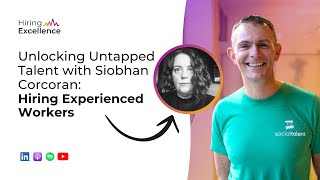
Siobhan Corcoran, a recruiter with nearly 30 years in the field, argues that companies are missing out by not hiring experienced older workers. Ageism and outdated assumptions keep valuable talent on the sidelines. She recommends adding age to diversity initiatives, running pilot programs, and rethinking benefits and interview processes to surface what experienced hires actually want.
Questions this video answers
November 14, 2024.
From 20% in 1990 to 35% in 2023.
Chapters
The very first thing is just awareness to include it there and to make sure that, you know, recruiters and, you know, whatever technology that I'm using is not biased against somebody because of age. And that the very, very least is that our funnel of applications and our outward reach is not rooting these people out at the very, very first stage.
Hi and welcome to the show. I'm Johnny Campbell, CEO and co founder of Social talent. And this week on the podcast, we're talking to Siobhan Corcoran about the greatest pool of untapped talent left in talent acquisition. Jwon, you're very welcome to the podcast. Would you mind introducing yourself, maybe tell us a little about yourself. Where do we find you here today?
Yeah, that's a big intro. The biggest pool of untapped talent. So, Jonny, I've been in the recruitment business now for. I was just counting it up 29 years. So I've been around for quite a while. Started in the recruitment business in the 90s. Like a lot of people fell into it by accident, and here I am nearly 30 years later, still, still in the business. So must have, must have been doing something right. Started off in agencies, spent a long number of years in agencies, did the usual running desks and agencies. Went to the UK, did the hard stuff in London during the late 90s when it was really hard work, very much playing hard and working hard back then, and then went in house during the 2000s and went to work in a couple of different places. But kind of finally found my home in Oracle where I spent 15 years and left there a few years ago. And most recently I've been with EY and just finished up with EY as their leader talent leader, talent acquisition leader for them.
Siobhan, when you, when you just reference it, you say the hard stuff. We're talking about the hard recruiting stuff just for anyone.
Yeah, the running. The hard stuff. Running a desk, not being allowed to sit down in the morning until you had three interviews scheduled and all of your numbers on a ticker. Everybody's. Everybody's target on a ticker that went around like a stock exchange, you know, so you could see where you were in the rankings all the time. You know those kind of environments.
Oh, I do. I'm. I'm pretty much in this game as long as you. Since the 90s. And it's funny, I was chatting to a good friend of mine who I haven't spoken to in a couple of years, who I've known in recruiting for ages, and he, he told me today how he joined this organization, it's not for profit. And he ran his own business. He'd sold it to private equity. He'd been working with that business. And he told me about his new job. He said, I'll be honest with you, it's amazing. He goes, the pay is awful. All right. And he said. He goes, I'm just at this point in my life where this is what I want to do. And the thing I was doing, I just don't want to do that anymore. And I wanted to explore that with you because I think that speaks to the theme of today. You know, big reveal. The untapped potential in the market are potentially people like myself and yourself and folks older than us who we don't talk about. We're focused on the Gen Z, the Gen Y, the Millennials, everything else, and maybe less. The Gen Xers and the baby boomers. Talk to me about this. This revelation that you've had. Maybe it's not a revelation. It's. Maybe it's crept in over the years in terms of this talent marketplace. That's not happening.
Well, I mean, it definitely came from personal experience for me, and it has. It wasn't a revelation. It wasn't a eureka moment. It snuck up over a number of years. And probably when I decided that I was going to leave Oracle, I made a very, very brave, crazy decision to leave Oracle and relocate myself and my husband down to West Cork to kind of semi retire and run a guest house, which we did, renovated a house down on the Bear Peninsula. I mean, it was. It was a major culture shock for me anyway, going to that. Set up this guest house, run it for a season, got amazing reviews and we going towards getting ourselves onto the, you know, the lists of the. The kind of the blue Book and moving towards that kind of area, and we just. I just couldn't wait to get back to Dublin and get a proper job again. I really feel like I jumped too soon. I went, you know, I jumped straight out of, you know, a busy corporate EMEA role with a big team and a lot going on all the time, to life in West Cork on the Bear Peninsula. And it was too much for me. So I came back and went back into work with. With Ey and went back again into exactly what I had left at. At Oracle. And I guess what I'm now seeing is what friends of mine are doing and peers of mine are doing is they're at a point in their career where they want to keep working, they want to stay engaged, they want to be in a role that's productive and has value and is valued. But they want to step back a bit. They don't want the same level of time demands, time commitments, stress. In a lot of cases, people management that type of level of engagement and they're willing to take really, really big salary puts to do that. So that's kind of where I am now. I've finished up with ey. I don't want to go back into a similar kind of role at the same level doing the same thing. I'm lucky, I'm privileged that I don't need to earn at the same level that I have been and I'm ready to to do something else. And I'd like to not have to go and do something that I know nothing about and start from nothing. I'd like to be able to use what I know and still do that. But the opportunities for that seem very slim and I know I'm not alone. And as I've been scratching that surface, I see more and more of it.
Shauna I've shared in the podcast A Dirty Little Secret before of my early years in agency recruitment when I used to log into my ADAPT database and I'd run searches. I was searching for accountants, qualified accountants and financial controllers in industry for the most part I run my search and I'd put my search criteria and I get my results and I'd sort by age and everyone over 35 I control A and delete. And as a 20 something year old recruiter I was like, look, they're too old. And even if I thought there was competence, I was, I made this assumption, which I think many do at that age, they're gonna want more money and they're gonna want this job that I can't offer them because again, when you're perhaps earlier in your career, not everyone, but certainly I was this person and maybe you were also this person. You just had this view that the way you see your career trajectory is the way everybody does, that you're just on this constant ladder up and that never ends. And you know, you do get older and for some people it's perhaps that they paid off their mortgage and they realize I no longer am under that pressure I used to be to earn. Or it could be that their kids have grown up and moved away. I spoke to somebody late last week who's in that situation, decided to live abroad again because her kids were in college and she had the mortgage paid off with her husband and she's like, I can now do the stuff I couldn't do for 20 years. Or I had a good friend of mine who sold his business for lunch last week, a bit like yourself, said he spent a year on a farm milking cows and losing his goddamn mind. He's like, what was I doing? He went from literally at the cut and thrust of everything to zero. And it's just destroyed.
It was too much.
Yeah, too much. But I bring up, we do a weekly news that we send out with a few articles on the blog. And a couple of months ago we covered an article in Venezuela which talked about how Venezuelans have moved to this online work, particularly older workers above 50 where they're doing kind of gig work online for companies outside Venezuela and making three, four times the pension rate, which is awful in Venezuela and really balancing this life balance. They seem to have nailed this right in terms of, you know, folks in their 70s and older is even working for Amazon or private companies or all sorts of stuff and they've really kind of have leveraged remote work. So I think there's, I think what you've talked about is something that's been there forever, but maybe we now live in a world where the barriers to doing this have just come down so much. Not if there ever was an excuse to not hire someone who's older to do a job. But, you know, it's easier to set somebody up to do a job that gives that flexibility. Like what kind of. First of all, talk to me about what do you think are the barriers? I've given my personal story as the recruiter. What are some of the barriers, you think, to older candidates being considered for roles that they otherwise might want to do?
Yeah, I think, I think it's a. Some. It comes back to assumptions because what you were saying about, you know, sorting candidate CVs by age, you know, I was guilty of the same thing. You know, somebody when I, you know, when I was in my 20s or 30s, to me, somebody who was in their early 50s was, you know, ancient past us. And I think that, you know, we're not as old as maybe previous generations were in their 50s. You know, people are living longer now. Like the people coming into the workplace now as gen zers, they're expected to live till they're at least 100 years old, if not older. So, you know, we have to shift the workplace to look at people who are in different phases of their lives. Because the assumption has always been in the past that there was a three stage life. You know, that you had your childhood and your education, then you went into work, you worked your butt off and then at some magic age in or around 60s, you retired and you put your feet up for the rest of your life. And that's not going to happen for future generations. They're going to have these multi phase lives and multi staged lives and I think we're starting our generation are maybe just the very first point that we're seeing that and I think our structures and our assumptions are set up so that they are but they're as things used to be. So people are still thinking that once you're 50, you've got no energy, you don't know anything, you're not forward thinking, you're too old, you're not going to accept being managed by somebody younger than you. You're not going to know your way around any it, you're never going to be able to learn the software, you know the kind of, and I think we're, we're still kind of set up in a kind of stodgy old way like that. But that's not really the truth. I think the truth is that as Gen Xers, as you said, we are the first people who are maybe really starting to experiment with another stage in our life before we retire and younger people are all going to have to do this and they're going to have to, they're going to have to work, work much longer. So we need to start thinking about it and preparing for it.
What about the objection, Siobhan, that can come up and maybe is seen to be reasonably valid in that somebody who hires you for a job that you could have done on paper 10 years ago, 15 years ago, Siobhan. And you're going, I'm at a different time. I don't want the stress. I can, yes, I can do it with my sleep, that's why I want to do it. And I can offer more and help help you out. The concern is, and the pushback is yeah, but someone's going to come on, come on, offer her a really good job with loads of money. Six months into our job she's going to leave to get that job because she realized she made a mistake and she should go back to the high level career paying job that she had. How do you deal with that potentially defensible objection to hiring somebody who's more developed in their career for a job that, I hate to use the phrase, let's call it out, let's bring it up for the first time. Overqualified.
For overqualified. Yeah. Well, I mean I think you do it by sticking to what you said, if you offered them a job that gave them what they were looking for, which is, you know, the reduced stress, the reduced demand, whatever that flexibility, you know, that was offered. If you're giving people that, there shouldn't be a reason for them to move to a higher paid role because it's not an easy decision to come to and it's not a decision you come to lightly either. So I think it's a little bit like trust the people that you're hiring to some degree. Make sure you've got a really robust interview process. I'm always going on about interview processes, but make sure you've got a robust interview process where you really are exploring that with the people who you're bringing in and that you're giving them what they said, what you said you were going to give them, which is, you know, the role that gives them the balance and the flexibility as well as the contribution, allowing them to contribute that you said. I mean, there's always going to be somebody with a, you know, a defensive argument. But at the same time, I think you've got to make sure that we're thinking about this in a diversity, you know, with the same lens that we think about diversity as well. You know, that what are we getting from this as an employee, as the employer, what are we getting when we're bringing these people in, you know, that, you know, multi generational teams are more effective, they're more productive and you keep all of this knowledge in your firm and if you can offer this to people so that they aren't even leaving your firm, if this can be an internal piece that you're offering people is to make that change within your organization? I think the benefits are enormous.
Do you think on the internal piece, is there potentially a stigma attached with somebody who had a VP or director job title and all of a sudden they're down to manager or associate and six months later, do you think it is just genuinely harder for that candidate then? Because is it better to go? You know, I want to make this career change, but I'm going to have to change the company. Is it realistic to stay in the same company, honestly though, to be able to do this?
I, I don't know. I mean, maybe it is, maybe it is a, a lot to ask, but I think that comes down to a cultural shift really, about how we value people and what we value. If all you value are job titles and salaries and that's how you measure your value, then yeah. But if you are a company that really embraces people bringing their whole selves to work and you're, you know, you're allowing people to explore different parts of their lives more fully while staying engaged in a role. I think there's a cultural way that you can overcome that as well. But, you know, I wouldn't want to diminish that point though, Jonny, because it, you know, it's something that I do know that I've struggled with a bit in my own mind. Do you know, how do I go from, you know, senior Director on my LinkedIn profile to office manager or barista or whatever it is, you know, I. What would people think of me? Does it look weak? Does it look like I wasn't able for it anymore? You know, so like people like me and you and people who might be thinking about those changes, we kind of need some support as well and some way for ourselves to put some language on it and to formalize it and name us.
When I think about companies who might do this, well, I'll be honest with you, the only examples I can come up with, and I commend them, by the way, are a lot of the retail and hospitality companies. You might have Tesco, for example, a well known this part of world for hiring from multiple age groups and also for hiring for people with disabilities and everything else. McDonald's restaurants, really good at it as well. A lot of retail outlets, retail outlets and hospitality companies are really up for this or, you know, a lot of hotel change or are happy with people changing careers and jobs. And again, I commend them. I think it's wonderful. I think they've opened the door and shown that this is possible and shown you can give really great careers to people. Are there any, you know, companies different to that? Maybe the professional companies, tech companies that you've come across that have begun to do this are showing signs that they have embraced this.
I think in Oracle we saw bits of it, particularly in technology, in our technology hiring, where we had, you know, the rarest skill sets or people who were really skilled in maybe not quite defunct technologies, but technologies that, you know, younger people weren't studying, you know, as much anymore, but are still being used used. When we saw that there was much more of, you know, among hiring managers, a much more willingness to look at maybe older people and bring them in on, you know, not quite part time, but maybe fixed term contracts and stuff like that to bring that skill into the, into the company. But we, we never got as far as doing something formal around it and having a policy around it. And making sure that we weren't being ageist and that we were looking at all of our CVs and that all of the recruitment teams were looking at somebody's experience and what they said they wanted to do, as opposed to what their assumption was that that person wanted to do because of how many years experience they had. So we never got to tackle that as a company or as a firm. Only a couple of instances with individual.
Managers and teams and it can be done again. On our news over the summer, we covered an article from Forbes which talked about data from London school Economics around ageism. And they were talking about group hiring situations and they were saying that the. They found a very strong bias against old workers and these group hiring decisions. But when they introduced explicit training upfront to make people aware of potential bias and potential of different candidates from different age groups, they found that a huge amount of discrimination went away and that you had much more balanced and fair decision making and people were more willing to consider older workers. So it would suggest that the. This is quite possible from a focus perspective. But I think my sense is that a lot of organizations have so many other big things to deal with. Like in the US it's predominantly a gender and race challenge in terms of the two biggest priorities in D and I. Other parts of the world, you have, you know, disabilities as a big issue, LGBTQ kind of gender preferences as an issue, and ageism just doesn't really get a look in yet. You know, we know demographically it's gonna be the biggest challenge facing our society. In nearly every part of the world, we have an aging population. We are all, every one of us, without exception, if you're lucky, gonna be going to be in this demographic.
Absolutely.
And it's going to be our kids or someone else's kids who are making these decisions for us. This is the chance to. If you're 24 listening to this podcast, I'm wondering, what can I do? It's like this is you in X amount of years.
Yeah.
You know, so, so, so when you think about what steps could, you know, the recruiters and recruiting leaders who would probably be our main audience for this podcast and listening now that they could take to try and set up an environment where you have more openness and willingness to this demographic of. Of talent, what do you think are some of the steps if I was to, you know, give you this task and responsibility and the organization said, we're behind this, we want to support this, what would you be thinking of as the steps to take to Try and remedy it.
Well, probably the first thing that I would do is I would include age in DE and I, I don't see it being included in the, the places that I, where I can see it. Not saying that there aren't places and companies that are including it, but I don't see it being included in the same way that other, that other groups are being included. And so I think the very first thing is just awareness to include it there and to make sure that, you know, recruiters and, you know, whatever technology that I'm using is not biased against somebody because of age. And that the very, very least is that our funnel of applications and our outward reach is not ruling these people out at the very, very first stage. And then I think the second part of it is, as with anything that you're going to be trying is to get some, get some experience, you know, run some pilots, get some data, show, show people on a small scale what can be done before you start thinking about scaling it. You know, experiment with some of the roles in the firm, experiment with some of the internal people who maybe might be willing to give something a try internally before you go out to the market with us. But I think to first of all make sure that age is included in your DE and I, and then, you know, step by step, build it up, you know, show some, show some data, build up some data. I think that's probably the way you need to go.
We've always advocated from a DI perspective, regardless of the lens you're looking at it through that you gotta build, you know, strong policies, practices, and then you've got to make sure that you have the, the, the kind of, the policies have to be there, their processes have to be there, and then these to your practices and around age, for example, if you're looking to hire in talent that might be of a different age group and demographic and take this approach, sometimes you find that the organization setup's not suitable. So for example, you might not have the same parent, you might not have care, care, care leave the same way you have parental leave again, you know, you might be set up for younger workers who are starting families as opposed to older workers who are taking care of elderly parents or elderly siblings, for example, you might have those policies, you might not have it in the place that you can take a semi retirement again, seeing that to stay again, maybe move into that position and take a side or back step is that you're officially moving into a semi retirement program and it's officially just branded differently in an organization. That you don't offer the ability to have flexible benefits packages which, you know, as we all know, the benefits you might enjoy as an employee will probably need to change as you're getting older.
Exactly. Yeah.
Pension's less important when you're 24. It should be important, but it's just not, you know, vacation time. Give me more. But then when you're perhaps older, to pick on one topic, you might want to reprioritize your benefits and maybe that's not available to you because it's not designed for an organization that thinks that way.
Yeah. And sometimes I think, you know, bringing in something like sabbaticals would be a good move as well. Where you allow people to, you know, take a year or two and come back at a different level than they left and to give that gap, you know, so that you're not just stepping down overnight. They're the kinds of things that I think people are looking for. They're looking for, you know, the experiences. You talked about it earlier on. The things that you've always wanted to do, spend a year, you know, traveling on the train across Asia. Whatever those things you wanted to do are that you can't do when you're in a standard full time role to give people those opportunities later in their career. I think that could be another way you could look at it.
You mentioned the importance of interviewing and assessing and you know, at Social Talent, our framework that we promote is very much around this kind of four criteria. The the what being the skills that you have or abilities you might have or education. The the how which would be your values. You know, so alignment to the company's values or whatever it might be. So how are you going to apply these skills? There's your achievements. What have you done with this? But the fourth box which is often overlooked is the why. That's matching candidate motivation to the situation. Which I think is your point around the question of why would Siobhan take on this role. She's had more experience, she's overqualified. I'm using air quotes for those of you on audio only. I think if a good recruiting process has that fourth box in there that they're covering, why it should really get to the heart of is this the right position for this person at this point of their life right now? And that could be that we're over indexing on skills. Super alignment of value and values. Motivation. They're willing to work for the salaries and actually motivation wise we have something quite unique for them because the fact that maybe we look at this from the perspective of very few organizations are doing this. Well, that can be a real opportunity for one or two organizations or a group of organizations to come out there and go, we'll do this when nobody else is, you know, offering flexibility work from home 15 years ago was unbelievably novel. Yeah, maybe this is the way to be different on this angle today.
Yeah, I agree. I think that thing of making sure you are offering what that person is looking for is really important as well. You know, if you, because otherwise then if that person ends up back in a role where they are essentially where they started off, back in a full time role where they are taking on loads of responsibility and therefore they have all of the demands again, they will then leave for something where they can do that and get better paid for it. You have to make sure you're offering them the non financial things that these people are looking for. And I think that's probably the most important thing is that these things are not financial that these people are looking for. They are about quality of life. They're about how you spend every hour of your life becomes more important when you've got less of them to be a bit more. But that is like how, that's how it is for me. It's like I, I don't want to be spending hours doing things that I've been doing for the past 30 years. I want to use the skills and the knowledge that I have in a new way at a level that suits me and suits the employer. And there's a, you know, there's a synergy there and whether that means I work, you know, on fixed term contracts, whether you work reduced hours, whatever way that looks, there's, there's just got to be a way for people to stay engaged in that in the employment market with, with, with increased flexibility. Particularly when we're finding so many skills so difficult and we're fighting so hard for so many skill sets, you know, to just let them go off, walk off just seems completely insane to me. And I think it's only going to help us prepare for the future as well.
I think it would have to be called out very explicitly. I think we all have, you know, we all assume the bias exists that you and I had in our early careers recruiting because probably it does exist for the most part across, across most recruitment processes. So I think calling out that, you know, you're, you're welcome candidates who are more progressed in their career, who want to take a step back or two and are willing to Be considered and, you know, want to give their knowledge and experience to a role that doesn't have the same demands and we'd offer more flexibility. Those candidates, et cetera, et cetera. Different, different, I think has to be called out, I think, because everyone just is going to assume they're going to reject me. You put your, your name in, you get nobody back, you're overqualified, you're over experienced. This traditional thing. I feel, though, and I'd love to hear your thoughts on this, Siobhan, In a perfect world with all the talk of AI, you'd imagine, right, that pure AI would just go, someone with all the skills, more of the skills than everybody else and is willing to work for this salary and is applied, hire them in a heartbeat. But that's probably not what's going to happen.
Well, I mean, doesn't AI have all or a lot of our, our biases built into it? So, you know, I don't know, is it going to have another set of data that thinks, well, this person might have arthritis or might be, you know, might be going through menopause or might have all of these other things going on and make it making us some assumption there, like, I mean, wishful thinking? Yeah, but I, I think we, I think we have to be really deliberate. I don't think we, I think we have to be deliberate about it and not leave it to the chance that the robots will sort it out for us.
They probably won't sort out all our problems. But I know that we talked about this on the podcast. In fact, only recently we talked about this in the, on the podcast. We did, we did a fantastic guest, Catherine Marie, who talked about the skills first approach she has for hiring. And she's built a model that gets rid of the CV application and gets rid of the job spec. And it has two sides of the coin. It's a model where you analyze the actual tasks and the work involved, you know, dig into that with the hiring manager and you build in a model of what does a person ask actually do day to day. You match that to a semantic kind of index of skills powered by AI and then you interview the candidate through a similar form, so to speak, that kind of fills out their free text answers to a bunch of set questions. And the AI matches that to understand people who make decisions this way or act this way or have this particular skill will be right for this. And it's that kind of combination of skills first with AI that I get most passionate about for topics like this because I see A way whereby we are more purely matching, you know, what does the person need to do day to day and who can do this job and then who is willing and do they have the right values and become. Which is, which is truly what we're.
It takes the bias out of it and it goes back to what we were saying about making sure you've got a good interview process and you know, that you're including age in with, with, with your, all of your DE9 issues.
How big is this market that kind of, let's call the over 50 workforce from.
Yeah, I think it's a kind of a first world phenomenon, to be honest with you, at the moment. So I think it's probably really only relevant to mature markets where you have aging populations like Europe and the US that I saw a statistic that in the US in 1990, 20% of their workforce was between 50 and 74 and that's now at 35% in 2023. So that's, you know, that's a 35%. Over a third of the workforce are between 50 and 74. So it's a lot, it's a lot of people. Now, not all of those people are going to be able to afford to take a step back, but there is going to be a sizable chunk of those people who can. And they're probably going to be the ones who had some kind of a speciality, whether they were, you know, you know, they were accountants or they were technology in technology or in science or whatever, but where they had a real, where they had a real niche skill set. So I think, I don't know the exact numbers, but I definitely think that there are, you know, there's a huge pool of people there who want to do something like this to fund a lifestyle as opposed to, they want to fund their lifestyle. So they, they, they. It's not all about the money. It's just, you know, it's not about getting the biggest career and the biggest steps and climbing the ladder and all of those things. It's, it's, it's about, you know, having a quieter lifestyle, having a simpler life, maybe giving something back to your community, maybe spending more time with family and friends, traveling. All of those things that people might want to do and they just need to fund that and keep plugged in. They don't need to be the top earner and the, the, you know, the, the person in their peer group with the fanciest car and the biggest house and those things maybe have stepped back as in importance for them.
They've grown up.
A lot of them. They've grown up.
Grown up, so to speak. Yeah. So. So first of all, I want to thank you for raising the issue, Siobhan. I think it's important. 1. I think it's an untapped market. The data says 35% and I'd probably say it's growing in terms of its numbers. You know, we talked about the companies maybe trying to do this. There's. There's a few of them. So it's an opportunity for organizations or recruiters or leaders listening to this to think, okay, this is something we could go after. I think, to your point, it's just like any other DEI effort. You have to pick the topic and go for it. You have to put the weight power of your organization, your efforts behind it to do it well and do it right. But it seems to be one that offers. It's not a competing group of talent to hire from, just to be clear. It's just a focus area that's not being focused on that we could all add to. Add to the mix, which. Which I think is. Is probably the most interesting part of it. And you'll have people in your business who know, who can help you with this because they're. They're already there. You know, you have the aging populate.
They're already there. Yeah. They'll tell you what they're looking for.
They are. So give me one second. I got. The barking dog has started. Maggie, this is the part to cut. It was always gonna be my dog, wasn't it? Starting this conversation.
I seriously thought it was gonna be mine, but anyway, that's good.
The little growl. Siobhan, you're. Now, at this point in your life, you want to maybe focus on giving your skills, giving your interest to solving problems, but just in a different way. Not every hour of every day. Not chasing the corporate ladder, but not wanting the, you know, only measuring yourself. It's. But, but, but by the value of your salary, et cetera. Not to say you wouldn't take a good salary to the work as well.
I'm not averse to it. No. By any means. Yeah.
Not averse to it. If folks want to reach out to you, seek your help, talk to you more with this topic or see what you can offer, be the first employee they, they hired this way. Where can they find you?
I'm on LinkedIn. I'm always there. So anybody wants to see me, they can see me there.
And that's Siobhan. If you don't know any Irish people. It's S I O B H A N Corcoran. Don't ask why. It's about that way. And no, it's not any other way. Apart from Siobhan.
Two awkward ways. Two awkward names. Yeah, I have.
We'll figure that. We'll put your link to your LinkedIn profile. Thank you very much as well. Thanks so much. It's always great to see you. And thanks for joining us.
See you soon. All the rest, take care.
Bye.
Bye. Sa.
More from Johnny


Where Does Your Hiring Stand? Diagnose It with the Maturity Model | SocialTalent

Where Does Your Hiring Stand? Diagnose It with the Maturity Model | SocialTalent






NEW CONTENT - How to use Generative AI for Recruitment Marketing with Glen Cathey | SocialTalent

NEW CONTENT - How to Use Generative AI for Sourcing & Recruiting with Glen Cathey | SocialTalent

NEW CONTENT - How to Unlock the Power of Generative AI with Glen Cathey | SocialTalent