Inside the Infinite Machine › First of Kind
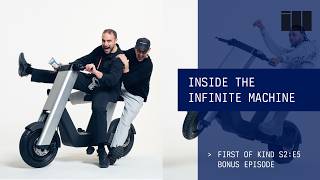
Joe from Infinite Machine walks through designing two micromobility vehicles: the P1 with a hub motor integrated into the wheel, and the smaller Alto with a hot-swap battery and pedal-to-footrest conversion that stays license-free. The company's aesthetic draws from NYC's dense, car-free environment.
Chapters
Oh man, that's a beauty. Joe, how you doing, man?
Welcome.
This is incredible, dude.
Good to see you.
What a beautiful office. Thank you. This is amazing, man. So the story of Infinite Machine starts with the P1.
Yes, this is the prototype of P1. We built this in-house with the equipment that we have here.
This was made here?
Made here, yeah. And you can think about this as kind of like a physical Figma prototype. So it looks like the thing, it even works like the thing a little bit, but it's not production. And so it's representative, it communicates the idea enough so that you can decide, okay, we want to actually make this thing.
And then how many variations of the body of the vehicle did you go through until you arrived at this form factor?
We did a very extensive and expansive design process digitally first and with sketches, actually hand-drawn sketches, which is how vehicles start. And that was in Figma. That was kind of laying things out, hundreds and hundreds of iterations that were everything from something that looked like this to something that looked completely different. We really went super wide. Once we kind of locked in on a direction, we built one prototype that we called P Zero that was functioning. That was compelling enough to know that there was some heat here, but there were things that we fundamentally needed to rethink, like the entire front of of the vehicle we had to re-engineer and redesign. That led to P1, and then within P1, we did start with the silhouette. We kind of locked in a silhouette. So this is kind of an early sketch our designer did. He's an incredible talent. We have kind of the core callouts of the different features of the vehicle, and we wanted to preserve that from this initial prototype through to production, which is hard. Like, a lot of times you see a concept car that looks really awesome, but then when the real one comes out, it looks really lame.
Were there any moments where you're like, oh gosh, this is not going to work just in the prototype form?
I don't think we ever lost faith, honestly. But the front end of the vehicle is quite unique. So you'll see that there's a continuous form from the top of the handlebars to the axle of the wheel.
Yes.
Almost every other motor vehicle, like two-wheeler, has a brake here, and the wheel is free moving. So if you visualize like a Vespa or a motorcycle, the wheel is separated from this kind of front module. But we wanted a vehicle that, even though it was a two-wheeler, felt very automotive, had a clear volume. It didn't feel like a bike in the traditional sense. And so having this be one continuous plane was actually really important.
And you mentioned earlier that there was this big unlock with the electric motor residing inside the actual tire.
Yeah.
How does that cascade through the organism, through the vehicle itself?
One of the things with putting the motor in the wheel is it's unsprung, meaning that the suspension, the shock, is above it. So the motor is actually taking a lot of the force of impact. But electric hub motors, which go in the wheel, have gotten so good that they can withstand that kind of thing for many thousands and thousands of miles. And so it's actually gotten to the point where we can use them for everyday urban vehicles. Anywhere you have a wheel, you can put a motor on an electric vehicle. You need to find a place for enough battery to move the thing, and then you need to find a place for some of the other componentry. But to me, the way I think about a prototype is it gives the internal team and whoever is supporting it the conviction to turn it into a real thing. Turning into a real thing is very expensive. It takes a long time. It could take 2 years to go from engineering model for this to engineering model for production. Like, right, 2 years between like you have a thing that works and you have a thing that you can ship. For example, everything on P1 needs to be of course legal, but also needs to be waterproof, dustproof, highly durable for tens and tens of thousands of miles. So that is a whole other kind of design. It's not just like Can we take this around the block? It's like, can this work day to day?
Can you manufacture hundreds, thousands of these?
Exactly. And can they withstand the elements on a daily basis? Can it be parked outside for many years? Once you go from prototype to production in that process, I'd say that the design and engineering process are very kind of handheld. And I would say even more so than in software because at the end of the day in a digital product, Most of the time you really should never expose how it works under the hood, right? But there are constraints in the physical world that the thing needs to accomplish the task, and that has an interface and visual element to it.
It seems as though it's a much more consequential decision to have like the production ready to go and manufacture, make end versions of it. When, when did you know that this was finally ready to produce?
You're basically doing rounds of production builds, so it starts with what's called a rideable prototype, but using the production design. It's an RP. Once we test that, we then might make an iteration. You go to an RP2. So we have RP1, RP2, could go to RP3. Once you lock that in, we now are like, okay, we have conviction in this design, in this mechanical structure. So we're going to start making the tools, the molds. The molds are the most expensive and they're the least reversible part of the process.
That's the thing you're really committed to.
Yeah, you're committing it to metal. So you have RP, then you have engineering validation test, which is EVT, and that's like like does this thing work? Then you test it, you're running testing. Then once you do that, you go into DVT, which is design validation test. Does this thing look and feel the way that it should? Once you validate that—
That's an internal heuristic, right? That's like, does it sort of pass our bar?
Yes. Then you go into PVT, which is like product validation test, which is kind of more holistic validation. Once that's all locked in, then you go to mass production, MP. That you're really not changing. So you are making iterations between the the validation test cycles, but once you're in MP, you don't really want to change it. And so we're trying to snuff out issues before that. Now software, on the other hand, on the vehicle, we are updating continuously.
Right, continuously. Yeah, yeah. So what, what are the biggest differences between like the system on the Alto versus the P1?
They're very, very similar in their architecture. They share a lot of the same architecture. You can see the motor in Alto is just a lot physically smaller.
Correct.
So that's a 2,000-watt motor, that's a 6,000-watt motor. The battery on Alto, which would sit in that dock, is half the size of the battery on P1. That's a 72-volt system, that's a 48-volt system.
Similar range or lower, lesser range because of the, uh, the size?
Still less range on Alto, but because you're going at a slower speed on average, it's not half the range, it's like 60% of the range.
Yep.
You can see here, this is the motor controller on Alto. It's just, again, a lot smaller, but it's the same thing. This is the Alto screen. So it's just a lot smaller. And Alto is like, it's a third the price of P1, but you're getting a lot of the value of it. We took a lot of the things that we learned in P1 and brought it to Alto. So P1 was like a 5-year odyssey from like conception, passion project, prototyping, productionizing, learning, iterating. Alto was actually like a year from a concept to mass production, like just over a year.
Because in large part of everything that went into P1 to inform, okay, now we know.
And actually use some of the a lot of technology from it, used a lot of the platform, but we were a lot smarter. We also knew a lot of the pitfalls that we avoided. And while we were building P1, the idea of Alto kind of emerged. So even though we only were working on it for like a concentrated, more or less, year, it had been backburnered for like a year before that, where we were kind of sketching and just ideating on it. I, in general, believe in the idea of like a gestation period for a product where it's low stakes, it doesn't need to exist, It doesn't need to accomplish any goals. It's just percolating. We're like, right, you know, it's gestating in the womb and we'll see what happens and it gets to figure out what it is. We did that for P1 while it was a passion project and Alto basically had that because P1 was our focus. So this didn't need to be our business. But once we developed conviction, we're like, okay, let's go. And we just did it.
Yeah. And so with Alto, it percolates for a bit, but then there is that moment of genesis again where like, okay, this is a time in which we should be working on this product. Very seriously, going from a concept to something that we should prototype actively. Like, how— what was that threshold for you guys, and how did you sort of end up with this design for the vehicle?
So basically what we realized with P1, for most people, they're thinking about the bike lane, you know, when they think about, you know, micromobility. We've seen this extreme surge of popularity in bike lanes and e-bikes, but when we look at the products in the bike lane, we're not inspired by those products. Almost a similar perspective to what we had with traditional scooters, like sit-down scooters like Vespas. We saw the same pattern emerging in the bike lane, right? But the scale was 10 to 100x as large. And so we thought, oh, could we actually take the magic of P1 and bring it down to a bike lane form factor that way more people can have access to, then develops its own identity? So even in the industrial design, you could see we share some material similarities, but Alto is rounded. And, you know, we have kind of rounded radii here. It's not all hard-edged. And these, you're using extrusions. These are using sheet metal bending, and these are using extrusion. So They're both industrial processes, but they're different. This is also designed for high volume. So we'll be able to make a lot of these, you know, hundreds of thousands, eventually millions, hopefully. We also wanted to make something with this that could work for the widest array of people. So it's very, very simple in its form, but it's configurable.
So that requires a license. This should not, right?
This doesn't need a license. You don't need a license plate. You don't need a driver's license. You don't need insurance. It's much more open. It's much lower friction. This uses car infrastructure. This uses bike infrastructure.
Right.
You turn it on with an NFC card or your phone. And then I would say the most kind of iconic part of this vehicle is the way we've done the seat and the battery system. So you tap this to open the seat area.
Oh, cool.
It's kind of locked.
That's amazing.
And then the battery, you just pull out. So this is a hot-swap battery. There's no manual connectors. You just drop it in. And you can put it any way. So you can put it like this or like this. And you just drop it back in.
Wow.
Then when you're at home, you have a dock that you can just drop that in. Yeah. Now you'll notice that the light stayed on while I took the battery out. Yeah. It's because we have a backup battery that keeps the system running while that's out. So for example, if you take the battery in to charge overnight, there's another battery that will keep the alarm going. So if anyone tampers with the vehicle, you'll get a notification.
Great.
So I'd say this is like— I mean, we did a lot of work to make this work. This element, not only houses the battery, but it's also structural. It's bearing the weight of the rider, right? It's part of the frame itself. Yes, this is an extruded piece of aluminum. This seat also fits 2 people, which most e-bikes don't. So we're accomplishing a lot with this. And then the biggest thing is now you have all this storage here where you can put stuff, whereas in traditional bicycle there's nowhere to put things.
You're sticking things in the front of a weird basket, or— yeah, yeah.
So we do have a basket that attaches to the back, but you don't need it. We actually have these plastic inserts that slot in here and here and turns the area between your legs into a slot. The other really cool thing is the regulations around what makes an e-bike is something that has pedals. So we thought, okay, obviously needs pedals, but what if you don't want a pedal? Could we design a system that actually converts between pedals and footrests? And so Zach designed this ingenious mechanism where the pedals turn into footrests.
No way!
We have a clutch system.
That's cool.
That allows them to convert in— into place. So I'd say those are some of the core things. And then the front end itself, as this one continuous plane, is, I'd say, unique. And actually, one of the coolest things about this vehicle is people are like, where'd you get the name from? The name actually comes from the bike's design. So if you're looking at it from your perspective, you've got the O— no, the front wheel— you've got an L over here, you've got a T over here, and then the back wheel is the shape of the bike. Yeah.
That is super clever. That is super clever.
This the P Zero? That's not the P Zero. That is maybe the seed of a new idea. We'll see. This might become the next Infinite Machine vehicle.
Yeah?
I don't quite see it yet, but we'll see.
Give it some time. And so tell me where we are. I mean, like, how did you end up in this beautiful space?
Yeah, so we're in New York City, which is just such a gift, and we're right on the East River. We're really close to the bike lane over the Queensborough Bridge, so you can go to Manhattan in like 10 minutes. We did a wide search. We wanted to be in New York. New York is really the ultimate non-car city.
I didn't get the chance to ask you this earlier. You know, there's often this like East Coast-West Coast rivalry.
Yeah.
Sometimes it like simmers in tech. But I also feel as though products are often just a reflection of the environment in which they're created.
Yes.
It is really hard for me to picture a company like Facebook being built anywhere but like Palo Alto. It feels like that environment created that company and that product. How does New York sort of shape this company and these products?
I think it's like intrinsic to what we're doing. I think it's intrinsic to the vehicles, to the brand. I was actually in San Francisco last week with our vehicles, and they're incredible there. They're just easy, like, because San Francisco is just kind of ratcheted down on the intensity scale, so everything just works super, super well.
That's very different than, say, like the Waymo approach, where like New York is the final frontier. It's like, it's like that final boss.
You start in hard mode. Yeah, yeah. So we can kind of go, go a few levels down. I think also though, aesthetically, like, it's definitely more of a New York language. The industrial design is much more hard, uh, much more brutal in that way. Even our graphic language, like, I, I don't think our aesthetic is very San Francisco, and that's okay. Like, we are embracing, you know, where we're, where we were from. And, uh, we are kind of excited about this idea of like a Neo-New York aesthetic. What does that look like? What is a super futuristic metropolis look like. I hope that when people buy our products, wherever they are in the world, they feel like they're kind of getting a slice of New York City and like the wild, magical part of New York. And even if they're in Milan or in, you know, Shanghai or in Vietnam, like in any of those places, you should feel like you're kind of touching the place where it came from.
This is First of Kind. A new series about design and tech told by its pioneers. Sponsored by Framer, Cursor, Vercel, and Profound. Follow us on X, YouTube, Threads, Spotify, and Apple Podcasts. The future belongs to designers who build.