Can Investors Actually Make Huge AI Valuations Pay Off? | TechCrunch Disrupt 2023
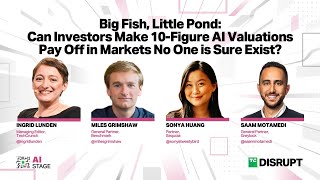
In a 30‑minute TechCrunch Disrupt panel moderated by Ingrid Lunden, investors Myles Grimshaw (Benchmark), Sonya Huang (Sequoia) and Sam Motamedi (Greylock) debate whether the soaring valuations of AI companies are justified and where the real investment opportunities lie. The discussion opens with a comparison of headline valuations – OpenAI (~$30 B), Anthropic (≈$5 B with a secondary market premium) and the modest seed‑stage French startup Mistral – and asks whether the market is overheated. The panelists converge on the view that OpenAI, as the category king, commands a premium, but that the broader AI ecosystem offers multiple layers of upside. They outline a three‑tier stack: foundation models (the “intel” of AI), infrastructure that operationalizes those models (compute, tooling, orchestration), and applications that embed AI into workflows. Open‑source models such as Llama 2 are highlighted as catalysts for competition and for lowering entry barriers. Strategic capital from cloud providers (Microsoft, AWS, etc.) is seen as a growing force, primarily to secure compute and distribution, while traditional venture capital brings product expertise and board support. The panel warns of a massive AI compute spend (≈$100 B in data‑center capex) that outpaces proven revenue, urging a pause to consider sustainable business models. They discuss the rise of AI‑specific developer stacks (analogous to MongoDB/Datadog) and the importance of building moats through proprietary data, IP partnerships, and addressing copyright concerns. Regulatory risks – especially copyright lawsuits and potential AGI‑related oversight – are flagged as emerging challenges that could affect startup trajectories. Finally, the conversation contrasts “copilot” strategies that augment incumbents (e.g., Salesforce, Epic) with startup approaches that aim to create new categories (e.g., autonomous CRM by Gong, health‑care copilots) and stresses the need for user‑centric value rather than merely grafting GPT‑4 onto existing products.
Chapters
Today we'll hear from Myles Grimshaw from Benchmark, Sonia Wang from Sequoia, and Sam Motometi from Greylock, along with our moderator, Ingrid London. Please welcome them all to the stage. Hi. Good morning everybody.
Well done for the early birds coming.
In for the first time of the day. Thanks very much. Thanks you guys for joining me here. Thanks for having us. So we've got a pretty broad topic here that we're meant to be parsing in 30 minutes or less, which is about overvaluation and investing in the AI space, which is a big one. So I thought I would kick this off by looking at probably the big elephant in the AI investing room, which is OpenAI. They're valued at about 30 billion, but we've got a couple of others that are significantly less. But some big deals. Anthropic has raised a ton of money, 5 billion valuation, but is trading on secondary market at 25% above that. So we can say what is that gives it about a 7,7 billion valuation or so. Then you've got Mistral, I wrote about out of France, much more modest, but raised 113 million seed round. $113 million seed round, right. So are they overvalued? Let's start with that one. What do you guys think about this? Is this super heated or do you think we're going to be getting back into a kind of reasonable place soon? Any one of you should answer.
I think you're the OpenAI investor.
Yeah, let's go confirm that.
Okay. Okay.
Let's see. I think, I mean, I think of the foundation model opportunity as the chance to kind of invest in the intel inside of the entire AI wave. And it's true that there is a lot of companies that have cropped up in the last year or so, some of which have raised boatloads of money in order to try to take on OpenAI. But OpenAI is the company out in front, right? They've been the ones pushing out GPT 2, 3, 4, leading the industry. And when we look historically at categories, most of the market cap tends to accrue to the category king. In this case, OpenAI is very much in that position. I can't speak about their financials here, but I think they've been rumored to be in the billion dollar revenue range in the press. If you believe that and you look at some of the public revenue, multiple trading comps, I actually don't think the valuations are all that unreasonable in OpenAI at all.
Okay, what about the rest of the market though? Like that's the, as you say, the category leader. So we can give them a pass. Maybe we're going to assume we can, because I'll come back to that in a second. I don't know about how sustained those revenues are going to be, but. Sam, you look like you want to say something.
No, I was just going to add. I think there's a duality that's true at the same time and somewhat contradictory. On the optimistic side, we're early days of a new computing paradigm that's going to reinvent the way we work and live, and it's going to lead to a lot of new software companies.
And.
And there's many reasons to be optimistic. And by the way, like, to Sonia's point around the rumored revenue numbers with OpenAI, I think it's not just the scale of revenue, but it's the velocity of revenue. I think this is the first time in a long time that enterprises and consumers alike are interacting with products that feel magical. They spread very virally through word of mouth. They drive value that's much higher than what people historically have gotten from software, because these things can think and write and act for you. And so if you have that kind of explosive growth, actually, a lot of these valuations over time may be very rationalized. Now, that said, the other kind of side is it's a very exuberant market and I think a lot of money is going to get lost. A lot of these companies are overvalued. And the key is going to be which are the teams that have the capability to build really enduring and fantastic products. And I think for those teams, we'll look back and things that today feel expensive will feel cheap in other places. There will for sure be lots of cases of overvaluation.
Miles, are you guys sort of. Were you bummed that you didn't get to invest in OpenAI? I can ask you the same question, but yeah, I mean, has that been a bit of like the one that got away? Did you guys try to get in but couldn't? Because.
Yeah, no, no, obviously, obviously, at Benchmark, we focus early. And so I think the title of this panel is like 10 figure AI valuations where we're way earlier. 10 figures can be a. Can be a success for a founder, a success for Benchmark, I would say, obviously it started as a nonprofit, so, you know, so it wasn't really a focus in that way. I would say for all the founders, though, what's exciting is how much progress open source is making and how good llama 2 is. For everyone. The competition with Mistral or Anthropic is great for companies building, for new companies forming, because competition at that level is great for blossoming innovation more broadly. And I think we're starting to see a lot of teams who are using llama2 and getting decent results out of it. And I think that ferocity of competition at that level will benefit all of us in terms of creating new application experiences and the like. And so I think it's been good.
But do you think Sonya's right? Do you think it's kind of an uneven market really in terms of opportunity? Like when we're looking at sort of foundation versus everything else, do you think that's a correct way of viewing it and do you think that it really will be about one foundation, one foundation?
I think they are definitely out ahead for sure. And ChatGPT, which is where a lot of the revenue is coming from, is like a consumer experience. Right. So that's different to selling the model as a service for other people to build as well. And so you could have it succeed as a consumer business and have lots of competition on this side. Right. There are different mechanics there. I think that you could go look at some of the image models right now that are happening and I'm really impressed with sort of the new challenger competition that's emerging with not very much money, tens of millions of dollars, not hundreds of millions of dollars. And so I think that whether you think about, if you think about a bunch of the inputs, chips know how, et cetera, that is all going to go that way. And so there may be even more economies of scale in terms of like performance that comes from it. But I think there's a chance that with over time, not in a six month time frame, but an 18 month time frame, chips know how talent, et cetera, means that there is more flourishing of, of open source and other competition in the arc of time. That makes that a great enabler for all of the application innovation.
Okay. I think it was some who just talked about the consumer appeal of ChatGPT. That's obviously been the thing that's created an absolute boom in public consciousness of everything. But of course for people who are in the know, there are so many ways of viewing AI investment. Right? You've got foundation models, you've got services on top of that, the infrastructure, all of the stuff around chips and so on. What are the other opportunities? Let's pretend. I would like to think that there's going to be a lot of opportunity in the foundation model too. I Mean, I think that one always has to hope for competition in these things. No offense to OpenAI or Sequoia, but. But let's assume they have one in that space for now. Where is the big opportunity, do you guys think, for other real investments or even these huge wins for something that might be small now that will kind of really win in a category? Will it be in chips? Will it be in some service that sits on top of the models? Or where do you guys think it's going? Any of you?
Sure, I'm happy to start. I actually think the way you outlined it is exactly right, which is we think of the world in three layers. There's the foundation models, there's infrastructure that's built on top and used by enterprises and organizations to actually operationalize those models, and then there's applications. Our view is there's going to be huge opportunities up and down that stack. Let's leave foundation models aside on the application layer. Again, like once you have these emergent capabilities where these things can code alongside you, design alongside you, generate images, generate text, and you think about some of the large application companies, whether it's a company like Adobe or Salesforce, a lot of these product lines can be enhanced and also become vulnerable to new entrants that are leveraging AI. I spend a lot of time in cybersecurity. One of the ways these models are used for bad is to generate really effective cyber attacks. Right. For example, you can use ChatGPT to generate a phishing attack and target Miles and impersonate someone he knows and get, get him to do something.
Not Sonia, just Miles.
Just Miles.
She's smarter.
And so there's opportunity like that creates challenges, but it creates opportunities. And you know, you can use generative models to actually protect against these things. So a lot going on in the application side and then on the infrastructure side, I completely agree with Miles. Like I think one of our big takeaways over the last year has been how quickly the open source models are improving and becoming very, very viable candidates for developers who are building applications. But you need a lot of tooling around the open source model if you're a developer to actually be able to stand up and scale an application. And just like with the rise of web, we saw a new stack, database, orchestration services, monitoring companies get created. Companies like MongoDB and Datadog. I think we're gonna see equally important companies get created around this AI developer stack. And you know, to your, to your language of big wins, I think opportunity for really big wins for entrepreneurs.
Yeah, I mean, I think that was you guys doing Lang Lang Chain. Yeah, Lang Chain. Sorry, I'm not getting the name right.
I think what's so early.
I think of that as one of these classic companies of what?
Yeah, absolutely. I think, I think about it simply as, you know, ML AI had previously been the reign of sort of like the ML wizards. Right. They were like building special models, orchestrating it all. And every application engineer, every engineer, I think will become an AI engineer. It will just be a part of the tool set and the programming experience in the development environment of every engineer. And that'll be a many model world. I also don't think we've seen the diversity play out yet because fine tuning is for example, only just coming online really in terms of accessible to startups if you weren't a savant at it. And so the diversity of even models over the base model, that could be possible. The, the programming environment for that, the tool chain for that is where LangChain's focused. And I think we're seeing at the company the most amazing pockets light up from like incumbents. You wouldn't imagine moving terribly fast to the new startup with three people dreaming of the future.
Yeah. My skepticism is that everyone moves very fast now and then when they get their bills for the compute power, they will pull back a little. Which is to my next question. Okay, so it was very interesting with OpenAI's around Sonia, where you had a lot of strategic participation, obviously Microsoft and so on. I was talking with one of your colleagues in London at Sequoia, and I'm forever curious about midjourney. I don't know if anyone here is from midjourney, but if you are, I'd love to talk to you. They have of course eschewed all fundraising so far. Someone who is at Sequoia was saying, oh, that's all going to change because they need compute power. They're going to do a deal. They're going to do a deal. It's going to be a deal with a strategic. So I was like, oh, really cool, that's interesting. I wonder who it's going to be. When is it going to be? I don't know any of the details. I'd love to know. So my question is, when you guys are going in and looking at AI companies, how much are you seeing strategics coming in on the deals or wanting to be on the deals, or gazumping you and getting in on the deals when you're not? Because the AI companies are. The AI startups are right now their biggest priority is just getting their product out. And they have so much already incoming inbound interest. They don't even need the help of a VC to like make a business deal right now. They just need compute or whatever, maybe. Sonia, I'd love to hear your answer.
On this to your mid journey point. I think something might have gotten lost in translation there because I absolutely don't think they have their backs up against the wall. They can control their own destiny. Who here has used Midjourney show of hands? A lot of people in this room midjourney. It's incredible because it's cool and it almost breaks. It breaks what you would expect to happen in the market where stable diffusion is. But Midjourney has just curated the aesthetic space and actually created beauty out of all the possible pixels. And because of that, people are paying a lot of money for it. And so that business is cash flow positive. It's been reported many times they don't need compute. And so if they decide to partner with a strategic, if they decide to partner with a venture firm, that's completely up to them. And so I think something might have gotten lost in translation on that point. To your point, more broadly on strategics and how they're entering. I think every strategic right now is seeing two things. One, they're seeing what Microsoft did with OpenAI and just how transformative it was for that business. And they all want their own OpenAI. Two, for the strategics that have cloud businesses, they're realizing that a lot of these foundation models spend a lot of money on compute and they want that going to their own clouds. And so they're using this as an angle to get compute onto their own clouds.
Exactly.
And then maybe third, they actually feel defensively for their own businesses. They're very scared. And so partnering and investing in these companies gives them a little bit of comfort. And so the kind of amalgamation of all of those things is absolutely happening in the ecosystem. I think this isn't different from before when we had to compete with strategic investors for rounds. And I think it's a coopetition cooperation ecosystem because we each bring different things to the table. When you work with a traditional venture firm, you get company building expertise, you get a board member, et cetera. When you work with a strategic, you get the compute that they bring, you get strategic partnerships and distributions. So I think in a similar way to how we've always worked with strategics, it's very much happening here. And everyone is eyeing that Microsoft OpenAI deal, hoping to strike something similar Right.
So yeah, that's great answer. But are you. So you're not seeing any change in that? There's no kind of like increased competition or higher profile for the strategics because of that. So I mean, to be honest, the way that you've described it sounds like some of them still have a credibility pitch to make on that front. I think Microsoft came in with a lot of power already. I think aws I would be very surprised if they didn't look for or make a big deal of that sort themselves soon.
Yeah, a lot of them are striking these partnerships. And I mean absolutely, the number of strategic dollars is escalating in this ecosystem. They're just not necessarily competing for the same sorts of deals that we necessarily are always looking at.
I think for any teams don't learn the lessons from crypto. Right. Crypto was let me focus on the technology and not really give too much attention to engagement and try and shill a token to the next patsy or shill my compute to the next big chip vendor or whatever. And I think here we can't defy the basic principles of business. You still need to really serve a customer and reach that customer and get deep engagement and succeed. And I think a strategic in terms of getting access to more compute or the like is a part of that. But you still got to build a real business. And so if you try and say which L2am I going to be on making that sort of decision early on, you've probably already lost in many ways. And so I think I would be wary of those lessons. And I think classical business building in that sense is still is more important than ever in that way.
Yeah.
And I actually think following up on that, if you look at the sheer number of dollars that has gone into AI compute this year and my partner David Khan published a post this morning on this this year Nvidia is forecasted to end the year at $50 billion of data center compute run rates, $50 billion of chips plus $50 billion ish of energy and all your other data center costs, $100 billion of CapEx going into the ground. I can tell you there's not $100 billion of net new AI revenue that's been generated and there's probably not $100 billion of actual critical thinking around business models. So to an extent there has been, I think an overbuilding of everyone sees this gold rush, doesn't want to miss it and I think now is the time to step back and reflect on, on what are we actually going to do with all this money.
Yeah, I think that's such a good point. Do you think that anyone is thinking that way yet, or are we just in the middle of it right now too much?
I think a lot of teams are thinking about it. We actually wrote about this this morning. This idea of Generative AIs Act 2.
You're referring to the report you guys published? Yeah, it was a great report.
Thank you.
Thank you.
And so just so everyone else has the context, a year ago, we published a report that actually coined the market Generative AI. And it just kind of. I think everyone was shocked by the firestorm of activity that followed. We published another post this morning, kind of reflecting on where we are and where we go from here. And the gist of the post is if you can think of the last year of activity as kind of the awkward teenage years or Act 1 of generative AI, comparable in some ways to the early days of the App Store. So I went in and looked at some of the early apps. There was a lightsaber app, there was a Playing through the piano app, There was a Play Flip cup app. Those were some of the first apps in the App Store.
Very cool.
They were cool kind of lightweight demonstrations of this new technology that everyone wanted to play with. And so I think we have that analogy in AI today. You've got a lot of these AI avatar apps, for example, but a lot of the companies that we've partnered with, I'm sure from Greylock and Benchmark as well, companies like Foundry, companies like Harvey, they're actually, we think, thinking about AI from the customer back rather than from the technology out. And so I think we're seeing movements in the right direction, but we're still evolving through kind of the awkward teenage years of the ecosystem.
Yeah, I mean, you guys have an interesting point in there on Moats, which is, I think what you're referring to here, this idea of like having a technology moat versus a moat of customers around your product is kind of related to this idea of, like, what it is that is going to build the value around the business. Do you have thoughts on that, Sam?
Yeah, I mean, I agree with a lot of what Sonia said. I think taking a step back, like the rules of gravity still apply to AI businesses. And if you think at the. If you look at the last generation of software applications, value was derived because either you became a system of record for data in a domain that's really powerful for an enterprise, or you owned an important workflow, and that workflow tied to business value. It had highly Retentive and engaged end user behavior. And that's exactly like, that's the same framework we should all be using whether we're building or investing in AI companies. And what I'd say is, you know, if you look at the first like 12 months, let's say since you all wrote that post, a lot of the applications that we talk about today, to me some of them feel very incremental. Like hey, you know, I have an existing workflow in sales and I apply a natural language interface.
I mean you guys are just to interrupt you for a second, you guys are doing enterprise basically. So would you say it's even the case in enterprise is very incremental, the AI opportunity. So I think the consumer for sure, it feels like literally like a kind of everyone is a me too chasing the same thing. I think enterprise is just much meatier.
No, I think the opportunity set is immense. The observation I'd share is I think some of the early tools that folks have used and have started to grow, some of them to me feel a little bit more incremental. And I think the opportunity is like, I think the way software works is going to actually change. If you look at the enterprise today, you have these systems of record that are like databases, things like Salesforce and Workday and ServiceNow and their workflows on top of them. And then end users have to figure out how to adapt the job they need to do to the constraints of those workflows and those databases. I think AI is going to flip that on its head. And so you're going to start with a user, maybe a sales leader who says hey, I want to look at my pipeline and what my pipeline looks like. And then using AI agents, you can materialize that on the fly. You can generate UIs that are specific to the task that needs to be happen, that needs to happen. And you make that end user ten times more efficient. And that's going to be a very different way of looking at sales workflow than the way for example, Salesforce looks at it. That's like the big opportunity set. That's what we get excited about. We're seeing some new teams begin to think in that way. But I think that's what's going to be like the foundations of really enduring businesses versus I'm just running to build something incremental and get it out into market.
I think most of what we've seen so far is, is copilots like Copilot's this, Copilot's that. And I really think of that for any of the founders in the audience as an incumbent's game, there may be some pocket somewhere like in healthcare where you have pretty stodgy, very good at regulatory capture incumbents like Epic and so you can go play in that arena if you want it as a challenger. But mostly I think Copilot totally fits the business model, the user experience, the advantages of the incumbent.
Are you saying Copilots are good or bad?
I think they're a bad strategy for startups. They're a great strategy for them.
I am fascinated by this. It's perfect. Keep talking because I have a great question to follow up on. Okay, keep going. I can't believe it. No copilots. Okay, go ahead.
I think they're great for the incumbent because they fit in the UX of the incumbent. They can add onto the seat, which is the business paradigm of most incumbents. The incumbents have all the distribution to those users, it's their users, et cetera. I think if you're a startup doing that, you're probably trying to get bought at the end of the day, right? You're trying to get the incumbent who you're living on top of, trying to probably buy you. I think the opportunity for challenges to Sam's point is it's a new computing paradigm. It's more akin to the evolution of cloud and the emergence of cloud in terms of re architecting how software is built and deployed where maybe we don't have as many users using the software. Maybe it'll do more for you. The paradigm of me having to sit over and be a monkey in the ux, clicking away will go away. I would say I use ChatGPT and all of our user expectations on what software should be able to do through the roof. If I have to click on just a simple thing, click on a calendar invite and send it anymore. It's sort of like why this should natural language. So our user expectations are going up a ton of and I think the rearchitecting of what an application experience is and maybe the business model are tied to it is going to be emergently possible. And that's the opportunity for the startup to come and use this as a tool to solve a business problem, but also dislodge well established incumbents.
Okay, so I completely see where you're going with this, but I always thought that part of the reason why Copilot has become such a thing is because frankly we've got a lot of people freaking out about what AI is going to do and that it's Going to take on way too much responsibility and then run riot with it. So just taking one example, I wrote about a company just this morning about doing a copilot for medical, the healthcare industry. The idea is that they're going to sit with the practitioner and parse all of the information that the patient is giving in order to help provide better insights. Kind of coded on the fly for the admin, the back end and everything else. It's never going to take over the role of the doctor. It will be the doctor's copilot, therefore no longer a threat, a helper. So I think that's where I think copilots are kind of, if anything, the way they're going to go. I mean, do you guys not agree?
I totally agree with what you're saying and I also agree with Miles Point.
Can agree with me.
Not possible.
I think the broader mental model of a copilot for how AI is going to impact work is absolutely correct.
Right.
And I'm in the optimistic bucket. I think we're all going to become more productive, more fulfilled, happier with these.
You want them to just be the pilot, not the co pilot?
I think I want them to be the pilot for the things I don't like doing or I shouldn't be doing or I'm not uniquely good at. So it can free me up and free any of us up to focus on the things we're uniquely great at. And so you mentioned the healthcare example. Like we're investors in a company called Notable Health which has some similar, similar concepts and is making, you know, physicians much more productive. You know, we're another company called Cresta which is building copilots for the contact center. And so if you're an agent in Tempe, Arizona working for Verizon, you're suddenly using the software, you're making more money, you're more effective at your job and it becomes the way your GPS is in your car, it's an assistant to you in everything you do. Now I think Miles Point and Miles, I don't mean to, you know, to serve your point is I think entrepreneurs have to ask themselves if you were building a new company. Because, you know, if you take the analogy of AIs like the shift from on premise software to cloud software, one of the big differences is AI is consensus. Everybody believes in AI. Salesforce has GPT day and GPT rolled out across all of their products. So it's not sufficient as a new entrepreneur to say I'm just going to build Copilot on top of Salesforce, you have to think about what does the end user want, what is the kind of copilot mean for them? And build that in a first principled way that's much like more radically different than what the incumbent offers. Otherwise the copilot gains are going to go to the incumbent, not to startup company.
Yeah.
Can I take that example and run with it actually? Because I actually think so. I'm on the board of a company called Gong. We invested a few years ago. Gong, Gong, yeah, they're good. And I actually think it's a great example to illustrate this point because Salesforce at this point can now transcribe your calls. And so if all GONG was, was a call transcription tool, I think they'd be in a really tough spot. But what Gong did was, hey, now that we have transcription, can we actually on top of your system of record, that is Salesforce, can we create a fully autonomous system of intelligence, an autonomous CRM in a way. And to miles point, I'm like, why do I have to update my CRM, things like that. Gong does that for you. So it's kind of. It's not just a transcription tool writing alongside of Salesforce, it's actually creating a completely new category, an autonomous CRM on top of the systems of record.
It's actually training you as well, isn't it?
Exactly.
It provides all this kind of like nudges to the sales rep for what they're going to say.
Exactly. I kind of think about it as if the incumbent, if all they have to do is add a GPT4 endpoint into their product for you to not have a product, then you're in a really tough spot.
Yeah, that's basically a copilot. Gong is a copilot. I don't think GONG ever has an intention of taking over what the salesperson does. I mean, I haven't written about them in a while, but I mean, yeah.
I think we're maybe confusing the lowercase copilots with something helping you do your work with the uppercase copilot of I'm going to be like GitHub copilot and plug into an existing system of record and not do much more. I do think GONG will help you do your work, but I do think it has a chance to usurp the systems of record over time.
Ok, listen, I think this is also a good moment because we don't have too much time left, but I would love to hear what you guys think about the kind of, you know, the currents and regulation. Does that worry you all, when you're making investments in companies and looking at the trajectory of opportunity, whether it has to do with what kind of data gets used in the services that you're about to back or how they're going to be able to kind of like, you know, really, really saturate the market or whatever, you know, in a kind of competitive sense. Where is regulation figuring for you guys? I feel like it's on the doorstep of AI, so I really would love.
To hear, I think, I think to your point, there are a lot of important problems to still be solved before AI is pervasive and kind of in everything we do and how we work. You mentioned some of the points around what data sets can you train on? There are questions around quality and making sure these models don't hallucinate, fairness, etc. And these are really important questions. I think from our perspective, we believe that's actually an opportunity for entrepreneurs to build great tools that can help solve these problems. And just the observation I'd share is I think a lot of Silicon Valley has benefited from open source software and I think what's happening now on the open source side from a model perspective is taking these capabilities and massively democratizing them so developers in the room can use them at low cost, fine tune them to the problems they care about and build excellent customer specific solutions. And so, you know, we don't want to get in the way of that.
Yeah, I mean, obviously you're anti regulation, but I mean, do you guys worry about regulators kind of stepping in faster?
But I don't think we need more focus on it.
You want more focus on it?
I don't think we need more focus on it. Like it's incredibly early and we've already got an enormous amount of focus on it.
I know, but do you worry that that might not.
I worry for all the startups out there that it will stifle what's possible. And regulatory capture is like a classic strategic move of the incumbents. And so I think it's sort of no surprise that some of the biggest players are out there pushing it now. I do think there are some things to worry about. You can go read the GPT4 paper, I think it was, and they do do some fun things. They actually tried to get it to like they gave it access to, I don't know, the equivalent of a Venmo account and said go try and make some money on the Internet and come back and put it in your wallet and then try and buy something. It's like I Can't do it. Right. And so will it be able to do it as we get to AGI at some point? Maybe. Okay, so we should focus on it, but I don't think we're under focusing on that right now. And I think every startup should be worried that the lockdown, the clampdown that is trying to come, the checkboxes is going to be really stifling. If open source, use of open source has to pass through a bunch of crazy criteria, man, that's a burden for every small company. That can be stifling.
But all the same, Sonia, I'm sorry, I don't mean to cut you off, but Sonia, very short on time, but when you looking at a company, do you factor in where they may find themselves hitting a wall because of potential pending regulatory problems that they may find themselves falling into?
We absolutely think, we think about it. I think most of these companies will break through. I actually think the copyright question is worth answering more immediately than the AGI risk question. Because this morning some of my favorite authors, Jonathan Franzen, et cetera, sued OpenAI on the topic of copyright. And I think we've got a real problem to answer on copyright, like how fair is it that these models can produce derivative work and what do we do about that? I actually do think that though is going to lead to proprietary data and content and IP partnerships that actually will create moats for all these companies. And so to the point of, you know, where the AI companies create defensibility, where we're seeing a lot of them turn now is to their own recording artists, their own IP partnerships and actually that could be quite interesting.
Yeah, cool. That was very, very fascinating. Thank you so much you guys. And I have questions. Keep asking you off stage. Thanks very much. Thanks everybody. Whole house, awesome. Thank.
You.
More from Sonya

Building the GitHub for RL Environments: Prime Intellect's Will Brown & Johannes Hagemann
Building the GitHub for RL Environments: Prime Intellect's Will Brown & Johannes Hagemann



Context Engineering Our Way to Long-Horizon Agents: LangChain’s Harrison Chase
Context Engineering Our Way to Long-Horizon Agents: LangChain’s Harrison Chase

How Ricursive Intelligence’s Founders are Using AI to Shape The Future of Chip Design
How Ricursive Intelligence’s Founders are Using AI to Shape The Future of Chip Design

Training General Robots for Any Task: Physical Intelligence’s Karol Hausman and Tobi Springenberg

Why the Next AI Revolution Will Happen Off-Screen: Samsara CEO Sanjit Biswas
Why the Next AI Revolution Will Happen Off-Screen: Samsara CEO Sanjit Biswas