Language & Climate Change | Language Intersection Insights with Sophia Kianni
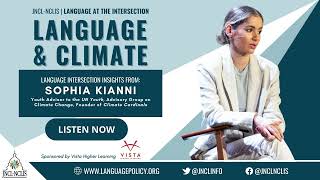
Sophia Kianni, founder of Climate Cardinals, translates climate information into over 100 languages. Her bilingual Iranian-American background drove her to build the nonprofit because climate education was locked behind six UN languages. She argues that multilingual, intersectional approaches are essential to reach people climate science currently leaves behind.
Questions this video answers
Over 100 languages.
75% of the world doesn't speak English.
80% of scientific literature is only available in English.
Six UN languages.
Temperatures in the Middle East are rising more than twice the global average.
Chapters
Hello and welcome to the jncl Nicholas Language at the Intersection Insights interview series where we talk with professionals from many fields to hear their perspectives on how multilingualism moves our world. The Joint National Committee for Languages and the National Council for Language and International Studies proudly presents this series with generous sponsorship support from VISTA Higher Learning.
I'm Amanda Sewald, current president of the Joint National Committee for Languages and the National Council for Language and International Studies. Jncl Nicholas. And today we introduce you to Sophia Kiani, an advisor to the UN Youth Advisory Group on Climate Change and the founder of Climate Cardinals, who will help us explore the intersection of language and climate change and how multilingualism moves her world.
Hi, my name is Sofia Kiani and I am the founder and executive director of Climate Cardinals. And my language intersection is language and climate change.
Thank you so much, Sophia. So I just want to start by asking you how you use multiple languages in your life and work.
So I'm Iranian American, so I speak both Farsi and English. And so at Climate Cardinals, we translate climate information into over 100 languages. So it's very important for us to be multilingual.
That's wonderful. And to specifically talk a little bit more about what you do with Climate Cardinals. How do you feel that multilingualism in general and being multilingual and having more than one language available to you has impacted your ability to affect change or engage people in discussions about climate change?
Well, for me, my bilingual background is actually what sparked creating my nonprofit, because when I was in middle school, I went to Iran, which is my parents home country. And while I was there, I was struck by the fact that my relatives knew nothing about climate change, despite the fact temperatures in the Middle east are rising more than twice the global average. And I also realized there was a lack of resources available in Farsi, which is Iran's native language. And so I worked to translate resources into Farsi with the help of my mom. So my background was really influential in allowing me to realize that there was a lack of climate resources and education available in languages other than English, which is why I decided to start my nonprofit.
It's incredible work and it's so very important and I am in awe of all that you've done and I'm so grateful to you. Speaking of that, I really just want to focus on the generational piece of multilingualism here. You mentioned having your mother involved with helping you and connecting to your own heritage and identity as a part of this. So I guess if you were speaking to Other. Other people your age, other people in your generation, and potentially in generations to come, or even the generation, you know, just prior to you. What would you say about how important it is to study, preserve and grow multilingualism and why?
Well, I think that multilingualism is also very connected to culture. I think for me, being able to grow up Iranian American, being able to see, speak both Farsi and English, helped me to really connect and to embrace my Iranian background and to also really connect deeply with my relatives and with my family and to learn more about my history. And so I think it's something that has definitely really benefited me and is something that, like, I continue to cherish.
Yeah, that's incredible. And it's so important. And you know, often I hear when I go to universities and when I've visited universities, I hear a lot about, you know, testing out of language. But I can see where one of the things that we work towards as advocates is looking at how even university majors and as a university student right now, what do you think about the fact that so many majors don't require a component of language proficiency? And maybe you can talk a little bit about where you see that that would be important, which is everywhere, of course, and in every major, but certainly from your perspective, how you would like to see that change?
Yeah. So I currently attend Stanford. And at Stanford, taking a language is a require if you aren't able to test out. I think that for me it's been really awesome. Even though I'm a science, technology and society major, it's really cool that I've been able to take Farsi classes and to learn how to read and write fluently, which I wasn't able to do before.
I remember at my previous school, before I transferred Indiana, I did not have a language requirement. And so I wasn't going to be taking any Farsi classes because I was able to take a different course of study instead.
So I think that definitely having like a grounded liberal arts education that emphasizes taking another language and learning more about another culture is something that all students would benefit from and that I think that all universities should really emphasize.
That's fantastic. And even, you know, taking that a step further, we know that some universities now even like engineering majors. And I'm glad you mentioned that you're a science and technology major, that that is a component of the major requirement, not even just the basic requirements that, you know, taking classes in Farsi that would be about climate, or offering a class in Farsi that would be about climate would be Incredible for you to be able to do. Maybe you can just talk about where you see that that could benefit our society if more professional people came out with degrees that also connected to that language proficiency.
Well, I mean, I think about issues like the fact that while 75% of the world doesn't speak English, 80% of scientific literature is only available in English. And so I think issues like that are really exacerbated by the fact that a lot of take second language courses and don't realize how important it is to understand the world in another language and to communicate with other people in their native languages. And so I think that the way we would be able to solve that problem is by emphasizing second language studies and making sure that people are aware that English isn't the only language in the world and there are so many other languages that we need to be cognizant of and we need to communicate, be able to communicate issues such as climate change and other languages as well.
Thank you for saying that and for talking about that. And is there something that you wish that people knew about the impact that you can have on climate in particular, if you're able to utilize language in multiple languages?
Yeah, I mean, I think that when it comes to climate change, the more people are aware and educated about the ramifications of climate change and what we can do, then the greater collective impact we'll be able to have. Especially when considering that a lot of large institutions that put out climate information like the un, they only provide their information in the six UN languages that account for less than half of the world speaking population. So I think that being aware of the impact that having more climate resources and education available in more languages would have. I think that being aware of that would really push these organizations to be able to have their resources available in other languages to ensure that as many people as possible are able to learn about climate change and what they can do about it.
Would you say that in addition to have. That's great. And would you say that in addition to having information in their language to educate them, that being able to understand issues of climate and issues of planet impact in another language also lends a different type of perspective? And if so, can you talk a little bit about that?
I mean, I think that just learning about an issue in your native language has such a different impact, Especially when considering that like when you're communicating with people in their native language and you're also specifically talking about the impacts that climate change are having on their community. I think that's how you're able to be most impactful. So for me, that was talking about, like, the impacts that climate change was having on Iran in Farsi. I think that's how I was able to have the biggest impact in like, making my relatives aware of the issue and to really care about it.
I love that you're talking about the intergenerational piece of education, education with regard to climate change and the planet and of course, the actual impacts that these things have. So I wonder from your perspective, what you feel that your generation, and specifically your experience, can teach legislators in the United States and can teach others, even our advocates, about how to approach climate change from a perspective that looks at culture and language and looks at the needs that people have.
I think what my story really emphasizes is the need for an intersectional approach when it comes to climate change. So not just considering, like teaching people just the science, but also teaching people things such as how climate change intersects with racism, how climate change intersects with economics. And so for me, like, talking about how climate change intersects with culture and language, I think that, like, the general applicable lesson here is that, like, we need to be looking at climate change through a multifaceted lens and considering lots of implications.
Sophia, I'm very, very inspired by you. I just want to tell you that as a mother of a person your age, I also am inspired by to hear someone talk this way about it. I hope that others in my generation and other generations can accurately hear, listen and use the information, the knowledge that you're sharing with us, to make a difference. So I want to just ask you how you feel.
Our efforts in facing climate change would be different if we had more of a multilingual society here, specifically in the United States.
I mean, I think that we would just be able to reach more populations and to be able to greater convince people that climate change is an issue. Since there are a lot of people in the United States who either don't speak English or speak English as a second language. And I think specifically around, like, climate education, making sure that there are curricular options available in languages other than English, like even like the UN languages or like languages that are very commonly spoken, like Chinese, Russian, Spanish. Making sure that climate education and resources are available in those languages that are spoken by a lot of people in the United States, I think would be able to really, like, convince the general populace as many people as possible that climate change is a huge issue and that they need to be getting out and voting and doing something about, about it.
Phenomenal. Phenomenal. Sophia, is there anything else that I haven't asked you that you want to make sure you share both about your story, anything to do with language and also anything to do with Climate Cardinals or your specific work that you want to share?
No, I think that those were really thoughtful questions, so I think I was able to communicate everything I wanted.
It's fantastic. Let's keep the work going. Thank you so much, Sophia. We'll talk to you very soon.
That concludes today's featured story from our Language at the Intersection Insights interview series. For more information about the advocacy work of the Joint National Committee for Languages and National Council for Languages and International Studies, please visit www.languagepolicy. to learn more about this interview series, hear stories from other professionals and explore how language moves our world, visit www.languagepolicy.org. language at the intersection thank you to our interviewees for sharing their stories, thank you to our series sponsors, VISTA Higher Learning and thank you all for listening.
Sam.
More from Sophia

Phoebe Gates & Sophia Kianni on Phia, podcasting and rapid growth | TechCrunch Disrupt 2025

From Dorm Rooms to $8 Million in Funding: Life Lessons from the Founders of Phia | Ambition 2.0
Language Shouldn't Be a Barrier to Climate Action | Sophia Kianni | TED Countdown