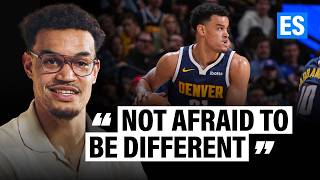
In this video, Spencer Jones—a second‑year Denver Nuggets forward, Stanford graduate, and emerging entrepreneur—walks viewers through how he turns All‑Star Weekend into a strategic business platform. He opens by sharing his personal journey from a Kansas City family of medical professionals to Stanford and the NBA, emphasizing the importance of balancing on‑court performance with off‑court brand building. Jones explains how he uses LinkedIn to amplify his investor profile, attract venture‑capital attention, and source deals, contrasting it with the more limited reach of Instagram. He recounts his participation in the Pursuit of Excellence panel, where he discussed AI applications in sports, highlighting two tools he uses: Plantiga, a biomechanics chip that predicts injury risk, and Python, a mental‑performance platform that measures focus and reaction time. He then previews the upcoming Brand Innovators Sports & Culture Summit, where he learned about branding, especially the differences between tech and consumer‑packaged‑goods (CPG) investments. Finally, Jones describes the MBA Launchpad boat cruise, a networking event that connects early‑stage companies with NBA and MBA networks, and outlines his long‑term ambition to build a successful venture fund and eventually launch his own company, using data‑driven insights to bridge sports intuition with quantifiable metrics.
Chapters
What's up guys? Spencer Jones, second-year forward for the Denver Nuggets. Off the court, an entrepreneur, investor, and excited to dive into the business piece of All-Star Weekend. Got a couple panels to be on, plenty of founders and Stanford alumni to connect with, and so I'm excited. It's a huge way to kind of elevate your brand, really get into a lot of business opportunities because it gives you the space to, you know, while you're present of mind with the season going and you'll have a lot of gravity to yourself, maybe more so than the offseason. Kind of capitalize on it with certain business deals, and then also, you know, gives players the chance to connect with all the business that surrounds them that they may not be super involved in during the season that their, you know, either agencies help run or assistants and stuff like that. And so it really helps them kind of get into where they're putting their money. I was born and raised Kansas City, come from a family that's definitely prioritized education. My dad was an anesthesiologist Grandfather was a general surgeon. Once basketball came into the picture, tried to always pair those two together. That's why I went to Stanford, where a place where I could, you know, both excel and play against the best teams while also getting a top-tier education. Spent 5 years there. I got a little NIL money, which helped. Went undrafted, picked up a two-way with the Denver Nuggets, then got re-signed to that two-way, and then now moving on to a standard contract with the team. That's been the journey so far, but throughout it, always Having an element outside of the court to balance with what I'm doing to kind of, you know, not put too much pressure on both while capitalizing on both at the same time. You know, always aware of the brand I'm building and the future I eventually want to get to, knowing that you're not going to have this NBA brand and lifestyle forever. You know, what are you going to build beyond it? I feel like what I'm doing is trendsetting. I'm only in my second year and I'm already building this brand on LinkedIn with an investment portfolio. When we beat the Sixers without I think our like top 6 players or whatever. And then I posted about it on LinkedIn. A bunch of those NBA outlets kind of gravitated towards it and it kind of blew up there. LinkedIn's been very beneficial for what I'm looking for. As an investor, you realize quickly that the VC community is a very kind of like tight-knit, like you get in by who you know. You have to get in there strategically. And one way is obviously, you know, being an NBA player with a big brand. But another is also building a network to where you can become much more of a strategic investor, and I do that by having other people who can deploy capital. So like when I build an audience that is CEOs, people with money, people who can move businesses, when I talk about an investment, it brings eyes to that, you know, versus on Instagram where it's just a bunch of people who may not have those type of influence and, you know, can maybe purchase a simple product but can't move along the lines of an investment. The first event was the Pursuit of Excellence panel, which was amazing to be a part of. We talked about AI innovations and also how tech is being utilized in sports. And one of the big ways it is for me is, you know, my role in evaluating my body through my biomechanics and the— not only the products I use that measure the biomechanics, but the AI that then can give you insights to it. One of them being Plantiga. It's a chip that measures biomechanics that I've been talking about and allows me to analyze my movement patterns and be able to predict where injuries could happen, what parts of my body need more work. Another one is Python, which helps me from the mental capacity. It's able to measure my focus. And then also you use it for reaction time to know kind of where you're at neurologically before the game, whether I need to hype myself up, bring it down, where I'm at compared to my typical baseline. It was great for me. Great talk about the intersection of AI and sports where it's actually tangible versus just hype. And, you know, it was also a great chance to get pitched by a couple of startups. Now we're headed to Brand Innovators Sports and Culture Summit. Another big panel there, be a little bit bigger and a lot more to talk about, so I'm excited. It was a very interesting one for me in terms of learning about brand building. Usually more of a tech guy, but you know, obviously adding CPG to my portfolio, it's two different sides of the coin where tech you typically think of having an intellectual property and you evaluate tech by saying like this is the best thing on the market versus a CPG, it's all about how well it's marketed. Definitely took away some things on how to further monetize my unique LinkedIn audience beyond what I've been using it to just source deals, but you know, how to then leverage that network. Now we're going to, you know, what might be one of my favorites is the MBA Launchpad. It's a boat cruise. It takes early-stage companies that have interesting technologies and invests in them and helps them integrate into the MBA. That's really the goal here today is hopefully you all meet one or two new people, have it spark some new partnerships, some new ideas. For me, I always like to tailor my interest between what's a great idea and then what can actually be implemented, especially when you're talking with sports. For me, it's interesting the things that were once tangible that you can now, you know, make fairly tangible. So like being able to like take all that stuff, that feeling, superstition, and put a quantifiable number on it, on why I feel ready, how focused do I feel, how rested do I feel. What are the tangible things with that? I think just bringing more and more data to that is what I'm really interested in. I want to build a successful venture fund that is done and has certain metrics for when I'm finished to then be able to show people like, look, I was in the NBA, I was able to invest in these companies, it was a successful round, and that makes it much easier for me to then raise another one and, you know, garner even more attention and more money to be able to invest in certain things and then I would hope by the end of everything I'll have an idea to be able to build a company of my own very early in my career. Don't want to pigeonhole myself, so, you know, I'm just kind of excited to where everything leads.