Spencer Jones on the Life of a Two-Way Contract and Playing with the Nuggets
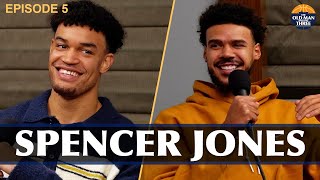
In this episode of The Old Man and the Three, host Cam Johnson and co‑host Tommy Alter interview Denver Nuggets guard Spencer Jones. The conversation covers the practical realities of being a two‑way player—frequent, short‑notice call‑ups, long travel between Grand Rapids (the G‑League affiliate) and Denver, and the mental adjustments required when shifting between the G‑League and NBA. Jones explains how his role has evolved from a high‑post scorer in high school to a three‑point shooter at Stanford, then to a defense‑first, hustle‑oriented role with the Nuggets, emphasizing the importance of effort, timing, and learning how officials call games. He reflects on playing alongside Nikola Jokić, describing the confidence‑boosting effect of Jokić’s passing and the need to stay aggressive despite limited minutes. The interview also delves into his personal background—growing up in Kansas City, winning three state championships, choosing Stanford for its academic and basketball fit, and majoring in Management Science & Engineering. Jones discusses his proactive use of LinkedIn to maintain professional connections, share thoughtful posts twice a week, and generate early investment opportunities, positioning himself for a post‑basketball career in venture capital and entrepreneurship. He shares lifestyle logistics of a two‑way contract (housing, car‑sharing, avoiding lifestyle creep) and his long‑term financial planning, including angel investing and building a portfolio. Throughout, the tone remains conversational and reflective, with Jones expressing enthusiasm for his growth on and off the court while acknowledging the challenges of injuries and the grind of a two‑way contract.
Chapters
That was a goal to have that set up.
He's actually using LinkedIn for what it's supposed to be for. Not only is he an NBA player—
Spencer needs a LinkedIn sponsorship.
Not only is he— I'm pitching this right now. Yes, good. They need to— we're gonna bring in a deal here. The only active NBA player to actually use LinkedIn for what it is supposed to be for, Spencer Jones. Spencer Keith Jones.
I don't know why I put my middle name on there. Oh, you did. I know, I know. I need to take that off.
What's up, everybody? Welcome back to The Old Man and the Three. I'm your host, Cam Johnson, joined as always by Tommy Alter. Today we have a special guest, Denver Nugget Spencer Jones.
Tommy?
Hey, man.
How you feeling?
I'm all right, man. On the mend, for sure.
Do you want to give a little— I will say, I was watching the game. This is the Mavericks game last week. When you fell down, and it didn't look— I texted you afterwards, it looked gnarly. It didn't look good. Um, do you want to give your thought process, just how it even— I mean, you've had a lot of these different injuries over the years, so you know your body pretty well, but just your sort of thought process when it all went down?
Yeah, unfortunately you're spot on with that. Um, yeah, I just hyperextended that knee, uh, came down on a little awkward, but passed all those initial tests, which gave me comfort in terms of, you know, the stability of the joint and everything in there. And so ultimately, worst case scenario was avoided, and I'll be back in a couple weeks. Um, started the rehab process last couple days, and, you know, I'm already starting to see improvements, so I'll be okay. Thank you, Tommy.
The nice thing is you— and maybe nice isn't the right word, but because you've lived this before, you have a good sense of how to get through this kind of thing, I would say.
Yeah, I mean, yeah, I mean, it's part of the game, one. And two, it's just You know, I've had my fair share of things and this is no different in terms of just kind of attacking it and getting back to, to playing high-level basketball. But in the meantime, I mean, we have a good team, a deep team, and, and, and I trust that everybody will continue to, to keep everything going for us as a group. And then of course, you know, we should have some other guys coming back, you know, maybe a little bit before I get back. So. Hopefully when I get back, it's— I'm joining a full, full strength group.
Before we get to Spencer, one thing we have to acknowledge, just because it happened since the last time I saw you or we taped, we talk— I'd say almost every episode we talk about with Spencer, the magic of Joker. I mean, everyone has their own story and their own version of it. But Christmas, the Christmas performance, I think is probably one for the books, I would say.
Man, that's an understatement. Um, what was it, 56-16 and 15 maybe?
Yeah.
And a win in overtime against a really good Minnesota team. Uh, it's starting to get to the point, like, as we just kind of sit there and, and digest what really happened, it's, it's incredible on efficiency. Um, just, he's able to do these, these types of games so frequently that you almost, it's almost kind of easy to take it for granted. I think I saw a stat somewhere that said it was the 7th best statistical game in NBA history. And it's just like, you know, on Christmas Day, on Christmas night, Christmas night, on the short-handed game, short-handed. Um, it's just incredible just the way he's able to control the game completely.
And I would also say just, it was really, it was really a full, all, almost all the games on Christmas were great. We're really good. I went to the Knicks game in New York, which was, they had a crazy comeback. What was crazy about your guys won by the end was like, I don't think I've ever seen that in overtime before. Usually it's like you do that, but you coming back like that overtime is nuts.
No, and down 9 too. We started off overtime down 9 quickly.
Yeah.
And then we hit big shot after big shot and Yoko obviously, and Jamal had a great game too. He had 9 threes and 30-some points, but it gets lost in the shuffle with, uh, Joker's performance. But yeah, great slate of games. Um, Christmas is the NBA's day as much as the NFL tries to continue to impede on that. And I don't really care what the total viewership numbers are. NBA has Christmas.
It does feel, it felt like the NBA took it back this year.
Last year they got there, the NFL, and part of it was bad luck for the NFL because all those guys were hurt.
Yeah, and the matchups just didn't turn out to be what, you know, as hyped as you'd think they would have been preseason with non-playoff teams and guys with injuries. But yeah, this one I think swung in the NBA's favor in terms of excitement.
So we'll get to, we'll go to Spencer in a second.
I just think right before we get to that, You know, we talk about this with him, but just your perspective, what you love the most about playing with him.
About playing with Spence?
Yeah.
Oh, he's just willing to do whatever it takes. Uh, dirty work guy, willing to guard the other team's best player, move his feet, um, and, and sacrifice in that way. I think he understands that that's his ticket to a lot of playing time, and that's, that's the, the ticket that he's been using. I mean, he's— his minutes are, are way up. And his impact on the game, you know, across the board is way up. But it starts on that defensive end. And he's, he's willing to be in the right spot. He's willing to make the extra effort. And he's willing to put 110% on the defensive end and on the glass. And that's everything you want in a teammate. You know, especially a guy that's trying to make their way. There's a lot of pressures with that. And we'll get into it in the episode. But there's a lot of pressures with that. And he's been handling it in such a great way.
All right.
And without further ado, here's the episode with Spence. Hope you enjoy.
And Denver Nugget on the rise, Spencer Jones. Spencer, thanks for joining us today.
I appreciate you, man. Thanks for having me, brother.
How nice is this sweater? Can we say that? We started—
sharp guy. Stanford.
Come on, man.
Stanford educated, you know, just clean cut, you know, professional, real professional. Spencer, from KC.
Yep.
You're one of 3 guys in KC.
Yep.
From KC on our team. Did you grow up playing against those guys? Christian and Tamar?
Yep. Yep. Grew up playing against Christian. We were in the same league for high school, so I played him a couple of times. I got mine in our last game and then played him again, both our freshman year in college. We were both playing a lot in college and then he got his getback there. And then Tamar, he was a grade lower, so I didn't play him directly, but he had an older brother who was a year above. So like, you basically got an older brother. Yeah, TB's got an older brother. And so, you know, I always knew him. We played with his brother a little bit growing up and stuff like that. So yeah, I mean, we've known each other for, shoot, that's a group of 3 for probably like 5, 6 years.
Were you guys in the same high school conference or different levels?
So like, it was weird. So I went to a private school, he went to public school. So we're like, it was same regular season conference. And it was like, it goes all the way up to 6A. CB's was 6A, ours was 4A. It just depends on how many kids are in your school. But so like, we played against all the 6A teams. In the regular season. And then, you know, when it went to postseason, we were playing all 4A teams, so we like would coast through.
Like, oh, so you front-loaded your 3 state championships?
3 state championships. Because like once we got the postseason, it was way easier because the schools were smaller.
Not bad, man. Not bad. Not bad. Good little KC nugget. A lot of KC flavor on our team.
Hey man, it's a great place to grow up, man. Just check it out sometime.
You know what I did? I was there. Yeah, I was there one time.
Really?
And I hate that place because that's where my last college basketball game was. We played at— what was it called? The Sprint Center.
You gotta give it another chance. It's T-Mobile.
Okay, so Sprint We lost to Auburn, who got ridiculously hot in the Sweet 16. That's my—
I was on that team.
Jared Harper, uh, Bryce Brown, maybe. They had, uh, Chuma Okiki. They had one wing, I forget his name, kind of strong. Those are their main guys, but they were on fire at that point. They were hooping.
Um, I don't blame you. That's a good reason to not want to go back to a city, and they were 12 for 15 from 3 in the second half. What's the barbecue spot at the gas station?
Joe's. That's actually right up the street from my school. From, uh, from—
yeah, that place is crazy.
After practice, man, always, always go take a little Z-Man.
It's a green gas station and it's like the best barbecue in the world.
Spence, um, you're a rare case of someone in this day and age playing, committing to a school and playing there their whole career.
100%.
5 whole years. I read your article on LinkedIn.
Oh boy.
Which we'll get into in a minute, right? I read your write-up piece. And first of all, I just need the people to know that like the Stanford education that you have is not BS. Your writing shows it.
Yep.
You know what I mean?
It's a very thoughtful and well-written piece. You wanna talk about that for a sec?
Yeah, yeah. No, it was interesting. You know, I had some like alumni and tell me like, you know, yeah, you should probably write a piece about your experience just 'cause how unique it was where, you know, freshman year, was kind of like that last real regular season of college basketball before we had COVID and everything messed it up. So you gotta— I got to taste old, old college basketball. And then, you know, my whole career is, you know, every year has some significant change. COVID, then NIL getting reinstated, then people getting used to it, and then all the other stuff that's happened in there. So like, you know, every year was just completely different. And yeah, to stay stagnant and, you know, true to my roots and, you know, to Stanford and everything through that, you know, they thought it would be a a great piece. And, you know, they also kind of said like, hey man, you know, having a presence on LinkedIn would be great. And I'm sure we'll get into that. But a lot of that was just to keep up with the alumni and everybody I'd met on my time there so I can, you know, use them and, you know, stay connected with them for obviously after career.
Did you feel like your basketball changed over those 4 years?
Yeah, honestly, my role in basketball changed at every step. So like high school, we would kind of have like an older school coach and everything like that. And I was, you know, still like around 6'7" then. So you're pretty tall for high school. So I played like a lot of like high-low, high-post stuff. Didn't really shoot that many threes. And, you know, I had great numbers and everything like that. But then I got to Stanford and was like, you know, obviously college guys are bigger. And I was trying to develop into a guard. And I just saw like biggest thing we lacked was 3-point shooting. So just really got in the lab and doing that. And then, you know, that's how I got to start there in my second game, just because my 3-point percentage was so great. And then I think I got close to beating like the freshman record there. And then obviously, broke the school record there for that. And then, you know, I get to the Nuggets and I mean, we got plenty of shooters, you know, Cam, Jamal, obviously Jokic's got to get his shots, A.G. shooting crazy. And so, you know, I had to kind of change to be like, all right, what can I do to get on the floor now? And that's where the defensive emphasis kind of came in. And so it's been interesting how to see it all change at every stage a little bit.
Talk to me about the life of a two-way, especially on a team like ours where everything is kind of established. At this point, this is your second year. You've experienced a very, very wide spectrum of experiences for an NBA player. You've been a starter now for a good couple weeks. You've, you were a reserve guy before that, and then you were a deep reserve guy last year and a lot of G League experience too. Talk to me about that breadth of experience.
Yeah, it's, it's crazy. I mean, you're basically just on call like what, last year I went back and forth. I counted, it was either 9 or 10 times. And like both times, like rarely did I ever get like a day before notice. There were 2 times where it's like the call woke me up to say like, hey, you're getting on a flight in literally like 6 hours to come down. And I mean, that's pretty much like how it was. I mean, now I think we have, they're like, I've talked to some of the 2As this year where we have it a little bit, a little bit more structured. Like they kind of know when they're coming back. But last year it was like, you know, we had an injury, A.G. wanted to sit or somebody like that. You're flying, you're flying down and everything like that. And it was crazy, like, and it took me till about, I mean, you know, when I'm coming down, I'm pretty much just sitting and, you know, maybe garbage time minutes and stuff like that. It took till I want to say February or like January to get like that first real opportunity. And even then, you know, I remember it because it was in Golden State, which was great because it was, you know, not too far from Stanford. So I had a bunch of people come by, but I had what I had just coming off a back-to-back in the G. It was like Saturday, Sunday. Had just played basically 40 minutes a game there. Then I leave after that game, or no, I leave the next day, flying, you know, from Grand Rapids to Golden State. And then I get in, miss walkthrough, whatever. I'm thinking it's just, you know, general, just, you know, do my workouts and then sit the whole rest of the game and whatever. And then, you know, I get the defensive coach come in like an hour and a half before the game telling me like, hey, you're playing tonight. I'm like, all right, whatever. They said that, you know, they say that a bunch of times. He's like, no, no, you're playing like legit like 20 minutes, something like that. I'm like, I missed walkthrough. I have no idea what our game plan is. I don't even know who's like playing for the Warriors or whatever. I'm like, what are we doing? He's like, we're just switching 1 through 5 or whatever. So I get, you know, it's probably a throwaway game for us and everything like that. And so that was like the first legitimate opportunity I had. We ended up, yeah, we ended up beating the Warriors and everything like that. It was great. Had a solid 6 points and, you know, did some stuff. And so that was, that was great. But like, it took that long to get that opportunity. Even then, like, it was my third game in 3 days, and I was exhausted after that.
What's your perspective hearing that?
It's crazy. I mean, our G League team, there's only a couple teams where the, the G League team is significantly further away from the NBA team. And Grand Rapids is one of them. Maybe Miami to Sioux Falls, but Denver to Grand Rapids. Um, I think they're independently owned, which is why, like, the difference there exists, but that's not, like, an easy flight necessarily.
No, it's like, it's over 2 hours. It's over 2 hours.
Yeah, it doesn't sound like an easy flight.
So it's not like you're up the road. It's not like he's 15, 20, an hour even, or a drive. Like, a 2-hour drive would be so much different than, than trying to navigate those flights. So, I mean, it's, it's crazy, yes, but at the same time, like, that's what, that's what he has to do. Yeah, that's— he hasn't— doesn't have an option. Like, for a guy that's trying to just get their foot in the door and prove it, like, that's your job right now, right? If I'm, if I'm you in your shoes, my job is to just go out there every night, and this is why I belong, and this is why I need to get on the standard. So it's like you got to do it. And you'll probably look back on this one day and be like, man, like, yeah, I was grinding.
Yeah, no, no, I mean, 100%. And like, it is also weird having them so far apart. They're, you know, the communication, you know, isn't as good as it would be. So like, you know, sometimes I think guys could fall into like, you know, go down the G, you feel like you got to put up a lot of numbers because everybody in the G is putting up a lot of numbers. But I think like what kind of separated was like the fact that I was going hard defensively and everything like that um, which eventually separated because, like, I mean, look, you go to the G, you'll get, you'll get numbers. I mean, as many possessions there are, it's just fast break and stuff like that. But yeah, the ways to stand out is like, I mean, you know, you just got to realize, like, look, we got Yoke, we got Jamal, everything like that. Doesn't matter if I'm scoring 30 points on 20 shots or whatever. It's like, what am I doing all that little stuff that's actually gonna have an impact in the game in the 5 minutes that I'll actually have a chance to play?
Yeah, I was going to ask about your, your, the difference in approach To even take the Nuggets specifically out of it, but just like being in the G versus coming to the NBA versus where, you know, you know you're playing a role.
Yeah.
Like no matter what team you're on, you know you're playing a role versus the G. Like, like to your point, you probably are going to be able to get a little more active and try more things. But how do you kind of like with what you're describing where you're like, okay, on a Tuesday, I, I've taken 20 shots a night and on Wednesday I'm playing defense and I'm taking 2 shots a night from a, from a pure, like, a habit standpoint, you know, it's probably tricky to, like, juggle those things back and forth. So how do you, how do you, like, get your shit off in the G but then come back and learn how to, like, calm it down that quickly?
Yeah, I try to keep it as similar as possible. Like, you know, a lot of my stuff is going to be— if I'm, if I'm up in the Nuggets, like, realistically, a lot of the stuff is going to be, like, you know, off of closeouts and stuff like that. So it's like Not, you know, maybe setting a screen, slipping out, you know, for when you're setting a screen for Yoak, you slip out and he wants to give you an assist, stuff like that. So like being a really good screener and finding points off of that and like trying to find those little advantages, trying to do a lot of off of closeouts, trying to do everything within like 2, 3 dribbles or less because that's realistically kind of how it's going to be. Try to keep it as similar as possible while also like, you know, there are some chances where you want to show them like, yeah, I have a little bit more in my bag just because you also want to show like potential of what you could be at the same time. Like it is also saying like, look, I can have an immediate impact now, but You know, the NBA loves potential and everything like that. You have to show a little bit. So it's—
I—
it is, it is tough. And like, that's where a lot of guys struggle in the G and everything like that. But it's— it— I try to keep it as similar as possible. But like, you know, inevitably, like, yeah, you can take some risks and stuff like that and do everything like that. But yeah, when it comes to the Nuggets, I mean, yeah, look, when I'm thrown in there, especially in the beginning, it was like, look, we have a generational offense, so don't mess that up. Don't mess it up. Don't, don't mess up. Try to be in the right spot. Don't mess that up. You get— you get a wide open shot, yeah, take it. It's not wide open, get it to Yoke, and, you know, we'll get a better one. And then just, you know, try to make up for all the deficiencies our starters have on the other end.
How do you feel you found the balance between that aggression when you're with us?
Yeah.
And, you know, because when you scored, you scored in bunches with us. Yeah. Yesterday, for example, you, you had your 9 points really quickly. How do you balance your mindset with that um, in terms of like— because basketball, in my opinion, like, you need a lot of rhythm, right? So, so what are you doing to find that rhythm or just to find the mental balance when you're going through stretches where you're not seeing the ball much and then you might get 3 spot-up 3s in a row?
Yeah, for me, like, I want to try to get the easy ones as much as I can, um, whether that's, you know, pick— getting a pickpocket easy layup or, um, you know, dunker spot, cutting at the right time, getting an easy layoff yoke. I mean, that'll kind of get you into it, but, um, I mean, like, yeah, you knew in like the beginning, like first couple of starts, I only took like 1 or 2 shots a game. A lot of that was mental. Like, I don't want to mess up the offense. You know, we can get some, we can get some good stuff. But as you keep playing, like, you realize the defense is like, if you aren't aggressive, the defense is really going to sag off and everything like that. And like, look, knowing I can shoot and everything like that, I'm like, all right, I got to, you know, I got to prove anything that like last night, I mean, they were deliberately kind of like sagging off, everything like that. If you don't take those shots, like it's a confidence issue and then you're getting pulled out. So like, you have to like, they're NBA, they're going to force you to show you what you can do. And like, if you shy away from that, like you're going to be able to pull that to the bench. So it was kind of like the defense has kind of forced, forced that kind of aggression out of me.
I have a sort of lifestyle question on this, on this shift. And I can imagine some of this is probably similar to like if you had gotten traded in the middle of the season or something like that, but like finding a place to live, getting a car, like the logistical information of like, this is what my life is, not necessarily knowing where you're going to be day to day. How do you, are you just like, how do you do it? How do you manage that part of it?
It's a little bit easier here because they take care of my apartment and then my apartment's right next to the arena. So I still don't have a car. I borrowed a teammate's of mine's right now. Car share. Car share. It's a nice little Range, man. I'm enjoying it. But like, that's the thing I've always tried to do. Like, I know I'm on a two-way. I'm still on a two-way. And like, you know, part of the reason a lot of guys have financial issues, you know, is like, The two main reasons are like, look, they have that lifestyle creep and want to try to maintain the lifestyle that, you know, guys with bigger contracts have and everything like that. And then the people around them— are you pointing to me?
You got a bigger contract?
We're talking about the bigger— that's all I meant. That's all I meant. So I like deliberately like, look, I'm only going to creep it up as my money creeps up. So I had things in route and like, I didn't plan on not buying a car. It's just like, look, it's a 5-minute walk to the gym and everything like that. Security hates it now, now that I'm starting more and everything like that. But you know, I'll, I'll get it eventually. But we'll see. I think it's gonna be—
it's gonna be a funny story at the point where you're like walking home after like a 40-piece. Why is this guy walking?
He doesn't have a car.
He doesn't have a car.
Yeah, I mean, I talked to Deuce about this and some of the other guys is like, he's like, yeah, my Grand Rapids setup is like super bare bones. This is my bed and my TV and PlayStation. And he's like, I don't have clothes, I live out of suitcase. It's like, yeah, yeah, your walls are bare and everything like that.
Like, I mean, like, yeah, especially last year, you're just living out of suitcase. You have no idea when that call's coming. Yeah, my suitcase was always just right next to my bed with a couple clothes in it just in case. And I mean, that's just, that's just life.
You wanna go back to Stanford?
Yeah.
What made you pick Stanford from the beginning? What were your college options coming outta high school?
Yeah, coming outta high school, well, one, it was always gonna be an academic decision. That's how my parents were actually to the fact that I still like took the Common App and everything like that. 'Cause we didn't like the off— we, I was kind of late bloomer, everything like that. And we didn't like the offers at the time. So like I took the Common App, did the ACT, whatever.
ACT score?
29, 30, something like that. Yeah, it was all right. My siblings did better, so they'll always give me slack for it. I know my brother got a 34. So my sister got something like 32s or something like that. Um, but yeah, so I took it and then like picked— I forget what schools, but picked out schools I kind of knew I'd get into. I think Rice was like one of them and stuff like that. That's cool. And so that was like the baseline of like academic piece, and then from then on, like, we'd take basketball over. But I think it was, uh, what we ended like Northwestern, Michigan, Stanford, Harvard, and like one other Ivies were kind of like the ones we were, we were thinking. So, and then Stanford, just because I mean, look, you don't miss out on anything there. You're in at what was in the Pac-12, so you're playing the UCLA's, Oregon's, you're not missing anything on the basketball piece. And then just as good as an Ivies, and but it's free.
Apart from home. Yeah, apart from home.
Oh, well, that was— well, they— I wanted to get out of home. Everybody— yeah, my brother went to East Coast, so did my sister. Um, my parents pushed us to get out.
What'd you, uh, what'd you major in?
Uh, they called it management science and engineering, basically industrial engineering.
Do you have a sense of if for whatever reason this had not worked out, what you think you would have wanted to be doing?
Yeah, I mean, when you get to Stanford, obviously around Silicon Valley, all those startups, venture capital and everything like that. So I always thought, um, you know, that might have been something I'd go into. My dad was a doc, so maybe do it from the health side, um, and everything like that. And so that's honestly kind of what I've started since I've been in the league. I'm you know, a year and a half, done some angel investing and stuff like that, always talking to VCs and everything like that and kind of building out my portfolio. So like, you know, when I'm done with my career, I have a solid portfolio with, you know, actual like, um, you know, projections of how, how it performed, everything like that. And then, you know, maybe go out, build my own fund, or with the companies I've been working with, you know, work with them and stuff like that. So I'm always cognizant of, you know, what to do after.
I feel like Stanford's the perfect place.
I feel like that's the— you know, it was, it was—
it's funny, I I feel like this— there was a period where guys would want to play for the Warriors for this exact reason. Yeah, like just for the, just for the, the access to Silicon Valley. Now with everything so, you know, globalized and kind of flatlined, I'm not so sure that you have to like be there specifically.
Still helps though, definitely. I mean, like, we would always have honorary captains and a lot of them would be like, you know, the partners of top VC firms. Um, our walk-on, um, who I'm good friends with, his dad, uh, is the CEO of Zoom. So I mean, he was He was loving it. I mean, when COVID happened, we saw that stock rise and we were looking at him and he's—
he's acting different. Why you moving different?
He was picking up the tab. But I mean, like, you had guys like that all over. He had a guy who was like, what, 2 steps under Elon Musk and stuff like that. And he's actually sent me some interesting investment opportunities. So it's actually really cool to see all the people, you know, usually you don't see those connections come to, you know, come to fruition until later down the line. But, you know, now they have a little bit of capital and a brand and stuff like that. It's been cool to see it. Kind of payoff already.
Do you feel like it's gotten better since you've come into the league in terms of guys? I mean, there's the cliché, there's whatever, the documentary about guys who have gone broke and blown their money over years, everything like that. But just guys being wiser about doing the kind of things that he's doing in terms of just being like, I don't know how long this is going to last, so I'm going to set myself up now knowing that 5 years from now, if I'm doing something else, I will have taken advantage of the fact that I'm in a position to, you know, get these meetings and have these conversations.
I haven't been around long enough to be super confident in that answer. I would say I don't know exactly what the statistics show, but I think it would be getting better just from pure awareness.
You would think. But I remember we had one of the meetings with the Nuggets. The guy from UBS or whatever, a big bank or whatever, he was like, I mean, the main difference is like, it just takes longer. You know, cuz we're making so much money and everything like that. So he is like, he is like the, it's really, it's getting better, but relatively not as much as you would think. Instead of bleeding out over after 5 years, it's, it's like 10, 15, 20, like to get to that financial kind of instability and everything like that. But I've, I've met several, um, other, uh, guys in the NBA or NFL and stuff that are looking like that. Usually a little bit older, but there's definitely, you know, there's definitely more emphasis and everything like that. So I do think it is getting a little bit better.
I have to say the, the LinkedIn stuff is amazing and you should never stop. You should like it.
How many, how many active players have a LinkedIn?
Uh, I mean, there's a decent amount. Like, all the main guys— I know KD and everything has ones, but like, they got ghostwriters. I don't know anybody who's on— I don't know anybody in the NBA who's on it like, like I am.
You are the NBA LinkedIn poster child.
I guess.
Okay, so those posts that go to LinkedIn, how often will you post? Will you post every game, every week?
I do. Usually I try to keep it twice a week.
Do you post that to any other social media platform?
Uh, not really. I just wanted, like, I just want to keep it linked because it only— it's the only reason I started it was because I was like, all right, I'm leaving Stanford. Obviously I want to keep these connections. Um, and like, what's the best way to— and then was it kind of like the best way to do it without like individually trying to text everybody individually? It's like, all right, how do I keep a presence within all those business professionals? I mean, they're already on there. Yeah. So it's just easy way to keep presence of mind.
It's extremely smart and practical when you explain it this way, because basically there is not— you're not going to write like an Instagram story.
After—
like, there's no other— unless you're going to write an op-ed somewhere, which just seems like a waste of time and honestly probably wouldn't even reach those people that you're talking about.
He posts it on LinkedIn.
Yeah, it's been great. It's been fantastic. I mean, I've had— I've actually had a couple investments come from that, and like, it's been great.
So no matter what anybody says about the LinkedIn stuff, it is simply for pursuing your business goals.
Yeah, that was the goal. That was the goal, to have that set up.
He's actually using LinkedIn for what it's supposed to be for.
Not only is he an NBA player, he needs a LinkedIn LinkedIn sponsorship.
Not only is he like, I'm pitching this right now. Yes, good. They need to— we're gonna bring in a deal here. The only active NBA player to actually use LinkedIn for what it is supposed to be for, Spencer Jones. Spencer Keith Jones.
I don't know why I put my middle name on. Oh, you did. I know, I know. I need to take that off. Well, you did. That's great, man.
What's been your favorite part about playing with Joker?
To the easy baskets that just come. Like, if you're just in the right spot, he hits you every time. Like, every time. Especially now he's got more confidence with me and everything like that. I mean, that, and then like, he just plays in such a calm demeanor, everything like that. Like, you know, I've messed up a couple of his assists and whatever, he's still gonna pass it, he's gonna be all right.
It's a bad feeling, right?
It's a bad, it's a terrible feeling. He makes you feel better because he's like, yeah, I'll come right back to you. Whatever, you know, whatever. I'll have, I'll have 17 assists instead of 23 tonight. Yeah, that's whatever.
I'm trying to think of the right way to phrase this the right way. Is there some The thing that's unique about your perspective, you have a different perspective because you've played in multiple situations before getting here where, like, your first time playing meaningful minutes, you're playing with a guy who's like, maybe will go down as the best offensive player of all time.
You know what I mean?
And so, like, it kind of warps your expectations of what the NBA is actually like because, like, it's never going to get easier than it is with him, if that makes sense.
No, 100%. I'm very, yeah, very cognizant of that. But it's also like, take advantage of it as much as you can. Like I said, I don't have to force anything. Yeah. Because like, even if it like, you know, in a lot of games there's been times where like I haven't gotten a shot for like the first 3 quarters, but then it comes to 4th quarter where they're like, all right, screw it, we gotta throw a 3rd, you know, second guy at Jokic and everything like that. And that's where I get like my wide open look and I'm, you know, knock it down. Obviously there's a little pressure to do that, but it's, yeah, it's just the fact you don't have to rush anything. So you can really just allow the game to come with you, come to you. You're not really worried too much about stats also just because, You know, when you're on a winning team, as long as you keep winning, you're proving value to everybody else with the fact of the minutes you're playing and stuff like that. So a lot of that just takes— take the tension of just thinking like what others perceive of you and your stats and everything like that. Like maybe other people deal with it, you know, teams that are lower trying to prove their value and stuff like that. But if you're just on a winning team, usually, you know, they always say winning usually takes care of it.
So what about, um, defense, defensive side of the ball?
I—
what do you, what do you feel like you've learned in the last like 3 months?
How great some of these guys are at drawing fouls and just like how they, they just know what to do. And also just, you know, how I'm gonna get— yeah, the tail end of the call.
I'm not gonna say anything controversial, but he's learning how the game gets officiated, especially as a two-way player. And I, I told— like, we all tell you, like, if they don't— I'm again avoiding controversy, but Like, really, really good defenders get away with a lot.
Yeah.
And it's because referees know how they play and, and they've been doing it for a long time. They let them get away with it. But Spence has a physical style of defense. We tell you, I told you that in pickup from day one. Like, you— it's a physical style of defense. And if you continue down the path of, of proving and putting together the tape that you can move your feet, time swipes, time blocks, time contact, then that will continue to improve for you. But in the, in, in the meantime, it's a lot of fouls, right? And it's something that you have to deal with because it's pulling you out of the game at certain places, changing the way you play. But I do have to give you a lot of credit because the one thing that you always give is effort and attention to detail.
Yeah, I mean, look, that's number one thing as a young guy on a winning team is how you're gonna get on the floor. It's just that constant effort and energy and like the physical styles, the I had to because that's what D.A. wanted coming into the preseason for guys to pick up the ball quicker or further up and really kind of push guys around because that's like, I mean, our defense can be a little up and down and stuff like that. And it's because, you know, sometimes we don't give as much energy to that end just because our offense is so great. We know we can kind of take care of it. So that was kind of the next thing to make us even better as a team than what we already, already are and everything like that. But yeah, it's, it would be, it is frustrating like now, especially since I'm getting more minutes. Like when I first was getting minutes, like, yeah, I'm in there for 10 minutes. 2, 3 fouls. Who cares? It was like, now, like, yeah, 20-plus where it's like, shoot, I got 2 quick ones in the first. Now I'm sitting most of the second. And like, you're kind of watching other guys like Bruce, hella defender, but like, you see like, oh, he gets away with that. That was just what I got called for. And I'm like, all right.
That is really annoying.
It makes sense when you think about it.
Yeah.
And it's going to change the way you defend, right? Like, if you have 4 and you're going up and you're going in the game, like, you're trying not to draw that 5th. If you have 5, you're obviously trying not to get that 6th. And it's like, you know, you're a little more tentative in your mind, but you've done a good job of balancing that and staying aggressive. I do wanna give a quick shout out to like, this is how, when I knew, so I was here preseason playing pickup. I didn't really know your game.
I don't think anyone knew. Yeah.
And so what definitely caught me off rip was like more to it than you'd think, but super like just quiet, calm, fit in, like do the right things. Everything that you're saying, like you embodied it from day one. And everybody was raving on the coaching staff about, your progression throughout the summer. Um, and then obviously me and you, you know, similar sizes, we're matched up against each other a lot in pickup. And, and I learned pretty quickly, um, that you are a good defender and that you are physical. And then I even doubled first play of training camp, first live play of training camp, dude.
Collision with Spence, stitches, stitches on his arm that didn't heal for like a month. You'll see in a lot of the first games I had a little— I had like a wrap around my arm, bro. It took forever for that to heal. Oh my gosh. Julian was so pissed at me for a while. Cause he had just gotten like a, cause he had a fake tooth or whatever, but just got like an implant or whatever, like a week before. And like he was part of that play. I just whacked it out. Whacked it out. Yeah. I had to get stitches, missed the first day of training camp, but I knew it was going to be important training camp for me. I'm like, all right, screw this, man. I was like, you're just kidding.
I was like, dang.
Not even, I kid you not.
First play.
It was literally for, yeah, first live sec.
Just covered in hot.
It's coming in hot.
But it's, I mean, honestly, it's just a credit to where you play. I think Dallas was a huge game for you to gain that confidence. When you, I think you might've scored 7 points quick, maybe. And it like, maybe the first couple buckets, you know, you're just in the right spot. But after that moment, I felt like you're, I think that's the moment it flipped. 'Cause I think—
That's where I, at this moment I actually felt like I was taking like risks, you know, like with the offensive game where I was like, all right, let me try to, create something a little bit here, you know, where, where it's versus like, this is just like the right play. If I don't shoot it, you know, everybody would, you know.
And sometimes that's what it takes, right? Like seeing the ball go through the hoop, seeing the aggression pay off. And, um, like, would you have 28 that game?
Yeah.
Like, just knowing I can go out there and get 28, I can do that, you know what I mean? Like, oh, you know what I mean? It puts a lot in perspective.
100%. No, even mentally, like, I mean The beginning, like, I was, I was, I've been more than happy with like 6, you know, or something like that. Then you hit 28, like, oh shoot, like, you can, you know, you can have, you can, you know, get to 10, 15, you know, like, not, not really, like, you know, obviously still playing within yourself, but like, it's like, all right, this is, yeah, like, you have a different expectation going in the game rather than just like, all right, let's hope I just get these 2 easy lays from Yoke. Yeah.
What have you, I know he's been out for a little bit, but what have you learned from AG in terms of just how he plays?
AG's actually really helped me 'Cause I've never played the dunker. I was, I'm like trying to figure out how to move where Yoke wants me to go. Yeah, that's what I'm saying. Yeah. And like, you know, I'm obviously not a super athletic guy. I have some athleticism, but he was really helping me on like how to, how to move it, how to get those easy buckets, when to cut off, when your man doubles and stuff like that and everything like that. So he's been, he's been super helpful on that spacing issue. And that's what leads to a lot of, a lot of shots. 'Cause at first, you know, a lot of times I, you know, I obviously cut a lot and try to move a lot, but it'd be the wrong timing or wrong spacing. Sometimes I mess with Yoke and everything like that. And obviously, like I said, you know, it's a cardinal sin if you try to mess with our offense. So, but he's been, he's been fantastic. Kind of helped me with that.
What about Jamal?
Jamal's been, Jamal's been great. I mean, like, I remember, I'll remember.
Fucking ballin'. Like, he just is, his shot making has been crazy.
He's been insane, but he's a great teammate. I remember one of the times it also flipped. I forget what game it was, but I think it was, I think it was a little bit before Dallas, but it was like, it was like one of those times where I said like, you know, like defense was going to make you prove, you know, what you are and the shooter and everything like that. I remember like they were sagging off, like they were sagging off. I just missed two. They were like in and out, like great shots.
What came to you?
In and out. I know, I can't remember who it was. It was a home game. It was a home game.
Was it San Antonio?
Yeah, I think it was. Yeah.
San Antonio.
San Antonio. San Antonio.
Right.
In and out. Like it's just in and out.
But like, yeah, yeah. I'm like, shoot. And then like Maul drives again and like, again, they're like foot in the paint. I'm wide open. Kicks it to me again. He's like, shoot. Like yelling at me, shoot it as he's passing it. And that goes in, and like, that, that's a bit— because I just shot 2, I'm taking 3 shots in a row as a, you know, basically a 2-way on a, you know, a team that has Jokic, Maul, anything like that. And, you know, for him to trust me to still take that shot and everything like that, like, that shows the kind of teammate he is. And yeah, no, he's been on a, he's been on a crazy tear. You know, I hope he, I hope he gets his All-Star, uh, his first All-Star appearance this year. He deserves it. Yeah, definitely should.
Spencer, um, your progression as a player is really encouraging. And so like, man, I just, you should be so like proud of yourself, but also like continue to put the foot on the gas 'cause of what you can accomplish. I love your off the court stuff and how you approach that.
Appreciate you.
It's a really good lesson to young pros. And especially like some people think like, oh, I'll start investing and I'll start getting into the business side when I get a lot, a lot of money. But that's all subjective. Like if you were to go, with even with the two-way salary into the real world, that would say that's a lot, a lot of money. Exactly. So for you to be like, we had this conversation, preface it, we had this conversation about investments and all that stuff. I think it was in SAC just a couple of weeks ago. And it's like for you to be on top of that stuff, you're so young, you got so much ahead of you, like just your future's headed in the right direction. So just big kudos to you, man.
Appreciate you.
Thanks for joining the show.
Yeah, man. Thanks for having me.
More from Spencer

A Business Day in the Life with NBA Player, Investor and Entrepreneur Spencer Jones at All-Star
Spencer Jones On His NBA Journey And Winning On And Off The Court | EssentiallySports Exclusive