Mastering the Go-To-Market Strategy in 90 Days
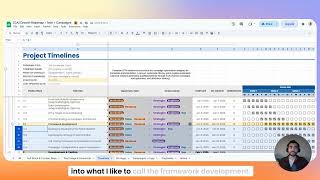
Spencer Tahil (Growth Alliance) presents a 90-day go-to-market (GTM) implementation roadmap via a self-updating Gantt chart aimed at B2B SaaS/marketplace customers. The plan is structured as three 30-day phases: Phase 1 — audit, discovery, and infrastructure setup (domain warm-up, ICP definition, measurement protocols); Phase 2 — campaign launch, consolidated testing, personalization and optimization; Phase 3 — scaling, evergreen and signal-triggered plays, documentation and knowledge transfer. The walkthrough also covers team roles (marketing, sales, revenue, operations), tooling choices (orchestration, list-building, CRM/warehousing) and financial planning guidance for ROI attribution.
Chapters
Hey guys, I am going to walk you through a 90 day go to Market strategy and implementation plan in probably around five minutes. So I just want to outline this. This should be taken as a guide and not a final plan. But if you would like a final plan then I am happy to supply you with a proposal and agreement that follows exactly. Everything that I am going to show you guys today. Everything that I supply my clients with at Growth alliance is going to be in this growth roadmap that I'm going to show you in this really fancy Gantt chart. And then everything from here you guys can go and change everything later on. So just to dive into it, I'm going to show you this breakdown file. So on the screen what you're going to see now is a self changing and self updating Gantt chart from my days as a Project Manager. As you can see, this is the go to market track and and the start date is the one that controls everything in the whole Gantt chart. So let's say if you are starting a go to market motion with email, LinkedIn inbound and outbound, let's say we're starting all of that in January 2026. All we have to do is set the start date for January. If you guys are going to start it in Q2 and you guys want to put everything out in April 1st, everything is going to self update all the way through the whole Gantt chart. So you can see that on the right hand side where I'm highlighting right here. I'm going to change it back to January. In the 90 day plan I want to break down the strategy behind it only being 90 days. In 90 days you should be able to come in, audit everything that is existing, consolidate everything, change it, test it, test the infrastructure, scale it, document it, and then hand it back off to somebody like you or anybody that's going to be managing the program. If support is then needed after the sprint, then that's where you guys could keep somebody like me on board. Everything that I'm going to show you is completely proprietary. This is everything that I do for all of my other clients. It's a look behind the scenes. I just want to break it down for you. I'm going to expand every single tab and I'm going to show you exactly how I break down every single subtask for the go to Market plan. On the left hand side of this Gantt chart you're going to see the phase and track and then you're going to see the task title supported by the department and the team as well as the parties involved is important to understand that when you're going to market either with a SaaS platform or with a paid service, that different specific departments need to be involved when you're creating this whole plan. So I've broken this down by team. So marketing, sales, revenue and operations. This is kind of like where go to market engineering kind of like makes a crux and then the parties involved on the backside. So let's say we need to talk to a marketing strategist or GTM engineer. GTM engineer or sales rep. You can break this down, you can change this in the future. But just as an outline, this is how I think about it in my head. The start date and the ending date work on a moving platform. So you can see that week one, week two, week three, week four. There are five days every week. As long as I've counted my days correctly, then There should be 10 working days within a specific category to get the discovery and infrastructure foundation completed. This is how this Gantt chart works. I'm going to bring you through the whole strategy for the first 30, for the second 30 and the last 30 days to complete the 30, 60, 90 day plan of a go to market implementation without further ado. Let's go. So on the left hand side we're going to dive in and I'm going to show you all within phase one there are going to be specific phase objectives, as I like to call them and they're going to be specific phase outcomes. So we're going to see the phase objectives being here. So 1.1 we have the objectives which is set up, audit, lightly optimize email and LinkedIn infrastructure. This is very important when you guys have no idea what kind of infrastructure or what channel you guys want to have. If you guys are going to run ads, which in the future we're going to manage. But let's just say for right now you just want to go to market with inbound, outbound, with email and with LinkedIn. If you're a B2B marketplace or a B2B SaaS platform, right, you want to sell your services in those channels. I need to set up the infrastructure on the back end. The very first thing that we need to do is make sure that infrastructure is solid enough for you to scale up up to that 90 day plan. After 90 days you guys can go ahead and triple the infrastructure. But if you guys have cracks in the infrastructure of your house, this is where the problem starts and this is where I start. So building the house is not on borrowed time. We build the house the right way, we take our time, we, we, we audit, we set up and we optimize whatever is there and then we build on top of that. So on the back end, discovery and infrastructure foundation. The objectives are just to get the solid how the foundation of the house, the desired outcomes of Phase 1.1 is all the infrastructure is capable of supporting the target campaign velocity and the volumes and then defining, also defining the target account framework. So There are also four subsections of Section 1.1, Phase 1.1, which is again like very comprehensive on how I'm going to break this down for you. But every single subtask or every single task has subtasks. So I need to configure and warm up all of the domains and if you guys have ever tried to send cold emails, you would know that Google and Outlook don't like it when your domains are not warmed up. So I take care of all of that on the back end and I think that you guys should do this as well on the other, on the other side, right? I need to understand what is it that you actually do and who do you do it for. So within the very first. Let's see, I mean, let's see on the right hand side, on day three, I'm going to be interviewing you and your sales team, looking through your documentation on notion or on or on wherever your database is, looking through your database files, plugging them into Claude, understanding what type of ICP or ideal customer profile you guys like to talk to and what kind of offer we can actually create for you to go to market with. So after we have the foundation of knowledge, we get into what I like to call the framework development. So again, going from phase 1.1 down to 1.2, each sub task or timeline track takes around 14 days. I want you to keep that in the back of your head because I like to do 14 day sprints for any testing. You never, you never, if you guys have ever run ads, you never run ads just for seven days. It just doesn't make sense. You have to get enough testing data. And coming from that background, I've always thought that you should always do go to market motions and sprints and then ab test those sprints to make sure that you guys are actually getting the results as you go over time and making sure that you can make the minute testing ground edits so that you can scale properly, if that makes any sense. I'm kind of tripping over my words. Regardless on day seven or on day eight, roughly on the first day of week two, we can see right here on this box. January 8th is when we start to develop all of the frameworks. So messaging, development, personalization. What is the note actually saying here? The note says that I should be creating Persona specific outreach messaging optimized for different prospect tiers and engagements at engagement stages. This is huge. If you've ever created a go to market plan or a strategy, you know that every single Persona should, should have its own different messaging because at the end of the day the different, the pain points for every single Persona are going to be completely different. Every single buyer is going to have a different jurisdiction and every single buyer is going to have a different way of thinking. So you need to write to the person that's going to be buying. If you're in the business of business world, you mean this could probably think you could start thinking about this as C level versus user level and then kind of, kind of like changing the copy based on who, who you're talking to. And if you're at the D2C or the direct to consumer or the B2C level, this is probably a motion based buying or ads copy or ads testing. I primarily work in B2B regardless. If you want to do B2B or B2C, then that's a completely different strategy at the end of phase one. So I'm just going to go ahead and minimize everything now or I'll keep it open. Actually, at the end of phase one, you have all of the strategic assessment and all of the system setup completely done. And and then we also have the measurement protocols in place. So this is the very first 30 days of working together with somebody that's like a go to market engineer or systems thinker, whatever you want to describe, you should be having all of the different parties involved. So marketing, sales, revenue, you need a strategist, you might need somebody technical most likely if you're going to do a lot of orchestration. And then at the end of phase one, you're basically ready to launch the campaigns, right? So we see phase 1, 2, 1.4, which is actually bringing us through configuring the initial outbound campaigns, setting up the comprehensive channels and then actually preparing to launch everything. I see that I made a typo there. And then let's fix that. Right? See, this is why we, we test things. So this is how it works. And then we prepare to launch everything at the end of week four. You could launch them sooner. I wouldn't recommend it for Many reasons. We can go into this later. At the beginning of phase two, what ends up actually happening is that we do the consolidated testing and we do this at scale. So just starting to think about it, we move from phase one, which is up here from assessment and system setup, and we move into phase two, which is second category of the 30 days. 30 to 60. Right. What does the next 30 days look like strategically? Within the second phase, we go through the campaign launch and optimization. So what we're doing is a subtask. Put it in your notion, you can put it in your ClickUp. We use ClickUp. That's where it goes. Everything you see here goes right into my backend. And then we're going to push all of the systematic outbound campaigns out, do control testing, and then we're going to do the systematic testing for about a whole week. We're going to make iterative changes, develop the lead magnets with you, you can see that the lead magnets actually get developed here. This is Tuesday to Tuesday. It's about a week long. Right. And then multi channel coordination, making sure that everything actually gets attributed back into your CRM. Very, very important. Doesn't matter what you're doing, all the marketing and all the sales that you do needs to be tied back to revenue. And I think that's why a lot of people think go to market engineering has nothing to do with revenue, which is completely irrelevant. I think that you should be ROI first. And so making sure that everything gets actually measured is very, very important. And this is where a lot of teams actually mess up because they don't have the right attribution set up. Personalization optimization happens towards the end of the initial testing period. So we're actually testing for around seven days first. And then towards the end of it, after we have a full week's worth of data, then we're going to start doing optimization during the second half of phase two, which is around week seven. We can see it around right here. If you can see my mouse, we start to have campaigns performance optimization. This is where we're actually doing very minute changes in the copy as well as the data flows. So, so we're establishing the systematic optimization plans. And you can also follow along if you go directly into this GANTT chart. And this is what I present to people. This is how I organize my projects. All of these go into the backend of a project management system. So the methodology stays the same, the process stays the same, maybe the tools different a little bit. Whether you're using clay, using Cargo, Using anything else. Like any orchestration layer, there are different types of tools that you can use. Actually going into this in a little bit, I'll walk you through the different orchestration tools and the different list building tools that I have here on the left hand side in the different tab. Going back to the timeline, all of this, the process wise, it stays the same. It's the growth alliance go to market project timeline. It's the strategy that I've been running for, for months, for years for clients. Right before go to market engineering was a thing. As far as phase three, phase two is wrapped up, we've got the scaling protocol developed, we've got quality control measures in place, we've got the messages refined. At the end of phase two, we have the improvement in consolidated SCAL plans. In phase three, what ends up happening is that we move over into actually documentation, target achievement and signal based campaigns. So a lot of people just go boom, let's send all the emails, right? Let's go send all the LinkedIn messages. This is like not the way that you should be doing things in my opinion. You need to set up for success. You need to set up for Evergreen plays. When you're in a B2B world, which is what we serve. If a B2B SaaS company in your space gets funding, shouldn't you reach out to them? Or shouldn't you at least have the account intelligence going into your CRM so your account executives can go and you know, maybe contact them? Or shouldn't you guys have call intelligence to, to track your your different types of competitors? This is exactly what we do in phase three. Just because all the backend work needs to be set up for the scale and the volume and then on the phase three we go in the signal based campaigns. This is a sprint. So making sure at the end of 90 days that everything gets done is very, very important for Bay. Right? So we need to set up exactly what happens on the backside. Signal based plays, implementing Evergreen cold campaign development sequences and then trigger based campaigns. Just because somebody comes into market does not mean that they're interested in buying from you. So understanding the strategy between it's just intelligence versus it's a signal versus intent is really, really important. And I think this is the strategy that needs to be mapped out between your strategist, your go to market engineer, your go to market person as well as your testers. So you need to understand, you need to look at your pipeline, you need to understand what the data sources are, you need to reverse engineer your success for you guys to be able to get here. So this is where we go through phase one and phase two with all the strategic alignment and then phase three, we really nail down on the ideal customer profile at the end of phase three, at the end of 90 days, what you end up getting is actually complete knowledge documentation with videos, team training. If that's going to be an ae, that's going to be an sdr, that's going to be a marketing strategist, it's going to be a go to market engineer or a marketing operations person. Whoever it's going to be, you guys need to know how to run the system. Campaign management optimization and then a support framework. If you want to do knowledge transfer, if you want that knowledge transfer to go back in, in house, which a lot of people do at this point in time, there's no point to keep paying agency, right? But if you don't want to hire somebody in house and you just love what keeps on going, what ends up happening is that I actually have the support framework, right. So that ends up working out. If you want to do campaign optimization, new offer framing, multichannel strategic consulting, any of that, it's just continuous, right. You don't, we don't have to, we don't have to go back to the drawing board. So this is how exactly I run my 90 day sprints for go to market engineering or go to market track. And then on the side I actually do other things. I do revenue operation. So like CRM, data cleaning, data consolidation, account based marketing, whatever, like whatever you guys need as far as it's like account based marketing. I love account based marketing. Complex projects on demand. You're going to see that box down here. Basically all that means is if you guys want to do call intelligence, workflow, AI agents, anything in between, I handle that. That's a completely different track. We're just talking about go to market here. A little bit of a background on how all of this works. Now that I've brought you through the whole Gantt chart, I want you to understand the tool usage and financials. So for financial planning you should be able to understand where your money is going so that you guys can make it roi, right? And at the same time the full stack and the context based on the left hand side in this, this whole window here is important for you to understand that there are different tools and their use cases overlap sometimes. So you might have seen a few of these tools on your screen. You've got Clay, which is a huge market leader and then we have Cargo, right So like if we're going to start using cargo, we, you, you would know that they have an integrated snowflake server, right? So you can use this for any of the use cases that I've listed here. Orchestration layer, another orchestration layer, AI workflows, the CRM warehousing. Right. You probably wouldn't use Clay as a CRM, but you might use. Let's see, let's see, where is it? You might use Close or HubSpot for a data layer or a CRM. Right? But you're not going to use it for warehousing because not all contacts have deals and not all contacts should be created inside of your CRM unless they're valid to go talk to. Right? So when you're writing a cold go to market effort, you need to separate your data sources. So this is where all of the orchestration and all of the backend ends up happening. All of the tool usage and financials come into play on this tab. And then the timelines for the go to market plan are very easy to follow with this Gantt chart. If you want to have a look at this, please let me know if you want to have a specific strategy put together. My name is Spencer, I'm from Growth Alliance. I founded this company. It's awesome. And if you want to look at any campaigns or copies, you can also push everything down here. Right. So this is the Gantt chart of the go to market track that we offer. And I hope that this helps you. If you have any questions or concerns, please look me up on LinkedIn. I'm happy to answer all of your questions and talk you through anything you need. Bye.
More from Spencer









Mega GTM Talk #2: Spencer Tahil, Brian Ragone & Pawel Nical on Where GTM Is Headed

