Winning Before the Market Shifts: GTM Strategies Ahead of the Curve
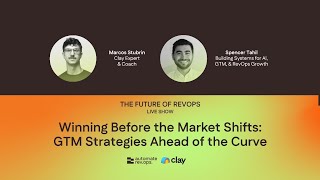
This is a YouTube video titled "Winning Before the Market Shifts: GTM Strategies Ahead of the Curve" recorded in August 2025. It features a detailed conversational session between Adam Robinson and Spencer Tahil discussing go-to-market strategies, revenue operations, AI integration in sales roles, data activation versus enrichment, and technical tools for scaling enterprise systems. The dialogue covers practical insights on system design, SDR roles, buyer signal detection, personalization at scale, and workflow automation, highlighting Spencer Tahil's expertise in revenue activation and go-to-market engineering.
The conversational one hour session. So feel free to drop your questions in the chat. We're gonna go through a lot of questions. Spencer is a little bit concerned about the amount of questions I prepared for him. But we're gonna make it really, really challenging and tough for him.
Don't do that to me.
All right, Spencer, would you like to start with a quick intro of yourself, what you're currently doing, what type of companies you help. Maybe we can start off that way.
Yeah, sure. Hey guys. As the audience joins, just a little background on me. I'm Spencer. I recently launched Growth alliance but I have been working in revenue operations and go to market for around five years now. I recently picked up like AI development as well as like really hardcore prompt engineering probably for the last like year and a half. Learned most of it from LinkedIn actually just from following the right people like Marcos David. I follow you guys for a while and usually where I kind of tend to fit best are anywhere from series A to enterprise companies. Most of my clientele in the portfolio are like enterprise grade. So we're looking at setting up like very unique, very boutique abm, so account based marketing place as well as unique go to market and revenue operation engines. So the name of the game is revenue activation. At that rate. So either your series A, series B or your enterprise. I do serve mid market but most of the time they usually fall into one of these two categories.
Awesome. Awesome. Thank you. Thank you. Do you work as a freelancer or you currently building a team? What is the current status of growth?
I was, I was a freelancer for probably four years. I love what I do. I love, I mean anybody that's in here listening will probably understand like if you guys are working under somebody, sometimes you don't get to choose the people you work with as a freelancer you get, you have the freedom to say no. So I kind of took that philosophy and when I launched Growth alliance in it was a soft launch in June, like Marcus, I texted you and it was, I'm like telling you like yeah, we're to, we're going to launch in June but we actually onboarded two clients and we had to delay public launch until July. Now it's, it's the same clientele, we've got a very small portfolio. But yeah, I still hold the same reserve the reserved rights to act as a freelancer only I have, it's just me and one other person. His name is Jonathan, but he's coming in actually full time. So it's not actually publicly announced yet. But there you go into the world now.
Yeah, I mean we're in the AI era, so maybe with two people you can scale up to 10 million, who knows? So it's a great time to scale without hiring or without increasing headcount. And this is basically what we are focused on with these systems. Right. Have a quick question about. I mean you just mentioned that you deliver your services to series A to enterprise clients. So how does your systems approach change as companies scale? That's like a very wide question to.
Start off, I think systematically, right. When we start to understand that to scale you have to have good systems. Like it doesn't matter, it doesn't matter what the system does. It's like my philosophy is it's like you're going to get garbage in, garbage out either way. I talked about that on like a few other like webinars that I've done for some other people. The system is the output is only as good as the input, right? So depends as the load scales. I would say the higher up in the market that you go on enterprise you have multiple inputs, multiple outputs. So you have different stakeholders, you have different, you have marketing team, you have the sales team, you have the revenue operations team. Designing the system holistically is what I do. So as you scale up or scale down from the mid market, let's just say like an agency that's doing 10 mil, right. That could still be considered mid market. But if you're going up to a 2000, 50,000 person organization, these different teams have to adopt with whatever solution you create. It's a lot easier to see and it's a lot easier to pivot when you're just like at a startup or something like this. So when you start to discuss things like series A startup and you want to build an application and you just want to get an MVP online, okay, like drop that MVP and then iterate really quickly when you go up and you build the system at the enterprise level, like way above, like the means of like a startup would, right. You have to move a little bit slower. You have to get buy in from different people. So startups are actually well positioned to pivot a lot faster. But when I design the system, I design it a modular way. So it depends on what the input is, what the output is, but it's not system dependent. Does that make any sense?
100% yeah. We also see that same characteristic of the enterprise companies and how difficult it is to move fast, you know, and to build fast. What we have outlined on the system design so yeah, totally. Way more, way faster to set it up for a smaller company that has way less bureaucratic steps even to get a new tool, a new data provider. How do you overcome those challenges when you are helping an enterprise company and you get stuck because you have to use this tool but it has to pass through five people process, how do you normally manage that? It comes to mind the credit system of play that it's a great solution in those cases. But what is your take on that specific topic?
So I think, are we specifically speaking about enterprise and larger grade companies at this point? I would assume so. Right.
Okay.
So just, just to confirm, right. So if whenever I'm in a discovery call like I think this is like the best case example or like the best case scenario here. When I'm talking to a startup, they usually don't have anything, they're like, okay, like whatever the expert says, right. If on the enterprise level they're usually going to have three or four different minds that are going to be having to align to make one decision to adopt one tool. And usually like when you know the, the whole point of this revenue operation show is to talk about CLAY and all the new tools. Right. I ran into a problem a while back, probably like three or four months ago when a lot of like these like larger teams are like oh, we need to run it by privacy team or we need to run it by legal team. And this whole scenario of hey, is this tool compliant, like SOC2 compliant and everything like this, it becomes an issue. So what I'm doing now is when I have these conversations of hey, can we adopt this different tool? We do xyz. I'm already front loading this. I'm like hey guys, like yada yada yada, here's the price or here's this and all the capabilities. But also by the way, I noticed that you guys are sock to compliant. Just letting you know if you need extra privacy restrictions, I can go and talk to the CLAY Enterprise team or something. And I think when you come from that advisory seat it becomes a much easier conversation and then you can address every single person in the room and then forget about like, forget about that side. Right. Like if they, if they have their needs met, then your job becomes explicitly easier to handle. Right, Nice.
I love the way you overcome and shortcut these challenges. Then I did some research on previous interviews you've done and I noticed you're an advocate of data activation over data enrichment. Most RevOps teams are drowning in data but starving for results. So what does data Activation actually look like in practice for you.
Data activation.
Data activation, yeah.
So a live view of this is probably going to be when somebody said like a really practical application is like, hey, like Marcos, you come to me and you're like, hey, I need to enrich my CRM. This is like the number one issue that I'm saying, hey, I need my CRM enriched. I need to enrich my contacts. I need to like renew my companies, like my 12,000 companies, my CRM. Okay, great, I can do that. Anybody. Just hook it up into clay or hook it up into cargo and be done with it. Right. The problem with doing this is that you're spending so much money doing it and you don't necessarily, you're not necessarily going to have an act, like a strategy to activate that new data. So what is it that you're actually after? Is it just the fact that you, is there? Is the problem that you don't know what the problem is? Or is the problem that you don't have the right data? Because if you don't know what the problem is, then you can't fix it. But if you have the right data, does that solve your problem? So I think like, when, when I start to talk about like data activation, not just data enrichment, it comes down to the fundamental question, after you pay for this enrichment, once you spend the money to do X, how are you going to make it back on? Why? Right? Like how I would do it is I go into Salesforce, I go into Sales, into HubSpot, and I say, you have a list of 12,000 accounts that you want to enrich. Why? And like, like, I'm not going to make you guys spend money just to have enriched data. I think that's silly. How does that help you close deals? How does that help you activate that revenue? Because every single step that you take in a business, especially at that enterprise level, has to be tied back to revenue. And I think when me and you have that conversation to those other businesses, it becomes a lot easier to say, hey, you're actually not just paying for somebody to spend your money, they're actually thinking about how to make that money back. So don't enrich everything, right?
Yeah, no, 100%. And also I think that the conditional formula, you know, for running each column and running each in each row in particular is so important, especially in clay, because it allows you to, you know, filter out the not qualified or unqualified accounts and prospects. And we sort of need to have the same approach for the CRM records as well. Right.
Yeah. And that's like super important. Like if you, if you approach it in the, in the revenue activation way instead of just the data enrichment way, because it becomes a little bit more valuable in my opinion. If you just want the data, fine, let's do it. But I think that you should be revenue focused, right? Yeah.
100%. 100%. Maybe I want to switch topics about the hot roll, the industry. You know that recently Clay announced the race of their Series C, $100 million at a 3.2 billion valuation. So Clay sort of invented this go to market engineer role. What, what is, where does a go to market engineer actually fit inside revops? Like is this a replacement of any traditional Rebels roll or is something that you see is complementary?
Definitely complementary. I think there's a huge, I think there's a huge misunderstanding of what a go to market engineer is though, because I mean I wrote a whole article about this. Right. Like I, I wrote, I wrote a whole thing about, I said, like what, what the fuck is a GTM engineer? You know, like I wrote a whole article on it. Got picked up. Yeah. And, and I think there's a huge discrepancy between like, is it a replacement for revenue operations? No, I don't think so. But do I think that it's a really good addition to revenue operations? Yes, and I think it's a really good addition to rev ops in the aspect of you have somebody that is like inter departmental and can see more than just a revenue focused person. So you have somebody that sits in between sales, marketing and revenue and you don't just have somebody that's focused on the dashboards and stuff like this. That's why attribution is so important to the revenue team, because then they can take that money and reinvest it. But if you don't have somebody that's actually on the ground level sending the campaigns or actually like doing the data crunching, doing the revenue activation strategy, doing the data enrichment, you're not usually going to find that on the revenue team. You're usually going to find that on the marketing or the sales team. That's what the role of a GTM engineer is. It's getting ground level. But for marketing, for revenue, in my opinion at least, you know, Interesting.
Yeah, you know, I, I sort of have to agree with that. I saw that you believe in impairing strategic CDM leaders with technical systems, like technical systems architects, rather than looking for the typical unicorn hire. So why is the partnership approach more effective? Do you get my, my question? I Took this from a previous take, hot take of you that you recommend to have like the strategic GTM role and the, and the RevOps architects as a duo on a team. I don't know if you remember that.
I think. Yeah, well, I don't know which one I said this in, but I think having, I think having an architect is good. Like anybody that's a revenue in a revenue activation or revenue operations will probably understand that term like architect. If you're not in rev ops or you're not in operations at all, it's like what the hell does an architect do? It's somebody that draws up the plan, somebody that thinks in the system, that builds the house. Right. I think having somebody that's strategic enough and can see the whole system together is really important. But I also think that having somebody that is going, yeah, that's going to be more technical that can help take the pressure off of like, you know, you go from a T shaped marketer down to like a specialist or you go from somebody that's super broad and then you have somebody that's specialized in each division. Inherently that's the same. That's the same thing that a lot of agencies do. That's a lot of some same things that like a lot of businesses do. They hire an ads manager, they hire a copywriter. What's the difference between somebody that makes a clay table versus somebody that designs the strategy? And I think that that's like kind of like where the idea comes from. Because if you're expecting one person to do it all that that's a unicorn. Like really hard to hire, really hard to control and really hard to pay. I would say.
Yeah, yeah, yeah. Also, I mean we see it in the rev up space that the extremely technical roles that get 4, 400,000 annual salaries because they really solve complex problems. But when we see the go to market engineer as the, as a role, it's like a skill set of this go to market strategy with the, I would say right now those technical skills and the computational thinking to be able to brief the tools we use to achieve the goals we need. Right. What about the SDR role in this scheme? Because we are hearing a lot of AI SDR that you don't need to hire any more STR roles. What's your take on the role of the sdr? How has it changed with this new modern tech stack?
I'm gonna piss people off with this answer. I would say, I would say the SDR role is always going to exist. I think people inherently, people do People, people do business with, people they trust and people trust people they like. So I think realistically the role of an SDR is to keep on creating that connection and discovery, like doing your own discovery and understanding what the problem is. But I do think that there's a problem, a fundamental problem that's emerging with the SDR role, like in general in these like AI mandated companies. Because now SDRs, everybody in their manager know that GPT or AI exists, right? But the problem is, is that a lot of SDRs aren't taking advantage of it in the way that they could. And the ones that are, are joining your bootcamp, right, to learn more about like, oh, how can I be more efficient at my job? I want more commission. X, Y, Z, whatever they get paid, right? And, and like that's like realistically the point. I think if you're not going to adopt it, you're going to get replaced by somebody that has adopted it because that person is just going to be three, four times more efficient than you are. So I think like gone are the days of just going to Apollo, going to LinkedIn sales nav and doing your manual outreach. Like you can do it like that. You could generate a list, generate a one to one message sequence and be done with it. And then you have six more hours during your working day to take your sales calls. So like what manager, what manager wouldn't want that? And I think like that's, that's the role of SDR now. It's like you either adapt or you don't. And the game of the name of the game is efficiency and efficiency makes money and people like money on both sides. Right? That's the role of SDR now though, right? In my opinion.
Yeah, yeah, I see that. I mean, and we are seeing it on the systems. We implement that right now. We are able to, you know, take back all of those repetitive tasks from the STR role and also feed them with high, high impact selling actions. You know, like, hey, reach out to this guy because he engaged with our content or reach out to him. So here comes the signals questions. Can you share some examples of how buyer signal detection translated into actual pipeline for one of your clients? How are you approaching the signals opportunity that we see right now?
So signals is this like really interesting thing and I know that Sarah just dropped a question in the comments, so we'll get to that in a second. I would say on the example of like kind of like signal based closing or signal based outbound and like activation strategy, you have to make sure that you calibrate the signal to the sig to the buying intent strength. And I think like this is like a really big problem is that Clay and like RB to be like rbdb, like Adam, Adam Robinson, like kind of like debut debuted RB to be right. And he was the one that first revolutionized kind of like inbound, let outbound. We all know this, but when you say like signals, like somebody visiting your website, yeah, that's a signal, but is it intent? Probably not. Is somebody commenting on your LinkedIn post three times every week? That's probably intent. Are they. Are they viewing your profile? How many times are they viewing your profile? Right. What, what qualifies as intent? What's. How many times does that signal have to happen for you have. For you to qualify that as being buyer intent? And I think like, that's like, you know, that's a really good example of like what we were able to do is a signal that we, like I was able to implement was series A, B or C funding and that person reaching out to the CFO at the target account that got funding to pitch a cloud spend optimization tool. Right. There was no intent, but the signal was relevancy, it was timing. So if we can tie back the timing to a specific UVP or unique value proposition and that timing and the UVP match up, great. It's a big signal and you should probably jump on that. But if somebody's just visiting your website, I don't, I don't consider that intent. I mean, it is. But realistically, like somebody can view your website for two seconds, it's not intent. Like, in my opinion, then you can.
Measure, like if they visited five times and they were at the pricing page. Okay. Then it's more intense than just one visit. Right. So that's something.
Exactly. And there are different, there are different tools that you can track that with. You know, I'm just using RB2B as an example.
Nice. Yeah. Yeah. Of course. It's interesting also how to monitor these signals, you know, especially when there are multiple different signals coming from multiple different environments. For people that don't know, we're speaking about monitoring when qualified prospect engage with your LinkedIn content, when they visit your website, when they visit your blog, when they. I mean, there's so many different types of signals that you could set up. And then the challenge is how to automate the qualification of these people. That is engaging with your. With your inbound. Right. What is your go to in terms of the qualification process? This is not one of the questions I prepare But I'm curious because I find it like a very crucial foundational step of any system how you filter out the people that is engaging with your, your inbound.
You can't say yes to everyone and if you do, it's like you're just gonna waste your time. I'm, I'm, that's like realistically kind of just the issue. Like there's only so many, there's only so many minutes and hours that an SDR can take. Like calls during the day and if they want like for instance, like you have 8, 1 hour, 1630 minute calls a day, right. Like how many of those are going to end in nothing? Would you rather like spend your time doing something that has a higher likelihood to convert? Probably. So like what do you, what is the opportunity cost of saying yes to everybody? So like the qualification, qualification criteria for an inbound versus an outbound should be relatively the same in my opinion. Right. Like we can, like for instance, like I can route something, I can route them something through HubSpot. Let's say I'm, let's say I'm sequencing through like instantly Smart lead and for forge, whatever the outbound, I'm already outbounding on a qualified list. Right. Like I know the icp, I know the Persona, I know the geo, I know the demographic and I know the angles. Right. I can either do a signal based outbound or not. Once they come into pipeline, like once they're interested, they're already, you know, they've already booked that meeting so they're already in pipeline. But once, if they're inbounding, there's, there has to be the same qualification matrix that you would apply to an ICP target list for a campaign and you would have to filter it down internally because if they don't match that qualification matrix, then you're just saying yes to everything and it doesn't make really sense time wise. So whatever qualification matrix that you're going to set up for outbound, you need to mimic that on inbound side. But you should treat the inbound with much more importance and because if they pass the qualification, they're going to want more attention, they're more hot. Basically, yeah.
And then the challenge is how we send out an automated personalized message to them so then the reply rate can get up to. I'm seeing here. Oh, never mind. I got a stat from a previous campaign you did 66% open rates. But yeah. How about the personalization at scale? How do you balance the automation efficiency with like genuine personalization? What Is your approach for that?
Actually one of, one of. I'm not going to name him, but one of my teammates is actually in this recording call and he's going to know exactly what we're talking about. So what we were able to do like when, when you're doing the one to one outbound, right? Like you can build a system prompt like when, when you're doing like a system prompt. Any user prompt pair. I was just talking to like texting Jordan Crawford on, on LinkedIn on one of his posts actually. Because you can't like for me I wouldn't trust a single GPT model to be able to do research and the sequencing. Right. What I would want to do is I want to make sure that whatever I'm saying is going to be super relevant. So pick up, kind of pick up in the, in kind of the void of the market, whatever the signal is going to be, whatever the relevancy point is going to be, pick it up with, you know, doing deep research. Perplexity Gro, Claude, Gemini do great models about this, right? They, they pick up what you want to hear. I think it comes down to what is relevant to the person you're texting. Okay, you're a cloud spend optimization company but do you like what matters to them? Like if you're pitching that solution, it's probably saving money. So you should probably go and look out for on Google New Financial hires if you're targeting E comm stores. One of our clients is an E. Like for instance wants to target all the E comm stores like anybody with a Shopify account and, and we want to go to market and we want to hit the 1.5 million stores in America. Out of that giant list, we only got 50,000 or so target accounts using the qualification matrix. When we're sending them a message, we actually ended up spending, I think we're on like iteration, like F or G. At this point where we're going like a B test on what resonates the most. It's like first we optimize the subject line, say like what resonates with the role and then from there we're going like what is the body text? And in the body text it's everything that we've picked up on them and done the research on before saying like hey, we noticed that you're going into North America, you guys have store locator xyz. So again it's making sure that it's more relevant than it is personalized. Personalization is just personalization and relevance.
That's like the. Yeah, but first comes relevance. Right. And exactly though. Because we still struggle with deliverability as well and how we keep control of the, of the system, the sending systems, you know, how to keep them sustainable over time. And that's where AI messages and AI personalized messages can help us to spin ducks. Full emails. I totally agree with what you say that prioritizing relevance is key.
Yeah. And you have to match the relevance to that target audience actually. And that's super important. You can't just. If, just imagine if I write you an email and if, let's say your colleague wrote Reddit, would it make sense to them? Like, would it. Would it resonate with the person sitting next to you? If the answer is no, then you're probably writing a really good email because you're writing it really relevant, really personalized to that person. If it affects everybody, if it, if it talks to everybody, it's talking not to your audience. It's like a landing page. The landing page on a website usually talks to your direct audience to a specific person, a specific role or a specific category. An email is no difference. It's the first thing that you're. Somebody is going to see.
Awesome. Right now with Clay, we have the ability to personalize not even messages, but also, for example, lead magnets, in my opinion is like a super important campaign asset. Even system revenue acceleration systems asset. What is your approach for lead magnets? Do you. Have you explored generating hyper personalized lead magnets? Do you think that's like a sweet spot for this modern tech stack? Or you think it's too much like.
As in like ads, like procedurally generated ads or landing pages.
Could be, could be like a personalized landing page. You know, right now, Clay integrated to Luma allow you to personalize landing pages. You could even generate personalized reports as long as the data, the input data that you need for that report is somewhere in the, in the Internet. So I don't know. Just curious about how much you leverage the lead magnets. And if you have explore. Yeah. Personalizing lead magnets at scale.
Yes. Not me personally. Most of my clients are referred in, but the clients that I are that I'm managing now and can't say the name but like one of them is, is getting like we're working on. We've actually just shipped out a, like a customer marketing plan for them. So like imagine like we're going to market with this offer and saying, hey, join a meeting. And at the end of the meeting we can get you like a Personalized marketing plan. Xyz. Right. Like, all the information on their competitors is out there. And right. You can, you can write the prompt to look at the domain of the person that you're emailing and then from there say to them, like, hey, we actually have this document for you. Join a meeting. We can give it to you as a lead magnet. Right. And, and then on the inbound side, this was actually the whole initiative of this of like, why we were brought in was to be able to help them grab the information from the market. So there wasn't somebody internally that was using Clay and like, kind of like integrating with, I don't know, like something like Ad intel or Spy Fu or Semrush or something like this. So going out and doing the research and then from there we had to create like, they had to create a PDF or a PDF document or a PowerPoint, like a Google Slides with all the variables in it. And then what we would, what I'm doing is I would go out and find all the information they want to put in the PowerPoint and then procedurally load it into the PowerPoint and then email it to the SDR or like send it to the SDR in a sock message. Here's the report on this person, you know.
Yeah, yeah, yeah. Like the, the Google Slides Clay integration has come out like two months ago or at the most, I think. So it's pretty, pretty new as well. Yeah. I remember Jordan Crawford saying that the sweet spot is to send messages that people would be willing to pay to receive. You know, are like, getting surprised by like a piece of value that you can even personalize, you know, that you can provide to them. So. Yeah, I also believe that that's like a really great position to be for a campaign. So I wanted to talk about the tech stack that you normally use besides Clay. First of all, do you think Clay is a mandatory tool for any RevOps team? Or you think. Not always. What's the first question?
Not always. The system has to be modular enough to. To change out the orchestration layer. Clay is just an orchestra. It's just a really great orchestration layer, but believe me, it has problems. And like, when you start starting to go enterprise and they have thousands and tens of thousands of accounts or 47,000 contacts that are unmarked in their CRM, or 423,000 contacts in their CRM. Yeah, it's just not the right solution. You have to go somewhere else for that, basically.
You mean when the databases are too large? Most startups have very large total Reservoir Markets, and I bet CRM databases as well. So what happens if a startup has, I don't know, as you mentioned, 300,000 records in their CRM to activate? What would you do if it's not orchestrating with. With Clay?
Well, you have to put the data somewhere. Right. And so a solution that I discovered, this is going to be a giant shout out to him to Tariq from Cargo, actually. So we've been experimenting internally with Cargo for at least, like, probably a few months now. And for one deduplication table, like, let's just say, like, somebody comes, they need to deduplicate their Salesforce instance, and let's say they have like 400,000 contacts in there. Just for as an example. Example, we were able to set it up in about 45 minutes. 45 minutes. Like, we could import all the information in, manipulate it, rewrite all the fields using custom IDs, enrich it, and then push it back to the Salesforce instance.
So you did that with Cargo?
We did it with Cargo, yeah. And. And like Clay, you error out at 50,000 rows and then you have all the native integr integration problems where you're having kind of like, I don't know, like their integration only updates every 24 hours with a HubSpot list. Right. Like, you have those limitations. So as you're going larger and larger, it becomes an issue. And you don't have to use any specific tool. Like I use Relay if I want to do a batch run, or I can. You can use N8N for workflow development. You can. You can use whatever you want. Just depends on the size of the data because it has to go somewhere. And if it's not somewhere, then you can't use it. And that tends to be the problem with a lot of, like, larger companies, like enterprises.
Yeah. Many people use Snowflake as well.
Yep. So. So Cargo lets you do that. That was kind of like why I had gone to talk to Tariq from Cargo, because you can pretty much push all of your information to a hosted Snowflake server and then manipulate it there through Cargo and then push it back. It's pretty cool.
Really. Interesting. That's good to know. You know, it's something that is a recurring question, I believe, in the industry.
Yeah.
Cool, cool, cool, cool. Do we have any questions from the audience that we can address right now? On topic? Okay. The chat has been going on. I'm not really.
I imagine Adam is my friend. Adam. I don't know if that's him, though, because I don't see a last name.
Okay, let's, let's speak about the agents. You know, everybody's right now playing a lot with mcps, playing a lot with creating their own agents to replace their operations. There are computer operations. So have you explored any, any interesting stuff on this, on this field that you'd like to, to highlight?
Yeah, I, I'm partnered with Relay. Relay app. Yeah. And, and I, I love, I love them. The support is great. There's also, like, maybe you guys have been on LinkedIn, maybe you haven't, but if you've been on LinkedIn in the last three months, you'll see N8N and you'll see Adeo. So it's, it just completely depends on what you're trying to automate. And I think N8N specifically is doing really good and they are doing really well because it's accessible and it's not as a crappy experience to use as something like make or Zapier, for instance. With, with like Zapier, you're, you're getting the access to all the different tools, right? You have like 2000 integrations or something like that. It's pricier, but like, you get those, that access and that's like what you pay for when you use app here, you get everything. You get the enterprise model, right? When you want to, like, go like, quick. I think N8N is taking the stage and I think it's because you can literally create the whole workflow. Schema or schema, I don't know how it's called. Sorry. And. And then from there you can import the JSON file and create the whole workflow. So you go into, you go into this like, Claude chat and you like, say, like, hey, I want to make a workflow for this. Da, da, da, da. And then from there you just press the import button and you import it and then you select your nodes and it looks like a make build. And before N8N, you know, took the stage on LinkedIn, it was like everybody posting the make builds because they were pretty to look at. And I think the functionality across the Marketplace, I think N8N is really well poised. Like, I would probably put one up if I wasn't using Relay. But there are some, like, discrepancies in the marketplace. Like, a lot of the times if they don't have a native integration, you have to do an API request. And a lot of people aren't technical enough to do the API request. And that's why I have like, somebody, I have people with me on My team that are like super technical and can figure that stuff out so that I can focus on the strategy, you know, 100%.
And that there comes again the strategist and the. And the builder. Right. And the architect. Yeah, I feel like NAN is comparable to Play on its flexibility and maybe, I mean we normally we're building stuff on Play and also recently migrated from make to N8N and it wasn't that difficult because of the, you know, they know how you have for no code workflow building is similar, but then you have these tools that like relay app that they solve specific problems, they sort of productize the workflows for people that is not willing to set a custom workflow. But do you think these solutions have their limitations or you think what's your take on that?
I think you're limited by the person that's configuring it because like any, any technical developer is going to figure out, oh, I can write the post request, I can use the API, right. And I think that is the future. Like people like when no code came out, right. Stuff like this, it was so accessible to somebody like me. Like I, I didn't grow up coding, right. But I could definitely create a workflow if the tools are already there and it makes something like Zapier, the forerunner in the whole ecosystem many, many years ago and even today, right. Because they have some of the largest market share, I think. But I think it there, the tools do have their limitations and I think as people become more and more technical and the tooling systems to write those custom requests, like the post requests and the API calls and stuff like this, as it becomes easier and easier to do, you're going to see a lot of like the technical developers, not like trying to keep up, like struggling to keep up with somebody that knows how to prompt really well versus, you know, you can, you can hand code something. But now you have like, how do you call it? Vibe. Vibe coding. Yeah. You have people that are creating whole apps in like 20 hours or like four hours or something. It's because they, they know how to prompt, they know what they're doing or they don't. And they are able to iterate on it quickly. And the developers, they're struggling to keep up. Right. There's just so much accessibility. You know, I think that's the limitation. It's just, it's just what is the input that you're giving it? Is it the person that's coding it? You're going to get limited by the amount of time. If you're getting. If you're having somebody technical do it, then they're going to understand. But if you have somebody that can prompt its way their way through it, you can vibe code, something you're just limited by the input.
I don't do code. I don't, I'm not a developer, but I still remember the first time I tested Lovable just out of the first prompt because it was so clear in my head what I wanted. It was sort of like an assessment process for a company to understand what is the low hanging fruit. And we're gonna get to that question real soon. But then yeah, just out of one prompt it gave me exactly website user experience that I was aiming to get. I was just bumping on my chair of excitement. Couldn't believe it. The power of it. But then yeah, I definitely need someone with the coding skills to sort of validate the backend of what these tools build as well. You know, I guess that technical human in the loop is also necessary for scale. Maybe not for MVPs, you know, for prototyping, but for building a solid product. I guess it's, it's necessary, right?
Yeah. I think like even with the things that I'm doing with like writing like the campaigns and stuff like this, like we're still cross check, like we're still configuring it with like quality assurance. Like I think that there is a time and place to be like yeah, let it go and do its thing. But I don't think that even like the average, the average prompt engineer that is in marketing is going to have a success rate of 100%. Maybe you're going to have like 950 out of a thousand that are going to work. But what do you do when it catastrophically fails at the last like the last 50 instances? Like you still, you have to catch those and it's just up to the, again it comes down to the user of like what is, what is the failure rate that you're willing to prompt through it, you know.
Yeah. About the low hanging fruit. What is the most common mistake you see rev ops teams making when you get into a company? What's the typical low hanging fruit you identify first?
Not going after, probably not duplicating their existing list or their knowledge base. So like going to closed one is the very first playbook that I'll put in like any, any business that is enterprise grade. I'm sure they have a book of business that is amazing and if they don't, maybe they only have like three or four wins. Right. Like closed one deals, that's keeping the, the, the, the whole place afloat, that's fine. But making like a lookalike audience of your closed one and then actually building of course like building an exclusion list of all of the people that you, that are in your PIP before you start sequencing them or reaching back out. Because nothing is worse than hitting somebody that's already in pipeline from somebody else. Like hey Bob, Bob is talking to me and then I've just shot them an email on LinkedIn that's like that really it's bad first of all. And second of all, like it shows that you guys are not coordinated enough inside. Right. And I, and I think that yeah.
Blacklist management is a full time role. I'm just kidding. But it's so important, you know, to filter out people that is not supposed to get a message for sure. So we normally identify low hanging fruits on the social media audiences of our clients, you know, people that is already in their first level connections in their network and we pass them through qualification step and we can trigger some, I wouldn't automate that much for those, you know. But at least we can send some high impacts or high selling actions to reps to reach out or re engage as well about re engagement. What is the, what is the way you approach re engaging with qualified leads that probably you, you make these lists or you have, you know this. Yeah. Maybe you have records from the CRM, you qualify them, you reach out to them and they replay that 10. What do we do with those 90% that didn't reply. How do you reprocess them? How do you manage them?
Are they in pipeline yet or no?
No.
Okay, so if they're not in pipeline then hit them again in I don't know, 90 or 180 days. But if they're already like, let's say they have like if they're in pipeline already and they, you know, let's say they're already in your CRM instance and let's assume again that the scenario is we've reached out to them, they said that they were interested but they didn't commit to a meeting or follow up or something like this. It's dead. Like the pipeline is like, it's dead. Like this is like what you're gonna hear is like oh the pipeline is dead. Or these contacts are dead inside this. They're not dead, you just didn't revive them. So I think the reactivation strategy with just cold outbound is make sure that you're not prospecting the same group of people for at least 90 to 180 days depending on what your like, you know, your accounts are. People will get notification, fatigue, whatever. If you're going to hit the same account, meaning the same company, what you can do is you can target the founder, the C level and like a VP one time and then you can go back and either hit those people again with a, with another message. Maybe you guys have developed something new you want to share, you want to find, you want to wait until there's any like a market circumstance to reach back out. But if you're going to do it automatically, what you can do is add a CRM field and it said like last contacted, last enrichment date, last company information update. And then from there you can add them to an active list inside of HubSpot or Salesforce saying hey, this, this person. It's been 90 or 180 days since we've last contacted them and since we've last emailed them. Let's go and do individual research on them and then reach out to them again and not mention X or we can even mention our prior communication. You can do all of that. You create a HubSpot list. It's an active list set the field as has been more than 90 days, has not have this, does have this, whatever. Then from there you just outbound them. If they're already in the pipeline then you can go ahead and you can do the same thing or you can go from one person and you can use something like the swarm to be able to map the connections of that person. So you can say like, hey Marcos, I actually you're in my pipeline but I want to go talk to David because I'm more interested in your account. I'm not interested in you, I'm interested in the account of doing business with, you know, this company. And let's say Marcos, you're, you know, you haven't responded in 90 days. So I want to go and email you, but I also want to use the swarm to see, hey, I'm going to go talk to David and then I'm going to get both of you guys.
I never used it yet. My next question is what is, what is the most creative AI use case you've implemented that actually moved the needle for revenue? I think that this form is, it's a pretty cool one.
I would say the most creative. It's an ABM play. So that's an account based marketing play. And it is just imagine it's a video marketing, you're a video marketing agency and you're trying to go after 25 target accounts or something like that. It's just make make believe here. And you are most interested in pitching video marketing services, right? That's, that's, that's what, yeah, that's what you do. Like you got to make it visual. You know, that's what's sticking in the ecosystem now, right? And you want to go after these target list of accounts or you want to qualify these accounts that are having as many ads as that are either video or not video. It's either 50% or more of your ads are video or they're not. Or most of them are carousels or most of your ads are to be, I don't know, static, text based carousels, whatever. There's two different use cases there, right? There's the use case of your marketing agency, your video marketing agency and you need to get clients to do more video versus take over their video management. So if you have 80% of your, your ads are video, imagine being able to, you know, lower the cost as a video marketing agency. There's your pitch. If you're not doing video yet video, your angle is video marketing is actually converting higher. Here's the pitch. Boom. Right? So understanding the flow of kind of looking at like for instance I'm going to name drop a few different tools here but looking in clay, looking at the inclusion list of the active accounts that are you're targeting with account based marketing, right? Looking at that list or doing even your outbound, looking up the domain of the person that you're going to target and then using something like ad intel or SpyFu to like these are tools that can look up the ads and the ad intelligence and everything like this. Look up what percentage of those ads are going to be that are going to be like video ads or not. Crunch that raw data like using an AI prompt like, like I've written it already, it just like looks, hey, there's like 313 different ads and like there's out of those, those are going to be like 296 of them are going to be video. Like the type of the content is going to be video and you can see how many ads are, you know what type of ad distribution they're running from there. You can take this content that's been parsed out in a summary and feed it into something like Octave. Octave is by Zach, by Zach Vaderboard. Awesome, awesome guy, awesome tool. Helps you write one to one messages at scale. Parse that in like parse the ad information in as. As additional runtime context, reach out to the person that you want to reach out to, like your growth director of marketing or your marketing manager. And then one to one him on that side. But then use the swarm to say, hey, actually I'm interested in the account of this account. Right. Reach out to that person plus other people at that company that your company is. That knows other people. So the swarm data is able to connect your company with a target company and then look up the bridges in between. So now you're doing one to one messaging at scale, plus you're using your network to map to their network and you can go around. So you basically have one to one and then you have the network effect that's going around this. So of course, like, this is great. You can mention something that's super relevant and then you can reach out to people at scale and that moves needles. That's the most creative thing I've done though. It's super cool.
Wow. It took me a while to understand, to be honest. What do you do with the, with the swarm?
In this case, you map. So you basically map. So like originally it was, it was designed to ask for warm intros, right? Like the whole tool was ask for a warm intro. It's higher conversion rate from your network.
That is connected with this. This guy.
Exactly. So you would, on LinkedIn you would just say second degree connections. Right? But there's also an option to go third degree connections. Right. And so one to one, Marcos, if I wanted to like, if I wanted you to introduce me to like somebody in your network, I would have to go on your connections list and then from there be like, oh, like all of these, all of Marcus's connections. Seven. I don't know how many connections. Seven thousand connections over there. There. I have to qualify that list now. And now, okay, only 20 of them are worth reaching out to. I can come to you now and be like, hey, introduce me to all these 20. Or I could just approach those 20 people and just. Or ask you be like, hey, can you actually intro me to a few of these different people? And this is the use case. It's a data company. It's not, it's not realistically like the playbook. You can do whatever you want with the data. But Swarm is a giant network mapper and I think like a lot. Yeah. And it's great for like VCs too.
Dive into it after. After the call. We've never used it before and now we've heard about the use case and it sounds super Powerful. Especially for abm. Especially for abm. Yeah.
Yeah, it's really helpful. I would say like if you are an eight, if you're like a larger business, if you're running account based marketing or you're actually like in a portfolio, like if you're trying to like trying to get investors or something like this, then you can map the connections of all the investors or the the vc. This is where the strongest use cases I'm seeing for it.
Nice. Yeah, that makes total sense. All right, we have our own time if you have any a quick question we can address it. But so far it's been a pleasure to chat with you Spencer. Super cool stuff that you're building and also sharing on your LinkedIn. If you want to drop your LinkedIn link so people can follow you as well in the chat. So let's see.
I have to go find it. Hold on.
Go get it, go get it.
Yeah, there you go.
There is the link. You can follow Spencer on LinkedIn. Yeah, I'm probably going to cut some clips of these chats so you're gonna see it on LinkedIn as well. We don't have any questions. Apparently your answers were pretty clear. CL clear. But yeah, we're on time. So thank you everyone for joining. I hope you had a useful session and see you in the next one.
All right, thanks guys. Thanks for hosting. See you.
See you. Bye. Bye.
More from Spencer









Mega GTM Talk #2: Spencer Tahil, Brian Ragone & Pawel Nical on Where GTM Is Headed

