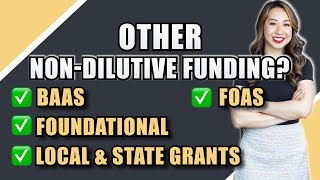
Federal grants consultant Stacy Chin breaks down four grant types beyond SBIR: BAAs offer high-risk R&D funding but face intense competition; FOAs from NIH and NSF provide larger awards but require university partnerships and longer timelines; foundation grants move faster with fewer strings attached; state and local grants have lower competition but smaller budgets. Match your startup's stage and sector to the right funding vehicle.
Chapters
If you're a startup looking for non-dilutive funding, you probably know about the SBIR program. But what if you're not a good fit for the SBIR program or just want to diversify your funding opportunities? The good news? SBIR isn't the only game in town. There are other powerful grant opportunities, including Broad Agency Announcements, BAAs, Funding Opportunity Announcements, FOAs, foundational grants, and state-level funding. But which ones are worth your time? And what are the pros and cons to each? In this video, I'll break it all down so that you can maximize maximize your chances of securing non-dilutive funding for you and your startup. Hey guys, welcome back to the channel. If you're joining us for the first time, I am Stacy Chin, a professional federal grants and contracting consultant who has helped to raise over $40 million of non-dilutive funding for startups developing innovations in healthcare, climate, and defense. First up, let's talk about Broad Agency Announcements, or BAAs. These funding opportunities are issued by federal agencies primarily for research and development purposes that aligns with governmental interests. Agencies like the Department of Defense, DOD, or the Department of Energy, like DOE. The pros, BAAs provide startups with flexible funding options compared to SBIRs as they have fewer restrictions on the company size and commercialization requirements. And these BAAs are opportunities to support high-risk, cutting-edge technologies that may not fit traditional grant programs, making them a very attractive option for startups developing breakthrough innovations. Now, those securing funding through BAAs can open doors to governmental contracts and future funding opportunities. It's important to note that these vehicles can even help companies build long-term engagements with federal agencies, allowing them to scale technologies beyond the award. But here are the cons. Securing one of these BAAs is highly competitive, and they typically require a strong technical background to stand out among the sea of applications. Unlike SBIR grants, BAAs are less structured, meaning their requirements and funding expectations can vary vary significantly depending on the issuing agency, and this flexibility can be beneficial for innovative projects. But this also means that applicants must carefully navigate the process to ensure alignment with the agency's funding priorities. Bottom line, BAAs are great if you're developing a highly innovative and technical innovation that aligns to governmental needs, but you'll need to be strategic about how you position your proposal. Next up, we have funding opportunity announcements, or FOAs. These are grant solicitations released by federal agencies like the NIH, the DOD, and the NSF. Unlike SBIRs, FOAs can sometimes be open to a broader range of applicants, including universities, nonprofits, and larger businesses partnering with startups. I find that FOAs are a strong option if your startup is in a field like healthcare, energy, or defense. If you find a way to craft a narrative to be aligned to the agency's funding priorities. Here are the pros for FOAs. FOAs often provide larger funding opportunities than SBIR grants, depending on the agency and specific research focus. And these opportunities are typically mission-driven, supporting projects that addresses both societal or health challenges. Unlike SBIRs, some FOAs require startups to collaborate or partner with universities, research labs, or other types of industry partnerships in order to strengthen their proposal so that we can show the agency they have all the necessary resources to execute the proposal plan. And here Here are the cons. FOAs often come with complex application processes that might require institutional backing, making them less accessible to some startups. Additionally, the funding timelines for FOAs tend to be much longer compared to SBIRs, which can delay potential project initiations and impact developmental timelines. Many FOAs often require specific matching funds or cost sharing, meaning that startups might also plan for additional funding commitments to meet the eligibility requirements. Third, let's talk about foundational grants. Unlike governmental grants, foundational grants come from private organizations, philanthropies, and corporate sponsors. Some well-known examples could be the Gates Foundation, the Wellcome Trust, and the Lemelson Foundation. Overall, foundational grants can be a great fit if your startup is tackling big global challenges like healthcare access, education, or sustainability. And here are the pros. Foundational grants offer greater flexibility in eligibility, often welcoming early-stage startups and non-traditional applicants who may not qualify for federal funding programs. And these foundational grants can provide significant funding support for innovations focused on social impact, such as healthcare, education, or sustainability. Additionally, foundational grants tend to have fewer bureaucratic hurdles than governmental grants, meaning faster application cycles, allowing startups to get access to funding much more quickly and efficiently. But here are the cons. Foundational grants are highly mission-driven. Meaning that your innovation must closely align with the specific goals and priorities of the granting organization. And while they can provide valuable funding, the amounts are often smaller compared to federal grants, limiting the financial support available for large-scale projects. Additionally, many foundations prioritize funding for nonprofits, which might require for-profit entities to explore creative structuring or partnerships to qualify for these opportunities. Last but not least are state and local grants. And they must not be overlooked. Many states have their own innovation funds, economic development programs, and startup grants to boost local businesses. So state and local grants are a great way to supplement some of your non-dilutive funding sources, especially for startups who are looking to build strong regional ties and to gain early traction. And here are the beautiful pros. State and local grants are often easier to secure than federal grant funding due to lower competition, making them a valuable funding source for startups looking for early-stage support. In addition to direct funding, these grants can come with added incentives such as tax credits, incubator support, and networking opportunities to help startups to grow. Some states also offer matching grants for startups that receive SBIR funding or other federal— by giving them the extra financial boost to further develop and commercialize their innovation. But here are the cons. State and local grants typically offer lower funding amounts compared to federal grants. Making them better suited for early-stage companies with those early-day support rather than supporting large-scale projects. So usually these types of grant opportunities are limited to startups operating within the state or those committed to creating local jobs, which can restrict eligibility. Additionally, some states also come with reporting or milestone-backed requirements, adding additional administrative burden that startups must manage along with the developmental efforts. So at the end of the day, should you look for other non-dilutive funding opportunities outside of the SBIR realm? Absolutely. If you're developing deep tech, BAAs might be a great fit. Or if you're in healthcare, maybe look for a FOA opportunity that might be aligned to your research goals. However, if you have a socially impact-driven mission, then maybe foundational grants are the way to go for you. And of course, if you want local support, state grants can help bridge that funding gap for you and your business. So at the end of the day, the key is to diversify. Don't put all your eggs in one basket. Explore multiple non-dilutive funding sources. and this will help you to increase your chances of getting non-dilutive funding for you and your startup. If you found any of these tips helpful, I would really appreciate if you like this video and subscribe to this channel so you can learn new ways to keep your equity throughout your fundraising journey. And also, don't forget to check out our website at keepyourequity.co for more resources, advice, templates, and tips on how you can secure non-dilutive funding. Thank you so much for joining me today, and I'll see you in a video very soon.