How to Win DoD & NSF Funding | SBIR Strategy for Dual-Use Startups (MassChallenge x Scout)
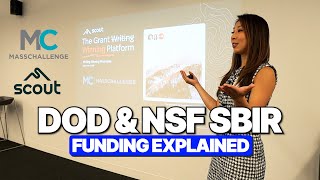
Stacy Chin explains how dual-use startups can win non-dilutive R&D funding from DoD and NSF through SBIR and STTR programs. Phase 1 awards fund feasibility studies, Phase 2 funds development, and Phase 3 supports commercialization. Reviewers prioritize technology novelty, a rigorous research plan, market opportunity, and team capability, so tailor each proposal to the agency's specific solicitation.
Chapters
Congratulations everyone for being in the cohort. I'm Stacy Chin and I'm here today to talk about one of my most favorite topics, which is how to get sweet free money from the government. Best ways in my opinion to get the money is through something called grants. As you guys know, I specialize in a type of grant called the SBIR and STTR program. And so this stands for the Small Business Innovation Research or the Small Business Technology Transfer programs. How many of us here have received an SBIR grant? These are really competitive R&D applications, mostly designed to be to give non- non-diluted funding to small businesses that are working on R&D efforts to commercialize new technologies. Expect a 10 to 20% success rate. These are crazy competitive. Name of the game is more shots on goal, but in, in a very strategic way. And so right now there's about $4 billion award annually, except for this year, around 6,000 awards given out across the US. This is a program spans different agencies and across 11, like the DOD, the DOE, USDA, NIH, and NSF, and so forth. And so this is one of the best ways, in my opinion, to get non-diluted capital push forward your R&D efforts without giving away your equity. And so why do we have this program? There's a couple different reasons. So the SBIR/STTR program is sponsored by the US SBA, and their goal is to foster innovation across the US. Their goal there is to support and encourage new developments and new technologies by giving you guys non-diluted capital. We want to promote commercialization. How can we spur economic growth, new jobs in this vehicle? And finally, can we give non-diluted capital for startups that can advance federal research that are aligned to what they're looking for in order to advance the next steps to make sure we have competitive edge in the marketplace. The SBIR and STTR program comes in 3 different phases. Phase 1 is all about proving your feasibility. Do you have a proof of concept? Do you have an idea that might work? And typically you have these heavy R&D programs that are these avenues. They give about up to even $300,000 of a Phase 1 award, project period of 6 to 12 months. If you were successful in your Phase 1 application, you can proceed to a Phase 2, and that's when you continue your R&D efforts and push forward towards commercialization, whether that is getting a pilot, integrating it with a partner, or looking at scale. And typically these are around like $1 to $2 million a year grants or contracts for a project period of about 2 years. And then finally, if you are successful, you can then proceed to Phase 3, which is all about commercialization. And usually this is when you partner with a private institution or obtain a governmental contract to proceed with next step, usually through either a paid pilot or just a partnership with an end user. All right, so if you're thinking about going for an SBIR program, there are some things we have to check off our checklist. First, you have to be a small business in the U.S. that's a for-profit entity. Next, you have to be independently controlled. Over 51% of your company needs to be owned by U.S. citizens or permanent residents. Next, your PI must be primarily employed by the small business. You have to be engaged in R&D effort. We're not here to fund market research, customer discovery. They want the hardcore technical R&D efforts to fund that is also pushing towards your commercialization and go-to-market. You have to be small, which means that you have to have less than 500 employees. In the company. And finally, even though we encourage more shots on goal, you can't get award for duplicate awards. So that's where the strategy comes along, and we can talk more about that in a bit. So how do you put together an application? So in these 4 quadrants, it's kind of how I think about what do I need to do in order to have a strong SBIR proposal. The first thing they're going to look at across the board of all the agencies is your technology and the innovation strength. Do you have something that's novel, unique, and highly innovative? So they're looking at your technology. Are you making something that's groundbreaking or some just sort of increments based on what's out there. The latter they're not interested in. They're looking at your proposal. Do you have rigorous R&D efforts that can help you progress your proposal and your technology? And finally, your research plan. Do you have a feasible research plan that would take you from point A to point B upon completion of your efforts? Next, it's not enough to just develop your technology, but we have to position it for commercialization. So even though you have the solution on your technology, are you taking that and are your efforts solving a big market gap? And we can talk more about how to address that market opportunity. Next thing, do you have competitive advantage? right? Whatever you're working on, how does that perform better compared to what's out there? And that's really important to make sure we stand that out in their applications. And then finally, how do you make money from this, right? We work with a lot of excellent PhDs in sciences and engineers that are developing groundbreaking research, but not all of that can lead to revenue. So we want to make sure when we plan our technical applications and our R&D approach that we align those efforts towards the market needs so that we can eventually make money. Next, they're looking at your team. They're looking at you as a PI and whether you have the right resources in place to carry this out. So that means, do you as a PI have expertise and background to carry this out? Two, do you have the right technical expertise, whether it's clinicians or engineers or scientists, to actually carry out what you propose in your efforts? And then finally, if you need a physical space, do you have access to that physical space? If you're doing software, do you have the right resources to make sure everything's compliant? And then finally, alignment with the SBIR agencies. Although different agencies have many different SBIR programs, sometimes your technology and your go-to-market goal may not be a fit for all of them. So it's really important before you even start writing to understand the different agencies in alignment to make make sure what you're developing is aligned to what they're looking for. I always tell clients, even though the DOD has a lot of money, about $2 billion allocated for this SBIR program, so if it's not working and it's not a good fit, don't do it. It's just wasting everyone's time. So we'll talk more about how to find the alignment in a bit as well. Again, this is the security and resilience cohort for the Mass Challenge, and if I look into my crystal ball, many of you might be going for the DOD application, the NSF application, and then a DOE. Some of you in healthcare might also be going for NIH, and I'm happy to have a separate conversation with you. Right now, the DOD is a little bit on hiatus, as you guys know. So we're keeping a close eye out to know when the next solicitations are coming out. So with that, we're going to talk about the DOD and NSF, since I think many of you might be appropriate for these applications. Anyone either been awarded or looking into DOD? Okay, great. How about NSF? Okay, great. Usually everyone going for DOD, sometimes I would also advise go for NSF. And vice versa. So we can talk more about, about that as well. So again, when we talk about going for SBIRs, we talk about a more shots on goal strategy. For example, if you want to go and raise VC funding, do you only talk to one VC and call it a day? No. Same thing with grants and non-dilutive. Every time you submit an application, you always want to tailor it to the agency. We'll talk about that in a bit. And make sure you understand the goals, right? Are your startup technology goals aligned to what the agency is looking for? When we first talk about DOD solicitations, the first question I get is how to find them. Does this portal, the DSIP, look familiar to Anyone? Or has— is this the first time someone has— anyone has seen this before? Perfect. Okay, so this is my go-to when I want to find DoD SBIR topics. So if you type in DSIP, which is the Defense SBIR and STTR Innovation Portal, you get this guy. And so let me tell you how to walk you through how to navigate this because it can get a little bit confusing sometimes. So here I am in the, the DSIP. When we go and pursue DoD SBIR applications, these are contracts, not grants. That means they're looking for a really specific need in their defense agency. And so it's really important to kind of read what's out there and making sure that it's aligned to what you want to do before we go in and apply. When a client comes to me and asks, "Hey, I want to find a DOD topic," or "I want to find a DOD application," we first learn about what their technology is, and then I go under this topic here. This is the topic and topic Q&A section where you can find all the solicitations for you and your technology. Every— the first Wednesday of every month is when they release a brand new topic. So as you see, when you have SBIR program, it's broken up by different sectors. Different sub-agencies. So the Army has its own program, the Navy has its own program, Air Force, etc., etc. And so it's important to first read through these and find which one is the right topic fit for you. So usually I like to just open this carrot, kind of read through whether this is a Phase 1 and Phase 2, understand what they're looking for, and kind of figure out, you know, do I have a technology or solution that's a good fit for this? If you're not too sure, don't go for it. I want you to feel really good in your gut before you go for these applications. This is time-consuming, which is why I can tell you a bit about Scout. We're trying to make this much easier so that have a good fit for you and the solicitations out there. And so one thing I find challenging as well is that there is these two different links. Usually this link goes to the solicitation of the entire program, but as I shared, each of the subagencies have their own rules and regulations as well. So you can kind of depend on— lean on this as your overall Bible. When you prepare your application, you really want to look at the component instructions because the Army is going to have different solicitation requirements than the Navy. Some might be pitch deck, text, some might be 15 pages, some might be 5 pages. You miss one document and then you're out. So this is a very important thing. You want to read through to its entirety, understand what the components, and make sure your technical narrative and all the supporting documents are aligned to what the agency looks like, right? So if, if you miss like a line or like if you miss one mandatory document, that's an excuse for them to withdraw your application. So that's why you want to make sure everything is to the T, follow the rules and regulations before submit. So like I mentioned, new topics come out every single Wednesday of the month. AFWERX, for example. So DOD, you have all the subagencies. You have Air Force, Navy, Army, DHS, etc., etc., MDA, etc., etc. Air Force is really interesting because they love innovation. So they're trying to figure out how to unlock more capital to fund more innovation. So the Air Force has a really cool program called the AFWERX. So AFWERX is spun out of the Air Force, and the Air Force also has a traditional one as well. The AFWERX program is an SBIR program that's all about finding your end user. So Phase 1 is about pitching your application, understanding what the needs are in the Air Force, and then finding who that end customer is. That's how you want to position your AFWERX SBIR Phase 1. And that's really different compared to all the ones we talked about. It used to have been a pitch deck as an application, like, for like 4 or 5 years, but they recently changed it to a white paper. So that was always fun, which is why it's important to read the solicitation. So the AFWERX program, bottom line, is part of Air Force, comes out— Phase 1 comes out once a year, and then Phase 2, Director Phase 2, comes out another time a year. So you want to keep an eye on the deadlines. They posted this as well too. But the best way to find the solicitation and to keep an eye out is to go on the website. So the source of truth is always on like their website. Each of the agencies also have their own SBIR websites just to have everything in one place. But it's still, in my opinion, a little bit challenging. So that's why Scout, we're trying to make it easier with AI to make things a little more cohesive and comprehensive. So NASA definitely has an SBIR program. They came out a couple of months ago. So AFWERX has a SpaceWorks as well too. So that's some space technology they're definitely interested in. NASA is just a much smaller agency as well. So we have experience on our team to also do. If you go to wingrants.com, we have AI to try to like zhuzh it up, because you're right, that is just— finding a grant is incredibly time-consuming as well. So that's what we're trying to fix. But unfortunately, there's no other way unless these— we're trying to use these technologies. Even ChatGPT won't even like give you the right output. It's just too complicated. And I was a reviewer for NIH and NSF. We— they take confidentiality very seriously. Um, you are exposing a lot, like David mentioned, um, to the reviewers, but they're trying to keep everything as confidential as possible. But that's the risk that you want to take. I do find that clients that are nervous to expose their secrets flaws in their applications typically don't lead to a successful proposal because it makes it much more challenging for reviewers to evaluate the novelty of your innovation and whether or not it applies to the solicitation. So we tell, we encourage people to, you know, tell as much as possible you feel comfortable with. But usually in the public sector, you, if you were awarded and then abstract will get disclosed. So, but people behind the scenes as the reviewers will be looking at your application. Yeah, the IP all stays to you depending on what you do with the DOD. If you kind of progress in that way, there could be other red tape down the road we can talk about as well. For DOD is a little bit different because you're developing technology in collaboration with someone else to solve a defense need. And so usually in the other agency, the IP is yours because these are grants. This is a contract as well. So usually the majority of people we work with, the IP is yours, but there are some instances too. All the SBIR and STTR opportunities are— should be announced in the portal because this is a public ask in the bid.
More from Stacy

Applying for NIH SBIR in Jan 5, 2027? You Should Be Starting NOW. Here's why...



How to Get Invited to Apply for $305K in NSF SBIR Funding || Step-by-Step Guide




