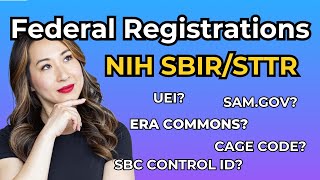
In this instructional YouTube video, Stacy Chin of keepyourequity.co walks science and technology startup founders through the six mandatory federal registrations required to submit an NIH SBIR or STTR grant application. She explains why the registrations are essential for eligibility, accountability, and fraud prevention, and emphasizes the need to start months in advance because each registration builds on the previous one. Practical workflow advice includes creating a master Excel log for passwords and contact info, using consistent email addresses across systems, and allowing ample time for SAM.gov (up to two weeks) and eRA Commons (7‑10 days) approvals. The video then details each registration step-by-step: obtaining an Employer Identification Number (EIN) from the IRS; registering in the System for Award Management (SAM.gov) to receive a Unique Entity Identifier (UEI) and a Commercial and Governmental Entity (CAGE) code; registering at SBIR.gov to acquire a Small Business Control (SBC) ID; creating a Grants.gov profile linked to the UEI; and finally registering in the NIH eRA Commons (signing official, PI, and key personnel IDs). She notes that all identifiers—EIN, UEI, CAGE, SBC ID, and eRA Commons IDs—must be on hand to submit the application via ASSIST in eRA Commons. Throughout, she offers encouragement, calls viewers to like and subscribe, and points to a detailed guide on keepyourequity.co for further assistance.
Chapters
Let's chat about the mandatory federal registrations that your small business needs to complete in order to submit an NIH SBIR or STTR application. Yes, there are multiple governmental registrations that must be approved before small business can even submit an SBIR application. And trust me, you do not want to wait until the last minute or else you'll risk missing the deadline. And we don't want all your hard work going to waste, right? So in this video, I'm going to share what registrations you'll need to complete, how to get your EIN, your UEI, your CAGE code, and your SBC control ID number, and how to make this whole entire company registration process less painful for you so that you can go about your merry way to submit your SBI application to the NIH with ease. Hey guys, welcome back to the channel. I'm Stacy Chin from keepyourequity.co, and our mission is to help startups secure non-dilutive funding. We specialize in science and tech startups by providing guidance on how to secure federal funding from programs such as those from the SBIR and the STTR. If you'd like to learn more about those programs, I'll leave a link to another video in the description below. We also advise other private and public companies as well as NGOs in navigating the federal grants and contracting landscape. So all these federal registrations are mandatory, and every startup must go through this process. Now you might be asking, Stacy Chin, why do we need these registrations? Well, there's a couple of for reasons. One, these registrations help verify that your business is eligible to receive federal funding. The NIH wants to ensure that it is awarding grants to legitimate, qualified small businesses in the U.S., and the process checks things for like business size, ownership, and operational capabilities. Two, the government also needs to ensure that the federal funds will be distributed and used appropriately. Registrations like the System for Award Management or SAM, includes financial information that helps track how grant money is spent, ensuring accountability and transparency in the use of taxpayers' dollars. And finally, 3, by requiring detailed information about the business, the government can reduce the risk of fraud. So now that we understand the importance of these federal registrations, let's chat about some admin stuff to make this process as easy as possible. First, start an Excel sheet to keep things organized. There will be multiple passwords, logins, authentication codes, and contact information. You you know, all that fun stuff. You want to have this log handy to update whenever you need to change your password information or have to troubleshoot anything in case things go wrong. Second, each registration I'm going to share later in this video builds upon each other, kind of like leveling up in a video game. You cannot level up or proceed to the next registration until the previous one has been completed and approved. Third, and for that reason, you'll want to start these registrations months in advance of a deadline. The SAM registration, for example, can take up to 2 weeks for approval, and the NIH Electronic Research Administration Common, or eRA Common, can take up to 7 to 10 days. And that is if everything goes well the first time around. So give yourself plenty of time to go through all the registrations so that we have time to troubleshoot anything if needed. Now, if you find yourself with less than a month away from an NIH SBIR deadline and you haven't started these registrations, then all I can say is, ooh, that sucks. And now, because these registrations build upon each other, I found it easiest if you kept the same contact email address and addresses across all the registrations. Because if you use a different email in SAM.gov, for example, you might be running into issues down the road, like in Grants.gov. So keep things easy, keep things consistent, and keep jotting down all that information in that handy Excel sheet on the side. So the next part of this video, I'm going to go over the 6 governmental registrations all startups must complete if they want to submit an SBIR or STTR application to the National Institutes of Health, or NIH. And we also have a handy guide that can walk you through these registrations on paper on our website at keepyourequity.co that goes into much more detail and has all these key links. So make sure to go there and check it out. But before we get into it, I have one huge favor to ask you. We recently learned that 90% of our viewers have not yet subscribed to this channel. My goal is to get that down to 70%. So if you found any of these videos or tips helpful, I would greatly appreciate if you can like this video and subscribe to this channel. It truly helps us out a lot. In exchange, I promise we'll continue working hard on our end to give you founders all the necessary tips, resources, and advice to help you secure non-dilutive funding throughout your fundraising journey. Alright, do we have a deal? If so, let's jump into it. Alright, now the first federal registration that you'll need to complete is an Employer Identification Number, or EIN, and this is known as the Federal Tax Identification Number, is your unique 9-digit number assigned by the Internal Revenue Services, or IRS, to any business entity operating in the United States. So make sure to reach out to an accountant or lawyer to learn how to secure an EIN for your company. Remember, I'm just an SBA consultant, so don't take this as legal or accounting advice. But either way, you're going to need this EIN number before you can proceed to the next registration, and you'll need to include your EIN number whenever submitting an SBA application. Next, You'll want to register your company at the United States System of Award Management portal, or SAM, by going to SAM.gov. SAM serves as a central repository for all business and financial information to award or administer grants, contracts, other types of similar financial agreements. And this registration is required to do business within the U.S. government. So in SAM.gov, your goal is to secure a Unique Entity Identifier number, or UEI. And this is a 12-character alphanumeric identifier the U.S. government assigns to entities like companies, nonprofits, or governmental agencies, and for-profit institutions like you guys who want to do business with the federal government. And this system was implemented to provide a standard way to uniquely identify entities across all federal agencies. And you also need this UEI when you're submitting your NIH SBIR application, so keep that in mind. Now here's a super important tip: SAM.gov takes the longest for review and approval, so you want to make sure you give yourselves plenty of time to register your company in SAM.gov. Next, you're going to want a Commercial and Governmental Entity code, or CAGE code, which is a unique 5-character identifier assigned to suppliers of various goods and services to the government. And this can also be done in SAM.gov. Next up, take your EIN and your UEI and register your company or startup at SBIR.gov. And you cannot proceed to the step until your SAM.gov registrations have been completed and approved. So stay patient. So what is SBIR.gov? So this is the official website of the SBIR/STTR program that is administered by the Small Business Administration, or SBA, within partnership with the 11 other federal agencies like the NIH. So once your SBIR.gov registration is approved, you receive a Small Business Control ID, or SBC Control ID, which is a unique identifier required for companies applying for funding opportunities through the SBIR/STTR program. And this document should look something like this. And you're also going to need this SBC Control ID number when submitting your NIH SBIR application. Next up, register your company on Grants.gov. So Grants.gov is the official website managed by the Office of Management and Budget under the U.S. government that serves as a central repository and application portal for all federal grant opportunities. It streamlines the process of finding and applying for federal grants across various agencies in the hopes of making it easier for organizations, educational institutions, governments, and other individuals to access and compete for federal funding. So when making a profile, you'll want to make sure to include your UEI so that your account connects to your small business. And finally, with all that out of the way, you can now register on the Electronic Research Administration Commons, or eRA Commons. And this is the online interface where applicants, grantees, and federal staff at the NIH and other agencies can access and share administrative information related to research grants. Registration here allows you to submit applications, track their status, and manage grant awards. Here, it is also important to sign up for an eRA Commons ID by registering as a signing official, or SO, first. Once you have that approved, you then go ahead, log in, and then make other eRA Commons IDs, like for the principal investigator or PI, as well as other senior key personnel that you plan to provide a biosketch for within your SBIR/STTR application. All right, so when you're ready to submit an NIH SBIR/STTR application, you can do so via ASSIST, which you can find in eRA Commons. Make sure you have your EIN your UEI, your SPC Control ID handy, which are all required to submit a successful SBIR/STTR grant. Thank you so much for watching until the end of this video. I hope you found these tips helpful to guide you through all the necessary federal company registrations that you'll need before you submitting an SBIR/STTR application. And if you haven't done so, please like this video and subscribe to this channel. And don't forget to check out our website at keepyourequity.co for more resources, templates, and advice and courses to help secure non-dilutive funding throughout your fundraising journey. Thank you so much for joining me today, and I'll see you in the video very soon.